.avif)





Blogs
Stay updated with our latest blog posts.
Knowing how to maintain your heating and cooling system is one of the most practical things you can do as a homeowner in Wichita. Nearly half of the average home's $1,900 annual energy bill goes straight to heating and cooling — and a poorly maintained system makes that number climb even higher. In Central Kansas, where summers push into triple digits and winters can drop well below freezing, your HVAC system doesn't get a break. When it fails, it tends to fail at the worst possible time.
Here's a quick overview of the most important HVAC maintenance steps:
The good news is that most of these steps are simple, low-cost, and take just minutes. The ones that aren't DIY-friendly — like checking refrigerant levels, inspecting your heat exchanger, or testing electrical connections — are exactly what a licensed HVAC technician handles during a professional tune-up. Together, routine DIY care and seasonal professional service can extend your system's life by years, keep your energy bills in check, and protect your home from safety hazards like carbon monoxide leaks.
Whether your system is a furnace, central AC, heat pump, or mini-split, the principles are the same: stay consistent, catch problems early, and don't wait for a breakdown to take action.
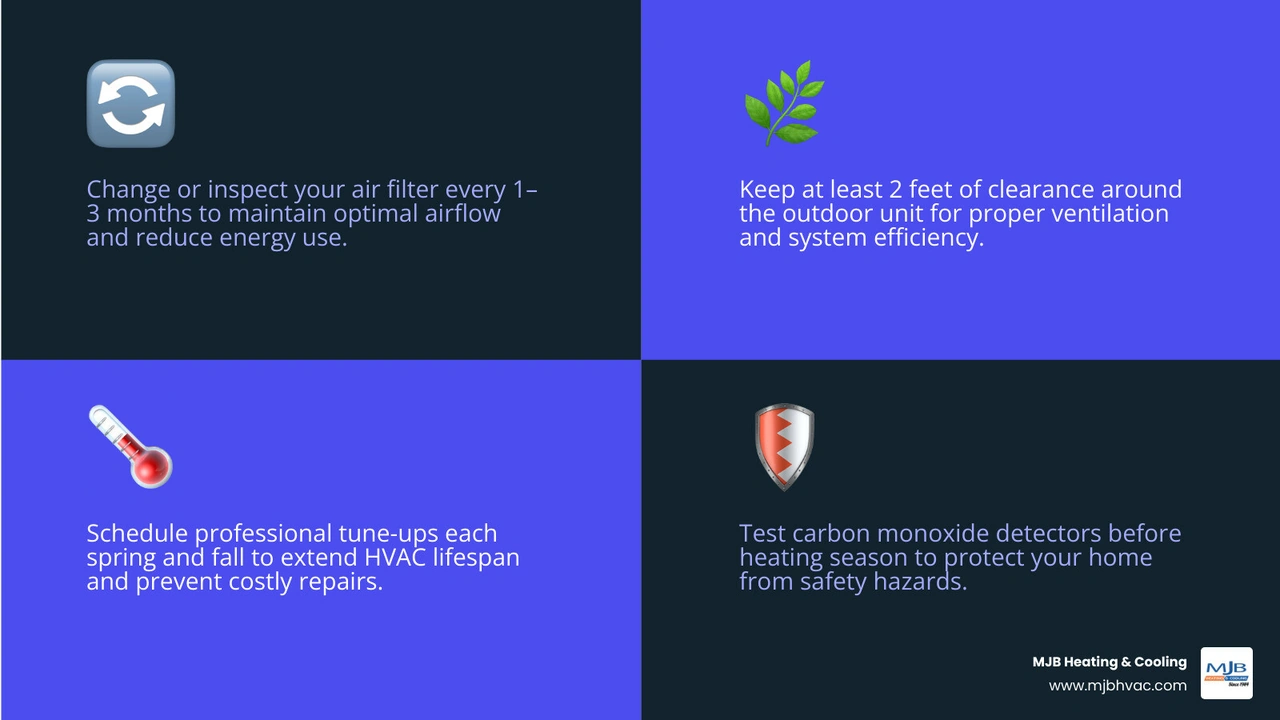
The simplest answer to how to maintain your heating and cooling system is this: do a little every month, and do a little more before summer and winter hit hard.
A good year-round routine includes:
If you need a companion checklist, our guide on essential HVAC maintenance tips for your furnace and AC is a helpful next read.
A smart trick we often recommend is tying HVAC reminders to daylight saving time. When the clocks change in spring and fall, check your filter, test your thermostat, and make sure your next tune-up is on the calendar. It is not fancy, but it works.
Your monthly routine does not need to be long. In most Wichita-area homes, 10 to 15 minutes is enough.
Start with these steps:
Monthly attention matters because airflow problems can cut HVAC efficiency by up to 15 percent. A small issue, like a dirty filter or blocked vent, can quietly force your equipment to run longer and work harder.
Pre-season maintenance is where you prevent surprise breakdowns.
Before summer, your cooling system should be checked in spring. Before winter, your heating system should be checked in fall. That timing matters in Kansas because weather swings can be extreme, and the busiest repair days are usually the hottest or coldest ones.
Pre-season service should focus on:
Think of spring and fall tune-ups like getting ahead of the weather instead of arguing with it later.
Not every HVAC task belongs on a homeowner to-do list, but several important ones do.
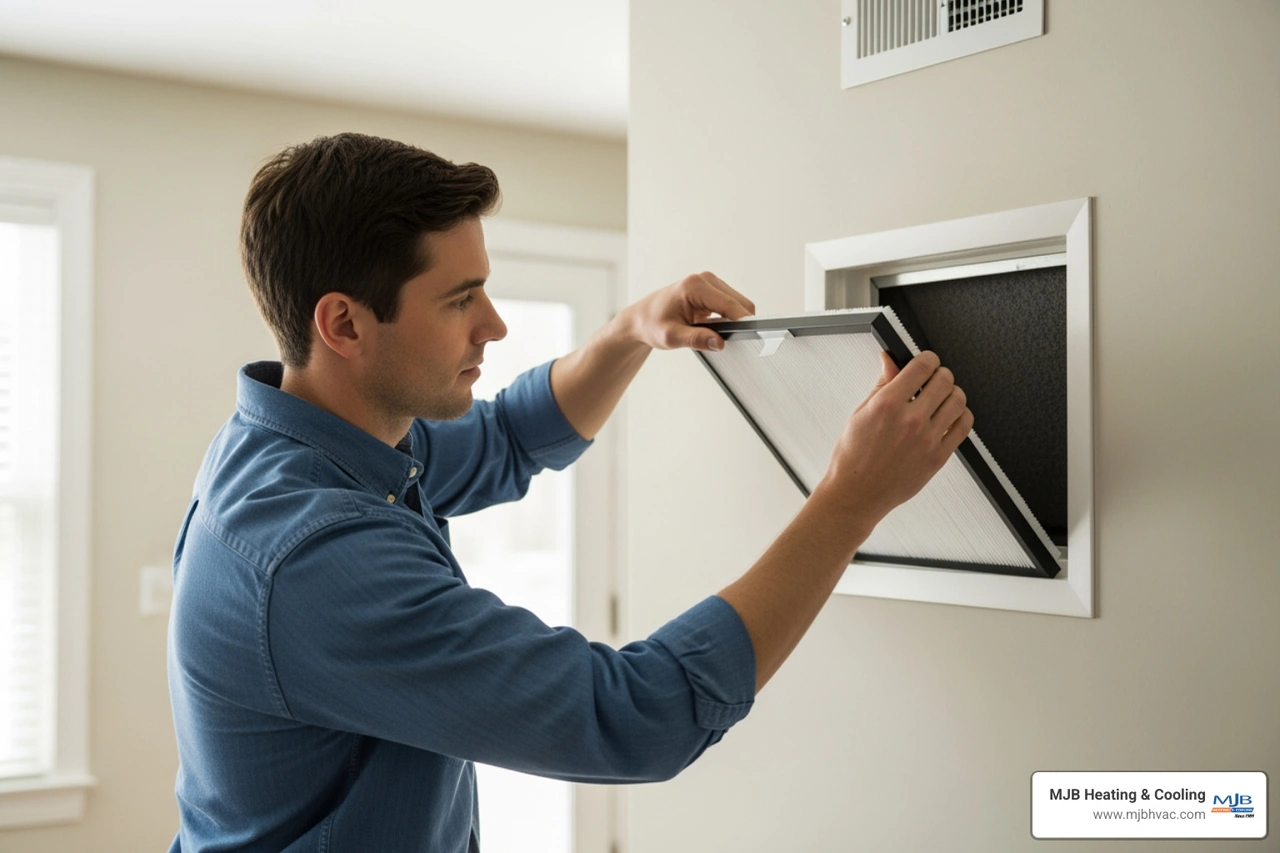
The safest DIY jobs are the ones that involve basic cleaning, airflow, and observation. Those small steps can make a meaningful difference in comfort, efficiency, and system life.
For more filter guidance, see How Often Should HVAC Air Filters Be Changed and How Often Should You Change Your HVAC Air Filter.
Filter care is the MVP of HVAC maintenance. Not glamorous, but absolutely essential.
A dirty filter can:
Most homes should check filters every 30 days and replace them every 1 to 3 months, depending on use. In Central Kansas, homes with pets, dust, allergies, or heavy summer and winter runtime often need more frequent changes.
A few filter and airflow tips:
Avoid closing lots of vents in unused rooms. It sounds efficient, but it can increase pressure in the duct system and reduce overall airflow.
Your outdoor condenser needs breathing room. Keep at least 2 feet of clearance around it, and trim back weeds, shrubs, and tall grass. Debris buildup around the unit can block airflow and reduce performance.
Homeowners can also safely:
The condensate drain is another small item with big consequences. If it clogs, you may end up with water damage, excess humidity, or a system that shuts off. Many homeowners can flush the drain line carefully with water or vinegar, but if there is already standing water or repeated clogging, it is time to call us.
And do not forget the thermostat. Seasonal schedule changes, dead batteries, or incorrect settings can mimic bigger HVAC problems. A programmable or smart thermostat can help reduce wasted runtime and improve comfort consistency.
Professional tune-ups are where we go beyond surface-level maintenance.
For most Wichita and Central Kansas homes, we recommend service twice a year: once in spring for cooling and once in fall for heating. Our article on how often you should service your HVAC system explains the timing in more detail, and if you are weighing long-term preventive care, read is an HVAC maintenance plan worth it.
A professional tune-up should include core checks such as:
Then the checklist changes depending on whether we are preparing for cooling or heating season.
Spring AC or heat pump maintenance should include:
Dirty coils reduce heat transfer, which means the system runs longer to cool the home. Low or incorrect refrigerant charge also hurts efficiency and can lead to poor cooling or frozen coils. Refrigerant work is never a DIY project.
Fall furnace or heating maintenance should include:
This is the season for safety-first maintenance. A heating tune-up is not just about comfort. It is also about catching combustion problems, venting issues, or early signs of carbon monoxide risk before you rely on the furnace every day.
DIY maintenance is fine. DIY repair is where things can go sideways fast.
Call a professional if you notice:
If a problem involves gas, refrigerant, wiring, or internal mechanical parts, it is firmly in pro territory.
Maintenance is not just about avoiding breakdowns. It is one of the most direct ways to improve efficiency.
Nearly half of the average home's annual energy bill goes to heating and cooling. That means HVAC performance has a big impact on household energy use. When airflow is restricted, coils are dirty, or ducts are leaking, your system wastes energy trying to do a job it could have done much more easily.
Our related resources on how proper maintenance prevents mold growth, the average lifespan of an HVAC system in Kansas, and how proper HVAC sizing affects comfort and efficiency all connect back to the same idea: small problems rarely stay small in an HVAC system.
| Neglected HVAC system | Maintained HVAC system |
|---|---|
| Dirty filter restricts airflow | Clean filter supports proper airflow |
| Coils collect dust and grime | Coils transfer heat more effectively |
| Duct leaks waste conditioned air | Sealed ducts deliver more air where needed |
| Higher runtime and more wear | More efficient operation and less strain |
| More hot and cold spots | Better comfort and more balanced temperatures |
| Greater risk of moisture and mold issues | Better drainage and humidity control |
A dirty filter raises static pressure and reduces airflow. Then the blower has to work harder. Then comfort drops. Then the system runs longer. It is basically a domino effect with a utility bill attached.
Dirty evaporator or condenser coils also reduce heat absorption and heat release. In cooling mode, that can contribute to longer cycles, poor humidity control, and even frozen coils.
Duct issues matter too. In a typical home, about 20 to 30 percent of the air moving through the duct system can be lost through leaks, holes, and poor connections. That is a lot of conditioned air disappearing into unconditioned spaces instead of your living room or bedroom.
Ducts should be inspected for leaks, loose connections, and damaged insulation. Accessible leaks should be sealed with mastic or foil-backed HVAC tape, not regular cloth duct tape. Despite the name, duct tape is not the hero here.
Good duct maintenance helps:
Smart thermostats can also help by keeping schedules consistent and reducing unnecessary runtime. Used correctly, they help your system work smarter, not just harder. In a climate like Wichita's, that means less overcooling in summer and less overheating in winter.
Kansas weather has opinions. Strong ones.
In Wichita and nearby communities like Derby, Andover, Haysville, Newton, Mulvane, and El Dorado, HVAC systems deal with heat waves, cold snaps, dust, pollen, spring storms, and humidity swings. That means maintenance here should match the seasons, not just the calendar.
For more region-specific advice, visit HVAC maintenance tips for Kansas homeowners.
Spring is the right time to get cooling equipment ready before the first stretch of serious heat.
Priorities include:
During summer, continue checking filters more often. High runtime, dust, and pet hair can clog them faster than many homeowners expect.
Fall is for furnace prep. Do not wait until the first freezing night to find out there is an ignition problem.
Priorities include:
In winter, continue basic checks. If you have a heat pump, keep snow and ice from blocking airflow around the outdoor unit. If you have a furnace, pay close attention to odors, startup behavior, and detector alarms.
Some HVAC problems can wait a day or two. Some absolutely should not.
When safety is involved, quick action matters more than wishful thinking.
Every homeowner should include these safety basics in their routine:
If your home uses gas heat, carbon monoxide protection is not optional. It is essential.
Call for immediate professional attention if you notice:
These symptoms can point to electrical faults, airflow collapse, refrigerant issues, drainage problems, combustion problems, or venting hazards. In other words: not a good time for trial-and-error home repair videos.
Learning how to maintain your heating and cooling system comes down to consistency. Change filters on time, keep airflow open, watch the outdoor unit, flush the drain when appropriate, and schedule professional tune-ups in spring and fall. Those habits help improve efficiency, lower unnecessary energy waste, reduce surprise breakdowns, and extend the life of your equipment.
For homeowners in Wichita and across the Central Kansas communities we serve, preventive HVAC care is especially important because our weather puts heating and cooling systems to work year-round. If your system is aging or struggling, it may also be worth exploring Kansas energy rebates for HVAC upgrades.
At MJB Heating & Cooling, we have served the Wichita metro area since 1984 with honest service and quality workmanship. If you want help with seasonal maintenance, repairs, or planning long-term system care, learn more about our HVAC services here: MJB Heating & Cooling services.
Knowing how to maintain your heating and cooling system is one of the most practical things you can do as a homeowner in Wichita. Nearly half of the average home's $1,900 annual energy bill goes straight to heating and cooling — and a poorly maintained system makes that number climb even higher. In Central Kansas, where summers push into triple digits and winters can drop well below freezing, your HVAC system doesn't get a break. When it fails, it tends to fail at the worst possible time.
Here's a quick overview of the most important HVAC maintenance steps:
The good news is that most of these steps are simple, low-cost, and take just minutes. The ones that aren't DIY-friendly — like checking refrigerant levels, inspecting your heat exchanger, or testing electrical connections — are exactly what a licensed HVAC technician handles during a professional tune-up. Together, routine DIY care and seasonal professional service can extend your system's life by years, keep your energy bills in check, and protect your home from safety hazards like carbon monoxide leaks.
Whether your system is a furnace, central AC, heat pump, or mini-split, the principles are the same: stay consistent, catch problems early, and don't wait for a breakdown to take action.
The simplest answer to how to maintain your heating and cooling system is this: do a little every month, and do a little more before summer and winter hit hard.
A good year-round routine includes:
If you need a companion checklist, our guide on essential HVAC maintenance tips for your furnace and AC is a helpful next read.
A smart trick we often recommend is tying HVAC reminders to daylight saving time. When the clocks change in spring and fall, check your filter, test your thermostat, and make sure your next tune-up is on the calendar. It is not fancy, but it works.
Your monthly routine does not need to be long. In most Wichita-area homes, 10 to 15 minutes is enough.
Start with these steps:
Monthly attention matters because airflow problems can cut HVAC efficiency by up to 15 percent. A small issue, like a dirty filter or blocked vent, can quietly force your equipment to run longer and work harder.
Pre-season maintenance is where you prevent surprise breakdowns.
Before summer, your cooling system should be checked in spring. Before winter, your heating system should be checked in fall. That timing matters in Kansas because weather swings can be extreme, and the busiest repair days are usually the hottest or coldest ones.
Pre-season service should focus on:
Think of spring and fall tune-ups like getting ahead of the weather instead of arguing with it later.
Not every HVAC task belongs on a homeowner to-do list, but several important ones do.
The safest DIY jobs are the ones that involve basic cleaning, airflow, and observation. Those small steps can make a meaningful difference in comfort, efficiency, and system life.
For more filter guidance, see How Often Should HVAC Air Filters Be Changed and How Often Should You Change Your HVAC Air Filter.
Filter care is the MVP of HVAC maintenance. Not glamorous, but absolutely essential.
A dirty filter can:
Most homes should check filters every 30 days and replace them every 1 to 3 months, depending on use. In Central Kansas, homes with pets, dust, allergies, or heavy summer and winter runtime often need more frequent changes.
A few filter and airflow tips:
Avoid closing lots of vents in unused rooms. It sounds efficient, but it can increase pressure in the duct system and reduce overall airflow.
Your outdoor condenser needs breathing room. Keep at least 2 feet of clearance around it, and trim back weeds, shrubs, and tall grass. Debris buildup around the unit can block airflow and reduce performance.
Homeowners can also safely:
The condensate drain is another small item with big consequences. If it clogs, you may end up with water damage, excess humidity, or a system that shuts off. Many homeowners can flush the drain line carefully with water or vinegar, but if there is already standing water or repeated clogging, it is time to call us.
And do not forget the thermostat. Seasonal schedule changes, dead batteries, or incorrect settings can mimic bigger HVAC problems. A programmable or smart thermostat can help reduce wasted runtime and improve comfort consistency.
Professional tune-ups are where we go beyond surface-level maintenance.
For most Wichita and Central Kansas homes, we recommend service twice a year: once in spring for cooling and once in fall for heating. Our article on how often you should service your HVAC system explains the timing in more detail, and if you are weighing long-term preventive care, read is an HVAC maintenance plan worth it.
A professional tune-up should include core checks such as:
Then the checklist changes depending on whether we are preparing for cooling or heating season.
Spring AC or heat pump maintenance should include:
Dirty coils reduce heat transfer, which means the system runs longer to cool the home. Low or incorrect refrigerant charge also hurts efficiency and can lead to poor cooling or frozen coils. Refrigerant work is never a DIY project.
Fall furnace or heating maintenance should include:
This is the season for safety-first maintenance. A heating tune-up is not just about comfort. It is also about catching combustion problems, venting issues, or early signs of carbon monoxide risk before you rely on the furnace every day.
DIY maintenance is fine. DIY repair is where things can go sideways fast.
Call a professional if you notice:
If a problem involves gas, refrigerant, wiring, or internal mechanical parts, it is firmly in pro territory.
Maintenance is not just about avoiding breakdowns. It is one of the most direct ways to improve efficiency.
Nearly half of the average home's annual energy bill goes to heating and cooling. That means HVAC performance has a big impact on household energy use. When airflow is restricted, coils are dirty, or ducts are leaking, your system wastes energy trying to do a job it could have done much more easily.
Our related resources on how proper maintenance prevents mold growth, the average lifespan of an HVAC system in Kansas, and how proper HVAC sizing affects comfort and efficiency all connect back to the same idea: small problems rarely stay small in an HVAC system.
| Neglected HVAC system | Maintained HVAC system |
|---|---|
| Dirty filter restricts airflow | Clean filter supports proper airflow |
| Coils collect dust and grime | Coils transfer heat more effectively |
| Duct leaks waste conditioned air | Sealed ducts deliver more air where needed |
| Higher runtime and more wear | More efficient operation and less strain |
| More hot and cold spots | Better comfort and more balanced temperatures |
| Greater risk of moisture and mold issues | Better drainage and humidity control |
A dirty filter raises static pressure and reduces airflow. Then the blower has to work harder. Then comfort drops. Then the system runs longer. It is basically a domino effect with a utility bill attached.
Dirty evaporator or condenser coils also reduce heat absorption and heat release. In cooling mode, that can contribute to longer cycles, poor humidity control, and even frozen coils.
Duct issues matter too. In a typical home, about 20 to 30 percent of the air moving through the duct system can be lost through leaks, holes, and poor connections. That is a lot of conditioned air disappearing into unconditioned spaces instead of your living room or bedroom.
Ducts should be inspected for leaks, loose connections, and damaged insulation. Accessible leaks should be sealed with mastic or foil-backed HVAC tape, not regular cloth duct tape. Despite the name, duct tape is not the hero here.
Good duct maintenance helps:
Smart thermostats can also help by keeping schedules consistent and reducing unnecessary runtime. Used correctly, they help your system work smarter, not just harder. In a climate like Wichita's, that means less overcooling in summer and less overheating in winter.
Kansas weather has opinions. Strong ones.
In Wichita and nearby communities like Derby, Andover, Haysville, Newton, Mulvane, and El Dorado, HVAC systems deal with heat waves, cold snaps, dust, pollen, spring storms, and humidity swings. That means maintenance here should match the seasons, not just the calendar.
For more region-specific advice, visit HVAC maintenance tips for Kansas homeowners.
Spring is the right time to get cooling equipment ready before the first stretch of serious heat.
Priorities include:
During summer, continue checking filters more often. High runtime, dust, and pet hair can clog them faster than many homeowners expect.
Fall is for furnace prep. Do not wait until the first freezing night to find out there is an ignition problem.
Priorities include:
In winter, continue basic checks. If you have a heat pump, keep snow and ice from blocking airflow around the outdoor unit. If you have a furnace, pay close attention to odors, startup behavior, and detector alarms.
Some HVAC problems can wait a day or two. Some absolutely should not.
When safety is involved, quick action matters more than wishful thinking.
Every homeowner should include these safety basics in their routine:
If your home uses gas heat, carbon monoxide protection is not optional. It is essential.
Call for immediate professional attention if you notice:
These symptoms can point to electrical faults, airflow collapse, refrigerant issues, drainage problems, combustion problems, or venting hazards. In other words: not a good time for trial-and-error home repair videos.
Learning how to maintain your heating and cooling system comes down to consistency. Change filters on time, keep airflow open, watch the outdoor unit, flush the drain when appropriate, and schedule professional tune-ups in spring and fall. Those habits help improve efficiency, lower unnecessary energy waste, reduce surprise breakdowns, and extend the life of your equipment.
For homeowners in Wichita and across the Central Kansas communities we serve, preventive HVAC care is especially important because our weather puts heating and cooling systems to work year-round. If your system is aging or struggling, it may also be worth exploring Kansas energy rebates for HVAC upgrades.
At MJB Heating & Cooling, we have served the Wichita metro area since 1984 with honest service and quality workmanship. If you want help with seasonal maintenance, repairs, or planning long-term system care, learn more about our HVAC services here: MJB Heating & Cooling services.
Knowing how to maintain your heating and cooling system is one of the most practical things you can do as a homeowner in Wichita. Nearly half of the average home's $1,900 annual energy bill goes straight to heating and cooling — and a poorly maintained system makes that number climb even higher. In Central Kansas, where summers push into triple digits and winters can drop well below freezing, your HVAC system doesn't get a break. When it fails, it tends to fail at the worst possible time.
Here's a quick overview of the most important HVAC maintenance steps:
The good news is that most of these steps are simple, low-cost, and take just minutes. The ones that aren't DIY-friendly — like checking refrigerant levels, inspecting your heat exchanger, or testing electrical connections — are exactly what a licensed HVAC technician handles during a professional tune-up. Together, routine DIY care and seasonal professional service can extend your system's life by years, keep your energy bills in check, and protect your home from safety hazards like carbon monoxide leaks.
Whether your system is a furnace, central AC, heat pump, or mini-split, the principles are the same: stay consistent, catch problems early, and don't wait for a breakdown to take action.
The simplest answer to how to maintain your heating and cooling system is this: do a little every month, and do a little more before summer and winter hit hard.
A good year-round routine includes:
If you need a companion checklist, our guide on essential HVAC maintenance tips for your furnace and AC is a helpful next read.
A smart trick we often recommend is tying HVAC reminders to daylight saving time. When the clocks change in spring and fall, check your filter, test your thermostat, and make sure your next tune-up is on the calendar. It is not fancy, but it works.
Your monthly routine does not need to be long. In most Wichita-area homes, 10 to 15 minutes is enough.
Start with these steps:
Monthly attention matters because airflow problems can cut HVAC efficiency by up to 15 percent. A small issue, like a dirty filter or blocked vent, can quietly force your equipment to run longer and work harder.
Pre-season maintenance is where you prevent surprise breakdowns.
Before summer, your cooling system should be checked in spring. Before winter, your heating system should be checked in fall. That timing matters in Kansas because weather swings can be extreme, and the busiest repair days are usually the hottest or coldest ones.
Pre-season service should focus on:
Think of spring and fall tune-ups like getting ahead of the weather instead of arguing with it later.
Not every HVAC task belongs on a homeowner to-do list, but several important ones do.
The safest DIY jobs are the ones that involve basic cleaning, airflow, and observation. Those small steps can make a meaningful difference in comfort, efficiency, and system life.
For more filter guidance, see How Often Should HVAC Air Filters Be Changed and How Often Should You Change Your HVAC Air Filter.
Filter care is the MVP of HVAC maintenance. Not glamorous, but absolutely essential.
A dirty filter can:
Most homes should check filters every 30 days and replace them every 1 to 3 months, depending on use. In Central Kansas, homes with pets, dust, allergies, or heavy summer and winter runtime often need more frequent changes.
A few filter and airflow tips:
Avoid closing lots of vents in unused rooms. It sounds efficient, but it can increase pressure in the duct system and reduce overall airflow.
Your outdoor condenser needs breathing room. Keep at least 2 feet of clearance around it, and trim back weeds, shrubs, and tall grass. Debris buildup around the unit can block airflow and reduce performance.
Homeowners can also safely:
The condensate drain is another small item with big consequences. If it clogs, you may end up with water damage, excess humidity, or a system that shuts off. Many homeowners can flush the drain line carefully with water or vinegar, but if there is already standing water or repeated clogging, it is time to call us.
And do not forget the thermostat. Seasonal schedule changes, dead batteries, or incorrect settings can mimic bigger HVAC problems. A programmable or smart thermostat can help reduce wasted runtime and improve comfort consistency.
Professional tune-ups are where we go beyond surface-level maintenance.
For most Wichita and Central Kansas homes, we recommend service twice a year: once in spring for cooling and once in fall for heating. Our article on how often you should service your HVAC system explains the timing in more detail, and if you are weighing long-term preventive care, read is an HVAC maintenance plan worth it.
A professional tune-up should include core checks such as:
Then the checklist changes depending on whether we are preparing for cooling or heating season.
Spring AC or heat pump maintenance should include:
Dirty coils reduce heat transfer, which means the system runs longer to cool the home. Low or incorrect refrigerant charge also hurts efficiency and can lead to poor cooling or frozen coils. Refrigerant work is never a DIY project.
Fall furnace or heating maintenance should include:
This is the season for safety-first maintenance. A heating tune-up is not just about comfort. It is also about catching combustion problems, venting issues, or early signs of carbon monoxide risk before you rely on the furnace every day.
DIY maintenance is fine. DIY repair is where things can go sideways fast.
Call a professional if you notice:
If a problem involves gas, refrigerant, wiring, or internal mechanical parts, it is firmly in pro territory.
Maintenance is not just about avoiding breakdowns. It is one of the most direct ways to improve efficiency.
Nearly half of the average home's annual energy bill goes to heating and cooling. That means HVAC performance has a big impact on household energy use. When airflow is restricted, coils are dirty, or ducts are leaking, your system wastes energy trying to do a job it could have done much more easily.
Our related resources on how proper maintenance prevents mold growth, the average lifespan of an HVAC system in Kansas, and how proper HVAC sizing affects comfort and efficiency all connect back to the same idea: small problems rarely stay small in an HVAC system.
| Neglected HVAC system | Maintained HVAC system |
|---|---|
| Dirty filter restricts airflow | Clean filter supports proper airflow |
| Coils collect dust and grime | Coils transfer heat more effectively |
| Duct leaks waste conditioned air | Sealed ducts deliver more air where needed |
| Higher runtime and more wear | More efficient operation and less strain |
| More hot and cold spots | Better comfort and more balanced temperatures |
| Greater risk of moisture and mold issues | Better drainage and humidity control |
A dirty filter raises static pressure and reduces airflow. Then the blower has to work harder. Then comfort drops. Then the system runs longer. It is basically a domino effect with a utility bill attached.
Dirty evaporator or condenser coils also reduce heat absorption and heat release. In cooling mode, that can contribute to longer cycles, poor humidity control, and even frozen coils.
Duct issues matter too. In a typical home, about 20 to 30 percent of the air moving through the duct system can be lost through leaks, holes, and poor connections. That is a lot of conditioned air disappearing into unconditioned spaces instead of your living room or bedroom.
Ducts should be inspected for leaks, loose connections, and damaged insulation. Accessible leaks should be sealed with mastic or foil-backed HVAC tape, not regular cloth duct tape. Despite the name, duct tape is not the hero here.
Good duct maintenance helps:
Smart thermostats can also help by keeping schedules consistent and reducing unnecessary runtime. Used correctly, they help your system work smarter, not just harder. In a climate like Wichita's, that means less overcooling in summer and less overheating in winter.
Kansas weather has opinions. Strong ones.
In Wichita and nearby communities like Derby, Andover, Haysville, Newton, Mulvane, and El Dorado, HVAC systems deal with heat waves, cold snaps, dust, pollen, spring storms, and humidity swings. That means maintenance here should match the seasons, not just the calendar.
For more region-specific advice, visit HVAC maintenance tips for Kansas homeowners.
Spring is the right time to get cooling equipment ready before the first stretch of serious heat.
Priorities include:
During summer, continue checking filters more often. High runtime, dust, and pet hair can clog them faster than many homeowners expect.
Fall is for furnace prep. Do not wait until the first freezing night to find out there is an ignition problem.
Priorities include:
In winter, continue basic checks. If you have a heat pump, keep snow and ice from blocking airflow around the outdoor unit. If you have a furnace, pay close attention to odors, startup behavior, and detector alarms.
Some HVAC problems can wait a day or two. Some absolutely should not.
When safety is involved, quick action matters more than wishful thinking.
Every homeowner should include these safety basics in their routine:
If your home uses gas heat, carbon monoxide protection is not optional. It is essential.
Call for immediate professional attention if you notice:
These symptoms can point to electrical faults, airflow collapse, refrigerant issues, drainage problems, combustion problems, or venting hazards. In other words: not a good time for trial-and-error home repair videos.
Learning how to maintain your heating and cooling system comes down to consistency. Change filters on time, keep airflow open, watch the outdoor unit, flush the drain when appropriate, and schedule professional tune-ups in spring and fall. Those habits help improve efficiency, lower unnecessary energy waste, reduce surprise breakdowns, and extend the life of your equipment.
For homeowners in Wichita and across the Central Kansas communities we serve, preventive HVAC care is especially important because our weather puts heating and cooling systems to work year-round. If your system is aging or struggling, it may also be worth exploring Kansas energy rebates for HVAC upgrades.
At MJB Heating & Cooling, we have served the Wichita metro area since 1984 with honest service and quality workmanship. If you want help with seasonal maintenance, repairs, or planning long-term system care, learn more about our HVAC services here: MJB Heating & Cooling services.


Knowing how to maintain your heating and cooling system is one of the most practical things you can do as a homeowner in Wichita. Nearly half of the average home's $1,900 annual energy bill goes straight to heating and cooling — and a poorly maintained system makes that number climb even higher. In Central Kansas, where summers push into triple digits and winters can drop well below freezing, your HVAC system doesn't get a break. When it fails, it tends to fail at the worst possible time.
Here's a quick overview of the most important HVAC maintenance steps:
The good news is that most of these steps are simple, low-cost, and take just minutes. The ones that aren't DIY-friendly — like checking refrigerant levels, inspecting your heat exchanger, or testing electrical connections — are exactly what a licensed HVAC technician handles during a professional tune-up. Together, routine DIY care and seasonal professional service can extend your system's life by years, keep your energy bills in check, and protect your home from safety hazards like carbon monoxide leaks.
Whether your system is a furnace, central AC, heat pump, or mini-split, the principles are the same: stay consistent, catch problems early, and don't wait for a breakdown to take action.
The simplest answer to how to maintain your heating and cooling system is this: do a little every month, and do a little more before summer and winter hit hard.
A good year-round routine includes:
If you need a companion checklist, our guide on essential HVAC maintenance tips for your furnace and AC is a helpful next read.
A smart trick we often recommend is tying HVAC reminders to daylight saving time. When the clocks change in spring and fall, check your filter, test your thermostat, and make sure your next tune-up is on the calendar. It is not fancy, but it works.
Your monthly routine does not need to be long. In most Wichita-area homes, 10 to 15 minutes is enough.
Start with these steps:
Monthly attention matters because airflow problems can cut HVAC efficiency by up to 15 percent. A small issue, like a dirty filter or blocked vent, can quietly force your equipment to run longer and work harder.
Pre-season maintenance is where you prevent surprise breakdowns.
Before summer, your cooling system should be checked in spring. Before winter, your heating system should be checked in fall. That timing matters in Kansas because weather swings can be extreme, and the busiest repair days are usually the hottest or coldest ones.
Pre-season service should focus on:
Think of spring and fall tune-ups like getting ahead of the weather instead of arguing with it later.
Not every HVAC task belongs on a homeowner to-do list, but several important ones do.
The safest DIY jobs are the ones that involve basic cleaning, airflow, and observation. Those small steps can make a meaningful difference in comfort, efficiency, and system life.
For more filter guidance, see How Often Should HVAC Air Filters Be Changed and How Often Should You Change Your HVAC Air Filter.
Filter care is the MVP of HVAC maintenance. Not glamorous, but absolutely essential.
A dirty filter can:
Most homes should check filters every 30 days and replace them every 1 to 3 months, depending on use. In Central Kansas, homes with pets, dust, allergies, or heavy summer and winter runtime often need more frequent changes.
A few filter and airflow tips:
Avoid closing lots of vents in unused rooms. It sounds efficient, but it can increase pressure in the duct system and reduce overall airflow.
Your outdoor condenser needs breathing room. Keep at least 2 feet of clearance around it, and trim back weeds, shrubs, and tall grass. Debris buildup around the unit can block airflow and reduce performance.
Homeowners can also safely:
The condensate drain is another small item with big consequences. If it clogs, you may end up with water damage, excess humidity, or a system that shuts off. Many homeowners can flush the drain line carefully with water or vinegar, but if there is already standing water or repeated clogging, it is time to call us.
And do not forget the thermostat. Seasonal schedule changes, dead batteries, or incorrect settings can mimic bigger HVAC problems. A programmable or smart thermostat can help reduce wasted runtime and improve comfort consistency.
Professional tune-ups are where we go beyond surface-level maintenance.
For most Wichita and Central Kansas homes, we recommend service twice a year: once in spring for cooling and once in fall for heating. Our article on how often you should service your HVAC system explains the timing in more detail, and if you are weighing long-term preventive care, read is an HVAC maintenance plan worth it.
A professional tune-up should include core checks such as:
Then the checklist changes depending on whether we are preparing for cooling or heating season.
Spring AC or heat pump maintenance should include:
Dirty coils reduce heat transfer, which means the system runs longer to cool the home. Low or incorrect refrigerant charge also hurts efficiency and can lead to poor cooling or frozen coils. Refrigerant work is never a DIY project.
Fall furnace or heating maintenance should include:
This is the season for safety-first maintenance. A heating tune-up is not just about comfort. It is also about catching combustion problems, venting issues, or early signs of carbon monoxide risk before you rely on the furnace every day.
DIY maintenance is fine. DIY repair is where things can go sideways fast.
Call a professional if you notice:
If a problem involves gas, refrigerant, wiring, or internal mechanical parts, it is firmly in pro territory.
Maintenance is not just about avoiding breakdowns. It is one of the most direct ways to improve efficiency.
Nearly half of the average home's annual energy bill goes to heating and cooling. That means HVAC performance has a big impact on household energy use. When airflow is restricted, coils are dirty, or ducts are leaking, your system wastes energy trying to do a job it could have done much more easily.
Our related resources on how proper maintenance prevents mold growth, the average lifespan of an HVAC system in Kansas, and how proper HVAC sizing affects comfort and efficiency all connect back to the same idea: small problems rarely stay small in an HVAC system.
| Neglected HVAC system | Maintained HVAC system |
|---|---|
| Dirty filter restricts airflow | Clean filter supports proper airflow |
| Coils collect dust and grime | Coils transfer heat more effectively |
| Duct leaks waste conditioned air | Sealed ducts deliver more air where needed |
| Higher runtime and more wear | More efficient operation and less strain |
| More hot and cold spots | Better comfort and more balanced temperatures |
| Greater risk of moisture and mold issues | Better drainage and humidity control |
A dirty filter raises static pressure and reduces airflow. Then the blower has to work harder. Then comfort drops. Then the system runs longer. It is basically a domino effect with a utility bill attached.
Dirty evaporator or condenser coils also reduce heat absorption and heat release. In cooling mode, that can contribute to longer cycles, poor humidity control, and even frozen coils.
Duct issues matter too. In a typical home, about 20 to 30 percent of the air moving through the duct system can be lost through leaks, holes, and poor connections. That is a lot of conditioned air disappearing into unconditioned spaces instead of your living room or bedroom.
Ducts should be inspected for leaks, loose connections, and damaged insulation. Accessible leaks should be sealed with mastic or foil-backed HVAC tape, not regular cloth duct tape. Despite the name, duct tape is not the hero here.
Good duct maintenance helps:
Smart thermostats can also help by keeping schedules consistent and reducing unnecessary runtime. Used correctly, they help your system work smarter, not just harder. In a climate like Wichita's, that means less overcooling in summer and less overheating in winter.
Kansas weather has opinions. Strong ones.
In Wichita and nearby communities like Derby, Andover, Haysville, Newton, Mulvane, and El Dorado, HVAC systems deal with heat waves, cold snaps, dust, pollen, spring storms, and humidity swings. That means maintenance here should match the seasons, not just the calendar.
For more region-specific advice, visit HVAC maintenance tips for Kansas homeowners.
Spring is the right time to get cooling equipment ready before the first stretch of serious heat.
Priorities include:
During summer, continue checking filters more often. High runtime, dust, and pet hair can clog them faster than many homeowners expect.
Fall is for furnace prep. Do not wait until the first freezing night to find out there is an ignition problem.
Priorities include:
In winter, continue basic checks. If you have a heat pump, keep snow and ice from blocking airflow around the outdoor unit. If you have a furnace, pay close attention to odors, startup behavior, and detector alarms.
Some HVAC problems can wait a day or two. Some absolutely should not.
When safety is involved, quick action matters more than wishful thinking.
Every homeowner should include these safety basics in their routine:
If your home uses gas heat, carbon monoxide protection is not optional. It is essential.
Call for immediate professional attention if you notice:
These symptoms can point to electrical faults, airflow collapse, refrigerant issues, drainage problems, combustion problems, or venting hazards. In other words: not a good time for trial-and-error home repair videos.
Learning how to maintain your heating and cooling system comes down to consistency. Change filters on time, keep airflow open, watch the outdoor unit, flush the drain when appropriate, and schedule professional tune-ups in spring and fall. Those habits help improve efficiency, lower unnecessary energy waste, reduce surprise breakdowns, and extend the life of your equipment.
For homeowners in Wichita and across the Central Kansas communities we serve, preventive HVAC care is especially important because our weather puts heating and cooling systems to work year-round. If your system is aging or struggling, it may also be worth exploring Kansas energy rebates for HVAC upgrades.
At MJB Heating & Cooling, we have served the Wichita metro area since 1984 with honest service and quality workmanship. If you want help with seasonal maintenance, repairs, or planning long-term system care, learn more about our HVAC services here: MJB Heating & Cooling services.
Knowing how to maintain your heating and cooling system is one of the most practical things you can do as a homeowner in Wichita. Nearly half of the average home's $1,900 annual energy bill goes straight to heating and cooling — and a poorly maintained system makes that number climb even higher. In Central Kansas, where summers push into triple digits and winters can drop well below freezing, your HVAC system doesn't get a break. When it fails, it tends to fail at the worst possible time.
Here's a quick overview of the most important HVAC maintenance steps:
The good news is that most of these steps are simple, low-cost, and take just minutes. The ones that aren't DIY-friendly — like checking refrigerant levels, inspecting your heat exchanger, or testing electrical connections — are exactly what a licensed HVAC technician handles during a professional tune-up. Together, routine DIY care and seasonal professional service can extend your system's life by years, keep your energy bills in check, and protect your home from safety hazards like carbon monoxide leaks.
Whether your system is a furnace, central AC, heat pump, or mini-split, the principles are the same: stay consistent, catch problems early, and don't wait for a breakdown to take action.
The simplest answer to how to maintain your heating and cooling system is this: do a little every month, and do a little more before summer and winter hit hard.
A good year-round routine includes:
If you need a companion checklist, our guide on essential HVAC maintenance tips for your furnace and AC is a helpful next read.
A smart trick we often recommend is tying HVAC reminders to daylight saving time. When the clocks change in spring and fall, check your filter, test your thermostat, and make sure your next tune-up is on the calendar. It is not fancy, but it works.
Your monthly routine does not need to be long. In most Wichita-area homes, 10 to 15 minutes is enough.
Start with these steps:
Monthly attention matters because airflow problems can cut HVAC efficiency by up to 15 percent. A small issue, like a dirty filter or blocked vent, can quietly force your equipment to run longer and work harder.
Pre-season maintenance is where you prevent surprise breakdowns.
Before summer, your cooling system should be checked in spring. Before winter, your heating system should be checked in fall. That timing matters in Kansas because weather swings can be extreme, and the busiest repair days are usually the hottest or coldest ones.
Pre-season service should focus on:
Think of spring and fall tune-ups like getting ahead of the weather instead of arguing with it later.
Not every HVAC task belongs on a homeowner to-do list, but several important ones do.
The safest DIY jobs are the ones that involve basic cleaning, airflow, and observation. Those small steps can make a meaningful difference in comfort, efficiency, and system life.
For more filter guidance, see How Often Should HVAC Air Filters Be Changed and How Often Should You Change Your HVAC Air Filter.
Filter care is the MVP of HVAC maintenance. Not glamorous, but absolutely essential.
A dirty filter can:
Most homes should check filters every 30 days and replace them every 1 to 3 months, depending on use. In Central Kansas, homes with pets, dust, allergies, or heavy summer and winter runtime often need more frequent changes.
A few filter and airflow tips:
Avoid closing lots of vents in unused rooms. It sounds efficient, but it can increase pressure in the duct system and reduce overall airflow.
Your outdoor condenser needs breathing room. Keep at least 2 feet of clearance around it, and trim back weeds, shrubs, and tall grass. Debris buildup around the unit can block airflow and reduce performance.
Homeowners can also safely:
The condensate drain is another small item with big consequences. If it clogs, you may end up with water damage, excess humidity, or a system that shuts off. Many homeowners can flush the drain line carefully with water or vinegar, but if there is already standing water or repeated clogging, it is time to call us.
And do not forget the thermostat. Seasonal schedule changes, dead batteries, or incorrect settings can mimic bigger HVAC problems. A programmable or smart thermostat can help reduce wasted runtime and improve comfort consistency.
Professional tune-ups are where we go beyond surface-level maintenance.
For most Wichita and Central Kansas homes, we recommend service twice a year: once in spring for cooling and once in fall for heating. Our article on how often you should service your HVAC system explains the timing in more detail, and if you are weighing long-term preventive care, read is an HVAC maintenance plan worth it.
A professional tune-up should include core checks such as:
Then the checklist changes depending on whether we are preparing for cooling or heating season.
Spring AC or heat pump maintenance should include:
Dirty coils reduce heat transfer, which means the system runs longer to cool the home. Low or incorrect refrigerant charge also hurts efficiency and can lead to poor cooling or frozen coils. Refrigerant work is never a DIY project.
Fall furnace or heating maintenance should include:
This is the season for safety-first maintenance. A heating tune-up is not just about comfort. It is also about catching combustion problems, venting issues, or early signs of carbon monoxide risk before you rely on the furnace every day.
DIY maintenance is fine. DIY repair is where things can go sideways fast.
Call a professional if you notice:
If a problem involves gas, refrigerant, wiring, or internal mechanical parts, it is firmly in pro territory.
Maintenance is not just about avoiding breakdowns. It is one of the most direct ways to improve efficiency.
Nearly half of the average home's annual energy bill goes to heating and cooling. That means HVAC performance has a big impact on household energy use. When airflow is restricted, coils are dirty, or ducts are leaking, your system wastes energy trying to do a job it could have done much more easily.
Our related resources on how proper maintenance prevents mold growth, the average lifespan of an HVAC system in Kansas, and how proper HVAC sizing affects comfort and efficiency all connect back to the same idea: small problems rarely stay small in an HVAC system.
| Neglected HVAC system | Maintained HVAC system |
|---|---|
| Dirty filter restricts airflow | Clean filter supports proper airflow |
| Coils collect dust and grime | Coils transfer heat more effectively |
| Duct leaks waste conditioned air | Sealed ducts deliver more air where needed |
| Higher runtime and more wear | More efficient operation and less strain |
| More hot and cold spots | Better comfort and more balanced temperatures |
| Greater risk of moisture and mold issues | Better drainage and humidity control |
A dirty filter raises static pressure and reduces airflow. Then the blower has to work harder. Then comfort drops. Then the system runs longer. It is basically a domino effect with a utility bill attached.
Dirty evaporator or condenser coils also reduce heat absorption and heat release. In cooling mode, that can contribute to longer cycles, poor humidity control, and even frozen coils.
Duct issues matter too. In a typical home, about 20 to 30 percent of the air moving through the duct system can be lost through leaks, holes, and poor connections. That is a lot of conditioned air disappearing into unconditioned spaces instead of your living room or bedroom.
Ducts should be inspected for leaks, loose connections, and damaged insulation. Accessible leaks should be sealed with mastic or foil-backed HVAC tape, not regular cloth duct tape. Despite the name, duct tape is not the hero here.
Good duct maintenance helps:
Smart thermostats can also help by keeping schedules consistent and reducing unnecessary runtime. Used correctly, they help your system work smarter, not just harder. In a climate like Wichita's, that means less overcooling in summer and less overheating in winter.
Kansas weather has opinions. Strong ones.
In Wichita and nearby communities like Derby, Andover, Haysville, Newton, Mulvane, and El Dorado, HVAC systems deal with heat waves, cold snaps, dust, pollen, spring storms, and humidity swings. That means maintenance here should match the seasons, not just the calendar.
For more region-specific advice, visit HVAC maintenance tips for Kansas homeowners.
Spring is the right time to get cooling equipment ready before the first stretch of serious heat.
Priorities include:
During summer, continue checking filters more often. High runtime, dust, and pet hair can clog them faster than many homeowners expect.
Fall is for furnace prep. Do not wait until the first freezing night to find out there is an ignition problem.
Priorities include:
In winter, continue basic checks. If you have a heat pump, keep snow and ice from blocking airflow around the outdoor unit. If you have a furnace, pay close attention to odors, startup behavior, and detector alarms.
Some HVAC problems can wait a day or two. Some absolutely should not.
When safety is involved, quick action matters more than wishful thinking.
Every homeowner should include these safety basics in their routine:
If your home uses gas heat, carbon monoxide protection is not optional. It is essential.
Call for immediate professional attention if you notice:
These symptoms can point to electrical faults, airflow collapse, refrigerant issues, drainage problems, combustion problems, or venting hazards. In other words: not a good time for trial-and-error home repair videos.
Learning how to maintain your heating and cooling system comes down to consistency. Change filters on time, keep airflow open, watch the outdoor unit, flush the drain when appropriate, and schedule professional tune-ups in spring and fall. Those habits help improve efficiency, lower unnecessary energy waste, reduce surprise breakdowns, and extend the life of your equipment.
For homeowners in Wichita and across the Central Kansas communities we serve, preventive HVAC care is especially important because our weather puts heating and cooling systems to work year-round. If your system is aging or struggling, it may also be worth exploring Kansas energy rebates for HVAC upgrades.
At MJB Heating & Cooling, we have served the Wichita metro area since 1984 with honest service and quality workmanship. If you want help with seasonal maintenance, repairs, or planning long-term system care, learn more about our HVAC services here: MJB Heating & Cooling services.


Our A/C stopped working on a Sunday and due to health issues, we needed to find a service company available on a Sunday. I called MJB and left a message on their emergency voice mail. Within 10 minutes Tom Buck called me to hear my description of the symptoms. He was just finishing an appointment in Wichita and would be on his way to my home on the south end of Derby. He arrived within 30 minutes! From start to finish he was the perfect example of what you could ever hope for in an HVAC tech and a human being. His evaluation of our system inside and out was as thorough as I could ever imagine and once he was done with the repair, our system is running as well or better than ever. Well worth the price for the evaluation, parts, and labor. Thank you again Tom for an awesome experience.
Our AC went out during the hottest days of the year, and they were out next day! We have been jerked around by a shoddy home warranty for years. We finally had a chance to pick our own repair people, and MJB came highly recommended. I can see why! I was impressed with the honesty and speed at which they fixed our AC unit!
Our commercial building had a lightening/electrical strike and damaged our 20 ton AC unit. No one could find us a new unit before the end of September. Imagining going all of August and September with no AC in Kansas and working inside near 100 degree temps is less than thrilling. Dale and the team at MJB called around and saved the day. They had us a new unit 5 weeks earlier than other could promise and I now have happy employees. The unit is amazingly quiet, super cold and so much more energy efficient. Thank you for being our super hero!
Came out and installed my new furnace. Was very polite and affordable. They are very acknowledgeable and I highly recommend!
Thank you very much. We had our 1st warm night in 3weeks. MJB took the time and effort to find the real problem. And the employees were kind and thoughtful and explained things very well. I cannot thank you and all of MJB. Will recommend you highly. Thanks again Marjorie Herman Oxford Kansas
We had a new system installed and I was so impressed with how quick they were in come out and install it, in the middle of a hot summer day. They were so friendly & very professional. I had a small problem with a weird sound and they came over immediately and fixed it. Love them!