.avif)





Blogs
Stay updated with our latest blog posts.
Kansas energy rebates for HVAC upgrades are available right now through a combination of federal tax credits, utility rebates from providers like Evergy, and a major state program coming soon — and many Wichita-area homeowners are leaving real money on the table simply because they don't know where to look.
Here's a quick breakdown of what's currently available:
| Program | Who It's For | Max Benefit |
|---|---|---|
| Federal Tax Credit (Section 25C) | All income levels | Up to $2,000 for heat pumps; up to $600 for central AC or furnaces |
| Evergy Utility Rebates | Evergy Kansas customers | Up to $1,000 for qualifying heat pumps; up to $600 for central AC |
| Geothermal (Section 25D) | All income levels | 30% of total cost, no cap through 2032 |
| Kansas Home Rebates (HER/HEAR) | Low-to-moderate income households | Up to 100% of costs for qualifying upgrades (launching soon) |
Up to half of your home's energy use goes toward heating and cooling. That means upgrading to a high-efficiency system doesn't just improve comfort — it can meaningfully reduce your monthly bills while putting money back in your pocket through rebates and credits.
Kansas has allocated over $105 million in federal IRA funding for the upcoming Home Efficiency Rebate (HER) and Home Electrification and Appliance Rebate (HEAR) programs, managed through the Kansas Corporation Commission (KCC). While those programs are not yet open for applications as of April 2026, Evergy utility rebates and federal tax credits are active and available today.
Whether you're replacing a failing system or planning a proactive upgrade, understanding how these programs work — and how to stack them — can significantly reduce what you pay out of pocket.
When we talk about the Inflation Reduction Act (IRA), we’re really talking about a massive shift in how the government encourages us to think about our home comfort. The centerpiece for most of our neighbors in Wichita and Derby is the Energy Efficient Home Improvement Credit, technically known as Section 25C.
This isn't just a small "thank you" note from the IRS; it's a robust 30% tax credit on the total cost of your project. However, it does come with some annual "speed limits" or caps that you need to know about to maximize your savings.
If you’ve been considering an air-source heat pump or a ductless mini-split, now is the time to act. These systems qualify for a massive $2,000 annual limit. Because heat pumps provide both heating and cooling, they are the "gold standard" for energy efficiency in the eyes of the federal government.
Whether you are in Andover or Haysville, installing an ENERGY STAR Most Efficient heat pump means you can claim 30% of the installation and equipment cost, up to that $2,000 ceiling, every single year through 2032.
If you aren't quite ready to go full heat pump and prefer a traditional central air conditioner or a high-efficiency gas furnace, you can still save. These systems are capped at $600 each. While that’s lower than the heat pump credit, it’s still a significant chunk of change that stays in your bank account rather than going to Uncle Sam.
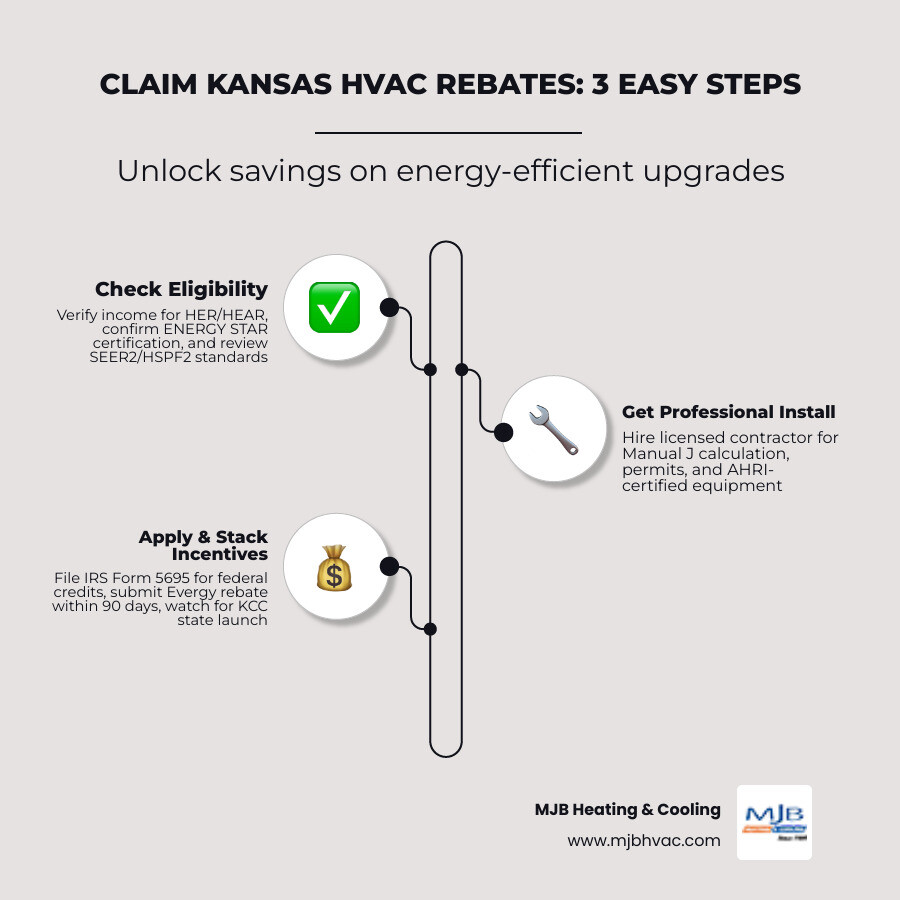
To claim these credits, you’ll need to file IRS Form 5695 with your federal tax return. It’s important to keep your receipts and the Manufacturer’s Certification Statement, which proves the equipment meets the necessary efficiency standards. We always recommend checking our Promotions page to see how these federal credits might align with our current local offers.
For those looking for the ultimate in efficiency, geothermal heat pumps fall under Section 25D. This is the Residential Clean Energy Credit, and it’s even more generous. It offers a 30% credit on the entire cost of the system with no upper dollar limit. Since geothermal systems are a larger investment, this 30% can equate to many thousands of dollars in tax savings.
While tax credits help you at the end of the year, rebates often provide more immediate relief. The landscape for kansas energy rebates for hvac upgrades is currently evolving. The Kansas Corporation Commission (KCC) Energy Office is the primary body managing the rollout of the state’s $105.5 million federal allocation.
This funding is split into two distinct programs:
To stay ahead of the curve, it helps to understand the technical side of things. You can Discover Energy Savings with Daikin's HSPF Rating Insights to see how modern ratings directly impact your eligibility for these state-managed funds.
One of the most important things to understand about the upcoming HER and HEAR programs is that they are designed with "equitable access" in mind. This means the amount of money you get back depends heavily on your household income relative to the Area Median Income (AMI).
The KCC uses HUD income tiers to determine these brackets. If you are a renter in Wichita or El Dorado, don't worry—you can participate too! You’ll just need written permission from your landlord to move forward with the upgrades.
You can't just install any old unit and expect a check from the state. To qualify for kansas energy rebates for hvac upgrades, your equipment must meet specific efficiency metrics.
As of 2026, we have fully transitioned to SEER2, HSPF2, and AFUE ratings. These are more rigorous testing standards that better reflect how equipment performs in the "real world" of Kansas weather—from those 100-degree August days in Newton to the sub-zero January nights in Park City.
Another critical factor is the R410A refrigerant phase-out. As of January 1, 2025, the manufacturing of systems using R410A was prohibited. Most new systems we install today use low-GWP (Global Warming Potential) refrigerants like R-32 or R-454B. These newer systems are not only better for the environment but are often built to the exact efficiency standards required for the highest rebate tiers.
| Equipment Type | Federal Tax Credit (25C) | Evergy Rebate (Max) |
|---|---|---|
| Central AC | SEER2 16+ | SEER2 17+ |
| Heat Pump | ENERGY STAR Most Efficient | SEER2 20+ |
| Gas Furnace | 97% AFUE | N/A (Utility focus is electric) |
If you live in the Evergy Kansas Central territory, which covers most of our service area from Wichita to Augusta, you have access to some of the most straightforward rebates in the state. Evergy's program is designed to reward homeowners who go above and beyond the minimum legal efficiency standards.
Evergy offers a sliding scale for their rebates. The more efficient the unit, the bigger the check:
Efficiency isn't just about the machine outside your house; it's about the "envelope" of your home. Evergy and Spire Energy both offer incentives for related upgrades that help your HVAC system work less:
If you’re worried about the upfront investment, we offer several Financing options that can help bridge the gap until your rebate checks arrive.
One of the biggest mistakes we see homeowners make is trying to "DIY" an installation or hiring an unlicensed "handyman" to save a few bucks. In rebates, this is a recipe for disaster.
To qualify for almost any state or utility rebate in Kansas, the system must be installed by a licensed HVAC contractor. In Sedgwick County and surrounding areas, this isn't just a suggestion—it's the law. Mechanical permits are required for all heating and cooling installations to ensure they meet local safety codes.
When we perform an installation in Maize or Goddard, we handle the permitting process and ensure the system passes all municipal inspections. Without a permit and a professional invoice, your rebate application will likely be rejected.
Before we even pull a wrench, we perform a Manual J load calculation. This is a technical way of saying we measure your home's square footage, window orientation, and insulation levels to determine exactly what size system you need.
An oversized system will "short cycle," turning on and off too frequently, which kills efficiency and wears out the motor. An undersized system will run forever and never keep you cool. Most rebate programs require proof that the system was properly sized for the home.
If you want to unlock the maximum state rebates (HER program), you’ll likely need a home energy assessment. This is a top-to-bottom inspection where a professional uses tools like blower doors and thermal cameras to find energy leaks. The federal government even offers a $150 tax credit specifically to help cover the cost of this audit.
The best part about these programs? You can often stack them! For example, if you install a qualifying heat pump in Valley Center, you could potentially claim:
The key is timing. Utility rebates often have a strict 90-day window for application after the installation is complete. We help our customers gather all the necessary AHRI certificates and invoices to make sure they don't miss these deadlines.
As of April 2026, the Kansas Corporation Commission is in the final stages of launching the public application portals. While some administrative delays moved the timeline from 2025, the funding is secured. We recommend staying in touch with our team, as we will be among the first to know when the "green light" is given for point-of-sale discounts.
Yes! Stacking is one of the most effective ways to lower your total investment. However, per IRS rules, you must subtract the value of any utility rebate from the total project cost before calculating your 30% federal tax credit. For example, if a project costs $10,000 and you get a $1,000 Evergy rebate, you would calculate your 30% tax credit based on the remaining $9,000.
Generally, no. Federal tax credits require the equipment to be "placed in service," and most manufacturer warranties—which are often required for rebate eligibility—are voided if the system is not installed by a licensed professional. Furthermore, Evergy and the KCC specifically require a licensed contractor's signature and license number on the rebate application.
Navigating kansas energy rebates for hvac upgrades can feel like a full-time job, but it’s a job that pays well. From the $2,000 federal tax credit to the $1,000 Evergy rebates and the massive state-wide funding currently rolling out, there has never been a better time to invest in your home’s comfort.
At MJB Heating & Cooling, we’ve been serving the Wichita metro area since 1984. Founded in Derby, our family-owned business was built on a foundation of quality workmanship and an honest approach. We don't just want to sell you a box; we want to help you design a comfort system that saves you money for the next 15 to 20 years.
Whether you are in Augusta, Mulvane, or right here in Wichita, our team of licensed technicians is ready to help you navigate the technical requirements of these rebate programs. We’ll handle the Manual J calculations, the permits, and the AHRI certifications so you can focus on enjoying a perfectly cooled (or heated) home.
Ready to start saving? Check out our https://www.mjbhvac.com/promotions to see how we can help you maximize your Kansas HVAC incentives today. Give us a call, and let’s get you paid for upgrading your comfort!
Kansas energy rebates for HVAC upgrades are available right now through a combination of federal tax credits, utility rebates from providers like Evergy, and a major state program coming soon — and many Wichita-area homeowners are leaving real money on the table simply because they don't know where to look.
Here's a quick breakdown of what's currently available:
| Program | Who It's For | Max Benefit |
|---|---|---|
| Federal Tax Credit (Section 25C) | All income levels | Up to $2,000 for heat pumps; up to $600 for central AC or furnaces |
| Evergy Utility Rebates | Evergy Kansas customers | Up to $1,000 for qualifying heat pumps; up to $600 for central AC |
| Geothermal (Section 25D) | All income levels | 30% of total cost, no cap through 2032 |
| Kansas Home Rebates (HER/HEAR) | Low-to-moderate income households | Up to 100% of costs for qualifying upgrades (launching soon) |
Up to half of your home's energy use goes toward heating and cooling. That means upgrading to a high-efficiency system doesn't just improve comfort — it can meaningfully reduce your monthly bills while putting money back in your pocket through rebates and credits.
Kansas has allocated over $105 million in federal IRA funding for the upcoming Home Efficiency Rebate (HER) and Home Electrification and Appliance Rebate (HEAR) programs, managed through the Kansas Corporation Commission (KCC). While those programs are not yet open for applications as of April 2026, Evergy utility rebates and federal tax credits are active and available today.
Whether you're replacing a failing system or planning a proactive upgrade, understanding how these programs work — and how to stack them — can significantly reduce what you pay out of pocket.
When we talk about the Inflation Reduction Act (IRA), we’re really talking about a massive shift in how the government encourages us to think about our home comfort. The centerpiece for most of our neighbors in Wichita and Derby is the Energy Efficient Home Improvement Credit, technically known as Section 25C.
This isn't just a small "thank you" note from the IRS; it's a robust 30% tax credit on the total cost of your project. However, it does come with some annual "speed limits" or caps that you need to know about to maximize your savings.
If you’ve been considering an air-source heat pump or a ductless mini-split, now is the time to act. These systems qualify for a massive $2,000 annual limit. Because heat pumps provide both heating and cooling, they are the "gold standard" for energy efficiency in the eyes of the federal government.
Whether you are in Andover or Haysville, installing an ENERGY STAR Most Efficient heat pump means you can claim 30% of the installation and equipment cost, up to that $2,000 ceiling, every single year through 2032.
If you aren't quite ready to go full heat pump and prefer a traditional central air conditioner or a high-efficiency gas furnace, you can still save. These systems are capped at $600 each. While that’s lower than the heat pump credit, it’s still a significant chunk of change that stays in your bank account rather than going to Uncle Sam.
To claim these credits, you’ll need to file IRS Form 5695 with your federal tax return. It’s important to keep your receipts and the Manufacturer’s Certification Statement, which proves the equipment meets the necessary efficiency standards. We always recommend checking our Promotions page to see how these federal credits might align with our current local offers.
For those looking for the ultimate in efficiency, geothermal heat pumps fall under Section 25D. This is the Residential Clean Energy Credit, and it’s even more generous. It offers a 30% credit on the entire cost of the system with no upper dollar limit. Since geothermal systems are a larger investment, this 30% can equate to many thousands of dollars in tax savings.
While tax credits help you at the end of the year, rebates often provide more immediate relief. The landscape for kansas energy rebates for hvac upgrades is currently evolving. The Kansas Corporation Commission (KCC) Energy Office is the primary body managing the rollout of the state’s $105.5 million federal allocation.
This funding is split into two distinct programs:
To stay ahead of the curve, it helps to understand the technical side of things. You can Discover Energy Savings with Daikin's HSPF Rating Insights to see how modern ratings directly impact your eligibility for these state-managed funds.
One of the most important things to understand about the upcoming HER and HEAR programs is that they are designed with "equitable access" in mind. This means the amount of money you get back depends heavily on your household income relative to the Area Median Income (AMI).
The KCC uses HUD income tiers to determine these brackets. If you are a renter in Wichita or El Dorado, don't worry—you can participate too! You’ll just need written permission from your landlord to move forward with the upgrades.
You can't just install any old unit and expect a check from the state. To qualify for kansas energy rebates for hvac upgrades, your equipment must meet specific efficiency metrics.
As of 2026, we have fully transitioned to SEER2, HSPF2, and AFUE ratings. These are more rigorous testing standards that better reflect how equipment performs in the "real world" of Kansas weather—from those 100-degree August days in Newton to the sub-zero January nights in Park City.
Another critical factor is the R410A refrigerant phase-out. As of January 1, 2025, the manufacturing of systems using R410A was prohibited. Most new systems we install today use low-GWP (Global Warming Potential) refrigerants like R-32 or R-454B. These newer systems are not only better for the environment but are often built to the exact efficiency standards required for the highest rebate tiers.
| Equipment Type | Federal Tax Credit (25C) | Evergy Rebate (Max) |
|---|---|---|
| Central AC | SEER2 16+ | SEER2 17+ |
| Heat Pump | ENERGY STAR Most Efficient | SEER2 20+ |
| Gas Furnace | 97% AFUE | N/A (Utility focus is electric) |
If you live in the Evergy Kansas Central territory, which covers most of our service area from Wichita to Augusta, you have access to some of the most straightforward rebates in the state. Evergy's program is designed to reward homeowners who go above and beyond the minimum legal efficiency standards.
Evergy offers a sliding scale for their rebates. The more efficient the unit, the bigger the check:
Efficiency isn't just about the machine outside your house; it's about the "envelope" of your home. Evergy and Spire Energy both offer incentives for related upgrades that help your HVAC system work less:
If you’re worried about the upfront investment, we offer several Financing options that can help bridge the gap until your rebate checks arrive.
One of the biggest mistakes we see homeowners make is trying to "DIY" an installation or hiring an unlicensed "handyman" to save a few bucks. In rebates, this is a recipe for disaster.
To qualify for almost any state or utility rebate in Kansas, the system must be installed by a licensed HVAC contractor. In Sedgwick County and surrounding areas, this isn't just a suggestion—it's the law. Mechanical permits are required for all heating and cooling installations to ensure they meet local safety codes.
When we perform an installation in Maize or Goddard, we handle the permitting process and ensure the system passes all municipal inspections. Without a permit and a professional invoice, your rebate application will likely be rejected.
Before we even pull a wrench, we perform a Manual J load calculation. This is a technical way of saying we measure your home's square footage, window orientation, and insulation levels to determine exactly what size system you need.
An oversized system will "short cycle," turning on and off too frequently, which kills efficiency and wears out the motor. An undersized system will run forever and never keep you cool. Most rebate programs require proof that the system was properly sized for the home.
If you want to unlock the maximum state rebates (HER program), you’ll likely need a home energy assessment. This is a top-to-bottom inspection where a professional uses tools like blower doors and thermal cameras to find energy leaks. The federal government even offers a $150 tax credit specifically to help cover the cost of this audit.
The best part about these programs? You can often stack them! For example, if you install a qualifying heat pump in Valley Center, you could potentially claim:
The key is timing. Utility rebates often have a strict 90-day window for application after the installation is complete. We help our customers gather all the necessary AHRI certificates and invoices to make sure they don't miss these deadlines.
As of April 2026, the Kansas Corporation Commission is in the final stages of launching the public application portals. While some administrative delays moved the timeline from 2025, the funding is secured. We recommend staying in touch with our team, as we will be among the first to know when the "green light" is given for point-of-sale discounts.
Yes! Stacking is one of the most effective ways to lower your total investment. However, per IRS rules, you must subtract the value of any utility rebate from the total project cost before calculating your 30% federal tax credit. For example, if a project costs $10,000 and you get a $1,000 Evergy rebate, you would calculate your 30% tax credit based on the remaining $9,000.
Generally, no. Federal tax credits require the equipment to be "placed in service," and most manufacturer warranties—which are often required for rebate eligibility—are voided if the system is not installed by a licensed professional. Furthermore, Evergy and the KCC specifically require a licensed contractor's signature and license number on the rebate application.
Navigating kansas energy rebates for hvac upgrades can feel like a full-time job, but it’s a job that pays well. From the $2,000 federal tax credit to the $1,000 Evergy rebates and the massive state-wide funding currently rolling out, there has never been a better time to invest in your home’s comfort.
At MJB Heating & Cooling, we’ve been serving the Wichita metro area since 1984. Founded in Derby, our family-owned business was built on a foundation of quality workmanship and an honest approach. We don't just want to sell you a box; we want to help you design a comfort system that saves you money for the next 15 to 20 years.
Whether you are in Augusta, Mulvane, or right here in Wichita, our team of licensed technicians is ready to help you navigate the technical requirements of these rebate programs. We’ll handle the Manual J calculations, the permits, and the AHRI certifications so you can focus on enjoying a perfectly cooled (or heated) home.
Ready to start saving? Check out our https://www.mjbhvac.com/promotions to see how we can help you maximize your Kansas HVAC incentives today. Give us a call, and let’s get you paid for upgrading your comfort!
Kansas energy rebates for HVAC upgrades are available right now through a combination of federal tax credits, utility rebates from providers like Evergy, and a major state program coming soon — and many Wichita-area homeowners are leaving real money on the table simply because they don't know where to look.
Here's a quick breakdown of what's currently available:
| Program | Who It's For | Max Benefit |
|---|---|---|
| Federal Tax Credit (Section 25C) | All income levels | Up to $2,000 for heat pumps; up to $600 for central AC or furnaces |
| Evergy Utility Rebates | Evergy Kansas customers | Up to $1,000 for qualifying heat pumps; up to $600 for central AC |
| Geothermal (Section 25D) | All income levels | 30% of total cost, no cap through 2032 |
| Kansas Home Rebates (HER/HEAR) | Low-to-moderate income households | Up to 100% of costs for qualifying upgrades (launching soon) |
Up to half of your home's energy use goes toward heating and cooling. That means upgrading to a high-efficiency system doesn't just improve comfort — it can meaningfully reduce your monthly bills while putting money back in your pocket through rebates and credits.
Kansas has allocated over $105 million in federal IRA funding for the upcoming Home Efficiency Rebate (HER) and Home Electrification and Appliance Rebate (HEAR) programs, managed through the Kansas Corporation Commission (KCC). While those programs are not yet open for applications as of April 2026, Evergy utility rebates and federal tax credits are active and available today.
Whether you're replacing a failing system or planning a proactive upgrade, understanding how these programs work — and how to stack them — can significantly reduce what you pay out of pocket.
When we talk about the Inflation Reduction Act (IRA), we’re really talking about a massive shift in how the government encourages us to think about our home comfort. The centerpiece for most of our neighbors in Wichita and Derby is the Energy Efficient Home Improvement Credit, technically known as Section 25C.
This isn't just a small "thank you" note from the IRS; it's a robust 30% tax credit on the total cost of your project. However, it does come with some annual "speed limits" or caps that you need to know about to maximize your savings.
If you’ve been considering an air-source heat pump or a ductless mini-split, now is the time to act. These systems qualify for a massive $2,000 annual limit. Because heat pumps provide both heating and cooling, they are the "gold standard" for energy efficiency in the eyes of the federal government.
Whether you are in Andover or Haysville, installing an ENERGY STAR Most Efficient heat pump means you can claim 30% of the installation and equipment cost, up to that $2,000 ceiling, every single year through 2032.
If you aren't quite ready to go full heat pump and prefer a traditional central air conditioner or a high-efficiency gas furnace, you can still save. These systems are capped at $600 each. While that’s lower than the heat pump credit, it’s still a significant chunk of change that stays in your bank account rather than going to Uncle Sam.
To claim these credits, you’ll need to file IRS Form 5695 with your federal tax return. It’s important to keep your receipts and the Manufacturer’s Certification Statement, which proves the equipment meets the necessary efficiency standards. We always recommend checking our Promotions page to see how these federal credits might align with our current local offers.
For those looking for the ultimate in efficiency, geothermal heat pumps fall under Section 25D. This is the Residential Clean Energy Credit, and it’s even more generous. It offers a 30% credit on the entire cost of the system with no upper dollar limit. Since geothermal systems are a larger investment, this 30% can equate to many thousands of dollars in tax savings.
While tax credits help you at the end of the year, rebates often provide more immediate relief. The landscape for kansas energy rebates for hvac upgrades is currently evolving. The Kansas Corporation Commission (KCC) Energy Office is the primary body managing the rollout of the state’s $105.5 million federal allocation.
This funding is split into two distinct programs:
To stay ahead of the curve, it helps to understand the technical side of things. You can Discover Energy Savings with Daikin's HSPF Rating Insights to see how modern ratings directly impact your eligibility for these state-managed funds.
One of the most important things to understand about the upcoming HER and HEAR programs is that they are designed with "equitable access" in mind. This means the amount of money you get back depends heavily on your household income relative to the Area Median Income (AMI).
The KCC uses HUD income tiers to determine these brackets. If you are a renter in Wichita or El Dorado, don't worry—you can participate too! You’ll just need written permission from your landlord to move forward with the upgrades.
You can't just install any old unit and expect a check from the state. To qualify for kansas energy rebates for hvac upgrades, your equipment must meet specific efficiency metrics.
As of 2026, we have fully transitioned to SEER2, HSPF2, and AFUE ratings. These are more rigorous testing standards that better reflect how equipment performs in the "real world" of Kansas weather—from those 100-degree August days in Newton to the sub-zero January nights in Park City.
Another critical factor is the R410A refrigerant phase-out. As of January 1, 2025, the manufacturing of systems using R410A was prohibited. Most new systems we install today use low-GWP (Global Warming Potential) refrigerants like R-32 or R-454B. These newer systems are not only better for the environment but are often built to the exact efficiency standards required for the highest rebate tiers.
| Equipment Type | Federal Tax Credit (25C) | Evergy Rebate (Max) |
|---|---|---|
| Central AC | SEER2 16+ | SEER2 17+ |
| Heat Pump | ENERGY STAR Most Efficient | SEER2 20+ |
| Gas Furnace | 97% AFUE | N/A (Utility focus is electric) |
If you live in the Evergy Kansas Central territory, which covers most of our service area from Wichita to Augusta, you have access to some of the most straightforward rebates in the state. Evergy's program is designed to reward homeowners who go above and beyond the minimum legal efficiency standards.
Evergy offers a sliding scale for their rebates. The more efficient the unit, the bigger the check:
Efficiency isn't just about the machine outside your house; it's about the "envelope" of your home. Evergy and Spire Energy both offer incentives for related upgrades that help your HVAC system work less:
If you’re worried about the upfront investment, we offer several Financing options that can help bridge the gap until your rebate checks arrive.
One of the biggest mistakes we see homeowners make is trying to "DIY" an installation or hiring an unlicensed "handyman" to save a few bucks. In rebates, this is a recipe for disaster.
To qualify for almost any state or utility rebate in Kansas, the system must be installed by a licensed HVAC contractor. In Sedgwick County and surrounding areas, this isn't just a suggestion—it's the law. Mechanical permits are required for all heating and cooling installations to ensure they meet local safety codes.
When we perform an installation in Maize or Goddard, we handle the permitting process and ensure the system passes all municipal inspections. Without a permit and a professional invoice, your rebate application will likely be rejected.
Before we even pull a wrench, we perform a Manual J load calculation. This is a technical way of saying we measure your home's square footage, window orientation, and insulation levels to determine exactly what size system you need.
An oversized system will "short cycle," turning on and off too frequently, which kills efficiency and wears out the motor. An undersized system will run forever and never keep you cool. Most rebate programs require proof that the system was properly sized for the home.
If you want to unlock the maximum state rebates (HER program), you’ll likely need a home energy assessment. This is a top-to-bottom inspection where a professional uses tools like blower doors and thermal cameras to find energy leaks. The federal government even offers a $150 tax credit specifically to help cover the cost of this audit.
The best part about these programs? You can often stack them! For example, if you install a qualifying heat pump in Valley Center, you could potentially claim:
The key is timing. Utility rebates often have a strict 90-day window for application after the installation is complete. We help our customers gather all the necessary AHRI certificates and invoices to make sure they don't miss these deadlines.
As of April 2026, the Kansas Corporation Commission is in the final stages of launching the public application portals. While some administrative delays moved the timeline from 2025, the funding is secured. We recommend staying in touch with our team, as we will be among the first to know when the "green light" is given for point-of-sale discounts.
Yes! Stacking is one of the most effective ways to lower your total investment. However, per IRS rules, you must subtract the value of any utility rebate from the total project cost before calculating your 30% federal tax credit. For example, if a project costs $10,000 and you get a $1,000 Evergy rebate, you would calculate your 30% tax credit based on the remaining $9,000.
Generally, no. Federal tax credits require the equipment to be "placed in service," and most manufacturer warranties—which are often required for rebate eligibility—are voided if the system is not installed by a licensed professional. Furthermore, Evergy and the KCC specifically require a licensed contractor's signature and license number on the rebate application.
Navigating kansas energy rebates for hvac upgrades can feel like a full-time job, but it’s a job that pays well. From the $2,000 federal tax credit to the $1,000 Evergy rebates and the massive state-wide funding currently rolling out, there has never been a better time to invest in your home’s comfort.
At MJB Heating & Cooling, we’ve been serving the Wichita metro area since 1984. Founded in Derby, our family-owned business was built on a foundation of quality workmanship and an honest approach. We don't just want to sell you a box; we want to help you design a comfort system that saves you money for the next 15 to 20 years.
Whether you are in Augusta, Mulvane, or right here in Wichita, our team of licensed technicians is ready to help you navigate the technical requirements of these rebate programs. We’ll handle the Manual J calculations, the permits, and the AHRI certifications so you can focus on enjoying a perfectly cooled (or heated) home.
Ready to start saving? Check out our https://www.mjbhvac.com/promotions to see how we can help you maximize your Kansas HVAC incentives today. Give us a call, and let’s get you paid for upgrading your comfort!


Kansas energy rebates for HVAC upgrades are available right now through a combination of federal tax credits, utility rebates from providers like Evergy, and a major state program coming soon — and many Wichita-area homeowners are leaving real money on the table simply because they don't know where to look.
Here's a quick breakdown of what's currently available:
• Federal Tax Credit (Section 25C) — Who It's For: All income levels — Max Benefit: Up to $2,000 for heat pumps; up to $600 for central AC or furnaces
• Evergy Utility Rebates — Who It's For: Evergy Kansas customers — Max Benefit: Up to $1,000 for qualifying heat pumps; up to $600 for central AC
• Geothermal (Section 25D) — Who It's For: All income levels — Max Benefit: 30% of total cost, no cap through 2032
• Kansas Home Rebates (HER/HEAR) — Who It's For: Low-to-moderate income households — Max Benefit: Up to 100% of costs for qualifying upgrades (launching soon)
Up to half of your home's energy use goes toward heating and cooling. That means upgrading to a high-efficiency system doesn't just improve comfort — it can meaningfully reduce your monthly bills while putting money back in your pocket through rebates and credits.
Kansas has allocated over $105 million in federal IRA funding for the upcoming Home Efficiency Rebate (HER) and Home Electrification and Appliance Rebate (HEAR) programs, managed through the Kansas Corporation Commission (KCC). While those programs are not yet open for applications as of April 2026, Evergy utility rebates and federal tax credits are active and available today.
Whether you're replacing a failing system or planning a proactive upgrade, understanding how these programs work — and how to stack them — can significantly reduce what you pay out of pocket.

When we talk about the Inflation Reduction Act (IRA), we’re really talking about a massive shift in how the government encourages us to think about our home comfort. The centerpiece for most of our neighbors in Wichita and Derby is the Energy Efficient Home Improvement Credit, technically known as Section 25C.
This isn't just a small "thank you" note from the IRS; it's a robust 30% tax credit on the total cost of your project. However, it does come with some annual "speed limits" or caps that you need to know about to maximize your savings.
If you’ve been considering an air-source heat pump or a ductless mini-split, now is the time to act. These systems qualify for a massive $2,000 annual limit. Because heat pumps provide both heating and cooling, they are the "gold standard" for energy efficiency in the eyes of the federal government.
Whether you are in Andover or Haysville, installing an ENERGY STAR Most Efficient heat pump means you can claim 30% of the installation and equipment cost, up to that $2,000 ceiling, every single year through 2032.
If you aren't quite ready to go full heat pump and prefer a traditional central air conditioner or a high-efficiency gas furnace, you can still save. These systems are capped at $600 each. While that’s lower than the heat pump credit, it’s still a significant chunk of change that stays in your bank account rather than going to Uncle Sam.
To claim these credits, you’ll need to file IRS Form 5695 with your federal tax return. It’s important to keep your receipts and the Manufacturer’s Certification Statement, which proves the equipment meets the necessary efficiency standards. We always recommend checking our Promotions page to see how these federal credits might align with our current local offers.
For those looking for the ultimate in efficiency, geothermal heat pumps fall under Section 25D. This is the Residential Clean Energy Credit, and it’s even more generous. It offers a 30% credit on the entire cost of the system with no upper dollar limit. Since geothermal systems are a larger investment, this 30% can equate to many thousands of dollars in tax savings.
While tax credits help you at the end of the year, rebates often provide more immediate relief. The landscape for kansas energy rebates for hvac upgrades is currently evolving. The Kansas Corporation Commission (KCC) Energy Office is the primary body managing the rollout of the state’s $105.5 million federal allocation.
This funding is split into two distinct programs:
1. Home Efficiency Rebates (HER): This program focuses on "whole-home" energy reductions. If we can prove that your HVAC upgrade, combined with things like insulation, reduces your home's energy usage by 20% or more, you could qualify for substantial cash back.
2. Home Electrification and Appliance Rebates (HEAR): This is more specific to equipment. It targets high-efficiency electric appliances, including heat pumps, and is designed to provide point-of-sale discounts. This means you might see the savings right on your invoice rather than waiting for a check in the mail.
To stay ahead of the curve, it helps to understand the technical side of things. You can Discover Energy Savings with Daikin's HSPF Rating Insights to see how modern ratings directly impact your eligibility for these state-managed funds.
One of the most important things to understand about the upcoming HER and HEAR programs is that they are designed with "equitable access" in mind. This means the amount of money you get back depends heavily on your household income relative to the Area Median Income (AMI).
• Low-Income Households (<80% AMI): If your household income is less than 80% of the median for your county (like Sedgwick or Butler County), you may be eligible for rebates that cover 100% of the project cost, up to certain limits (e.g., $8,000 for a heat pump).
• Moderate-Income Households (80-150% AMI): If you fall into this bracket, you could still see 50% of your costs covered.
• Higher Income (>150% AMI): While you might not qualify for the HEAR appliance rebates, you are still fully eligible for the federal tax credits and utility rebates mentioned earlier.
The KCC uses HUD income tiers to determine these brackets. If you are a renter in Wichita or El Dorado, don't worry—you can participate too! You’ll just need written permission from your landlord to move forward with the upgrades.
You can't just install any old unit and expect a check from the state. To qualify for kansas energy rebates for hvac upgrades, your equipment must meet specific efficiency metrics.
As of 2026, we have fully transitioned to SEER2, HSPF2, and AFUE ratings. These are more rigorous testing standards that better reflect how equipment performs in the "real world" of Kansas weather—from those 100-degree August days in Newton to the sub-zero January nights in Park City.
Another critical factor is the R410A refrigerant phase-out. As of January 1, 2025, the manufacturing of systems using R410A was prohibited. Most new systems we install today use low-GWP (Global Warming Potential) refrigerants like R-32 or R-454B. These newer systems are not only better for the environment but are often built to the exact efficiency standards required for the highest rebate tiers.
• Central AC — Federal Tax Credit (25C): SEER2 16+ — Evergy Rebate (Max): SEER2 17+
• Heat Pump — Federal Tax Credit (25C): ENERGY STAR Most Efficient — Evergy Rebate (Max): SEER2 20+
• Gas Furnace — Federal Tax Credit (25C): 97% AFUE — Evergy Rebate (Max): N/A (Utility focus is electric)
If you live in the Evergy Kansas Central territory, which covers most of our service area from Wichita to Augusta, you have access to some of the most straightforward rebates in the state. Evergy's program is designed to reward homeowners who go above and beyond the minimum legal efficiency standards.
Evergy offers a sliding scale for their rebates. The more efficient the unit, the bigger the check:
• Air Source Heat Pumps: You can receive up to $1,000 for a system with a SEER2 rating of 20 or higher. Even a SEER2 15 system can net you $500.
• Central Air Conditioners: Upgrading to a SEER2 17+ system can get you a $600 rebate.
• Ductless Mini-Splits: These versatile systems can qualify for a $200 rebate per unit.
Efficiency isn't just about the machine outside your house; it's about the "envelope" of your home. Evergy and Spire Energy both offer incentives for related upgrades that help your HVAC system work less:
• Insulation: Evergy offers roughly $0.15 per square foot for ceiling insulation (up to R-38), with a maximum of $500.
• Duct Sealing: You can get up to 50% of the cost back, capped at $250.
• Air Sealing: This helps stop those pesky drafts in older homes in places like Wellington or Winfield, with rebates up to $300.
If you’re worried about the upfront investment, we offer several Financing options that can help bridge the gap until your rebate checks arrive.
One of the biggest mistakes we see homeowners make is trying to "DIY" an installation or hiring an unlicensed "handyman" to save a few bucks. In rebates, this is a recipe for disaster.
To qualify for almost any state or utility rebate in Kansas, the system must be installed by a licensed HVAC contractor. In Sedgwick County and surrounding areas, this isn't just a suggestion—it's the law. Mechanical permits are required for all heating and cooling installations to ensure they meet local safety codes.
When we perform an installation in Maize or Goddard, we handle the permitting process and ensure the system passes all municipal inspections. Without a permit and a professional invoice, your rebate application will likely be rejected.
Before we even pull a wrench, we perform a Manual J load calculation. This is a technical way of saying we measure your home's square footage, window orientation, and insulation levels to determine exactly what size system you need.
An oversized system will "short cycle," turning on and off too frequently, which kills efficiency and wears out the motor. An undersized system will run forever and never keep you cool. Most rebate programs require proof that the system was properly sized for the home.
If you want to unlock the maximum state rebates (HER program), you’ll likely need a home energy assessment. This is a top-to-bottom inspection where a professional uses tools like blower doors and thermal cameras to find energy leaks. The federal government even offers a $150 tax credit specifically to help cover the cost of this audit.
The best part about these programs? You can often stack them! For example, if you install a qualifying heat pump in Valley Center, you could potentially claim:
1. A $2,000 federal tax credit.
2. A $1,000 Evergy utility rebate.
3. A state rebate (if income-qualified).
The key is timing. Utility rebates often have a strict 90-day window for application after the installation is complete. We help our customers gather all the necessary AHRI certificates and invoices to make sure they don't miss these deadlines.
As of April 2026, the Kansas Corporation Commission is in the final stages of launching the public application portals. While some administrative delays moved the timeline from 2025, the funding is secured. We recommend staying in touch with our team, as we will be among the first to know when the "green light" is given for point-of-sale discounts.
Yes! Stacking is one of the most effective ways to lower your total investment. However, per IRS rules, you must subtract the value of any utility rebate from the total project cost before calculating your 30% federal tax credit. For example, if a project costs $10,000 and you get a $1,000 Evergy rebate, you would calculate your 30% tax credit based on the remaining $9,000.
Generally, no. Federal tax credits require the equipment to be "placed in service," and most manufacturer warranties—which are often required for rebate eligibility—are voided if the system is not installed by a licensed professional. Furthermore, Evergy and the KCC specifically require a licensed contractor's signature and license number on the rebate application.
Navigating kansas energy rebates for hvac upgrades can feel like a full-time job, but it’s a job that pays well. From the $2,000 federal tax credit to the $1,000 Evergy rebates and the massive state-wide funding currently rolling out, there has never been a better time to invest in your home’s comfort.
At MJB Heating & Cooling, we’ve been serving the Wichita metro area since 1984. Founded in Derby, our family-owned business was built on a foundation of quality workmanship and an honest approach. We don't just want to sell you a box; we want to help you design a comfort system that saves you money for the next 15 to 20 years.
Whether you are in Augusta, Mulvane, or right here in Wichita, our team of licensed technicians is ready to help you navigate the technical requirements of these rebate programs. We’ll handle the Manual J calculations, the permits, and the AHRI certifications so you can focus on enjoying a perfectly cooled (or heated) home.
Ready to start saving? Check out our /promotions to see how we can help you maximize your Kansas HVAC incentives today. Give us a call, and let’s get you paid for upgrading your comfort!
Kansas energy rebates for HVAC upgrades are available right now through a combination of federal tax credits, utility rebates from providers like Evergy, and a major state program coming soon — and many Wichita-area homeowners are leaving real money on the table simply because they don't know where to look.
Here's a quick breakdown of what's currently available:
| Program | Who It's For | Max Benefit |
|---|---|---|
| Federal Tax Credit (Section 25C) | All income levels | Up to $2,000 for heat pumps; up to $600 for central AC or furnaces |
| Evergy Utility Rebates | Evergy Kansas customers | Up to $1,000 for qualifying heat pumps; up to $600 for central AC |
| Geothermal (Section 25D) | All income levels | 30% of total cost, no cap through 2032 |
| Kansas Home Rebates (HER/HEAR) | Low-to-moderate income households | Up to 100% of costs for qualifying upgrades (launching soon) |
Up to half of your home's energy use goes toward heating and cooling. That means upgrading to a high-efficiency system doesn't just improve comfort — it can meaningfully reduce your monthly bills while putting money back in your pocket through rebates and credits.
Kansas has allocated over $105 million in federal IRA funding for the upcoming Home Efficiency Rebate (HER) and Home Electrification and Appliance Rebate (HEAR) programs, managed through the Kansas Corporation Commission (KCC). While those programs are not yet open for applications as of April 2026, Evergy utility rebates and federal tax credits are active and available today.
Whether you're replacing a failing system or planning a proactive upgrade, understanding how these programs work — and how to stack them — can significantly reduce what you pay out of pocket.
When we talk about the Inflation Reduction Act (IRA), we’re really talking about a massive shift in how the government encourages us to think about our home comfort. The centerpiece for most of our neighbors in Wichita and Derby is the Energy Efficient Home Improvement Credit, technically known as Section 25C.
This isn't just a small "thank you" note from the IRS; it's a robust 30% tax credit on the total cost of your project. However, it does come with some annual "speed limits" or caps that you need to know about to maximize your savings.
If you’ve been considering an air-source heat pump or a ductless mini-split, now is the time to act. These systems qualify for a massive $2,000 annual limit. Because heat pumps provide both heating and cooling, they are the "gold standard" for energy efficiency in the eyes of the federal government.
Whether you are in Andover or Haysville, installing an ENERGY STAR Most Efficient heat pump means you can claim 30% of the installation and equipment cost, up to that $2,000 ceiling, every single year through 2032.
If you aren't quite ready to go full heat pump and prefer a traditional central air conditioner or a high-efficiency gas furnace, you can still save. These systems are capped at $600 each. While that’s lower than the heat pump credit, it’s still a significant chunk of change that stays in your bank account rather than going to Uncle Sam.
To claim these credits, you’ll need to file IRS Form 5695 with your federal tax return. It’s important to keep your receipts and the Manufacturer’s Certification Statement, which proves the equipment meets the necessary efficiency standards. We always recommend checking our Promotions page to see how these federal credits might align with our current local offers.
For those looking for the ultimate in efficiency, geothermal heat pumps fall under Section 25D. This is the Residential Clean Energy Credit, and it’s even more generous. It offers a 30% credit on the entire cost of the system with no upper dollar limit. Since geothermal systems are a larger investment, this 30% can equate to many thousands of dollars in tax savings.
While tax credits help you at the end of the year, rebates often provide more immediate relief. The landscape for kansas energy rebates for hvac upgrades is currently evolving. The Kansas Corporation Commission (KCC) Energy Office is the primary body managing the rollout of the state’s $105.5 million federal allocation.
This funding is split into two distinct programs:
To stay ahead of the curve, it helps to understand the technical side of things. You can Discover Energy Savings with Daikin's HSPF Rating Insights to see how modern ratings directly impact your eligibility for these state-managed funds.
One of the most important things to understand about the upcoming HER and HEAR programs is that they are designed with "equitable access" in mind. This means the amount of money you get back depends heavily on your household income relative to the Area Median Income (AMI).
The KCC uses HUD income tiers to determine these brackets. If you are a renter in Wichita or El Dorado, don't worry—you can participate too! You’ll just need written permission from your landlord to move forward with the upgrades.
You can't just install any old unit and expect a check from the state. To qualify for kansas energy rebates for hvac upgrades, your equipment must meet specific efficiency metrics.
As of 2026, we have fully transitioned to SEER2, HSPF2, and AFUE ratings. These are more rigorous testing standards that better reflect how equipment performs in the "real world" of Kansas weather—from those 100-degree August days in Newton to the sub-zero January nights in Park City.
Another critical factor is the R410A refrigerant phase-out. As of January 1, 2025, the manufacturing of systems using R410A was prohibited. Most new systems we install today use low-GWP (Global Warming Potential) refrigerants like R-32 or R-454B. These newer systems are not only better for the environment but are often built to the exact efficiency standards required for the highest rebate tiers.
| Equipment Type | Federal Tax Credit (25C) | Evergy Rebate (Max) |
|---|---|---|
| Central AC | SEER2 16+ | SEER2 17+ |
| Heat Pump | ENERGY STAR Most Efficient | SEER2 20+ |
| Gas Furnace | 97% AFUE | N/A (Utility focus is electric) |
If you live in the Evergy Kansas Central territory, which covers most of our service area from Wichita to Augusta, you have access to some of the most straightforward rebates in the state. Evergy's program is designed to reward homeowners who go above and beyond the minimum legal efficiency standards.
Evergy offers a sliding scale for their rebates. The more efficient the unit, the bigger the check:
Efficiency isn't just about the machine outside your house; it's about the "envelope" of your home. Evergy and Spire Energy both offer incentives for related upgrades that help your HVAC system work less:
If you’re worried about the upfront investment, we offer several Financing options that can help bridge the gap until your rebate checks arrive.
One of the biggest mistakes we see homeowners make is trying to "DIY" an installation or hiring an unlicensed "handyman" to save a few bucks. In rebates, this is a recipe for disaster.
To qualify for almost any state or utility rebate in Kansas, the system must be installed by a licensed HVAC contractor. In Sedgwick County and surrounding areas, this isn't just a suggestion—it's the law. Mechanical permits are required for all heating and cooling installations to ensure they meet local safety codes.
When we perform an installation in Maize or Goddard, we handle the permitting process and ensure the system passes all municipal inspections. Without a permit and a professional invoice, your rebate application will likely be rejected.
Before we even pull a wrench, we perform a Manual J load calculation. This is a technical way of saying we measure your home's square footage, window orientation, and insulation levels to determine exactly what size system you need.
An oversized system will "short cycle," turning on and off too frequently, which kills efficiency and wears out the motor. An undersized system will run forever and never keep you cool. Most rebate programs require proof that the system was properly sized for the home.
If you want to unlock the maximum state rebates (HER program), you’ll likely need a home energy assessment. This is a top-to-bottom inspection where a professional uses tools like blower doors and thermal cameras to find energy leaks. The federal government even offers a $150 tax credit specifically to help cover the cost of this audit.
The best part about these programs? You can often stack them! For example, if you install a qualifying heat pump in Valley Center, you could potentially claim:
The key is timing. Utility rebates often have a strict 90-day window for application after the installation is complete. We help our customers gather all the necessary AHRI certificates and invoices to make sure they don't miss these deadlines.
As of April 2026, the Kansas Corporation Commission is in the final stages of launching the public application portals. While some administrative delays moved the timeline from 2025, the funding is secured. We recommend staying in touch with our team, as we will be among the first to know when the "green light" is given for point-of-sale discounts.
Yes! Stacking is one of the most effective ways to lower your total investment. However, per IRS rules, you must subtract the value of any utility rebate from the total project cost before calculating your 30% federal tax credit. For example, if a project costs $10,000 and you get a $1,000 Evergy rebate, you would calculate your 30% tax credit based on the remaining $9,000.
Generally, no. Federal tax credits require the equipment to be "placed in service," and most manufacturer warranties—which are often required for rebate eligibility—are voided if the system is not installed by a licensed professional. Furthermore, Evergy and the KCC specifically require a licensed contractor's signature and license number on the rebate application.
Navigating kansas energy rebates for hvac upgrades can feel like a full-time job, but it’s a job that pays well. From the $2,000 federal tax credit to the $1,000 Evergy rebates and the massive state-wide funding currently rolling out, there has never been a better time to invest in your home’s comfort.
At MJB Heating & Cooling, we’ve been serving the Wichita metro area since 1984. Founded in Derby, our family-owned business was built on a foundation of quality workmanship and an honest approach. We don't just want to sell you a box; we want to help you design a comfort system that saves you money for the next 15 to 20 years.
Whether you are in Augusta, Mulvane, or right here in Wichita, our team of licensed technicians is ready to help you navigate the technical requirements of these rebate programs. We’ll handle the Manual J calculations, the permits, and the AHRI certifications so you can focus on enjoying a perfectly cooled (or heated) home.
Ready to start saving? Check out our https://www.mjbhvac.com/promotions to see how we can help you maximize your Kansas HVAC incentives today. Give us a call, and let’s get you paid for upgrading your comfort!


Our A/C stopped working on a Sunday and due to health issues, we needed to find a service company available on a Sunday. I called MJB and left a message on their emergency voice mail. Within 10 minutes Tom Buck called me to hear my description of the symptoms. He was just finishing an appointment in Wichita and would be on his way to my home on the south end of Derby. He arrived within 30 minutes! From start to finish he was the perfect example of what you could ever hope for in an HVAC tech and a human being. His evaluation of our system inside and out was as thorough as I could ever imagine and once he was done with the repair, our system is running as well or better than ever. Well worth the price for the evaluation, parts, and labor. Thank you again Tom for an awesome experience.
Our AC went out during the hottest days of the year, and they were out next day! We have been jerked around by a shoddy home warranty for years. We finally had a chance to pick our own repair people, and MJB came highly recommended. I can see why! I was impressed with the honesty and speed at which they fixed our AC unit!
Our commercial building had a lightening/electrical strike and damaged our 20 ton AC unit. No one could find us a new unit before the end of September. Imagining going all of August and September with no AC in Kansas and working inside near 100 degree temps is less than thrilling. Dale and the team at MJB called around and saved the day. They had us a new unit 5 weeks earlier than other could promise and I now have happy employees. The unit is amazingly quiet, super cold and so much more energy efficient. Thank you for being our super hero!
Came out and installed my new furnace. Was very polite and affordable. They are very acknowledgeable and I highly recommend!
Thank you very much. We had our 1st warm night in 3weeks. MJB took the time and effort to find the real problem. And the employees were kind and thoughtful and explained things very well. I cannot thank you and all of MJB. Will recommend you highly. Thanks again Marjorie Herman Oxford Kansas
We had a new system installed and I was so impressed with how quick they were in come out and install it, in the middle of a hot summer day. They were so friendly & very professional. I had a small problem with a weird sound and they came over immediately and fixed it. Love them!