


.avif)





Blogs
Stay updated with our latest blog posts.
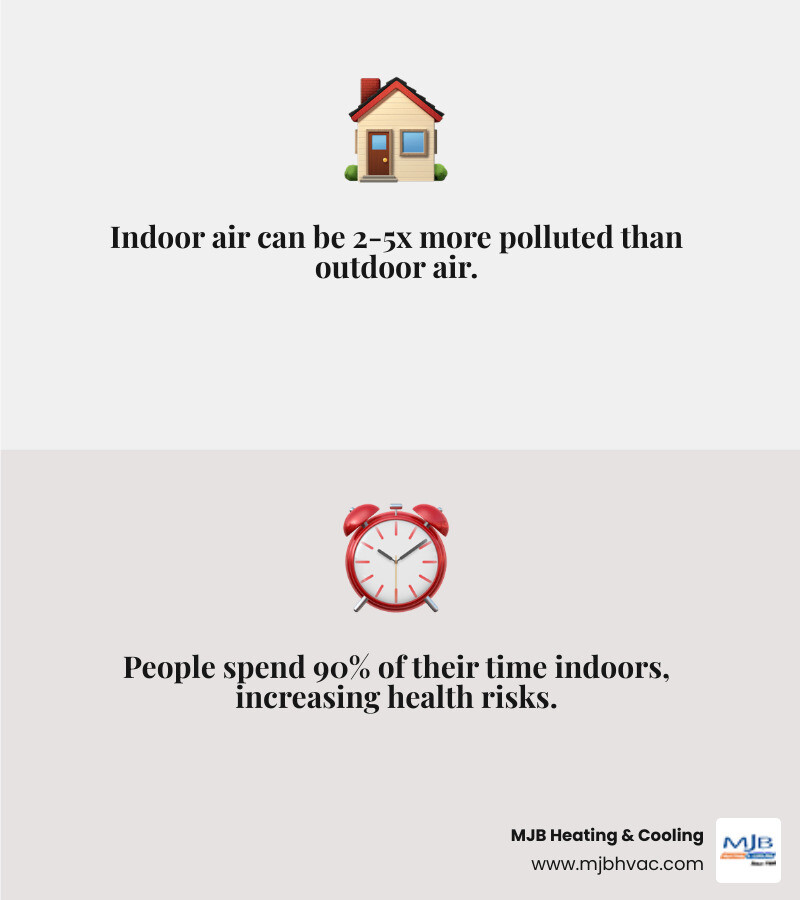
How indoor air quality affects your health is something most people never think about — until symptoms show up. The air inside your home, office, or school can actually be 2 to 5 times more polluted than the air outside. And since most of us spend around 90% of our time indoors, that's a serious concern.
Poor indoor air quality can trigger a range of health problems, from minor irritations to life-threatening conditions:
For homeowners in the Wichita metro area, this is especially relevant. Central Kansas homes are tightly built for energy efficiency — which is great for utility bills, but can trap pollutants inside without proper ventilation and filtration.
The good news? Understanding the risks is the first step toward protecting your family. And there's a lot you can do about it.
When we talk about Indoor Air Quality (IAQ), we aren't just talking about whether the room smells like old gym socks. IAQ refers to the air quality within and around buildings and structures, specifically as it relates to the health and comfort of the people inside. It’s a complex cocktail of gases, particles, biological contaminants, and even humidity levels.
At MJB Heating & Cooling, we’ve spent decades helping our neighbors in Derby, Andover, and Wichita understand that the air you breathe is just as important as the temperature on your thermostat. Several factors determine your IAQ:
Understanding Air Purification Remove Indoor Pollutants is the first step in realizing that your home shouldn't be a sealed box of stale air.
As we move through 2026, the way we build homes has changed. Modern houses in places like Maize and Rose Hill are incredibly energy-efficient. While this saves us money on heating and cooling, it means our homes are "airtight." Without a dedicated plan for air exchange, synthetic materials from new furniture, carpets, and even the paint on the walls can off-gas Volatile Organic Compounds (VOCs) that have nowhere to go.
Additionally, our Central Kansas climate—with its humid summers and bone-chilling winters—forces us to keep our windows shut for most of the year. This lack of natural airflow makes mechanical intervention a necessity rather than a luxury.
It isn't just about physical illness; it’s about how you feel every day. Have you ever noticed you feel "foggy" after sitting in a stuffy office all afternoon? Research shows that poor IAQ, specifically high levels of CO2 and particulate matter, can significantly tank your cognitive function and productivity.
When your air is clean, you sleep better. When you sleep better, your stress levels drop. There is a direct line between the filtration in your HVAC system and your overall happiness. A home that feels fresh and smells clean isn't just a "nice to have"—it’s a sanctuary for your mental well-being.
We often think of air pollution as the smog we see over big cities, but the invisible threats inside your home are often more potent. How indoor air quality affects your health depends on your age, your genetics, and how long you’ve been breathing the "bad stuff."
Certain groups are much more vulnerable. Children, for instance, breathe more air per pound of body weight than adults, and their lungs are still developing. Older adults and pregnant women also face higher risks, as do our neighbors with pre-existing conditions like asthma or heart disease. If you live in Haysville and are concerned about a family member's respiratory health, exploring Whole House Air Purification Haysville Ks can be a life-changing decision.
Immediate effects can show up after just a single exposure or repeated short-term exposures to a pollutant. These symptoms are often mistaken for a common cold or "seasonal allergies," but the tell-tale sign is that they often improve when you leave the house for a few hours.
Common immediate symptoms include:
In fact, Air Purification Eliminates Summer Allergens by removing the pollen and mold spores that hitch a ride into your home during the Kansas humid season.
The long-term effects are the ones that keep us up at night. These can show up years after exposure or after long, repeated periods of living in a home with poor air. According to 2021 data, household air pollution was responsible for 2.9 million deaths globally. In the U.S., the risks often manifest as:
| Symptom Category | Immediate Effects | Chronic (Long-Term) Effects |
|---|---|---|
| Respiratory | Coughing, sneezing, shortness of breath | COPD, chronic bronchitis, asthma development |
| Neurological | Headaches, dizziness, "brain fog" | Cognitive decline, increased stroke risk |
| General | Fatigue, eye/nose irritation | Cardiovascular disease, lung cancer |
| Vulnerable Groups | Rapid asthma triggers in children | Impaired lung development in infants |
To fix the problem, we have to know what we're fighting. In the Wichita metro area, we see a specific set of "usual suspects" when it comes to air pollution. If you're in Andover, you might want to look into Whole House Air Purification Andover Ks to combat these specific local threats.
These are the living (or formerly living) things that make us sneeze.
Don't panic! While the list of pollutants is long, the list of solutions is effective. We believe in a three-pronged approach: Source Control, Ventilation, and Filtration.
The easiest "win" for any homeowner is staying on top of maintenance. We often get asked, How Often Should Hvac Air Filters Be Changed? In the dusty, windy environment of Kansas, the answer is usually every 1 to 3 months, depending on your home’s specific needs.
While standard filters catch the big stuff (like pet hair and dust bunnies), advanced technology handles the microscopic threats.
For those looking for a modern touch, there are even Ways Ductless Ac Improves Indoor Air, as these systems often feature multi-stage filtration that is superior to traditional window units.
In Kansas, humidity control is half the battle. You want to keep your indoor humidity between 30% and 50%.
Using a whole-home dehumidifier in the summer and a humidifier in the winter ensures your air stays in that "Goldilocks" zone of health and comfort.
If you find yourself dusting your coffee table on Monday only to see a layer of gray on Tuesday, that’s a red flag. Other signs include musty odors that won't go away, family members having "allergy attacks" only when they are inside, and physical symptoms like dry skin or frequent headaches.
That is what makes radon so dangerous. It’s a silent "lung-damager." It enters through your foundation and builds up in low-lying areas like basements. Over time, breathing in these radioactive particles damages the lining of your lungs. Because you can't see it, professional testing is the only way to know if you're at risk. We recommend testing every two years.
We love a good Snake Plant or Spider Plant as much as anyone! They do produce oxygen and can absorb some VOCs. However, you would need a literal jungle in your living room to match the cleaning power of a single high-efficiency HVAC filter. Think of plants as a beautiful supplement, not a total solution. (And be careful not to overwater them, or you'll end up with mold in the soil!)
At MJB Heating & Cooling, we aren't just here to fix a broken air conditioner. We’re here to make sure the air your family breathes is safe, clean, and healthy. As a family-owned business serving the Wichita metro area since 1984, we pride ourselves on an honest business approach. We live in these communities too—from Derby to El Dorado—and we know exactly what the Kansas climate throws at your home.
If you’re Concerned about the air quality in my house? Contact MJB Heating & Cooling for whole-house air purification in Derby, KS. We’d be honored to help you breathe a little easier. Whether you need a simple filter upgrade or a complete whole-home air purification system, we’ve got the local expertise and quality workmanship to get the job done right.
How indoor air quality affects your health is something most people never think about — until symptoms show up. The air inside your home, office, or school can actually be 2 to 5 times more polluted than the air outside. And since most of us spend around 90% of our time indoors, that's a serious concern.
Poor indoor air quality can trigger a range of health problems, from minor irritations to life-threatening conditions:
For homeowners in the Wichita metro area, this is especially relevant. Central Kansas homes are tightly built for energy efficiency — which is great for utility bills, but can trap pollutants inside without proper ventilation and filtration.
The good news? Understanding the risks is the first step toward protecting your family. And there's a lot you can do about it.
When we talk about Indoor Air Quality (IAQ), we aren't just talking about whether the room smells like old gym socks. IAQ refers to the air quality within and around buildings and structures, specifically as it relates to the health and comfort of the people inside. It’s a complex cocktail of gases, particles, biological contaminants, and even humidity levels.
At MJB Heating & Cooling, we’ve spent decades helping our neighbors in Derby, Andover, and Wichita understand that the air you breathe is just as important as the temperature on your thermostat. Several factors determine your IAQ:
Understanding Air Purification Remove Indoor Pollutants is the first step in realizing that your home shouldn't be a sealed box of stale air.
As we move through 2026, the way we build homes has changed. Modern houses in places like Maize and Rose Hill are incredibly energy-efficient. While this saves us money on heating and cooling, it means our homes are "airtight." Without a dedicated plan for air exchange, synthetic materials from new furniture, carpets, and even the paint on the walls can off-gas Volatile Organic Compounds (VOCs) that have nowhere to go.
Additionally, our Central Kansas climate—with its humid summers and bone-chilling winters—forces us to keep our windows shut for most of the year. This lack of natural airflow makes mechanical intervention a necessity rather than a luxury.
It isn't just about physical illness; it’s about how you feel every day. Have you ever noticed you feel "foggy" after sitting in a stuffy office all afternoon? Research shows that poor IAQ, specifically high levels of CO2 and particulate matter, can significantly tank your cognitive function and productivity.
When your air is clean, you sleep better. When you sleep better, your stress levels drop. There is a direct line between the filtration in your HVAC system and your overall happiness. A home that feels fresh and smells clean isn't just a "nice to have"—it’s a sanctuary for your mental well-being.
We often think of air pollution as the smog we see over big cities, but the invisible threats inside your home are often more potent. How indoor air quality affects your health depends on your age, your genetics, and how long you’ve been breathing the "bad stuff."
Certain groups are much more vulnerable. Children, for instance, breathe more air per pound of body weight than adults, and their lungs are still developing. Older adults and pregnant women also face higher risks, as do our neighbors with pre-existing conditions like asthma or heart disease. If you live in Haysville and are concerned about a family member's respiratory health, exploring Whole House Air Purification Haysville Ks can be a life-changing decision.
Immediate effects can show up after just a single exposure or repeated short-term exposures to a pollutant. These symptoms are often mistaken for a common cold or "seasonal allergies," but the tell-tale sign is that they often improve when you leave the house for a few hours.
Common immediate symptoms include:
In fact, Air Purification Eliminates Summer Allergens by removing the pollen and mold spores that hitch a ride into your home during the Kansas humid season.
The long-term effects are the ones that keep us up at night. These can show up years after exposure or after long, repeated periods of living in a home with poor air. According to 2021 data, household air pollution was responsible for 2.9 million deaths globally. In the U.S., the risks often manifest as:
| Symptom Category | Immediate Effects | Chronic (Long-Term) Effects |
|---|---|---|
| Respiratory | Coughing, sneezing, shortness of breath | COPD, chronic bronchitis, asthma development |
| Neurological | Headaches, dizziness, "brain fog" | Cognitive decline, increased stroke risk |
| General | Fatigue, eye/nose irritation | Cardiovascular disease, lung cancer |
| Vulnerable Groups | Rapid asthma triggers in children | Impaired lung development in infants |
To fix the problem, we have to know what we're fighting. In the Wichita metro area, we see a specific set of "usual suspects" when it comes to air pollution. If you're in Andover, you might want to look into Whole House Air Purification Andover Ks to combat these specific local threats.
These are the living (or formerly living) things that make us sneeze.
Don't panic! While the list of pollutants is long, the list of solutions is effective. We believe in a three-pronged approach: Source Control, Ventilation, and Filtration.
The easiest "win" for any homeowner is staying on top of maintenance. We often get asked, How Often Should Hvac Air Filters Be Changed? In the dusty, windy environment of Kansas, the answer is usually every 1 to 3 months, depending on your home’s specific needs.
While standard filters catch the big stuff (like pet hair and dust bunnies), advanced technology handles the microscopic threats.
For those looking for a modern touch, there are even Ways Ductless Ac Improves Indoor Air, as these systems often feature multi-stage filtration that is superior to traditional window units.
In Kansas, humidity control is half the battle. You want to keep your indoor humidity between 30% and 50%.
Using a whole-home dehumidifier in the summer and a humidifier in the winter ensures your air stays in that "Goldilocks" zone of health and comfort.
If you find yourself dusting your coffee table on Monday only to see a layer of gray on Tuesday, that’s a red flag. Other signs include musty odors that won't go away, family members having "allergy attacks" only when they are inside, and physical symptoms like dry skin or frequent headaches.
That is what makes radon so dangerous. It’s a silent "lung-damager." It enters through your foundation and builds up in low-lying areas like basements. Over time, breathing in these radioactive particles damages the lining of your lungs. Because you can't see it, professional testing is the only way to know if you're at risk. We recommend testing every two years.
We love a good Snake Plant or Spider Plant as much as anyone! They do produce oxygen and can absorb some VOCs. However, you would need a literal jungle in your living room to match the cleaning power of a single high-efficiency HVAC filter. Think of plants as a beautiful supplement, not a total solution. (And be careful not to overwater them, or you'll end up with mold in the soil!)
At MJB Heating & Cooling, we aren't just here to fix a broken air conditioner. We’re here to make sure the air your family breathes is safe, clean, and healthy. As a family-owned business serving the Wichita metro area since 1984, we pride ourselves on an honest business approach. We live in these communities too—from Derby to El Dorado—and we know exactly what the Kansas climate throws at your home.
If you’re Concerned about the air quality in my house? Contact MJB Heating & Cooling for whole-house air purification in Derby, KS. We’d be honored to help you breathe a little easier. Whether you need a simple filter upgrade or a complete whole-home air purification system, we’ve got the local expertise and quality workmanship to get the job done right.
How indoor air quality affects your health is something most people never think about — until symptoms show up. The air inside your home, office, or school can actually be 2 to 5 times more polluted than the air outside. And since most of us spend around 90% of our time indoors, that's a serious concern.
Poor indoor air quality can trigger a range of health problems, from minor irritations to life-threatening conditions:
For homeowners in the Wichita metro area, this is especially relevant. Central Kansas homes are tightly built for energy efficiency — which is great for utility bills, but can trap pollutants inside without proper ventilation and filtration.
The good news? Understanding the risks is the first step toward protecting your family. And there's a lot you can do about it.
When we talk about Indoor Air Quality (IAQ), we aren't just talking about whether the room smells like old gym socks. IAQ refers to the air quality within and around buildings and structures, specifically as it relates to the health and comfort of the people inside. It’s a complex cocktail of gases, particles, biological contaminants, and even humidity levels.
At MJB Heating & Cooling, we’ve spent decades helping our neighbors in Derby, Andover, and Wichita understand that the air you breathe is just as important as the temperature on your thermostat. Several factors determine your IAQ:
Understanding Air Purification Remove Indoor Pollutants is the first step in realizing that your home shouldn't be a sealed box of stale air.
As we move through 2026, the way we build homes has changed. Modern houses in places like Maize and Rose Hill are incredibly energy-efficient. While this saves us money on heating and cooling, it means our homes are "airtight." Without a dedicated plan for air exchange, synthetic materials from new furniture, carpets, and even the paint on the walls can off-gas Volatile Organic Compounds (VOCs) that have nowhere to go.
Additionally, our Central Kansas climate—with its humid summers and bone-chilling winters—forces us to keep our windows shut for most of the year. This lack of natural airflow makes mechanical intervention a necessity rather than a luxury.
It isn't just about physical illness; it’s about how you feel every day. Have you ever noticed you feel "foggy" after sitting in a stuffy office all afternoon? Research shows that poor IAQ, specifically high levels of CO2 and particulate matter, can significantly tank your cognitive function and productivity.
When your air is clean, you sleep better. When you sleep better, your stress levels drop. There is a direct line between the filtration in your HVAC system and your overall happiness. A home that feels fresh and smells clean isn't just a "nice to have"—it’s a sanctuary for your mental well-being.
We often think of air pollution as the smog we see over big cities, but the invisible threats inside your home are often more potent. How indoor air quality affects your health depends on your age, your genetics, and how long you’ve been breathing the "bad stuff."
Certain groups are much more vulnerable. Children, for instance, breathe more air per pound of body weight than adults, and their lungs are still developing. Older adults and pregnant women also face higher risks, as do our neighbors with pre-existing conditions like asthma or heart disease. If you live in Haysville and are concerned about a family member's respiratory health, exploring Whole House Air Purification Haysville Ks can be a life-changing decision.
Immediate effects can show up after just a single exposure or repeated short-term exposures to a pollutant. These symptoms are often mistaken for a common cold or "seasonal allergies," but the tell-tale sign is that they often improve when you leave the house for a few hours.
Common immediate symptoms include:
In fact, Air Purification Eliminates Summer Allergens by removing the pollen and mold spores that hitch a ride into your home during the Kansas humid season.
The long-term effects are the ones that keep us up at night. These can show up years after exposure or after long, repeated periods of living in a home with poor air. According to 2021 data, household air pollution was responsible for 2.9 million deaths globally. In the U.S., the risks often manifest as:
| Symptom Category | Immediate Effects | Chronic (Long-Term) Effects |
|---|---|---|
| Respiratory | Coughing, sneezing, shortness of breath | COPD, chronic bronchitis, asthma development |
| Neurological | Headaches, dizziness, "brain fog" | Cognitive decline, increased stroke risk |
| General | Fatigue, eye/nose irritation | Cardiovascular disease, lung cancer |
| Vulnerable Groups | Rapid asthma triggers in children | Impaired lung development in infants |
To fix the problem, we have to know what we're fighting. In the Wichita metro area, we see a specific set of "usual suspects" when it comes to air pollution. If you're in Andover, you might want to look into Whole House Air Purification Andover Ks to combat these specific local threats.
These are the living (or formerly living) things that make us sneeze.
Don't panic! While the list of pollutants is long, the list of solutions is effective. We believe in a three-pronged approach: Source Control, Ventilation, and Filtration.
The easiest "win" for any homeowner is staying on top of maintenance. We often get asked, How Often Should Hvac Air Filters Be Changed? In the dusty, windy environment of Kansas, the answer is usually every 1 to 3 months, depending on your home’s specific needs.
While standard filters catch the big stuff (like pet hair and dust bunnies), advanced technology handles the microscopic threats.
For those looking for a modern touch, there are even Ways Ductless Ac Improves Indoor Air, as these systems often feature multi-stage filtration that is superior to traditional window units.
In Kansas, humidity control is half the battle. You want to keep your indoor humidity between 30% and 50%.
Using a whole-home dehumidifier in the summer and a humidifier in the winter ensures your air stays in that "Goldilocks" zone of health and comfort.
If you find yourself dusting your coffee table on Monday only to see a layer of gray on Tuesday, that’s a red flag. Other signs include musty odors that won't go away, family members having "allergy attacks" only when they are inside, and physical symptoms like dry skin or frequent headaches.
That is what makes radon so dangerous. It’s a silent "lung-damager." It enters through your foundation and builds up in low-lying areas like basements. Over time, breathing in these radioactive particles damages the lining of your lungs. Because you can't see it, professional testing is the only way to know if you're at risk. We recommend testing every two years.
We love a good Snake Plant or Spider Plant as much as anyone! They do produce oxygen and can absorb some VOCs. However, you would need a literal jungle in your living room to match the cleaning power of a single high-efficiency HVAC filter. Think of plants as a beautiful supplement, not a total solution. (And be careful not to overwater them, or you'll end up with mold in the soil!)
At MJB Heating & Cooling, we aren't just here to fix a broken air conditioner. We’re here to make sure the air your family breathes is safe, clean, and healthy. As a family-owned business serving the Wichita metro area since 1984, we pride ourselves on an honest business approach. We live in these communities too—from Derby to El Dorado—and we know exactly what the Kansas climate throws at your home.
If you’re Concerned about the air quality in my house? Contact MJB Heating & Cooling for whole-house air purification in Derby, KS. We’d be honored to help you breathe a little easier. Whether you need a simple filter upgrade or a complete whole-home air purification system, we’ve got the local expertise and quality workmanship to get the job done right.


How indoor air quality affects your health is something most people never think about — until symptoms show up. The air inside your home, office, or school can actually be 2 to 5 times more polluted than the air outside. And since most of us spend around 90% of our time indoors, that's a serious concern.
Poor indoor air quality can trigger a range of health problems, from minor irritations to life-threatening conditions:
• Short-term effects: Eye, nose, and throat irritation; headaches; dizziness; fatigue; worsened asthma
• Long-term effects: Chronic respiratory diseases, heart disease, lung cancer, and reduced cognitive function
• Most at risk: Children, older adults, pregnant women, and anyone with a pre-existing lung or heart condition
• Key pollutants: Radon, mold, VOCs, carbon monoxide, dust mites, pet dander, and tobacco smoke
• Global scale: Household air pollution contributes to an estimated 2.9 million deaths per year worldwide
For homeowners in the Wichita metro area, this is especially relevant. Central Kansas homes are tightly built for energy efficiency — which is great for utility bills, but can trap pollutants inside without proper ventilation and filtration.
The good news? Understanding the risks is the first step toward protecting your family. And there's a lot you can do about it.

When we talk about Indoor Air Quality (IAQ), we aren't just talking about whether the room smells like old gym socks. IAQ refers to the air quality within and around buildings and structures, specifically as it relates to the health and comfort of the people inside. It’s a complex cocktail of gases, particles, biological contaminants, and even humidity levels.
At MJB Heating & Cooling, we’ve spent decades helping our neighbors in Derby, Andover, and Wichita understand that the air you breathe is just as important as the temperature on your thermostat. Several factors determine your IAQ:
1. Air Exchange Rate: This is how quickly indoor air is replaced by outdoor air. If your exchange rate is low, pollutants can hitch a ride on dust particles and circulate indefinitely.
2. Infiltration: This is the "accidental" air that leaks in through cracks in the foundation, windows, or doors.
3. Natural Ventilation: The air that comes in when you open the windows on a rare, perfect Kansas spring day.
4. Mechanical Ventilation: This is where we come in. It involves using outdoor-vented fans and HVAC systems to intentionally move air in and out.
Understanding Air Purification Remove Indoor Pollutants is the first step in realizing that your home shouldn't be a sealed box of stale air.
As we move through 2026, the way we build homes has changed. Modern houses in places like Maize and Rose Hill are incredibly energy-efficient. While this saves us money on heating and cooling, it means our homes are "airtight." Without a dedicated plan for air exchange, synthetic materials from new furniture, carpets, and even the paint on the walls can off-gas Volatile Organic Compounds (VOCs) that have nowhere to go.
Additionally, our Central Kansas climate—with its humid summers and bone-chilling winters—forces us to keep our windows shut for most of the year. This lack of natural airflow makes mechanical intervention a necessity rather than a luxury.
It isn't just about physical illness; it’s about how you feel every day. Have you ever noticed you feel "foggy" after sitting in a stuffy office all afternoon? Research shows that poor IAQ, specifically high levels of CO2 and particulate matter, can significantly tank your cognitive function and productivity.
When your air is clean, you sleep better. When you sleep better, your stress levels drop. There is a direct line between the filtration in your HVAC system and your overall happiness. A home that feels fresh and smells clean isn't just a "nice to have"—it’s a sanctuary for your mental well-being.
We often think of air pollution as the smog we see over big cities, but the invisible threats inside your home are often more potent. How indoor air quality affects your health depends on your age, your genetics, and how long you’ve been breathing the "bad stuff."
Certain groups are much more vulnerable. Children, for instance, breathe more air per pound of body weight than adults, and their lungs are still developing. Older adults and pregnant women also face higher risks, as do our neighbors with pre-existing conditions like asthma or heart disease. If you live in Haysville and are concerned about a family member's respiratory health, exploring Whole House Air Purification Haysville Ks can be a life-changing decision.
Immediate effects can show up after just a single exposure or repeated short-term exposures to a pollutant. These symptoms are often mistaken for a common cold or "seasonal allergies," but the tell-tale sign is that they often improve when you leave the house for a few hours.
Common immediate symptoms include:
• Irritation of the eyes, nose, and throat.
• Persistent headaches or "heavy" feeling in the head.
• Dizziness and fatigue.
• Aggravation of asthma (especially during the peak of summer).
In fact, Air Purification Eliminates Summer Allergens by removing the pollen and mold spores that hitch a ride into your home during the Kansas humid season.
The long-term effects are the ones that keep us up at night. These can show up years after exposure or after long, repeated periods of living in a home with poor air. According to 2021 data, household air pollution was responsible for 2.9 million deaths globally. In the U.S., the risks often manifest as:
• Respiratory Diseases: Chronic obstructive pulmonary disease (COPD) and worsened asthma.
• Heart Disease: Fine particulate matter (PM2.5) is small enough to enter your bloodstream, causing inflammation that leads to cardiovascular issues.
• Lung Cancer: Radon gas and secondhand smoke are primary drivers here.
• Respiratory — Immediate Effects: Coughing, sneezing, shortness of breath — Chronic (Long-Term) Effects: COPD, chronic bronchitis, asthma development
• Neurological — Immediate Effects: Headaches, dizziness, "brain fog" — Chronic (Long-Term) Effects: Cognitive decline, increased stroke risk
• General — Immediate Effects: Fatigue, eye/nose irritation — Chronic (Long-Term) Effects: Cardiovascular disease, lung cancer
• Vulnerable Groups — Immediate Effects: Rapid asthma triggers in children — Chronic (Long-Term) Effects: Impaired lung development in infants
To fix the problem, we have to know what we're fighting. In the Wichita metro area, we see a specific set of "usual suspects" when it comes to air pollution. If you're in Andover, you might want to look into Whole House Air Purification Andover Ks to combat these specific local threats.
These are the living (or formerly living) things that make us sneeze.
• Mold: Thrives in the high humidity we get in Kansas. It loves damp basements and leaky ductwork.
• Dust Mites: Tiny organisms that live in carpets and bedding.
• Pet Dander: Even if you love your Golden Retriever, his skin cells are a major IAQ offender.
• Pollen: It doesn't stay outside. It follows you in on your clothes and shoes.
• Radon: This is a big one. Radon is a naturally occurring radioactive gas that comes from the decay of uranium in the soil. It enters homes through cracks in the foundation. It is the second leading cause of lung cancer in the U.S., responsible for about 21,000 deaths annually.
• VOCs: Found in household cleaners, paints, and new furniture. They can be 2 to 5 times higher indoors than out.
• Carbon Monoxide (CO): An odorless, colorless gas from gas stoves, furnaces, or water heaters that aren't venting correctly.
• Tobacco and Thirdhand Smoke: Smoke particles can linger in furniture and carpets for years, continuing to release toxins.
Don't panic! While the list of pollutants is long, the list of solutions is effective. We believe in a three-pronged approach: Source Control, Ventilation, and Filtration.
The easiest "win" for any homeowner is staying on top of maintenance. We often get asked, How Often Should Hvac Air Filters Be Changed? In the dusty, windy environment of Kansas, the answer is usually every 1 to 3 months, depending on your home’s specific needs.
While standard filters catch the big stuff (like pet hair and dust bunnies), advanced technology handles the microscopic threats.
• HEPA Filters: These can trap 99.97% of particles as small as 0.3 microns.
• UV Lights: Installed inside your HVAC system, these use ultraviolet light to "zapping" mold spores and bacteria before they can circulate.
• Whole-House Systems: These integrate directly with your furnace and AC to clean the air in every single room simultaneously.
For those looking for a modern touch, there are even Ways Ductless Ac Improves Indoor Air, as these systems often feature multi-stage filtration that is superior to traditional window units.
In Kansas, humidity control is half the battle. You want to keep your indoor humidity between 30% and 50%.
• Too high: You’re inviting mold and dust mites to a house party.
• Too low: You’ll suffer from dry skin, irritated sinuses, and increased static electricity (which actually helps dust stay airborne).
Using a whole-home dehumidifier in the summer and a humidifier in the winter ensures your air stays in that "Goldilocks" zone of health and comfort.
If you find yourself dusting your coffee table on Monday only to see a layer of gray on Tuesday, that’s a red flag. Other signs include musty odors that won't go away, family members having "allergy attacks" only when they are inside, and physical symptoms like dry skin or frequent headaches.
That is what makes radon so dangerous. It’s a silent "lung-damager." It enters through your foundation and builds up in low-lying areas like basements. Over time, breathing in these radioactive particles damages the lining of your lungs. Because you can't see it, professional testing is the only way to know if you're at risk. We recommend testing every two years.
We love a good Snake Plant or Spider Plant as much as anyone! They do produce oxygen and can absorb some VOCs. However, you would need a literal jungle in your living room to match the cleaning power of a single high-efficiency HVAC filter. Think of plants as a beautiful supplement, not a total solution. (And be careful not to overwater them, or you'll end up with mold in the soil!)
At MJB Heating & Cooling, we aren't just here to fix a broken air conditioner. We’re here to make sure the air your family breathes is safe, clean, and healthy. As a family-owned business serving the Wichita metro area since 1984, we pride ourselves on an honest business approach. We live in these communities too—from Derby to El Dorado—and we know exactly what the Kansas climate throws at your home.
If you’re Concerned about the air quality in my house? Contact MJB Heating & Cooling for whole-house air purification in Derby, KS. We’d be honored to help you breathe a little easier. Whether you need a simple filter upgrade or a complete whole-home air purification system, we’ve got the local expertise and quality workmanship to get the job done right.
How indoor air quality affects your health is something most people never think about — until symptoms show up. The air inside your home, office, or school can actually be 2 to 5 times more polluted than the air outside. And since most of us spend around 90% of our time indoors, that's a serious concern.
Poor indoor air quality can trigger a range of health problems, from minor irritations to life-threatening conditions:
For homeowners in the Wichita metro area, this is especially relevant. Central Kansas homes are tightly built for energy efficiency — which is great for utility bills, but can trap pollutants inside without proper ventilation and filtration.
The good news? Understanding the risks is the first step toward protecting your family. And there's a lot you can do about it.
When we talk about Indoor Air Quality (IAQ), we aren't just talking about whether the room smells like old gym socks. IAQ refers to the air quality within and around buildings and structures, specifically as it relates to the health and comfort of the people inside. It’s a complex cocktail of gases, particles, biological contaminants, and even humidity levels.
At MJB Heating & Cooling, we’ve spent decades helping our neighbors in Derby, Andover, and Wichita understand that the air you breathe is just as important as the temperature on your thermostat. Several factors determine your IAQ:
Understanding Air Purification Remove Indoor Pollutants is the first step in realizing that your home shouldn't be a sealed box of stale air.
As we move through 2026, the way we build homes has changed. Modern houses in places like Maize and Rose Hill are incredibly energy-efficient. While this saves us money on heating and cooling, it means our homes are "airtight." Without a dedicated plan for air exchange, synthetic materials from new furniture, carpets, and even the paint on the walls can off-gas Volatile Organic Compounds (VOCs) that have nowhere to go.
Additionally, our Central Kansas climate—with its humid summers and bone-chilling winters—forces us to keep our windows shut for most of the year. This lack of natural airflow makes mechanical intervention a necessity rather than a luxury.
It isn't just about physical illness; it’s about how you feel every day. Have you ever noticed you feel "foggy" after sitting in a stuffy office all afternoon? Research shows that poor IAQ, specifically high levels of CO2 and particulate matter, can significantly tank your cognitive function and productivity.
When your air is clean, you sleep better. When you sleep better, your stress levels drop. There is a direct line between the filtration in your HVAC system and your overall happiness. A home that feels fresh and smells clean isn't just a "nice to have"—it’s a sanctuary for your mental well-being.
We often think of air pollution as the smog we see over big cities, but the invisible threats inside your home are often more potent. How indoor air quality affects your health depends on your age, your genetics, and how long you’ve been breathing the "bad stuff."
Certain groups are much more vulnerable. Children, for instance, breathe more air per pound of body weight than adults, and their lungs are still developing. Older adults and pregnant women also face higher risks, as do our neighbors with pre-existing conditions like asthma or heart disease. If you live in Haysville and are concerned about a family member's respiratory health, exploring Whole House Air Purification Haysville Ks can be a life-changing decision.
Immediate effects can show up after just a single exposure or repeated short-term exposures to a pollutant. These symptoms are often mistaken for a common cold or "seasonal allergies," but the tell-tale sign is that they often improve when you leave the house for a few hours.
Common immediate symptoms include:
In fact, Air Purification Eliminates Summer Allergens by removing the pollen and mold spores that hitch a ride into your home during the Kansas humid season.
The long-term effects are the ones that keep us up at night. These can show up years after exposure or after long, repeated periods of living in a home with poor air. According to 2021 data, household air pollution was responsible for 2.9 million deaths globally. In the U.S., the risks often manifest as:
| Symptom Category | Immediate Effects | Chronic (Long-Term) Effects |
|---|---|---|
| Respiratory | Coughing, sneezing, shortness of breath | COPD, chronic bronchitis, asthma development |
| Neurological | Headaches, dizziness, "brain fog" | Cognitive decline, increased stroke risk |
| General | Fatigue, eye/nose irritation | Cardiovascular disease, lung cancer |
| Vulnerable Groups | Rapid asthma triggers in children | Impaired lung development in infants |
To fix the problem, we have to know what we're fighting. In the Wichita metro area, we see a specific set of "usual suspects" when it comes to air pollution. If you're in Andover, you might want to look into Whole House Air Purification Andover Ks to combat these specific local threats.
These are the living (or formerly living) things that make us sneeze.
Don't panic! While the list of pollutants is long, the list of solutions is effective. We believe in a three-pronged approach: Source Control, Ventilation, and Filtration.
The easiest "win" for any homeowner is staying on top of maintenance. We often get asked, How Often Should Hvac Air Filters Be Changed? In the dusty, windy environment of Kansas, the answer is usually every 1 to 3 months, depending on your home’s specific needs.
While standard filters catch the big stuff (like pet hair and dust bunnies), advanced technology handles the microscopic threats.
For those looking for a modern touch, there are even Ways Ductless Ac Improves Indoor Air, as these systems often feature multi-stage filtration that is superior to traditional window units.
In Kansas, humidity control is half the battle. You want to keep your indoor humidity between 30% and 50%.
Using a whole-home dehumidifier in the summer and a humidifier in the winter ensures your air stays in that "Goldilocks" zone of health and comfort.
If you find yourself dusting your coffee table on Monday only to see a layer of gray on Tuesday, that’s a red flag. Other signs include musty odors that won't go away, family members having "allergy attacks" only when they are inside, and physical symptoms like dry skin or frequent headaches.
That is what makes radon so dangerous. It’s a silent "lung-damager." It enters through your foundation and builds up in low-lying areas like basements. Over time, breathing in these radioactive particles damages the lining of your lungs. Because you can't see it, professional testing is the only way to know if you're at risk. We recommend testing every two years.
We love a good Snake Plant or Spider Plant as much as anyone! They do produce oxygen and can absorb some VOCs. However, you would need a literal jungle in your living room to match the cleaning power of a single high-efficiency HVAC filter. Think of plants as a beautiful supplement, not a total solution. (And be careful not to overwater them, or you'll end up with mold in the soil!)
At MJB Heating & Cooling, we aren't just here to fix a broken air conditioner. We’re here to make sure the air your family breathes is safe, clean, and healthy. As a family-owned business serving the Wichita metro area since 1984, we pride ourselves on an honest business approach. We live in these communities too—from Derby to El Dorado—and we know exactly what the Kansas climate throws at your home.
If you’re Concerned about the air quality in my house? Contact MJB Heating & Cooling for whole-house air purification in Derby, KS. We’d be honored to help you breathe a little easier. Whether you need a simple filter upgrade or a complete whole-home air purification system, we’ve got the local expertise and quality workmanship to get the job done right.


Our A/C stopped working on a Sunday and due to health issues, we needed to find a service company available on a Sunday. I called MJB and left a message on their emergency voice mail. Within 10 minutes Tom Buck called me to hear my description of the symptoms. He was just finishing an appointment in Wichita and would be on his way to my home on the south end of Derby. He arrived within 30 minutes! From start to finish he was the perfect example of what you could ever hope for in an HVAC tech and a human being. His evaluation of our system inside and out was as thorough as I could ever imagine and once he was done with the repair, our system is running as well or better than ever. Well worth the price for the evaluation, parts, and labor. Thank you again Tom for an awesome experience.
Our AC went out during the hottest days of the year, and they were out next day! We have been jerked around by a shoddy home warranty for years. We finally had a chance to pick our own repair people, and MJB came highly recommended. I can see why! I was impressed with the honesty and speed at which they fixed our AC unit!
Our commercial building had a lightening/electrical strike and damaged our 20 ton AC unit. No one could find us a new unit before the end of September. Imagining going all of August and September with no AC in Kansas and working inside near 100 degree temps is less than thrilling. Dale and the team at MJB called around and saved the day. They had us a new unit 5 weeks earlier than other could promise and I now have happy employees. The unit is amazingly quiet, super cold and so much more energy efficient. Thank you for being our super hero!
Came out and installed my new furnace. Was very polite and affordable. They are very acknowledgeable and I highly recommend!
Thank you very much. We had our 1st warm night in 3weeks. MJB took the time and effort to find the real problem. And the employees were kind and thoughtful and explained things very well. I cannot thank you and all of MJB. Will recommend you highly. Thanks again Marjorie Herman Oxford Kansas
We had a new system installed and I was so impressed with how quick they were in come out and install it, in the middle of a hot summer day. They were so friendly & very professional. I had a small problem with a weird sound and they came over immediately and fixed it. Love them!


