.avif)





Blogs
Stay updated with our latest blog posts.
Spring ac preparation for kansas summer is the single most important thing you can do to keep your home cool, your energy bills manageable, and your family comfortable when the heat arrives. Here's a quick overview of what it involves:
Spring AC Preparation Checklist for Kansas Summer:
Kansas summers are no joke. In Wichita and across Central Kansas, July and August regularly push temperatures into the 90s — and with heat indexes climbing well above 100°F, your air conditioner isn't just a comfort appliance. It's a necessity.
The problem is, most homeowners don't think about their AC until it stops working on the hottest day of the year. By then, you're sweating through a repair wait, paying emergency service rates, and wondering why you didn't catch the problem sooner.
A little preparation in spring changes all of that. Getting your system checked, cleaned, and dialed in before summer arrives means fewer breakdowns, lower energy bills, and the kind of reliable cooling that gets you through even the worst Kansas heat waves.
This guide walks you through exactly what to do — from simple DIY steps you can handle yourself, to the professional service that makes sure nothing gets missed.
Living in the Wichita metro area, we all know that the transition from a mild April to a blistering June happens in the blink of an eye. By the time we hit those triple-digit temperatures in July and August, your air conditioner is working harder than almost any other appliance in your home.
If you haven't performed any spring ac preparation for kansas summer, you are essentially asking an unconditioned athlete to run a marathon in a sauna. Without a proper "warm-up" (or in this case, a cool-down check), components fail. Statistics show that Kansas City and Wichita summers are seeing triple-digit heat indexes more frequently, putting immense strain on older units.
When your system is neglected, two things happen: your reliability plummets and your energy bills skyrocket. A system choked with last year's dust and cottonwood seeds has to run longer cycles to reach your desired temperature. By following Essential HVAC Maintenance Tips, you ensure the system is physically capable of handling the load.
| Feature | Prepared AC System | Neglected AC System |
|---|---|---|
| Monthly Energy Bill | Optimized and predictable | 15-25% higher due to inefficiency |
| Cooling Speed | Reaches set temp quickly | Struggles to keep up during peak heat |
| Breakdown Risk | Low (checked for worn parts) | High (likely to fail during heatwaves) |
| Lifespan | 15+ years | 10 years or less |
| Air Quality | Fresh, filtered air | Dusty, potentially moldy air |
While some tasks require a licensed professional, there are several high-impact steps you can take right now to get your home ready. We always recommend starting with the outdoor unit.
Your outdoor condenser is responsible for releasing the heat collected from inside your home. If it’s buried under overgrown bushes or clogged with dead leaves, that heat has nowhere to go.
Inside the home, the air filter is your first line of defense. Knowing How Often to Change HVAC Air Filters is vital; the U.S. Department of Energy suggests every two months, but during a dusty Kansas spring, once a month is even better.
Don't forget the condensate drain line. This is the PVC pipe that carries moisture away from your unit. Over the winter, algae and mold can grow inside. A simple vinegar flush can prevent a backup that might otherwise cause water damage to your floors or walls.
Your thermostat is the "brain" of your HVAC system. To save money without sacrificing comfort, the U.S. Department of Energy recommends setting your thermostat to 78°F when you are away from home. This simple adjustment can save you up to 10% on your annual cooling costs.
If you are still using an old manual slider, consider an upgrade. Smart thermostats can learn your schedule and automatically adjust the temperature when you head to work or go to bed. This prevents the system from overworking when no one is around to enjoy the cool air.
Did you know the average household loses up to 40% of its circulating air through leaky ducts? That is literally like throwing money out the window. In places like Andover and Derby, older homes often have ductwork that has shifted or unsealed over time.
You should Clear Blocked Air Ducts in Andover homes by ensuring no furniture or rugs are covering your supply vents. If you notice rooms that stay stubbornly warm, it’s a classic sign of HVAC Air Flow Problems. Inspecting the insulation on your refrigerant lines (the foam sleeve on the outdoor pipes) is also a quick DIY win; if it’s rotted away, your system loses cooling power before the air even gets inside.
In Kansas, it’s not just the heat—it’s the humidity. High moisture levels make 90 degrees feel like 105. Your AC naturally acts as a dehumidifier, but it needs help when the "sticky" weather hits.
If you notice excessive moisture indoors, be careful. This could be a sign of a larger issue. Knowing Why Your AC is Leaking Water Inside can help you distinguish between normal condensation and a dangerous clog.
Sometimes, spring ac preparation for kansas summer reveals problems that a homeowner can't fix with a vacuum or a new filter. If you encounter any of the following, it’s time to call in the pros before the first heatwave hits.
A professional 20-point tune-up is the gold standard for summer readiness. While DIY steps are great, a technician has the tools to check refrigerant pressures, tighten electrical connections, and lubricate moving parts that are tucked deep inside the cabinet.
Enrolling in HVAC Maintenance Plans is the smartest move for busy homeowners. It ensures your system is serviced every spring and fall without you having to remember to call. Plus, if your AC Fails During a Heatwave, maintenance members often get priority service.
The ideal indoor humidity level is between 40% and 60%. In the Wichita metro area, where summer humidity can be oppressive, keeping your home in this range allows your body's natural cooling mechanism (sweat) to evaporate properly. It also prevents the growth of mold and mildew, which thrive in "sticky" air.
We recommend checking your filter every 30 days and replacing it at least every 2 months. However, if you live in a high-pollen area or near a gravel road where dust is common, you may need to change it monthly during peak summer. A clogged filter is the #1 cause of system strain and premature failure.
Yes, but only if you are in the room! Ceiling fans don't actually lower the temperature of the air; they create a wind chill effect on your skin. This allows you to raise your thermostat by about 4 degrees without feeling any warmer. Just remember to turn them off when you leave the room, and make sure they are set to rotate counterclockwise for the summer.
Preparing for a Kansas summer is all about being proactive. By handling the simple DIY tasks like clearing your condenser and changing your filters, you're already ahead of the curve. But for the peace of mind that comes with knowing your system can withstand a week of 100-degree days, a professional eye is irreplaceable.
At MJB Heating & Cooling, we’ve been keeping families in Wichita, Derby, Andover, and the surrounding areas comfortable since 1984. As a family-owned business, we pride ourselves on quality workmanship and an honest approach. Whether you need a quick tune-up or a complex repair, our team is ready to ensure your home stays a sanctuary all summer long.
Ready to get your system in top shape? Explore Our HVAC Services and let us help you beat the heat!
Spring ac preparation for kansas summer is the single most important thing you can do to keep your home cool, your energy bills manageable, and your family comfortable when the heat arrives. Here's a quick overview of what it involves:
Spring AC Preparation Checklist for Kansas Summer:
Kansas summers are no joke. In Wichita and across Central Kansas, July and August regularly push temperatures into the 90s — and with heat indexes climbing well above 100°F, your air conditioner isn't just a comfort appliance. It's a necessity.
The problem is, most homeowners don't think about their AC until it stops working on the hottest day of the year. By then, you're sweating through a repair wait, paying emergency service rates, and wondering why you didn't catch the problem sooner.
A little preparation in spring changes all of that. Getting your system checked, cleaned, and dialed in before summer arrives means fewer breakdowns, lower energy bills, and the kind of reliable cooling that gets you through even the worst Kansas heat waves.
This guide walks you through exactly what to do — from simple DIY steps you can handle yourself, to the professional service that makes sure nothing gets missed.
Living in the Wichita metro area, we all know that the transition from a mild April to a blistering June happens in the blink of an eye. By the time we hit those triple-digit temperatures in July and August, your air conditioner is working harder than almost any other appliance in your home.
If you haven't performed any spring ac preparation for kansas summer, you are essentially asking an unconditioned athlete to run a marathon in a sauna. Without a proper "warm-up" (or in this case, a cool-down check), components fail. Statistics show that Kansas City and Wichita summers are seeing triple-digit heat indexes more frequently, putting immense strain on older units.
When your system is neglected, two things happen: your reliability plummets and your energy bills skyrocket. A system choked with last year's dust and cottonwood seeds has to run longer cycles to reach your desired temperature. By following Essential HVAC Maintenance Tips, you ensure the system is physically capable of handling the load.
| Feature | Prepared AC System | Neglected AC System |
|---|---|---|
| Monthly Energy Bill | Optimized and predictable | 15-25% higher due to inefficiency |
| Cooling Speed | Reaches set temp quickly | Struggles to keep up during peak heat |
| Breakdown Risk | Low (checked for worn parts) | High (likely to fail during heatwaves) |
| Lifespan | 15+ years | 10 years or less |
| Air Quality | Fresh, filtered air | Dusty, potentially moldy air |
While some tasks require a licensed professional, there are several high-impact steps you can take right now to get your home ready. We always recommend starting with the outdoor unit.
Your outdoor condenser is responsible for releasing the heat collected from inside your home. If it’s buried under overgrown bushes or clogged with dead leaves, that heat has nowhere to go.
Inside the home, the air filter is your first line of defense. Knowing How Often to Change HVAC Air Filters is vital; the U.S. Department of Energy suggests every two months, but during a dusty Kansas spring, once a month is even better.
Don't forget the condensate drain line. This is the PVC pipe that carries moisture away from your unit. Over the winter, algae and mold can grow inside. A simple vinegar flush can prevent a backup that might otherwise cause water damage to your floors or walls.
Your thermostat is the "brain" of your HVAC system. To save money without sacrificing comfort, the U.S. Department of Energy recommends setting your thermostat to 78°F when you are away from home. This simple adjustment can save you up to 10% on your annual cooling costs.
If you are still using an old manual slider, consider an upgrade. Smart thermostats can learn your schedule and automatically adjust the temperature when you head to work or go to bed. This prevents the system from overworking when no one is around to enjoy the cool air.
Did you know the average household loses up to 40% of its circulating air through leaky ducts? That is literally like throwing money out the window. In places like Andover and Derby, older homes often have ductwork that has shifted or unsealed over time.
You should Clear Blocked Air Ducts in Andover homes by ensuring no furniture or rugs are covering your supply vents. If you notice rooms that stay stubbornly warm, it’s a classic sign of HVAC Air Flow Problems. Inspecting the insulation on your refrigerant lines (the foam sleeve on the outdoor pipes) is also a quick DIY win; if it’s rotted away, your system loses cooling power before the air even gets inside.
In Kansas, it’s not just the heat—it’s the humidity. High moisture levels make 90 degrees feel like 105. Your AC naturally acts as a dehumidifier, but it needs help when the "sticky" weather hits.
If you notice excessive moisture indoors, be careful. This could be a sign of a larger issue. Knowing Why Your AC is Leaking Water Inside can help you distinguish between normal condensation and a dangerous clog.
Sometimes, spring ac preparation for kansas summer reveals problems that a homeowner can't fix with a vacuum or a new filter. If you encounter any of the following, it’s time to call in the pros before the first heatwave hits.
A professional 20-point tune-up is the gold standard for summer readiness. While DIY steps are great, a technician has the tools to check refrigerant pressures, tighten electrical connections, and lubricate moving parts that are tucked deep inside the cabinet.
Enrolling in HVAC Maintenance Plans is the smartest move for busy homeowners. It ensures your system is serviced every spring and fall without you having to remember to call. Plus, if your AC Fails During a Heatwave, maintenance members often get priority service.
The ideal indoor humidity level is between 40% and 60%. In the Wichita metro area, where summer humidity can be oppressive, keeping your home in this range allows your body's natural cooling mechanism (sweat) to evaporate properly. It also prevents the growth of mold and mildew, which thrive in "sticky" air.
We recommend checking your filter every 30 days and replacing it at least every 2 months. However, if you live in a high-pollen area or near a gravel road where dust is common, you may need to change it monthly during peak summer. A clogged filter is the #1 cause of system strain and premature failure.
Yes, but only if you are in the room! Ceiling fans don't actually lower the temperature of the air; they create a wind chill effect on your skin. This allows you to raise your thermostat by about 4 degrees without feeling any warmer. Just remember to turn them off when you leave the room, and make sure they are set to rotate counterclockwise for the summer.
Preparing for a Kansas summer is all about being proactive. By handling the simple DIY tasks like clearing your condenser and changing your filters, you're already ahead of the curve. But for the peace of mind that comes with knowing your system can withstand a week of 100-degree days, a professional eye is irreplaceable.
At MJB Heating & Cooling, we’ve been keeping families in Wichita, Derby, Andover, and the surrounding areas comfortable since 1984. As a family-owned business, we pride ourselves on quality workmanship and an honest approach. Whether you need a quick tune-up or a complex repair, our team is ready to ensure your home stays a sanctuary all summer long.
Ready to get your system in top shape? Explore Our HVAC Services and let us help you beat the heat!
Spring ac preparation for kansas summer is the single most important thing you can do to keep your home cool, your energy bills manageable, and your family comfortable when the heat arrives. Here's a quick overview of what it involves:
Spring AC Preparation Checklist for Kansas Summer:
Kansas summers are no joke. In Wichita and across Central Kansas, July and August regularly push temperatures into the 90s — and with heat indexes climbing well above 100°F, your air conditioner isn't just a comfort appliance. It's a necessity.
The problem is, most homeowners don't think about their AC until it stops working on the hottest day of the year. By then, you're sweating through a repair wait, paying emergency service rates, and wondering why you didn't catch the problem sooner.
A little preparation in spring changes all of that. Getting your system checked, cleaned, and dialed in before summer arrives means fewer breakdowns, lower energy bills, and the kind of reliable cooling that gets you through even the worst Kansas heat waves.
This guide walks you through exactly what to do — from simple DIY steps you can handle yourself, to the professional service that makes sure nothing gets missed.
Living in the Wichita metro area, we all know that the transition from a mild April to a blistering June happens in the blink of an eye. By the time we hit those triple-digit temperatures in July and August, your air conditioner is working harder than almost any other appliance in your home.
If you haven't performed any spring ac preparation for kansas summer, you are essentially asking an unconditioned athlete to run a marathon in a sauna. Without a proper "warm-up" (or in this case, a cool-down check), components fail. Statistics show that Kansas City and Wichita summers are seeing triple-digit heat indexes more frequently, putting immense strain on older units.
When your system is neglected, two things happen: your reliability plummets and your energy bills skyrocket. A system choked with last year's dust and cottonwood seeds has to run longer cycles to reach your desired temperature. By following Essential HVAC Maintenance Tips, you ensure the system is physically capable of handling the load.
| Feature | Prepared AC System | Neglected AC System |
|---|---|---|
| Monthly Energy Bill | Optimized and predictable | 15-25% higher due to inefficiency |
| Cooling Speed | Reaches set temp quickly | Struggles to keep up during peak heat |
| Breakdown Risk | Low (checked for worn parts) | High (likely to fail during heatwaves) |
| Lifespan | 15+ years | 10 years or less |
| Air Quality | Fresh, filtered air | Dusty, potentially moldy air |
While some tasks require a licensed professional, there are several high-impact steps you can take right now to get your home ready. We always recommend starting with the outdoor unit.
Your outdoor condenser is responsible for releasing the heat collected from inside your home. If it’s buried under overgrown bushes or clogged with dead leaves, that heat has nowhere to go.
Inside the home, the air filter is your first line of defense. Knowing How Often to Change HVAC Air Filters is vital; the U.S. Department of Energy suggests every two months, but during a dusty Kansas spring, once a month is even better.
Don't forget the condensate drain line. This is the PVC pipe that carries moisture away from your unit. Over the winter, algae and mold can grow inside. A simple vinegar flush can prevent a backup that might otherwise cause water damage to your floors or walls.
Your thermostat is the "brain" of your HVAC system. To save money without sacrificing comfort, the U.S. Department of Energy recommends setting your thermostat to 78°F when you are away from home. This simple adjustment can save you up to 10% on your annual cooling costs.
If you are still using an old manual slider, consider an upgrade. Smart thermostats can learn your schedule and automatically adjust the temperature when you head to work or go to bed. This prevents the system from overworking when no one is around to enjoy the cool air.
Did you know the average household loses up to 40% of its circulating air through leaky ducts? That is literally like throwing money out the window. In places like Andover and Derby, older homes often have ductwork that has shifted or unsealed over time.
You should Clear Blocked Air Ducts in Andover homes by ensuring no furniture or rugs are covering your supply vents. If you notice rooms that stay stubbornly warm, it’s a classic sign of HVAC Air Flow Problems. Inspecting the insulation on your refrigerant lines (the foam sleeve on the outdoor pipes) is also a quick DIY win; if it’s rotted away, your system loses cooling power before the air even gets inside.
In Kansas, it’s not just the heat—it’s the humidity. High moisture levels make 90 degrees feel like 105. Your AC naturally acts as a dehumidifier, but it needs help when the "sticky" weather hits.
If you notice excessive moisture indoors, be careful. This could be a sign of a larger issue. Knowing Why Your AC is Leaking Water Inside can help you distinguish between normal condensation and a dangerous clog.
Sometimes, spring ac preparation for kansas summer reveals problems that a homeowner can't fix with a vacuum or a new filter. If you encounter any of the following, it’s time to call in the pros before the first heatwave hits.
A professional 20-point tune-up is the gold standard for summer readiness. While DIY steps are great, a technician has the tools to check refrigerant pressures, tighten electrical connections, and lubricate moving parts that are tucked deep inside the cabinet.
Enrolling in HVAC Maintenance Plans is the smartest move for busy homeowners. It ensures your system is serviced every spring and fall without you having to remember to call. Plus, if your AC Fails During a Heatwave, maintenance members often get priority service.
The ideal indoor humidity level is between 40% and 60%. In the Wichita metro area, where summer humidity can be oppressive, keeping your home in this range allows your body's natural cooling mechanism (sweat) to evaporate properly. It also prevents the growth of mold and mildew, which thrive in "sticky" air.
We recommend checking your filter every 30 days and replacing it at least every 2 months. However, if you live in a high-pollen area or near a gravel road where dust is common, you may need to change it monthly during peak summer. A clogged filter is the #1 cause of system strain and premature failure.
Yes, but only if you are in the room! Ceiling fans don't actually lower the temperature of the air; they create a wind chill effect on your skin. This allows you to raise your thermostat by about 4 degrees without feeling any warmer. Just remember to turn them off when you leave the room, and make sure they are set to rotate counterclockwise for the summer.
Preparing for a Kansas summer is all about being proactive. By handling the simple DIY tasks like clearing your condenser and changing your filters, you're already ahead of the curve. But for the peace of mind that comes with knowing your system can withstand a week of 100-degree days, a professional eye is irreplaceable.
At MJB Heating & Cooling, we’ve been keeping families in Wichita, Derby, Andover, and the surrounding areas comfortable since 1984. As a family-owned business, we pride ourselves on quality workmanship and an honest approach. Whether you need a quick tune-up or a complex repair, our team is ready to ensure your home stays a sanctuary all summer long.
Ready to get your system in top shape? Explore Our HVAC Services and let us help you beat the heat!

Spring ac preparation for kansas summer is the single most important thing you can do to keep your home cool, your energy bills manageable, and your family comfortable when the heat arrives. Here's a quick overview of what it involves:
Spring AC Preparation Checklist for Kansas Summer:
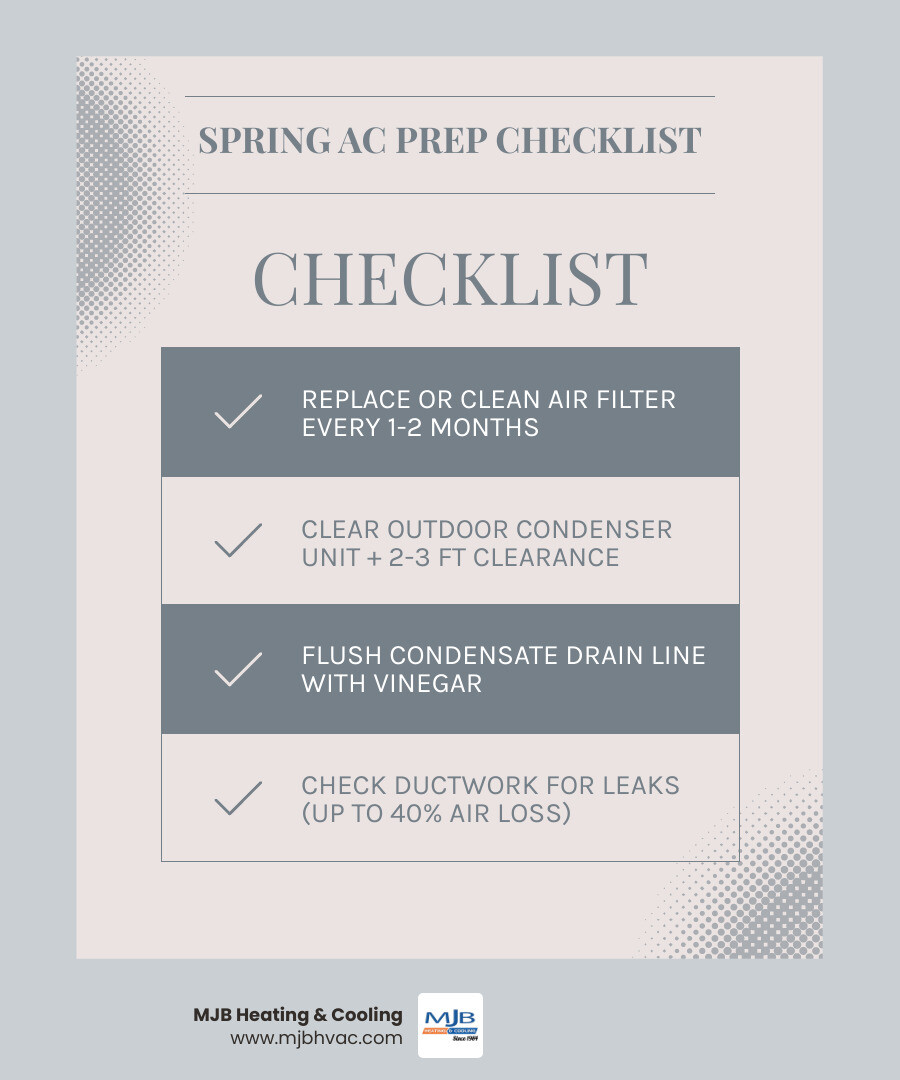
1. Replace or clean your air filter — every 1-2 months, especially before peak season
2. Clear the outdoor condenser unit — remove debris and maintain at least 2-3 feet of clearance around it
3. Flush the condensate drain line — use vinegar to prevent mold and clogs
4. Check ductwork for leaks — households can lose up to 40% of cooled air through leaky ducts
5. Set your thermostat correctly — the U.S. Department of Energy recommends 78°F when you're away to save up to 10% on energy costs
6. Control indoor humidity — aim for 40-60% to stay comfortable and prevent mold
7. Schedule a professional tune-up — before the hottest weeks hit, ideally in early spring
Kansas summers are no joke. In Wichita and across Central Kansas, July and August regularly push temperatures into the 90s — and with heat indexes climbing well above 100°F, your air conditioner isn't just a comfort appliance. It's a necessity.
The problem is, most homeowners don't think about their AC until it stops working on the hottest day of the year. By then, you're sweating through a repair wait, paying emergency service rates, and wondering why you didn't catch the problem sooner.
A little preparation in spring changes all of that. Getting your system checked, cleaned, and dialed in before summer arrives means fewer breakdowns, lower energy bills, and the kind of reliable cooling that gets you through even the worst Kansas heat waves.
This guide walks you through exactly what to do — from simple DIY steps you can handle yourself, to the professional service that makes sure nothing gets missed.

Living in the Wichita metro area, we all know that the transition from a mild April to a blistering June happens in the blink of an eye. By the time we hit those triple-digit temperatures in July and August, your air conditioner is working harder than almost any other appliance in your home.
If you haven't performed any spring ac preparation for kansas summer, you are essentially asking an unconditioned athlete to run a marathon in a sauna. Without a proper "warm-up" (or in this case, a cool-down check), components fail. Statistics show that Kansas City and Wichita summers are seeing triple-digit heat indexes more frequently, putting immense strain on older units.
When your system is neglected, two things happen: your reliability plummets and your energy bills skyrocket. A system choked with last year's dust and cottonwood seeds has to run longer cycles to reach your desired temperature. By following Essential HVAC Maintenance Tips, you ensure the system is physically capable of handling the load.
• Monthly Energy Bill — Prepared AC System: Optimized and predictable — Neglected AC System: 15-25% higher due to inefficiency
• Cooling Speed — Prepared AC System: Reaches set temp quickly — Neglected AC System: Struggles to keep up during peak heat
• Breakdown Risk — Prepared AC System: Low (checked for worn parts) — Neglected AC System: High (likely to fail during heatwaves)
• Lifespan — Prepared AC System: 15+ years — Neglected AC System: 10 years or less
• Air Quality — Prepared AC System: Fresh, filtered air — Neglected AC System: Dusty, potentially moldy air
While some tasks require a licensed professional, there are several high-impact steps you can take right now to get your home ready. We always recommend starting with the outdoor unit.
Your outdoor condenser is responsible for releasing the heat collected from inside your home. If it’s buried under overgrown bushes or clogged with dead leaves, that heat has nowhere to go.
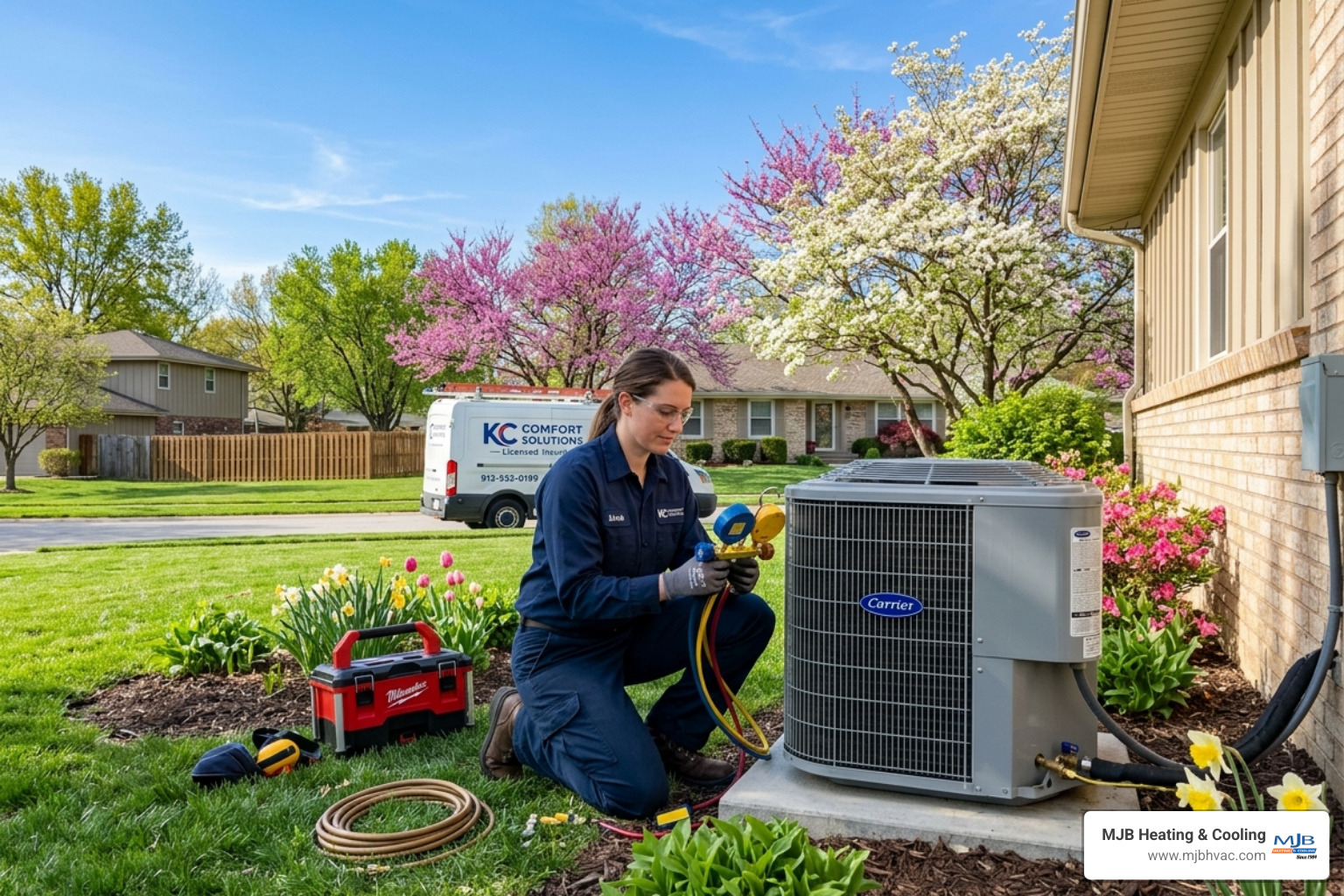
• Clear the Zone: Ensure there is at least 2 to 3 feet of open space around the unit on all sides.
• Remove Debris: Carefully pick out leaves, twigs, and grass clippings from the base.
• Straighten Fins: If the thin metal "fins" on the side of the unit are bent, use a fin comb to straighten them. This restores the airflow necessary for heat exchange.
Inside the home, the air filter is your first line of defense. Knowing How Often to Change HVAC Air Filters is vital; the U.S. Department of Energy suggests every two months, but during a dusty Kansas spring, once a month is even better.
Don't forget the condensate drain line. This is the PVC pipe that carries moisture away from your unit. Over the winter, algae and mold can grow inside. A simple vinegar flush can prevent a backup that might otherwise cause water damage to your floors or walls.
Your thermostat is the "brain" of your HVAC system. To save money without sacrificing comfort, the U.S. Department of Energy recommends setting your thermostat to 78°F when you are away from home. This simple adjustment can save you up to 10% on your annual cooling costs.
If you are still using an old manual slider, consider an upgrade. Smart thermostats can learn your schedule and automatically adjust the temperature when you head to work or go to bed. This prevents the system from overworking when no one is around to enjoy the cool air.
Did you know the average household loses up to 40% of its circulating air through leaky ducts? That is literally like throwing money out the window. In places like Andover and Derby, older homes often have ductwork that has shifted or unsealed over time.
You should Clear Blocked Air Ducts in Andover homes by ensuring no furniture or rugs are covering your supply vents. If you notice rooms that stay stubbornly warm, it’s a classic sign of HVAC Air Flow Problems. Inspecting the insulation on your refrigerant lines (the foam sleeve on the outdoor pipes) is also a quick DIY win; if it’s rotted away, your system loses cooling power before the air even gets inside.
In Kansas, it’s not just the heat—it’s the humidity. High moisture levels make 90 degrees feel like 105. Your AC naturally acts as a dehumidifier, but it needs help when the "sticky" weather hits.
• Ideal Humidity: Aim for 40-60%. This range is the "sweet spot" where sweat evaporates efficiently from your skin, making you feel cooler at higher temperatures.
• Ceiling Fans: Ensure your fans are rotating counterclockwise. This creates a downdraft or "wind chill" effect that can make a room feel 3 to 4 degrees cooler.
• Windows and Drapes: Close your blinds or heavy drapes during the day, especially on south-facing windows. This blocks solar heat gain, which is one of the biggest contributors to rising indoor temperatures.
If you notice excessive moisture indoors, be careful. This could be a sign of a larger issue. Knowing Why Your AC is Leaking Water Inside can help you distinguish between normal condensation and a dangerous clog.
Sometimes, spring ac preparation for kansas summer reveals problems that a homeowner can't fix with a vacuum or a new filter. If you encounter any of the following, it’s time to call in the pros before the first heatwave hits.
1. Strange Noises: Squealing, grinding, or rattling sounds often mean a belt is slipping or a motor bearing is failing. Check our guide on HVAC System Making Strange Noises for more details.
2. Unusual Odors: A "dirty gym sock" smell usually points to mold on the evaporator coils, while a burning smell indicates an electrical malfunction. Learn more about Unusual AC Smells: Causes and Solutions.
3. The "Ice" Factor: If you see ice forming on your outdoor refrigerant line or the indoor coil, your system is likely low on refrigerant or has severely restricted airflow. You must Address a Frozen AC Unit immediately to avoid destroying the compressor.
4. Tripped Breakers: If your AC keeps shutting off at the electrical panel, there is a high-voltage draw issue. Discover Why Your AC Circuit Breaker Keeps Tripping before you try to flip it back on.
A professional 20-point tune-up is the gold standard for summer readiness. While DIY steps are great, a technician has the tools to check refrigerant pressures, tighten electrical connections, and lubricate moving parts that are tucked deep inside the cabinet.
Enrolling in HVAC Maintenance Plans is the smartest move for busy homeowners. It ensures your system is serviced every spring and fall without you having to remember to call. Plus, if your AC Fails During a Heatwave, maintenance members often get priority service.
The ideal indoor humidity level is between 40% and 60%. In the Wichita metro area, where summer humidity can be oppressive, keeping your home in this range allows your body's natural cooling mechanism (sweat) to evaporate properly. It also prevents the growth of mold and mildew, which thrive in "sticky" air.
We recommend checking your filter every 30 days and replacing it at least every 2 months. However, if you live in a high-pollen area or near a gravel road where dust is common, you may need to change it monthly during peak summer. A clogged filter is the #1 cause of system strain and premature failure.
Yes, but only if you are in the room! Ceiling fans don't actually lower the temperature of the air; they create a wind chill effect on your skin. This allows you to raise your thermostat by about 4 degrees without feeling any warmer. Just remember to turn them off when you leave the room, and make sure they are set to rotate counterclockwise for the summer.
Preparing for a Kansas summer is all about being proactive. By handling the simple DIY tasks like clearing your condenser and changing your filters, you're already ahead of the curve. But for the peace of mind that comes with knowing your system can withstand a week of 100-degree days, a professional eye is irreplaceable.
At MJB Heating & Cooling, we’ve been keeping families in Wichita, Derby, Andover, and the surrounding areas comfortable since 1984. As a family-owned business, we pride ourselves on quality workmanship and an honest approach. Whether you need a quick tune-up or a complex repair, our team is ready to ensure your home stays a sanctuary all summer long.
Ready to get your system in top shape? Explore Our HVAC Services and let us help you beat the heat!
Spring ac preparation for kansas summer is the single most important thing you can do to keep your home cool, your energy bills manageable, and your family comfortable when the heat arrives. Here's a quick overview of what it involves:
Spring AC Preparation Checklist for Kansas Summer:
Kansas summers are no joke. In Wichita and across Central Kansas, July and August regularly push temperatures into the 90s — and with heat indexes climbing well above 100°F, your air conditioner isn't just a comfort appliance. It's a necessity.
The problem is, most homeowners don't think about their AC until it stops working on the hottest day of the year. By then, you're sweating through a repair wait, paying emergency service rates, and wondering why you didn't catch the problem sooner.
A little preparation in spring changes all of that. Getting your system checked, cleaned, and dialed in before summer arrives means fewer breakdowns, lower energy bills, and the kind of reliable cooling that gets you through even the worst Kansas heat waves.
This guide walks you through exactly what to do — from simple DIY steps you can handle yourself, to the professional service that makes sure nothing gets missed.
Living in the Wichita metro area, we all know that the transition from a mild April to a blistering June happens in the blink of an eye. By the time we hit those triple-digit temperatures in July and August, your air conditioner is working harder than almost any other appliance in your home.
If you haven't performed any spring ac preparation for kansas summer, you are essentially asking an unconditioned athlete to run a marathon in a sauna. Without a proper "warm-up" (or in this case, a cool-down check), components fail. Statistics show that Kansas City and Wichita summers are seeing triple-digit heat indexes more frequently, putting immense strain on older units.
When your system is neglected, two things happen: your reliability plummets and your energy bills skyrocket. A system choked with last year's dust and cottonwood seeds has to run longer cycles to reach your desired temperature. By following Essential HVAC Maintenance Tips, you ensure the system is physically capable of handling the load.
| Feature | Prepared AC System | Neglected AC System |
|---|---|---|
| Monthly Energy Bill | Optimized and predictable | 15-25% higher due to inefficiency |
| Cooling Speed | Reaches set temp quickly | Struggles to keep up during peak heat |
| Breakdown Risk | Low (checked for worn parts) | High (likely to fail during heatwaves) |
| Lifespan | 15+ years | 10 years or less |
| Air Quality | Fresh, filtered air | Dusty, potentially moldy air |
While some tasks require a licensed professional, there are several high-impact steps you can take right now to get your home ready. We always recommend starting with the outdoor unit.
Your outdoor condenser is responsible for releasing the heat collected from inside your home. If it’s buried under overgrown bushes or clogged with dead leaves, that heat has nowhere to go.
Inside the home, the air filter is your first line of defense. Knowing How Often to Change HVAC Air Filters is vital; the U.S. Department of Energy suggests every two months, but during a dusty Kansas spring, once a month is even better.
Don't forget the condensate drain line. This is the PVC pipe that carries moisture away from your unit. Over the winter, algae and mold can grow inside. A simple vinegar flush can prevent a backup that might otherwise cause water damage to your floors or walls.
Your thermostat is the "brain" of your HVAC system. To save money without sacrificing comfort, the U.S. Department of Energy recommends setting your thermostat to 78°F when you are away from home. This simple adjustment can save you up to 10% on your annual cooling costs.
If you are still using an old manual slider, consider an upgrade. Smart thermostats can learn your schedule and automatically adjust the temperature when you head to work or go to bed. This prevents the system from overworking when no one is around to enjoy the cool air.
Did you know the average household loses up to 40% of its circulating air through leaky ducts? That is literally like throwing money out the window. In places like Andover and Derby, older homes often have ductwork that has shifted or unsealed over time.
You should Clear Blocked Air Ducts in Andover homes by ensuring no furniture or rugs are covering your supply vents. If you notice rooms that stay stubbornly warm, it’s a classic sign of HVAC Air Flow Problems. Inspecting the insulation on your refrigerant lines (the foam sleeve on the outdoor pipes) is also a quick DIY win; if it’s rotted away, your system loses cooling power before the air even gets inside.
In Kansas, it’s not just the heat—it’s the humidity. High moisture levels make 90 degrees feel like 105. Your AC naturally acts as a dehumidifier, but it needs help when the "sticky" weather hits.
If you notice excessive moisture indoors, be careful. This could be a sign of a larger issue. Knowing Why Your AC is Leaking Water Inside can help you distinguish between normal condensation and a dangerous clog.
Sometimes, spring ac preparation for kansas summer reveals problems that a homeowner can't fix with a vacuum or a new filter. If you encounter any of the following, it’s time to call in the pros before the first heatwave hits.
A professional 20-point tune-up is the gold standard for summer readiness. While DIY steps are great, a technician has the tools to check refrigerant pressures, tighten electrical connections, and lubricate moving parts that are tucked deep inside the cabinet.
Enrolling in HVAC Maintenance Plans is the smartest move for busy homeowners. It ensures your system is serviced every spring and fall without you having to remember to call. Plus, if your AC Fails During a Heatwave, maintenance members often get priority service.
The ideal indoor humidity level is between 40% and 60%. In the Wichita metro area, where summer humidity can be oppressive, keeping your home in this range allows your body's natural cooling mechanism (sweat) to evaporate properly. It also prevents the growth of mold and mildew, which thrive in "sticky" air.
We recommend checking your filter every 30 days and replacing it at least every 2 months. However, if you live in a high-pollen area or near a gravel road where dust is common, you may need to change it monthly during peak summer. A clogged filter is the #1 cause of system strain and premature failure.
Yes, but only if you are in the room! Ceiling fans don't actually lower the temperature of the air; they create a wind chill effect on your skin. This allows you to raise your thermostat by about 4 degrees without feeling any warmer. Just remember to turn them off when you leave the room, and make sure they are set to rotate counterclockwise for the summer.
Preparing for a Kansas summer is all about being proactive. By handling the simple DIY tasks like clearing your condenser and changing your filters, you're already ahead of the curve. But for the peace of mind that comes with knowing your system can withstand a week of 100-degree days, a professional eye is irreplaceable.
At MJB Heating & Cooling, we’ve been keeping families in Wichita, Derby, Andover, and the surrounding areas comfortable since 1984. As a family-owned business, we pride ourselves on quality workmanship and an honest approach. Whether you need a quick tune-up or a complex repair, our team is ready to ensure your home stays a sanctuary all summer long.
Ready to get your system in top shape? Explore Our HVAC Services and let us help you beat the heat!


Our A/C stopped working on a Sunday and due to health issues, we needed to find a service company available on a Sunday. I called MJB and left a message on their emergency voice mail. Within 10 minutes Tom Buck called me to hear my description of the symptoms. He was just finishing an appointment in Wichita and would be on his way to my home on the south end of Derby. He arrived within 30 minutes! From start to finish he was the perfect example of what you could ever hope for in an HVAC tech and a human being. His evaluation of our system inside and out was as thorough as I could ever imagine and once he was done with the repair, our system is running as well or better than ever. Well worth the price for the evaluation, parts, and labor. Thank you again Tom for an awesome experience.
Our AC went out during the hottest days of the year, and they were out next day! We have been jerked around by a shoddy home warranty for years. We finally had a chance to pick our own repair people, and MJB came highly recommended. I can see why! I was impressed with the honesty and speed at which they fixed our AC unit!
Our commercial building had a lightening/electrical strike and damaged our 20 ton AC unit. No one could find us a new unit before the end of September. Imagining going all of August and September with no AC in Kansas and working inside near 100 degree temps is less than thrilling. Dale and the team at MJB called around and saved the day. They had us a new unit 5 weeks earlier than other could promise and I now have happy employees. The unit is amazingly quiet, super cold and so much more energy efficient. Thank you for being our super hero!
Came out and installed my new furnace. Was very polite and affordable. They are very acknowledgeable and I highly recommend!
Thank you very much. We had our 1st warm night in 3weeks. MJB took the time and effort to find the real problem. And the employees were kind and thoughtful and explained things very well. I cannot thank you and all of MJB. Will recommend you highly. Thanks again Marjorie Herman Oxford Kansas
We had a new system installed and I was so impressed with how quick they were in come out and install it, in the middle of a hot summer day. They were so friendly & very professional. I had a small problem with a weird sound and they came over immediately and fixed it. Love them!