.avif)





Blogs
Stay updated with our latest blog posts.
How proper maintenance prevents mold growth comes down to one thing: controlling moisture before mold ever gets a foothold. Mold spores are always in the air around us — indoors and out. They only become a problem when they land on a wet surface. Take away the moisture, and mold cannot grow. It really is that simple.
Here is a quick summary of how maintenance stops mold:
Central Kansas homeowners face a real challenge here. Wichita's humid summers push indoor humidity levels up fast, and that creates exactly the warm, damp conditions mold loves. Without consistent, proactive maintenance — especially of your HVAC system — moisture builds up quietly inside walls, ducts, and crawl spaces where you may not notice it for months.
The good news is that mold prevention is not complicated. It is mostly about staying consistent with routine home maintenance and keeping your heating and cooling system running clean and efficiently. When your HVAC system is well-maintained, it does a significant amount of the heavy lifting in keeping indoor air dry and safe.
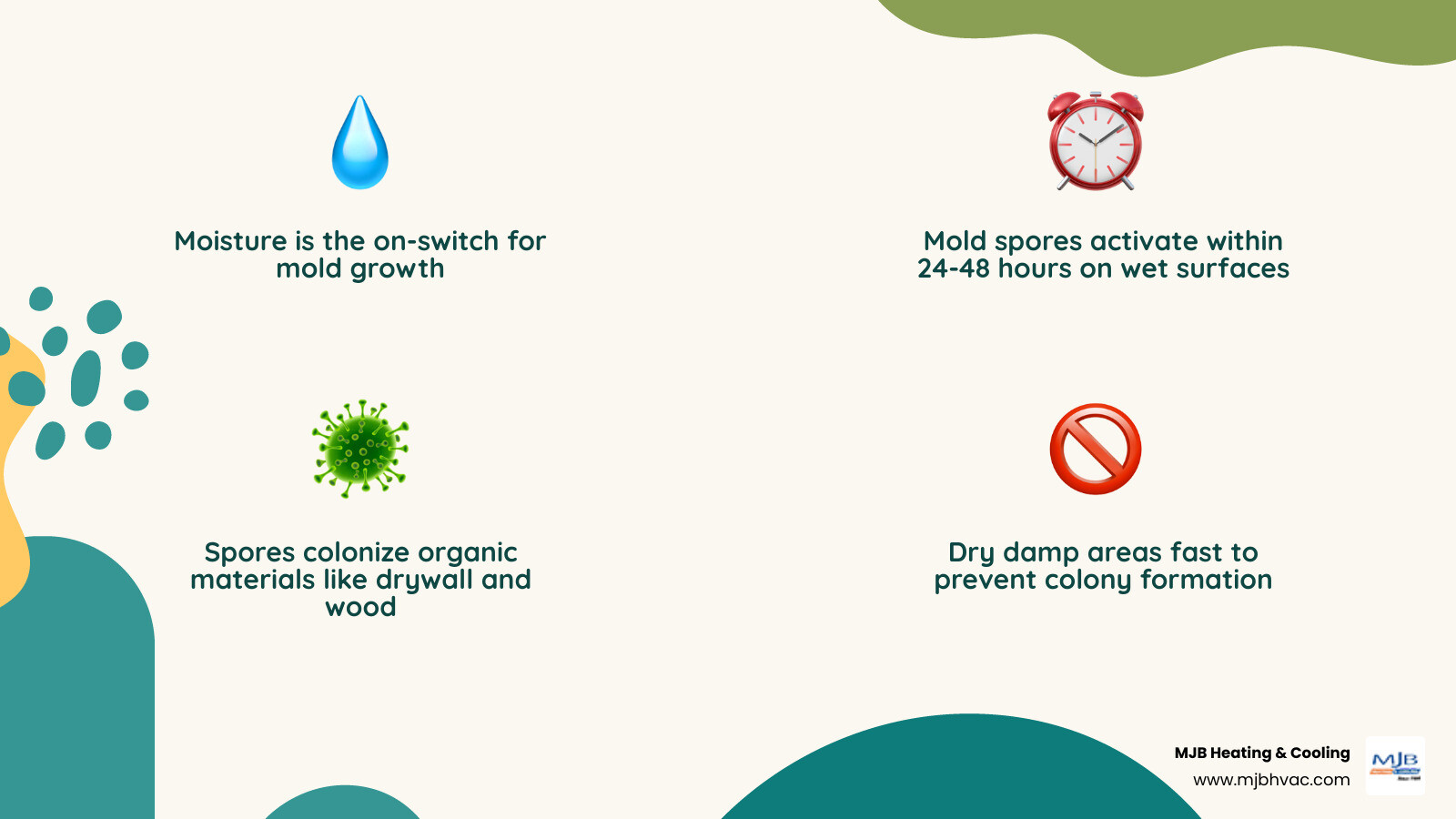
If mold were a machine, moisture would be its "on-switch." Mold spores are naturally occurring and virtually impossible to eliminate entirely from any indoor environment. However, these spores remain dormant until they find organic material (like drywall, wood, or dust) and a source of water.
The most critical window for prevention is the first 24 to 48 hours. Statistics show that if wet or damp materials are dried within this timeframe after a leak or spill, mold will typically not grow. Once you cross that 48-hour threshold, the spores begin to colonize, and the situation becomes much more difficult—and expensive—to manage.
In places like Andover and Haysville, managing relative humidity is a daily task. We recommend keeping your indoor relative humidity below 60%, with an ideal range between 30% and 50%. When levels climb above 60%, you are essentially inviting mold to move in. One simple way to support this is by staying on top of your air filters. You might wonder, how often should HVAC air filters be changed? In our experience, checking them monthly and replacing them at least every 90 days ensures your system can breathe properly and manage humidity effectively.
| Humidity Level | Risk Category | Impact on Mold Growth |
|---|---|---|
| Below 30% | Too Dry | Can cause respiratory irritation and dry skin. |
| 30% - 50% | Ideal Range | Prevents mold growth while maintaining comfort. |
| 50% - 60% | Moderate Risk | Mold can begin to grow in poorly ventilated corners. |
| Above 60% | High Risk | Ideal breeding conditions for mold and dust mites. |
Your HVAC system is the lungs of your home. If it is neglected, it can unfortunately become a primary source of mold distribution. Because air conditioners work by removing moisture from the air, they naturally deal with a lot of water.
The condensate drain pan is a common trouble spot. If the pan is tilted incorrectly or the drain line becomes clogged with "sludge" (a mix of dust and bacteria), water will pool. This standing water is a perfect nursery for mold. Furthermore, the evaporator coils stay damp during the cooling season; if they are covered in dust, mold can grow directly on the coils and send spores through your ductwork every time the fan kicks on.
If you ever notice water pooling around your indoor unit, you need to act fast. There are several reasons why AC leaking water inside your home happens, ranging from cracked pans to blocked lines. This is especially true for modern systems like ductless units. Homeowners often need to fix AC mini-split drainage problems Haysville to prevent wall damage and hidden mold growth behind the air handler.
While your standard AC unit does dehumidify, sometimes the Kansas humidity is just too much for a cooling system alone. This is where whole-house dehumidification and air purification come into play. By integrating these systems into your existing HVAC setup, you can maintain that "sweet spot" of 30-50% humidity even during a July heatwave in Augusta or El Dorado.
Monitoring is key. We suggest homeowners use a hygrometer—a simple, inexpensive device that measures humidity—to keep tabs on different levels of the home, especially basements. If you find your home is consistently damp, it might be time to look into whole-house air purification Andover KS or whole-house air purification Haysville KS. These systems don't just kill spores; they help manage the overall environment to make it inhospitable for fungus.
Some areas of your home are naturally more "mold-friendly" than others. Bathrooms, kitchens, and laundry rooms are high-moisture zones. Proper maintenance in these areas includes:
How proper maintenance prevents mold growth isn't just an indoor job; it starts with the exterior of your home. If water is pooling against your foundation, it will eventually find its way into your crawl space or basement.
In the Spring, your priority should be gutters and downspouts. Clogged gutters cause water to overflow and soak the siding and foundation. Ensure your downspouts direct water at least 5 to 10 feet away from the house.
In the Fall, focus on weatherization. Sealing air leaks around windows and doors prevents warm, moist air from meeting cold surfaces, which causes condensation. Following essential HVAC maintenance tips for your furnace and AC during the shoulder seasons ensures your system is ready to manage the air quality challenges of the coming months.
Winter brings its own risks, primarily condensation on windows. If you see "sweating" windows, your indoor humidity is too high. This moisture can drip down and rot windowsills, leading to mold.
Proper foundation grading is your first line of defense. The ground should slope away from your home at a rate of about 6 inches over the first 10 feet (a 5% slope). This prevents water from "ponding" near the foundation. If you have mulch or flower beds against the house, ensure they aren't trapping water against the siding.
We often get asked: "Can I just clean this myself?" The answer depends on the size of the problem.
The "10 Square Foot Rule" is a good guideline used by the EPA. If the mold covers an area smaller than roughly 3 feet by 3 feet, most homeowners can handle it. For small-scale cleanup, always wear protective gear: an N-95 respirator, long gloves, and goggles. Use a mixture of detergent and water for hard surfaces, or natural solutions like vinegar or hydrogen peroxide.
However, if the mold covers more than 10 square feet, or if it is inside your HVAC system, you should call a professional. Professional remediation is necessary for large areas because improper cleaning can actually send millions of spores airborne, worsening the problem. Furthermore, porous materials like carpets, padding, and drywall usually cannot be "cleaned" if mold has deeply penetrated them—they must be discarded and replaced.
To maintain a healthy environment after a cleanup, consider air purification to remove indoor pollutants. Advanced filtration is excellent for catching those lingering spores that the naked eye can't see. In fact, many Wichita families find that air purification eliminates summer allergens and mold spores simultaneously, providing much-needed relief during our high-pollen and high-humidity months.
To prevent mold growth in the Wichita metro area, you should keep your indoor relative humidity between 30% and 50%. During the peak of summer, try to keep it strictly below 50%. In the winter, you may need to drop it closer to 30-35% to prevent condensation on cold windows.
Mold is incredibly fast. It can begin to germinate and grow within 24 to 48 hours of exposure to moisture. This is why "drying it out tomorrow" is often too late. Use fans, dehumidifiers, and towels to dry any spill or leak immediately.
If the material is porous (meaning it has tiny holes that can trap spores), it is very difficult to clean. Drywall that has become soft or visibly moldy should always be replaced. Carpet and padding that have been soaked for more than 48 hours should generally be discarded, as mold can grow deep within the fibers and the underside where cleaners can't reach.
At MJB Heating & Cooling, we’ve seen how a little bit of prevention goes a long way. Since 1984, our family-owned business has been helping neighbors in Wichita, Derby, Mulvane, and across Central Kansas stay comfortable and safe. We believe in an honest approach—which means telling you that the best way to deal with mold is to never let it start.
How proper maintenance prevents mold growth is a year-round commitment. From cleaning your gutters in the spring to scheduling your annual HVAC tune-up, every small step protects your home's structural integrity and your family's health. Don't let hidden moisture turn into a costly remediation project.
Whether you are in Maize, Goddard, or Newton, our team is ready to help you optimize your indoor air quality. Schedule your professional HVAC maintenance and air quality inspection today and breathe easy knowing your home is protected against mold.
How proper maintenance prevents mold growth comes down to one thing: controlling moisture before mold ever gets a foothold. Mold spores are always in the air around us — indoors and out. They only become a problem when they land on a wet surface. Take away the moisture, and mold cannot grow. It really is that simple.
Here is a quick summary of how maintenance stops mold:
Central Kansas homeowners face a real challenge here. Wichita's humid summers push indoor humidity levels up fast, and that creates exactly the warm, damp conditions mold loves. Without consistent, proactive maintenance — especially of your HVAC system — moisture builds up quietly inside walls, ducts, and crawl spaces where you may not notice it for months.
The good news is that mold prevention is not complicated. It is mostly about staying consistent with routine home maintenance and keeping your heating and cooling system running clean and efficiently. When your HVAC system is well-maintained, it does a significant amount of the heavy lifting in keeping indoor air dry and safe.
If mold were a machine, moisture would be its "on-switch." Mold spores are naturally occurring and virtually impossible to eliminate entirely from any indoor environment. However, these spores remain dormant until they find organic material (like drywall, wood, or dust) and a source of water.
The most critical window for prevention is the first 24 to 48 hours. Statistics show that if wet or damp materials are dried within this timeframe after a leak or spill, mold will typically not grow. Once you cross that 48-hour threshold, the spores begin to colonize, and the situation becomes much more difficult—and expensive—to manage.
In places like Andover and Haysville, managing relative humidity is a daily task. We recommend keeping your indoor relative humidity below 60%, with an ideal range between 30% and 50%. When levels climb above 60%, you are essentially inviting mold to move in. One simple way to support this is by staying on top of your air filters. You might wonder, how often should HVAC air filters be changed? In our experience, checking them monthly and replacing them at least every 90 days ensures your system can breathe properly and manage humidity effectively.
| Humidity Level | Risk Category | Impact on Mold Growth |
|---|---|---|
| Below 30% | Too Dry | Can cause respiratory irritation and dry skin. |
| 30% - 50% | Ideal Range | Prevents mold growth while maintaining comfort. |
| 50% - 60% | Moderate Risk | Mold can begin to grow in poorly ventilated corners. |
| Above 60% | High Risk | Ideal breeding conditions for mold and dust mites. |
Your HVAC system is the lungs of your home. If it is neglected, it can unfortunately become a primary source of mold distribution. Because air conditioners work by removing moisture from the air, they naturally deal with a lot of water.
The condensate drain pan is a common trouble spot. If the pan is tilted incorrectly or the drain line becomes clogged with "sludge" (a mix of dust and bacteria), water will pool. This standing water is a perfect nursery for mold. Furthermore, the evaporator coils stay damp during the cooling season; if they are covered in dust, mold can grow directly on the coils and send spores through your ductwork every time the fan kicks on.
If you ever notice water pooling around your indoor unit, you need to act fast. There are several reasons why AC leaking water inside your home happens, ranging from cracked pans to blocked lines. This is especially true for modern systems like ductless units. Homeowners often need to fix AC mini-split drainage problems Haysville to prevent wall damage and hidden mold growth behind the air handler.
While your standard AC unit does dehumidify, sometimes the Kansas humidity is just too much for a cooling system alone. This is where whole-house dehumidification and air purification come into play. By integrating these systems into your existing HVAC setup, you can maintain that "sweet spot" of 30-50% humidity even during a July heatwave in Augusta or El Dorado.
Monitoring is key. We suggest homeowners use a hygrometer—a simple, inexpensive device that measures humidity—to keep tabs on different levels of the home, especially basements. If you find your home is consistently damp, it might be time to look into whole-house air purification Andover KS or whole-house air purification Haysville KS. These systems don't just kill spores; they help manage the overall environment to make it inhospitable for fungus.
Some areas of your home are naturally more "mold-friendly" than others. Bathrooms, kitchens, and laundry rooms are high-moisture zones. Proper maintenance in these areas includes:
How proper maintenance prevents mold growth isn't just an indoor job; it starts with the exterior of your home. If water is pooling against your foundation, it will eventually find its way into your crawl space or basement.
In the Spring, your priority should be gutters and downspouts. Clogged gutters cause water to overflow and soak the siding and foundation. Ensure your downspouts direct water at least 5 to 10 feet away from the house.
In the Fall, focus on weatherization. Sealing air leaks around windows and doors prevents warm, moist air from meeting cold surfaces, which causes condensation. Following essential HVAC maintenance tips for your furnace and AC during the shoulder seasons ensures your system is ready to manage the air quality challenges of the coming months.
Winter brings its own risks, primarily condensation on windows. If you see "sweating" windows, your indoor humidity is too high. This moisture can drip down and rot windowsills, leading to mold.
Proper foundation grading is your first line of defense. The ground should slope away from your home at a rate of about 6 inches over the first 10 feet (a 5% slope). This prevents water from "ponding" near the foundation. If you have mulch or flower beds against the house, ensure they aren't trapping water against the siding.
We often get asked: "Can I just clean this myself?" The answer depends on the size of the problem.
The "10 Square Foot Rule" is a good guideline used by the EPA. If the mold covers an area smaller than roughly 3 feet by 3 feet, most homeowners can handle it. For small-scale cleanup, always wear protective gear: an N-95 respirator, long gloves, and goggles. Use a mixture of detergent and water for hard surfaces, or natural solutions like vinegar or hydrogen peroxide.
However, if the mold covers more than 10 square feet, or if it is inside your HVAC system, you should call a professional. Professional remediation is necessary for large areas because improper cleaning can actually send millions of spores airborne, worsening the problem. Furthermore, porous materials like carpets, padding, and drywall usually cannot be "cleaned" if mold has deeply penetrated them—they must be discarded and replaced.
To maintain a healthy environment after a cleanup, consider air purification to remove indoor pollutants. Advanced filtration is excellent for catching those lingering spores that the naked eye can't see. In fact, many Wichita families find that air purification eliminates summer allergens and mold spores simultaneously, providing much-needed relief during our high-pollen and high-humidity months.
To prevent mold growth in the Wichita metro area, you should keep your indoor relative humidity between 30% and 50%. During the peak of summer, try to keep it strictly below 50%. In the winter, you may need to drop it closer to 30-35% to prevent condensation on cold windows.
Mold is incredibly fast. It can begin to germinate and grow within 24 to 48 hours of exposure to moisture. This is why "drying it out tomorrow" is often too late. Use fans, dehumidifiers, and towels to dry any spill or leak immediately.
If the material is porous (meaning it has tiny holes that can trap spores), it is very difficult to clean. Drywall that has become soft or visibly moldy should always be replaced. Carpet and padding that have been soaked for more than 48 hours should generally be discarded, as mold can grow deep within the fibers and the underside where cleaners can't reach.
At MJB Heating & Cooling, we’ve seen how a little bit of prevention goes a long way. Since 1984, our family-owned business has been helping neighbors in Wichita, Derby, Mulvane, and across Central Kansas stay comfortable and safe. We believe in an honest approach—which means telling you that the best way to deal with mold is to never let it start.
How proper maintenance prevents mold growth is a year-round commitment. From cleaning your gutters in the spring to scheduling your annual HVAC tune-up, every small step protects your home's structural integrity and your family's health. Don't let hidden moisture turn into a costly remediation project.
Whether you are in Maize, Goddard, or Newton, our team is ready to help you optimize your indoor air quality. Schedule your professional HVAC maintenance and air quality inspection today and breathe easy knowing your home is protected against mold.
How proper maintenance prevents mold growth comes down to one thing: controlling moisture before mold ever gets a foothold. Mold spores are always in the air around us — indoors and out. They only become a problem when they land on a wet surface. Take away the moisture, and mold cannot grow. It really is that simple.
Here is a quick summary of how maintenance stops mold:
Central Kansas homeowners face a real challenge here. Wichita's humid summers push indoor humidity levels up fast, and that creates exactly the warm, damp conditions mold loves. Without consistent, proactive maintenance — especially of your HVAC system — moisture builds up quietly inside walls, ducts, and crawl spaces where you may not notice it for months.
The good news is that mold prevention is not complicated. It is mostly about staying consistent with routine home maintenance and keeping your heating and cooling system running clean and efficiently. When your HVAC system is well-maintained, it does a significant amount of the heavy lifting in keeping indoor air dry and safe.
If mold were a machine, moisture would be its "on-switch." Mold spores are naturally occurring and virtually impossible to eliminate entirely from any indoor environment. However, these spores remain dormant until they find organic material (like drywall, wood, or dust) and a source of water.
The most critical window for prevention is the first 24 to 48 hours. Statistics show that if wet or damp materials are dried within this timeframe after a leak or spill, mold will typically not grow. Once you cross that 48-hour threshold, the spores begin to colonize, and the situation becomes much more difficult—and expensive—to manage.
In places like Andover and Haysville, managing relative humidity is a daily task. We recommend keeping your indoor relative humidity below 60%, with an ideal range between 30% and 50%. When levels climb above 60%, you are essentially inviting mold to move in. One simple way to support this is by staying on top of your air filters. You might wonder, how often should HVAC air filters be changed? In our experience, checking them monthly and replacing them at least every 90 days ensures your system can breathe properly and manage humidity effectively.
| Humidity Level | Risk Category | Impact on Mold Growth |
|---|---|---|
| Below 30% | Too Dry | Can cause respiratory irritation and dry skin. |
| 30% - 50% | Ideal Range | Prevents mold growth while maintaining comfort. |
| 50% - 60% | Moderate Risk | Mold can begin to grow in poorly ventilated corners. |
| Above 60% | High Risk | Ideal breeding conditions for mold and dust mites. |
Your HVAC system is the lungs of your home. If it is neglected, it can unfortunately become a primary source of mold distribution. Because air conditioners work by removing moisture from the air, they naturally deal with a lot of water.
The condensate drain pan is a common trouble spot. If the pan is tilted incorrectly or the drain line becomes clogged with "sludge" (a mix of dust and bacteria), water will pool. This standing water is a perfect nursery for mold. Furthermore, the evaporator coils stay damp during the cooling season; if they are covered in dust, mold can grow directly on the coils and send spores through your ductwork every time the fan kicks on.
If you ever notice water pooling around your indoor unit, you need to act fast. There are several reasons why AC leaking water inside your home happens, ranging from cracked pans to blocked lines. This is especially true for modern systems like ductless units. Homeowners often need to fix AC mini-split drainage problems Haysville to prevent wall damage and hidden mold growth behind the air handler.
While your standard AC unit does dehumidify, sometimes the Kansas humidity is just too much for a cooling system alone. This is where whole-house dehumidification and air purification come into play. By integrating these systems into your existing HVAC setup, you can maintain that "sweet spot" of 30-50% humidity even during a July heatwave in Augusta or El Dorado.
Monitoring is key. We suggest homeowners use a hygrometer—a simple, inexpensive device that measures humidity—to keep tabs on different levels of the home, especially basements. If you find your home is consistently damp, it might be time to look into whole-house air purification Andover KS or whole-house air purification Haysville KS. These systems don't just kill spores; they help manage the overall environment to make it inhospitable for fungus.
Some areas of your home are naturally more "mold-friendly" than others. Bathrooms, kitchens, and laundry rooms are high-moisture zones. Proper maintenance in these areas includes:
How proper maintenance prevents mold growth isn't just an indoor job; it starts with the exterior of your home. If water is pooling against your foundation, it will eventually find its way into your crawl space or basement.
In the Spring, your priority should be gutters and downspouts. Clogged gutters cause water to overflow and soak the siding and foundation. Ensure your downspouts direct water at least 5 to 10 feet away from the house.
In the Fall, focus on weatherization. Sealing air leaks around windows and doors prevents warm, moist air from meeting cold surfaces, which causes condensation. Following essential HVAC maintenance tips for your furnace and AC during the shoulder seasons ensures your system is ready to manage the air quality challenges of the coming months.
Winter brings its own risks, primarily condensation on windows. If you see "sweating" windows, your indoor humidity is too high. This moisture can drip down and rot windowsills, leading to mold.
Proper foundation grading is your first line of defense. The ground should slope away from your home at a rate of about 6 inches over the first 10 feet (a 5% slope). This prevents water from "ponding" near the foundation. If you have mulch or flower beds against the house, ensure they aren't trapping water against the siding.
We often get asked: "Can I just clean this myself?" The answer depends on the size of the problem.
The "10 Square Foot Rule" is a good guideline used by the EPA. If the mold covers an area smaller than roughly 3 feet by 3 feet, most homeowners can handle it. For small-scale cleanup, always wear protective gear: an N-95 respirator, long gloves, and goggles. Use a mixture of detergent and water for hard surfaces, or natural solutions like vinegar or hydrogen peroxide.
However, if the mold covers more than 10 square feet, or if it is inside your HVAC system, you should call a professional. Professional remediation is necessary for large areas because improper cleaning can actually send millions of spores airborne, worsening the problem. Furthermore, porous materials like carpets, padding, and drywall usually cannot be "cleaned" if mold has deeply penetrated them—they must be discarded and replaced.
To maintain a healthy environment after a cleanup, consider air purification to remove indoor pollutants. Advanced filtration is excellent for catching those lingering spores that the naked eye can't see. In fact, many Wichita families find that air purification eliminates summer allergens and mold spores simultaneously, providing much-needed relief during our high-pollen and high-humidity months.
To prevent mold growth in the Wichita metro area, you should keep your indoor relative humidity between 30% and 50%. During the peak of summer, try to keep it strictly below 50%. In the winter, you may need to drop it closer to 30-35% to prevent condensation on cold windows.
Mold is incredibly fast. It can begin to germinate and grow within 24 to 48 hours of exposure to moisture. This is why "drying it out tomorrow" is often too late. Use fans, dehumidifiers, and towels to dry any spill or leak immediately.
If the material is porous (meaning it has tiny holes that can trap spores), it is very difficult to clean. Drywall that has become soft or visibly moldy should always be replaced. Carpet and padding that have been soaked for more than 48 hours should generally be discarded, as mold can grow deep within the fibers and the underside where cleaners can't reach.
At MJB Heating & Cooling, we’ve seen how a little bit of prevention goes a long way. Since 1984, our family-owned business has been helping neighbors in Wichita, Derby, Mulvane, and across Central Kansas stay comfortable and safe. We believe in an honest approach—which means telling you that the best way to deal with mold is to never let it start.
How proper maintenance prevents mold growth is a year-round commitment. From cleaning your gutters in the spring to scheduling your annual HVAC tune-up, every small step protects your home's structural integrity and your family's health. Don't let hidden moisture turn into a costly remediation project.
Whether you are in Maize, Goddard, or Newton, our team is ready to help you optimize your indoor air quality. Schedule your professional HVAC maintenance and air quality inspection today and breathe easy knowing your home is protected against mold.


How proper maintenance prevents mold growth comes down to one thing: controlling moisture before mold ever gets a foothold. Mold spores are always in the air around us — indoors and out. They only become a problem when they land on a wet surface. Take away the moisture, and mold cannot grow. It really is that simple.
Here is a quick summary of how maintenance stops mold:
Central Kansas homeowners face a real challenge here. Wichita's humid summers push indoor humidity levels up fast, and that creates exactly the warm, damp conditions mold loves. Without consistent, proactive maintenance — especially of your HVAC system — moisture builds up quietly inside walls, ducts, and crawl spaces where you may not notice it for months.
The good news is that mold prevention is not complicated. It is mostly about staying consistent with routine home maintenance and keeping your heating and cooling system running clean and efficiently. When your HVAC system is well-maintained, it does a significant amount of the heavy lifting in keeping indoor air dry and safe.
If mold were a machine, moisture would be its "on-switch." Mold spores are naturally occurring and virtually impossible to eliminate entirely from any indoor environment. However, these spores remain dormant until they find organic material (like drywall, wood, or dust) and a source of water.
The most critical window for prevention is the first 24 to 48 hours. Statistics show that if wet or damp materials are dried within this timeframe after a leak or spill, mold will typically not grow. Once you cross that 48-hour threshold, the spores begin to colonize, and the situation becomes much more difficult—and expensive—to manage.
In places like Andover and Haysville, managing relative humidity is a daily task. We recommend keeping your indoor relative humidity below 60%, with an ideal range between 30% and 50%. When levels climb above 60%, you are essentially inviting mold to move in. One simple way to support this is by staying on top of your air filters. You might wonder, how often should HVAC air filters be changed? In our experience, checking them monthly and replacing them at least every 90 days ensures your system can breathe properly and manage humidity effectively.
| Humidity Level | Risk Category | Impact on Mold Growth |
|---|---|---|
| Below 30% | Too Dry | Can cause respiratory irritation and dry skin. |
| 30% - 50% | Ideal Range | Prevents mold growth while maintaining comfort. |
| 50% - 60% | Moderate Risk | Mold can begin to grow in poorly ventilated corners. |
| Above 60% | High Risk | Ideal breeding conditions for mold and dust mites. |
Your HVAC system is the lungs of your home. If it is neglected, it can unfortunately become a primary source of mold distribution. Because air conditioners work by removing moisture from the air, they naturally deal with a lot of water.
The condensate drain pan is a common trouble spot. If the pan is tilted incorrectly or the drain line becomes clogged with "sludge" (a mix of dust and bacteria), water will pool. This standing water is a perfect nursery for mold. Furthermore, the evaporator coils stay damp during the cooling season; if they are covered in dust, mold can grow directly on the coils and send spores through your ductwork every time the fan kicks on.
If you ever notice water pooling around your indoor unit, you need to act fast. There are several reasons why AC leaking water inside your home happens, ranging from cracked pans to blocked lines. This is especially true for modern systems like ductless units. Homeowners often need to fix AC mini-split drainage problems Haysville to prevent wall damage and hidden mold growth behind the air handler.
While your standard AC unit does dehumidify, sometimes the Kansas humidity is just too much for a cooling system alone. This is where whole-house dehumidification and air purification come into play. By integrating these systems into your existing HVAC setup, you can maintain that "sweet spot" of 30-50% humidity even during a July heatwave in Augusta or El Dorado.
Monitoring is key. We suggest homeowners use a hygrometer—a simple, inexpensive device that measures humidity—to keep tabs on different levels of the home, especially basements. If you find your home is consistently damp, it might be time to look into whole-house air purification Andover KS or whole-house air purification Haysville KS. These systems don't just kill spores; they help manage the overall environment to make it inhospitable for fungus.
Some areas of your home are naturally more "mold-friendly" than others. Bathrooms, kitchens, and laundry rooms are high-moisture zones. Proper maintenance in these areas includes:
How proper maintenance prevents mold growth isn't just an indoor job; it starts with the exterior of your home. If water is pooling against your foundation, it will eventually find its way into your crawl space or basement.
In the Spring, your priority should be gutters and downspouts. Clogged gutters cause water to overflow and soak the siding and foundation. Ensure your downspouts direct water at least 5 to 10 feet away from the house.
In the Fall, focus on weatherization. Sealing air leaks around windows and doors prevents warm, moist air from meeting cold surfaces, which causes condensation. Following essential HVAC maintenance tips for your furnace and AC during the shoulder seasons ensures your system is ready to manage the air quality challenges of the coming months.
Winter brings its own risks, primarily condensation on windows. If you see "sweating" windows, your indoor humidity is too high. This moisture can drip down and rot windowsills, leading to mold.
Proper foundation grading is your first line of defense. The ground should slope away from your home at a rate of about 6 inches over the first 10 feet (a 5% slope). This prevents water from "ponding" near the foundation. If you have mulch or flower beds against the house, ensure they aren't trapping water against the siding.
We often get asked: "Can I just clean this myself?" The answer depends on the size of the problem.
The "10 Square Foot Rule" is a good guideline used by the EPA. If the mold covers an area smaller than roughly 3 feet by 3 feet, most homeowners can handle it. For small-scale cleanup, always wear protective gear: an N-95 respirator, long gloves, and goggles. Use a mixture of detergent and water for hard surfaces, or natural solutions like vinegar or hydrogen peroxide.
However, if the mold covers more than 10 square feet, or if it is inside your HVAC system, you should call a professional. Professional remediation is necessary for large areas because improper cleaning can actually send millions of spores airborne, worsening the problem. Furthermore, porous materials like carpets, padding, and drywall usually cannot be "cleaned" if mold has deeply penetrated them—they must be discarded and replaced.
To maintain a healthy environment after a cleanup, consider air purification to remove indoor pollutants. Advanced filtration is excellent for catching those lingering spores that the naked eye can't see. In fact, many Wichita families find that air purification eliminates summer allergens and mold spores simultaneously, providing much-needed relief during our high-pollen and high-humidity months.
To prevent mold growth in the Wichita metro area, you should keep your indoor relative humidity between 30% and 50%. During the peak of summer, try to keep it strictly below 50%. In the winter, you may need to drop it closer to 30-35% to prevent condensation on cold windows.
Mold is incredibly fast. It can begin to germinate and grow within 24 to 48 hours of exposure to moisture. This is why "drying it out tomorrow" is often too late. Use fans, dehumidifiers, and towels to dry any spill or leak immediately.
If the material is porous (meaning it has tiny holes that can trap spores), it is very difficult to clean. Drywall that has become soft or visibly moldy should always be replaced. Carpet and padding that have been soaked for more than 48 hours should generally be discarded, as mold can grow deep within the fibers and the underside where cleaners can't reach.
At MJB Heating & Cooling, we’ve seen how a little bit of prevention goes a long way. Since 1984, our family-owned business has been helping neighbors in Wichita, Derby, Mulvane, and across Central Kansas stay comfortable and safe. We believe in an honest approach—which means telling you that the best way to deal with mold is to never let it start.
How proper maintenance prevents mold growth is a year-round commitment. From cleaning your gutters in the spring to scheduling your annual HVAC tune-up, every small step protects your home's structural integrity and your family's health. Don't let hidden moisture turn into a costly remediation project.
Whether you are in Maize, Goddard, or Newton, our team is ready to help you optimize your indoor air quality. Schedule your professional HVAC maintenance and air quality inspection today and breathe easy knowing your home is protected against mold.
How proper maintenance prevents mold growth comes down to one thing: controlling moisture before mold ever gets a foothold. Mold spores are always in the air around us — indoors and out. They only become a problem when they land on a wet surface. Take away the moisture, and mold cannot grow. It really is that simple.
Here is a quick summary of how maintenance stops mold:
Central Kansas homeowners face a real challenge here. Wichita's humid summers push indoor humidity levels up fast, and that creates exactly the warm, damp conditions mold loves. Without consistent, proactive maintenance — especially of your HVAC system — moisture builds up quietly inside walls, ducts, and crawl spaces where you may not notice it for months.
The good news is that mold prevention is not complicated. It is mostly about staying consistent with routine home maintenance and keeping your heating and cooling system running clean and efficiently. When your HVAC system is well-maintained, it does a significant amount of the heavy lifting in keeping indoor air dry and safe.
If mold were a machine, moisture would be its "on-switch." Mold spores are naturally occurring and virtually impossible to eliminate entirely from any indoor environment. However, these spores remain dormant until they find organic material (like drywall, wood, or dust) and a source of water.
The most critical window for prevention is the first 24 to 48 hours. Statistics show that if wet or damp materials are dried within this timeframe after a leak or spill, mold will typically not grow. Once you cross that 48-hour threshold, the spores begin to colonize, and the situation becomes much more difficult—and expensive—to manage.
In places like Andover and Haysville, managing relative humidity is a daily task. We recommend keeping your indoor relative humidity below 60%, with an ideal range between 30% and 50%. When levels climb above 60%, you are essentially inviting mold to move in. One simple way to support this is by staying on top of your air filters. You might wonder, how often should HVAC air filters be changed? In our experience, checking them monthly and replacing them at least every 90 days ensures your system can breathe properly and manage humidity effectively.
| Humidity Level | Risk Category | Impact on Mold Growth |
|---|---|---|
| Below 30% | Too Dry | Can cause respiratory irritation and dry skin. |
| 30% - 50% | Ideal Range | Prevents mold growth while maintaining comfort. |
| 50% - 60% | Moderate Risk | Mold can begin to grow in poorly ventilated corners. |
| Above 60% | High Risk | Ideal breeding conditions for mold and dust mites. |
Your HVAC system is the lungs of your home. If it is neglected, it can unfortunately become a primary source of mold distribution. Because air conditioners work by removing moisture from the air, they naturally deal with a lot of water.
The condensate drain pan is a common trouble spot. If the pan is tilted incorrectly or the drain line becomes clogged with "sludge" (a mix of dust and bacteria), water will pool. This standing water is a perfect nursery for mold. Furthermore, the evaporator coils stay damp during the cooling season; if they are covered in dust, mold can grow directly on the coils and send spores through your ductwork every time the fan kicks on.
If you ever notice water pooling around your indoor unit, you need to act fast. There are several reasons why AC leaking water inside your home happens, ranging from cracked pans to blocked lines. This is especially true for modern systems like ductless units. Homeowners often need to fix AC mini-split drainage problems Haysville to prevent wall damage and hidden mold growth behind the air handler.
While your standard AC unit does dehumidify, sometimes the Kansas humidity is just too much for a cooling system alone. This is where whole-house dehumidification and air purification come into play. By integrating these systems into your existing HVAC setup, you can maintain that "sweet spot" of 30-50% humidity even during a July heatwave in Augusta or El Dorado.
Monitoring is key. We suggest homeowners use a hygrometer—a simple, inexpensive device that measures humidity—to keep tabs on different levels of the home, especially basements. If you find your home is consistently damp, it might be time to look into whole-house air purification Andover KS or whole-house air purification Haysville KS. These systems don't just kill spores; they help manage the overall environment to make it inhospitable for fungus.
Some areas of your home are naturally more "mold-friendly" than others. Bathrooms, kitchens, and laundry rooms are high-moisture zones. Proper maintenance in these areas includes:
How proper maintenance prevents mold growth isn't just an indoor job; it starts with the exterior of your home. If water is pooling against your foundation, it will eventually find its way into your crawl space or basement.
In the Spring, your priority should be gutters and downspouts. Clogged gutters cause water to overflow and soak the siding and foundation. Ensure your downspouts direct water at least 5 to 10 feet away from the house.
In the Fall, focus on weatherization. Sealing air leaks around windows and doors prevents warm, moist air from meeting cold surfaces, which causes condensation. Following essential HVAC maintenance tips for your furnace and AC during the shoulder seasons ensures your system is ready to manage the air quality challenges of the coming months.
Winter brings its own risks, primarily condensation on windows. If you see "sweating" windows, your indoor humidity is too high. This moisture can drip down and rot windowsills, leading to mold.
Proper foundation grading is your first line of defense. The ground should slope away from your home at a rate of about 6 inches over the first 10 feet (a 5% slope). This prevents water from "ponding" near the foundation. If you have mulch or flower beds against the house, ensure they aren't trapping water against the siding.
We often get asked: "Can I just clean this myself?" The answer depends on the size of the problem.
The "10 Square Foot Rule" is a good guideline used by the EPA. If the mold covers an area smaller than roughly 3 feet by 3 feet, most homeowners can handle it. For small-scale cleanup, always wear protective gear: an N-95 respirator, long gloves, and goggles. Use a mixture of detergent and water for hard surfaces, or natural solutions like vinegar or hydrogen peroxide.
However, if the mold covers more than 10 square feet, or if it is inside your HVAC system, you should call a professional. Professional remediation is necessary for large areas because improper cleaning can actually send millions of spores airborne, worsening the problem. Furthermore, porous materials like carpets, padding, and drywall usually cannot be "cleaned" if mold has deeply penetrated them—they must be discarded and replaced.
To maintain a healthy environment after a cleanup, consider air purification to remove indoor pollutants. Advanced filtration is excellent for catching those lingering spores that the naked eye can't see. In fact, many Wichita families find that air purification eliminates summer allergens and mold spores simultaneously, providing much-needed relief during our high-pollen and high-humidity months.
To prevent mold growth in the Wichita metro area, you should keep your indoor relative humidity between 30% and 50%. During the peak of summer, try to keep it strictly below 50%. In the winter, you may need to drop it closer to 30-35% to prevent condensation on cold windows.
Mold is incredibly fast. It can begin to germinate and grow within 24 to 48 hours of exposure to moisture. This is why "drying it out tomorrow" is often too late. Use fans, dehumidifiers, and towels to dry any spill or leak immediately.
If the material is porous (meaning it has tiny holes that can trap spores), it is very difficult to clean. Drywall that has become soft or visibly moldy should always be replaced. Carpet and padding that have been soaked for more than 48 hours should generally be discarded, as mold can grow deep within the fibers and the underside where cleaners can't reach.
At MJB Heating & Cooling, we’ve seen how a little bit of prevention goes a long way. Since 1984, our family-owned business has been helping neighbors in Wichita, Derby, Mulvane, and across Central Kansas stay comfortable and safe. We believe in an honest approach—which means telling you that the best way to deal with mold is to never let it start.
How proper maintenance prevents mold growth is a year-round commitment. From cleaning your gutters in the spring to scheduling your annual HVAC tune-up, every small step protects your home's structural integrity and your family's health. Don't let hidden moisture turn into a costly remediation project.
Whether you are in Maize, Goddard, or Newton, our team is ready to help you optimize your indoor air quality. Schedule your professional HVAC maintenance and air quality inspection today and breathe easy knowing your home is protected against mold.


Our A/C stopped working on a Sunday and due to health issues, we needed to find a service company available on a Sunday. I called MJB and left a message on their emergency voice mail. Within 10 minutes Tom Buck called me to hear my description of the symptoms. He was just finishing an appointment in Wichita and would be on his way to my home on the south end of Derby. He arrived within 30 minutes! From start to finish he was the perfect example of what you could ever hope for in an HVAC tech and a human being. His evaluation of our system inside and out was as thorough as I could ever imagine and once he was done with the repair, our system is running as well or better than ever. Well worth the price for the evaluation, parts, and labor. Thank you again Tom for an awesome experience.
Our AC went out during the hottest days of the year, and they were out next day! We have been jerked around by a shoddy home warranty for years. We finally had a chance to pick our own repair people, and MJB came highly recommended. I can see why! I was impressed with the honesty and speed at which they fixed our AC unit!
Our commercial building had a lightening/electrical strike and damaged our 20 ton AC unit. No one could find us a new unit before the end of September. Imagining going all of August and September with no AC in Kansas and working inside near 100 degree temps is less than thrilling. Dale and the team at MJB called around and saved the day. They had us a new unit 5 weeks earlier than other could promise and I now have happy employees. The unit is amazingly quiet, super cold and so much more energy efficient. Thank you for being our super hero!
Came out and installed my new furnace. Was very polite and affordable. They are very acknowledgeable and I highly recommend!
Thank you very much. We had our 1st warm night in 3weeks. MJB took the time and effort to find the real problem. And the employees were kind and thoughtful and explained things very well. I cannot thank you and all of MJB. Will recommend you highly. Thanks again Marjorie Herman Oxford Kansas
We had a new system installed and I was so impressed with how quick they were in come out and install it, in the middle of a hot summer day. They were so friendly & very professional. I had a small problem with a weird sound and they came over immediately and fixed it. Love them!