.avif)





Blogs
Stay updated with our latest blog posts.
The average lifespan of an hvac system in kansas depends on the type of equipment you have — but Kansas homeowners face some unique challenges that can push systems toward the shorter end of those ranges.
Here's a quick breakdown by system type:
| HVAC System Type | Average Lifespan |
|---|---|
| Gas Furnace | 15–20 years |
| Electric Furnace | 20–25 years |
| Central Air Conditioner | 12–17 years |
| Heat Pump | 10–15 years |
| Boiler | 15–30 years |
| Ductless Mini-Split | 10–20+ years |
Kansas is hard on HVAC equipment. Wichita summers regularly push temperatures into the upper 90s, while winters demand continuous heating for months at a time. That kind of year-round stress — combined with the region's dust, humidity swings, and wide temperature extremes — means your system works harder than it would in a milder climate. Systems that might coast to the 17-year mark in a moderate region can start showing serious wear closer to the 12-year mark here.
For homeowners in the Wichita metro and surrounding Central Kansas communities, knowing where your system stands in its lifespan isn't just useful — it can save you from an unexpected breakdown on the hottest day of summer or the coldest night of January.
This guide walks you through what affects your system's lifespan, the warning signs to watch for, and how to get the most out of your equipment — so you can make smart, confident decisions about your home's comfort.
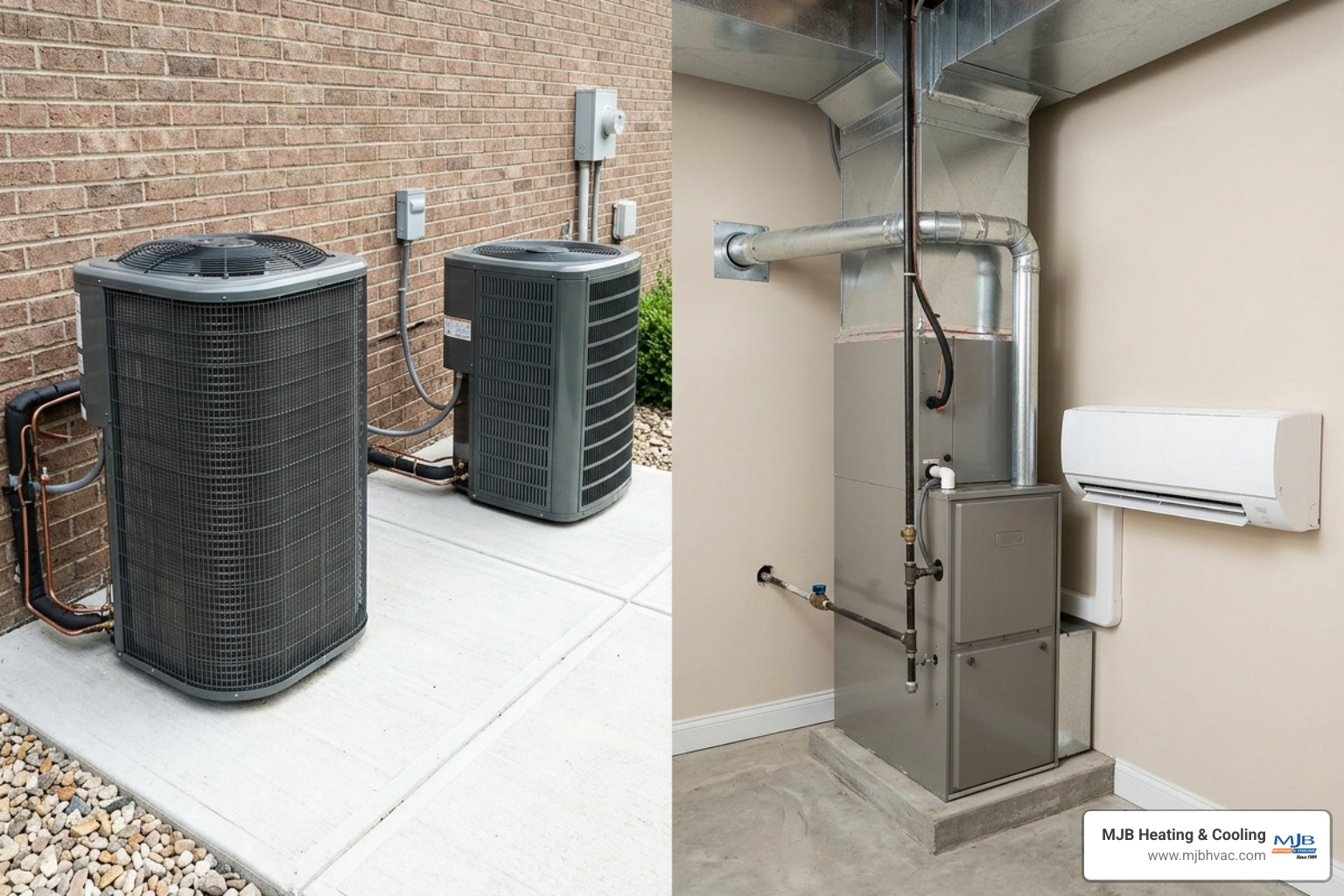
When we talk about the average lifespan of an hvac system in kansas, we are really looking at a collection of different machines, each with its own "expiration date." In our experience serving areas from Derby to Hutchinson, we see a wide variety of equipment, and the fuel source or technology used makes a massive difference in how many years of service you'll get.
Gas furnaces are the workhorses of Central Kansas winters. On average, a well-maintained gas furnace lasts between 15 and 20 years. Electric furnaces can sometimes stretch further—up to 25 years—simply because they have fewer moving parts and no combustion process that eventually wears through a metal heat exchanger. If you are looking for a replacement, it is helpful to Find the Perfect New Furnace: Tips for Homeowners to ensure you choose a model built for our local demands.
Your AC unit has a tougher life than your furnace. While the furnace sits safely inside, the AC condenser is outside, battling Kansas wind, sun, and dirt. Most central AC units in the Wichita metro last between 12 and 17 years. By the time a unit hits the 12-year mark, it has often completed over 4,000 full cooling cycles, and efficiency begins to drop significantly.
Heat pumps generally have the shortest lifespan, typically 10 to 15 years. This is because they work year-round—cooling in the summer and heating in the winter—meaning they never get a "season off." Ductless mini-splits are more variable; while they can last 20 years, the sophisticated electronics and high-demand usage in Kansas often mean they follow a similar 12-to-15-year trajectory.
Though less common in newer suburban developments in places like Andover or Maize, boilers are incredibly durable. A standard boiler often lasts 20 to 30 years, and old-school cast iron models have been known to survive for 50 years or more, provided the heat exchanger remains intact.
Living in the "Air Capital of the World" means dealing with air that is often filled with more than just planes. The Kansas climate is uniquely aggressive toward mechanical systems.
In Kansas, it isn't unusual to see a 40-degree temperature swing in a single day. This causes rapid expansion and contraction of metal components, such as your furnace's heat exchanger or the copper coils in your AC. Over time, this "thermal stress" leads to microfractures and refrigerant leaks.
Our summers are brutal. When temperatures stay above 95 degrees for weeks, your AC might run nearly 24/7. This constant operation wears out fan motors and compressors much faster than in cooler northern states. Conversely, our winters are cold enough that furnaces must run at high capacity to keep up, leading to heavy seasonal stress on both ends of the calendar.
Central Kansas is notorious for high humidity in the summer and bone-dry air in the winter. High humidity makes your AC work 20% harder just to dehumidify the air before it can even begin cooling it. Furthermore, the dust from our agricultural surroundings and high winds can clog outdoor coils, forcing the compressor to run hotter and die younger. Following Essential HVAC Maintenance Tips for Your Furnace and AC is the best way to combat these environmental "lifespan killers."
Your HVAC system usually won't just quit without a word. It will "talk" to you through various symptoms. If your system was installed during or before 2014, keep a close eye out for these red flags.
Beyond the obvious signs, look for "short cycling"—where the unit turns on and off every few minutes. This is a major sign of component wear or an improperly sized system. You might also notice visible rust on the furnace cabinet or white "pitting" on the outdoor coils. These are signs of chemical corrosion that cannot be easily repaired.
One of the hardest questions we answer for families in Derby and El Dorado is: "Is it worth fixing this one more time?" To help, we suggest using the $5,000 Rule.
The Formula: Multiply the age of your system by the cost of the repair. If the total is more than $5,000, it is usually time to replace.
If your AC was built before 2010, it likely uses R-22 (Freon). This refrigerant has been phased out by the EPA. Because it is no longer produced, a simple leak repair can now cost over $1,000 just for the gas alone. In these cases, we almost always recommend a full system upgrade to a modern, environmentally friendly refrigerant like R-410A.
When you do decide to upgrade, make sure you have a list of Expert HVAC Installation Questions for Your Technician ready to go.
Replacing a system is an investment, but the ROI comes through energy savings. Modern high-efficiency systems (16-17 SEER) can reduce your utility bills by 35% compared to a degraded 10-year-old unit. Additionally, a new system comes with a 10-year warranty, giving you a decade of protection against the "surprise" repair costs that plague older units. If you are looking for a reliable HVAC Company Derby, KS, our team can help you crunch these numbers.
You don't have to just accept a short lifespan for your HVAC. There are several proactive habits that can add years to the average lifespan of an hvac system in kansas.
This is the single most important thing you can do. A dirty filter makes your system work 20% harder by restricting airflow. In the dusty environment of Central Kansas, we recommend checking your filter every 30 days and replacing it at least every 90 days. For households with pets or allergies, you may need to change it even more frequently. Not sure about the timing? Learn How Often Should HVAC Air Filters Be Changed? to keep your airflow optimized.
Professional inspections can catch small issues—like a $200 capacitor—before they turn into a $2,000 compressor failure. Many of our customers in places like Rose Hill and Goddard prefer the peace of mind that comes with a dedicated Maintenance Plan, which ensures these checks happen on schedule every single year.
Generally, no. Even if the repair is minor, a 15-year-old unit is at the very end of the average lifespan of an hvac system in kansas. It is likely operating at 70% of its original efficiency or less. The money you spend on the repair would be better served as a down payment on a new, high-efficiency system that will lower your monthly bills and provide a fresh warranty.
While hard water primarily affects plumbing and water heaters, the dust in the Wichita metro is a major HVAC enemy. Dust acts as an insulator on your coils, preventing heat transfer. This forces the system to run longer and hotter, which leads to premature motor failure. Regular coil cleaning during a maintenance visit is essential here.
The phase-out makes older units a liability. Because R-22 is scarce, the cost to "top off" a leaking system is astronomical. Furthermore, once the compressor fails on an R-22 system, you cannot simply swap it out for a new one; the entire indoor and outdoor system must be replaced to be compatible with modern refrigerants.
At MJB Heating & Cooling, we understand that your HVAC system is one of the most significant investments in your home. As a family-owned business with roots in Derby, KS, we’ve spent decades helping our neighbors across the Wichita metro—from Bel Aire to Wellington—navigate the challenges of our local climate.
Our honest business approach means we won't tell you to replace a system that still has good years left in it, but we also won't let you sink money into a "sinking ship" of a unit that is destined to fail when you need it most. Whether you need a quick repair in Andover or a full installation in Newton, we pride ourselves on quality workmanship and a commitment to your long-term comfort.
If you’re wondering where your current unit stands or if it’s time to start planning for a more efficient future, explore Our Services or give us a call. We're here to ensure your Kansas home stays comfortable for many years to come.
The average lifespan of an hvac system in kansas depends on the type of equipment you have — but Kansas homeowners face some unique challenges that can push systems toward the shorter end of those ranges.
Here's a quick breakdown by system type:
| HVAC System Type | Average Lifespan |
|---|---|
| Gas Furnace | 15–20 years |
| Electric Furnace | 20–25 years |
| Central Air Conditioner | 12–17 years |
| Heat Pump | 10–15 years |
| Boiler | 15–30 years |
| Ductless Mini-Split | 10–20+ years |
Kansas is hard on HVAC equipment. Wichita summers regularly push temperatures into the upper 90s, while winters demand continuous heating for months at a time. That kind of year-round stress — combined with the region's dust, humidity swings, and wide temperature extremes — means your system works harder than it would in a milder climate. Systems that might coast to the 17-year mark in a moderate region can start showing serious wear closer to the 12-year mark here.
For homeowners in the Wichita metro and surrounding Central Kansas communities, knowing where your system stands in its lifespan isn't just useful — it can save you from an unexpected breakdown on the hottest day of summer or the coldest night of January.
This guide walks you through what affects your system's lifespan, the warning signs to watch for, and how to get the most out of your equipment — so you can make smart, confident decisions about your home's comfort.
When we talk about the average lifespan of an hvac system in kansas, we are really looking at a collection of different machines, each with its own "expiration date." In our experience serving areas from Derby to Hutchinson, we see a wide variety of equipment, and the fuel source or technology used makes a massive difference in how many years of service you'll get.
Gas furnaces are the workhorses of Central Kansas winters. On average, a well-maintained gas furnace lasts between 15 and 20 years. Electric furnaces can sometimes stretch further—up to 25 years—simply because they have fewer moving parts and no combustion process that eventually wears through a metal heat exchanger. If you are looking for a replacement, it is helpful to Find the Perfect New Furnace: Tips for Homeowners to ensure you choose a model built for our local demands.
Your AC unit has a tougher life than your furnace. While the furnace sits safely inside, the AC condenser is outside, battling Kansas wind, sun, and dirt. Most central AC units in the Wichita metro last between 12 and 17 years. By the time a unit hits the 12-year mark, it has often completed over 4,000 full cooling cycles, and efficiency begins to drop significantly.
Heat pumps generally have the shortest lifespan, typically 10 to 15 years. This is because they work year-round—cooling in the summer and heating in the winter—meaning they never get a "season off." Ductless mini-splits are more variable; while they can last 20 years, the sophisticated electronics and high-demand usage in Kansas often mean they follow a similar 12-to-15-year trajectory.
Though less common in newer suburban developments in places like Andover or Maize, boilers are incredibly durable. A standard boiler often lasts 20 to 30 years, and old-school cast iron models have been known to survive for 50 years or more, provided the heat exchanger remains intact.
Living in the "Air Capital of the World" means dealing with air that is often filled with more than just planes. The Kansas climate is uniquely aggressive toward mechanical systems.
In Kansas, it isn't unusual to see a 40-degree temperature swing in a single day. This causes rapid expansion and contraction of metal components, such as your furnace's heat exchanger or the copper coils in your AC. Over time, this "thermal stress" leads to microfractures and refrigerant leaks.
Our summers are brutal. When temperatures stay above 95 degrees for weeks, your AC might run nearly 24/7. This constant operation wears out fan motors and compressors much faster than in cooler northern states. Conversely, our winters are cold enough that furnaces must run at high capacity to keep up, leading to heavy seasonal stress on both ends of the calendar.
Central Kansas is notorious for high humidity in the summer and bone-dry air in the winter. High humidity makes your AC work 20% harder just to dehumidify the air before it can even begin cooling it. Furthermore, the dust from our agricultural surroundings and high winds can clog outdoor coils, forcing the compressor to run hotter and die younger. Following Essential HVAC Maintenance Tips for Your Furnace and AC is the best way to combat these environmental "lifespan killers."
Your HVAC system usually won't just quit without a word. It will "talk" to you through various symptoms. If your system was installed during or before 2014, keep a close eye out for these red flags.
Beyond the obvious signs, look for "short cycling"—where the unit turns on and off every few minutes. This is a major sign of component wear or an improperly sized system. You might also notice visible rust on the furnace cabinet or white "pitting" on the outdoor coils. These are signs of chemical corrosion that cannot be easily repaired.
One of the hardest questions we answer for families in Derby and El Dorado is: "Is it worth fixing this one more time?" To help, we suggest using the $5,000 Rule.
The Formula: Multiply the age of your system by the cost of the repair. If the total is more than $5,000, it is usually time to replace.
If your AC was built before 2010, it likely uses R-22 (Freon). This refrigerant has been phased out by the EPA. Because it is no longer produced, a simple leak repair can now cost over $1,000 just for the gas alone. In these cases, we almost always recommend a full system upgrade to a modern, environmentally friendly refrigerant like R-410A.
When you do decide to upgrade, make sure you have a list of Expert HVAC Installation Questions for Your Technician ready to go.
Replacing a system is an investment, but the ROI comes through energy savings. Modern high-efficiency systems (16-17 SEER) can reduce your utility bills by 35% compared to a degraded 10-year-old unit. Additionally, a new system comes with a 10-year warranty, giving you a decade of protection against the "surprise" repair costs that plague older units. If you are looking for a reliable HVAC Company Derby, KS, our team can help you crunch these numbers.
You don't have to just accept a short lifespan for your HVAC. There are several proactive habits that can add years to the average lifespan of an hvac system in kansas.
This is the single most important thing you can do. A dirty filter makes your system work 20% harder by restricting airflow. In the dusty environment of Central Kansas, we recommend checking your filter every 30 days and replacing it at least every 90 days. For households with pets or allergies, you may need to change it even more frequently. Not sure about the timing? Learn How Often Should HVAC Air Filters Be Changed? to keep your airflow optimized.
Professional inspections can catch small issues—like a $200 capacitor—before they turn into a $2,000 compressor failure. Many of our customers in places like Rose Hill and Goddard prefer the peace of mind that comes with a dedicated Maintenance Plan, which ensures these checks happen on schedule every single year.
Generally, no. Even if the repair is minor, a 15-year-old unit is at the very end of the average lifespan of an hvac system in kansas. It is likely operating at 70% of its original efficiency or less. The money you spend on the repair would be better served as a down payment on a new, high-efficiency system that will lower your monthly bills and provide a fresh warranty.
While hard water primarily affects plumbing and water heaters, the dust in the Wichita metro is a major HVAC enemy. Dust acts as an insulator on your coils, preventing heat transfer. This forces the system to run longer and hotter, which leads to premature motor failure. Regular coil cleaning during a maintenance visit is essential here.
The phase-out makes older units a liability. Because R-22 is scarce, the cost to "top off" a leaking system is astronomical. Furthermore, once the compressor fails on an R-22 system, you cannot simply swap it out for a new one; the entire indoor and outdoor system must be replaced to be compatible with modern refrigerants.
At MJB Heating & Cooling, we understand that your HVAC system is one of the most significant investments in your home. As a family-owned business with roots in Derby, KS, we’ve spent decades helping our neighbors across the Wichita metro—from Bel Aire to Wellington—navigate the challenges of our local climate.
Our honest business approach means we won't tell you to replace a system that still has good years left in it, but we also won't let you sink money into a "sinking ship" of a unit that is destined to fail when you need it most. Whether you need a quick repair in Andover or a full installation in Newton, we pride ourselves on quality workmanship and a commitment to your long-term comfort.
If you’re wondering where your current unit stands or if it’s time to start planning for a more efficient future, explore Our Services or give us a call. We're here to ensure your Kansas home stays comfortable for many years to come.
The average lifespan of an hvac system in kansas depends on the type of equipment you have — but Kansas homeowners face some unique challenges that can push systems toward the shorter end of those ranges.
Here's a quick breakdown by system type:
| HVAC System Type | Average Lifespan |
|---|---|
| Gas Furnace | 15–20 years |
| Electric Furnace | 20–25 years |
| Central Air Conditioner | 12–17 years |
| Heat Pump | 10–15 years |
| Boiler | 15–30 years |
| Ductless Mini-Split | 10–20+ years |
Kansas is hard on HVAC equipment. Wichita summers regularly push temperatures into the upper 90s, while winters demand continuous heating for months at a time. That kind of year-round stress — combined with the region's dust, humidity swings, and wide temperature extremes — means your system works harder than it would in a milder climate. Systems that might coast to the 17-year mark in a moderate region can start showing serious wear closer to the 12-year mark here.
For homeowners in the Wichita metro and surrounding Central Kansas communities, knowing where your system stands in its lifespan isn't just useful — it can save you from an unexpected breakdown on the hottest day of summer or the coldest night of January.
This guide walks you through what affects your system's lifespan, the warning signs to watch for, and how to get the most out of your equipment — so you can make smart, confident decisions about your home's comfort.
When we talk about the average lifespan of an hvac system in kansas, we are really looking at a collection of different machines, each with its own "expiration date." In our experience serving areas from Derby to Hutchinson, we see a wide variety of equipment, and the fuel source or technology used makes a massive difference in how many years of service you'll get.
Gas furnaces are the workhorses of Central Kansas winters. On average, a well-maintained gas furnace lasts between 15 and 20 years. Electric furnaces can sometimes stretch further—up to 25 years—simply because they have fewer moving parts and no combustion process that eventually wears through a metal heat exchanger. If you are looking for a replacement, it is helpful to Find the Perfect New Furnace: Tips for Homeowners to ensure you choose a model built for our local demands.
Your AC unit has a tougher life than your furnace. While the furnace sits safely inside, the AC condenser is outside, battling Kansas wind, sun, and dirt. Most central AC units in the Wichita metro last between 12 and 17 years. By the time a unit hits the 12-year mark, it has often completed over 4,000 full cooling cycles, and efficiency begins to drop significantly.
Heat pumps generally have the shortest lifespan, typically 10 to 15 years. This is because they work year-round—cooling in the summer and heating in the winter—meaning they never get a "season off." Ductless mini-splits are more variable; while they can last 20 years, the sophisticated electronics and high-demand usage in Kansas often mean they follow a similar 12-to-15-year trajectory.
Though less common in newer suburban developments in places like Andover or Maize, boilers are incredibly durable. A standard boiler often lasts 20 to 30 years, and old-school cast iron models have been known to survive for 50 years or more, provided the heat exchanger remains intact.
Living in the "Air Capital of the World" means dealing with air that is often filled with more than just planes. The Kansas climate is uniquely aggressive toward mechanical systems.
In Kansas, it isn't unusual to see a 40-degree temperature swing in a single day. This causes rapid expansion and contraction of metal components, such as your furnace's heat exchanger or the copper coils in your AC. Over time, this "thermal stress" leads to microfractures and refrigerant leaks.
Our summers are brutal. When temperatures stay above 95 degrees for weeks, your AC might run nearly 24/7. This constant operation wears out fan motors and compressors much faster than in cooler northern states. Conversely, our winters are cold enough that furnaces must run at high capacity to keep up, leading to heavy seasonal stress on both ends of the calendar.
Central Kansas is notorious for high humidity in the summer and bone-dry air in the winter. High humidity makes your AC work 20% harder just to dehumidify the air before it can even begin cooling it. Furthermore, the dust from our agricultural surroundings and high winds can clog outdoor coils, forcing the compressor to run hotter and die younger. Following Essential HVAC Maintenance Tips for Your Furnace and AC is the best way to combat these environmental "lifespan killers."
Your HVAC system usually won't just quit without a word. It will "talk" to you through various symptoms. If your system was installed during or before 2014, keep a close eye out for these red flags.
Beyond the obvious signs, look for "short cycling"—where the unit turns on and off every few minutes. This is a major sign of component wear or an improperly sized system. You might also notice visible rust on the furnace cabinet or white "pitting" on the outdoor coils. These are signs of chemical corrosion that cannot be easily repaired.
One of the hardest questions we answer for families in Derby and El Dorado is: "Is it worth fixing this one more time?" To help, we suggest using the $5,000 Rule.
The Formula: Multiply the age of your system by the cost of the repair. If the total is more than $5,000, it is usually time to replace.
If your AC was built before 2010, it likely uses R-22 (Freon). This refrigerant has been phased out by the EPA. Because it is no longer produced, a simple leak repair can now cost over $1,000 just for the gas alone. In these cases, we almost always recommend a full system upgrade to a modern, environmentally friendly refrigerant like R-410A.
When you do decide to upgrade, make sure you have a list of Expert HVAC Installation Questions for Your Technician ready to go.
Replacing a system is an investment, but the ROI comes through energy savings. Modern high-efficiency systems (16-17 SEER) can reduce your utility bills by 35% compared to a degraded 10-year-old unit. Additionally, a new system comes with a 10-year warranty, giving you a decade of protection against the "surprise" repair costs that plague older units. If you are looking for a reliable HVAC Company Derby, KS, our team can help you crunch these numbers.
You don't have to just accept a short lifespan for your HVAC. There are several proactive habits that can add years to the average lifespan of an hvac system in kansas.
This is the single most important thing you can do. A dirty filter makes your system work 20% harder by restricting airflow. In the dusty environment of Central Kansas, we recommend checking your filter every 30 days and replacing it at least every 90 days. For households with pets or allergies, you may need to change it even more frequently. Not sure about the timing? Learn How Often Should HVAC Air Filters Be Changed? to keep your airflow optimized.
Professional inspections can catch small issues—like a $200 capacitor—before they turn into a $2,000 compressor failure. Many of our customers in places like Rose Hill and Goddard prefer the peace of mind that comes with a dedicated Maintenance Plan, which ensures these checks happen on schedule every single year.
Generally, no. Even if the repair is minor, a 15-year-old unit is at the very end of the average lifespan of an hvac system in kansas. It is likely operating at 70% of its original efficiency or less. The money you spend on the repair would be better served as a down payment on a new, high-efficiency system that will lower your monthly bills and provide a fresh warranty.
While hard water primarily affects plumbing and water heaters, the dust in the Wichita metro is a major HVAC enemy. Dust acts as an insulator on your coils, preventing heat transfer. This forces the system to run longer and hotter, which leads to premature motor failure. Regular coil cleaning during a maintenance visit is essential here.
The phase-out makes older units a liability. Because R-22 is scarce, the cost to "top off" a leaking system is astronomical. Furthermore, once the compressor fails on an R-22 system, you cannot simply swap it out for a new one; the entire indoor and outdoor system must be replaced to be compatible with modern refrigerants.
At MJB Heating & Cooling, we understand that your HVAC system is one of the most significant investments in your home. As a family-owned business with roots in Derby, KS, we’ve spent decades helping our neighbors across the Wichita metro—from Bel Aire to Wellington—navigate the challenges of our local climate.
Our honest business approach means we won't tell you to replace a system that still has good years left in it, but we also won't let you sink money into a "sinking ship" of a unit that is destined to fail when you need it most. Whether you need a quick repair in Andover or a full installation in Newton, we pride ourselves on quality workmanship and a commitment to your long-term comfort.
If you’re wondering where your current unit stands or if it’s time to start planning for a more efficient future, explore Our Services or give us a call. We're here to ensure your Kansas home stays comfortable for many years to come.

The average lifespan of an hvac system in kansas depends on the type of equipment you have — but Kansas homeowners face some unique challenges that can push systems toward the shorter end of those ranges.
Here's a quick breakdown by system type:
| HVAC System Type | Average Lifespan |
|---|---|
| Gas Furnace | 15–20 years |
| Electric Furnace | 20–25 years |
| Central Air Conditioner | 12–17 years |
| Heat Pump | 10–15 years |
| Boiler | 15–30 years |
| Ductless Mini-Split | 10–20+ years |
Kansas is hard on HVAC equipment. Wichita summers regularly push temperatures into the upper 90s, while winters demand continuous heating for months at a time. That kind of year-round stress — combined with the region's dust, humidity swings, and wide temperature extremes — means your system works harder than it would in a milder climate. Systems that might coast to the 17-year mark in a moderate region can start showing serious wear closer to the 12-year mark here.
For homeowners in the Wichita metro and surrounding Central Kansas communities, knowing where your system stands in its lifespan isn't just useful — it can save you from an unexpected breakdown on the hottest day of summer or the coldest night of January.
This guide walks you through what affects your system's lifespan, the warning signs to watch for, and how to get the most out of your equipment — so you can make smart, confident decisions about your home's comfort.
When we talk about the average lifespan of an hvac system in kansas, we are really looking at a collection of different machines, each with its own "expiration date." In our experience serving areas from Derby to Hutchinson, we see a wide variety of equipment, and the fuel source or technology used makes a massive difference in how many years of service you'll get.
Gas furnaces are the workhorses of Central Kansas winters. On average, a well-maintained gas furnace lasts between 15 and 20 years. Electric furnaces can sometimes stretch further—up to 25 years—simply because they have fewer moving parts and no combustion process that eventually wears through a metal heat exchanger. If you are looking for a replacement, it is helpful to Find the Perfect New Furnace: Tips for Homeowners to ensure you choose a model built for our local demands.
Your AC unit has a tougher life than your furnace. While the furnace sits safely inside, the AC condenser is outside, battling Kansas wind, sun, and dirt. Most central AC units in the Wichita metro last between 12 and 17 years. By the time a unit hits the 12-year mark, it has often completed over 4,000 full cooling cycles, and efficiency begins to drop significantly.
Heat pumps generally have the shortest lifespan, typically 10 to 15 years. This is because they work year-round—cooling in the summer and heating in the winter—meaning they never get a "season off." Ductless mini-splits are more variable; while they can last 20 years, the sophisticated electronics and high-demand usage in Kansas often mean they follow a similar 12-to-15-year trajectory.
Though less common in newer suburban developments in places like Andover or Maize, boilers are incredibly durable. A standard boiler often lasts 20 to 30 years, and old-school cast iron models have been known to survive for 50 years or more, provided the heat exchanger remains intact.
Living in the "Air Capital of the World" means dealing with air that is often filled with more than just planes. The Kansas climate is uniquely aggressive toward mechanical systems.
In Kansas, it isn't unusual to see a 40-degree temperature swing in a single day. This causes rapid expansion and contraction of metal components, such as your furnace's heat exchanger or the copper coils in your AC. Over time, this "thermal stress" leads to microfractures and refrigerant leaks.
Our summers are brutal. When temperatures stay above 95 degrees for weeks, your AC might run nearly 24/7. This constant operation wears out fan motors and compressors much faster than in cooler northern states. Conversely, our winters are cold enough that furnaces must run at high capacity to keep up, leading to heavy seasonal stress on both ends of the calendar.
Central Kansas is notorious for high humidity in the summer and bone-dry air in the winter. High humidity makes your AC work 20% harder just to dehumidify the air before it can even begin cooling it. Furthermore, the dust from our agricultural surroundings and high winds can clog outdoor coils, forcing the compressor to run hotter and die younger. Following Essential HVAC Maintenance Tips for Your Furnace and AC is the best way to combat these environmental "lifespan killers."
Your HVAC system usually won't just quit without a word. It will "talk" to you through various symptoms. If your system was installed during or before 2014, keep a close eye out for these red flags.
Beyond the obvious signs, look for "short cycling"—where the unit turns on and off every few minutes. This is a major sign of component wear or an improperly sized system. You might also notice visible rust on the furnace cabinet or white "pitting" on the outdoor coils. These are signs of chemical corrosion that cannot be easily repaired.
One of the hardest questions we answer for families in Derby and El Dorado is: "Is it worth fixing this one more time?" To help, we suggest using the $5,000 Rule.
The Formula: Multiply the age of your system by the cost of the repair. If the total is more than $5,000, it is usually time to replace.
If your AC was built before 2010, it likely uses R-22 (Freon). This refrigerant has been phased out by the EPA. Because it is no longer produced, a simple leak repair can now cost over $1,000 just for the gas alone. In these cases, we almost always recommend a full system upgrade to a modern, environmentally friendly refrigerant like R-410A.
When you do decide to upgrade, make sure you have a list of Expert HVAC Installation Questions for Your Technician ready to go.
Replacing a system is an investment, but the ROI comes through energy savings. Modern high-efficiency systems (16-17 SEER) can reduce your utility bills by 35% compared to a degraded 10-year-old unit. Additionally, a new system comes with a 10-year warranty, giving you a decade of protection against the "surprise" repair costs that plague older units. If you are looking for a reliable HVAC Company Derby, KS, our team can help you crunch these numbers.
You don't have to just accept a short lifespan for your HVAC. There are several proactive habits that can add years to the average lifespan of an hvac system in kansas.
This is the single most important thing you can do. A dirty filter makes your system work 20% harder by restricting airflow. In the dusty environment of Central Kansas, we recommend checking your filter every 30 days and replacing it at least every 90 days. For households with pets or allergies, you may need to change it even more frequently. Not sure about the timing? Learn How Often Should HVAC Air Filters Be Changed? to keep your airflow optimized.
Professional inspections can catch small issues—like a $200 capacitor—before they turn into a $2,000 compressor failure. Many of our customers in places like Rose Hill and Goddard prefer the peace of mind that comes with a dedicated Maintenance Plan, which ensures these checks happen on schedule every single year.
Generally, no. Even if the repair is minor, a 15-year-old unit is at the very end of the average lifespan of an hvac system in kansas. It is likely operating at 70% of its original efficiency or less. The money you spend on the repair would be better served as a down payment on a new, high-efficiency system that will lower your monthly bills and provide a fresh warranty.
While hard water primarily affects plumbing and water heaters, the dust in the Wichita metro is a major HVAC enemy. Dust acts as an insulator on your coils, preventing heat transfer. This forces the system to run longer and hotter, which leads to premature motor failure. Regular coil cleaning during a maintenance visit is essential here.
The phase-out makes older units a liability. Because R-22 is scarce, the cost to "top off" a leaking system is astronomical. Furthermore, once the compressor fails on an R-22 system, you cannot simply swap it out for a new one; the entire indoor and outdoor system must be replaced to be compatible with modern refrigerants.
At MJB Heating & Cooling, we understand that your HVAC system is one of the most significant investments in your home. As a family-owned business with roots in Derby, KS, we’ve spent decades helping our neighbors across the Wichita metro—from Bel Aire to Wellington—navigate the challenges of our local climate.
Our honest business approach means we won't tell you to replace a system that still has good years left in it, but we also won't let you sink money into a "sinking ship" of a unit that is destined to fail when you need it most. Whether you need a quick repair in Andover or a full installation in Newton, we pride ourselves on quality workmanship and a commitment to your long-term comfort.
If you’re wondering where your current unit stands or if it’s time to start planning for a more efficient future, explore Our Services or give us a call. We're here to ensure your Kansas home stays comfortable for many years to come.
The average lifespan of an hvac system in kansas depends on the type of equipment you have — but Kansas homeowners face some unique challenges that can push systems toward the shorter end of those ranges.
Here's a quick breakdown by system type:
| HVAC System Type | Average Lifespan |
|---|---|
| Gas Furnace | 15–20 years |
| Electric Furnace | 20–25 years |
| Central Air Conditioner | 12–17 years |
| Heat Pump | 10–15 years |
| Boiler | 15–30 years |
| Ductless Mini-Split | 10–20+ years |
Kansas is hard on HVAC equipment. Wichita summers regularly push temperatures into the upper 90s, while winters demand continuous heating for months at a time. That kind of year-round stress — combined with the region's dust, humidity swings, and wide temperature extremes — means your system works harder than it would in a milder climate. Systems that might coast to the 17-year mark in a moderate region can start showing serious wear closer to the 12-year mark here.
For homeowners in the Wichita metro and surrounding Central Kansas communities, knowing where your system stands in its lifespan isn't just useful — it can save you from an unexpected breakdown on the hottest day of summer or the coldest night of January.
This guide walks you through what affects your system's lifespan, the warning signs to watch for, and how to get the most out of your equipment — so you can make smart, confident decisions about your home's comfort.
When we talk about the average lifespan of an hvac system in kansas, we are really looking at a collection of different machines, each with its own "expiration date." In our experience serving areas from Derby to Hutchinson, we see a wide variety of equipment, and the fuel source or technology used makes a massive difference in how many years of service you'll get.
Gas furnaces are the workhorses of Central Kansas winters. On average, a well-maintained gas furnace lasts between 15 and 20 years. Electric furnaces can sometimes stretch further—up to 25 years—simply because they have fewer moving parts and no combustion process that eventually wears through a metal heat exchanger. If you are looking for a replacement, it is helpful to Find the Perfect New Furnace: Tips for Homeowners to ensure you choose a model built for our local demands.
Your AC unit has a tougher life than your furnace. While the furnace sits safely inside, the AC condenser is outside, battling Kansas wind, sun, and dirt. Most central AC units in the Wichita metro last between 12 and 17 years. By the time a unit hits the 12-year mark, it has often completed over 4,000 full cooling cycles, and efficiency begins to drop significantly.
Heat pumps generally have the shortest lifespan, typically 10 to 15 years. This is because they work year-round—cooling in the summer and heating in the winter—meaning they never get a "season off." Ductless mini-splits are more variable; while they can last 20 years, the sophisticated electronics and high-demand usage in Kansas often mean they follow a similar 12-to-15-year trajectory.
Though less common in newer suburban developments in places like Andover or Maize, boilers are incredibly durable. A standard boiler often lasts 20 to 30 years, and old-school cast iron models have been known to survive for 50 years or more, provided the heat exchanger remains intact.
Living in the "Air Capital of the World" means dealing with air that is often filled with more than just planes. The Kansas climate is uniquely aggressive toward mechanical systems.
In Kansas, it isn't unusual to see a 40-degree temperature swing in a single day. This causes rapid expansion and contraction of metal components, such as your furnace's heat exchanger or the copper coils in your AC. Over time, this "thermal stress" leads to microfractures and refrigerant leaks.
Our summers are brutal. When temperatures stay above 95 degrees for weeks, your AC might run nearly 24/7. This constant operation wears out fan motors and compressors much faster than in cooler northern states. Conversely, our winters are cold enough that furnaces must run at high capacity to keep up, leading to heavy seasonal stress on both ends of the calendar.
Central Kansas is notorious for high humidity in the summer and bone-dry air in the winter. High humidity makes your AC work 20% harder just to dehumidify the air before it can even begin cooling it. Furthermore, the dust from our agricultural surroundings and high winds can clog outdoor coils, forcing the compressor to run hotter and die younger. Following Essential HVAC Maintenance Tips for Your Furnace and AC is the best way to combat these environmental "lifespan killers."
Your HVAC system usually won't just quit without a word. It will "talk" to you through various symptoms. If your system was installed during or before 2014, keep a close eye out for these red flags.
Beyond the obvious signs, look for "short cycling"—where the unit turns on and off every few minutes. This is a major sign of component wear or an improperly sized system. You might also notice visible rust on the furnace cabinet or white "pitting" on the outdoor coils. These are signs of chemical corrosion that cannot be easily repaired.
One of the hardest questions we answer for families in Derby and El Dorado is: "Is it worth fixing this one more time?" To help, we suggest using the $5,000 Rule.
The Formula: Multiply the age of your system by the cost of the repair. If the total is more than $5,000, it is usually time to replace.
If your AC was built before 2010, it likely uses R-22 (Freon). This refrigerant has been phased out by the EPA. Because it is no longer produced, a simple leak repair can now cost over $1,000 just for the gas alone. In these cases, we almost always recommend a full system upgrade to a modern, environmentally friendly refrigerant like R-410A.
When you do decide to upgrade, make sure you have a list of Expert HVAC Installation Questions for Your Technician ready to go.
Replacing a system is an investment, but the ROI comes through energy savings. Modern high-efficiency systems (16-17 SEER) can reduce your utility bills by 35% compared to a degraded 10-year-old unit. Additionally, a new system comes with a 10-year warranty, giving you a decade of protection against the "surprise" repair costs that plague older units. If you are looking for a reliable HVAC Company Derby, KS, our team can help you crunch these numbers.
You don't have to just accept a short lifespan for your HVAC. There are several proactive habits that can add years to the average lifespan of an hvac system in kansas.
This is the single most important thing you can do. A dirty filter makes your system work 20% harder by restricting airflow. In the dusty environment of Central Kansas, we recommend checking your filter every 30 days and replacing it at least every 90 days. For households with pets or allergies, you may need to change it even more frequently. Not sure about the timing? Learn How Often Should HVAC Air Filters Be Changed? to keep your airflow optimized.
Professional inspections can catch small issues—like a $200 capacitor—before they turn into a $2,000 compressor failure. Many of our customers in places like Rose Hill and Goddard prefer the peace of mind that comes with a dedicated Maintenance Plan, which ensures these checks happen on schedule every single year.
Generally, no. Even if the repair is minor, a 15-year-old unit is at the very end of the average lifespan of an hvac system in kansas. It is likely operating at 70% of its original efficiency or less. The money you spend on the repair would be better served as a down payment on a new, high-efficiency system that will lower your monthly bills and provide a fresh warranty.
While hard water primarily affects plumbing and water heaters, the dust in the Wichita metro is a major HVAC enemy. Dust acts as an insulator on your coils, preventing heat transfer. This forces the system to run longer and hotter, which leads to premature motor failure. Regular coil cleaning during a maintenance visit is essential here.
The phase-out makes older units a liability. Because R-22 is scarce, the cost to "top off" a leaking system is astronomical. Furthermore, once the compressor fails on an R-22 system, you cannot simply swap it out for a new one; the entire indoor and outdoor system must be replaced to be compatible with modern refrigerants.
At MJB Heating & Cooling, we understand that your HVAC system is one of the most significant investments in your home. As a family-owned business with roots in Derby, KS, we’ve spent decades helping our neighbors across the Wichita metro—from Bel Aire to Wellington—navigate the challenges of our local climate.
Our honest business approach means we won't tell you to replace a system that still has good years left in it, but we also won't let you sink money into a "sinking ship" of a unit that is destined to fail when you need it most. Whether you need a quick repair in Andover or a full installation in Newton, we pride ourselves on quality workmanship and a commitment to your long-term comfort.
If you’re wondering where your current unit stands or if it’s time to start planning for a more efficient future, explore Our Services or give us a call. We're here to ensure your Kansas home stays comfortable for many years to come.


Our A/C stopped working on a Sunday and due to health issues, we needed to find a service company available on a Sunday. I called MJB and left a message on their emergency voice mail. Within 10 minutes Tom Buck called me to hear my description of the symptoms. He was just finishing an appointment in Wichita and would be on his way to my home on the south end of Derby. He arrived within 30 minutes! From start to finish he was the perfect example of what you could ever hope for in an HVAC tech and a human being. His evaluation of our system inside and out was as thorough as I could ever imagine and once he was done with the repair, our system is running as well or better than ever. Well worth the price for the evaluation, parts, and labor. Thank you again Tom for an awesome experience.
Our AC went out during the hottest days of the year, and they were out next day! We have been jerked around by a shoddy home warranty for years. We finally had a chance to pick our own repair people, and MJB came highly recommended. I can see why! I was impressed with the honesty and speed at which they fixed our AC unit!
Our commercial building had a lightening/electrical strike and damaged our 20 ton AC unit. No one could find us a new unit before the end of September. Imagining going all of August and September with no AC in Kansas and working inside near 100 degree temps is less than thrilling. Dale and the team at MJB called around and saved the day. They had us a new unit 5 weeks earlier than other could promise and I now have happy employees. The unit is amazingly quiet, super cold and so much more energy efficient. Thank you for being our super hero!
Came out and installed my new furnace. Was very polite and affordable. They are very acknowledgeable and I highly recommend!
Thank you very much. We had our 1st warm night in 3weeks. MJB took the time and effort to find the real problem. And the employees were kind and thoughtful and explained things very well. I cannot thank you and all of MJB. Will recommend you highly. Thanks again Marjorie Herman Oxford Kansas
We had a new system installed and I was so impressed with how quick they were in come out and install it, in the middle of a hot summer day. They were so friendly & very professional. I had a small problem with a weird sound and they came over immediately and fixed it. Love them!