.avif)





Blogs
Stay updated with our latest blog posts.
How much does a high efficiency system save is one of the most practical questions a homeowner can ask — and the answer can be significant. Depending on how old your current equipment is and what you upgrade to, you could cut your heating and cooling bills by anywhere from 20% to 50%. For a typical Central Kansas home spending over $2,200 a year on energy, with nearly half of that going to heating and cooling, those numbers add up fast.
Quick Answer: How Much Can You Save?
| Upgrade | Estimated Annual Savings |
|---|---|
| 10 SEER → 13 SEER (AC) | ~23% on cooling costs |
| 10 SEER → 15 SEER (AC) | ~33% on cooling costs |
| 10 SEER → 18 SEER (AC) | ~40%+ on cooling costs |
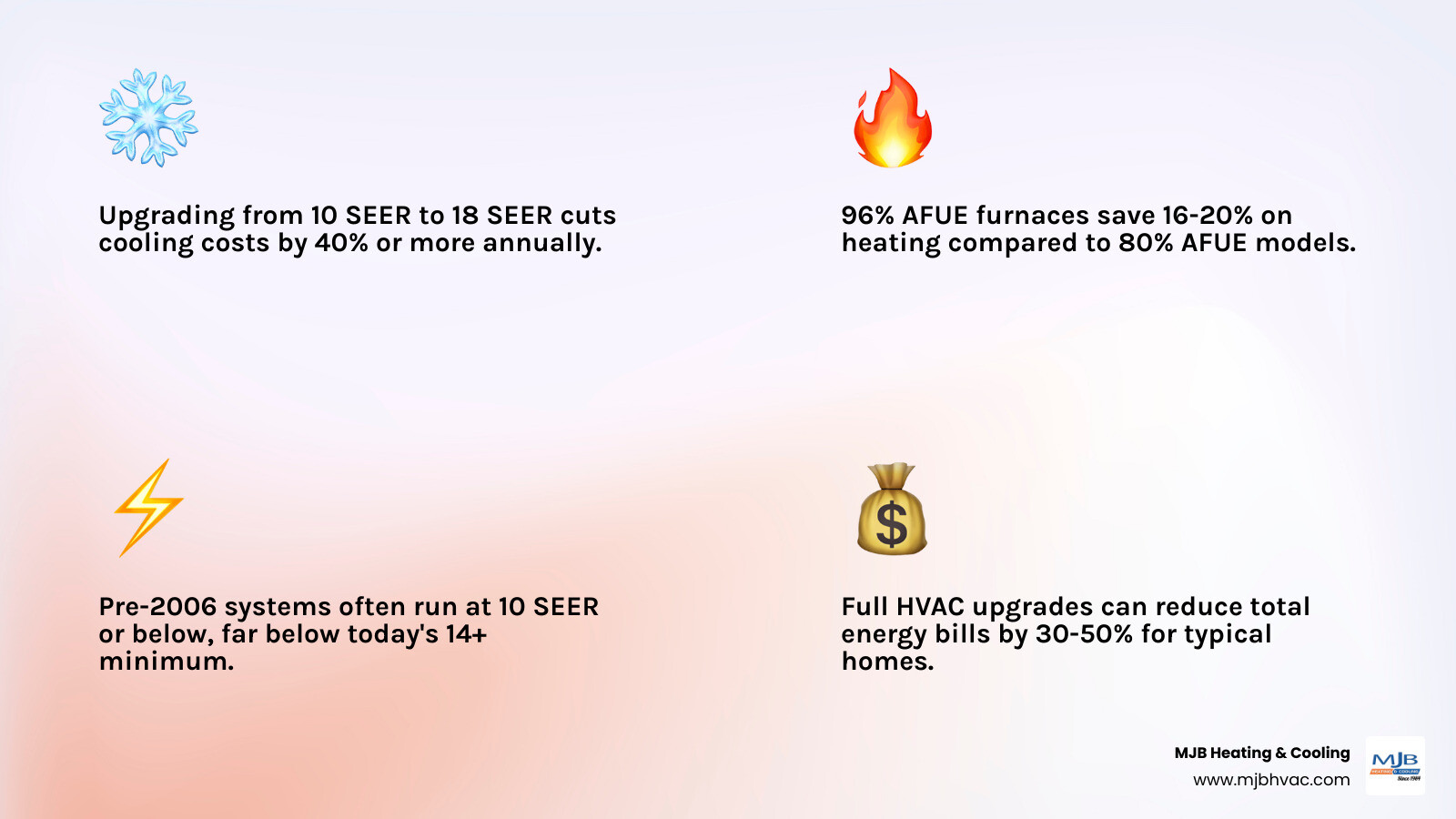
| 80% → 96% AFUE (furnace) | ~16–20% on heating costs (~$200–$260/year) |
| ENERGY STAR certified system | Up to 20% on combined heating and cooling |
| Full upgrade (SEER 10→18 + AFUE 80%→96%) | 30–50% total reduction in HVAC energy costs |
Here's the thing most people don't realize: if your system was installed before 2006, it's likely running at a SEER rating of 10 or below. Today's minimum federal standard is 13–14 SEER2, and high-efficiency models go up to 20 SEER2 and beyond. The gap between what you have and what's available now is often where the biggest savings hide.
The savings depend on a few key factors — your climate, your home's size, your local energy rates, and which type of system you're upgrading. In a place like Wichita, KS, where summers push near 90°F and winters can drop hard, your HVAC system works overtime. That means more runtime hours, and more opportunity for a high-efficiency upgrade to pay off.
This guide walks you through exactly how to think about those savings — from understanding efficiency ratings, to calculating your real-world payback period, to knowing which incentives can bring the upfront cost down.
When you start looking at new HVAC equipment in April 2026, you'll be hit with a "alphabet soup" of ratings. Understanding these numbers is the first step in figuring out how much does a high efficiency system save for your specific home. These ratings aren't just marketing fluff; they are standardized metrics regulated by the Department of Energy (DOE) to tell you exactly how much "bang" you get for your utility buck.
The primary metric for air conditioning is SEER2 (Seasonal Energy Efficiency Ratio 2). Think of SEER2 like the "miles per gallon" for your AC. It measures the total cooling output over a typical cooling season divided by the total electric energy input.
In the South and Southwest (including Kansas), the federal minimum for new installations is roughly 14.3 SEER2. However, premium systems can reach 20 SEER2 or higher. When you jump from an old 10 SEER unit to a 20 SEER2 model, you are effectively doubling your efficiency. This doesn't just lower the bill; it changes how the system runs. High-SEER2 units often use variable-speed compressors that stay on longer at lower speeds, preventing the massive "startup surges" of electricity that low-efficiency, single-stage units require every time they kick on.
For furnaces, we look at AFUE (Annual Fuel Utilization Efficiency). This is expressed as a percentage. If a furnace has an 80% AFUE rating, it means 80 cents of every dollar you spend on gas goes toward heating your home, while 20 cents literally goes up the chimney as waste.
High-efficiency condensing furnaces boast ratings of 90% to 98.5% AFUE. These systems use a secondary heat exchanger to extract heat from exhaust gases that standard furnaces simply throw away. If you're upgrading from an older 60% or 70% AFUE furnace, the jump to 96% is massive—you're suddenly getting nearly 30% more heat for the exact same amount of fuel.
For heat pumps, we also look at HSPF2 (Heating Seasonal Performance Factor 2). This measures heating efficiency over the course of a season. While the federal minimum is 7.5 HSPF2, high-performance cold-climate heat pumps can reach 10 to 13 HSPF2. To dive deeper into these specific heating metrics, you can Discover Energy Savings with Daikin's HSPF Rating Insights to see how modern heat pumps handle the transition between seasons.
The numbers speak for themselves when we look at the long-term data. On average, upgrading from a 10 SEER AC to a 15 SEER unit creates a 33% annual savings on cooling costs. If you go all the way to an 18 SEER unit, you can save 40% or more.
| System Comparison | Annual Savings Estimate | 5-Year Savings | 10-Year Savings |
|---|---|---|---|
| 10 SEER to 13 SEER | 23% | $375 | $750 |
| 10 SEER to 15 SEER | 33% | $550 | $1,100 |
| 60% to 80% AFUE | 25% | $2,506 | $5,012 |
| 80% to 96% AFUE | 17% | $1,100 | $2,200 |
Note: These are estimates based on average regional usage and energy rates as of April 2026.
Beyond the wallet, there is an environmental "saving" as well. Upgrading a standard household from a SEER 10/AFUE 80% setup to a SEER 18/AFUE 96% system can eliminate between 1.5 and 3 tons of CO2 emissions per year. High-efficiency systems also contribute to better home health. For instance, Ways Ductless AC Improves Indoor Air highlights how modern, efficient filtration and humidity control keep your living space cleaner while saving you money.
In Central Kansas, we don't just have "weather"—we have extremes. From the humid 95-degree days in Derby and Haysville to the sub-zero wind chills in Newton and Hutchinson, our HVAC systems are rarely at rest.
In hot climates like ours, AC units can run for 2,000+ hours a year. This makes the SEER2 rating incredibly impactful. A high-efficiency unit that handles humidity effectively means you can often keep your thermostat a few degrees higher while feeling just as comfortable, saving an additional 6–10% on your bill for every degree you don't have to "drop" to feel cool.
The type of equipment you choose dictates your ROI.
When we talk about high-efficiency systems, we have to address the "premium." A high-efficiency system generally costs more upfront than a standard model. The "payback period" is the amount of time it takes for the monthly energy savings to equal that initial extra investment.
For most homeowners in the Wichita metro area, a reasonable payback period is between 5 and 12 years. Considering a modern high-efficiency AC or heat pump should last 15–20 years (and a furnace up to 25–30 years), you are looking at a decade or more of "pure profit" once the system has paid for itself.
If your current system is over 10–12 years old and facing a major repair, the math often tilts heavily toward replacement. Repairing an old, low-efficiency unit is often "throwing good money after bad," as you continue to pay high utility bills on top of the repair costs.
The "sticker price" of high efficiency is often softened by incentives that many homeowners overlook:
By stacking these incentives, you can often reduce the "efficiency premium" by 30% to 50%, significantly shortening your payback period.
While we focus heavily on how much does a high efficiency system save in dollars, the non-financial benefits are often what homeowners love most.
High-efficiency systems aren't just "stronger"; they are smarter. Standard systems are either 100% "on" or 100% "off." This leads to the "sauna-to-icebox" cycle where temperatures swing by several degrees. High-efficiency units use modulating gas valves and variable-speed motors. They can run at 40% capacity on a mild day, providing a constant, gentle stream of air that keeps the temperature perfectly steady.
This constant airflow also means:
A high-efficiency system is a precision machine. Just like a high-performance car, it needs regular check-ups to maintain its "MPG." Neglecting maintenance can lead to a 5% drop in efficiency every single year. To keep your savings high, following Essential HVAC Maintenance Tips for Your Furnace and AC is non-negotiable. Annual tune-ups ensure that components like the secondary heat exchanger and variable-speed blowers are clean and functioning at peak performance.
One of the simplest ways to protect your investment is through your air filters. Clogged filters force the motor to work harder, which spikes your energy use and can eventually burn out expensive components. We often get asked How Often Should HVAC Air Filters Be Changed, and for high-efficiency systems, the answer is usually every 1–3 months depending on your home's needs.
This is a common concern. While you might not see the full 10-year energy payback, a high-efficiency system adds documented resale value to your home. In April 2026, home buyers are more energy-conscious than ever. Having a "certified high-efficiency" system on a home inspection report can be a major selling point that allows you to recoup the investment through a higher sale price.
They don't necessarily require more frequent maintenance, but they do require specialized maintenance. For example, high-efficiency furnaces produce "condensate" (water) as they run. This requires a drainage system that needs to be checked for clogs. As long as you have a professional annual tune-up, the maintenance burden is very similar to standard equipment.
Check the manufacture date on the nameplate of your outdoor unit or furnace. If it was made before 2006, it is almost certainly 10 SEER or lower. If your utility bills have been creeping up despite your usage habits staying the same, your system's efficiency is likely degrading, making it a prime candidate for an upgrade.
At MJB Heating & Cooling, we’ve seen the HVAC industry change a lot since we started in Derby, KS back in 1984. But one thing has remained constant: our commitment to an honest business approach and quality workmanship. We aren't here to sell you the most expensive system on the market; we're here to help you find the system that makes the most sense for your home, your budget, and your long-term comfort.
Whether you're in Wichita, Maize, Goddard, or any of our surrounding communities, we take pride in helping our neighbors stop burning cash on inefficient equipment. From professional installation to the meticulous maintenance that keeps those savings rolling in for years, we treat your home like our own.
Start saving today with professional HVAC solutions from MJB Heating & Cooling
How much does a high efficiency system save is one of the most practical questions a homeowner can ask — and the answer can be significant. Depending on how old your current equipment is and what you upgrade to, you could cut your heating and cooling bills by anywhere from 20% to 50%. For a typical Central Kansas home spending over $2,200 a year on energy, with nearly half of that going to heating and cooling, those numbers add up fast.
Quick Answer: How Much Can You Save?
| Upgrade | Estimated Annual Savings |
|---|---|
| 10 SEER → 13 SEER (AC) | ~23% on cooling costs |
| 10 SEER → 15 SEER (AC) | ~33% on cooling costs |
| 10 SEER → 18 SEER (AC) | ~40%+ on cooling costs |
| 80% → 96% AFUE (furnace) | ~16–20% on heating costs (~$200–$260/year) |
| ENERGY STAR certified system | Up to 20% on combined heating and cooling |
| Full upgrade (SEER 10→18 + AFUE 80%→96%) | 30–50% total reduction in HVAC energy costs |
Here's the thing most people don't realize: if your system was installed before 2006, it's likely running at a SEER rating of 10 or below. Today's minimum federal standard is 13–14 SEER2, and high-efficiency models go up to 20 SEER2 and beyond. The gap between what you have and what's available now is often where the biggest savings hide.
The savings depend on a few key factors — your climate, your home's size, your local energy rates, and which type of system you're upgrading. In a place like Wichita, KS, where summers push near 90°F and winters can drop hard, your HVAC system works overtime. That means more runtime hours, and more opportunity for a high-efficiency upgrade to pay off.
This guide walks you through exactly how to think about those savings — from understanding efficiency ratings, to calculating your real-world payback period, to knowing which incentives can bring the upfront cost down.
When you start looking at new HVAC equipment in April 2026, you'll be hit with a "alphabet soup" of ratings. Understanding these numbers is the first step in figuring out how much does a high efficiency system save for your specific home. These ratings aren't just marketing fluff; they are standardized metrics regulated by the Department of Energy (DOE) to tell you exactly how much "bang" you get for your utility buck.
The primary metric for air conditioning is SEER2 (Seasonal Energy Efficiency Ratio 2). Think of SEER2 like the "miles per gallon" for your AC. It measures the total cooling output over a typical cooling season divided by the total electric energy input.
In the South and Southwest (including Kansas), the federal minimum for new installations is roughly 14.3 SEER2. However, premium systems can reach 20 SEER2 or higher. When you jump from an old 10 SEER unit to a 20 SEER2 model, you are effectively doubling your efficiency. This doesn't just lower the bill; it changes how the system runs. High-SEER2 units often use variable-speed compressors that stay on longer at lower speeds, preventing the massive "startup surges" of electricity that low-efficiency, single-stage units require every time they kick on.
For furnaces, we look at AFUE (Annual Fuel Utilization Efficiency). This is expressed as a percentage. If a furnace has an 80% AFUE rating, it means 80 cents of every dollar you spend on gas goes toward heating your home, while 20 cents literally goes up the chimney as waste.
High-efficiency condensing furnaces boast ratings of 90% to 98.5% AFUE. These systems use a secondary heat exchanger to extract heat from exhaust gases that standard furnaces simply throw away. If you're upgrading from an older 60% or 70% AFUE furnace, the jump to 96% is massive—you're suddenly getting nearly 30% more heat for the exact same amount of fuel.
For heat pumps, we also look at HSPF2 (Heating Seasonal Performance Factor 2). This measures heating efficiency over the course of a season. While the federal minimum is 7.5 HSPF2, high-performance cold-climate heat pumps can reach 10 to 13 HSPF2. To dive deeper into these specific heating metrics, you can Discover Energy Savings with Daikin's HSPF Rating Insights to see how modern heat pumps handle the transition between seasons.
The numbers speak for themselves when we look at the long-term data. On average, upgrading from a 10 SEER AC to a 15 SEER unit creates a 33% annual savings on cooling costs. If you go all the way to an 18 SEER unit, you can save 40% or more.
| System Comparison | Annual Savings Estimate | 5-Year Savings | 10-Year Savings |
|---|---|---|---|
| 10 SEER to 13 SEER | 23% | $375 | $750 |
| 10 SEER to 15 SEER | 33% | $550 | $1,100 |
| 60% to 80% AFUE | 25% | $2,506 | $5,012 |
| 80% to 96% AFUE | 17% | $1,100 | $2,200 |
Note: These are estimates based on average regional usage and energy rates as of April 2026.
Beyond the wallet, there is an environmental "saving" as well. Upgrading a standard household from a SEER 10/AFUE 80% setup to a SEER 18/AFUE 96% system can eliminate between 1.5 and 3 tons of CO2 emissions per year. High-efficiency systems also contribute to better home health. For instance, Ways Ductless AC Improves Indoor Air highlights how modern, efficient filtration and humidity control keep your living space cleaner while saving you money.
In Central Kansas, we don't just have "weather"—we have extremes. From the humid 95-degree days in Derby and Haysville to the sub-zero wind chills in Newton and Hutchinson, our HVAC systems are rarely at rest.
In hot climates like ours, AC units can run for 2,000+ hours a year. This makes the SEER2 rating incredibly impactful. A high-efficiency unit that handles humidity effectively means you can often keep your thermostat a few degrees higher while feeling just as comfortable, saving an additional 6–10% on your bill for every degree you don't have to "drop" to feel cool.
The type of equipment you choose dictates your ROI.
When we talk about high-efficiency systems, we have to address the "premium." A high-efficiency system generally costs more upfront than a standard model. The "payback period" is the amount of time it takes for the monthly energy savings to equal that initial extra investment.
For most homeowners in the Wichita metro area, a reasonable payback period is between 5 and 12 years. Considering a modern high-efficiency AC or heat pump should last 15–20 years (and a furnace up to 25–30 years), you are looking at a decade or more of "pure profit" once the system has paid for itself.
If your current system is over 10–12 years old and facing a major repair, the math often tilts heavily toward replacement. Repairing an old, low-efficiency unit is often "throwing good money after bad," as you continue to pay high utility bills on top of the repair costs.
The "sticker price" of high efficiency is often softened by incentives that many homeowners overlook:
By stacking these incentives, you can often reduce the "efficiency premium" by 30% to 50%, significantly shortening your payback period.
While we focus heavily on how much does a high efficiency system save in dollars, the non-financial benefits are often what homeowners love most.
High-efficiency systems aren't just "stronger"; they are smarter. Standard systems are either 100% "on" or 100% "off." This leads to the "sauna-to-icebox" cycle where temperatures swing by several degrees. High-efficiency units use modulating gas valves and variable-speed motors. They can run at 40% capacity on a mild day, providing a constant, gentle stream of air that keeps the temperature perfectly steady.
This constant airflow also means:
A high-efficiency system is a precision machine. Just like a high-performance car, it needs regular check-ups to maintain its "MPG." Neglecting maintenance can lead to a 5% drop in efficiency every single year. To keep your savings high, following Essential HVAC Maintenance Tips for Your Furnace and AC is non-negotiable. Annual tune-ups ensure that components like the secondary heat exchanger and variable-speed blowers are clean and functioning at peak performance.
One of the simplest ways to protect your investment is through your air filters. Clogged filters force the motor to work harder, which spikes your energy use and can eventually burn out expensive components. We often get asked How Often Should HVAC Air Filters Be Changed, and for high-efficiency systems, the answer is usually every 1–3 months depending on your home's needs.
This is a common concern. While you might not see the full 10-year energy payback, a high-efficiency system adds documented resale value to your home. In April 2026, home buyers are more energy-conscious than ever. Having a "certified high-efficiency" system on a home inspection report can be a major selling point that allows you to recoup the investment through a higher sale price.
They don't necessarily require more frequent maintenance, but they do require specialized maintenance. For example, high-efficiency furnaces produce "condensate" (water) as they run. This requires a drainage system that needs to be checked for clogs. As long as you have a professional annual tune-up, the maintenance burden is very similar to standard equipment.
Check the manufacture date on the nameplate of your outdoor unit or furnace. If it was made before 2006, it is almost certainly 10 SEER or lower. If your utility bills have been creeping up despite your usage habits staying the same, your system's efficiency is likely degrading, making it a prime candidate for an upgrade.
At MJB Heating & Cooling, we’ve seen the HVAC industry change a lot since we started in Derby, KS back in 1984. But one thing has remained constant: our commitment to an honest business approach and quality workmanship. We aren't here to sell you the most expensive system on the market; we're here to help you find the system that makes the most sense for your home, your budget, and your long-term comfort.
Whether you're in Wichita, Maize, Goddard, or any of our surrounding communities, we take pride in helping our neighbors stop burning cash on inefficient equipment. From professional installation to the meticulous maintenance that keeps those savings rolling in for years, we treat your home like our own.
Start saving today with professional HVAC solutions from MJB Heating & Cooling
How much does a high efficiency system save is one of the most practical questions a homeowner can ask — and the answer can be significant. Depending on how old your current equipment is and what you upgrade to, you could cut your heating and cooling bills by anywhere from 20% to 50%. For a typical Central Kansas home spending over $2,200 a year on energy, with nearly half of that going to heating and cooling, those numbers add up fast.
Quick Answer: How Much Can You Save?
| Upgrade | Estimated Annual Savings |
|---|---|
| 10 SEER → 13 SEER (AC) | ~23% on cooling costs |
| 10 SEER → 15 SEER (AC) | ~33% on cooling costs |
| 10 SEER → 18 SEER (AC) | ~40%+ on cooling costs |
| 80% → 96% AFUE (furnace) | ~16–20% on heating costs (~$200–$260/year) |
| ENERGY STAR certified system | Up to 20% on combined heating and cooling |
| Full upgrade (SEER 10→18 + AFUE 80%→96%) | 30–50% total reduction in HVAC energy costs |
Here's the thing most people don't realize: if your system was installed before 2006, it's likely running at a SEER rating of 10 or below. Today's minimum federal standard is 13–14 SEER2, and high-efficiency models go up to 20 SEER2 and beyond. The gap between what you have and what's available now is often where the biggest savings hide.
The savings depend on a few key factors — your climate, your home's size, your local energy rates, and which type of system you're upgrading. In a place like Wichita, KS, where summers push near 90°F and winters can drop hard, your HVAC system works overtime. That means more runtime hours, and more opportunity for a high-efficiency upgrade to pay off.
This guide walks you through exactly how to think about those savings — from understanding efficiency ratings, to calculating your real-world payback period, to knowing which incentives can bring the upfront cost down.
When you start looking at new HVAC equipment in April 2026, you'll be hit with a "alphabet soup" of ratings. Understanding these numbers is the first step in figuring out how much does a high efficiency system save for your specific home. These ratings aren't just marketing fluff; they are standardized metrics regulated by the Department of Energy (DOE) to tell you exactly how much "bang" you get for your utility buck.
The primary metric for air conditioning is SEER2 (Seasonal Energy Efficiency Ratio 2). Think of SEER2 like the "miles per gallon" for your AC. It measures the total cooling output over a typical cooling season divided by the total electric energy input.
In the South and Southwest (including Kansas), the federal minimum for new installations is roughly 14.3 SEER2. However, premium systems can reach 20 SEER2 or higher. When you jump from an old 10 SEER unit to a 20 SEER2 model, you are effectively doubling your efficiency. This doesn't just lower the bill; it changes how the system runs. High-SEER2 units often use variable-speed compressors that stay on longer at lower speeds, preventing the massive "startup surges" of electricity that low-efficiency, single-stage units require every time they kick on.
For furnaces, we look at AFUE (Annual Fuel Utilization Efficiency). This is expressed as a percentage. If a furnace has an 80% AFUE rating, it means 80 cents of every dollar you spend on gas goes toward heating your home, while 20 cents literally goes up the chimney as waste.
High-efficiency condensing furnaces boast ratings of 90% to 98.5% AFUE. These systems use a secondary heat exchanger to extract heat from exhaust gases that standard furnaces simply throw away. If you're upgrading from an older 60% or 70% AFUE furnace, the jump to 96% is massive—you're suddenly getting nearly 30% more heat for the exact same amount of fuel.
For heat pumps, we also look at HSPF2 (Heating Seasonal Performance Factor 2). This measures heating efficiency over the course of a season. While the federal minimum is 7.5 HSPF2, high-performance cold-climate heat pumps can reach 10 to 13 HSPF2. To dive deeper into these specific heating metrics, you can Discover Energy Savings with Daikin's HSPF Rating Insights to see how modern heat pumps handle the transition between seasons.
The numbers speak for themselves when we look at the long-term data. On average, upgrading from a 10 SEER AC to a 15 SEER unit creates a 33% annual savings on cooling costs. If you go all the way to an 18 SEER unit, you can save 40% or more.
| System Comparison | Annual Savings Estimate | 5-Year Savings | 10-Year Savings |
|---|---|---|---|
| 10 SEER to 13 SEER | 23% | $375 | $750 |
| 10 SEER to 15 SEER | 33% | $550 | $1,100 |
| 60% to 80% AFUE | 25% | $2,506 | $5,012 |
| 80% to 96% AFUE | 17% | $1,100 | $2,200 |
Note: These are estimates based on average regional usage and energy rates as of April 2026.
Beyond the wallet, there is an environmental "saving" as well. Upgrading a standard household from a SEER 10/AFUE 80% setup to a SEER 18/AFUE 96% system can eliminate between 1.5 and 3 tons of CO2 emissions per year. High-efficiency systems also contribute to better home health. For instance, Ways Ductless AC Improves Indoor Air highlights how modern, efficient filtration and humidity control keep your living space cleaner while saving you money.
In Central Kansas, we don't just have "weather"—we have extremes. From the humid 95-degree days in Derby and Haysville to the sub-zero wind chills in Newton and Hutchinson, our HVAC systems are rarely at rest.
In hot climates like ours, AC units can run for 2,000+ hours a year. This makes the SEER2 rating incredibly impactful. A high-efficiency unit that handles humidity effectively means you can often keep your thermostat a few degrees higher while feeling just as comfortable, saving an additional 6–10% on your bill for every degree you don't have to "drop" to feel cool.
The type of equipment you choose dictates your ROI.
When we talk about high-efficiency systems, we have to address the "premium." A high-efficiency system generally costs more upfront than a standard model. The "payback period" is the amount of time it takes for the monthly energy savings to equal that initial extra investment.
For most homeowners in the Wichita metro area, a reasonable payback period is between 5 and 12 years. Considering a modern high-efficiency AC or heat pump should last 15–20 years (and a furnace up to 25–30 years), you are looking at a decade or more of "pure profit" once the system has paid for itself.
If your current system is over 10–12 years old and facing a major repair, the math often tilts heavily toward replacement. Repairing an old, low-efficiency unit is often "throwing good money after bad," as you continue to pay high utility bills on top of the repair costs.
The "sticker price" of high efficiency is often softened by incentives that many homeowners overlook:
By stacking these incentives, you can often reduce the "efficiency premium" by 30% to 50%, significantly shortening your payback period.
While we focus heavily on how much does a high efficiency system save in dollars, the non-financial benefits are often what homeowners love most.
High-efficiency systems aren't just "stronger"; they are smarter. Standard systems are either 100% "on" or 100% "off." This leads to the "sauna-to-icebox" cycle where temperatures swing by several degrees. High-efficiency units use modulating gas valves and variable-speed motors. They can run at 40% capacity on a mild day, providing a constant, gentle stream of air that keeps the temperature perfectly steady.
This constant airflow also means:
A high-efficiency system is a precision machine. Just like a high-performance car, it needs regular check-ups to maintain its "MPG." Neglecting maintenance can lead to a 5% drop in efficiency every single year. To keep your savings high, following Essential HVAC Maintenance Tips for Your Furnace and AC is non-negotiable. Annual tune-ups ensure that components like the secondary heat exchanger and variable-speed blowers are clean and functioning at peak performance.
One of the simplest ways to protect your investment is through your air filters. Clogged filters force the motor to work harder, which spikes your energy use and can eventually burn out expensive components. We often get asked How Often Should HVAC Air Filters Be Changed, and for high-efficiency systems, the answer is usually every 1–3 months depending on your home's needs.
This is a common concern. While you might not see the full 10-year energy payback, a high-efficiency system adds documented resale value to your home. In April 2026, home buyers are more energy-conscious than ever. Having a "certified high-efficiency" system on a home inspection report can be a major selling point that allows you to recoup the investment through a higher sale price.
They don't necessarily require more frequent maintenance, but they do require specialized maintenance. For example, high-efficiency furnaces produce "condensate" (water) as they run. This requires a drainage system that needs to be checked for clogs. As long as you have a professional annual tune-up, the maintenance burden is very similar to standard equipment.
Check the manufacture date on the nameplate of your outdoor unit or furnace. If it was made before 2006, it is almost certainly 10 SEER or lower. If your utility bills have been creeping up despite your usage habits staying the same, your system's efficiency is likely degrading, making it a prime candidate for an upgrade.
At MJB Heating & Cooling, we’ve seen the HVAC industry change a lot since we started in Derby, KS back in 1984. But one thing has remained constant: our commitment to an honest business approach and quality workmanship. We aren't here to sell you the most expensive system on the market; we're here to help you find the system that makes the most sense for your home, your budget, and your long-term comfort.
Whether you're in Wichita, Maize, Goddard, or any of our surrounding communities, we take pride in helping our neighbors stop burning cash on inefficient equipment. From professional installation to the meticulous maintenance that keeps those savings rolling in for years, we treat your home like our own.
Start saving today with professional HVAC solutions from MJB Heating & Cooling


How much does a high efficiency system save is one of the most practical questions a homeowner can ask — and the answer can be significant. Depending on how old your current equipment is and what you upgrade to, you could cut your heating and cooling bills by anywhere from 20% to 50%. For a typical Central Kansas home spending over $2,200 a year on energy, with nearly half of that going to heating and cooling, those numbers add up fast.
Quick Answer: How Much Can You Save?
• 10 SEER → 13 SEER (AC) — Estimated Annual Savings: ~23% on cooling costs
• 10 SEER → 15 SEER (AC) — Estimated Annual Savings: ~33% on cooling costs
• 10 SEER → 18 SEER (AC) — Estimated Annual Savings: ~40%+ on cooling costs
• 80% → 96% AFUE (furnace) — Estimated Annual Savings: ~16–20% on heating costs (~$200–$260/year)
• ENERGY STAR certified system — Estimated Annual Savings: Up to 20% on combined heating and cooling
• Full upgrade (SEER 10→18 + AFUE 80%→96%) — Estimated Annual Savings: 30–50% total reduction in HVAC energy costs
Here's the thing most people don't realize: if your system was installed before 2006, it's likely running at a SEER rating of 10 or below. Today's minimum federal standard is 13–14 SEER2, and high-efficiency models go up to 20 SEER2 and beyond. The gap between what you have and what's available now is often where the biggest savings hide.
The savings depend on a few key factors — your climate, your home's size, your local energy rates, and which type of system you're upgrading. In a place like Wichita, KS, where summers push near 90°F and winters can drop hard, your HVAC system works overtime. That means more runtime hours, and more opportunity for a high-efficiency upgrade to pay off.
This guide walks you through exactly how to think about those savings — from understanding efficiency ratings, to calculating your real-world payback period, to knowing which incentives can bring the upfront cost down.

When you start looking at new HVAC equipment in April 2026, you'll be hit with a "alphabet soup" of ratings. Understanding these numbers is the first step in figuring out how much does a high efficiency system save for your specific home. These ratings aren't just marketing fluff; they are standardized metrics regulated by the Department of Energy (DOE) to tell you exactly how much "bang" you get for your utility buck.
The primary metric for air conditioning is SEER2 (Seasonal Energy Efficiency Ratio 2). Think of SEER2 like the "miles per gallon" for your AC. It measures the total cooling output over a typical cooling season divided by the total electric energy input.
In the South and Southwest (including Kansas), the federal minimum for new installations is roughly 14.3 SEER2. However, premium systems can reach 20 SEER2 or higher. When you jump from an old 10 SEER unit to a 20 SEER2 model, you are effectively doubling your efficiency. This doesn't just lower the bill; it changes how the system runs. High-SEER2 units often use variable-speed compressors that stay on longer at lower speeds, preventing the massive "startup surges" of electricity that low-efficiency, single-stage units require every time they kick on.
For furnaces, we look at AFUE (Annual Fuel Utilization Efficiency). This is expressed as a percentage. If a furnace has an 80% AFUE rating, it means 80 cents of every dollar you spend on gas goes toward heating your home, while 20 cents literally goes up the chimney as waste.
High-efficiency condensing furnaces boast ratings of 90% to 98.5% AFUE. These systems use a secondary heat exchanger to extract heat from exhaust gases that standard furnaces simply throw away. If you're upgrading from an older 60% or 70% AFUE furnace, the jump to 96% is massive—you're suddenly getting nearly 30% more heat for the exact same amount of fuel.
For heat pumps, we also look at HSPF2 (Heating Seasonal Performance Factor 2). This measures heating efficiency over the course of a season. While the federal minimum is 7.5 HSPF2, high-performance cold-climate heat pumps can reach 10 to 13 HSPF2. To dive deeper into these specific heating metrics, you can Discover Energy Savings with Daikin's HSPF Rating Insights to see how modern heat pumps handle the transition between seasons.
The numbers speak for themselves when we look at the long-term data. On average, upgrading from a 10 SEER AC to a 15 SEER unit creates a 33% annual savings on cooling costs. If you go all the way to an 18 SEER unit, you can save 40% or more.
• 10 SEER to 13 SEER — Annual Savings Estimate: 23% — 5-Year Savings: $375 — 10-Year Savings: $750
• 10 SEER to 15 SEER — Annual Savings Estimate: 33% — 5-Year Savings: $550 — 10-Year Savings: $1,100
• 60% to 80% AFUE — Annual Savings Estimate: 25% — 5-Year Savings: $2,506 — 10-Year Savings: $5,012
• 80% to 96% AFUE — Annual Savings Estimate: 17% — 5-Year Savings: $1,100 — 10-Year Savings: $2,200
Note: These are estimates based on average regional usage and energy rates as of April 2026.
Beyond the wallet, there is an environmental "saving" as well. Upgrading a standard household from a SEER 10/AFUE 80% setup to a SEER 18/AFUE 96% system can eliminate between 1.5 and 3 tons of CO2 emissions per year. High-efficiency systems also contribute to better home health. For instance, Ways Ductless AC Improves Indoor Air highlights how modern, efficient filtration and humidity control keep your living space cleaner while saving you money.
In Central Kansas, we don't just have "weather"—we have extremes. From the humid 95-degree days in Derby and Haysville to the sub-zero wind chills in Newton and Hutchinson, our HVAC systems are rarely at rest.
In hot climates like ours, AC units can run for 2,000+ hours a year. This makes the SEER2 rating incredibly impactful. A high-efficiency unit that handles humidity effectively means you can often keep your thermostat a few degrees higher while feeling just as comfortable, saving an additional 6–10% on your bill for every degree you don't have to "drop" to feel cool.
The type of equipment you choose dictates your ROI.
• Heat Pumps: These are the "efficiency kings" because they move heat rather than creating it. In areas like Andover or Goddard, a high-efficiency heat pump can provide year-round savings.
• Condensing Furnaces: If you live in a larger home in El Dorado or Augusta, the 17-cent-per-dollar difference between an 80% and 97% AFUE furnace adds up to hundreds of dollars every winter.
• Mini-Splits: These allow for "zoning," meaning you aren't paying to cool the guest room you never use. For the best results, AC Mini-Split Placement for Maximum Efficiency is key to ensuring you get the full savings benefit.
When we talk about high-efficiency systems, we have to address the "premium." A high-efficiency system generally costs more upfront than a standard model. The "payback period" is the amount of time it takes for the monthly energy savings to equal that initial extra investment.
For most homeowners in the Wichita metro area, a reasonable payback period is between 5 and 12 years. Considering a modern high-efficiency AC or heat pump should last 15–20 years (and a furnace up to 25–30 years), you are looking at a decade or more of "pure profit" once the system has paid for itself.
If your current system is over 10–12 years old and facing a major repair, the math often tilts heavily toward replacement. Repairing an old, low-efficiency unit is often "throwing good money after bad," as you continue to pay high utility bills on top of the repair costs.
The "sticker price" of high efficiency is often softened by incentives that many homeowners overlook:
• Federal Tax Credits: Under the Inflation Reduction Act, homeowners can claim up to $2,000 annually for qualifying heat pumps and up to $600 for high-efficiency central AC or furnaces.
• Utility Rebates: Companies like Evergy offer substantial rebates for high-efficiency cooling and heating equipment in Kansas. These can range from a few hundred to over a thousand dollars, depending on the SEER2/HSPF2 ratings.
• Manufacturer Rebates: Many brands offer seasonal "instant rebates" that further lower the upfront investment.
By stacking these incentives, you can often reduce the "efficiency premium" by 30% to 50%, significantly shortening your payback period.
While we focus heavily on how much does a high efficiency system save in dollars, the non-financial benefits are often what homeowners love most.
High-efficiency systems aren't just "stronger"; they are smarter. Standard systems are either 100% "on" or 100% "off." This leads to the "sauna-to-icebox" cycle where temperatures swing by several degrees. High-efficiency units use modulating gas valves and variable-speed motors. They can run at 40% capacity on a mild day, providing a constant, gentle stream of air that keeps the temperature perfectly steady.
This constant airflow also means:
1. Better Humidity Control: The system runs longer cycles at lower speeds, which allows it to pull more moisture out of the air—crucial for Kansas summers.
2. Noise Reduction: Because they don't always run at full blast, these units are significantly quieter, both inside and outside the home.
3. Improved Air Quality: Constant air movement means your air is being filtered more frequently.
A high-efficiency system is a precision machine. Just like a high-performance car, it needs regular check-ups to maintain its "MPG." Neglecting maintenance can lead to a 5% drop in efficiency every single year. To keep your savings high, following Essential HVAC Maintenance Tips for Your Furnace and AC is non-negotiable. Annual tune-ups ensure that components like the secondary heat exchanger and variable-speed blowers are clean and functioning at peak performance.
One of the simplest ways to protect your investment is through your air filters. Clogged filters force the motor to work harder, which spikes your energy use and can eventually burn out expensive components. We often get asked How Often Should HVAC Air Filters Be Changed, and for high-efficiency systems, the answer is usually every 1–3 months depending on your home's needs.
This is a common concern. While you might not see the full 10-year energy payback, a high-efficiency system adds documented resale value to your home. In April 2026, home buyers are more energy-conscious than ever. Having a "certified high-efficiency" system on a home inspection report can be a major selling point that allows you to recoup the investment through a higher sale price.
They don't necessarily require more frequent maintenance, but they do require specialized maintenance. For example, high-efficiency furnaces produce "condensate" (water) as they run. This requires a drainage system that needs to be checked for clogs. As long as you have a professional annual tune-up, the maintenance burden is very similar to standard equipment.
Check the manufacture date on the nameplate of your outdoor unit or furnace. If it was made before 2006, it is almost certainly 10 SEER or lower. If your utility bills have been creeping up despite your usage habits staying the same, your system's efficiency is likely degrading, making it a prime candidate for an upgrade.
At MJB Heating & Cooling, we’ve seen the HVAC industry change a lot since we started in Derby, KS back in 1984. But one thing has remained constant: our commitment to an honest business approach and quality workmanship. We aren't here to sell you the most expensive system on the market; we're here to help you find the system that makes the most sense for your home, your budget, and your long-term comfort.
Whether you're in Wichita, Maize, Goddard, or any of our surrounding communities, we take pride in helping our neighbors stop burning cash on inefficient equipment. From professional installation to the meticulous maintenance that keeps those savings rolling in for years, we treat your home like our own.
Start saving today with professional HVAC solutions from MJB Heating & Cooling
How much does a high efficiency system save is one of the most practical questions a homeowner can ask — and the answer can be significant. Depending on how old your current equipment is and what you upgrade to, you could cut your heating and cooling bills by anywhere from 20% to 50%. For a typical Central Kansas home spending over $2,200 a year on energy, with nearly half of that going to heating and cooling, those numbers add up fast.
Quick Answer: How Much Can You Save?
| Upgrade | Estimated Annual Savings |
|---|---|
| 10 SEER → 13 SEER (AC) | ~23% on cooling costs |
| 10 SEER → 15 SEER (AC) | ~33% on cooling costs |
| 10 SEER → 18 SEER (AC) | ~40%+ on cooling costs |
| 80% → 96% AFUE (furnace) | ~16–20% on heating costs (~$200–$260/year) |
| ENERGY STAR certified system | Up to 20% on combined heating and cooling |
| Full upgrade (SEER 10→18 + AFUE 80%→96%) | 30–50% total reduction in HVAC energy costs |
Here's the thing most people don't realize: if your system was installed before 2006, it's likely running at a SEER rating of 10 or below. Today's minimum federal standard is 13–14 SEER2, and high-efficiency models go up to 20 SEER2 and beyond. The gap between what you have and what's available now is often where the biggest savings hide.
The savings depend on a few key factors — your climate, your home's size, your local energy rates, and which type of system you're upgrading. In a place like Wichita, KS, where summers push near 90°F and winters can drop hard, your HVAC system works overtime. That means more runtime hours, and more opportunity for a high-efficiency upgrade to pay off.
This guide walks you through exactly how to think about those savings — from understanding efficiency ratings, to calculating your real-world payback period, to knowing which incentives can bring the upfront cost down.
When you start looking at new HVAC equipment in April 2026, you'll be hit with a "alphabet soup" of ratings. Understanding these numbers is the first step in figuring out how much does a high efficiency system save for your specific home. These ratings aren't just marketing fluff; they are standardized metrics regulated by the Department of Energy (DOE) to tell you exactly how much "bang" you get for your utility buck.
The primary metric for air conditioning is SEER2 (Seasonal Energy Efficiency Ratio 2). Think of SEER2 like the "miles per gallon" for your AC. It measures the total cooling output over a typical cooling season divided by the total electric energy input.
In the South and Southwest (including Kansas), the federal minimum for new installations is roughly 14.3 SEER2. However, premium systems can reach 20 SEER2 or higher. When you jump from an old 10 SEER unit to a 20 SEER2 model, you are effectively doubling your efficiency. This doesn't just lower the bill; it changes how the system runs. High-SEER2 units often use variable-speed compressors that stay on longer at lower speeds, preventing the massive "startup surges" of electricity that low-efficiency, single-stage units require every time they kick on.
For furnaces, we look at AFUE (Annual Fuel Utilization Efficiency). This is expressed as a percentage. If a furnace has an 80% AFUE rating, it means 80 cents of every dollar you spend on gas goes toward heating your home, while 20 cents literally goes up the chimney as waste.
High-efficiency condensing furnaces boast ratings of 90% to 98.5% AFUE. These systems use a secondary heat exchanger to extract heat from exhaust gases that standard furnaces simply throw away. If you're upgrading from an older 60% or 70% AFUE furnace, the jump to 96% is massive—you're suddenly getting nearly 30% more heat for the exact same amount of fuel.
For heat pumps, we also look at HSPF2 (Heating Seasonal Performance Factor 2). This measures heating efficiency over the course of a season. While the federal minimum is 7.5 HSPF2, high-performance cold-climate heat pumps can reach 10 to 13 HSPF2. To dive deeper into these specific heating metrics, you can Discover Energy Savings with Daikin's HSPF Rating Insights to see how modern heat pumps handle the transition between seasons.
The numbers speak for themselves when we look at the long-term data. On average, upgrading from a 10 SEER AC to a 15 SEER unit creates a 33% annual savings on cooling costs. If you go all the way to an 18 SEER unit, you can save 40% or more.
| System Comparison | Annual Savings Estimate | 5-Year Savings | 10-Year Savings |
|---|---|---|---|
| 10 SEER to 13 SEER | 23% | $375 | $750 |
| 10 SEER to 15 SEER | 33% | $550 | $1,100 |
| 60% to 80% AFUE | 25% | $2,506 | $5,012 |
| 80% to 96% AFUE | 17% | $1,100 | $2,200 |
Note: These are estimates based on average regional usage and energy rates as of April 2026.
Beyond the wallet, there is an environmental "saving" as well. Upgrading a standard household from a SEER 10/AFUE 80% setup to a SEER 18/AFUE 96% system can eliminate between 1.5 and 3 tons of CO2 emissions per year. High-efficiency systems also contribute to better home health. For instance, Ways Ductless AC Improves Indoor Air highlights how modern, efficient filtration and humidity control keep your living space cleaner while saving you money.
In Central Kansas, we don't just have "weather"—we have extremes. From the humid 95-degree days in Derby and Haysville to the sub-zero wind chills in Newton and Hutchinson, our HVAC systems are rarely at rest.
In hot climates like ours, AC units can run for 2,000+ hours a year. This makes the SEER2 rating incredibly impactful. A high-efficiency unit that handles humidity effectively means you can often keep your thermostat a few degrees higher while feeling just as comfortable, saving an additional 6–10% on your bill for every degree you don't have to "drop" to feel cool.
The type of equipment you choose dictates your ROI.
When we talk about high-efficiency systems, we have to address the "premium." A high-efficiency system generally costs more upfront than a standard model. The "payback period" is the amount of time it takes for the monthly energy savings to equal that initial extra investment.
For most homeowners in the Wichita metro area, a reasonable payback period is between 5 and 12 years. Considering a modern high-efficiency AC or heat pump should last 15–20 years (and a furnace up to 25–30 years), you are looking at a decade or more of "pure profit" once the system has paid for itself.
If your current system is over 10–12 years old and facing a major repair, the math often tilts heavily toward replacement. Repairing an old, low-efficiency unit is often "throwing good money after bad," as you continue to pay high utility bills on top of the repair costs.
The "sticker price" of high efficiency is often softened by incentives that many homeowners overlook:
By stacking these incentives, you can often reduce the "efficiency premium" by 30% to 50%, significantly shortening your payback period.
While we focus heavily on how much does a high efficiency system save in dollars, the non-financial benefits are often what homeowners love most.
High-efficiency systems aren't just "stronger"; they are smarter. Standard systems are either 100% "on" or 100% "off." This leads to the "sauna-to-icebox" cycle where temperatures swing by several degrees. High-efficiency units use modulating gas valves and variable-speed motors. They can run at 40% capacity on a mild day, providing a constant, gentle stream of air that keeps the temperature perfectly steady.
This constant airflow also means:
A high-efficiency system is a precision machine. Just like a high-performance car, it needs regular check-ups to maintain its "MPG." Neglecting maintenance can lead to a 5% drop in efficiency every single year. To keep your savings high, following Essential HVAC Maintenance Tips for Your Furnace and AC is non-negotiable. Annual tune-ups ensure that components like the secondary heat exchanger and variable-speed blowers are clean and functioning at peak performance.
One of the simplest ways to protect your investment is through your air filters. Clogged filters force the motor to work harder, which spikes your energy use and can eventually burn out expensive components. We often get asked How Often Should HVAC Air Filters Be Changed, and for high-efficiency systems, the answer is usually every 1–3 months depending on your home's needs.
This is a common concern. While you might not see the full 10-year energy payback, a high-efficiency system adds documented resale value to your home. In April 2026, home buyers are more energy-conscious than ever. Having a "certified high-efficiency" system on a home inspection report can be a major selling point that allows you to recoup the investment through a higher sale price.
They don't necessarily require more frequent maintenance, but they do require specialized maintenance. For example, high-efficiency furnaces produce "condensate" (water) as they run. This requires a drainage system that needs to be checked for clogs. As long as you have a professional annual tune-up, the maintenance burden is very similar to standard equipment.
Check the manufacture date on the nameplate of your outdoor unit or furnace. If it was made before 2006, it is almost certainly 10 SEER or lower. If your utility bills have been creeping up despite your usage habits staying the same, your system's efficiency is likely degrading, making it a prime candidate for an upgrade.
At MJB Heating & Cooling, we’ve seen the HVAC industry change a lot since we started in Derby, KS back in 1984. But one thing has remained constant: our commitment to an honest business approach and quality workmanship. We aren't here to sell you the most expensive system on the market; we're here to help you find the system that makes the most sense for your home, your budget, and your long-term comfort.
Whether you're in Wichita, Maize, Goddard, or any of our surrounding communities, we take pride in helping our neighbors stop burning cash on inefficient equipment. From professional installation to the meticulous maintenance that keeps those savings rolling in for years, we treat your home like our own.
Start saving today with professional HVAC solutions from MJB Heating & Cooling


Our A/C stopped working on a Sunday and due to health issues, we needed to find a service company available on a Sunday. I called MJB and left a message on their emergency voice mail. Within 10 minutes Tom Buck called me to hear my description of the symptoms. He was just finishing an appointment in Wichita and would be on his way to my home on the south end of Derby. He arrived within 30 minutes! From start to finish he was the perfect example of what you could ever hope for in an HVAC tech and a human being. His evaluation of our system inside and out was as thorough as I could ever imagine and once he was done with the repair, our system is running as well or better than ever. Well worth the price for the evaluation, parts, and labor. Thank you again Tom for an awesome experience.
Our AC went out during the hottest days of the year, and they were out next day! We have been jerked around by a shoddy home warranty for years. We finally had a chance to pick our own repair people, and MJB came highly recommended. I can see why! I was impressed with the honesty and speed at which they fixed our AC unit!
Our commercial building had a lightening/electrical strike and damaged our 20 ton AC unit. No one could find us a new unit before the end of September. Imagining going all of August and September with no AC in Kansas and working inside near 100 degree temps is less than thrilling. Dale and the team at MJB called around and saved the day. They had us a new unit 5 weeks earlier than other could promise and I now have happy employees. The unit is amazingly quiet, super cold and so much more energy efficient. Thank you for being our super hero!
Came out and installed my new furnace. Was very polite and affordable. They are very acknowledgeable and I highly recommend!
Thank you very much. We had our 1st warm night in 3weeks. MJB took the time and effort to find the real problem. And the employees were kind and thoughtful and explained things very well. I cannot thank you and all of MJB. Will recommend you highly. Thanks again Marjorie Herman Oxford Kansas
We had a new system installed and I was so impressed with how quick they were in come out and install it, in the middle of a hot summer day. They were so friendly & very professional. I had a small problem with a weird sound and they came over immediately and fixed it. Love them!