.avif)





Blogs
Stay updated with our latest blog posts.
If you're wondering how to lower ac bills during hot kansas summers, here are the most effective steps you can take right now:
Kansas summers are no joke. In the Wichita metro area and across Central Kansas, July and August regularly bring scorching temperatures, stubborn humidity, and heat waves that push your air conditioner to its absolute limit. When your AC runs nonstop just to keep up, your energy bill climbs fast — and many homeowners feel like there's nothing they can do about it.
The good news? Most of the biggest energy wasters in a Kansas home are surprisingly simple to fix. Small changes — from how you set your thermostat to how you hang your curtains — add up to real savings over a long, hot summer.
In our decades of serving families from Derby to Maize, we’ve seen exactly what the Kansas climate does to a home’s efficiency. The Wichita climate is unique; we don't just deal with the heat, we deal with the "heavy" air — that thick humidity that makes 90 degrees feel like 105. When the humidity is high, your AC has to work twice as hard: first to remove the moisture from the air, and second to actually lower the temperature.
This constant battle leads to high energy consumption. If your system is struggling, you might notice it running in long cycles or failing to reach the temperature you’ve set. Often, the culprit isn't a broken machine, but a lack of airflow or "leaky" home habits. Understanding How to Spot HVAC Air Flow Problems is the first step in diagnosing why your bills are spiking.
One of the most common questions we get in Andover and Sedgwick is, "What temperature should I actually set my AC to?" While we all love a crisp, cool house, the 78-degree setting is the "magic number" for financial efficiency.
It might sound a bit warm at first, but consider this: for every single degree you set your thermostat above 75°F, you can save between 10% and 15% on the energy used for cooling. If you’re currently cranking it down to 70°F, moving it up to 78°F could nearly cut your cooling costs in half.
We highly recommend investing in a smart thermostat. By April 2026, these devices have become incredibly intuitive. They allow you to program schedules so the house is warmer while you're at work in Wichita and cooler by the time you pull into the driveway. In fact, Kansas homeowners can save up to $145 per year just by using a smart thermostat to manage their cooling schedules.
For those with larger homes or specific comfort needs, we often discuss AC Mini-Split Placement for Maximum Efficiency. These systems allow for "zoning," meaning you aren't paying to keep a guest room in Goddard at 72 degrees when no one is using it.
If you want to know how to lower ac bills during hot kansas summers, look no further than your air filter. It is the single most important DIY task for any homeowner in the Newton or El Dorado area.
When a filter is clogged with Kansas dust, pet dander, and pollen, your AC has to "gasp" for air. This strain forces the motor to work harder, using more electricity and wearing out parts faster. Clearing or cleaning a clogged filter can save you 5% to 15% in energy use immediately. If you aren't sure of the timeline, check out our guide on How Often Should HVAC Air Filters Be Changed.
Beyond the filter, airflow optimization is key. We often find that 78% of service calls we receive in the summer are the result of service neglect. A professional tune-up ensures that your refrigerant levels are correct, your coils are clean, and your electrical connections are tight. Following Essential HVAC Maintenance Tips for Your Furnace and AC can prevent a mid-July breakdown when the Heat Index is soaring.
Think of your home like a cooler. If you leave the lid cracked, the ice melts. In places like Rose Hill or Park City, many homes are "leaking" cool air through tiny gaps around doors and windows.
Air leaks are the silent killers of efficiency. When hot, humid Kansas air seeps into your home, your AC has to run longer to dehumidify the space. By applying simple weatherstripping to door frames and using caulk to seal gaps around window casings, you can create a tight "envelope" for your home.
Don't forget the attic! Proper attic insulation is your home's first line of defense against the sun beating down on your roof. If your insulation is thin or settled, that heat radiates straight into your living space. Sealing these leaks and boosting your insulation can reduce your overall cooling costs by up to 20%. If you're considering an upgrade, our Guide to Preparing Your Home for a New AC covers how a well-sealed home makes your new unit much more effective.
In Kansas, the sun is most intense on the south and west sides of your house. If you have large windows facing these directions in your Valley Center or Bel Aire home, they act like giant heaters.
Using blackout curtains or heavy thermal drapes can be a game-changer. Blinds that are fully pulled down and closed over a window with direct sun exposure can reduce heat gain by up to 45%. It’s a low-tech solution that yields high-tech savings.
Once you’ve blocked the heat, you need to move the cool air efficiently. This is where the humble ceiling fan comes in.
If you feel like certain rooms in your home stay stuffy regardless of the fan, you may need to Clear Blocked Air Ducts in Andover Home or check for obstructions in your ventilation system.
When the temperature hits 100 degrees in Hutchinson or Wellington, the local power grid feels the strain. This is often when utility companies like Evergy or BPU implement peak demand hours.
To lower your bills, try to shift your heavy electricity usage to "off-peak" hours — usually early morning or late at night.
For those looking at long-term savings, comparing the efficiency of different systems is vital.
| Feature | Central AC | Ductless Mini-Split |
|---|---|---|
| Energy Loss | High (via ductwork) | Very Low (no ducts) |
| Zoning | Limited | Excellent |
| Installation | Complex (if no ducts) | Simple |
| Efficiency | Standard SEER ratings | High SEER ratings |
If you’re debating which system is right for your home’s layout, our Central AC vs Ductless Mini-Split Comparison provides a deeper dive into the pros and cons for Kansas residents.
Sometimes, despite your best efforts, the AC just won't behave. During extreme heat waves, we see a few common issues pop up in places like Haysville and Mulvane.
One interesting tip for your outdoor unit: landscaping matters. Planting shrubs or trees to shade your outdoor AC unit (while keeping at least two feet of clearance for airflow) can make the system up to 10% more efficient. If the unit is sitting in the direct, baking sun, it has a harder time releasing the heat it pulled from your house.
However, keep an eye out for "red flag" symptoms:
For the best balance of comfort and savings, 78°F is the industry standard. This setting prevents your system from running 24/7 while still keeping the humidity at a manageable level. Every degree you can tolerate above 75°F puts about 10% back into your pocket.
In the Wichita area, we recommend checking your filter every 30 days. If you have pets (the "fur factor") or if it’s a particularly dusty Kansas summer with high winds, you’ll likely need to replace it every 1-2 months. At a minimum, never go longer than 3 months without a fresh filter.
No, fans do not lower the actual temperature of a room. They cool you by moving air across your skin, which helps evaporate sweat. Because of this "wind chill," you can feel up to 4 degrees cooler, allowing you to rely less on the air conditioner and save significantly on your monthly bill.
Lowering your AC bills during a hot Kansas summer doesn't require a miracle; it requires a strategy. By combining smart thermostat habits, simple home sealing, and the targeted use of fans and shading, you can stay comfortable without dreading the arrival of your utility bill.
At MJB Heating & Cooling, we’ve been part of the Central Kansas community since 1984. As a family-owned business founded in Derby, we pride ourselves on quality workmanship and an honest approach to every job. Whether you're in Wichita, Augusta, or Clearwater, we understand the specific demands our climate puts on your HVAC system.
From routine tune-ups that boost efficiency to emergency repairs during a July heat wave, our team is here to ensure your home remains a sanctuary. If your AC is struggling to keep up or your bills are higher than they should be, don't wait for the next heat wave to hit.
Contact us today for Professional HVAC Service and let us help you find the most efficient way to keep your cool.
If you're wondering how to lower ac bills during hot kansas summers, here are the most effective steps you can take right now:
Kansas summers are no joke. In the Wichita metro area and across Central Kansas, July and August regularly bring scorching temperatures, stubborn humidity, and heat waves that push your air conditioner to its absolute limit. When your AC runs nonstop just to keep up, your energy bill climbs fast — and many homeowners feel like there's nothing they can do about it.
The good news? Most of the biggest energy wasters in a Kansas home are surprisingly simple to fix. Small changes — from how you set your thermostat to how you hang your curtains — add up to real savings over a long, hot summer.
In our decades of serving families from Derby to Maize, we’ve seen exactly what the Kansas climate does to a home’s efficiency. The Wichita climate is unique; we don't just deal with the heat, we deal with the "heavy" air — that thick humidity that makes 90 degrees feel like 105. When the humidity is high, your AC has to work twice as hard: first to remove the moisture from the air, and second to actually lower the temperature.
This constant battle leads to high energy consumption. If your system is struggling, you might notice it running in long cycles or failing to reach the temperature you’ve set. Often, the culprit isn't a broken machine, but a lack of airflow or "leaky" home habits. Understanding How to Spot HVAC Air Flow Problems is the first step in diagnosing why your bills are spiking.
One of the most common questions we get in Andover and Sedgwick is, "What temperature should I actually set my AC to?" While we all love a crisp, cool house, the 78-degree setting is the "magic number" for financial efficiency.
It might sound a bit warm at first, but consider this: for every single degree you set your thermostat above 75°F, you can save between 10% and 15% on the energy used for cooling. If you’re currently cranking it down to 70°F, moving it up to 78°F could nearly cut your cooling costs in half.
We highly recommend investing in a smart thermostat. By April 2026, these devices have become incredibly intuitive. They allow you to program schedules so the house is warmer while you're at work in Wichita and cooler by the time you pull into the driveway. In fact, Kansas homeowners can save up to $145 per year just by using a smart thermostat to manage their cooling schedules.
For those with larger homes or specific comfort needs, we often discuss AC Mini-Split Placement for Maximum Efficiency. These systems allow for "zoning," meaning you aren't paying to keep a guest room in Goddard at 72 degrees when no one is using it.
If you want to know how to lower ac bills during hot kansas summers, look no further than your air filter. It is the single most important DIY task for any homeowner in the Newton or El Dorado area.
When a filter is clogged with Kansas dust, pet dander, and pollen, your AC has to "gasp" for air. This strain forces the motor to work harder, using more electricity and wearing out parts faster. Clearing or cleaning a clogged filter can save you 5% to 15% in energy use immediately. If you aren't sure of the timeline, check out our guide on How Often Should HVAC Air Filters Be Changed.
Beyond the filter, airflow optimization is key. We often find that 78% of service calls we receive in the summer are the result of service neglect. A professional tune-up ensures that your refrigerant levels are correct, your coils are clean, and your electrical connections are tight. Following Essential HVAC Maintenance Tips for Your Furnace and AC can prevent a mid-July breakdown when the Heat Index is soaring.
Think of your home like a cooler. If you leave the lid cracked, the ice melts. In places like Rose Hill or Park City, many homes are "leaking" cool air through tiny gaps around doors and windows.
Air leaks are the silent killers of efficiency. When hot, humid Kansas air seeps into your home, your AC has to run longer to dehumidify the space. By applying simple weatherstripping to door frames and using caulk to seal gaps around window casings, you can create a tight "envelope" for your home.
Don't forget the attic! Proper attic insulation is your home's first line of defense against the sun beating down on your roof. If your insulation is thin or settled, that heat radiates straight into your living space. Sealing these leaks and boosting your insulation can reduce your overall cooling costs by up to 20%. If you're considering an upgrade, our Guide to Preparing Your Home for a New AC covers how a well-sealed home makes your new unit much more effective.
In Kansas, the sun is most intense on the south and west sides of your house. If you have large windows facing these directions in your Valley Center or Bel Aire home, they act like giant heaters.
Using blackout curtains or heavy thermal drapes can be a game-changer. Blinds that are fully pulled down and closed over a window with direct sun exposure can reduce heat gain by up to 45%. It’s a low-tech solution that yields high-tech savings.
Once you’ve blocked the heat, you need to move the cool air efficiently. This is where the humble ceiling fan comes in.
If you feel like certain rooms in your home stay stuffy regardless of the fan, you may need to Clear Blocked Air Ducts in Andover Home or check for obstructions in your ventilation system.
When the temperature hits 100 degrees in Hutchinson or Wellington, the local power grid feels the strain. This is often when utility companies like Evergy or BPU implement peak demand hours.
To lower your bills, try to shift your heavy electricity usage to "off-peak" hours — usually early morning or late at night.
For those looking at long-term savings, comparing the efficiency of different systems is vital.
| Feature | Central AC | Ductless Mini-Split |
|---|---|---|
| Energy Loss | High (via ductwork) | Very Low (no ducts) |
| Zoning | Limited | Excellent |
| Installation | Complex (if no ducts) | Simple |
| Efficiency | Standard SEER ratings | High SEER ratings |
If you’re debating which system is right for your home’s layout, our Central AC vs Ductless Mini-Split Comparison provides a deeper dive into the pros and cons for Kansas residents.
Sometimes, despite your best efforts, the AC just won't behave. During extreme heat waves, we see a few common issues pop up in places like Haysville and Mulvane.
One interesting tip for your outdoor unit: landscaping matters. Planting shrubs or trees to shade your outdoor AC unit (while keeping at least two feet of clearance for airflow) can make the system up to 10% more efficient. If the unit is sitting in the direct, baking sun, it has a harder time releasing the heat it pulled from your house.
However, keep an eye out for "red flag" symptoms:
For the best balance of comfort and savings, 78°F is the industry standard. This setting prevents your system from running 24/7 while still keeping the humidity at a manageable level. Every degree you can tolerate above 75°F puts about 10% back into your pocket.
In the Wichita area, we recommend checking your filter every 30 days. If you have pets (the "fur factor") or if it’s a particularly dusty Kansas summer with high winds, you’ll likely need to replace it every 1-2 months. At a minimum, never go longer than 3 months without a fresh filter.
No, fans do not lower the actual temperature of a room. They cool you by moving air across your skin, which helps evaporate sweat. Because of this "wind chill," you can feel up to 4 degrees cooler, allowing you to rely less on the air conditioner and save significantly on your monthly bill.
Lowering your AC bills during a hot Kansas summer doesn't require a miracle; it requires a strategy. By combining smart thermostat habits, simple home sealing, and the targeted use of fans and shading, you can stay comfortable without dreading the arrival of your utility bill.
At MJB Heating & Cooling, we’ve been part of the Central Kansas community since 1984. As a family-owned business founded in Derby, we pride ourselves on quality workmanship and an honest approach to every job. Whether you're in Wichita, Augusta, or Clearwater, we understand the specific demands our climate puts on your HVAC system.
From routine tune-ups that boost efficiency to emergency repairs during a July heat wave, our team is here to ensure your home remains a sanctuary. If your AC is struggling to keep up or your bills are higher than they should be, don't wait for the next heat wave to hit.
Contact us today for Professional HVAC Service and let us help you find the most efficient way to keep your cool.
If you're wondering how to lower ac bills during hot kansas summers, here are the most effective steps you can take right now:
Kansas summers are no joke. In the Wichita metro area and across Central Kansas, July and August regularly bring scorching temperatures, stubborn humidity, and heat waves that push your air conditioner to its absolute limit. When your AC runs nonstop just to keep up, your energy bill climbs fast — and many homeowners feel like there's nothing they can do about it.
The good news? Most of the biggest energy wasters in a Kansas home are surprisingly simple to fix. Small changes — from how you set your thermostat to how you hang your curtains — add up to real savings over a long, hot summer.
In our decades of serving families from Derby to Maize, we’ve seen exactly what the Kansas climate does to a home’s efficiency. The Wichita climate is unique; we don't just deal with the heat, we deal with the "heavy" air — that thick humidity that makes 90 degrees feel like 105. When the humidity is high, your AC has to work twice as hard: first to remove the moisture from the air, and second to actually lower the temperature.
This constant battle leads to high energy consumption. If your system is struggling, you might notice it running in long cycles or failing to reach the temperature you’ve set. Often, the culprit isn't a broken machine, but a lack of airflow or "leaky" home habits. Understanding How to Spot HVAC Air Flow Problems is the first step in diagnosing why your bills are spiking.
One of the most common questions we get in Andover and Sedgwick is, "What temperature should I actually set my AC to?" While we all love a crisp, cool house, the 78-degree setting is the "magic number" for financial efficiency.
It might sound a bit warm at first, but consider this: for every single degree you set your thermostat above 75°F, you can save between 10% and 15% on the energy used for cooling. If you’re currently cranking it down to 70°F, moving it up to 78°F could nearly cut your cooling costs in half.
We highly recommend investing in a smart thermostat. By April 2026, these devices have become incredibly intuitive. They allow you to program schedules so the house is warmer while you're at work in Wichita and cooler by the time you pull into the driveway. In fact, Kansas homeowners can save up to $145 per year just by using a smart thermostat to manage their cooling schedules.
For those with larger homes or specific comfort needs, we often discuss AC Mini-Split Placement for Maximum Efficiency. These systems allow for "zoning," meaning you aren't paying to keep a guest room in Goddard at 72 degrees when no one is using it.
If you want to know how to lower ac bills during hot kansas summers, look no further than your air filter. It is the single most important DIY task for any homeowner in the Newton or El Dorado area.
When a filter is clogged with Kansas dust, pet dander, and pollen, your AC has to "gasp" for air. This strain forces the motor to work harder, using more electricity and wearing out parts faster. Clearing or cleaning a clogged filter can save you 5% to 15% in energy use immediately. If you aren't sure of the timeline, check out our guide on How Often Should HVAC Air Filters Be Changed.
Beyond the filter, airflow optimization is key. We often find that 78% of service calls we receive in the summer are the result of service neglect. A professional tune-up ensures that your refrigerant levels are correct, your coils are clean, and your electrical connections are tight. Following Essential HVAC Maintenance Tips for Your Furnace and AC can prevent a mid-July breakdown when the Heat Index is soaring.
Think of your home like a cooler. If you leave the lid cracked, the ice melts. In places like Rose Hill or Park City, many homes are "leaking" cool air through tiny gaps around doors and windows.
Air leaks are the silent killers of efficiency. When hot, humid Kansas air seeps into your home, your AC has to run longer to dehumidify the space. By applying simple weatherstripping to door frames and using caulk to seal gaps around window casings, you can create a tight "envelope" for your home.
Don't forget the attic! Proper attic insulation is your home's first line of defense against the sun beating down on your roof. If your insulation is thin or settled, that heat radiates straight into your living space. Sealing these leaks and boosting your insulation can reduce your overall cooling costs by up to 20%. If you're considering an upgrade, our Guide to Preparing Your Home for a New AC covers how a well-sealed home makes your new unit much more effective.
In Kansas, the sun is most intense on the south and west sides of your house. If you have large windows facing these directions in your Valley Center or Bel Aire home, they act like giant heaters.
Using blackout curtains or heavy thermal drapes can be a game-changer. Blinds that are fully pulled down and closed over a window with direct sun exposure can reduce heat gain by up to 45%. It’s a low-tech solution that yields high-tech savings.
Once you’ve blocked the heat, you need to move the cool air efficiently. This is where the humble ceiling fan comes in.
If you feel like certain rooms in your home stay stuffy regardless of the fan, you may need to Clear Blocked Air Ducts in Andover Home or check for obstructions in your ventilation system.
When the temperature hits 100 degrees in Hutchinson or Wellington, the local power grid feels the strain. This is often when utility companies like Evergy or BPU implement peak demand hours.
To lower your bills, try to shift your heavy electricity usage to "off-peak" hours — usually early morning or late at night.
For those looking at long-term savings, comparing the efficiency of different systems is vital.
| Feature | Central AC | Ductless Mini-Split |
|---|---|---|
| Energy Loss | High (via ductwork) | Very Low (no ducts) |
| Zoning | Limited | Excellent |
| Installation | Complex (if no ducts) | Simple |
| Efficiency | Standard SEER ratings | High SEER ratings |
If you’re debating which system is right for your home’s layout, our Central AC vs Ductless Mini-Split Comparison provides a deeper dive into the pros and cons for Kansas residents.
Sometimes, despite your best efforts, the AC just won't behave. During extreme heat waves, we see a few common issues pop up in places like Haysville and Mulvane.
One interesting tip for your outdoor unit: landscaping matters. Planting shrubs or trees to shade your outdoor AC unit (while keeping at least two feet of clearance for airflow) can make the system up to 10% more efficient. If the unit is sitting in the direct, baking sun, it has a harder time releasing the heat it pulled from your house.
However, keep an eye out for "red flag" symptoms:
For the best balance of comfort and savings, 78°F is the industry standard. This setting prevents your system from running 24/7 while still keeping the humidity at a manageable level. Every degree you can tolerate above 75°F puts about 10% back into your pocket.
In the Wichita area, we recommend checking your filter every 30 days. If you have pets (the "fur factor") or if it’s a particularly dusty Kansas summer with high winds, you’ll likely need to replace it every 1-2 months. At a minimum, never go longer than 3 months without a fresh filter.
No, fans do not lower the actual temperature of a room. They cool you by moving air across your skin, which helps evaporate sweat. Because of this "wind chill," you can feel up to 4 degrees cooler, allowing you to rely less on the air conditioner and save significantly on your monthly bill.
Lowering your AC bills during a hot Kansas summer doesn't require a miracle; it requires a strategy. By combining smart thermostat habits, simple home sealing, and the targeted use of fans and shading, you can stay comfortable without dreading the arrival of your utility bill.
At MJB Heating & Cooling, we’ve been part of the Central Kansas community since 1984. As a family-owned business founded in Derby, we pride ourselves on quality workmanship and an honest approach to every job. Whether you're in Wichita, Augusta, or Clearwater, we understand the specific demands our climate puts on your HVAC system.
From routine tune-ups that boost efficiency to emergency repairs during a July heat wave, our team is here to ensure your home remains a sanctuary. If your AC is struggling to keep up or your bills are higher than they should be, don't wait for the next heat wave to hit.
Contact us today for Professional HVAC Service and let us help you find the most efficient way to keep your cool.


If you're wondering how to lower ac bills during hot kansas summers, here are the most effective steps you can take right now:
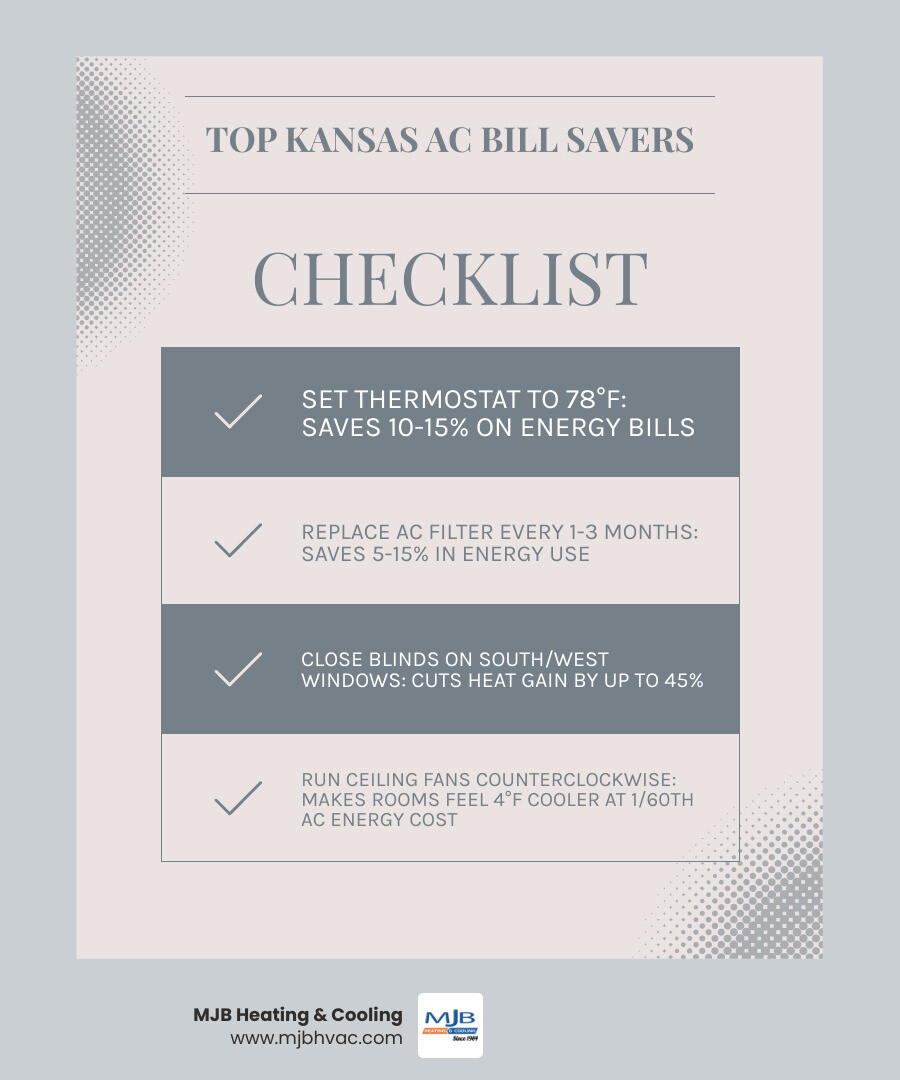
1. Set your thermostat to 78°F when you're home — each degree above 75°F saves 10-15% on energy
2. Replace your AC filter every 1-3 months — a clean filter saves 5-15% in energy use
3. Close blinds on south- and west-facing windows — fully closed blinds cut heat gain by up to 45%
4. Run ceiling fans counterclockwise — they make rooms feel up to 4 degrees cooler at 1/60th the energy cost of AC
5. Seal doors and windows with weatherstripping or caulk — this alone can reduce cooling costs by up to 20%
6. Shift appliance use to early morning or late evening to avoid adding heat during peak afternoon hours
7. Schedule a professional AC tune-up before the hottest months hit
Kansas summers are no joke. In the Wichita metro area and across Central Kansas, July and August regularly bring scorching temperatures, stubborn humidity, and heat waves that push your air conditioner to its absolute limit. When your AC runs nonstop just to keep up, your energy bill climbs fast — and many homeowners feel like there's nothing they can do about it.
The good news? Most of the biggest energy wasters in a Kansas home are surprisingly simple to fix. Small changes — from how you set your thermostat to how you hang your curtains — add up to real savings over a long, hot summer.

In our decades of serving families from Derby to Maize, we’ve seen exactly what the Kansas climate does to a home’s efficiency. The Wichita climate is unique; we don't just deal with the heat, we deal with the "heavy" air — that thick humidity that makes 90 degrees feel like 105. When the humidity is high, your AC has to work twice as hard: first to remove the moisture from the air, and second to actually lower the temperature.
This constant battle leads to high energy consumption. If your system is struggling, you might notice it running in long cycles or failing to reach the temperature you’ve set. Often, the culprit isn't a broken machine, but a lack of airflow or "leaky" home habits. Understanding How to Spot HVAC Air Flow Problems is the first step in diagnosing why your bills are spiking.
One of the most common questions we get in Andover and Sedgwick is, "What temperature should I actually set my AC to?" While we all love a crisp, cool house, the 78-degree setting is the "magic number" for financial efficiency.
It might sound a bit warm at first, but consider this: for every single degree you set your thermostat above 75°F, you can save between 10% and 15% on the energy used for cooling. If you’re currently cranking it down to 70°F, moving it up to 78°F could nearly cut your cooling costs in half.
We highly recommend investing in a smart thermostat. By April 2026, these devices have become incredibly intuitive. They allow you to program schedules so the house is warmer while you're at work in Wichita and cooler by the time you pull into the driveway. In fact, Kansas homeowners can save up to $145 per year just by using a smart thermostat to manage their cooling schedules.
For those with larger homes or specific comfort needs, we often discuss AC Mini-Split Placement for Maximum Efficiency. These systems allow for "zoning," meaning you aren't paying to keep a guest room in Goddard at 72 degrees when no one is using it.
If you want to know how to lower ac bills during hot kansas summers, look no further than your air filter. It is the single most important DIY task for any homeowner in the Newton or El Dorado area.
When a filter is clogged with Kansas dust, pet dander, and pollen, your AC has to "gasp" for air. This strain forces the motor to work harder, using more electricity and wearing out parts faster. Clearing or cleaning a clogged filter can save you 5% to 15% in energy use immediately. If you aren't sure of the timeline, check out our guide on How Often Should HVAC Air Filters Be Changed.
Beyond the filter, airflow optimization is key. We often find that 78% of service calls we receive in the summer are the result of service neglect. A professional tune-up ensures that your refrigerant levels are correct, your coils are clean, and your electrical connections are tight. Following Essential HVAC Maintenance Tips for Your Furnace and AC can prevent a mid-July breakdown when the Heat Index is soaring.
Think of your home like a cooler. If you leave the lid cracked, the ice melts. In places like Rose Hill or Park City, many homes are "leaking" cool air through tiny gaps around doors and windows.
Air leaks are the silent killers of efficiency. When hot, humid Kansas air seeps into your home, your AC has to run longer to dehumidify the space. By applying simple weatherstripping to door frames and using caulk to seal gaps around window casings, you can create a tight "envelope" for your home.
Don't forget the attic! Proper attic insulation is your home's first line of defense against the sun beating down on your roof. If your insulation is thin or settled, that heat radiates straight into your living space. Sealing these leaks and boosting your insulation can reduce your overall cooling costs by up to 20%. If you're considering an upgrade, our Guide to Preparing Your Home for a New AC covers how a well-sealed home makes your new unit much more effective.
In Kansas, the sun is most intense on the south and west sides of your house. If you have large windows facing these directions in your Valley Center or Bel Aire home, they act like giant heaters.
Using blackout curtains or heavy thermal drapes can be a game-changer. Blinds that are fully pulled down and closed over a window with direct sun exposure can reduce heat gain by up to 45%. It’s a low-tech solution that yields high-tech savings.
Once you’ve blocked the heat, you need to move the cool air efficiently. This is where the humble ceiling fan comes in.
• The Direction Matters: Ensure your fans are rotating counter-clockwise in the summer. This pushes a breeze directly down, creating a "wind chill effect" on your skin.
• The Savings: Fans use about 1/60th the energy of an air conditioner. While they don't lower the temperature of the room, they make you feel about four degrees cooler. This allows you to raise that thermostat to 78°F without feeling like you're melting.
• The Rule: Fans cool people, not rooms. If you leave the room, turn the fan off!
If you feel like certain rooms in your home stay stuffy regardless of the fan, you may need to Clear Blocked Air Ducts in Andover Home or check for obstructions in your ventilation system.
When the temperature hits 100 degrees in Hutchinson or Wellington, the local power grid feels the strain. This is often when utility companies like Evergy or BPU implement peak demand hours.
To lower your bills, try to shift your heavy electricity usage to "off-peak" hours — usually early morning or late at night.
• Cooking: Avoid using the oven during the day. It’s essentially a giant heater in the middle of your kitchen. Use a microwave, an air fryer, or head outside to the grill.
• Laundry: Run the dryer after the sun goes down. Dryers vent a massive amount of air out of your house, which is often replaced by hot air pulled in from outside.
• Dishwashing: Set your dishwasher to run at midnight.
For those looking at long-term savings, comparing the efficiency of different systems is vital.
• Energy Loss — Central AC: High (via ductwork) — Ductless Mini-Split: Very Low (no ducts)
• Zoning — Central AC: Limited — Ductless Mini-Split: Excellent
• Installation — Central AC: Complex (if no ducts) — Ductless Mini-Split: Simple
• Efficiency — Central AC: Standard SEER ratings — Ductless Mini-Split: High SEER ratings
If you’re debating which system is right for your home’s layout, our Central AC vs Ductless Mini-Split Comparison provides a deeper dive into the pros and cons for Kansas residents.
Sometimes, despite your best efforts, the AC just won't behave. During extreme heat waves, we see a few common issues pop up in places like Haysville and Mulvane.
One interesting tip for your outdoor unit: landscaping matters. Planting shrubs or trees to shade your outdoor AC unit (while keeping at least two feet of clearance for airflow) can make the system up to 10% more efficient. If the unit is sitting in the direct, baking sun, it has a harder time releasing the heat it pulled from your house.
However, keep an eye out for "red flag" symptoms:
1. Tripping Breakers: If your AC is constantly shutting off at the panel, it’s likely drawing too much power. Find out Why Your AC Circuit Breaker Keeps Tripping before you try to reset it again.
2. Unusual Smells: Musty or burning odors are never a good sign. We've detailed What Causes Unusual AC Smells in Your Home to help you identify if it's a simple mold issue or a dangerous electrical problem.
3. Water Leaks: If you see a puddle around your indoor unit, your condensate line might be clogged. Understanding Why AC Leaking Water Inside Your Home can save you from expensive floor repairs.
For the best balance of comfort and savings, 78°F is the industry standard. This setting prevents your system from running 24/7 while still keeping the humidity at a manageable level. Every degree you can tolerate above 75°F puts about 10% back into your pocket.
In the Wichita area, we recommend checking your filter every 30 days. If you have pets (the "fur factor") or if it’s a particularly dusty Kansas summer with high winds, you’ll likely need to replace it every 1-2 months. At a minimum, never go longer than 3 months without a fresh filter.
No, fans do not lower the actual temperature of a room. They cool you by moving air across your skin, which helps evaporate sweat. Because of this "wind chill," you can feel up to 4 degrees cooler, allowing you to rely less on the air conditioner and save significantly on your monthly bill.
Lowering your AC bills during a hot Kansas summer doesn't require a miracle; it requires a strategy. By combining smart thermostat habits, simple home sealing, and the targeted use of fans and shading, you can stay comfortable without dreading the arrival of your utility bill.
At MJB Heating & Cooling, we’ve been part of the Central Kansas community since 1984. As a family-owned business founded in Derby, we pride ourselves on quality workmanship and an honest approach to every job. Whether you're in Wichita, Augusta, or Clearwater, we understand the specific demands our climate puts on your HVAC system.
From routine tune-ups that boost efficiency to emergency repairs during a July heat wave, our team is here to ensure your home remains a sanctuary. If your AC is struggling to keep up or your bills are higher than they should be, don't wait for the next heat wave to hit.
Contact us today for Professional HVAC Service and let us help you find the most efficient way to keep your cool.
If you're wondering how to lower ac bills during hot kansas summers, here are the most effective steps you can take right now:
Kansas summers are no joke. In the Wichita metro area and across Central Kansas, July and August regularly bring scorching temperatures, stubborn humidity, and heat waves that push your air conditioner to its absolute limit. When your AC runs nonstop just to keep up, your energy bill climbs fast — and many homeowners feel like there's nothing they can do about it.
The good news? Most of the biggest energy wasters in a Kansas home are surprisingly simple to fix. Small changes — from how you set your thermostat to how you hang your curtains — add up to real savings over a long, hot summer.
In our decades of serving families from Derby to Maize, we’ve seen exactly what the Kansas climate does to a home’s efficiency. The Wichita climate is unique; we don't just deal with the heat, we deal with the "heavy" air — that thick humidity that makes 90 degrees feel like 105. When the humidity is high, your AC has to work twice as hard: first to remove the moisture from the air, and second to actually lower the temperature.
This constant battle leads to high energy consumption. If your system is struggling, you might notice it running in long cycles or failing to reach the temperature you’ve set. Often, the culprit isn't a broken machine, but a lack of airflow or "leaky" home habits. Understanding How to Spot HVAC Air Flow Problems is the first step in diagnosing why your bills are spiking.
One of the most common questions we get in Andover and Sedgwick is, "What temperature should I actually set my AC to?" While we all love a crisp, cool house, the 78-degree setting is the "magic number" for financial efficiency.
It might sound a bit warm at first, but consider this: for every single degree you set your thermostat above 75°F, you can save between 10% and 15% on the energy used for cooling. If you’re currently cranking it down to 70°F, moving it up to 78°F could nearly cut your cooling costs in half.
We highly recommend investing in a smart thermostat. By April 2026, these devices have become incredibly intuitive. They allow you to program schedules so the house is warmer while you're at work in Wichita and cooler by the time you pull into the driveway. In fact, Kansas homeowners can save up to $145 per year just by using a smart thermostat to manage their cooling schedules.
For those with larger homes or specific comfort needs, we often discuss AC Mini-Split Placement for Maximum Efficiency. These systems allow for "zoning," meaning you aren't paying to keep a guest room in Goddard at 72 degrees when no one is using it.
If you want to know how to lower ac bills during hot kansas summers, look no further than your air filter. It is the single most important DIY task for any homeowner in the Newton or El Dorado area.
When a filter is clogged with Kansas dust, pet dander, and pollen, your AC has to "gasp" for air. This strain forces the motor to work harder, using more electricity and wearing out parts faster. Clearing or cleaning a clogged filter can save you 5% to 15% in energy use immediately. If you aren't sure of the timeline, check out our guide on How Often Should HVAC Air Filters Be Changed.
Beyond the filter, airflow optimization is key. We often find that 78% of service calls we receive in the summer are the result of service neglect. A professional tune-up ensures that your refrigerant levels are correct, your coils are clean, and your electrical connections are tight. Following Essential HVAC Maintenance Tips for Your Furnace and AC can prevent a mid-July breakdown when the Heat Index is soaring.
Think of your home like a cooler. If you leave the lid cracked, the ice melts. In places like Rose Hill or Park City, many homes are "leaking" cool air through tiny gaps around doors and windows.
Air leaks are the silent killers of efficiency. When hot, humid Kansas air seeps into your home, your AC has to run longer to dehumidify the space. By applying simple weatherstripping to door frames and using caulk to seal gaps around window casings, you can create a tight "envelope" for your home.
Don't forget the attic! Proper attic insulation is your home's first line of defense against the sun beating down on your roof. If your insulation is thin or settled, that heat radiates straight into your living space. Sealing these leaks and boosting your insulation can reduce your overall cooling costs by up to 20%. If you're considering an upgrade, our Guide to Preparing Your Home for a New AC covers how a well-sealed home makes your new unit much more effective.
In Kansas, the sun is most intense on the south and west sides of your house. If you have large windows facing these directions in your Valley Center or Bel Aire home, they act like giant heaters.
Using blackout curtains or heavy thermal drapes can be a game-changer. Blinds that are fully pulled down and closed over a window with direct sun exposure can reduce heat gain by up to 45%. It’s a low-tech solution that yields high-tech savings.
Once you’ve blocked the heat, you need to move the cool air efficiently. This is where the humble ceiling fan comes in.
If you feel like certain rooms in your home stay stuffy regardless of the fan, you may need to Clear Blocked Air Ducts in Andover Home or check for obstructions in your ventilation system.
When the temperature hits 100 degrees in Hutchinson or Wellington, the local power grid feels the strain. This is often when utility companies like Evergy or BPU implement peak demand hours.
To lower your bills, try to shift your heavy electricity usage to "off-peak" hours — usually early morning or late at night.
For those looking at long-term savings, comparing the efficiency of different systems is vital.
| Feature | Central AC | Ductless Mini-Split |
|---|---|---|
| Energy Loss | High (via ductwork) | Very Low (no ducts) |
| Zoning | Limited | Excellent |
| Installation | Complex (if no ducts) | Simple |
| Efficiency | Standard SEER ratings | High SEER ratings |
If you’re debating which system is right for your home’s layout, our Central AC vs Ductless Mini-Split Comparison provides a deeper dive into the pros and cons for Kansas residents.
Sometimes, despite your best efforts, the AC just won't behave. During extreme heat waves, we see a few common issues pop up in places like Haysville and Mulvane.
One interesting tip for your outdoor unit: landscaping matters. Planting shrubs or trees to shade your outdoor AC unit (while keeping at least two feet of clearance for airflow) can make the system up to 10% more efficient. If the unit is sitting in the direct, baking sun, it has a harder time releasing the heat it pulled from your house.
However, keep an eye out for "red flag" symptoms:
For the best balance of comfort and savings, 78°F is the industry standard. This setting prevents your system from running 24/7 while still keeping the humidity at a manageable level. Every degree you can tolerate above 75°F puts about 10% back into your pocket.
In the Wichita area, we recommend checking your filter every 30 days. If you have pets (the "fur factor") or if it’s a particularly dusty Kansas summer with high winds, you’ll likely need to replace it every 1-2 months. At a minimum, never go longer than 3 months without a fresh filter.
No, fans do not lower the actual temperature of a room. They cool you by moving air across your skin, which helps evaporate sweat. Because of this "wind chill," you can feel up to 4 degrees cooler, allowing you to rely less on the air conditioner and save significantly on your monthly bill.
Lowering your AC bills during a hot Kansas summer doesn't require a miracle; it requires a strategy. By combining smart thermostat habits, simple home sealing, and the targeted use of fans and shading, you can stay comfortable without dreading the arrival of your utility bill.
At MJB Heating & Cooling, we’ve been part of the Central Kansas community since 1984. As a family-owned business founded in Derby, we pride ourselves on quality workmanship and an honest approach to every job. Whether you're in Wichita, Augusta, or Clearwater, we understand the specific demands our climate puts on your HVAC system.
From routine tune-ups that boost efficiency to emergency repairs during a July heat wave, our team is here to ensure your home remains a sanctuary. If your AC is struggling to keep up or your bills are higher than they should be, don't wait for the next heat wave to hit.
Contact us today for Professional HVAC Service and let us help you find the most efficient way to keep your cool.


Our A/C stopped working on a Sunday and due to health issues, we needed to find a service company available on a Sunday. I called MJB and left a message on their emergency voice mail. Within 10 minutes Tom Buck called me to hear my description of the symptoms. He was just finishing an appointment in Wichita and would be on his way to my home on the south end of Derby. He arrived within 30 minutes! From start to finish he was the perfect example of what you could ever hope for in an HVAC tech and a human being. His evaluation of our system inside and out was as thorough as I could ever imagine and once he was done with the repair, our system is running as well or better than ever. Well worth the price for the evaluation, parts, and labor. Thank you again Tom for an awesome experience.
Our AC went out during the hottest days of the year, and they were out next day! We have been jerked around by a shoddy home warranty for years. We finally had a chance to pick our own repair people, and MJB came highly recommended. I can see why! I was impressed with the honesty and speed at which they fixed our AC unit!
Our commercial building had a lightening/electrical strike and damaged our 20 ton AC unit. No one could find us a new unit before the end of September. Imagining going all of August and September with no AC in Kansas and working inside near 100 degree temps is less than thrilling. Dale and the team at MJB called around and saved the day. They had us a new unit 5 weeks earlier than other could promise and I now have happy employees. The unit is amazingly quiet, super cold and so much more energy efficient. Thank you for being our super hero!
Came out and installed my new furnace. Was very polite and affordable. They are very acknowledgeable and I highly recommend!
Thank you very much. We had our 1st warm night in 3weeks. MJB took the time and effort to find the real problem. And the employees were kind and thoughtful and explained things very well. I cannot thank you and all of MJB. Will recommend you highly. Thanks again Marjorie Herman Oxford Kansas
We had a new system installed and I was so impressed with how quick they were in come out and install it, in the middle of a hot summer day. They were so friendly & very professional. I had a small problem with a weird sound and they came over immediately and fixed it. Love them!