.avif)





Blogs
Stay updated with our latest blog posts.
The central ac vs ductless mini split comparison comes down to one practical question: does your home already have working ductwork, and how well is it actually performing?
Both systems cool your home using refrigerant. But how they deliver that cooled air — and how much of it actually reaches you — is where the differences add up fast.
Quick Answer: Central AC vs. Ductless Mini Split
| Factor | Central AC | Ductless Mini Split |
|---|---|---|
| Requires ductwork | Yes | No |
| Best for | Homes with existing ducts | Homes without ducts, additions, zones |
| SEER2 efficiency range | 13–21+ | 18–38+ |
| Duct energy loss | 20–30% | None |
| Zone control | Limited (add-ons needed) | Built-in, per room |
| Heating capability | Pairs with furnace | Built-in heat pump |
| Typical lifespan | 15–20 years | 20+ years |
| Installation disruption | High (if adding ducts) | Minimal |
Choose central AC if:
Choose a ductless mini split if:
For Central Kansas homeowners in Wichita, Andover, Derby, and surrounding communities, the answer often depends on your home's age, layout, and the condition of any existing duct system. Older homes, slab-on-grade construction, and room additions all tend to favor ductless. Homes built after the 1970s with intact ductwork often do just fine with central air — as long as those ducts aren't leaking.
Here's the part most people don't hear until they're already committed to a system: typical duct systems lose around 25–30% of cooled air before it ever reaches a vent. On a hot Kansas summer day, that's a significant chunk of your energy bill disappearing into your attic or walls. Ductless systems eliminate that loss entirely by delivering conditioned air directly into each room.
That said, neither system wins in every situation. The right choice depends on your specific home, how you use it, and what your long-term comfort goals are.
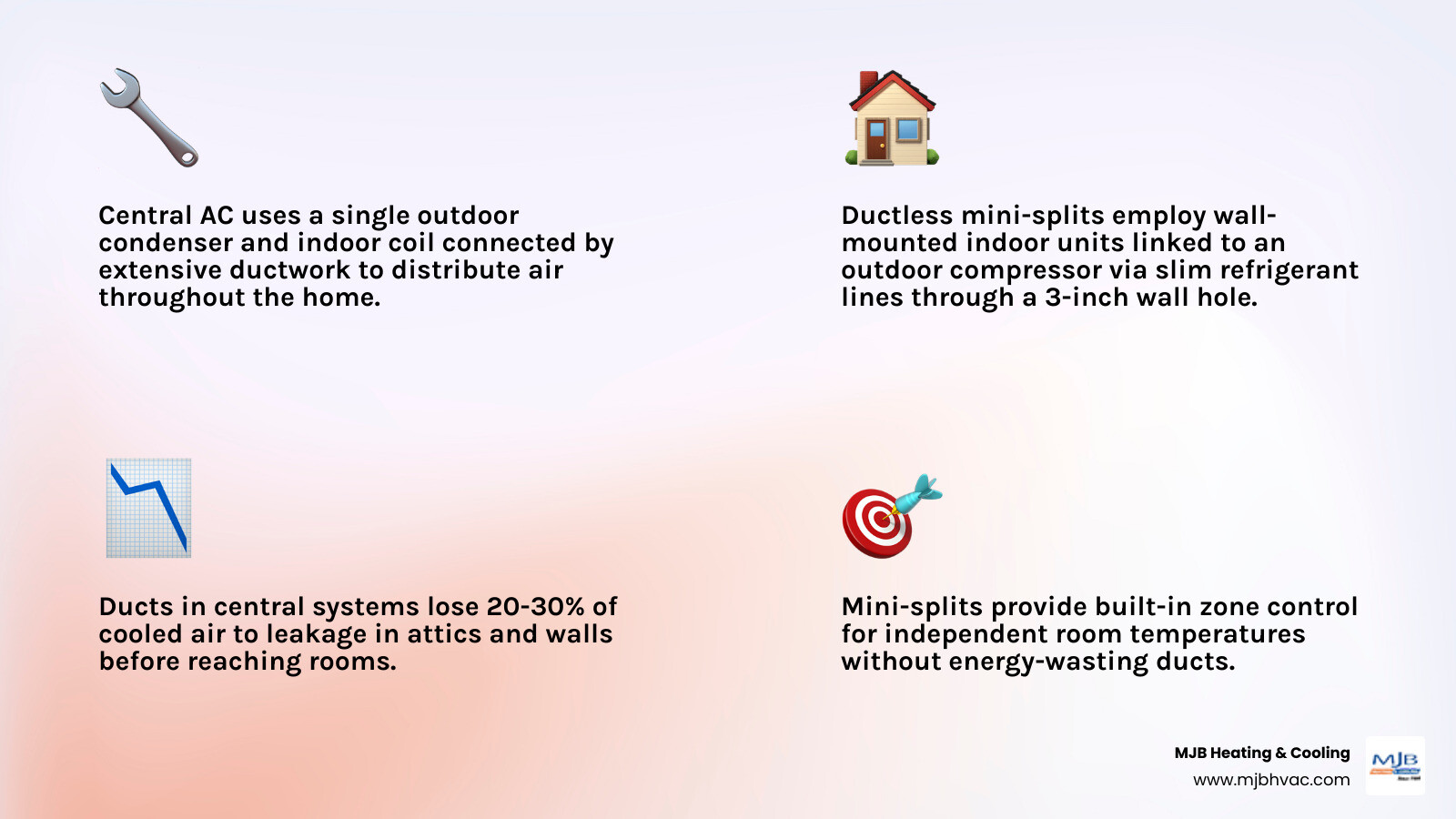
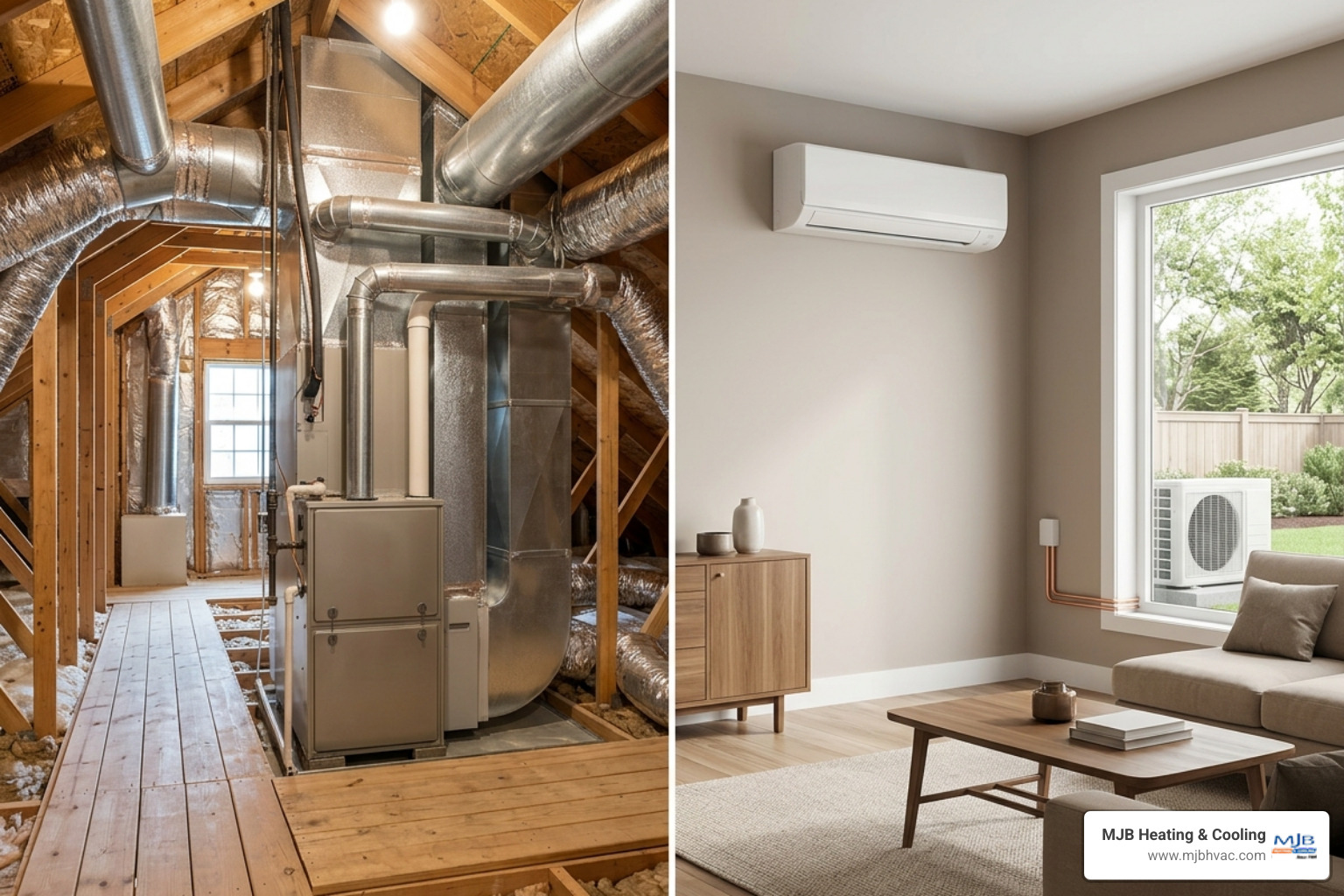
To make an informed choice for your sanctuary, we first need to look at how these two technologies differ under the hood. Traditional central air conditioning is a "whole-home" solution. It relies on a large outdoor condenser unit and an indoor evaporator coil, usually tucked away in a closet or basement. The cool air is then pushed through a network of hidden ducts and out through vents in every room. It’s a set-it-and-forget-it approach where one thermostat dictates the temperature for the entire house.
Ductless mini-splits, on the other hand, take a more surgical approach. Instead of one massive air handler, they use small, sleek indoor units (often called "heads") mounted directly on the walls or ceilings of specific rooms. These are connected to an outdoor compressor by small refrigerant lines and electrical wiring that only require a tiny three-inch hole in your exterior wall. This setup allows for Single vs Multi-Zone Ductless AC Systems, meaning you can cool just the living room during the day and only the bedrooms at night.
The beauty of the ductless approach is Temperature Zoning with Ductless AC Systems. In a traditional central system, if your upstairs bedroom is sweltering while your downstairs kitchen is freezing, there isn't much the thermostat can do. With a mini-split, each zone has its own controller. This is a game-changer for families in Central Kansas who have different "comfort settings"—no more thermostat wars!
As we move through 2026, energy efficiency isn't just a buzzword; it’s a necessity for managing utility bills. When performing a central ac vs ductless mini split comparison, the SEER2 (Seasonal Energy Efficiency Ratio 2) ratings tell a compelling story. Central AC systems typically range from 13 to 21+ SEER2. Ductless systems, however, frequently soar into the 30s, with some ultra-high-efficiency models reaching as high as 38+ SEER2.
Why the massive gap? It comes down to two main factors: inverter technology and duct loss. Most central AC units are "single-stage," meaning they are either 100% on or 100% off. Imagine driving a car by only flooring the gas or hitting the brakes—it’s not very efficient. Ductless systems use inverter-driven, variable-speed compressors that adjust their output to match the cooling load exactly. They sip energy to maintain a steady temperature rather than gulping it down during frequent start-stop cycles.
Then there is the "duct tax." Research shows that typical duct systems lose about 25% to 30% of their cooling energy through leaks, poor insulation, or "thermal bridging" (where heat from a hot attic transfers through the duct walls into the cool air inside). Because ductless systems deliver air directly into the room, they have zero duct loss.
When you factor in the 2026 efficiency standards, the operational savings of a mini-split become very clear. By eliminating the 30% waste from leaky ducts and utilizing variable-speed technology, ductless systems can save homeowners up to 30% or more on cooling costs compared to traditional central air.
For a home in Wichita or Derby, this means your "unconditioned spaces"—like the attic or the crawlspace—stop stealing the air you’ve already paid to cool. Furthermore, AC Mini Split Placement for Maximum Efficiency ensures that the air handler isn't fighting against sunlight or heat-generating appliances, further driving down monthly consumption.
| Feature | Central AC | Ductless Mini Split |
|---|---|---|
| Max SEER2 | Up to 26 | Up to 38+ |
| Compressor Type | Single or Two-Stage | Variable-Speed Inverter |
| Energy Waste | 20-30% via ducts | 0% |
| Zoning | One temperature for all | Individual room control |
Home layout is often the deciding factor in our local service area. If you live in a newer home in Andover or Maize that was built with a robust duct system, replacing your old unit with a high-efficiency central AC is often a straightforward and effective choice.
However, Central Kansas is full of beautiful older homes, slab-on-grade houses, and creative room additions that weren't designed for bulky ductwork. In these cases, Ductless AC Andover KS services are often the most practical path forward. Installing new ducts in an existing home can be incredibly invasive—requiring us to cut into walls and ceilings—and can add up to $18,000 to the total project cost.
Multi-story homes also present a unique challenge. We often see situations where the central AC keeps the first floor perfect, but the upstairs remains five degrees warmer. Instead of replacing the whole system, many homeowners opt for AC Mini Split Haysville KS installations to "boost" the cooling in those stubborn upstairs bedrooms or home offices.
While we talk a lot about cooling, we can't forget our Kansas winters. Most modern mini-splits are actually heat pumps. This means they can reverse their operation to provide highly efficient heating. In the past, heat pumps struggled when temperatures dropped below freezing, but 2026-era cold-climate models can now provide effective heat even when it's well below zero outside.
For those in Derby or Wichita, AC Mini Split Derby KS systems can serve as a primary heat source or a supplemental one. If you have a room that is always chilly in the winter—like a converted garage or a sunroom—a mini-split provides a "two-for-one" solution that handles both July's heat and January's frost without needing to tap into your main furnace.
No matter which system you choose, longevity depends on how well you treat it. Central AC systems typically last about 15 to 20 years. Interestingly, because they don't have to work as hard (thanks to that inverter technology), mini-split systems can often last 20 to 30 years with proper care.
Maintenance requirements differ slightly between the two. Central AC requires you to change one or two large filters every 1 to 3 months and have the ductwork professionally cleaned every few years. Ductless systems require you to clean the small, reusable filters inside each indoor head every 2 to 4 weeks. It’s a simple task—just rinse them in the sink and let them dry—but it’s vital for preventing Temperature Inconsistencies in Your AC Mini Split.
When it comes to breathing easy, there are many Ways Ductless AC Improves Indoor Air. Because there are no ducts, there is no place for dust, allergens, or mold to accumulate and circulate through your home. Each unit filters the air in that specific room, which is excellent for allergy sufferers.
However, you should keep an eye out for Signs Your Ductless AC System Needs Attention, such as strange noises or a drop in performance. If you notice a decrease in comfort, we can help you Resolve Poor Airflow Issues with Ductless AC to ensure your system continues to run at peak efficiency for decades.
At MJB Heating & Cooling, we believe there is no "one-size-fits-all" answer to the central ac vs ductless mini split comparison. Our family-owned business has been serving the Wichita metro area since 1984, and we've seen every type of home configuration imaginable. Whether you are in Derby, Andover, or anywhere in between, our goal is to provide an honest, professional assessment of what will work best for your unique sanctuary.
If your home has healthy ducts and you like uniform cooling, a modern central AC is a fantastic investment. If you are dealing with hot spots, a lack of ductwork, or a desire for the ultimate in energy efficiency and zone control, a mini-split is likely the "game-changer" you've been looking for. We pride ourselves on quality workmanship and a straightforward approach—we'll never sell you a system you don't need.
For those ready to explore their options, we offer expert Ductless AC Derby KS services and whole-home cooling consultations to help you stay comfortable through the harshest Kansas seasons.
Ductless mini-splits are the clear winner for homes without existing ductwork. Retrofitting a home with new ducts is a massive undertaking that involves tearing into drywall, losing closet space, and significant labor. A mini-split installation is much less invasive, usually completed in a single day, and preserves the structural integrity and aesthetic of your home.
Mini-splits are remarkably quiet. The indoor units typically operate between 19 and 26 decibels—that is softer than a whisper or a quiet library. You’ll barely notice they are running. Central AC systems are also modern and quiet, but you will often hear the "whoosh" of air moving through the vents and the sound of the large air handler starting up, which can be more disruptive than the steady, low-hum of a ductless unit.
Absolutely! This is what we call a hybrid configuration. Many Wichita homeowners keep their central AC for the main part of the house but add a mini-split to a "problem room" like a master bedroom that won't stay cool or a newly finished basement. This allows you to Troubleshoot Uneven Cooling with Ductless AC without overworking your main system, giving you the best of both worlds.
The central ac vs ductless mini split comparison comes down to one practical question: does your home already have working ductwork, and how well is it actually performing?
Both systems cool your home using refrigerant. But how they deliver that cooled air — and how much of it actually reaches you — is where the differences add up fast.
Quick Answer: Central AC vs. Ductless Mini Split
| Factor | Central AC | Ductless Mini Split |
|---|---|---|
| Requires ductwork | Yes | No |
| Best for | Homes with existing ducts | Homes without ducts, additions, zones |
| SEER2 efficiency range | 13–21+ | 18–38+ |
| Duct energy loss | 20–30% | None |
| Zone control | Limited (add-ons needed) | Built-in, per room |
| Heating capability | Pairs with furnace | Built-in heat pump |
| Typical lifespan | 15–20 years | 20+ years |
| Installation disruption | High (if adding ducts) | Minimal |
Choose central AC if:
Choose a ductless mini split if:
For Central Kansas homeowners in Wichita, Andover, Derby, and surrounding communities, the answer often depends on your home's age, layout, and the condition of any existing duct system. Older homes, slab-on-grade construction, and room additions all tend to favor ductless. Homes built after the 1970s with intact ductwork often do just fine with central air — as long as those ducts aren't leaking.
Here's the part most people don't hear until they're already committed to a system: typical duct systems lose around 25–30% of cooled air before it ever reaches a vent. On a hot Kansas summer day, that's a significant chunk of your energy bill disappearing into your attic or walls. Ductless systems eliminate that loss entirely by delivering conditioned air directly into each room.
That said, neither system wins in every situation. The right choice depends on your specific home, how you use it, and what your long-term comfort goals are.
To make an informed choice for your sanctuary, we first need to look at how these two technologies differ under the hood. Traditional central air conditioning is a "whole-home" solution. It relies on a large outdoor condenser unit and an indoor evaporator coil, usually tucked away in a closet or basement. The cool air is then pushed through a network of hidden ducts and out through vents in every room. It’s a set-it-and-forget-it approach where one thermostat dictates the temperature for the entire house.
Ductless mini-splits, on the other hand, take a more surgical approach. Instead of one massive air handler, they use small, sleek indoor units (often called "heads") mounted directly on the walls or ceilings of specific rooms. These are connected to an outdoor compressor by small refrigerant lines and electrical wiring that only require a tiny three-inch hole in your exterior wall. This setup allows for Single vs Multi-Zone Ductless AC Systems, meaning you can cool just the living room during the day and only the bedrooms at night.
The beauty of the ductless approach is Temperature Zoning with Ductless AC Systems. In a traditional central system, if your upstairs bedroom is sweltering while your downstairs kitchen is freezing, there isn't much the thermostat can do. With a mini-split, each zone has its own controller. This is a game-changer for families in Central Kansas who have different "comfort settings"—no more thermostat wars!
As we move through 2026, energy efficiency isn't just a buzzword; it’s a necessity for managing utility bills. When performing a central ac vs ductless mini split comparison, the SEER2 (Seasonal Energy Efficiency Ratio 2) ratings tell a compelling story. Central AC systems typically range from 13 to 21+ SEER2. Ductless systems, however, frequently soar into the 30s, with some ultra-high-efficiency models reaching as high as 38+ SEER2.
Why the massive gap? It comes down to two main factors: inverter technology and duct loss. Most central AC units are "single-stage," meaning they are either 100% on or 100% off. Imagine driving a car by only flooring the gas or hitting the brakes—it’s not very efficient. Ductless systems use inverter-driven, variable-speed compressors that adjust their output to match the cooling load exactly. They sip energy to maintain a steady temperature rather than gulping it down during frequent start-stop cycles.
Then there is the "duct tax." Research shows that typical duct systems lose about 25% to 30% of their cooling energy through leaks, poor insulation, or "thermal bridging" (where heat from a hot attic transfers through the duct walls into the cool air inside). Because ductless systems deliver air directly into the room, they have zero duct loss.
When you factor in the 2026 efficiency standards, the operational savings of a mini-split become very clear. By eliminating the 30% waste from leaky ducts and utilizing variable-speed technology, ductless systems can save homeowners up to 30% or more on cooling costs compared to traditional central air.
For a home in Wichita or Derby, this means your "unconditioned spaces"—like the attic or the crawlspace—stop stealing the air you’ve already paid to cool. Furthermore, AC Mini Split Placement for Maximum Efficiency ensures that the air handler isn't fighting against sunlight or heat-generating appliances, further driving down monthly consumption.
| Feature | Central AC | Ductless Mini Split |
|---|---|---|
| Max SEER2 | Up to 26 | Up to 38+ |
| Compressor Type | Single or Two-Stage | Variable-Speed Inverter |
| Energy Waste | 20-30% via ducts | 0% |
| Zoning | One temperature for all | Individual room control |
Home layout is often the deciding factor in our local service area. If you live in a newer home in Andover or Maize that was built with a robust duct system, replacing your old unit with a high-efficiency central AC is often a straightforward and effective choice.
However, Central Kansas is full of beautiful older homes, slab-on-grade houses, and creative room additions that weren't designed for bulky ductwork. In these cases, Ductless AC Andover KS services are often the most practical path forward. Installing new ducts in an existing home can be incredibly invasive—requiring us to cut into walls and ceilings—and can add up to $18,000 to the total project cost.
Multi-story homes also present a unique challenge. We often see situations where the central AC keeps the first floor perfect, but the upstairs remains five degrees warmer. Instead of replacing the whole system, many homeowners opt for AC Mini Split Haysville KS installations to "boost" the cooling in those stubborn upstairs bedrooms or home offices.
While we talk a lot about cooling, we can't forget our Kansas winters. Most modern mini-splits are actually heat pumps. This means they can reverse their operation to provide highly efficient heating. In the past, heat pumps struggled when temperatures dropped below freezing, but 2026-era cold-climate models can now provide effective heat even when it's well below zero outside.
For those in Derby or Wichita, AC Mini Split Derby KS systems can serve as a primary heat source or a supplemental one. If you have a room that is always chilly in the winter—like a converted garage or a sunroom—a mini-split provides a "two-for-one" solution that handles both July's heat and January's frost without needing to tap into your main furnace.
No matter which system you choose, longevity depends on how well you treat it. Central AC systems typically last about 15 to 20 years. Interestingly, because they don't have to work as hard (thanks to that inverter technology), mini-split systems can often last 20 to 30 years with proper care.
Maintenance requirements differ slightly between the two. Central AC requires you to change one or two large filters every 1 to 3 months and have the ductwork professionally cleaned every few years. Ductless systems require you to clean the small, reusable filters inside each indoor head every 2 to 4 weeks. It’s a simple task—just rinse them in the sink and let them dry—but it’s vital for preventing Temperature Inconsistencies in Your AC Mini Split.
When it comes to breathing easy, there are many Ways Ductless AC Improves Indoor Air. Because there are no ducts, there is no place for dust, allergens, or mold to accumulate and circulate through your home. Each unit filters the air in that specific room, which is excellent for allergy sufferers.
However, you should keep an eye out for Signs Your Ductless AC System Needs Attention, such as strange noises or a drop in performance. If you notice a decrease in comfort, we can help you Resolve Poor Airflow Issues with Ductless AC to ensure your system continues to run at peak efficiency for decades.
At MJB Heating & Cooling, we believe there is no "one-size-fits-all" answer to the central ac vs ductless mini split comparison. Our family-owned business has been serving the Wichita metro area since 1984, and we've seen every type of home configuration imaginable. Whether you are in Derby, Andover, or anywhere in between, our goal is to provide an honest, professional assessment of what will work best for your unique sanctuary.
If your home has healthy ducts and you like uniform cooling, a modern central AC is a fantastic investment. If you are dealing with hot spots, a lack of ductwork, or a desire for the ultimate in energy efficiency and zone control, a mini-split is likely the "game-changer" you've been looking for. We pride ourselves on quality workmanship and a straightforward approach—we'll never sell you a system you don't need.
For those ready to explore their options, we offer expert Ductless AC Derby KS services and whole-home cooling consultations to help you stay comfortable through the harshest Kansas seasons.
Ductless mini-splits are the clear winner for homes without existing ductwork. Retrofitting a home with new ducts is a massive undertaking that involves tearing into drywall, losing closet space, and significant labor. A mini-split installation is much less invasive, usually completed in a single day, and preserves the structural integrity and aesthetic of your home.
Mini-splits are remarkably quiet. The indoor units typically operate between 19 and 26 decibels—that is softer than a whisper or a quiet library. You’ll barely notice they are running. Central AC systems are also modern and quiet, but you will often hear the "whoosh" of air moving through the vents and the sound of the large air handler starting up, which can be more disruptive than the steady, low-hum of a ductless unit.
Absolutely! This is what we call a hybrid configuration. Many Wichita homeowners keep their central AC for the main part of the house but add a mini-split to a "problem room" like a master bedroom that won't stay cool or a newly finished basement. This allows you to Troubleshoot Uneven Cooling with Ductless AC without overworking your main system, giving you the best of both worlds.
The central ac vs ductless mini split comparison comes down to one practical question: does your home already have working ductwork, and how well is it actually performing?
Both systems cool your home using refrigerant. But how they deliver that cooled air — and how much of it actually reaches you — is where the differences add up fast.
Quick Answer: Central AC vs. Ductless Mini Split
| Factor | Central AC | Ductless Mini Split |
|---|---|---|
| Requires ductwork | Yes | No |
| Best for | Homes with existing ducts | Homes without ducts, additions, zones |
| SEER2 efficiency range | 13–21+ | 18–38+ |
| Duct energy loss | 20–30% | None |
| Zone control | Limited (add-ons needed) | Built-in, per room |
| Heating capability | Pairs with furnace | Built-in heat pump |
| Typical lifespan | 15–20 years | 20+ years |
| Installation disruption | High (if adding ducts) | Minimal |
Choose central AC if:
Choose a ductless mini split if:
For Central Kansas homeowners in Wichita, Andover, Derby, and surrounding communities, the answer often depends on your home's age, layout, and the condition of any existing duct system. Older homes, slab-on-grade construction, and room additions all tend to favor ductless. Homes built after the 1970s with intact ductwork often do just fine with central air — as long as those ducts aren't leaking.
Here's the part most people don't hear until they're already committed to a system: typical duct systems lose around 25–30% of cooled air before it ever reaches a vent. On a hot Kansas summer day, that's a significant chunk of your energy bill disappearing into your attic or walls. Ductless systems eliminate that loss entirely by delivering conditioned air directly into each room.
That said, neither system wins in every situation. The right choice depends on your specific home, how you use it, and what your long-term comfort goals are.
To make an informed choice for your sanctuary, we first need to look at how these two technologies differ under the hood. Traditional central air conditioning is a "whole-home" solution. It relies on a large outdoor condenser unit and an indoor evaporator coil, usually tucked away in a closet or basement. The cool air is then pushed through a network of hidden ducts and out through vents in every room. It’s a set-it-and-forget-it approach where one thermostat dictates the temperature for the entire house.
Ductless mini-splits, on the other hand, take a more surgical approach. Instead of one massive air handler, they use small, sleek indoor units (often called "heads") mounted directly on the walls or ceilings of specific rooms. These are connected to an outdoor compressor by small refrigerant lines and electrical wiring that only require a tiny three-inch hole in your exterior wall. This setup allows for Single vs Multi-Zone Ductless AC Systems, meaning you can cool just the living room during the day and only the bedrooms at night.
The beauty of the ductless approach is Temperature Zoning with Ductless AC Systems. In a traditional central system, if your upstairs bedroom is sweltering while your downstairs kitchen is freezing, there isn't much the thermostat can do. With a mini-split, each zone has its own controller. This is a game-changer for families in Central Kansas who have different "comfort settings"—no more thermostat wars!
As we move through 2026, energy efficiency isn't just a buzzword; it’s a necessity for managing utility bills. When performing a central ac vs ductless mini split comparison, the SEER2 (Seasonal Energy Efficiency Ratio 2) ratings tell a compelling story. Central AC systems typically range from 13 to 21+ SEER2. Ductless systems, however, frequently soar into the 30s, with some ultra-high-efficiency models reaching as high as 38+ SEER2.
Why the massive gap? It comes down to two main factors: inverter technology and duct loss. Most central AC units are "single-stage," meaning they are either 100% on or 100% off. Imagine driving a car by only flooring the gas or hitting the brakes—it’s not very efficient. Ductless systems use inverter-driven, variable-speed compressors that adjust their output to match the cooling load exactly. They sip energy to maintain a steady temperature rather than gulping it down during frequent start-stop cycles.
Then there is the "duct tax." Research shows that typical duct systems lose about 25% to 30% of their cooling energy through leaks, poor insulation, or "thermal bridging" (where heat from a hot attic transfers through the duct walls into the cool air inside). Because ductless systems deliver air directly into the room, they have zero duct loss.
When you factor in the 2026 efficiency standards, the operational savings of a mini-split become very clear. By eliminating the 30% waste from leaky ducts and utilizing variable-speed technology, ductless systems can save homeowners up to 30% or more on cooling costs compared to traditional central air.
For a home in Wichita or Derby, this means your "unconditioned spaces"—like the attic or the crawlspace—stop stealing the air you’ve already paid to cool. Furthermore, AC Mini Split Placement for Maximum Efficiency ensures that the air handler isn't fighting against sunlight or heat-generating appliances, further driving down monthly consumption.
| Feature | Central AC | Ductless Mini Split |
|---|---|---|
| Max SEER2 | Up to 26 | Up to 38+ |
| Compressor Type | Single or Two-Stage | Variable-Speed Inverter |
| Energy Waste | 20-30% via ducts | 0% |
| Zoning | One temperature for all | Individual room control |
Home layout is often the deciding factor in our local service area. If you live in a newer home in Andover or Maize that was built with a robust duct system, replacing your old unit with a high-efficiency central AC is often a straightforward and effective choice.
However, Central Kansas is full of beautiful older homes, slab-on-grade houses, and creative room additions that weren't designed for bulky ductwork. In these cases, Ductless AC Andover KS services are often the most practical path forward. Installing new ducts in an existing home can be incredibly invasive—requiring us to cut into walls and ceilings—and can add up to $18,000 to the total project cost.
Multi-story homes also present a unique challenge. We often see situations where the central AC keeps the first floor perfect, but the upstairs remains five degrees warmer. Instead of replacing the whole system, many homeowners opt for AC Mini Split Haysville KS installations to "boost" the cooling in those stubborn upstairs bedrooms or home offices.
While we talk a lot about cooling, we can't forget our Kansas winters. Most modern mini-splits are actually heat pumps. This means they can reverse their operation to provide highly efficient heating. In the past, heat pumps struggled when temperatures dropped below freezing, but 2026-era cold-climate models can now provide effective heat even when it's well below zero outside.
For those in Derby or Wichita, AC Mini Split Derby KS systems can serve as a primary heat source or a supplemental one. If you have a room that is always chilly in the winter—like a converted garage or a sunroom—a mini-split provides a "two-for-one" solution that handles both July's heat and January's frost without needing to tap into your main furnace.
No matter which system you choose, longevity depends on how well you treat it. Central AC systems typically last about 15 to 20 years. Interestingly, because they don't have to work as hard (thanks to that inverter technology), mini-split systems can often last 20 to 30 years with proper care.
Maintenance requirements differ slightly between the two. Central AC requires you to change one or two large filters every 1 to 3 months and have the ductwork professionally cleaned every few years. Ductless systems require you to clean the small, reusable filters inside each indoor head every 2 to 4 weeks. It’s a simple task—just rinse them in the sink and let them dry—but it’s vital for preventing Temperature Inconsistencies in Your AC Mini Split.
When it comes to breathing easy, there are many Ways Ductless AC Improves Indoor Air. Because there are no ducts, there is no place for dust, allergens, or mold to accumulate and circulate through your home. Each unit filters the air in that specific room, which is excellent for allergy sufferers.
However, you should keep an eye out for Signs Your Ductless AC System Needs Attention, such as strange noises or a drop in performance. If you notice a decrease in comfort, we can help you Resolve Poor Airflow Issues with Ductless AC to ensure your system continues to run at peak efficiency for decades.
At MJB Heating & Cooling, we believe there is no "one-size-fits-all" answer to the central ac vs ductless mini split comparison. Our family-owned business has been serving the Wichita metro area since 1984, and we've seen every type of home configuration imaginable. Whether you are in Derby, Andover, or anywhere in between, our goal is to provide an honest, professional assessment of what will work best for your unique sanctuary.
If your home has healthy ducts and you like uniform cooling, a modern central AC is a fantastic investment. If you are dealing with hot spots, a lack of ductwork, or a desire for the ultimate in energy efficiency and zone control, a mini-split is likely the "game-changer" you've been looking for. We pride ourselves on quality workmanship and a straightforward approach—we'll never sell you a system you don't need.
For those ready to explore their options, we offer expert Ductless AC Derby KS services and whole-home cooling consultations to help you stay comfortable through the harshest Kansas seasons.
Ductless mini-splits are the clear winner for homes without existing ductwork. Retrofitting a home with new ducts is a massive undertaking that involves tearing into drywall, losing closet space, and significant labor. A mini-split installation is much less invasive, usually completed in a single day, and preserves the structural integrity and aesthetic of your home.
Mini-splits are remarkably quiet. The indoor units typically operate between 19 and 26 decibels—that is softer than a whisper or a quiet library. You’ll barely notice they are running. Central AC systems are also modern and quiet, but you will often hear the "whoosh" of air moving through the vents and the sound of the large air handler starting up, which can be more disruptive than the steady, low-hum of a ductless unit.
Absolutely! This is what we call a hybrid configuration. Many Wichita homeowners keep their central AC for the main part of the house but add a mini-split to a "problem room" like a master bedroom that won't stay cool or a newly finished basement. This allows you to Troubleshoot Uneven Cooling with Ductless AC without overworking your main system, giving you the best of both worlds.

The central ac vs ductless mini split comparison comes down to one practical question: does your home already have working ductwork, and how well is it actually performing?
Both systems cool your home using refrigerant. But how they deliver that cooled air — and how much of it actually reaches you — is where the differences add up fast.
Quick Answer: Central AC vs. Ductless Mini Split
• Requires ductwork — Central AC: Yes — Ductless Mini Split: No
• Best for — Central AC: Homes with existing ducts — Ductless Mini Split: Homes without ducts, additions, zones
• SEER2 efficiency range — Central AC: 13–21+ — Ductless Mini Split: 18–38+
• Duct energy loss — Central AC: 20–30% — Ductless Mini Split: None
• Zone control — Central AC: Limited (add-ons needed) — Ductless Mini Split: Built-in, per room
• Heating capability — Central AC: Pairs with furnace — Ductless Mini Split: Built-in heat pump
• Typical lifespan — Central AC: 15–20 years — Ductless Mini Split: 20+ years
• Installation disruption — Central AC: High (if adding ducts) — Ductless Mini Split: Minimal
Choose central AC if:
• Your home has existing ductwork in good condition
• You want whole-home cooling from one thermostat
• You have a larger home over 2,000 square feet
Choose a ductless mini split if:
• Your home has no ductwork
• You're cooling an addition, garage, or converted space
• You want room-by-room temperature control
• You're replacing both an aging AC and furnace
For Central Kansas homeowners in Wichita, Andover, Derby, and surrounding communities, the answer often depends on your home's age, layout, and the condition of any existing duct system. Older homes, slab-on-grade construction, and room additions all tend to favor ductless. Homes built after the 1970s with intact ductwork often do just fine with central air — as long as those ducts aren't leaking.
Here's the part most people don't hear until they're already committed to a system: typical duct systems lose around 25–30% of cooled air before it ever reaches a vent. On a hot Kansas summer day, that's a significant chunk of your energy bill disappearing into your attic or walls. Ductless systems eliminate that loss entirely by delivering conditioned air directly into each room.
That said, neither system wins in every situation. The right choice depends on your specific home, how you use it, and what your long-term comfort goals are.

To make an informed choice for your sanctuary, we first need to look at how these two technologies differ under the hood. Traditional central air conditioning is a "whole-home" solution. It relies on a large outdoor condenser unit and an indoor evaporator coil, usually tucked away in a closet or basement. The cool air is then pushed through a network of hidden ducts and out through vents in every room. It’s a set-it-and-forget-it approach where one thermostat dictates the temperature for the entire house.
Ductless mini-splits, on the other hand, take a more surgical approach. Instead of one massive air handler, they use small, sleek indoor units (often called "heads") mounted directly on the walls or ceilings of specific rooms. These are connected to an outdoor compressor by small refrigerant lines and electrical wiring that only require a tiny three-inch hole in your exterior wall. This setup allows for Single vs Multi-Zone Ductless AC Systems, meaning you can cool just the living room during the day and only the bedrooms at night.
The beauty of the ductless approach is Temperature Zoning with Ductless AC Systems. In a traditional central system, if your upstairs bedroom is sweltering while your downstairs kitchen is freezing, there isn't much the thermostat can do. With a mini-split, each zone has its own controller. This is a game-changer for families in Central Kansas who have different "comfort settings"—no more thermostat wars!
As we move through 2026, energy efficiency isn't just a buzzword; it’s a necessity for managing utility bills. When performing a central ac vs ductless mini split comparison, the SEER2 (Seasonal Energy Efficiency Ratio 2) ratings tell a compelling story. Central AC systems typically range from 13 to 21+ SEER2. Ductless systems, however, frequently soar into the 30s, with some ultra-high-efficiency models reaching as high as 38+ SEER2.
Why the massive gap? It comes down to two main factors: inverter technology and duct loss. Most central AC units are "single-stage," meaning they are either 100% on or 100% off. Imagine driving a car by only flooring the gas or hitting the brakes—it’s not very efficient. Ductless systems use inverter-driven, variable-speed compressors that adjust their output to match the cooling load exactly. They sip energy to maintain a steady temperature rather than gulping it down during frequent start-stop cycles.
Then there is the "duct tax." Research shows that typical duct systems lose about 25% to 30% of their cooling energy through leaks, poor insulation, or "thermal bridging" (where heat from a hot attic transfers through the duct walls into the cool air inside). Because ductless systems deliver air directly into the room, they have zero duct loss.
When you factor in the 2026 efficiency standards, the operational savings of a mini-split become very clear. By eliminating the 30% waste from leaky ducts and utilizing variable-speed technology, ductless systems can save homeowners up to 30% or more on cooling costs compared to traditional central air.
For a home in Wichita or Derby, this means your "unconditioned spaces"—like the attic or the crawlspace—stop stealing the air you’ve already paid to cool. Furthermore, AC Mini Split Placement for Maximum Efficiency ensures that the air handler isn't fighting against sunlight or heat-generating appliances, further driving down monthly consumption.
• Max SEER2 — Central AC: Up to 26 — Ductless Mini Split: Up to 38+
• Compressor Type — Central AC: Single or Two-Stage — Ductless Mini Split: Variable-Speed Inverter
• Energy Waste — Central AC: 20-30% via ducts — Ductless Mini Split: 0%
• Zoning — Central AC: One temperature for all — Ductless Mini Split: Individual room control
Home layout is often the deciding factor in our local service area. If you live in a newer home in Andover or Maize that was built with a robust duct system, replacing your old unit with a high-efficiency central AC is often a straightforward and effective choice.
However, Central Kansas is full of beautiful older homes, slab-on-grade houses, and creative room additions that weren't designed for bulky ductwork. In these cases, Ductless AC Andover KS services are often the most practical path forward. Installing new ducts in an existing home can be incredibly invasive—requiring us to cut into walls and ceilings—and can add up to $18,000 to the total project cost.
Multi-story homes also present a unique challenge. We often see situations where the central AC keeps the first floor perfect, but the upstairs remains five degrees warmer. Instead of replacing the whole system, many homeowners opt for AC Mini Split Haysville KS installations to "boost" the cooling in those stubborn upstairs bedrooms or home offices.
While we talk a lot about cooling, we can't forget our Kansas winters. Most modern mini-splits are actually heat pumps. This means they can reverse their operation to provide highly efficient heating. In the past, heat pumps struggled when temperatures dropped below freezing, but 2026-era cold-climate models can now provide effective heat even when it's well below zero outside.
For those in Derby or Wichita, AC Mini Split Derby KS systems can serve as a primary heat source or a supplemental one. If you have a room that is always chilly in the winter—like a converted garage or a sunroom—a mini-split provides a "two-for-one" solution that handles both July's heat and January's frost without needing to tap into your main furnace.
No matter which system you choose, longevity depends on how well you treat it. Central AC systems typically last about 15 to 20 years. Interestingly, because they don't have to work as hard (thanks to that inverter technology), mini-split systems can often last 20 to 30 years with proper care.
Maintenance requirements differ slightly between the two. Central AC requires you to change one or two large filters every 1 to 3 months and have the ductwork professionally cleaned every few years. Ductless systems require you to clean the small, reusable filters inside each indoor head every 2 to 4 weeks. It’s a simple task—just rinse them in the sink and let them dry—but it’s vital for preventing Temperature Inconsistencies in Your AC Mini Split.
When it comes to breathing easy, there are many Ways Ductless AC Improves Indoor Air. Because there are no ducts, there is no place for dust, allergens, or mold to accumulate and circulate through your home. Each unit filters the air in that specific room, which is excellent for allergy sufferers.
However, you should keep an eye out for Signs Your Ductless AC System Needs Attention, such as strange noises or a drop in performance. If you notice a decrease in comfort, we can help you Resolve Poor Airflow Issues with Ductless AC to ensure your system continues to run at peak efficiency for decades.
At MJB Heating & Cooling, we believe there is no "one-size-fits-all" answer to the central ac vs ductless mini split comparison. Our family-owned business has been serving the Wichita metro area since 1984, and we've seen every type of home configuration imaginable. Whether you are in Derby, Andover, or anywhere in between, our goal is to provide an honest, professional assessment of what will work best for your unique sanctuary.
If your home has healthy ducts and you like uniform cooling, a modern central AC is a fantastic investment. If you are dealing with hot spots, a lack of ductwork, or a desire for the ultimate in energy efficiency and zone control, a mini-split is likely the "game-changer" you've been looking for. We pride ourselves on quality workmanship and a straightforward approach—we'll never sell you a system you don't need.
For those ready to explore their options, we offer expert Ductless AC Derby KS services and whole-home cooling consultations to help you stay comfortable through the harshest Kansas seasons.
Ductless mini-splits are the clear winner for homes without existing ductwork. Retrofitting a home with new ducts is a massive undertaking that involves tearing into drywall, losing closet space, and significant labor. A mini-split installation is much less invasive, usually completed in a single day, and preserves the structural integrity and aesthetic of your home.
Mini-splits are remarkably quiet. The indoor units typically operate between 19 and 26 decibels—that is softer than a whisper or a quiet library. You’ll barely notice they are running. Central AC systems are also modern and quiet, but you will often hear the "whoosh" of air moving through the vents and the sound of the large air handler starting up, which can be more disruptive than the steady, low-hum of a ductless unit.
Absolutely! This is what we call a hybrid configuration. Many Wichita homeowners keep their central AC for the main part of the house but add a mini-split to a "problem room" like a master bedroom that won't stay cool or a newly finished basement. This allows you to Troubleshoot Uneven Cooling with Ductless AC without overworking your main system, giving you the best of both worlds.
The central ac vs ductless mini split comparison comes down to one practical question: does your home already have working ductwork, and how well is it actually performing?
Both systems cool your home using refrigerant. But how they deliver that cooled air — and how much of it actually reaches you — is where the differences add up fast.
Quick Answer: Central AC vs. Ductless Mini Split
| Factor | Central AC | Ductless Mini Split |
|---|---|---|
| Requires ductwork | Yes | No |
| Best for | Homes with existing ducts | Homes without ducts, additions, zones |
| SEER2 efficiency range | 13–21+ | 18–38+ |
| Duct energy loss | 20–30% | None |
| Zone control | Limited (add-ons needed) | Built-in, per room |
| Heating capability | Pairs with furnace | Built-in heat pump |
| Typical lifespan | 15–20 years | 20+ years |
| Installation disruption | High (if adding ducts) | Minimal |
Choose central AC if:
Choose a ductless mini split if:
For Central Kansas homeowners in Wichita, Andover, Derby, and surrounding communities, the answer often depends on your home's age, layout, and the condition of any existing duct system. Older homes, slab-on-grade construction, and room additions all tend to favor ductless. Homes built after the 1970s with intact ductwork often do just fine with central air — as long as those ducts aren't leaking.
Here's the part most people don't hear until they're already committed to a system: typical duct systems lose around 25–30% of cooled air before it ever reaches a vent. On a hot Kansas summer day, that's a significant chunk of your energy bill disappearing into your attic or walls. Ductless systems eliminate that loss entirely by delivering conditioned air directly into each room.
That said, neither system wins in every situation. The right choice depends on your specific home, how you use it, and what your long-term comfort goals are.
To make an informed choice for your sanctuary, we first need to look at how these two technologies differ under the hood. Traditional central air conditioning is a "whole-home" solution. It relies on a large outdoor condenser unit and an indoor evaporator coil, usually tucked away in a closet or basement. The cool air is then pushed through a network of hidden ducts and out through vents in every room. It’s a set-it-and-forget-it approach where one thermostat dictates the temperature for the entire house.
Ductless mini-splits, on the other hand, take a more surgical approach. Instead of one massive air handler, they use small, sleek indoor units (often called "heads") mounted directly on the walls or ceilings of specific rooms. These are connected to an outdoor compressor by small refrigerant lines and electrical wiring that only require a tiny three-inch hole in your exterior wall. This setup allows for Single vs Multi-Zone Ductless AC Systems, meaning you can cool just the living room during the day and only the bedrooms at night.
The beauty of the ductless approach is Temperature Zoning with Ductless AC Systems. In a traditional central system, if your upstairs bedroom is sweltering while your downstairs kitchen is freezing, there isn't much the thermostat can do. With a mini-split, each zone has its own controller. This is a game-changer for families in Central Kansas who have different "comfort settings"—no more thermostat wars!
As we move through 2026, energy efficiency isn't just a buzzword; it’s a necessity for managing utility bills. When performing a central ac vs ductless mini split comparison, the SEER2 (Seasonal Energy Efficiency Ratio 2) ratings tell a compelling story. Central AC systems typically range from 13 to 21+ SEER2. Ductless systems, however, frequently soar into the 30s, with some ultra-high-efficiency models reaching as high as 38+ SEER2.
Why the massive gap? It comes down to two main factors: inverter technology and duct loss. Most central AC units are "single-stage," meaning they are either 100% on or 100% off. Imagine driving a car by only flooring the gas or hitting the brakes—it’s not very efficient. Ductless systems use inverter-driven, variable-speed compressors that adjust their output to match the cooling load exactly. They sip energy to maintain a steady temperature rather than gulping it down during frequent start-stop cycles.
Then there is the "duct tax." Research shows that typical duct systems lose about 25% to 30% of their cooling energy through leaks, poor insulation, or "thermal bridging" (where heat from a hot attic transfers through the duct walls into the cool air inside). Because ductless systems deliver air directly into the room, they have zero duct loss.
When you factor in the 2026 efficiency standards, the operational savings of a mini-split become very clear. By eliminating the 30% waste from leaky ducts and utilizing variable-speed technology, ductless systems can save homeowners up to 30% or more on cooling costs compared to traditional central air.
For a home in Wichita or Derby, this means your "unconditioned spaces"—like the attic or the crawlspace—stop stealing the air you’ve already paid to cool. Furthermore, AC Mini Split Placement for Maximum Efficiency ensures that the air handler isn't fighting against sunlight or heat-generating appliances, further driving down monthly consumption.
| Feature | Central AC | Ductless Mini Split |
|---|---|---|
| Max SEER2 | Up to 26 | Up to 38+ |
| Compressor Type | Single or Two-Stage | Variable-Speed Inverter |
| Energy Waste | 20-30% via ducts | 0% |
| Zoning | One temperature for all | Individual room control |
Home layout is often the deciding factor in our local service area. If you live in a newer home in Andover or Maize that was built with a robust duct system, replacing your old unit with a high-efficiency central AC is often a straightforward and effective choice.
However, Central Kansas is full of beautiful older homes, slab-on-grade houses, and creative room additions that weren't designed for bulky ductwork. In these cases, Ductless AC Andover KS services are often the most practical path forward. Installing new ducts in an existing home can be incredibly invasive—requiring us to cut into walls and ceilings—and can add up to $18,000 to the total project cost.
Multi-story homes also present a unique challenge. We often see situations where the central AC keeps the first floor perfect, but the upstairs remains five degrees warmer. Instead of replacing the whole system, many homeowners opt for AC Mini Split Haysville KS installations to "boost" the cooling in those stubborn upstairs bedrooms or home offices.
While we talk a lot about cooling, we can't forget our Kansas winters. Most modern mini-splits are actually heat pumps. This means they can reverse their operation to provide highly efficient heating. In the past, heat pumps struggled when temperatures dropped below freezing, but 2026-era cold-climate models can now provide effective heat even when it's well below zero outside.
For those in Derby or Wichita, AC Mini Split Derby KS systems can serve as a primary heat source or a supplemental one. If you have a room that is always chilly in the winter—like a converted garage or a sunroom—a mini-split provides a "two-for-one" solution that handles both July's heat and January's frost without needing to tap into your main furnace.
No matter which system you choose, longevity depends on how well you treat it. Central AC systems typically last about 15 to 20 years. Interestingly, because they don't have to work as hard (thanks to that inverter technology), mini-split systems can often last 20 to 30 years with proper care.
Maintenance requirements differ slightly between the two. Central AC requires you to change one or two large filters every 1 to 3 months and have the ductwork professionally cleaned every few years. Ductless systems require you to clean the small, reusable filters inside each indoor head every 2 to 4 weeks. It’s a simple task—just rinse them in the sink and let them dry—but it’s vital for preventing Temperature Inconsistencies in Your AC Mini Split.
When it comes to breathing easy, there are many Ways Ductless AC Improves Indoor Air. Because there are no ducts, there is no place for dust, allergens, or mold to accumulate and circulate through your home. Each unit filters the air in that specific room, which is excellent for allergy sufferers.
However, you should keep an eye out for Signs Your Ductless AC System Needs Attention, such as strange noises or a drop in performance. If you notice a decrease in comfort, we can help you Resolve Poor Airflow Issues with Ductless AC to ensure your system continues to run at peak efficiency for decades.
At MJB Heating & Cooling, we believe there is no "one-size-fits-all" answer to the central ac vs ductless mini split comparison. Our family-owned business has been serving the Wichita metro area since 1984, and we've seen every type of home configuration imaginable. Whether you are in Derby, Andover, or anywhere in between, our goal is to provide an honest, professional assessment of what will work best for your unique sanctuary.
If your home has healthy ducts and you like uniform cooling, a modern central AC is a fantastic investment. If you are dealing with hot spots, a lack of ductwork, or a desire for the ultimate in energy efficiency and zone control, a mini-split is likely the "game-changer" you've been looking for. We pride ourselves on quality workmanship and a straightforward approach—we'll never sell you a system you don't need.
For those ready to explore their options, we offer expert Ductless AC Derby KS services and whole-home cooling consultations to help you stay comfortable through the harshest Kansas seasons.
Ductless mini-splits are the clear winner for homes without existing ductwork. Retrofitting a home with new ducts is a massive undertaking that involves tearing into drywall, losing closet space, and significant labor. A mini-split installation is much less invasive, usually completed in a single day, and preserves the structural integrity and aesthetic of your home.
Mini-splits are remarkably quiet. The indoor units typically operate between 19 and 26 decibels—that is softer than a whisper or a quiet library. You’ll barely notice they are running. Central AC systems are also modern and quiet, but you will often hear the "whoosh" of air moving through the vents and the sound of the large air handler starting up, which can be more disruptive than the steady, low-hum of a ductless unit.
Absolutely! This is what we call a hybrid configuration. Many Wichita homeowners keep their central AC for the main part of the house but add a mini-split to a "problem room" like a master bedroom that won't stay cool or a newly finished basement. This allows you to Troubleshoot Uneven Cooling with Ductless AC without overworking your main system, giving you the best of both worlds.


Our A/C stopped working on a Sunday and due to health issues, we needed to find a service company available on a Sunday. I called MJB and left a message on their emergency voice mail. Within 10 minutes Tom Buck called me to hear my description of the symptoms. He was just finishing an appointment in Wichita and would be on his way to my home on the south end of Derby. He arrived within 30 minutes! From start to finish he was the perfect example of what you could ever hope for in an HVAC tech and a human being. His evaluation of our system inside and out was as thorough as I could ever imagine and once he was done with the repair, our system is running as well or better than ever. Well worth the price for the evaluation, parts, and labor. Thank you again Tom for an awesome experience.
Our AC went out during the hottest days of the year, and they were out next day! We have been jerked around by a shoddy home warranty for years. We finally had a chance to pick our own repair people, and MJB came highly recommended. I can see why! I was impressed with the honesty and speed at which they fixed our AC unit!
Our commercial building had a lightening/electrical strike and damaged our 20 ton AC unit. No one could find us a new unit before the end of September. Imagining going all of August and September with no AC in Kansas and working inside near 100 degree temps is less than thrilling. Dale and the team at MJB called around and saved the day. They had us a new unit 5 weeks earlier than other could promise and I now have happy employees. The unit is amazingly quiet, super cold and so much more energy efficient. Thank you for being our super hero!
Came out and installed my new furnace. Was very polite and affordable. They are very acknowledgeable and I highly recommend!
Thank you very much. We had our 1st warm night in 3weeks. MJB took the time and effort to find the real problem. And the employees were kind and thoughtful and explained things very well. I cannot thank you and all of MJB. Will recommend you highly. Thanks again Marjorie Herman Oxford Kansas
We had a new system installed and I was so impressed with how quick they were in come out and install it, in the middle of a hot summer day. They were so friendly & very professional. I had a small problem with a weird sound and they came over immediately and fixed it. Love them!