.avif)





Blogs
Stay updated with our latest blog posts.
The best HVAC setup for Kansas weather combines a high-efficiency dual-fuel system — pairing an air-source heat pump with a gas furnace backup — alongside variable-speed technology and properly sealed ductwork. Here is a quick-reference breakdown:
Top HVAC Configurations for Kansas Homes
| Priority | Recommended Setup | Why It Works for Kansas |
|---|---|---|
| Best overall | Dual-fuel (heat pump + gas furnace) | Handles full temperature range efficiently |
| Best efficiency | Variable-speed compressor + smart thermostat | Controls humidity and reduces energy waste |
| Best long-term ROI | Geothermal heat pump | Stable ground temps, low operating costs |
| Minimum standard | High-efficiency furnace (96% AFUE) + 16 SEER2 AC | Reliable and code-compliant for all Kansas zones |
Kansas is genuinely one of the hardest places in the continental US to keep a home comfortable year-round. Wichita alone has recorded a high of 114°F and a low of -22°F — a 136-degree swing that few other regions can match. Add in the humid summers, dry winters, and weather that can drop 40 degrees in a single afternoon, and it becomes clear why a standard, one-size-fits-all HVAC system simply isn't enough.
For homeowners across the Wichita metro — from Derby to Hutchinson, Andover to Wellington — getting the heating and cooling setup right is not just about comfort. It is about avoiding system breakdowns during the very moments you need relief most, keeping energy bills manageable through brutal heat waves and arctic cold snaps, and protecting a significant home investment for the long haul.
This guide from MJB Heating & Cooling walks through everything Central Kansas homeowners need to know to make a smart, informed HVAC decision — from system types and sizing to ductwork, smart controls, and maintenance.
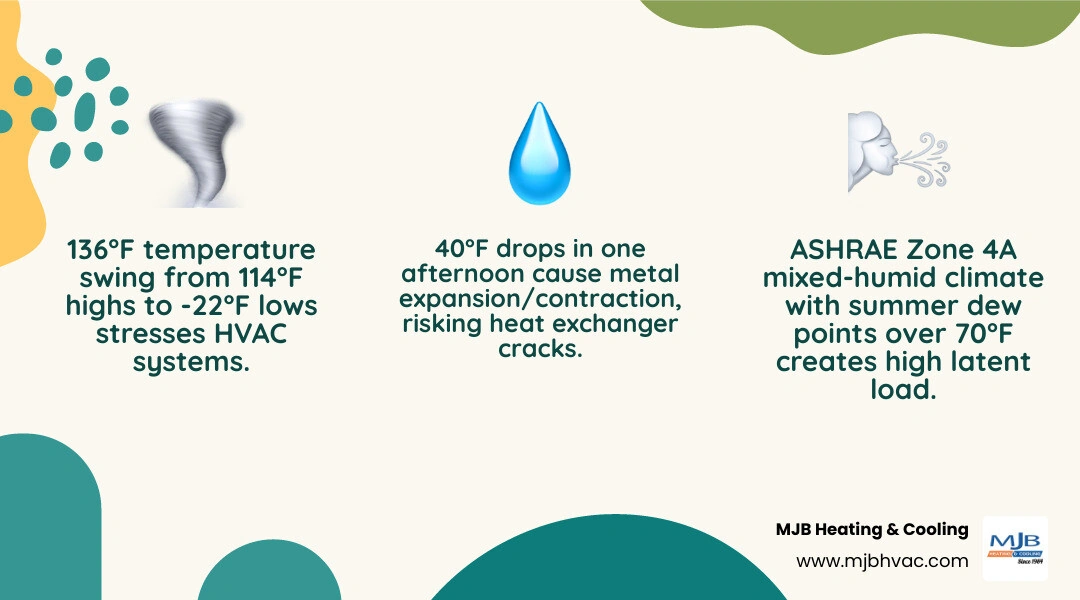
Kansas weather is famous for its unpredictability. One week we are wearing t-shirts in February, and the next, we are hunkering down against a polar vortex. This 136-degree temperature swing creates a unique mechanical stress on heating and cooling equipment. Most of our service area, including places like Andover, Maize, and Rose Hill, falls into ASHRAE Climate Zone 4A, categorized as "Mixed-Humid." This means we face both extreme cold and significant moisture levels.
The "latent load"—or the amount of energy needed to remove humidity from the air—is a major factor here. In Eastern and Central Kansas, summer dew points frequently exceed 70°F. If your system isn't configured to handle this moisture, your home will feel clammy even if the temperature is 72°F. Furthermore, our region is subject to intense wind exposure and rapid continental air mass shifts. It is not uncommon to see a 40-degree temperature drop in a single afternoon, which can cause metal components in older systems to expand and contract so quickly that heat exchangers crack.
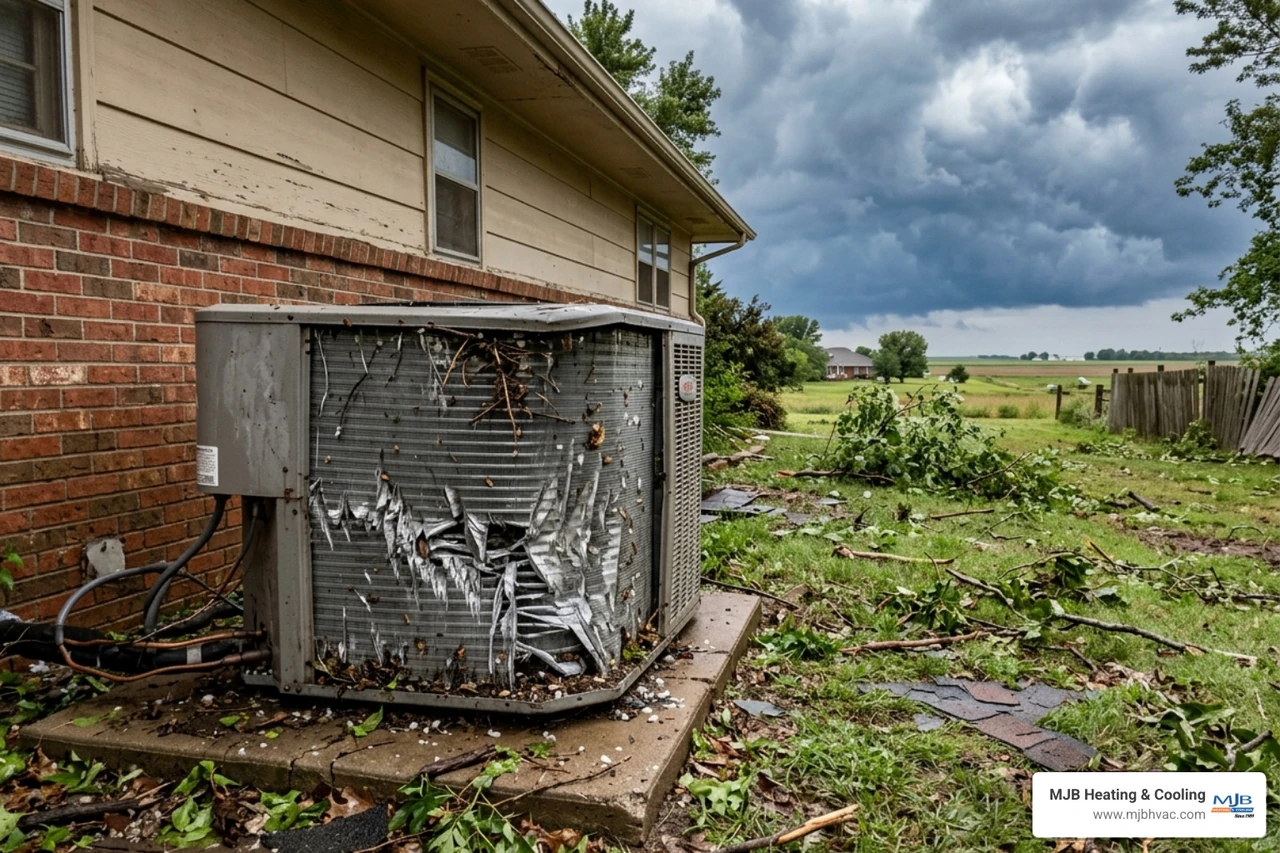
Understanding How Kansas Severe Weather Affects Your HVAC System is the first step in protecting your home. From lightning surges that fry modern control boards to hail that flattens condenser fins, our climate is a gauntlet for mechanical equipment.
When we talk to families in Derby or Goddard about the best hvac setup for kansas weather, we focus on resilience and versatility. A standard air conditioner paired with a basic furnace is the traditional route, but modern technology offers much better ways to stay comfortable without breaking the bank.
In our Kansas Climate HVAC Guide, we emphasize that efficiency ratings like SEER2 (for cooling) and AFUE (for heating) are critical. In Kansas, where we have roughly 5,200 heating degree days and 1,400 cooling degree days, prioritizing a furnace with at least 96% AFUE ensures that 96 cents of every dollar spent on gas actually goes toward heating your home.
For the majority of homes in the Wichita metro area, a dual-fuel (or "hybrid") system is the gold standard. This setup consists of an electric air-source heat pump paired with a natural gas furnace.
The heat pump handles the "shoulder seasons" and moderate winter days with incredible efficiency. However, standard air-source heat pumps can lose effectiveness when temperatures drop below 25°F. That is where the gas furnace comes in. The system automatically switches to gas heat during extreme cold snaps, providing that high-BTU "toasty" warmth that only a furnace can provide when it’s -5°F outside in Newton or El Dorado.
Performance Comparison: Heat Pump vs. Dual-Fuel in Kansas
| Feature | Standalone Heat Pump | Dual-Fuel Hybrid System |
|---|---|---|
| Efficiency at 40°F | Excellent | Excellent |
| Performance at -10°F | Struggles/Requires Electric Heat | High Performance (Gas Backup) |
| Annual Energy Savings | High | Highest (20-30% reduction) |
| Comfort Level | Consistent/Mild | Superior (Handles extremes) |
The secret to conquering Kansas humidity is variable-speed technology. Unlike traditional "single-stage" units that are either 100% on or 100% off, variable-speed compressors and blowers can run at low speeds for longer periods. This continuous modulation allows the system to pull significantly more moisture out of the air, which is essential during those muggy July nights in Valley Center and Park City. It also prevents the "blast of cold" followed by a "warm lull," providing much more precise temperature control.
Even the most expensive system will fail if it isn't sized correctly. We never recommend choosing a system based on square footage alone. Instead, we use a Manual J load calculation. This engineering standard accounts for your home’s insulation (R-values), window types, orientation (south-facing windows add massive heat in Wichita summers), and even the number of people living in the house.
An oversized unit is a common problem in Kansas; it will "short-cycle," turning on and off so quickly that it never has a chance to dehumidify the air, leading to a "cold but moldy" environment.
Ductwork is the "circulatory system" of your home. In many older Kansas homes, leaking ducts can waste 20% to 30% of your system's capacity. Sealing these leaks and ensuring proper insulation in unconditioned spaces like attics or crawl spaces is vital.
Finally, smart thermostats and integrated dehumidification systems allow you to manage these complex setups with ease. By using an ENERGY STAR certified smart thermostat, many Kansas homeowners save an additional 10% to 15% on their annual bills by automatically adjusting temperatures when they are away.
Living in the Sunflower State means your HVAC system works hard nearly every day of the year. To keep it running, we recommend a "twice-a-year" maintenance schedule: a cooling tune-up in the spring and a heating check-up in the fall.
Following Hvac Maintenance Tips for Kansas Homeowners can extend the life of your equipment by years. Some of the most important DIY steps include:
While modern cold-climate heat pumps are much better than they used to be, a standalone unit can struggle during our deepest freezes. We generally recommend a dual-fuel setup for our service area. If you do go with a standalone heat pump, ensure it has an auxiliary electric heat strip to handle temperatures that drop into the negatives.
During peak summer heat in July and August, your system may run 12 to 14 hours a day. Combined with Kansas pollen and dust, filters can clog quickly. We recommend checking them every 30 days during the summer to prevent airflow restriction, which can lead to frozen coils and compressor failure.
Geothermal systems are incredibly effective here because Kansas ground temperatures remain a stable 55°F to 60°F year-round, regardless of the air temperature. While the initial installation of the loop system is a larger project, the operating costs are roughly 60% lower than conventional systems, often paying for themselves in 7 to 12 years.
Finding the best hvac setup for kansas weather is about balancing technology with local expertise. At MJB Heating & Cooling, we’ve been part of the Central Kansas community since 1984. As a family-owned business founded in Derby, KS, we understand the specific challenges that homeowners in Wichita, Haysville, Mulvane, and the surrounding areas face every season.
We pride ourselves on quality workmanship and an honest business approach. Whether you need a simple repair in Clearwater or a full dual-fuel installation in Andover, our goal is to ensure your home remains a comfortable sanctuary regardless of what the Kansas sky is doing.
Don't wait for the next record-breaking heat wave or a sub-zero cold snap to find out if your system is up to the task. Schedule your professional HVAC service today and let our experienced technicians help you find the perfect comfort solution for your home.
The best HVAC setup for Kansas weather combines a high-efficiency dual-fuel system — pairing an air-source heat pump with a gas furnace backup — alongside variable-speed technology and properly sealed ductwork. Here is a quick-reference breakdown:
Top HVAC Configurations for Kansas Homes
| Priority | Recommended Setup | Why It Works for Kansas |
|---|---|---|
| Best overall | Dual-fuel (heat pump + gas furnace) | Handles full temperature range efficiently |
| Best efficiency | Variable-speed compressor + smart thermostat | Controls humidity and reduces energy waste |
| Best long-term ROI | Geothermal heat pump | Stable ground temps, low operating costs |
| Minimum standard | High-efficiency furnace (96% AFUE) + 16 SEER2 AC | Reliable and code-compliant for all Kansas zones |
Kansas is genuinely one of the hardest places in the continental US to keep a home comfortable year-round. Wichita alone has recorded a high of 114°F and a low of -22°F — a 136-degree swing that few other regions can match. Add in the humid summers, dry winters, and weather that can drop 40 degrees in a single afternoon, and it becomes clear why a standard, one-size-fits-all HVAC system simply isn't enough.
For homeowners across the Wichita metro — from Derby to Hutchinson, Andover to Wellington — getting the heating and cooling setup right is not just about comfort. It is about avoiding system breakdowns during the very moments you need relief most, keeping energy bills manageable through brutal heat waves and arctic cold snaps, and protecting a significant home investment for the long haul.
This guide from MJB Heating & Cooling walks through everything Central Kansas homeowners need to know to make a smart, informed HVAC decision — from system types and sizing to ductwork, smart controls, and maintenance.
Kansas weather is famous for its unpredictability. One week we are wearing t-shirts in February, and the next, we are hunkering down against a polar vortex. This 136-degree temperature swing creates a unique mechanical stress on heating and cooling equipment. Most of our service area, including places like Andover, Maize, and Rose Hill, falls into ASHRAE Climate Zone 4A, categorized as "Mixed-Humid." This means we face both extreme cold and significant moisture levels.
The "latent load"—or the amount of energy needed to remove humidity from the air—is a major factor here. In Eastern and Central Kansas, summer dew points frequently exceed 70°F. If your system isn't configured to handle this moisture, your home will feel clammy even if the temperature is 72°F. Furthermore, our region is subject to intense wind exposure and rapid continental air mass shifts. It is not uncommon to see a 40-degree temperature drop in a single afternoon, which can cause metal components in older systems to expand and contract so quickly that heat exchangers crack.
Understanding How Kansas Severe Weather Affects Your HVAC System is the first step in protecting your home. From lightning surges that fry modern control boards to hail that flattens condenser fins, our climate is a gauntlet for mechanical equipment.
When we talk to families in Derby or Goddard about the best hvac setup for kansas weather, we focus on resilience and versatility. A standard air conditioner paired with a basic furnace is the traditional route, but modern technology offers much better ways to stay comfortable without breaking the bank.
In our Kansas Climate HVAC Guide, we emphasize that efficiency ratings like SEER2 (for cooling) and AFUE (for heating) are critical. In Kansas, where we have roughly 5,200 heating degree days and 1,400 cooling degree days, prioritizing a furnace with at least 96% AFUE ensures that 96 cents of every dollar spent on gas actually goes toward heating your home.
For the majority of homes in the Wichita metro area, a dual-fuel (or "hybrid") system is the gold standard. This setup consists of an electric air-source heat pump paired with a natural gas furnace.
The heat pump handles the "shoulder seasons" and moderate winter days with incredible efficiency. However, standard air-source heat pumps can lose effectiveness when temperatures drop below 25°F. That is where the gas furnace comes in. The system automatically switches to gas heat during extreme cold snaps, providing that high-BTU "toasty" warmth that only a furnace can provide when it’s -5°F outside in Newton or El Dorado.
Performance Comparison: Heat Pump vs. Dual-Fuel in Kansas
| Feature | Standalone Heat Pump | Dual-Fuel Hybrid System |
|---|---|---|
| Efficiency at 40°F | Excellent | Excellent |
| Performance at -10°F | Struggles/Requires Electric Heat | High Performance (Gas Backup) |
| Annual Energy Savings | High | Highest (20-30% reduction) |
| Comfort Level | Consistent/Mild | Superior (Handles extremes) |
The secret to conquering Kansas humidity is variable-speed technology. Unlike traditional "single-stage" units that are either 100% on or 100% off, variable-speed compressors and blowers can run at low speeds for longer periods. This continuous modulation allows the system to pull significantly more moisture out of the air, which is essential during those muggy July nights in Valley Center and Park City. It also prevents the "blast of cold" followed by a "warm lull," providing much more precise temperature control.
Even the most expensive system will fail if it isn't sized correctly. We never recommend choosing a system based on square footage alone. Instead, we use a Manual J load calculation. This engineering standard accounts for your home’s insulation (R-values), window types, orientation (south-facing windows add massive heat in Wichita summers), and even the number of people living in the house.
An oversized unit is a common problem in Kansas; it will "short-cycle," turning on and off so quickly that it never has a chance to dehumidify the air, leading to a "cold but moldy" environment.
Ductwork is the "circulatory system" of your home. In many older Kansas homes, leaking ducts can waste 20% to 30% of your system's capacity. Sealing these leaks and ensuring proper insulation in unconditioned spaces like attics or crawl spaces is vital.
Finally, smart thermostats and integrated dehumidification systems allow you to manage these complex setups with ease. By using an ENERGY STAR certified smart thermostat, many Kansas homeowners save an additional 10% to 15% on their annual bills by automatically adjusting temperatures when they are away.
Living in the Sunflower State means your HVAC system works hard nearly every day of the year. To keep it running, we recommend a "twice-a-year" maintenance schedule: a cooling tune-up in the spring and a heating check-up in the fall.
Following Hvac Maintenance Tips for Kansas Homeowners can extend the life of your equipment by years. Some of the most important DIY steps include:
While modern cold-climate heat pumps are much better than they used to be, a standalone unit can struggle during our deepest freezes. We generally recommend a dual-fuel setup for our service area. If you do go with a standalone heat pump, ensure it has an auxiliary electric heat strip to handle temperatures that drop into the negatives.
During peak summer heat in July and August, your system may run 12 to 14 hours a day. Combined with Kansas pollen and dust, filters can clog quickly. We recommend checking them every 30 days during the summer to prevent airflow restriction, which can lead to frozen coils and compressor failure.
Geothermal systems are incredibly effective here because Kansas ground temperatures remain a stable 55°F to 60°F year-round, regardless of the air temperature. While the initial installation of the loop system is a larger project, the operating costs are roughly 60% lower than conventional systems, often paying for themselves in 7 to 12 years.
Finding the best hvac setup for kansas weather is about balancing technology with local expertise. At MJB Heating & Cooling, we’ve been part of the Central Kansas community since 1984. As a family-owned business founded in Derby, KS, we understand the specific challenges that homeowners in Wichita, Haysville, Mulvane, and the surrounding areas face every season.
We pride ourselves on quality workmanship and an honest business approach. Whether you need a simple repair in Clearwater or a full dual-fuel installation in Andover, our goal is to ensure your home remains a comfortable sanctuary regardless of what the Kansas sky is doing.
Don't wait for the next record-breaking heat wave or a sub-zero cold snap to find out if your system is up to the task. Schedule your professional HVAC service today and let our experienced technicians help you find the perfect comfort solution for your home.
The best HVAC setup for Kansas weather combines a high-efficiency dual-fuel system — pairing an air-source heat pump with a gas furnace backup — alongside variable-speed technology and properly sealed ductwork. Here is a quick-reference breakdown:
Top HVAC Configurations for Kansas Homes
| Priority | Recommended Setup | Why It Works for Kansas |
|---|---|---|
| Best overall | Dual-fuel (heat pump + gas furnace) | Handles full temperature range efficiently |
| Best efficiency | Variable-speed compressor + smart thermostat | Controls humidity and reduces energy waste |
| Best long-term ROI | Geothermal heat pump | Stable ground temps, low operating costs |
| Minimum standard | High-efficiency furnace (96% AFUE) + 16 SEER2 AC | Reliable and code-compliant for all Kansas zones |
Kansas is genuinely one of the hardest places in the continental US to keep a home comfortable year-round. Wichita alone has recorded a high of 114°F and a low of -22°F — a 136-degree swing that few other regions can match. Add in the humid summers, dry winters, and weather that can drop 40 degrees in a single afternoon, and it becomes clear why a standard, one-size-fits-all HVAC system simply isn't enough.
For homeowners across the Wichita metro — from Derby to Hutchinson, Andover to Wellington — getting the heating and cooling setup right is not just about comfort. It is about avoiding system breakdowns during the very moments you need relief most, keeping energy bills manageable through brutal heat waves and arctic cold snaps, and protecting a significant home investment for the long haul.
This guide from MJB Heating & Cooling walks through everything Central Kansas homeowners need to know to make a smart, informed HVAC decision — from system types and sizing to ductwork, smart controls, and maintenance.
Kansas weather is famous for its unpredictability. One week we are wearing t-shirts in February, and the next, we are hunkering down against a polar vortex. This 136-degree temperature swing creates a unique mechanical stress on heating and cooling equipment. Most of our service area, including places like Andover, Maize, and Rose Hill, falls into ASHRAE Climate Zone 4A, categorized as "Mixed-Humid." This means we face both extreme cold and significant moisture levels.
The "latent load"—or the amount of energy needed to remove humidity from the air—is a major factor here. In Eastern and Central Kansas, summer dew points frequently exceed 70°F. If your system isn't configured to handle this moisture, your home will feel clammy even if the temperature is 72°F. Furthermore, our region is subject to intense wind exposure and rapid continental air mass shifts. It is not uncommon to see a 40-degree temperature drop in a single afternoon, which can cause metal components in older systems to expand and contract so quickly that heat exchangers crack.
Understanding How Kansas Severe Weather Affects Your HVAC System is the first step in protecting your home. From lightning surges that fry modern control boards to hail that flattens condenser fins, our climate is a gauntlet for mechanical equipment.
When we talk to families in Derby or Goddard about the best hvac setup for kansas weather, we focus on resilience and versatility. A standard air conditioner paired with a basic furnace is the traditional route, but modern technology offers much better ways to stay comfortable without breaking the bank.
In our Kansas Climate HVAC Guide, we emphasize that efficiency ratings like SEER2 (for cooling) and AFUE (for heating) are critical. In Kansas, where we have roughly 5,200 heating degree days and 1,400 cooling degree days, prioritizing a furnace with at least 96% AFUE ensures that 96 cents of every dollar spent on gas actually goes toward heating your home.
For the majority of homes in the Wichita metro area, a dual-fuel (or "hybrid") system is the gold standard. This setup consists of an electric air-source heat pump paired with a natural gas furnace.
The heat pump handles the "shoulder seasons" and moderate winter days with incredible efficiency. However, standard air-source heat pumps can lose effectiveness when temperatures drop below 25°F. That is where the gas furnace comes in. The system automatically switches to gas heat during extreme cold snaps, providing that high-BTU "toasty" warmth that only a furnace can provide when it’s -5°F outside in Newton or El Dorado.
Performance Comparison: Heat Pump vs. Dual-Fuel in Kansas
| Feature | Standalone Heat Pump | Dual-Fuel Hybrid System |
|---|---|---|
| Efficiency at 40°F | Excellent | Excellent |
| Performance at -10°F | Struggles/Requires Electric Heat | High Performance (Gas Backup) |
| Annual Energy Savings | High | Highest (20-30% reduction) |
| Comfort Level | Consistent/Mild | Superior (Handles extremes) |
The secret to conquering Kansas humidity is variable-speed technology. Unlike traditional "single-stage" units that are either 100% on or 100% off, variable-speed compressors and blowers can run at low speeds for longer periods. This continuous modulation allows the system to pull significantly more moisture out of the air, which is essential during those muggy July nights in Valley Center and Park City. It also prevents the "blast of cold" followed by a "warm lull," providing much more precise temperature control.
Even the most expensive system will fail if it isn't sized correctly. We never recommend choosing a system based on square footage alone. Instead, we use a Manual J load calculation. This engineering standard accounts for your home’s insulation (R-values), window types, orientation (south-facing windows add massive heat in Wichita summers), and even the number of people living in the house.
An oversized unit is a common problem in Kansas; it will "short-cycle," turning on and off so quickly that it never has a chance to dehumidify the air, leading to a "cold but moldy" environment.
Ductwork is the "circulatory system" of your home. In many older Kansas homes, leaking ducts can waste 20% to 30% of your system's capacity. Sealing these leaks and ensuring proper insulation in unconditioned spaces like attics or crawl spaces is vital.
Finally, smart thermostats and integrated dehumidification systems allow you to manage these complex setups with ease. By using an ENERGY STAR certified smart thermostat, many Kansas homeowners save an additional 10% to 15% on their annual bills by automatically adjusting temperatures when they are away.
Living in the Sunflower State means your HVAC system works hard nearly every day of the year. To keep it running, we recommend a "twice-a-year" maintenance schedule: a cooling tune-up in the spring and a heating check-up in the fall.
Following Hvac Maintenance Tips for Kansas Homeowners can extend the life of your equipment by years. Some of the most important DIY steps include:
While modern cold-climate heat pumps are much better than they used to be, a standalone unit can struggle during our deepest freezes. We generally recommend a dual-fuel setup for our service area. If you do go with a standalone heat pump, ensure it has an auxiliary electric heat strip to handle temperatures that drop into the negatives.
During peak summer heat in July and August, your system may run 12 to 14 hours a day. Combined with Kansas pollen and dust, filters can clog quickly. We recommend checking them every 30 days during the summer to prevent airflow restriction, which can lead to frozen coils and compressor failure.
Geothermal systems are incredibly effective here because Kansas ground temperatures remain a stable 55°F to 60°F year-round, regardless of the air temperature. While the initial installation of the loop system is a larger project, the operating costs are roughly 60% lower than conventional systems, often paying for themselves in 7 to 12 years.
Finding the best hvac setup for kansas weather is about balancing technology with local expertise. At MJB Heating & Cooling, we’ve been part of the Central Kansas community since 1984. As a family-owned business founded in Derby, KS, we understand the specific challenges that homeowners in Wichita, Haysville, Mulvane, and the surrounding areas face every season.
We pride ourselves on quality workmanship and an honest business approach. Whether you need a simple repair in Clearwater or a full dual-fuel installation in Andover, our goal is to ensure your home remains a comfortable sanctuary regardless of what the Kansas sky is doing.
Don't wait for the next record-breaking heat wave or a sub-zero cold snap to find out if your system is up to the task. Schedule your professional HVAC service today and let our experienced technicians help you find the perfect comfort solution for your home.

The best HVAC setup for Kansas weather combines a high-efficiency dual-fuel system — pairing an air-source heat pump with a gas furnace backup — alongside variable-speed technology and properly sealed ductwork. Here is a quick-reference breakdown:
Top HVAC Configurations for Kansas Homes
| Priority | Recommended Setup | Why It Works for Kansas |
|---|---|---|
| Best overall | Dual-fuel (heat pump + gas furnace) | Handles full temperature range efficiently |
| Best efficiency | Variable-speed compressor + smart thermostat | Controls humidity and reduces energy waste |
| Best long-term ROI | Geothermal heat pump | Stable ground temps, low operating costs |
| Minimum standard | High-efficiency furnace (96% AFUE) + 16 SEER2 AC | Reliable and code-compliant for all Kansas zones |
Kansas is genuinely one of the hardest places in the continental US to keep a home comfortable year-round. Wichita alone has recorded a high of 114°F and a low of -22°F — a 136-degree swing that few other regions can match. Add in the humid summers, dry winters, and weather that can drop 40 degrees in a single afternoon, and it becomes clear why a standard, one-size-fits-all HVAC system simply isn't enough.
For homeowners across the Wichita metro — from Derby to Hutchinson, Andover to Wellington — getting the heating and cooling setup right is not just about comfort. It is about avoiding system breakdowns during the very moments you need relief most, keeping energy bills manageable through brutal heat waves and arctic cold snaps, and protecting a significant home investment for the long haul.
This guide from MJB Heating & Cooling walks through everything Central Kansas homeowners need to know to make a smart, informed HVAC decision — from system types and sizing to ductwork, smart controls, and maintenance.
Kansas weather is famous for its unpredictability. One week we are wearing t-shirts in February, and the next, we are hunkering down against a polar vortex. This 136-degree temperature swing creates a unique mechanical stress on heating and cooling equipment. Most of our service area, including places like Andover, Maize, and Rose Hill, falls into ASHRAE Climate Zone 4A, categorized as "Mixed-Humid." This means we face both extreme cold and significant moisture levels.
The "latent load"—or the amount of energy needed to remove humidity from the air—is a major factor here. In Eastern and Central Kansas, summer dew points frequently exceed 70°F. If your system isn't configured to handle this moisture, your home will feel clammy even if the temperature is 72°F. Furthermore, our region is subject to intense wind exposure and rapid continental air mass shifts. It is not uncommon to see a 40-degree temperature drop in a single afternoon, which can cause metal components in older systems to expand and contract so quickly that heat exchangers crack.
Understanding How Kansas Severe Weather Affects Your HVAC System is the first step in protecting your home. From lightning surges that fry modern control boards to hail that flattens condenser fins, our climate is a gauntlet for mechanical equipment.
When we talk to families in Derby or Goddard about the best hvac setup for kansas weather, we focus on resilience and versatility. A standard air conditioner paired with a basic furnace is the traditional route, but modern technology offers much better ways to stay comfortable without breaking the bank.
In our Kansas Climate HVAC Guide, we emphasize that efficiency ratings like SEER2 (for cooling) and AFUE (for heating) are critical. In Kansas, where we have roughly 5,200 heating degree days and 1,400 cooling degree days, prioritizing a furnace with at least 96% AFUE ensures that 96 cents of every dollar spent on gas actually goes toward heating your home.
For the majority of homes in the Wichita metro area, a dual-fuel (or "hybrid") system is the gold standard. This setup consists of an electric air-source heat pump paired with a natural gas furnace.
The heat pump handles the "shoulder seasons" and moderate winter days with incredible efficiency. However, standard air-source heat pumps can lose effectiveness when temperatures drop below 25°F. That is where the gas furnace comes in. The system automatically switches to gas heat during extreme cold snaps, providing that high-BTU "toasty" warmth that only a furnace can provide when it’s -5°F outside in Newton or El Dorado.
Performance Comparison: Heat Pump vs. Dual-Fuel in Kansas
| Feature | Standalone Heat Pump | Dual-Fuel Hybrid System |
|---|---|---|
| Efficiency at 40°F | Excellent | Excellent |
| Performance at -10°F | Struggles/Requires Electric Heat | High Performance (Gas Backup) |
| Annual Energy Savings | High | Highest (20-30% reduction) |
| Comfort Level | Consistent/Mild | Superior (Handles extremes) |
The secret to conquering Kansas humidity is variable-speed technology. Unlike traditional "single-stage" units that are either 100% on or 100% off, variable-speed compressors and blowers can run at low speeds for longer periods. This continuous modulation allows the system to pull significantly more moisture out of the air, which is essential during those muggy July nights in Valley Center and Park City. It also prevents the "blast of cold" followed by a "warm lull," providing much more precise temperature control.
Even the most expensive system will fail if it isn't sized correctly. We never recommend choosing a system based on square footage alone. Instead, we use a Manual J load calculation. This engineering standard accounts for your home’s insulation (R-values), window types, orientation (south-facing windows add massive heat in Wichita summers), and even the number of people living in the house.
An oversized unit is a common problem in Kansas; it will "short-cycle," turning on and off so quickly that it never has a chance to dehumidify the air, leading to a "cold but moldy" environment.
Ductwork is the "circulatory system" of your home. In many older Kansas homes, leaking ducts can waste 20% to 30% of your system's capacity. Sealing these leaks and ensuring proper insulation in unconditioned spaces like attics or crawl spaces is vital.
Finally, smart thermostats and integrated dehumidification systems allow you to manage these complex setups with ease. By using an ENERGY STAR certified smart thermostat, many Kansas homeowners save an additional 10% to 15% on their annual bills by automatically adjusting temperatures when they are away.
Living in the Sunflower State means your HVAC system works hard nearly every day of the year. To keep it running, we recommend a "twice-a-year" maintenance schedule: a cooling tune-up in the spring and a heating check-up in the fall.
Following Hvac Maintenance Tips for Kansas Homeowners can extend the life of your equipment by years. Some of the most important DIY steps include:
While modern cold-climate heat pumps are much better than they used to be, a standalone unit can struggle during our deepest freezes. We generally recommend a dual-fuel setup for our service area. If you do go with a standalone heat pump, ensure it has an auxiliary electric heat strip to handle temperatures that drop into the negatives.
During peak summer heat in July and August, your system may run 12 to 14 hours a day. Combined with Kansas pollen and dust, filters can clog quickly. We recommend checking them every 30 days during the summer to prevent airflow restriction, which can lead to frozen coils and compressor failure.
Geothermal systems are incredibly effective here because Kansas ground temperatures remain a stable 55°F to 60°F year-round, regardless of the air temperature. While the initial installation of the loop system is a larger project, the operating costs are roughly 60% lower than conventional systems, often paying for themselves in 7 to 12 years.
Finding the best hvac setup for kansas weather is about balancing technology with local expertise. At MJB Heating & Cooling, we’ve been part of the Central Kansas community since 1984. As a family-owned business founded in Derby, KS, we understand the specific challenges that homeowners in Wichita, Haysville, Mulvane, and the surrounding areas face every season.
We pride ourselves on quality workmanship and an honest business approach. Whether you need a simple repair in Clearwater or a full dual-fuel installation in Andover, our goal is to ensure your home remains a comfortable sanctuary regardless of what the Kansas sky is doing.
Don't wait for the next record-breaking heat wave or a sub-zero cold snap to find out if your system is up to the task. Schedule your professional HVAC service today and let our experienced technicians help you find the perfect comfort solution for your home.
The best HVAC setup for Kansas weather combines a high-efficiency dual-fuel system — pairing an air-source heat pump with a gas furnace backup — alongside variable-speed technology and properly sealed ductwork. Here is a quick-reference breakdown:
Top HVAC Configurations for Kansas Homes
| Priority | Recommended Setup | Why It Works for Kansas |
|---|---|---|
| Best overall | Dual-fuel (heat pump + gas furnace) | Handles full temperature range efficiently |
| Best efficiency | Variable-speed compressor + smart thermostat | Controls humidity and reduces energy waste |
| Best long-term ROI | Geothermal heat pump | Stable ground temps, low operating costs |
| Minimum standard | High-efficiency furnace (96% AFUE) + 16 SEER2 AC | Reliable and code-compliant for all Kansas zones |
Kansas is genuinely one of the hardest places in the continental US to keep a home comfortable year-round. Wichita alone has recorded a high of 114°F and a low of -22°F — a 136-degree swing that few other regions can match. Add in the humid summers, dry winters, and weather that can drop 40 degrees in a single afternoon, and it becomes clear why a standard, one-size-fits-all HVAC system simply isn't enough.
For homeowners across the Wichita metro — from Derby to Hutchinson, Andover to Wellington — getting the heating and cooling setup right is not just about comfort. It is about avoiding system breakdowns during the very moments you need relief most, keeping energy bills manageable through brutal heat waves and arctic cold snaps, and protecting a significant home investment for the long haul.
This guide from MJB Heating & Cooling walks through everything Central Kansas homeowners need to know to make a smart, informed HVAC decision — from system types and sizing to ductwork, smart controls, and maintenance.
Kansas weather is famous for its unpredictability. One week we are wearing t-shirts in February, and the next, we are hunkering down against a polar vortex. This 136-degree temperature swing creates a unique mechanical stress on heating and cooling equipment. Most of our service area, including places like Andover, Maize, and Rose Hill, falls into ASHRAE Climate Zone 4A, categorized as "Mixed-Humid." This means we face both extreme cold and significant moisture levels.
The "latent load"—or the amount of energy needed to remove humidity from the air—is a major factor here. In Eastern and Central Kansas, summer dew points frequently exceed 70°F. If your system isn't configured to handle this moisture, your home will feel clammy even if the temperature is 72°F. Furthermore, our region is subject to intense wind exposure and rapid continental air mass shifts. It is not uncommon to see a 40-degree temperature drop in a single afternoon, which can cause metal components in older systems to expand and contract so quickly that heat exchangers crack.
Understanding How Kansas Severe Weather Affects Your HVAC System is the first step in protecting your home. From lightning surges that fry modern control boards to hail that flattens condenser fins, our climate is a gauntlet for mechanical equipment.
When we talk to families in Derby or Goddard about the best hvac setup for kansas weather, we focus on resilience and versatility. A standard air conditioner paired with a basic furnace is the traditional route, but modern technology offers much better ways to stay comfortable without breaking the bank.
In our Kansas Climate HVAC Guide, we emphasize that efficiency ratings like SEER2 (for cooling) and AFUE (for heating) are critical. In Kansas, where we have roughly 5,200 heating degree days and 1,400 cooling degree days, prioritizing a furnace with at least 96% AFUE ensures that 96 cents of every dollar spent on gas actually goes toward heating your home.
For the majority of homes in the Wichita metro area, a dual-fuel (or "hybrid") system is the gold standard. This setup consists of an electric air-source heat pump paired with a natural gas furnace.
The heat pump handles the "shoulder seasons" and moderate winter days with incredible efficiency. However, standard air-source heat pumps can lose effectiveness when temperatures drop below 25°F. That is where the gas furnace comes in. The system automatically switches to gas heat during extreme cold snaps, providing that high-BTU "toasty" warmth that only a furnace can provide when it’s -5°F outside in Newton or El Dorado.
Performance Comparison: Heat Pump vs. Dual-Fuel in Kansas
| Feature | Standalone Heat Pump | Dual-Fuel Hybrid System |
|---|---|---|
| Efficiency at 40°F | Excellent | Excellent |
| Performance at -10°F | Struggles/Requires Electric Heat | High Performance (Gas Backup) |
| Annual Energy Savings | High | Highest (20-30% reduction) |
| Comfort Level | Consistent/Mild | Superior (Handles extremes) |
The secret to conquering Kansas humidity is variable-speed technology. Unlike traditional "single-stage" units that are either 100% on or 100% off, variable-speed compressors and blowers can run at low speeds for longer periods. This continuous modulation allows the system to pull significantly more moisture out of the air, which is essential during those muggy July nights in Valley Center and Park City. It also prevents the "blast of cold" followed by a "warm lull," providing much more precise temperature control.
Even the most expensive system will fail if it isn't sized correctly. We never recommend choosing a system based on square footage alone. Instead, we use a Manual J load calculation. This engineering standard accounts for your home’s insulation (R-values), window types, orientation (south-facing windows add massive heat in Wichita summers), and even the number of people living in the house.
An oversized unit is a common problem in Kansas; it will "short-cycle," turning on and off so quickly that it never has a chance to dehumidify the air, leading to a "cold but moldy" environment.
Ductwork is the "circulatory system" of your home. In many older Kansas homes, leaking ducts can waste 20% to 30% of your system's capacity. Sealing these leaks and ensuring proper insulation in unconditioned spaces like attics or crawl spaces is vital.
Finally, smart thermostats and integrated dehumidification systems allow you to manage these complex setups with ease. By using an ENERGY STAR certified smart thermostat, many Kansas homeowners save an additional 10% to 15% on their annual bills by automatically adjusting temperatures when they are away.
Living in the Sunflower State means your HVAC system works hard nearly every day of the year. To keep it running, we recommend a "twice-a-year" maintenance schedule: a cooling tune-up in the spring and a heating check-up in the fall.
Following Hvac Maintenance Tips for Kansas Homeowners can extend the life of your equipment by years. Some of the most important DIY steps include:
While modern cold-climate heat pumps are much better than they used to be, a standalone unit can struggle during our deepest freezes. We generally recommend a dual-fuel setup for our service area. If you do go with a standalone heat pump, ensure it has an auxiliary electric heat strip to handle temperatures that drop into the negatives.
During peak summer heat in July and August, your system may run 12 to 14 hours a day. Combined with Kansas pollen and dust, filters can clog quickly. We recommend checking them every 30 days during the summer to prevent airflow restriction, which can lead to frozen coils and compressor failure.
Geothermal systems are incredibly effective here because Kansas ground temperatures remain a stable 55°F to 60°F year-round, regardless of the air temperature. While the initial installation of the loop system is a larger project, the operating costs are roughly 60% lower than conventional systems, often paying for themselves in 7 to 12 years.
Finding the best hvac setup for kansas weather is about balancing technology with local expertise. At MJB Heating & Cooling, we’ve been part of the Central Kansas community since 1984. As a family-owned business founded in Derby, KS, we understand the specific challenges that homeowners in Wichita, Haysville, Mulvane, and the surrounding areas face every season.
We pride ourselves on quality workmanship and an honest business approach. Whether you need a simple repair in Clearwater or a full dual-fuel installation in Andover, our goal is to ensure your home remains a comfortable sanctuary regardless of what the Kansas sky is doing.
Don't wait for the next record-breaking heat wave or a sub-zero cold snap to find out if your system is up to the task. Schedule your professional HVAC service today and let our experienced technicians help you find the perfect comfort solution for your home.


Our A/C stopped working on a Sunday and due to health issues, we needed to find a service company available on a Sunday. I called MJB and left a message on their emergency voice mail. Within 10 minutes Tom Buck called me to hear my description of the symptoms. He was just finishing an appointment in Wichita and would be on his way to my home on the south end of Derby. He arrived within 30 minutes! From start to finish he was the perfect example of what you could ever hope for in an HVAC tech and a human being. His evaluation of our system inside and out was as thorough as I could ever imagine and once he was done with the repair, our system is running as well or better than ever. Well worth the price for the evaluation, parts, and labor. Thank you again Tom for an awesome experience.
Our AC went out during the hottest days of the year, and they were out next day! We have been jerked around by a shoddy home warranty for years. We finally had a chance to pick our own repair people, and MJB came highly recommended. I can see why! I was impressed with the honesty and speed at which they fixed our AC unit!
Our commercial building had a lightening/electrical strike and damaged our 20 ton AC unit. No one could find us a new unit before the end of September. Imagining going all of August and September with no AC in Kansas and working inside near 100 degree temps is less than thrilling. Dale and the team at MJB called around and saved the day. They had us a new unit 5 weeks earlier than other could promise and I now have happy employees. The unit is amazingly quiet, super cold and so much more energy efficient. Thank you for being our super hero!
Came out and installed my new furnace. Was very polite and affordable. They are very acknowledgeable and I highly recommend!
Thank you very much. We had our 1st warm night in 3weeks. MJB took the time and effort to find the real problem. And the employees were kind and thoughtful and explained things very well. I cannot thank you and all of MJB. Will recommend you highly. Thanks again Marjorie Herman Oxford Kansas
We had a new system installed and I was so impressed with how quick they were in come out and install it, in the middle of a hot summer day. They were so friendly & very professional. I had a small problem with a weird sound and they came over immediately and fixed it. Love them!