.avif)





Blogs
Stay updated with our latest blog posts.
If your AC is not cooling properly in extreme heat, you are not alone — and the fix is often simpler than you think. During peak summer temperatures in Wichita and the surrounding Central Kansas area, even a well-maintained system can fall behind. When outdoor temps push past 95°F or higher, your AC has to work significantly harder to move heat out of your home. Any small inefficiency that goes unnoticed in mild weather becomes a real problem fast.
Here is a quick look at the most common things to check when your AC is running but not keeping up:
Most of these checks take only a few minutes and cost nothing. The sections below walk you through each one in detail, starting with the easiest DIY steps before covering the issues that require a licensed HVAC technician.

Simple guide to ac not cooling properly in extreme heat what to check:
Before you assume your air conditioner has breathed its last breath, it is best to start with the simplest, most obvious checks. When our homes in Derby, Wichita, or Goddard start warming up on a triple-digit July afternoon, our natural instinct is to panic. However, a systematic approach to DIY troubleshooting can save you a lot of stress.

First, take a close look at your thermostat. It sounds simple, but a family member might have bumped the settings, or a brief power flicker could have reset the system. Make sure the thermostat is set to COOL and the temperature setting is actually lower than the current room temperature.
Another crucial detail is the fan setting. You always want the fan set to AUTO, not ON. When the fan is set to "ON," the blower runs continuously, even when the outdoor compressor cycles off. This means the system will blow unconditioned, humid air back into your living spaces, making your home feel sticky and warm. Keeping it on "AUTO" ensures the fan only blows when the system is actively cooling.
If your thermostat looks correct but the system is completely silent, the issue might be electrical. Extreme summer heatwaves put an immense load on the local power grid and your home’s electrical system. This extra stress can easily cause a breaker to trip. You can check your main electrical panel to see if the switch labeled for your AC has flipped to the middle or "off" position. If it has, flip it completely to the "off" position first, then back to "on." If you want to dive deeper into why this happens, take a look at our guide on Why Your AC Circuit Breaker Keeps Tripping.
By ruling out these basic power and control issues first, you can keep your system running safely and efficiently. If you are looking for more ways to manage your system's load and save on energy during the peak of summer, check out our helpful tips on How to Lower AC Bills During Hot Kansas Summers.
When it comes to your ac not cooling properly in extreme heat what to check list, the indoor air filter should always be near the top. A dirty air filter is the number-one cause of restricted airflow, which triggers a cascade of cooling issues.
When your air filter is coated in a thick layer of dust, pet dander, and household debris, your blower motor has to work twice as hard to pull air through it. This restricted airflow can reduce your air conditioner's overall efficiency by up to 15%. During mild spring weather, your system might get by with a slightly dirty filter. But when outdoor temperatures climb, that restricted airflow will quickly cause your system to fall behind, leaving your home stuffy and warm.
When choosing a replacement filter, pay close attention to the MERV (Minimum Efficiency Reporting Value) ratings. For most residential HVAC systems in Central Kansas, we recommend using filters with a rating between MERV 8 and MERV 11. These filters provide an excellent balance of capturing airborne particles without restricting the vital airflow your system needs. Avoid using ultra-high MERV filters (like MERV 13 or higher) unless your system's ductwork was specifically designed for them, as they can restrict airflow so severely that they can actually cause your indoor evaporator coils to freeze.
Checking and replacing your filter every 30 to 90 days is one of the easiest ways to protect your system. If you want to make sure your system is fully ready to handle the intense summer sun before the heatwaves arrive, check out our guide on Spring AC Preparation for Kansas Summer.
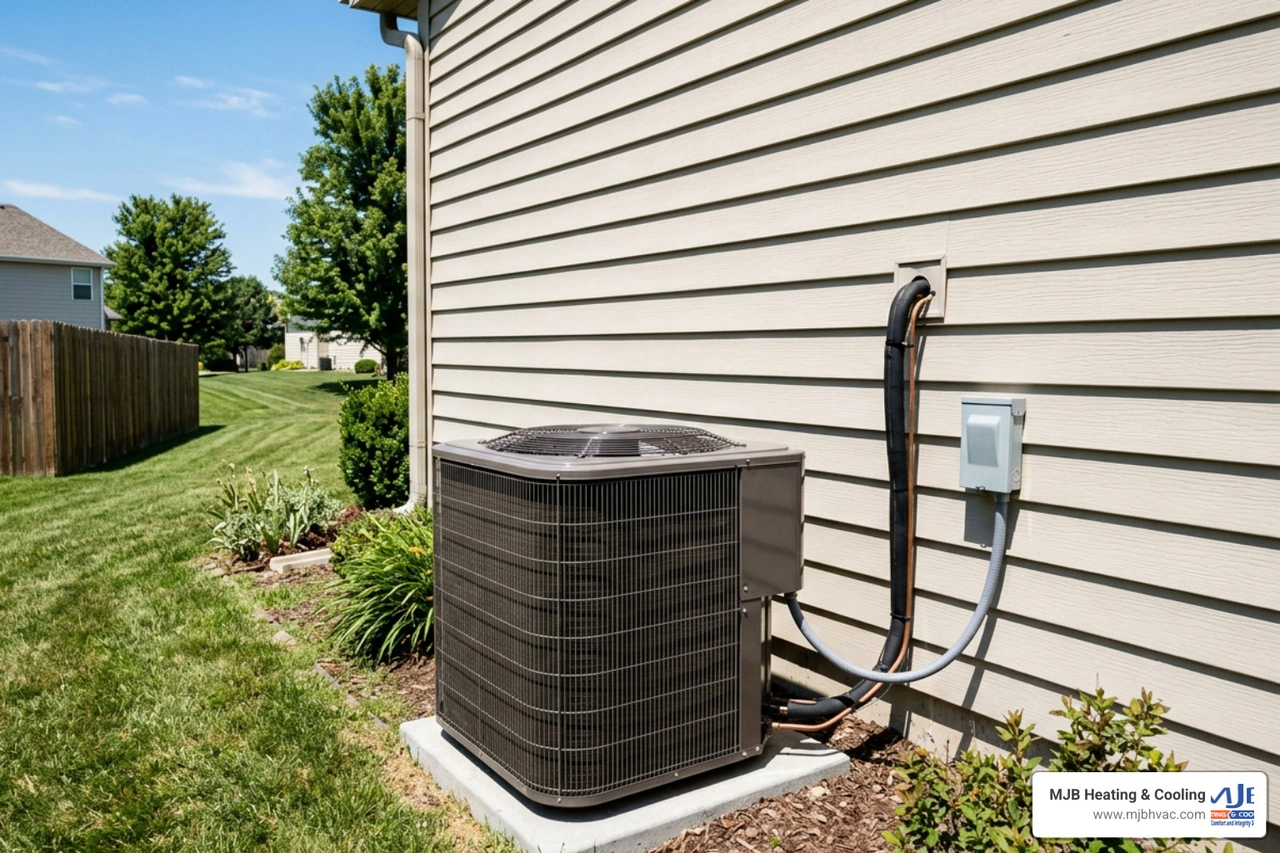
Once you have verified that your indoor airflow is clear, it is time to step outside. Your outdoor condenser unit plays a vital role in the cooling process. It acts as a heat rejector, taking the heat that was absorbed from inside your home and releasing it into the outdoor air.
For this heat transfer process to work efficiently, the outdoor unit needs plenty of breathing room. We recommend maintaining at least two feet of clear space on all sides of the condenser. Overgrown shrubs, tall weeds, stacked firewood, or decorative fences placed too close to the unit can trap hot air around it, forcing the system to work much harder to reject heat.
In Central Kansas communities like Maize, Rose Hill, and Valley Center, our outdoor units face a unique summer enemy: cottonwood fluff. During the late spring and early summer, cottonwood trees release fluffy white seeds that drift through the air and get sucked directly into the delicate fins of your condenser coil. This fluff acts like a thick wool blanket, insulating the coils and preventing heat from escaping.
You can gently clean your condenser coils by turning off the power to the unit and using a low-pressure garden hose to wash away dirt, grass clippings, and cottonwood fluff from the inside out. Never use a pressure washer, as the high pressure will easily bend the delicate aluminum fins and permanently restrict airflow. If the fan on your outdoor unit isn't spinning even after you have cleared external debris, you can read more about what might be happening in our article on what to do when the AC Fan Isn't Working But the Compressor Is.
While basic cleaning and thermostat adjustments are great DIY tasks, there comes a point where continuing to troubleshoot on your own can lead to expensive system damage or safety hazards. If your AC is running continuously but failing to cool your home, several critical internal components may have failed.
One of the most common issues we see during hot Kansas summers is a frozen evaporator coil. Although it sounds counterintuitive for an air conditioner to freeze up when it is 100°F outside, frozen coils actually account for roughly 30% of all "AC not cooling" service calls. When airflow is restricted (due to a dirty filter or blocked vents) or when refrigerant levels are low, the temperature of the indoor coil drops below freezing. Moisture in the air collects on the coil and quickly turns to ice, completely blocking the flow of cool air into your home.
If you notice ice forming on the brass valves of your outdoor unit or on the indoor copper refrigerant lines, you must turn the system off immediately. Continuing to run a frozen AC can cause liquid refrigerant to flood back into the compressor. This is known as "slugging," and it can cause permanent, catastrophic compressor damage. For step-by-step instructions on how to safely handle this issue, read our guide on How to Address a Frozen AC Unit in Home. Additionally, as that thick block of ice melts, it can quickly overwhelm your condensate drain pan, leading to water damage. You can learn more about preventing this in our article on Why AC Leaking Water Inside Your Home.
Another common culprit is a failed run capacitor. The capacitor acts like a large battery that provides the electrical "kick" needed to start and run the outdoor fan and compressor motors. Extreme heat degrades these electrical components over time, causing them to bulge, leak, or fail entirely. When a capacitor fails, you might hear a loud humming sound coming from your outdoor unit, but the fan or compressor won't start. Because capacitors store high voltage even when the power is turned off, they present a serious electrical hazard and should only be replaced by a licensed professional.
Finally, low refrigerant is a major cause of poor cooling. It is important to remember that refrigerant is a closed-loop chemical that is never "used up" or consumed by your system. If your refrigerant is low, it means you have a leak. Adding more refrigerant without locating and repairing the leak is only a temporary fix that can harm the environment and eventually ruin your compressor.
If you live in Andover and your system fails during a severe summer heatwave, you can find immediate local support by visiting AC Fails During a Heatwave Andover Solutions. For those in Haysville dealing with a system that turns on and off rapidly, check out our guide on how to Fix AC That Keeps Shutting Off Haysville.
To help you decide when to roll up your sleeves and when to pick up the phone, we have put together this comparison table:
| Symptom / Issue | What to Check (DIY) | When to Call a Professional |
|---|---|---|
| Warm air blowing from vents | Check thermostat settings (set to COOL, fan on AUTO) and replace dirty air filter. | Call a pro if the filter is clean but the air remains warm, indicating a potential refrigerant leak or compressor issue. |
| No power to the system | Check the main electrical panel for a tripped breaker and ensure the outdoor disconnect switch is turned on. | Call a pro if the breaker trips repeatedly, which points to a short circuit or failing compressor. |
| Ice on copper lines or outdoor unit | Turn the system off immediately and switch the thermostat fan to "ON" to begin thawing the ice. | Call a pro to inspect the system once the ice has melted, as frozen coils are usually caused by low refrigerant or blower motor issues. |
| Loud humming or clicking from outdoor unit | Ensure the outdoor unit is clear of external debris like tall grass or leaves. | Call a pro immediately. This is a classic sign of a failed run capacitor or a seized compressor motor. |
| Water pooling around indoor unit | Check the condensate drain line for visible clogs or algae buildup. | Call a pro if the drain pan continues to overflow or if the drain line is clogged deep inside your walls. |
Sometimes, an AC not cooling properly in extreme heat isn't a victim of a broken part, but rather a limitation of its own design or age. Most residential central air conditioning systems are designed to last between 10 to 15 years, provided they receive regular professional maintenance. As a system nears the end of its lifespan, its mechanical parts naturally wear down, causing it to lose its overall cooling capacity and efficiency.
If your air conditioner is over a decade old and struggles to keep your home comfortable on hot days, it may simply be reaching the end of its reliable service life. In these cases, investing in frequent repairs can quickly become less cost-effective than upgrading to a modern, high-efficiency system.
Another common issue during extreme heatwaves is improper system sizing. Air conditioners are sized based on a variety of factors, including your home's square footage, insulation levels, window placement, and local climate trends. If an AC unit is too small (undersized) for your home, it will run continuously during a heatwave without ever reaching your desired indoor temperature. Conversely, a unit that is too large (oversized) will cycle on and off too rapidly, failing to remove humidity and leaving your home feeling damp and clammy.
If you have recently added a sunroom, finished a basement, or made other major structural changes to your home, your existing AC may no longer be sized correctly to handle the increased cooling load. To learn more about how proper sizing keeps your home comfortable while keeping your utility bills in check, read our detailed article on How Proper HVAC Sizing Affects Comfort and Efficiency. If you are considering upgrading your system to ensure reliable comfort for the 2026 cooling season and beyond, we invite you to explore our AC Installation Andover KS Complete Guide.
When outdoor temperatures soar, your home absorbs a massive amount of heat through its roof, walls, and windows. If your home has poor insulation or leaky ductwork, your AC will struggle to keep up with this heavy heat load. In fact, typical homes lose 20% to 30% of their conditioned air through small leaks and gaps in the duct system before it ever reaches the living spaces. High outdoor humidity also forces your AC to spend extra energy removing moisture from the air before it can effectively lower the temperature. If you are experiencing similar issues with a ductless system, check out our guide on the Reasons AC Mini Split Isn't Cooling Properly.
It typically takes between 30 to 90 minutes to safely thaw a frozen evaporator coil, though thick ice buildup can sometimes take several hours to melt completely. To thaw your system safely, turn the thermostat completely to OFF and switch the fan setting to ON. This runs the indoor blower motor to circulate warm household air over the frozen coil, melting the ice without running the outdoor compressor. Never attempt to scrape or chip ice off the delicate aluminum fins with tools, as you can easily puncture the refrigerant lines and cause a major leak.
No, it is not safe to keep running your system if it isn't blowing cold air. If the system continues to run without cooling, the compressor (the expensive "heart" of your AC) can quickly overheat and suffer permanent mechanical failure. Running a malfunctioning system also wastes a massive amount of electricity, leading to incredibly high utility bills without providing any actual comfort. If your system is struggling, it is always best to turn it off at the thermostat and address the root cause of the issue.
When the Kansas summer heat is at its peak, a reliable air conditioner isn't just a matter of comfort — it is a matter of safety for you and your family. By keeping up with simple DIY checks like replacing your air filters regularly and keeping your outdoor unit clear of cottonwood fluff and debris, you can prevent the vast majority of common summer cooling issues.
If you have run through these troubleshooting steps and your home still feels warm, our family-owned team at MJB Heating & Cooling is here to help. Since 1984, we have proudly served Derby, KS, the Wichita metro area, and surrounding communities with an honest business approach and quality workmanship. We treat our customers like family, ensuring you receive direct, dependable solutions without any high-pressure sales tactics.
Don't spend another afternoon sweating through a heatwave. Schedule professional AC service with MJB Heating & Cooling today, and let us bring the cool comfort back to your home.
If your AC is not cooling properly in extreme heat, you are not alone — and the fix is often simpler than you think. During peak summer temperatures in Wichita and the surrounding Central Kansas area, even a well-maintained system can fall behind. When outdoor temps push past 95°F or higher, your AC has to work significantly harder to move heat out of your home. Any small inefficiency that goes unnoticed in mild weather becomes a real problem fast.
Here is a quick look at the most common things to check when your AC is running but not keeping up:
Most of these checks take only a few minutes and cost nothing. The sections below walk you through each one in detail, starting with the easiest DIY steps before covering the issues that require a licensed HVAC technician.
Simple guide to ac not cooling properly in extreme heat what to check:
Before you assume your air conditioner has breathed its last breath, it is best to start with the simplest, most obvious checks. When our homes in Derby, Wichita, or Goddard start warming up on a triple-digit July afternoon, our natural instinct is to panic. However, a systematic approach to DIY troubleshooting can save you a lot of stress.
First, take a close look at your thermostat. It sounds simple, but a family member might have bumped the settings, or a brief power flicker could have reset the system. Make sure the thermostat is set to COOL and the temperature setting is actually lower than the current room temperature.
Another crucial detail is the fan setting. You always want the fan set to AUTO, not ON. When the fan is set to "ON," the blower runs continuously, even when the outdoor compressor cycles off. This means the system will blow unconditioned, humid air back into your living spaces, making your home feel sticky and warm. Keeping it on "AUTO" ensures the fan only blows when the system is actively cooling.
If your thermostat looks correct but the system is completely silent, the issue might be electrical. Extreme summer heatwaves put an immense load on the local power grid and your home’s electrical system. This extra stress can easily cause a breaker to trip. You can check your main electrical panel to see if the switch labeled for your AC has flipped to the middle or "off" position. If it has, flip it completely to the "off" position first, then back to "on." If you want to dive deeper into why this happens, take a look at our guide on Why Your AC Circuit Breaker Keeps Tripping.
By ruling out these basic power and control issues first, you can keep your system running safely and efficiently. If you are looking for more ways to manage your system's load and save on energy during the peak of summer, check out our helpful tips on How to Lower AC Bills During Hot Kansas Summers.
When it comes to your ac not cooling properly in extreme heat what to check list, the indoor air filter should always be near the top. A dirty air filter is the number-one cause of restricted airflow, which triggers a cascade of cooling issues.
When your air filter is coated in a thick layer of dust, pet dander, and household debris, your blower motor has to work twice as hard to pull air through it. This restricted airflow can reduce your air conditioner's overall efficiency by up to 15%. During mild spring weather, your system might get by with a slightly dirty filter. But when outdoor temperatures climb, that restricted airflow will quickly cause your system to fall behind, leaving your home stuffy and warm.
When choosing a replacement filter, pay close attention to the MERV (Minimum Efficiency Reporting Value) ratings. For most residential HVAC systems in Central Kansas, we recommend using filters with a rating between MERV 8 and MERV 11. These filters provide an excellent balance of capturing airborne particles without restricting the vital airflow your system needs. Avoid using ultra-high MERV filters (like MERV 13 or higher) unless your system's ductwork was specifically designed for them, as they can restrict airflow so severely that they can actually cause your indoor evaporator coils to freeze.
Checking and replacing your filter every 30 to 90 days is one of the easiest ways to protect your system. If you want to make sure your system is fully ready to handle the intense summer sun before the heatwaves arrive, check out our guide on Spring AC Preparation for Kansas Summer.
Once you have verified that your indoor airflow is clear, it is time to step outside. Your outdoor condenser unit plays a vital role in the cooling process. It acts as a heat rejector, taking the heat that was absorbed from inside your home and releasing it into the outdoor air.
For this heat transfer process to work efficiently, the outdoor unit needs plenty of breathing room. We recommend maintaining at least two feet of clear space on all sides of the condenser. Overgrown shrubs, tall weeds, stacked firewood, or decorative fences placed too close to the unit can trap hot air around it, forcing the system to work much harder to reject heat.
In Central Kansas communities like Maize, Rose Hill, and Valley Center, our outdoor units face a unique summer enemy: cottonwood fluff. During the late spring and early summer, cottonwood trees release fluffy white seeds that drift through the air and get sucked directly into the delicate fins of your condenser coil. This fluff acts like a thick wool blanket, insulating the coils and preventing heat from escaping.
You can gently clean your condenser coils by turning off the power to the unit and using a low-pressure garden hose to wash away dirt, grass clippings, and cottonwood fluff from the inside out. Never use a pressure washer, as the high pressure will easily bend the delicate aluminum fins and permanently restrict airflow. If the fan on your outdoor unit isn't spinning even after you have cleared external debris, you can read more about what might be happening in our article on what to do when the AC Fan Isn't Working But the Compressor Is.
While basic cleaning and thermostat adjustments are great DIY tasks, there comes a point where continuing to troubleshoot on your own can lead to expensive system damage or safety hazards. If your AC is running continuously but failing to cool your home, several critical internal components may have failed.
One of the most common issues we see during hot Kansas summers is a frozen evaporator coil. Although it sounds counterintuitive for an air conditioner to freeze up when it is 100°F outside, frozen coils actually account for roughly 30% of all "AC not cooling" service calls. When airflow is restricted (due to a dirty filter or blocked vents) or when refrigerant levels are low, the temperature of the indoor coil drops below freezing. Moisture in the air collects on the coil and quickly turns to ice, completely blocking the flow of cool air into your home.
If you notice ice forming on the brass valves of your outdoor unit or on the indoor copper refrigerant lines, you must turn the system off immediately. Continuing to run a frozen AC can cause liquid refrigerant to flood back into the compressor. This is known as "slugging," and it can cause permanent, catastrophic compressor damage. For step-by-step instructions on how to safely handle this issue, read our guide on How to Address a Frozen AC Unit in Home. Additionally, as that thick block of ice melts, it can quickly overwhelm your condensate drain pan, leading to water damage. You can learn more about preventing this in our article on Why AC Leaking Water Inside Your Home.
Another common culprit is a failed run capacitor. The capacitor acts like a large battery that provides the electrical "kick" needed to start and run the outdoor fan and compressor motors. Extreme heat degrades these electrical components over time, causing them to bulge, leak, or fail entirely. When a capacitor fails, you might hear a loud humming sound coming from your outdoor unit, but the fan or compressor won't start. Because capacitors store high voltage even when the power is turned off, they present a serious electrical hazard and should only be replaced by a licensed professional.
Finally, low refrigerant is a major cause of poor cooling. It is important to remember that refrigerant is a closed-loop chemical that is never "used up" or consumed by your system. If your refrigerant is low, it means you have a leak. Adding more refrigerant without locating and repairing the leak is only a temporary fix that can harm the environment and eventually ruin your compressor.
If you live in Andover and your system fails during a severe summer heatwave, you can find immediate local support by visiting AC Fails During a Heatwave Andover Solutions. For those in Haysville dealing with a system that turns on and off rapidly, check out our guide on how to Fix AC That Keeps Shutting Off Haysville.
To help you decide when to roll up your sleeves and when to pick up the phone, we have put together this comparison table:
| Symptom / Issue | What to Check (DIY) | When to Call a Professional |
|---|---|---|
| Warm air blowing from vents | Check thermostat settings (set to COOL, fan on AUTO) and replace dirty air filter. | Call a pro if the filter is clean but the air remains warm, indicating a potential refrigerant leak or compressor issue. |
| No power to the system | Check the main electrical panel for a tripped breaker and ensure the outdoor disconnect switch is turned on. | Call a pro if the breaker trips repeatedly, which points to a short circuit or failing compressor. |
| Ice on copper lines or outdoor unit | Turn the system off immediately and switch the thermostat fan to "ON" to begin thawing the ice. | Call a pro to inspect the system once the ice has melted, as frozen coils are usually caused by low refrigerant or blower motor issues. |
| Loud humming or clicking from outdoor unit | Ensure the outdoor unit is clear of external debris like tall grass or leaves. | Call a pro immediately. This is a classic sign of a failed run capacitor or a seized compressor motor. |
| Water pooling around indoor unit | Check the condensate drain line for visible clogs or algae buildup. | Call a pro if the drain pan continues to overflow or if the drain line is clogged deep inside your walls. |
Sometimes, an AC not cooling properly in extreme heat isn't a victim of a broken part, but rather a limitation of its own design or age. Most residential central air conditioning systems are designed to last between 10 to 15 years, provided they receive regular professional maintenance. As a system nears the end of its lifespan, its mechanical parts naturally wear down, causing it to lose its overall cooling capacity and efficiency.
If your air conditioner is over a decade old and struggles to keep your home comfortable on hot days, it may simply be reaching the end of its reliable service life. In these cases, investing in frequent repairs can quickly become less cost-effective than upgrading to a modern, high-efficiency system.
Another common issue during extreme heatwaves is improper system sizing. Air conditioners are sized based on a variety of factors, including your home's square footage, insulation levels, window placement, and local climate trends. If an AC unit is too small (undersized) for your home, it will run continuously during a heatwave without ever reaching your desired indoor temperature. Conversely, a unit that is too large (oversized) will cycle on and off too rapidly, failing to remove humidity and leaving your home feeling damp and clammy.
If you have recently added a sunroom, finished a basement, or made other major structural changes to your home, your existing AC may no longer be sized correctly to handle the increased cooling load. To learn more about how proper sizing keeps your home comfortable while keeping your utility bills in check, read our detailed article on How Proper HVAC Sizing Affects Comfort and Efficiency. If you are considering upgrading your system to ensure reliable comfort for the 2026 cooling season and beyond, we invite you to explore our AC Installation Andover KS Complete Guide.
When outdoor temperatures soar, your home absorbs a massive amount of heat through its roof, walls, and windows. If your home has poor insulation or leaky ductwork, your AC will struggle to keep up with this heavy heat load. In fact, typical homes lose 20% to 30% of their conditioned air through small leaks and gaps in the duct system before it ever reaches the living spaces. High outdoor humidity also forces your AC to spend extra energy removing moisture from the air before it can effectively lower the temperature. If you are experiencing similar issues with a ductless system, check out our guide on the Reasons AC Mini Split Isn't Cooling Properly.
It typically takes between 30 to 90 minutes to safely thaw a frozen evaporator coil, though thick ice buildup can sometimes take several hours to melt completely. To thaw your system safely, turn the thermostat completely to OFF and switch the fan setting to ON. This runs the indoor blower motor to circulate warm household air over the frozen coil, melting the ice without running the outdoor compressor. Never attempt to scrape or chip ice off the delicate aluminum fins with tools, as you can easily puncture the refrigerant lines and cause a major leak.
No, it is not safe to keep running your system if it isn't blowing cold air. If the system continues to run without cooling, the compressor (the expensive "heart" of your AC) can quickly overheat and suffer permanent mechanical failure. Running a malfunctioning system also wastes a massive amount of electricity, leading to incredibly high utility bills without providing any actual comfort. If your system is struggling, it is always best to turn it off at the thermostat and address the root cause of the issue.
When the Kansas summer heat is at its peak, a reliable air conditioner isn't just a matter of comfort — it is a matter of safety for you and your family. By keeping up with simple DIY checks like replacing your air filters regularly and keeping your outdoor unit clear of cottonwood fluff and debris, you can prevent the vast majority of common summer cooling issues.
If you have run through these troubleshooting steps and your home still feels warm, our family-owned team at MJB Heating & Cooling is here to help. Since 1984, we have proudly served Derby, KS, the Wichita metro area, and surrounding communities with an honest business approach and quality workmanship. We treat our customers like family, ensuring you receive direct, dependable solutions without any high-pressure sales tactics.
Don't spend another afternoon sweating through a heatwave. Schedule professional AC service with MJB Heating & Cooling today, and let us bring the cool comfort back to your home.
If your AC is not cooling properly in extreme heat, you are not alone — and the fix is often simpler than you think. During peak summer temperatures in Wichita and the surrounding Central Kansas area, even a well-maintained system can fall behind. When outdoor temps push past 95°F or higher, your AC has to work significantly harder to move heat out of your home. Any small inefficiency that goes unnoticed in mild weather becomes a real problem fast.
Here is a quick look at the most common things to check when your AC is running but not keeping up:
Most of these checks take only a few minutes and cost nothing. The sections below walk you through each one in detail, starting with the easiest DIY steps before covering the issues that require a licensed HVAC technician.
Simple guide to ac not cooling properly in extreme heat what to check:
Before you assume your air conditioner has breathed its last breath, it is best to start with the simplest, most obvious checks. When our homes in Derby, Wichita, or Goddard start warming up on a triple-digit July afternoon, our natural instinct is to panic. However, a systematic approach to DIY troubleshooting can save you a lot of stress.
First, take a close look at your thermostat. It sounds simple, but a family member might have bumped the settings, or a brief power flicker could have reset the system. Make sure the thermostat is set to COOL and the temperature setting is actually lower than the current room temperature.
Another crucial detail is the fan setting. You always want the fan set to AUTO, not ON. When the fan is set to "ON," the blower runs continuously, even when the outdoor compressor cycles off. This means the system will blow unconditioned, humid air back into your living spaces, making your home feel sticky and warm. Keeping it on "AUTO" ensures the fan only blows when the system is actively cooling.
If your thermostat looks correct but the system is completely silent, the issue might be electrical. Extreme summer heatwaves put an immense load on the local power grid and your home’s electrical system. This extra stress can easily cause a breaker to trip. You can check your main electrical panel to see if the switch labeled for your AC has flipped to the middle or "off" position. If it has, flip it completely to the "off" position first, then back to "on." If you want to dive deeper into why this happens, take a look at our guide on Why Your AC Circuit Breaker Keeps Tripping.
By ruling out these basic power and control issues first, you can keep your system running safely and efficiently. If you are looking for more ways to manage your system's load and save on energy during the peak of summer, check out our helpful tips on How to Lower AC Bills During Hot Kansas Summers.
When it comes to your ac not cooling properly in extreme heat what to check list, the indoor air filter should always be near the top. A dirty air filter is the number-one cause of restricted airflow, which triggers a cascade of cooling issues.
When your air filter is coated in a thick layer of dust, pet dander, and household debris, your blower motor has to work twice as hard to pull air through it. This restricted airflow can reduce your air conditioner's overall efficiency by up to 15%. During mild spring weather, your system might get by with a slightly dirty filter. But when outdoor temperatures climb, that restricted airflow will quickly cause your system to fall behind, leaving your home stuffy and warm.
When choosing a replacement filter, pay close attention to the MERV (Minimum Efficiency Reporting Value) ratings. For most residential HVAC systems in Central Kansas, we recommend using filters with a rating between MERV 8 and MERV 11. These filters provide an excellent balance of capturing airborne particles without restricting the vital airflow your system needs. Avoid using ultra-high MERV filters (like MERV 13 or higher) unless your system's ductwork was specifically designed for them, as they can restrict airflow so severely that they can actually cause your indoor evaporator coils to freeze.
Checking and replacing your filter every 30 to 90 days is one of the easiest ways to protect your system. If you want to make sure your system is fully ready to handle the intense summer sun before the heatwaves arrive, check out our guide on Spring AC Preparation for Kansas Summer.
Once you have verified that your indoor airflow is clear, it is time to step outside. Your outdoor condenser unit plays a vital role in the cooling process. It acts as a heat rejector, taking the heat that was absorbed from inside your home and releasing it into the outdoor air.
For this heat transfer process to work efficiently, the outdoor unit needs plenty of breathing room. We recommend maintaining at least two feet of clear space on all sides of the condenser. Overgrown shrubs, tall weeds, stacked firewood, or decorative fences placed too close to the unit can trap hot air around it, forcing the system to work much harder to reject heat.
In Central Kansas communities like Maize, Rose Hill, and Valley Center, our outdoor units face a unique summer enemy: cottonwood fluff. During the late spring and early summer, cottonwood trees release fluffy white seeds that drift through the air and get sucked directly into the delicate fins of your condenser coil. This fluff acts like a thick wool blanket, insulating the coils and preventing heat from escaping.
You can gently clean your condenser coils by turning off the power to the unit and using a low-pressure garden hose to wash away dirt, grass clippings, and cottonwood fluff from the inside out. Never use a pressure washer, as the high pressure will easily bend the delicate aluminum fins and permanently restrict airflow. If the fan on your outdoor unit isn't spinning even after you have cleared external debris, you can read more about what might be happening in our article on what to do when the AC Fan Isn't Working But the Compressor Is.
While basic cleaning and thermostat adjustments are great DIY tasks, there comes a point where continuing to troubleshoot on your own can lead to expensive system damage or safety hazards. If your AC is running continuously but failing to cool your home, several critical internal components may have failed.
One of the most common issues we see during hot Kansas summers is a frozen evaporator coil. Although it sounds counterintuitive for an air conditioner to freeze up when it is 100°F outside, frozen coils actually account for roughly 30% of all "AC not cooling" service calls. When airflow is restricted (due to a dirty filter or blocked vents) or when refrigerant levels are low, the temperature of the indoor coil drops below freezing. Moisture in the air collects on the coil and quickly turns to ice, completely blocking the flow of cool air into your home.
If you notice ice forming on the brass valves of your outdoor unit or on the indoor copper refrigerant lines, you must turn the system off immediately. Continuing to run a frozen AC can cause liquid refrigerant to flood back into the compressor. This is known as "slugging," and it can cause permanent, catastrophic compressor damage. For step-by-step instructions on how to safely handle this issue, read our guide on How to Address a Frozen AC Unit in Home. Additionally, as that thick block of ice melts, it can quickly overwhelm your condensate drain pan, leading to water damage. You can learn more about preventing this in our article on Why AC Leaking Water Inside Your Home.
Another common culprit is a failed run capacitor. The capacitor acts like a large battery that provides the electrical "kick" needed to start and run the outdoor fan and compressor motors. Extreme heat degrades these electrical components over time, causing them to bulge, leak, or fail entirely. When a capacitor fails, you might hear a loud humming sound coming from your outdoor unit, but the fan or compressor won't start. Because capacitors store high voltage even when the power is turned off, they present a serious electrical hazard and should only be replaced by a licensed professional.
Finally, low refrigerant is a major cause of poor cooling. It is important to remember that refrigerant is a closed-loop chemical that is never "used up" or consumed by your system. If your refrigerant is low, it means you have a leak. Adding more refrigerant without locating and repairing the leak is only a temporary fix that can harm the environment and eventually ruin your compressor.
If you live in Andover and your system fails during a severe summer heatwave, you can find immediate local support by visiting AC Fails During a Heatwave Andover Solutions. For those in Haysville dealing with a system that turns on and off rapidly, check out our guide on how to Fix AC That Keeps Shutting Off Haysville.
To help you decide when to roll up your sleeves and when to pick up the phone, we have put together this comparison table:
| Symptom / Issue | What to Check (DIY) | When to Call a Professional |
|---|---|---|
| Warm air blowing from vents | Check thermostat settings (set to COOL, fan on AUTO) and replace dirty air filter. | Call a pro if the filter is clean but the air remains warm, indicating a potential refrigerant leak or compressor issue. |
| No power to the system | Check the main electrical panel for a tripped breaker and ensure the outdoor disconnect switch is turned on. | Call a pro if the breaker trips repeatedly, which points to a short circuit or failing compressor. |
| Ice on copper lines or outdoor unit | Turn the system off immediately and switch the thermostat fan to "ON" to begin thawing the ice. | Call a pro to inspect the system once the ice has melted, as frozen coils are usually caused by low refrigerant or blower motor issues. |
| Loud humming or clicking from outdoor unit | Ensure the outdoor unit is clear of external debris like tall grass or leaves. | Call a pro immediately. This is a classic sign of a failed run capacitor or a seized compressor motor. |
| Water pooling around indoor unit | Check the condensate drain line for visible clogs or algae buildup. | Call a pro if the drain pan continues to overflow or if the drain line is clogged deep inside your walls. |
Sometimes, an AC not cooling properly in extreme heat isn't a victim of a broken part, but rather a limitation of its own design or age. Most residential central air conditioning systems are designed to last between 10 to 15 years, provided they receive regular professional maintenance. As a system nears the end of its lifespan, its mechanical parts naturally wear down, causing it to lose its overall cooling capacity and efficiency.
If your air conditioner is over a decade old and struggles to keep your home comfortable on hot days, it may simply be reaching the end of its reliable service life. In these cases, investing in frequent repairs can quickly become less cost-effective than upgrading to a modern, high-efficiency system.
Another common issue during extreme heatwaves is improper system sizing. Air conditioners are sized based on a variety of factors, including your home's square footage, insulation levels, window placement, and local climate trends. If an AC unit is too small (undersized) for your home, it will run continuously during a heatwave without ever reaching your desired indoor temperature. Conversely, a unit that is too large (oversized) will cycle on and off too rapidly, failing to remove humidity and leaving your home feeling damp and clammy.
If you have recently added a sunroom, finished a basement, or made other major structural changes to your home, your existing AC may no longer be sized correctly to handle the increased cooling load. To learn more about how proper sizing keeps your home comfortable while keeping your utility bills in check, read our detailed article on How Proper HVAC Sizing Affects Comfort and Efficiency. If you are considering upgrading your system to ensure reliable comfort for the 2026 cooling season and beyond, we invite you to explore our AC Installation Andover KS Complete Guide.
When outdoor temperatures soar, your home absorbs a massive amount of heat through its roof, walls, and windows. If your home has poor insulation or leaky ductwork, your AC will struggle to keep up with this heavy heat load. In fact, typical homes lose 20% to 30% of their conditioned air through small leaks and gaps in the duct system before it ever reaches the living spaces. High outdoor humidity also forces your AC to spend extra energy removing moisture from the air before it can effectively lower the temperature. If you are experiencing similar issues with a ductless system, check out our guide on the Reasons AC Mini Split Isn't Cooling Properly.
It typically takes between 30 to 90 minutes to safely thaw a frozen evaporator coil, though thick ice buildup can sometimes take several hours to melt completely. To thaw your system safely, turn the thermostat completely to OFF and switch the fan setting to ON. This runs the indoor blower motor to circulate warm household air over the frozen coil, melting the ice without running the outdoor compressor. Never attempt to scrape or chip ice off the delicate aluminum fins with tools, as you can easily puncture the refrigerant lines and cause a major leak.
No, it is not safe to keep running your system if it isn't blowing cold air. If the system continues to run without cooling, the compressor (the expensive "heart" of your AC) can quickly overheat and suffer permanent mechanical failure. Running a malfunctioning system also wastes a massive amount of electricity, leading to incredibly high utility bills without providing any actual comfort. If your system is struggling, it is always best to turn it off at the thermostat and address the root cause of the issue.
When the Kansas summer heat is at its peak, a reliable air conditioner isn't just a matter of comfort — it is a matter of safety for you and your family. By keeping up with simple DIY checks like replacing your air filters regularly and keeping your outdoor unit clear of cottonwood fluff and debris, you can prevent the vast majority of common summer cooling issues.
If you have run through these troubleshooting steps and your home still feels warm, our family-owned team at MJB Heating & Cooling is here to help. Since 1984, we have proudly served Derby, KS, the Wichita metro area, and surrounding communities with an honest business approach and quality workmanship. We treat our customers like family, ensuring you receive direct, dependable solutions without any high-pressure sales tactics.
Don't spend another afternoon sweating through a heatwave. Schedule professional AC service with MJB Heating & Cooling today, and let us bring the cool comfort back to your home.

If your AC is not cooling properly in extreme heat, you are not alone — and the fix is often simpler than you think. During peak summer temperatures in Wichita and the surrounding Central Kansas area, even a well-maintained system can fall behind. When outdoor temps push past 95°F or higher, your AC has to work significantly harder to move heat out of your home. Any small inefficiency that goes unnoticed in mild weather becomes a real problem fast.
Here is a quick look at the most common things to check when your AC is running but not keeping up:
Most of these checks take only a few minutes and cost nothing. The sections below walk you through each one in detail, starting with the easiest DIY steps before covering the issues that require a licensed HVAC technician.
Simple guide to ac not cooling properly in extreme heat what to check:
Before you assume your air conditioner has breathed its last breath, it is best to start with the simplest, most obvious checks. When our homes in Derby, Wichita, or Goddard start warming up on a triple-digit July afternoon, our natural instinct is to panic. However, a systematic approach to DIY troubleshooting can save you a lot of stress.
First, take a close look at your thermostat. It sounds simple, but a family member might have bumped the settings, or a brief power flicker could have reset the system. Make sure the thermostat is set to COOL and the temperature setting is actually lower than the current room temperature.
Another crucial detail is the fan setting. You always want the fan set to AUTO, not ON. When the fan is set to "ON," the blower runs continuously, even when the outdoor compressor cycles off. This means the system will blow unconditioned, humid air back into your living spaces, making your home feel sticky and warm. Keeping it on "AUTO" ensures the fan only blows when the system is actively cooling.
If your thermostat looks correct but the system is completely silent, the issue might be electrical. Extreme summer heatwaves put an immense load on the local power grid and your home’s electrical system. This extra stress can easily cause a breaker to trip. You can check your main electrical panel to see if the switch labeled for your AC has flipped to the middle or "off" position. If it has, flip it completely to the "off" position first, then back to "on." If you want to dive deeper into why this happens, take a look at our guide on Why Your AC Circuit Breaker Keeps Tripping.
By ruling out these basic power and control issues first, you can keep your system running safely and efficiently. If you are looking for more ways to manage your system's load and save on energy during the peak of summer, check out our helpful tips on How to Lower AC Bills During Hot Kansas Summers.
When it comes to your ac not cooling properly in extreme heat what to check list, the indoor air filter should always be near the top. A dirty air filter is the number-one cause of restricted airflow, which triggers a cascade of cooling issues.
When your air filter is coated in a thick layer of dust, pet dander, and household debris, your blower motor has to work twice as hard to pull air through it. This restricted airflow can reduce your air conditioner's overall efficiency by up to 15%. During mild spring weather, your system might get by with a slightly dirty filter. But when outdoor temperatures climb, that restricted airflow will quickly cause your system to fall behind, leaving your home stuffy and warm.
When choosing a replacement filter, pay close attention to the MERV (Minimum Efficiency Reporting Value) ratings. For most residential HVAC systems in Central Kansas, we recommend using filters with a rating between MERV 8 and MERV 11. These filters provide an excellent balance of capturing airborne particles without restricting the vital airflow your system needs. Avoid using ultra-high MERV filters (like MERV 13 or higher) unless your system's ductwork was specifically designed for them, as they can restrict airflow so severely that they can actually cause your indoor evaporator coils to freeze.
Checking and replacing your filter every 30 to 90 days is one of the easiest ways to protect your system. If you want to make sure your system is fully ready to handle the intense summer sun before the heatwaves arrive, check out our guide on Spring AC Preparation for Kansas Summer.
Once you have verified that your indoor airflow is clear, it is time to step outside. Your outdoor condenser unit plays a vital role in the cooling process. It acts as a heat rejector, taking the heat that was absorbed from inside your home and releasing it into the outdoor air.
For this heat transfer process to work efficiently, the outdoor unit needs plenty of breathing room. We recommend maintaining at least two feet of clear space on all sides of the condenser. Overgrown shrubs, tall weeds, stacked firewood, or decorative fences placed too close to the unit can trap hot air around it, forcing the system to work much harder to reject heat.
In Central Kansas communities like Maize, Rose Hill, and Valley Center, our outdoor units face a unique summer enemy: cottonwood fluff. During the late spring and early summer, cottonwood trees release fluffy white seeds that drift through the air and get sucked directly into the delicate fins of your condenser coil. This fluff acts like a thick wool blanket, insulating the coils and preventing heat from escaping.
You can gently clean your condenser coils by turning off the power to the unit and using a low-pressure garden hose to wash away dirt, grass clippings, and cottonwood fluff from the inside out. Never use a pressure washer, as the high pressure will easily bend the delicate aluminum fins and permanently restrict airflow. If the fan on your outdoor unit isn't spinning even after you have cleared external debris, you can read more about what might be happening in our article on what to do when the AC Fan Isn't Working But the Compressor Is.
While basic cleaning and thermostat adjustments are great DIY tasks, there comes a point where continuing to troubleshoot on your own can lead to expensive system damage or safety hazards. If your AC is running continuously but failing to cool your home, several critical internal components may have failed.
One of the most common issues we see during hot Kansas summers is a frozen evaporator coil. Although it sounds counterintuitive for an air conditioner to freeze up when it is 100°F outside, frozen coils actually account for roughly 30% of all "AC not cooling" service calls. When airflow is restricted (due to a dirty filter or blocked vents) or when refrigerant levels are low, the temperature of the indoor coil drops below freezing. Moisture in the air collects on the coil and quickly turns to ice, completely blocking the flow of cool air into your home.
If you notice ice forming on the brass valves of your outdoor unit or on the indoor copper refrigerant lines, you must turn the system off immediately. Continuing to run a frozen AC can cause liquid refrigerant to flood back into the compressor. This is known as "slugging," and it can cause permanent, catastrophic compressor damage. For step-by-step instructions on how to safely handle this issue, read our guide on How to Address a Frozen AC Unit in Home. Additionally, as that thick block of ice melts, it can quickly overwhelm your condensate drain pan, leading to water damage. You can learn more about preventing this in our article on Why AC Leaking Water Inside Your Home.
Another common culprit is a failed run capacitor. The capacitor acts like a large battery that provides the electrical "kick" needed to start and run the outdoor fan and compressor motors. Extreme heat degrades these electrical components over time, causing them to bulge, leak, or fail entirely. When a capacitor fails, you might hear a loud humming sound coming from your outdoor unit, but the fan or compressor won't start. Because capacitors store high voltage even when the power is turned off, they present a serious electrical hazard and should only be replaced by a licensed professional.
Finally, low refrigerant is a major cause of poor cooling. It is important to remember that refrigerant is a closed-loop chemical that is never "used up" or consumed by your system. If your refrigerant is low, it means you have a leak. Adding more refrigerant without locating and repairing the leak is only a temporary fix that can harm the environment and eventually ruin your compressor.
If you live in Andover and your system fails during a severe summer heatwave, you can find immediate local support by visiting AC Fails During a Heatwave Andover Solutions. For those in Haysville dealing with a system that turns on and off rapidly, check out our guide on how to Fix AC That Keeps Shutting Off Haysville.
To help you decide when to roll up your sleeves and when to pick up the phone, we have put together this comparison table:
| Symptom / Issue | What to Check (DIY) | When to Call a Professional |
|---|---|---|
| Warm air blowing from vents | Check thermostat settings (set to COOL, fan on AUTO) and replace dirty air filter. | Call a pro if the filter is clean but the air remains warm, indicating a potential refrigerant leak or compressor issue. |
| No power to the system | Check the main electrical panel for a tripped breaker and ensure the outdoor disconnect switch is turned on. | Call a pro if the breaker trips repeatedly, which points to a short circuit or failing compressor. |
| Ice on copper lines or outdoor unit | Turn the system off immediately and switch the thermostat fan to "ON" to begin thawing the ice. | Call a pro to inspect the system once the ice has melted, as frozen coils are usually caused by low refrigerant or blower motor issues. |
| Loud humming or clicking from outdoor unit | Ensure the outdoor unit is clear of external debris like tall grass or leaves. | Call a pro immediately. This is a classic sign of a failed run capacitor or a seized compressor motor. |
| Water pooling around indoor unit | Check the condensate drain line for visible clogs or algae buildup. | Call a pro if the drain pan continues to overflow or if the drain line is clogged deep inside your walls. |
Sometimes, an AC not cooling properly in extreme heat isn't a victim of a broken part, but rather a limitation of its own design or age. Most residential central air conditioning systems are designed to last between 10 to 15 years, provided they receive regular professional maintenance. As a system nears the end of its lifespan, its mechanical parts naturally wear down, causing it to lose its overall cooling capacity and efficiency.
If your air conditioner is over a decade old and struggles to keep your home comfortable on hot days, it may simply be reaching the end of its reliable service life. In these cases, investing in frequent repairs can quickly become less cost-effective than upgrading to a modern, high-efficiency system.
Another common issue during extreme heatwaves is improper system sizing. Air conditioners are sized based on a variety of factors, including your home's square footage, insulation levels, window placement, and local climate trends. If an AC unit is too small (undersized) for your home, it will run continuously during a heatwave without ever reaching your desired indoor temperature. Conversely, a unit that is too large (oversized) will cycle on and off too rapidly, failing to remove humidity and leaving your home feeling damp and clammy.
If you have recently added a sunroom, finished a basement, or made other major structural changes to your home, your existing AC may no longer be sized correctly to handle the increased cooling load. To learn more about how proper sizing keeps your home comfortable while keeping your utility bills in check, read our detailed article on How Proper HVAC Sizing Affects Comfort and Efficiency. If you are considering upgrading your system to ensure reliable comfort for the 2026 cooling season and beyond, we invite you to explore our AC Installation Andover KS Complete Guide.
When outdoor temperatures soar, your home absorbs a massive amount of heat through its roof, walls, and windows. If your home has poor insulation or leaky ductwork, your AC will struggle to keep up with this heavy heat load. In fact, typical homes lose 20% to 30% of their conditioned air through small leaks and gaps in the duct system before it ever reaches the living spaces. High outdoor humidity also forces your AC to spend extra energy removing moisture from the air before it can effectively lower the temperature. If you are experiencing similar issues with a ductless system, check out our guide on the Reasons AC Mini Split Isn't Cooling Properly.
It typically takes between 30 to 90 minutes to safely thaw a frozen evaporator coil, though thick ice buildup can sometimes take several hours to melt completely. To thaw your system safely, turn the thermostat completely to OFF and switch the fan setting to ON. This runs the indoor blower motor to circulate warm household air over the frozen coil, melting the ice without running the outdoor compressor. Never attempt to scrape or chip ice off the delicate aluminum fins with tools, as you can easily puncture the refrigerant lines and cause a major leak.
No, it is not safe to keep running your system if it isn't blowing cold air. If the system continues to run without cooling, the compressor (the expensive "heart" of your AC) can quickly overheat and suffer permanent mechanical failure. Running a malfunctioning system also wastes a massive amount of electricity, leading to incredibly high utility bills without providing any actual comfort. If your system is struggling, it is always best to turn it off at the thermostat and address the root cause of the issue.
When the Kansas summer heat is at its peak, a reliable air conditioner isn't just a matter of comfort — it is a matter of safety for you and your family. By keeping up with simple DIY checks like replacing your air filters regularly and keeping your outdoor unit clear of cottonwood fluff and debris, you can prevent the vast majority of common summer cooling issues.
If you have run through these troubleshooting steps and your home still feels warm, our family-owned team at MJB Heating & Cooling is here to help. Since 1984, we have proudly served Derby, KS, the Wichita metro area, and surrounding communities with an honest business approach and quality workmanship. We treat our customers like family, ensuring you receive direct, dependable solutions without any high-pressure sales tactics.
Don't spend another afternoon sweating through a heatwave. Schedule professional AC service with MJB Heating & Cooling today, and let us bring the cool comfort back to your home.
If your AC is not cooling properly in extreme heat, you are not alone — and the fix is often simpler than you think. During peak summer temperatures in Wichita and the surrounding Central Kansas area, even a well-maintained system can fall behind. When outdoor temps push past 95°F or higher, your AC has to work significantly harder to move heat out of your home. Any small inefficiency that goes unnoticed in mild weather becomes a real problem fast.
Here is a quick look at the most common things to check when your AC is running but not keeping up:
Most of these checks take only a few minutes and cost nothing. The sections below walk you through each one in detail, starting with the easiest DIY steps before covering the issues that require a licensed HVAC technician.
Simple guide to ac not cooling properly in extreme heat what to check:
Before you assume your air conditioner has breathed its last breath, it is best to start with the simplest, most obvious checks. When our homes in Derby, Wichita, or Goddard start warming up on a triple-digit July afternoon, our natural instinct is to panic. However, a systematic approach to DIY troubleshooting can save you a lot of stress.
First, take a close look at your thermostat. It sounds simple, but a family member might have bumped the settings, or a brief power flicker could have reset the system. Make sure the thermostat is set to COOL and the temperature setting is actually lower than the current room temperature.
Another crucial detail is the fan setting. You always want the fan set to AUTO, not ON. When the fan is set to "ON," the blower runs continuously, even when the outdoor compressor cycles off. This means the system will blow unconditioned, humid air back into your living spaces, making your home feel sticky and warm. Keeping it on "AUTO" ensures the fan only blows when the system is actively cooling.
If your thermostat looks correct but the system is completely silent, the issue might be electrical. Extreme summer heatwaves put an immense load on the local power grid and your home’s electrical system. This extra stress can easily cause a breaker to trip. You can check your main electrical panel to see if the switch labeled for your AC has flipped to the middle or "off" position. If it has, flip it completely to the "off" position first, then back to "on." If you want to dive deeper into why this happens, take a look at our guide on Why Your AC Circuit Breaker Keeps Tripping.
By ruling out these basic power and control issues first, you can keep your system running safely and efficiently. If you are looking for more ways to manage your system's load and save on energy during the peak of summer, check out our helpful tips on How to Lower AC Bills During Hot Kansas Summers.
When it comes to your ac not cooling properly in extreme heat what to check list, the indoor air filter should always be near the top. A dirty air filter is the number-one cause of restricted airflow, which triggers a cascade of cooling issues.
When your air filter is coated in a thick layer of dust, pet dander, and household debris, your blower motor has to work twice as hard to pull air through it. This restricted airflow can reduce your air conditioner's overall efficiency by up to 15%. During mild spring weather, your system might get by with a slightly dirty filter. But when outdoor temperatures climb, that restricted airflow will quickly cause your system to fall behind, leaving your home stuffy and warm.
When choosing a replacement filter, pay close attention to the MERV (Minimum Efficiency Reporting Value) ratings. For most residential HVAC systems in Central Kansas, we recommend using filters with a rating between MERV 8 and MERV 11. These filters provide an excellent balance of capturing airborne particles without restricting the vital airflow your system needs. Avoid using ultra-high MERV filters (like MERV 13 or higher) unless your system's ductwork was specifically designed for them, as they can restrict airflow so severely that they can actually cause your indoor evaporator coils to freeze.
Checking and replacing your filter every 30 to 90 days is one of the easiest ways to protect your system. If you want to make sure your system is fully ready to handle the intense summer sun before the heatwaves arrive, check out our guide on Spring AC Preparation for Kansas Summer.
Once you have verified that your indoor airflow is clear, it is time to step outside. Your outdoor condenser unit plays a vital role in the cooling process. It acts as a heat rejector, taking the heat that was absorbed from inside your home and releasing it into the outdoor air.
For this heat transfer process to work efficiently, the outdoor unit needs plenty of breathing room. We recommend maintaining at least two feet of clear space on all sides of the condenser. Overgrown shrubs, tall weeds, stacked firewood, or decorative fences placed too close to the unit can trap hot air around it, forcing the system to work much harder to reject heat.
In Central Kansas communities like Maize, Rose Hill, and Valley Center, our outdoor units face a unique summer enemy: cottonwood fluff. During the late spring and early summer, cottonwood trees release fluffy white seeds that drift through the air and get sucked directly into the delicate fins of your condenser coil. This fluff acts like a thick wool blanket, insulating the coils and preventing heat from escaping.
You can gently clean your condenser coils by turning off the power to the unit and using a low-pressure garden hose to wash away dirt, grass clippings, and cottonwood fluff from the inside out. Never use a pressure washer, as the high pressure will easily bend the delicate aluminum fins and permanently restrict airflow. If the fan on your outdoor unit isn't spinning even after you have cleared external debris, you can read more about what might be happening in our article on what to do when the AC Fan Isn't Working But the Compressor Is.
While basic cleaning and thermostat adjustments are great DIY tasks, there comes a point where continuing to troubleshoot on your own can lead to expensive system damage or safety hazards. If your AC is running continuously but failing to cool your home, several critical internal components may have failed.
One of the most common issues we see during hot Kansas summers is a frozen evaporator coil. Although it sounds counterintuitive for an air conditioner to freeze up when it is 100°F outside, frozen coils actually account for roughly 30% of all "AC not cooling" service calls. When airflow is restricted (due to a dirty filter or blocked vents) or when refrigerant levels are low, the temperature of the indoor coil drops below freezing. Moisture in the air collects on the coil and quickly turns to ice, completely blocking the flow of cool air into your home.
If you notice ice forming on the brass valves of your outdoor unit or on the indoor copper refrigerant lines, you must turn the system off immediately. Continuing to run a frozen AC can cause liquid refrigerant to flood back into the compressor. This is known as "slugging," and it can cause permanent, catastrophic compressor damage. For step-by-step instructions on how to safely handle this issue, read our guide on How to Address a Frozen AC Unit in Home. Additionally, as that thick block of ice melts, it can quickly overwhelm your condensate drain pan, leading to water damage. You can learn more about preventing this in our article on Why AC Leaking Water Inside Your Home.
Another common culprit is a failed run capacitor. The capacitor acts like a large battery that provides the electrical "kick" needed to start and run the outdoor fan and compressor motors. Extreme heat degrades these electrical components over time, causing them to bulge, leak, or fail entirely. When a capacitor fails, you might hear a loud humming sound coming from your outdoor unit, but the fan or compressor won't start. Because capacitors store high voltage even when the power is turned off, they present a serious electrical hazard and should only be replaced by a licensed professional.
Finally, low refrigerant is a major cause of poor cooling. It is important to remember that refrigerant is a closed-loop chemical that is never "used up" or consumed by your system. If your refrigerant is low, it means you have a leak. Adding more refrigerant without locating and repairing the leak is only a temporary fix that can harm the environment and eventually ruin your compressor.
If you live in Andover and your system fails during a severe summer heatwave, you can find immediate local support by visiting AC Fails During a Heatwave Andover Solutions. For those in Haysville dealing with a system that turns on and off rapidly, check out our guide on how to Fix AC That Keeps Shutting Off Haysville.
To help you decide when to roll up your sleeves and when to pick up the phone, we have put together this comparison table:
| Symptom / Issue | What to Check (DIY) | When to Call a Professional |
|---|---|---|
| Warm air blowing from vents | Check thermostat settings (set to COOL, fan on AUTO) and replace dirty air filter. | Call a pro if the filter is clean but the air remains warm, indicating a potential refrigerant leak or compressor issue. |
| No power to the system | Check the main electrical panel for a tripped breaker and ensure the outdoor disconnect switch is turned on. | Call a pro if the breaker trips repeatedly, which points to a short circuit or failing compressor. |
| Ice on copper lines or outdoor unit | Turn the system off immediately and switch the thermostat fan to "ON" to begin thawing the ice. | Call a pro to inspect the system once the ice has melted, as frozen coils are usually caused by low refrigerant or blower motor issues. |
| Loud humming or clicking from outdoor unit | Ensure the outdoor unit is clear of external debris like tall grass or leaves. | Call a pro immediately. This is a classic sign of a failed run capacitor or a seized compressor motor. |
| Water pooling around indoor unit | Check the condensate drain line for visible clogs or algae buildup. | Call a pro if the drain pan continues to overflow or if the drain line is clogged deep inside your walls. |
Sometimes, an AC not cooling properly in extreme heat isn't a victim of a broken part, but rather a limitation of its own design or age. Most residential central air conditioning systems are designed to last between 10 to 15 years, provided they receive regular professional maintenance. As a system nears the end of its lifespan, its mechanical parts naturally wear down, causing it to lose its overall cooling capacity and efficiency.
If your air conditioner is over a decade old and struggles to keep your home comfortable on hot days, it may simply be reaching the end of its reliable service life. In these cases, investing in frequent repairs can quickly become less cost-effective than upgrading to a modern, high-efficiency system.
Another common issue during extreme heatwaves is improper system sizing. Air conditioners are sized based on a variety of factors, including your home's square footage, insulation levels, window placement, and local climate trends. If an AC unit is too small (undersized) for your home, it will run continuously during a heatwave without ever reaching your desired indoor temperature. Conversely, a unit that is too large (oversized) will cycle on and off too rapidly, failing to remove humidity and leaving your home feeling damp and clammy.
If you have recently added a sunroom, finished a basement, or made other major structural changes to your home, your existing AC may no longer be sized correctly to handle the increased cooling load. To learn more about how proper sizing keeps your home comfortable while keeping your utility bills in check, read our detailed article on How Proper HVAC Sizing Affects Comfort and Efficiency. If you are considering upgrading your system to ensure reliable comfort for the 2026 cooling season and beyond, we invite you to explore our AC Installation Andover KS Complete Guide.
When outdoor temperatures soar, your home absorbs a massive amount of heat through its roof, walls, and windows. If your home has poor insulation or leaky ductwork, your AC will struggle to keep up with this heavy heat load. In fact, typical homes lose 20% to 30% of their conditioned air through small leaks and gaps in the duct system before it ever reaches the living spaces. High outdoor humidity also forces your AC to spend extra energy removing moisture from the air before it can effectively lower the temperature. If you are experiencing similar issues with a ductless system, check out our guide on the Reasons AC Mini Split Isn't Cooling Properly.
It typically takes between 30 to 90 minutes to safely thaw a frozen evaporator coil, though thick ice buildup can sometimes take several hours to melt completely. To thaw your system safely, turn the thermostat completely to OFF and switch the fan setting to ON. This runs the indoor blower motor to circulate warm household air over the frozen coil, melting the ice without running the outdoor compressor. Never attempt to scrape or chip ice off the delicate aluminum fins with tools, as you can easily puncture the refrigerant lines and cause a major leak.
No, it is not safe to keep running your system if it isn't blowing cold air. If the system continues to run without cooling, the compressor (the expensive "heart" of your AC) can quickly overheat and suffer permanent mechanical failure. Running a malfunctioning system also wastes a massive amount of electricity, leading to incredibly high utility bills without providing any actual comfort. If your system is struggling, it is always best to turn it off at the thermostat and address the root cause of the issue.
When the Kansas summer heat is at its peak, a reliable air conditioner isn't just a matter of comfort — it is a matter of safety for you and your family. By keeping up with simple DIY checks like replacing your air filters regularly and keeping your outdoor unit clear of cottonwood fluff and debris, you can prevent the vast majority of common summer cooling issues.
If you have run through these troubleshooting steps and your home still feels warm, our family-owned team at MJB Heating & Cooling is here to help. Since 1984, we have proudly served Derby, KS, the Wichita metro area, and surrounding communities with an honest business approach and quality workmanship. We treat our customers like family, ensuring you receive direct, dependable solutions without any high-pressure sales tactics.
Don't spend another afternoon sweating through a heatwave. Schedule professional AC service with MJB Heating & Cooling today, and let us bring the cool comfort back to your home.


Our A/C stopped working on a Sunday and due to health issues, we needed to find a service company available on a Sunday. I called MJB and left a message on their emergency voice mail. Within 10 minutes Tom Buck called me to hear my description of the symptoms. He was just finishing an appointment in Wichita and would be on his way to my home on the south end of Derby. He arrived within 30 minutes! From start to finish he was the perfect example of what you could ever hope for in an HVAC tech and a human being. His evaluation of our system inside and out was as thorough as I could ever imagine and once he was done with the repair, our system is running as well or better than ever. Well worth the price for the evaluation, parts, and labor. Thank you again Tom for an awesome experience.
Our AC went out during the hottest days of the year, and they were out next day! We have been jerked around by a shoddy home warranty for years. We finally had a chance to pick our own repair people, and MJB came highly recommended. I can see why! I was impressed with the honesty and speed at which they fixed our AC unit!
Our commercial building had a lightening/electrical strike and damaged our 20 ton AC unit. No one could find us a new unit before the end of September. Imagining going all of August and September with no AC in Kansas and working inside near 100 degree temps is less than thrilling. Dale and the team at MJB called around and saved the day. They had us a new unit 5 weeks earlier than other could promise and I now have happy employees. The unit is amazingly quiet, super cold and so much more energy efficient. Thank you for being our super hero!
Came out and installed my new furnace. Was very polite and affordable. They are very acknowledgeable and I highly recommend!
Thank you very much. We had our 1st warm night in 3weeks. MJB took the time and effort to find the real problem. And the employees were kind and thoughtful and explained things very well. I cannot thank you and all of MJB. Will recommend you highly. Thanks again Marjorie Herman Oxford Kansas
We had a new system installed and I was so impressed with how quick they were in come out and install it, in the middle of a hot summer day. They were so friendly & very professional. I had a small problem with a weird sound and they came over immediately and fixed it. Love them!