


.avif)





Blogs
Stay updated with our latest blog posts.
How proper HVAC sizing affects comfort and efficiency comes down to one simple idea: a system that matches your home's actual heating and cooling needs runs better, costs less to operate, and keeps every room consistently comfortable.
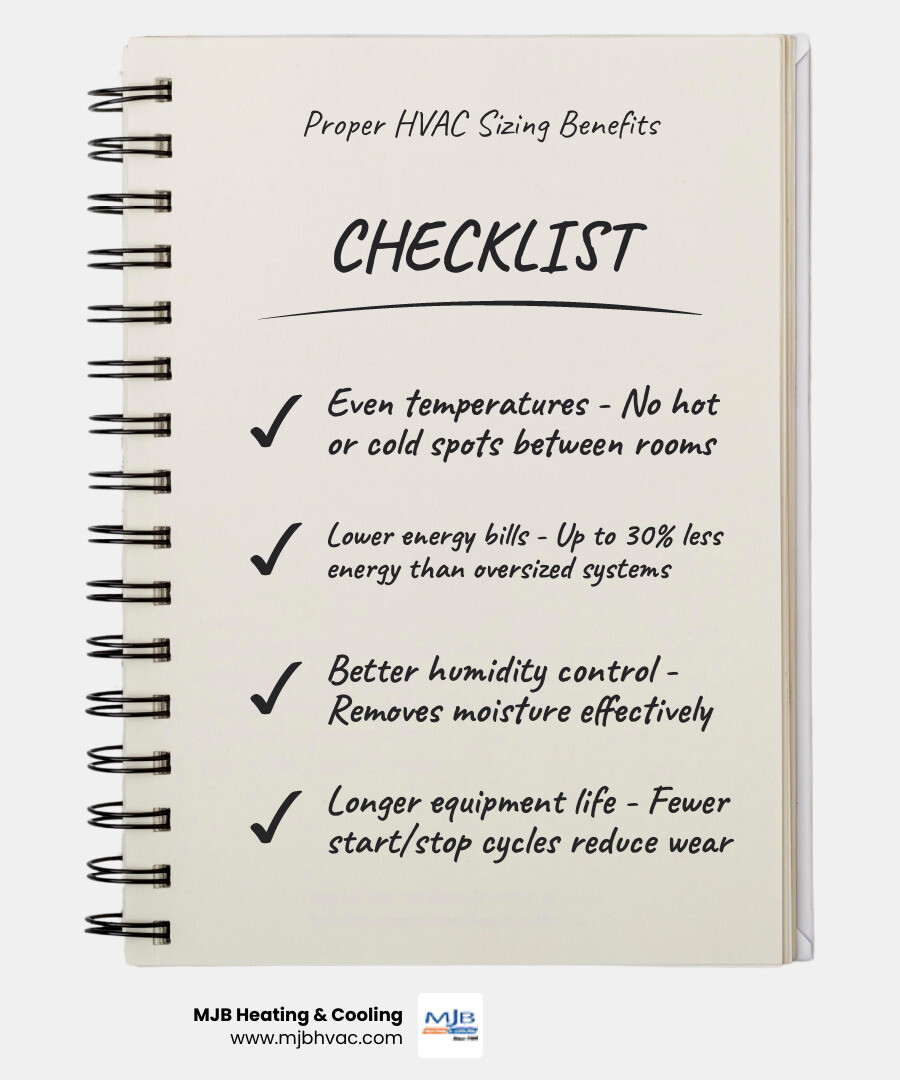
Here's a quick summary of what proper sizing does for your home:
More than half of U.S. homes have HVAC systems that are either too big or too small. That means most homeowners are already paying more than they should — in energy costs, repair bills, and daily discomfort — without even knowing it.
In Central Kansas, where summers push temperatures well above 90°F and winters can drop below zero, getting the size right isn't just a nice-to-have. It's the difference between a system that truly protects your home and one that struggles to keep up — or burns out trying.
The good news: there's a proven, professional process for getting it right. And once your system is properly sized, everything else — efficiency, comfort, reliability — falls into place.
When we talk about "sizing" in the HVAC world, we aren't talking about the physical dimensions of the metal box sitting outside your house in Andover or Derby. We’re talking about capacity. This capacity is measured in two main ways: BTUs (British Thermal Units) and tons.
One BTU is roughly the amount of energy required to heat or cool one pound of water by one degree Fahrenheit. In the air conditioning world, we often use "tons." Fun fact: one ton of cooling capacity is equal to 12,000 BTUs per hour. This measurement actually dates back to the days before electricity, when people used literal tons of ice to cool buildings! One ton of cooling is the amount of energy it takes to melt one ton of ice over 24 hours.
In the Wichita metro area, our climate is famously unpredictable. We experience the full range of weather extremes—humid, sweltering summers and freezing, bone-chilling winters. If your system is sized based on a "guess," it might work okay on a mild spring day in Rose Hill, but it will fail you when the Kansas humidity hits 90% in July.
Proper sizing ensures that your unit has enough "muscle" to handle the hottest days without being so large that it wastes energy and creates a clammy environment. It’s a delicate balance. If you're wondering how to keep your current system running while you contemplate an upgrade, check out our Essential HVAC Maintenance Tips for Your Furnace and AC.
For decades, many contractors used a "rule of thumb" like "one ton for every 500 square feet." In April 2026, we know that this method is about as accurate as predicting the Kansas weather three months in advance. It just doesn't work.
To find the perfect fit, we use what is known as a Manual J Load Calculation. This is the industry-standard scientific method for determining exactly how much heat your home gains in the summer and loses in the winter. We don't just look at the floor plan; we look at the "bones" of the house.
Factors we consider during a Manual J calculation include:
By crunching these numbers, we ensure you aren't buying more technology than you need. If you are in the market for a new heating system specifically, you might find our Find the Perfect New Furnace: Tips for Homeowners guide very helpful.
Once the Manual J tells us the "load" (the amount of energy needed), we don't just grab a random unit off the shelf. We move on to Manual S and Manual D.
Manual S is the protocol for equipment selection. It ensures the specific brand and model of AC or furnace can actually meet the requirements found in the Manual J. For example, a unit might be rated for 3 tons in a laboratory, but in the actual Kansas heat, its performance might be slightly different. Manual S accounts for these real-world conditions.
Manual D is all about the ductwork. Think of your ducts like the circulatory system of your home. If the "heart" (the HVAC unit) is strong but the "arteries" (the ducts) are too small or poorly designed, the system will struggle. This creates static pressure, which is essentially resistance to airflow. High static pressure makes your system noisy, inefficient, and prone to early failure. Before you sign off on a new unit, make sure you've read our Questions to Ask Before Your AC Installation.
How proper HVAC sizing affects comfort and efficiency is most visible in your monthly utility bills and your daily quality of life. A system that is "right-sized" operates in its "sweet spot." It doesn't have to work at 110% capacity to keep up, nor does it turn on and off every five minutes.
When a system is sized correctly, it runs for longer, steadier cycles. This leads to several major benefits:
| Feature | Properly Sized System | Improperly Sized System |
|---|---|---|
| Energy Consumption | Uses up to 30% less energy | High bills due to frequent starts or constant running |
| Temperature | Consistent throughout the home | 5–10°F swings between rooms or cycles |
| Humidity | Removes moisture effectively | Clammy, "sticky" indoor air |
| Lifespan | Lasts 15–20 years with maintenance | Can fail in half the time (7–10 years) |
| Sound | Quiet, steady operation | Noisy "whoosh" sounds and frequent clicking |
In today’s world—specifically as we look at the advanced technology available in April 2026—efficiency is higher than ever. Modern systems often feature variable-speed compressors. Unlike older "single-stage" units that are either 100% on or 100% off, variable-speed systems can modulate their output.
However, even the most expensive, high-efficiency variable-speed unit will underperform if it isn't sized correctly. If it’s too big, it will never get out of "low gear" before the thermostat is satisfied, leading to inefficient operation. If it's too small, it will run at 100% constantly, negating any energy-saving features.
Proper sizing allows these modern marvels to boost energy efficiency by up to 40% compared to older, mismatched systems. This directly impacts your wallet. For those preparing for a replacement in Maize or Goddard, our Guide to Preparing Your Home for a New AC is an essential read.
Comfort isn't just about the temperature on the thermostat; it’s about how the air feels on your skin. This is the difference between "sensible heat" (temperature) and "latent heat" (moisture).
An air conditioner's job is twofold: it lowers the air temperature and removes humidity. The moisture removal happens as air passes over the cold evaporator coils. This process takes time. If a system is oversized, it cools the house so quickly that it shuts off before it has a chance to pull the water out of the air. This results in a home that is 72°F but feels "clammy" or "sticky"—a perfect environment for mold growth and poor indoor air quality.
Installing the wrong size system is like buying a pair of shoes that are two sizes too small—or three sizes too big. You might be able to walk in them, but you’re going to be miserable, and you’re going to ruin the shoes (and your feet) pretty quickly.
Many homeowners in the Wichita area mistakenly believe that "bigger is better." They think a 5-ton unit will cool their house faster than a 3-ton unit. While it might cool the air faster, it creates a host of problems known as short cycling.
Short cycling is when the unit turns on, runs for three minutes, reaches the target temperature, and shuts off. Then, five minutes later, it does it again.
Before you commit to a size, ask your technician these Expert HVAC Installation Questions for Your Technician.
On the flip side, an undersized system is like a small engine trying to pull a massive trailer. It might get moving, but it’s going to overheat and eventually break down.
We strongly advise against it. While square footage is a starting point, it doesn't tell the whole story. Two houses in Bel Aire might both be 2,000 square feet, but if one has brand-new triple-pane windows and R-60 attic insulation, and the other has original 1970s windows and thin insulation, their HVAC needs will be vastly different. A "rule of thumb" would likely lead to an oversized system for the efficient home and an undersized one for the older home. Manual J is the only way to be sure.
No. As we've discussed, a "bigger" system actually provides worse cooling because it fails to dehumidify the air. You end up with a home that feels cold and damp, which is uncomfortable and can even lead to health issues like respiratory irritation from mold or dust mites thriving in high humidity. Proper sizing is about finding the "Goldilocks" zone—not too big, not too small, but just right.
If you notice any of the following, your system might be the wrong size:
If you suspect your system is the wrong size, it’s worth having a professional evaluation. You can learn more about what a proper install looks like in our Step-by-Step AC Installation Process.
At MJB Heating & Cooling, we’ve been serving the Wichita metro area, including communities like Andover, Augusta, and Derby, since 1984. As a family-owned business, we’ve built our reputation on quality workmanship and an honest approach. We don't believe in "guessing" when it comes to your home's comfort.
How proper HVAC sizing affects comfort and efficiency is something we see every day. We’ve seen the frustration of homeowners who were sold a system that was too large, and the exhaustion of those whose systems were too small to handle a Kansas heatwave. Our goal is to provide a "just right" solution that protects your investment and keeps your family comfortable for years to come.
Whether you are in Hutchinson, Newton, or right here in Wichita, we are ready to help you find the perfect fit for your home. Don't leave your comfort to chance or outdated rules of thumb.
How proper HVAC sizing affects comfort and efficiency comes down to one simple idea: a system that matches your home's actual heating and cooling needs runs better, costs less to operate, and keeps every room consistently comfortable.
Here's a quick summary of what proper sizing does for your home:
More than half of U.S. homes have HVAC systems that are either too big or too small. That means most homeowners are already paying more than they should — in energy costs, repair bills, and daily discomfort — without even knowing it.
In Central Kansas, where summers push temperatures well above 90°F and winters can drop below zero, getting the size right isn't just a nice-to-have. It's the difference between a system that truly protects your home and one that struggles to keep up — or burns out trying.
The good news: there's a proven, professional process for getting it right. And once your system is properly sized, everything else — efficiency, comfort, reliability — falls into place.
When we talk about "sizing" in the HVAC world, we aren't talking about the physical dimensions of the metal box sitting outside your house in Andover or Derby. We’re talking about capacity. This capacity is measured in two main ways: BTUs (British Thermal Units) and tons.
One BTU is roughly the amount of energy required to heat or cool one pound of water by one degree Fahrenheit. In the air conditioning world, we often use "tons." Fun fact: one ton of cooling capacity is equal to 12,000 BTUs per hour. This measurement actually dates back to the days before electricity, when people used literal tons of ice to cool buildings! One ton of cooling is the amount of energy it takes to melt one ton of ice over 24 hours.
In the Wichita metro area, our climate is famously unpredictable. We experience the full range of weather extremes—humid, sweltering summers and freezing, bone-chilling winters. If your system is sized based on a "guess," it might work okay on a mild spring day in Rose Hill, but it will fail you when the Kansas humidity hits 90% in July.
Proper sizing ensures that your unit has enough "muscle" to handle the hottest days without being so large that it wastes energy and creates a clammy environment. It’s a delicate balance. If you're wondering how to keep your current system running while you contemplate an upgrade, check out our Essential HVAC Maintenance Tips for Your Furnace and AC.
For decades, many contractors used a "rule of thumb" like "one ton for every 500 square feet." In April 2026, we know that this method is about as accurate as predicting the Kansas weather three months in advance. It just doesn't work.
To find the perfect fit, we use what is known as a Manual J Load Calculation. This is the industry-standard scientific method for determining exactly how much heat your home gains in the summer and loses in the winter. We don't just look at the floor plan; we look at the "bones" of the house.
Factors we consider during a Manual J calculation include:
By crunching these numbers, we ensure you aren't buying more technology than you need. If you are in the market for a new heating system specifically, you might find our Find the Perfect New Furnace: Tips for Homeowners guide very helpful.
Once the Manual J tells us the "load" (the amount of energy needed), we don't just grab a random unit off the shelf. We move on to Manual S and Manual D.
Manual S is the protocol for equipment selection. It ensures the specific brand and model of AC or furnace can actually meet the requirements found in the Manual J. For example, a unit might be rated for 3 tons in a laboratory, but in the actual Kansas heat, its performance might be slightly different. Manual S accounts for these real-world conditions.
Manual D is all about the ductwork. Think of your ducts like the circulatory system of your home. If the "heart" (the HVAC unit) is strong but the "arteries" (the ducts) are too small or poorly designed, the system will struggle. This creates static pressure, which is essentially resistance to airflow. High static pressure makes your system noisy, inefficient, and prone to early failure. Before you sign off on a new unit, make sure you've read our Questions to Ask Before Your AC Installation.
How proper HVAC sizing affects comfort and efficiency is most visible in your monthly utility bills and your daily quality of life. A system that is "right-sized" operates in its "sweet spot." It doesn't have to work at 110% capacity to keep up, nor does it turn on and off every five minutes.
When a system is sized correctly, it runs for longer, steadier cycles. This leads to several major benefits:
| Feature | Properly Sized System | Improperly Sized System |
|---|---|---|
| Energy Consumption | Uses up to 30% less energy | High bills due to frequent starts or constant running |
| Temperature | Consistent throughout the home | 5–10°F swings between rooms or cycles |
| Humidity | Removes moisture effectively | Clammy, "sticky" indoor air |
| Lifespan | Lasts 15–20 years with maintenance | Can fail in half the time (7–10 years) |
| Sound | Quiet, steady operation | Noisy "whoosh" sounds and frequent clicking |
In today’s world—specifically as we look at the advanced technology available in April 2026—efficiency is higher than ever. Modern systems often feature variable-speed compressors. Unlike older "single-stage" units that are either 100% on or 100% off, variable-speed systems can modulate their output.
However, even the most expensive, high-efficiency variable-speed unit will underperform if it isn't sized correctly. If it’s too big, it will never get out of "low gear" before the thermostat is satisfied, leading to inefficient operation. If it's too small, it will run at 100% constantly, negating any energy-saving features.
Proper sizing allows these modern marvels to boost energy efficiency by up to 40% compared to older, mismatched systems. This directly impacts your wallet. For those preparing for a replacement in Maize or Goddard, our Guide to Preparing Your Home for a New AC is an essential read.
Comfort isn't just about the temperature on the thermostat; it’s about how the air feels on your skin. This is the difference between "sensible heat" (temperature) and "latent heat" (moisture).
An air conditioner's job is twofold: it lowers the air temperature and removes humidity. The moisture removal happens as air passes over the cold evaporator coils. This process takes time. If a system is oversized, it cools the house so quickly that it shuts off before it has a chance to pull the water out of the air. This results in a home that is 72°F but feels "clammy" or "sticky"—a perfect environment for mold growth and poor indoor air quality.
Installing the wrong size system is like buying a pair of shoes that are two sizes too small—or three sizes too big. You might be able to walk in them, but you’re going to be miserable, and you’re going to ruin the shoes (and your feet) pretty quickly.
Many homeowners in the Wichita area mistakenly believe that "bigger is better." They think a 5-ton unit will cool their house faster than a 3-ton unit. While it might cool the air faster, it creates a host of problems known as short cycling.
Short cycling is when the unit turns on, runs for three minutes, reaches the target temperature, and shuts off. Then, five minutes later, it does it again.
Before you commit to a size, ask your technician these Expert HVAC Installation Questions for Your Technician.
On the flip side, an undersized system is like a small engine trying to pull a massive trailer. It might get moving, but it’s going to overheat and eventually break down.
We strongly advise against it. While square footage is a starting point, it doesn't tell the whole story. Two houses in Bel Aire might both be 2,000 square feet, but if one has brand-new triple-pane windows and R-60 attic insulation, and the other has original 1970s windows and thin insulation, their HVAC needs will be vastly different. A "rule of thumb" would likely lead to an oversized system for the efficient home and an undersized one for the older home. Manual J is the only way to be sure.
No. As we've discussed, a "bigger" system actually provides worse cooling because it fails to dehumidify the air. You end up with a home that feels cold and damp, which is uncomfortable and can even lead to health issues like respiratory irritation from mold or dust mites thriving in high humidity. Proper sizing is about finding the "Goldilocks" zone—not too big, not too small, but just right.
If you notice any of the following, your system might be the wrong size:
If you suspect your system is the wrong size, it’s worth having a professional evaluation. You can learn more about what a proper install looks like in our Step-by-Step AC Installation Process.
At MJB Heating & Cooling, we’ve been serving the Wichita metro area, including communities like Andover, Augusta, and Derby, since 1984. As a family-owned business, we’ve built our reputation on quality workmanship and an honest approach. We don't believe in "guessing" when it comes to your home's comfort.
How proper HVAC sizing affects comfort and efficiency is something we see every day. We’ve seen the frustration of homeowners who were sold a system that was too large, and the exhaustion of those whose systems were too small to handle a Kansas heatwave. Our goal is to provide a "just right" solution that protects your investment and keeps your family comfortable for years to come.
Whether you are in Hutchinson, Newton, or right here in Wichita, we are ready to help you find the perfect fit for your home. Don't leave your comfort to chance or outdated rules of thumb.
How proper HVAC sizing affects comfort and efficiency comes down to one simple idea: a system that matches your home's actual heating and cooling needs runs better, costs less to operate, and keeps every room consistently comfortable.
Here's a quick summary of what proper sizing does for your home:
More than half of U.S. homes have HVAC systems that are either too big or too small. That means most homeowners are already paying more than they should — in energy costs, repair bills, and daily discomfort — without even knowing it.
In Central Kansas, where summers push temperatures well above 90°F and winters can drop below zero, getting the size right isn't just a nice-to-have. It's the difference between a system that truly protects your home and one that struggles to keep up — or burns out trying.
The good news: there's a proven, professional process for getting it right. And once your system is properly sized, everything else — efficiency, comfort, reliability — falls into place.
When we talk about "sizing" in the HVAC world, we aren't talking about the physical dimensions of the metal box sitting outside your house in Andover or Derby. We’re talking about capacity. This capacity is measured in two main ways: BTUs (British Thermal Units) and tons.
One BTU is roughly the amount of energy required to heat or cool one pound of water by one degree Fahrenheit. In the air conditioning world, we often use "tons." Fun fact: one ton of cooling capacity is equal to 12,000 BTUs per hour. This measurement actually dates back to the days before electricity, when people used literal tons of ice to cool buildings! One ton of cooling is the amount of energy it takes to melt one ton of ice over 24 hours.
In the Wichita metro area, our climate is famously unpredictable. We experience the full range of weather extremes—humid, sweltering summers and freezing, bone-chilling winters. If your system is sized based on a "guess," it might work okay on a mild spring day in Rose Hill, but it will fail you when the Kansas humidity hits 90% in July.
Proper sizing ensures that your unit has enough "muscle" to handle the hottest days without being so large that it wastes energy and creates a clammy environment. It’s a delicate balance. If you're wondering how to keep your current system running while you contemplate an upgrade, check out our Essential HVAC Maintenance Tips for Your Furnace and AC.
For decades, many contractors used a "rule of thumb" like "one ton for every 500 square feet." In April 2026, we know that this method is about as accurate as predicting the Kansas weather three months in advance. It just doesn't work.
To find the perfect fit, we use what is known as a Manual J Load Calculation. This is the industry-standard scientific method for determining exactly how much heat your home gains in the summer and loses in the winter. We don't just look at the floor plan; we look at the "bones" of the house.
Factors we consider during a Manual J calculation include:
By crunching these numbers, we ensure you aren't buying more technology than you need. If you are in the market for a new heating system specifically, you might find our Find the Perfect New Furnace: Tips for Homeowners guide very helpful.
Once the Manual J tells us the "load" (the amount of energy needed), we don't just grab a random unit off the shelf. We move on to Manual S and Manual D.
Manual S is the protocol for equipment selection. It ensures the specific brand and model of AC or furnace can actually meet the requirements found in the Manual J. For example, a unit might be rated for 3 tons in a laboratory, but in the actual Kansas heat, its performance might be slightly different. Manual S accounts for these real-world conditions.
Manual D is all about the ductwork. Think of your ducts like the circulatory system of your home. If the "heart" (the HVAC unit) is strong but the "arteries" (the ducts) are too small or poorly designed, the system will struggle. This creates static pressure, which is essentially resistance to airflow. High static pressure makes your system noisy, inefficient, and prone to early failure. Before you sign off on a new unit, make sure you've read our Questions to Ask Before Your AC Installation.
How proper HVAC sizing affects comfort and efficiency is most visible in your monthly utility bills and your daily quality of life. A system that is "right-sized" operates in its "sweet spot." It doesn't have to work at 110% capacity to keep up, nor does it turn on and off every five minutes.
When a system is sized correctly, it runs for longer, steadier cycles. This leads to several major benefits:
| Feature | Properly Sized System | Improperly Sized System |
|---|---|---|
| Energy Consumption | Uses up to 30% less energy | High bills due to frequent starts or constant running |
| Temperature | Consistent throughout the home | 5–10°F swings between rooms or cycles |
| Humidity | Removes moisture effectively | Clammy, "sticky" indoor air |
| Lifespan | Lasts 15–20 years with maintenance | Can fail in half the time (7–10 years) |
| Sound | Quiet, steady operation | Noisy "whoosh" sounds and frequent clicking |
In today’s world—specifically as we look at the advanced technology available in April 2026—efficiency is higher than ever. Modern systems often feature variable-speed compressors. Unlike older "single-stage" units that are either 100% on or 100% off, variable-speed systems can modulate their output.
However, even the most expensive, high-efficiency variable-speed unit will underperform if it isn't sized correctly. If it’s too big, it will never get out of "low gear" before the thermostat is satisfied, leading to inefficient operation. If it's too small, it will run at 100% constantly, negating any energy-saving features.
Proper sizing allows these modern marvels to boost energy efficiency by up to 40% compared to older, mismatched systems. This directly impacts your wallet. For those preparing for a replacement in Maize or Goddard, our Guide to Preparing Your Home for a New AC is an essential read.
Comfort isn't just about the temperature on the thermostat; it’s about how the air feels on your skin. This is the difference between "sensible heat" (temperature) and "latent heat" (moisture).
An air conditioner's job is twofold: it lowers the air temperature and removes humidity. The moisture removal happens as air passes over the cold evaporator coils. This process takes time. If a system is oversized, it cools the house so quickly that it shuts off before it has a chance to pull the water out of the air. This results in a home that is 72°F but feels "clammy" or "sticky"—a perfect environment for mold growth and poor indoor air quality.
Installing the wrong size system is like buying a pair of shoes that are two sizes too small—or three sizes too big. You might be able to walk in them, but you’re going to be miserable, and you’re going to ruin the shoes (and your feet) pretty quickly.
Many homeowners in the Wichita area mistakenly believe that "bigger is better." They think a 5-ton unit will cool their house faster than a 3-ton unit. While it might cool the air faster, it creates a host of problems known as short cycling.
Short cycling is when the unit turns on, runs for three minutes, reaches the target temperature, and shuts off. Then, five minutes later, it does it again.
Before you commit to a size, ask your technician these Expert HVAC Installation Questions for Your Technician.
On the flip side, an undersized system is like a small engine trying to pull a massive trailer. It might get moving, but it’s going to overheat and eventually break down.
We strongly advise against it. While square footage is a starting point, it doesn't tell the whole story. Two houses in Bel Aire might both be 2,000 square feet, but if one has brand-new triple-pane windows and R-60 attic insulation, and the other has original 1970s windows and thin insulation, their HVAC needs will be vastly different. A "rule of thumb" would likely lead to an oversized system for the efficient home and an undersized one for the older home. Manual J is the only way to be sure.
No. As we've discussed, a "bigger" system actually provides worse cooling because it fails to dehumidify the air. You end up with a home that feels cold and damp, which is uncomfortable and can even lead to health issues like respiratory irritation from mold or dust mites thriving in high humidity. Proper sizing is about finding the "Goldilocks" zone—not too big, not too small, but just right.
If you notice any of the following, your system might be the wrong size:
If you suspect your system is the wrong size, it’s worth having a professional evaluation. You can learn more about what a proper install looks like in our Step-by-Step AC Installation Process.
At MJB Heating & Cooling, we’ve been serving the Wichita metro area, including communities like Andover, Augusta, and Derby, since 1984. As a family-owned business, we’ve built our reputation on quality workmanship and an honest approach. We don't believe in "guessing" when it comes to your home's comfort.
How proper HVAC sizing affects comfort and efficiency is something we see every day. We’ve seen the frustration of homeowners who were sold a system that was too large, and the exhaustion of those whose systems were too small to handle a Kansas heatwave. Our goal is to provide a "just right" solution that protects your investment and keeps your family comfortable for years to come.
Whether you are in Hutchinson, Newton, or right here in Wichita, we are ready to help you find the perfect fit for your home. Don't leave your comfort to chance or outdated rules of thumb.


How proper HVAC sizing affects comfort and efficiency comes down to one simple idea: a system that matches your home's actual heating and cooling needs runs better, costs less to operate, and keeps every room consistently comfortable.
Here's a quick summary of what proper sizing does for your home:
• Even temperatures - No hot or cold spots between rooms
• Lower energy bills - A correctly sized system can use up to 30% less energy than an oversized one
• Better humidity control - Your system runs long enough to pull moisture out of the air
• Longer equipment life - Fewer start/stop cycles means less wear on components
• Improved air quality - Consistent airflow means better filtration and fresher indoor air
More than half of U.S. homes have HVAC systems that are either too big or too small. That means most homeowners are already paying more than they should — in energy costs, repair bills, and daily discomfort — without even knowing it.
In Central Kansas, where summers push temperatures well above 90°F and winters can drop below zero, getting the size right isn't just a nice-to-have. It's the difference between a system that truly protects your home and one that struggles to keep up — or burns out trying.
The good news: there's a proven, professional process for getting it right. And once your system is properly sized, everything else — efficiency, comfort, reliability — falls into place.

When we talk about "sizing" in the HVAC world, we aren't talking about the physical dimensions of the metal box sitting outside your house in Andover or Derby. We’re talking about capacity. This capacity is measured in two main ways: BTUs (British Thermal Units) and tons.
One BTU is roughly the amount of energy required to heat or cool one pound of water by one degree Fahrenheit. In the air conditioning world, we often use "tons." Fun fact: one ton of cooling capacity is equal to 12,000 BTUs per hour. This measurement actually dates back to the days before electricity, when people used literal tons of ice to cool buildings! One ton of cooling is the amount of energy it takes to melt one ton of ice over 24 hours.
In the Wichita metro area, our climate is famously unpredictable. We experience the full range of weather extremes—humid, sweltering summers and freezing, bone-chilling winters. If your system is sized based on a "guess," it might work okay on a mild spring day in Rose Hill, but it will fail you when the Kansas humidity hits 90% in July.
Proper sizing ensures that your unit has enough "muscle" to handle the hottest days without being so large that it wastes energy and creates a clammy environment. It’s a delicate balance. If you're wondering how to keep your current system running while you contemplate an upgrade, check out our Essential HVAC Maintenance Tips for Your Furnace and AC.
For decades, many contractors used a "rule of thumb" like "one ton for every 500 square feet." In April 2026, we know that this method is about as accurate as predicting the Kansas weather three months in advance. It just doesn't work.
To find the perfect fit, we use what is known as a Manual J Load Calculation. This is the industry-standard scientific method for determining exactly how much heat your home gains in the summer and loses in the winter. We don't just look at the floor plan; we look at the "bones" of the house.
Factors we consider during a Manual J calculation include:
• Total Square Footage: The size of the conditioned space.
• Insulation Quality: Are your walls and attic packed with modern insulation, or are you living in a charming but drafty historic home in Newton?
• Window Orientation and Type: South-facing windows in a Wichita sunroom act like giant heaters. We calculate the solar heat gain from every pane of glass.
• Ceiling Height: A room with 12-foot vaulted ceilings requires more energy to heat and cool than a standard 8-foot room.
• Airtightness: How much air leaks through doors, recessed lights, and electrical outlets?
• Occupancy: How many people live in the home? (Humans generate heat too—about 350 to 600 BTUs per hour depending on activity!)
By crunching these numbers, we ensure you aren't buying more technology than you need. If you are in the market for a new heating system specifically, you might find our Find the Perfect New Furnace: Tips for Homeowners guide very helpful.
Once the Manual J tells us the "load" (the amount of energy needed), we don't just grab a random unit off the shelf. We move on to Manual S and Manual D.
Manual S is the protocol for equipment selection. It ensures the specific brand and model of AC or furnace can actually meet the requirements found in the Manual J. For example, a unit might be rated for 3 tons in a laboratory, but in the actual Kansas heat, its performance might be slightly different. Manual S accounts for these real-world conditions.
Manual D is all about the ductwork. Think of your ducts like the circulatory system of your home. If the "heart" (the HVAC unit) is strong but the "arteries" (the ducts) are too small or poorly designed, the system will struggle. This creates static pressure, which is essentially resistance to airflow. High static pressure makes your system noisy, inefficient, and prone to early failure. Before you sign off on a new unit, make sure you've read our Questions to Ask Before Your AC Installation.
How proper HVAC sizing affects comfort and efficiency is most visible in your monthly utility bills and your daily quality of life. A system that is "right-sized" operates in its "sweet spot." It doesn't have to work at 110% capacity to keep up, nor does it turn on and off every five minutes.
When a system is sized correctly, it runs for longer, steadier cycles. This leads to several major benefits:
• Energy Consumption — Properly Sized System: Uses up to 30% less energy — Improperly Sized System: High bills due to frequent starts or constant running
• Temperature — Properly Sized System: Consistent throughout the home — Improperly Sized System: 5–10°F swings between rooms or cycles
• Humidity — Properly Sized System: Removes moisture effectively — Improperly Sized System: Clammy, "sticky" indoor air
• Lifespan — Properly Sized System: Lasts 15–20 years with maintenance — Improperly Sized System: Can fail in half the time (7–10 years)
• Sound — Properly Sized System: Quiet, steady operation — Improperly Sized System: Noisy "whoosh" sounds and frequent clicking
In today’s world—specifically as we look at the advanced technology available in April 2026—efficiency is higher than ever. Modern systems often feature variable-speed compressors. Unlike older "single-stage" units that are either 100% on or 100% off, variable-speed systems can modulate their output.
However, even the most expensive, high-efficiency variable-speed unit will underperform if it isn't sized correctly. If it’s too big, it will never get out of "low gear" before the thermostat is satisfied, leading to inefficient operation. If it's too small, it will run at 100% constantly, negating any energy-saving features.
Proper sizing allows these modern marvels to boost energy efficiency by up to 40% compared to older, mismatched systems. This directly impacts your wallet. For those preparing for a replacement in Maize or Goddard, our Guide to Preparing Your Home for a New AC is an essential read.
Comfort isn't just about the temperature on the thermostat; it’s about how the air feels on your skin. This is the difference between "sensible heat" (temperature) and "latent heat" (moisture).
An air conditioner's job is twofold: it lowers the air temperature and removes humidity. The moisture removal happens as air passes over the cold evaporator coils. This process takes time. If a system is oversized, it cools the house so quickly that it shuts off before it has a chance to pull the water out of the air. This results in a home that is 72°F but feels "clammy" or "sticky"—a perfect environment for mold growth and poor indoor air quality.
Installing the wrong size system is like buying a pair of shoes that are two sizes too small—or three sizes too big. You might be able to walk in them, but you’re going to be miserable, and you’re going to ruin the shoes (and your feet) pretty quickly.
Many homeowners in the Wichita area mistakenly believe that "bigger is better." They think a 5-ton unit will cool their house faster than a 3-ton unit. While it might cool the air faster, it creates a host of problems known as short cycling.
Short cycling is when the unit turns on, runs for three minutes, reaches the target temperature, and shuts off. Then, five minutes later, it does it again.
• Increased Wear and Tear: The most stressful part of an HVAC unit's life is the startup. Frequent starts can cut the equipment lifespan by up to 50%.
• Temperature Swings: You’ll notice 3-5°F swings between cycles, making you feel hot one minute and chilly the next.
• High Energy Spikes: It takes a lot of electricity to kick-start a compressor. Constant starting leads to massive utility bills.
• Noise: Larger systems move more air through the same ducts, often creating a loud, disruptive whistling or humming sound.
Before you commit to a size, ask your technician these Expert HVAC Installation Questions for Your Technician.
On the flip side, an undersized system is like a small engine trying to pull a massive trailer. It might get moving, but it’s going to overheat and eventually break down.
• Constant Running: In the peak of a Wichita summer, an undersized unit will run 24/7 and still might not reach your desired temperature.
• Uneven Temperatures: You might find that the living room is okay, but the bedrooms are 10°F warmer.
• Frozen Coils: Because the unit never stops, the evaporator coils can actually drop below freezing and ice over, completely blocking airflow.
• Premature Failure: Running at 100% capacity for months on end leads to burnt-out motors and failed compressors.
We strongly advise against it. While square footage is a starting point, it doesn't tell the whole story. Two houses in Bel Aire might both be 2,000 square feet, but if one has brand-new triple-pane windows and R-60 attic insulation, and the other has original 1970s windows and thin insulation, their HVAC needs will be vastly different. A "rule of thumb" would likely lead to an oversized system for the efficient home and an undersized one for the older home. Manual J is the only way to be sure.
No. As we've discussed, a "bigger" system actually provides worse cooling because it fails to dehumidify the air. You end up with a home that feels cold and damp, which is uncomfortable and can even lead to health issues like respiratory irritation from mold or dust mites thriving in high humidity. Proper sizing is about finding the "Goldilocks" zone—not too big, not too small, but just right.
If you notice any of the following, your system might be the wrong size:
1. Your energy bills are significantly higher than your neighbors' with similar-sized homes.
2. The AC turns on and off every few minutes (short cycling).
3. The system runs all day without ever reaching the temperature you set.
4. Some rooms are always significantly warmer or cooler than others.
5. The air feels humid even when the AC is running.
If you suspect your system is the wrong size, it’s worth having a professional evaluation. You can learn more about what a proper install looks like in our Step-by-Step AC Installation Process.
At MJB Heating & Cooling, we’ve been serving the Wichita metro area, including communities like Andover, Augusta, and Derby, since 1984. As a family-owned business, we’ve built our reputation on quality workmanship and an honest approach. We don't believe in "guessing" when it comes to your home's comfort.
How proper HVAC sizing affects comfort and efficiency is something we see every day. We’ve seen the frustration of homeowners who were sold a system that was too large, and the exhaustion of those whose systems were too small to handle a Kansas heatwave. Our goal is to provide a "just right" solution that protects your investment and keeps your family comfortable for years to come.
Whether you are in Hutchinson, Newton, or right here in Wichita, we are ready to help you find the perfect fit for your home. Don't leave your comfort to chance or outdated rules of thumb.
How proper HVAC sizing affects comfort and efficiency comes down to one simple idea: a system that matches your home's actual heating and cooling needs runs better, costs less to operate, and keeps every room consistently comfortable.
Here's a quick summary of what proper sizing does for your home:
More than half of U.S. homes have HVAC systems that are either too big or too small. That means most homeowners are already paying more than they should — in energy costs, repair bills, and daily discomfort — without even knowing it.
In Central Kansas, where summers push temperatures well above 90°F and winters can drop below zero, getting the size right isn't just a nice-to-have. It's the difference between a system that truly protects your home and one that struggles to keep up — or burns out trying.
The good news: there's a proven, professional process for getting it right. And once your system is properly sized, everything else — efficiency, comfort, reliability — falls into place.
When we talk about "sizing" in the HVAC world, we aren't talking about the physical dimensions of the metal box sitting outside your house in Andover or Derby. We’re talking about capacity. This capacity is measured in two main ways: BTUs (British Thermal Units) and tons.
One BTU is roughly the amount of energy required to heat or cool one pound of water by one degree Fahrenheit. In the air conditioning world, we often use "tons." Fun fact: one ton of cooling capacity is equal to 12,000 BTUs per hour. This measurement actually dates back to the days before electricity, when people used literal tons of ice to cool buildings! One ton of cooling is the amount of energy it takes to melt one ton of ice over 24 hours.
In the Wichita metro area, our climate is famously unpredictable. We experience the full range of weather extremes—humid, sweltering summers and freezing, bone-chilling winters. If your system is sized based on a "guess," it might work okay on a mild spring day in Rose Hill, but it will fail you when the Kansas humidity hits 90% in July.
Proper sizing ensures that your unit has enough "muscle" to handle the hottest days without being so large that it wastes energy and creates a clammy environment. It’s a delicate balance. If you're wondering how to keep your current system running while you contemplate an upgrade, check out our Essential HVAC Maintenance Tips for Your Furnace and AC.
For decades, many contractors used a "rule of thumb" like "one ton for every 500 square feet." In April 2026, we know that this method is about as accurate as predicting the Kansas weather three months in advance. It just doesn't work.
To find the perfect fit, we use what is known as a Manual J Load Calculation. This is the industry-standard scientific method for determining exactly how much heat your home gains in the summer and loses in the winter. We don't just look at the floor plan; we look at the "bones" of the house.
Factors we consider during a Manual J calculation include:
By crunching these numbers, we ensure you aren't buying more technology than you need. If you are in the market for a new heating system specifically, you might find our Find the Perfect New Furnace: Tips for Homeowners guide very helpful.
Once the Manual J tells us the "load" (the amount of energy needed), we don't just grab a random unit off the shelf. We move on to Manual S and Manual D.
Manual S is the protocol for equipment selection. It ensures the specific brand and model of AC or furnace can actually meet the requirements found in the Manual J. For example, a unit might be rated for 3 tons in a laboratory, but in the actual Kansas heat, its performance might be slightly different. Manual S accounts for these real-world conditions.
Manual D is all about the ductwork. Think of your ducts like the circulatory system of your home. If the "heart" (the HVAC unit) is strong but the "arteries" (the ducts) are too small or poorly designed, the system will struggle. This creates static pressure, which is essentially resistance to airflow. High static pressure makes your system noisy, inefficient, and prone to early failure. Before you sign off on a new unit, make sure you've read our Questions to Ask Before Your AC Installation.
How proper HVAC sizing affects comfort and efficiency is most visible in your monthly utility bills and your daily quality of life. A system that is "right-sized" operates in its "sweet spot." It doesn't have to work at 110% capacity to keep up, nor does it turn on and off every five minutes.
When a system is sized correctly, it runs for longer, steadier cycles. This leads to several major benefits:
| Feature | Properly Sized System | Improperly Sized System |
|---|---|---|
| Energy Consumption | Uses up to 30% less energy | High bills due to frequent starts or constant running |
| Temperature | Consistent throughout the home | 5–10°F swings between rooms or cycles |
| Humidity | Removes moisture effectively | Clammy, "sticky" indoor air |
| Lifespan | Lasts 15–20 years with maintenance | Can fail in half the time (7–10 years) |
| Sound | Quiet, steady operation | Noisy "whoosh" sounds and frequent clicking |
In today’s world—specifically as we look at the advanced technology available in April 2026—efficiency is higher than ever. Modern systems often feature variable-speed compressors. Unlike older "single-stage" units that are either 100% on or 100% off, variable-speed systems can modulate their output.
However, even the most expensive, high-efficiency variable-speed unit will underperform if it isn't sized correctly. If it’s too big, it will never get out of "low gear" before the thermostat is satisfied, leading to inefficient operation. If it's too small, it will run at 100% constantly, negating any energy-saving features.
Proper sizing allows these modern marvels to boost energy efficiency by up to 40% compared to older, mismatched systems. This directly impacts your wallet. For those preparing for a replacement in Maize or Goddard, our Guide to Preparing Your Home for a New AC is an essential read.
Comfort isn't just about the temperature on the thermostat; it’s about how the air feels on your skin. This is the difference between "sensible heat" (temperature) and "latent heat" (moisture).
An air conditioner's job is twofold: it lowers the air temperature and removes humidity. The moisture removal happens as air passes over the cold evaporator coils. This process takes time. If a system is oversized, it cools the house so quickly that it shuts off before it has a chance to pull the water out of the air. This results in a home that is 72°F but feels "clammy" or "sticky"—a perfect environment for mold growth and poor indoor air quality.
Installing the wrong size system is like buying a pair of shoes that are two sizes too small—or three sizes too big. You might be able to walk in them, but you’re going to be miserable, and you’re going to ruin the shoes (and your feet) pretty quickly.
Many homeowners in the Wichita area mistakenly believe that "bigger is better." They think a 5-ton unit will cool their house faster than a 3-ton unit. While it might cool the air faster, it creates a host of problems known as short cycling.
Short cycling is when the unit turns on, runs for three minutes, reaches the target temperature, and shuts off. Then, five minutes later, it does it again.
Before you commit to a size, ask your technician these Expert HVAC Installation Questions for Your Technician.
On the flip side, an undersized system is like a small engine trying to pull a massive trailer. It might get moving, but it’s going to overheat and eventually break down.
We strongly advise against it. While square footage is a starting point, it doesn't tell the whole story. Two houses in Bel Aire might both be 2,000 square feet, but if one has brand-new triple-pane windows and R-60 attic insulation, and the other has original 1970s windows and thin insulation, their HVAC needs will be vastly different. A "rule of thumb" would likely lead to an oversized system for the efficient home and an undersized one for the older home. Manual J is the only way to be sure.
No. As we've discussed, a "bigger" system actually provides worse cooling because it fails to dehumidify the air. You end up with a home that feels cold and damp, which is uncomfortable and can even lead to health issues like respiratory irritation from mold or dust mites thriving in high humidity. Proper sizing is about finding the "Goldilocks" zone—not too big, not too small, but just right.
If you notice any of the following, your system might be the wrong size:
If you suspect your system is the wrong size, it’s worth having a professional evaluation. You can learn more about what a proper install looks like in our Step-by-Step AC Installation Process.
At MJB Heating & Cooling, we’ve been serving the Wichita metro area, including communities like Andover, Augusta, and Derby, since 1984. As a family-owned business, we’ve built our reputation on quality workmanship and an honest approach. We don't believe in "guessing" when it comes to your home's comfort.
How proper HVAC sizing affects comfort and efficiency is something we see every day. We’ve seen the frustration of homeowners who were sold a system that was too large, and the exhaustion of those whose systems were too small to handle a Kansas heatwave. Our goal is to provide a "just right" solution that protects your investment and keeps your family comfortable for years to come.
Whether you are in Hutchinson, Newton, or right here in Wichita, we are ready to help you find the perfect fit for your home. Don't leave your comfort to chance or outdated rules of thumb.


Our A/C stopped working on a Sunday and due to health issues, we needed to find a service company available on a Sunday. I called MJB and left a message on their emergency voice mail. Within 10 minutes Tom Buck called me to hear my description of the symptoms. He was just finishing an appointment in Wichita and would be on his way to my home on the south end of Derby. He arrived within 30 minutes! From start to finish he was the perfect example of what you could ever hope for in an HVAC tech and a human being. His evaluation of our system inside and out was as thorough as I could ever imagine and once he was done with the repair, our system is running as well or better than ever. Well worth the price for the evaluation, parts, and labor. Thank you again Tom for an awesome experience.
Our AC went out during the hottest days of the year, and they were out next day! We have been jerked around by a shoddy home warranty for years. We finally had a chance to pick our own repair people, and MJB came highly recommended. I can see why! I was impressed with the honesty and speed at which they fixed our AC unit!
Our commercial building had a lightening/electrical strike and damaged our 20 ton AC unit. No one could find us a new unit before the end of September. Imagining going all of August and September with no AC in Kansas and working inside near 100 degree temps is less than thrilling. Dale and the team at MJB called around and saved the day. They had us a new unit 5 weeks earlier than other could promise and I now have happy employees. The unit is amazingly quiet, super cold and so much more energy efficient. Thank you for being our super hero!
Came out and installed my new furnace. Was very polite and affordable. They are very acknowledgeable and I highly recommend!
Thank you very much. We had our 1st warm night in 3weeks. MJB took the time and effort to find the real problem. And the employees were kind and thoughtful and explained things very well. I cannot thank you and all of MJB. Will recommend you highly. Thanks again Marjorie Herman Oxford Kansas
We had a new system installed and I was so impressed with how quick they were in come out and install it, in the middle of a hot summer day. They were so friendly & very professional. I had a small problem with a weird sound and they came over immediately and fixed it. Love them!


