


.avif)





Blogs
Stay updated with our latest blog posts.
Signs your ac needs repair are often easier to spot than most homeowners realize — if you know what to look for. Here's a quick rundown:
Top signs your AC needs repair:
In Central Kansas, summer doesn't ease you in gently. When Wichita temperatures climb into the upper 90s and beyond, your air conditioner isn't a luxury — it's a lifeline. The dry, intense heat of the region puts real stress on cooling systems, and a unit that's struggling in June can fail completely by July.
The good news? Your AC almost always gives you warning signs before it quits entirely. Most AC problems are easier and less expensive to fix when caught early. Homeowners who act on early warning signs save an average of $1,500 in repair costs and can extend their system's life by five to seven years — that's a meaningful difference for any household budget.
Whether you've noticed your home feeling warmer than usual, heard a new noise coming from your unit, or seen your power bill creep up without explanation, this guide will help you understand what your system is trying to tell you.
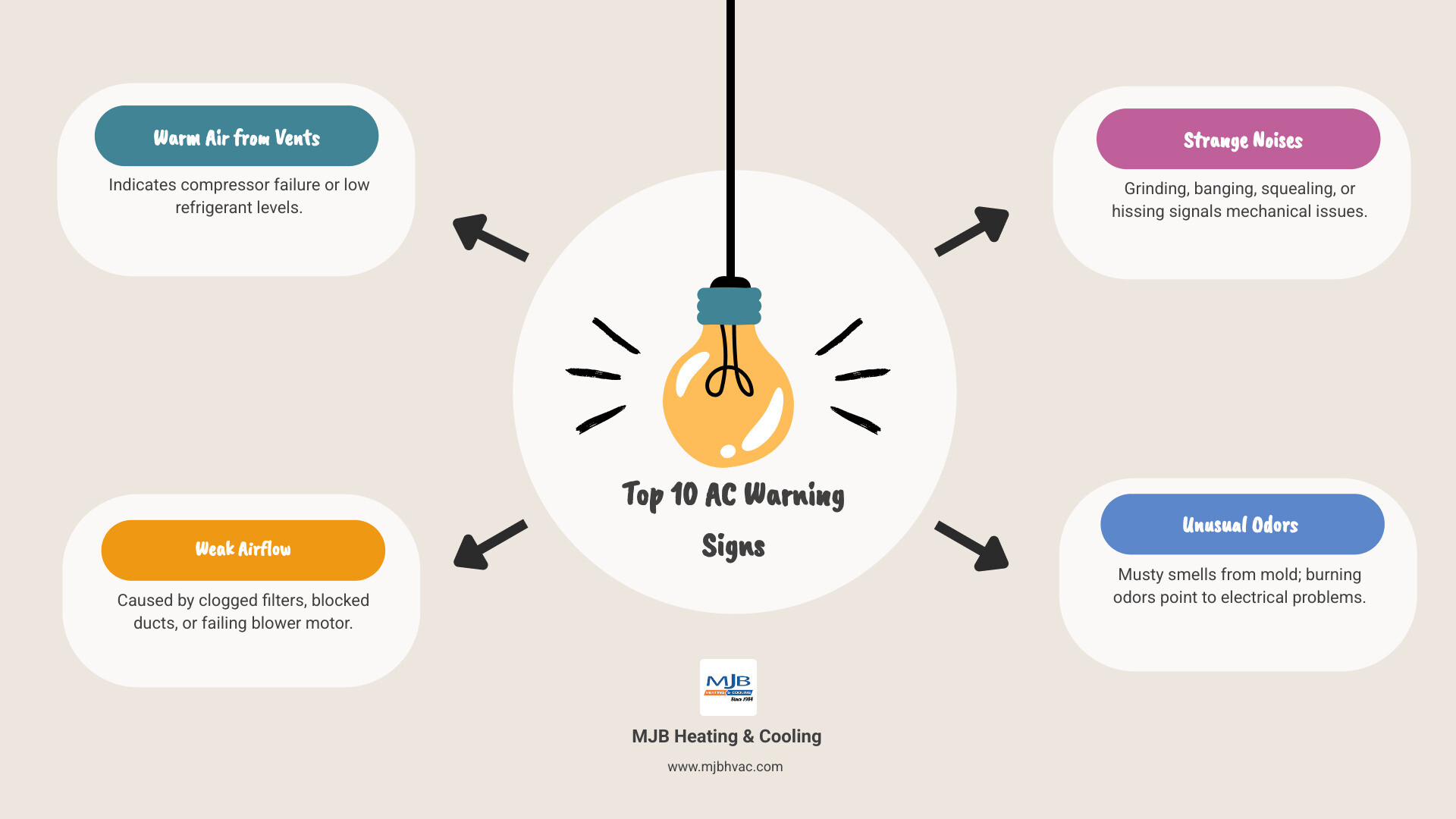
As we head into April 2026, many of us in the Wichita metro area are starting to think about that first big heatwave. If you’re standing by your vents and feeling lukewarm air, you aren't alone. One of the most common signs your ac needs repair is a lack of cold air. This often stems from a failing compressor or low refrigerant levels. In our dry climate, the system has to work incredibly hard to move heat out of your home; if the "heart" of the system (the compressor) is struggling, you'll feel it immediately.
Another red flag is weak airflow. If the air coming out of the registers feels more like a light breeze than a steady stream, you might be dealing with a clogged filter, a failing blower motor, or even leaky ductwork. In fact, research shows that up to 20-30% of conditioned air can escape through holes or poorly connected ducts before it ever reaches your living room.
If you notice that your AC fails during a heatwave, Andover solutions often involve checking the outdoor condenser. Sometimes, you might find that your AC fan isn’t working but the compressor is, which is a clear sign of a localized mechanical or electrical failure that needs professional eyes.
We’ve seen it happen time and again: a small "tick" in the unit goes ignored in May, and by the Fourth of July, the whole system has seized up. Addressing issues early isn't just about comfort; it's a major financial win. On average, homeowners who jump on repairs quickly save about $1,500 compared to those who wait for a total system blowout.
Consider the "domino effect." A dirty air filter is a cheap fix, but if left alone, it restricts airflow so much that the compressor overworks and eventually burns out. Replacing a filter is a few dollars; replacing a compressor can run into the thousands. Furthermore, air conditioning typically accounts for 12-27% of your monthly power bills. When a component starts to fail, the system loses efficiency, causing your bill to spike by 30% or more. That’s essentially throwing $50 to $100 out the window every single month.
A well-maintained central air unit should last 10-15 years. By catching the signs your ac needs repair early, you can push that lifespan toward the 20-year mark. If your AC stops working at night in Andover, it’s often a sign of a stressed system finally giving up under the pressure of a long day. Understanding why your AC stopped working at night can help you realize that these "surprises" are usually the result of long-term wear that could have been caught during a spring tune-up.
Your HVAC system should generally operate with a steady, unobtrusive hum. When it starts sounding like a heavy metal band or smelling like a locker room, it’s trying to tell you something important.
Musty odors are a frequent complaint in our area, often indicating mold or mildew growth within the ductwork or on the evaporator coils. On the other hand, a sharp, acrid burning smell usually points to an electrical issue, such as overheating wires or a motor that is about to seize. If you smell burning, turn the system off at the breaker immediately to avoid a fire hazard. For more details, you can read about what causes unusual AC smells in your home.
Noises are equally telling. Banging or clanking often means a part has come loose inside the blower assembly or compressor. Rattling might just be a loose screw, but it could also be the precursor to a major component failure. If you hear your HVAC system making strange noises, it is always worth a professional inspection before a small rattle becomes a big replacement.
Hissing is almost never a "minor" sound. Usually, it indicates a refrigerant leak. Because refrigerant is under high pressure, it makes a distinct hissing or whistling sound as it escapes through a crack in the coils or lines. Not only does this stop your AC from cooling, but it’s also an environmental hazard and can lead to frozen coils. If you have an AC that’s making hissing sounds in Haysville, you need a licensed technician to find the leak and recharge the system.
A loud grinding or screeching noise is typically the sound of metal-on-metal friction. This usually happens when the bearings in the fan motor have worn out. These bearings require lubrication and care; once they fail, the motor isn't far behind. If your AC starts making grinding noises in Haysville, shut it down. Continuing to run a grinding motor can cause it to burn out entirely, leading to a much more expensive repair.
If your AC kicks on, runs for three minutes, shuts off, and then repeats the process ten minutes later, you are experiencing "short cycling." This is one of the most damaging behaviors an HVAC system can exhibit. Every time your AC starts up, it uses a massive surge of electricity and puts significant strain on the compressor.
Short cycling can reduce your system's total lifespan by as much as 50%. It is often caused by:
If you notice your AC mini split making clicking noises along with frequent starts and stops, it could be an electrical relay struggling to stay engaged. This is often linked to why your AC circuit breaker keeps tripping — the system is drawing too much power as it struggles to stay running.
Beyond the mechanical wear, short cycling prevents your home from properly dehumidifying. Even in dry climates, we still have moisture in the air that needs to be removed for comfort. If the system doesn't run long enough to complete a full cooling cycle, your house will feel "sticky." Furthermore, the constant on-and-off can cause the coils to freeze over. Learning how to address a frozen AC unit in your home is important, but preventing the freeze by fixing the short cycling is even better.
While we live in a relatively dry area, moisture is still a key part of the cooling process. Your AC removes humidity from the air, which condenses into water and drains away through a condensate line. If you see water pooling around the base of your indoor unit, you likely have a clogged drain line. Dust and debris can create a "sludge" that blocks the pipe, causing water to back up and overflow the drain pan.
Ignoring water leaks is dangerous. Not only can it cause structural damage to your floors and drywall, but it also creates a breeding ground for mold. In our experience, why AC is leaking water inside your home is usually a simple fix if caught early, like clearing a blockage or repairing a cracked pan. For those with modern systems, you might need to fix AC mini split drainage problems in Haysville to ensure the internal pump or gravity drain is functioning correctly.
We love a good DIY project as much as anyone, but when it comes to the signs your ac needs repair, there is a fine line between a "quick fix" and a "dangerous mistake."
About 30% of all AC service calls could be avoided if homeowners checked their air filters. A dirty filter is the number one cause of poor airflow and system strain. Before calling us, always check your filter, ensure your thermostat is set to "cool" (and has fresh batteries), and check your circuit breaker.
However, anything involving the refrigerant, the electrical high-voltage lines, or the internal motor components requires a professional. Refrigerant is a regulated chemical that requires a license to handle, and DIY attempts can lead to system damage or personal injury.
| Task | DIY Friendly? | Why? |
|---|---|---|
| Changing Air Filters | Yes! | Easy to do, saves money, and solves 30% of issues. |
| Clearing Debris from Outdoor Unit | Yes | Keeping 2 feet of clearance helps the unit "breathe." |
| Thermostat Battery Replacement | Yes | Often the cause of a "dead" system. |
| Refrigerant Recharge | No | Requires EPA certification and specialized gauges. |
| Electrical Component Repair | No | High voltage risks and fire hazards. |
| Cleaning Evaporator Coils | No | Coils are fragile and easy to damage without the right tools. |
If you are trying to resolve poor airflow issues with a ductless AC, you can start by cleaning the filters. But if your AC mini split is displaying error codes, it’s usually time to call in the experts who can interpret those manufacturer-specific signals.
This is usually caused by one of three things: a refrigerant leak, a failed compressor, or a dirty evaporator coil. In some cases, it’s as simple as a thermostat set to "fan" instead of "cool," so check your settings first! If the settings are correct, you likely have a mechanical failure that is preventing the heat exchange process.
Most systems last between 10 and 15 years. We often use the "$5,000 Rule": multiply the age of the unit by the cost of the repair. If the total is more than $5,000, it’s usually more cost-effective to replace the unit with a newer, more efficient model. Also, if your system still uses R-22 refrigerant (which was phased out in 2020), repairs will be significantly more expensive due to the high cost of the remaining supply.
If your usage habits haven't changed but your bill has jumped by 20% or 30%, your AC is losing efficiency. This could be due to a failing motor drawing more power, a refrigerant leak causing the system to run longer, or duct leaks allowing 20-30% of your cold air to escape into the attic or crawlspace.
At MJB Heating & Cooling, we’ve been keeping Central Kansas comfortable since 1984. As a family-owned business with deep roots in Derby, we pride ourselves on an honest, "quality-first" approach to every job. We know that when you're looking for the signs your ac needs repair, you want clear answers and a technician you can trust.
Whether you're in Wichita, Andover, Newton, or any of our surrounding communities, we are here to help you navigate the summer heat with ease. Don't wait for a total breakdown in the middle of a July scorcher. If you've noticed any of the red flags we've discussed today—from strange noises to spiking bills—give us a call.
Schedule your professional AC repair service today and let our experienced team ensure your home stays the cool sanctuary it’s meant to be.
Signs your ac needs repair are often easier to spot than most homeowners realize — if you know what to look for. Here's a quick rundown:
Top signs your AC needs repair:
In Central Kansas, summer doesn't ease you in gently. When Wichita temperatures climb into the upper 90s and beyond, your air conditioner isn't a luxury — it's a lifeline. The dry, intense heat of the region puts real stress on cooling systems, and a unit that's struggling in June can fail completely by July.
The good news? Your AC almost always gives you warning signs before it quits entirely. Most AC problems are easier and less expensive to fix when caught early. Homeowners who act on early warning signs save an average of $1,500 in repair costs and can extend their system's life by five to seven years — that's a meaningful difference for any household budget.
Whether you've noticed your home feeling warmer than usual, heard a new noise coming from your unit, or seen your power bill creep up without explanation, this guide will help you understand what your system is trying to tell you.
As we head into April 2026, many of us in the Wichita metro area are starting to think about that first big heatwave. If you’re standing by your vents and feeling lukewarm air, you aren't alone. One of the most common signs your ac needs repair is a lack of cold air. This often stems from a failing compressor or low refrigerant levels. In our dry climate, the system has to work incredibly hard to move heat out of your home; if the "heart" of the system (the compressor) is struggling, you'll feel it immediately.
Another red flag is weak airflow. If the air coming out of the registers feels more like a light breeze than a steady stream, you might be dealing with a clogged filter, a failing blower motor, or even leaky ductwork. In fact, research shows that up to 20-30% of conditioned air can escape through holes or poorly connected ducts before it ever reaches your living room.
If you notice that your AC fails during a heatwave, Andover solutions often involve checking the outdoor condenser. Sometimes, you might find that your AC fan isn’t working but the compressor is, which is a clear sign of a localized mechanical or electrical failure that needs professional eyes.
We’ve seen it happen time and again: a small "tick" in the unit goes ignored in May, and by the Fourth of July, the whole system has seized up. Addressing issues early isn't just about comfort; it's a major financial win. On average, homeowners who jump on repairs quickly save about $1,500 compared to those who wait for a total system blowout.
Consider the "domino effect." A dirty air filter is a cheap fix, but if left alone, it restricts airflow so much that the compressor overworks and eventually burns out. Replacing a filter is a few dollars; replacing a compressor can run into the thousands. Furthermore, air conditioning typically accounts for 12-27% of your monthly power bills. When a component starts to fail, the system loses efficiency, causing your bill to spike by 30% or more. That’s essentially throwing $50 to $100 out the window every single month.
A well-maintained central air unit should last 10-15 years. By catching the signs your ac needs repair early, you can push that lifespan toward the 20-year mark. If your AC stops working at night in Andover, it’s often a sign of a stressed system finally giving up under the pressure of a long day. Understanding why your AC stopped working at night can help you realize that these "surprises" are usually the result of long-term wear that could have been caught during a spring tune-up.
Your HVAC system should generally operate with a steady, unobtrusive hum. When it starts sounding like a heavy metal band or smelling like a locker room, it’s trying to tell you something important.
Musty odors are a frequent complaint in our area, often indicating mold or mildew growth within the ductwork or on the evaporator coils. On the other hand, a sharp, acrid burning smell usually points to an electrical issue, such as overheating wires or a motor that is about to seize. If you smell burning, turn the system off at the breaker immediately to avoid a fire hazard. For more details, you can read about what causes unusual AC smells in your home.
Noises are equally telling. Banging or clanking often means a part has come loose inside the blower assembly or compressor. Rattling might just be a loose screw, but it could also be the precursor to a major component failure. If you hear your HVAC system making strange noises, it is always worth a professional inspection before a small rattle becomes a big replacement.
Hissing is almost never a "minor" sound. Usually, it indicates a refrigerant leak. Because refrigerant is under high pressure, it makes a distinct hissing or whistling sound as it escapes through a crack in the coils or lines. Not only does this stop your AC from cooling, but it’s also an environmental hazard and can lead to frozen coils. If you have an AC that’s making hissing sounds in Haysville, you need a licensed technician to find the leak and recharge the system.
A loud grinding or screeching noise is typically the sound of metal-on-metal friction. This usually happens when the bearings in the fan motor have worn out. These bearings require lubrication and care; once they fail, the motor isn't far behind. If your AC starts making grinding noises in Haysville, shut it down. Continuing to run a grinding motor can cause it to burn out entirely, leading to a much more expensive repair.
If your AC kicks on, runs for three minutes, shuts off, and then repeats the process ten minutes later, you are experiencing "short cycling." This is one of the most damaging behaviors an HVAC system can exhibit. Every time your AC starts up, it uses a massive surge of electricity and puts significant strain on the compressor.
Short cycling can reduce your system's total lifespan by as much as 50%. It is often caused by:
If you notice your AC mini split making clicking noises along with frequent starts and stops, it could be an electrical relay struggling to stay engaged. This is often linked to why your AC circuit breaker keeps tripping — the system is drawing too much power as it struggles to stay running.
Beyond the mechanical wear, short cycling prevents your home from properly dehumidifying. Even in dry climates, we still have moisture in the air that needs to be removed for comfort. If the system doesn't run long enough to complete a full cooling cycle, your house will feel "sticky." Furthermore, the constant on-and-off can cause the coils to freeze over. Learning how to address a frozen AC unit in your home is important, but preventing the freeze by fixing the short cycling is even better.
While we live in a relatively dry area, moisture is still a key part of the cooling process. Your AC removes humidity from the air, which condenses into water and drains away through a condensate line. If you see water pooling around the base of your indoor unit, you likely have a clogged drain line. Dust and debris can create a "sludge" that blocks the pipe, causing water to back up and overflow the drain pan.
Ignoring water leaks is dangerous. Not only can it cause structural damage to your floors and drywall, but it also creates a breeding ground for mold. In our experience, why AC is leaking water inside your home is usually a simple fix if caught early, like clearing a blockage or repairing a cracked pan. For those with modern systems, you might need to fix AC mini split drainage problems in Haysville to ensure the internal pump or gravity drain is functioning correctly.
We love a good DIY project as much as anyone, but when it comes to the signs your ac needs repair, there is a fine line between a "quick fix" and a "dangerous mistake."
About 30% of all AC service calls could be avoided if homeowners checked their air filters. A dirty filter is the number one cause of poor airflow and system strain. Before calling us, always check your filter, ensure your thermostat is set to "cool" (and has fresh batteries), and check your circuit breaker.
However, anything involving the refrigerant, the electrical high-voltage lines, or the internal motor components requires a professional. Refrigerant is a regulated chemical that requires a license to handle, and DIY attempts can lead to system damage or personal injury.
| Task | DIY Friendly? | Why? |
|---|---|---|
| Changing Air Filters | Yes! | Easy to do, saves money, and solves 30% of issues. |
| Clearing Debris from Outdoor Unit | Yes | Keeping 2 feet of clearance helps the unit "breathe." |
| Thermostat Battery Replacement | Yes | Often the cause of a "dead" system. |
| Refrigerant Recharge | No | Requires EPA certification and specialized gauges. |
| Electrical Component Repair | No | High voltage risks and fire hazards. |
| Cleaning Evaporator Coils | No | Coils are fragile and easy to damage without the right tools. |
If you are trying to resolve poor airflow issues with a ductless AC, you can start by cleaning the filters. But if your AC mini split is displaying error codes, it’s usually time to call in the experts who can interpret those manufacturer-specific signals.
This is usually caused by one of three things: a refrigerant leak, a failed compressor, or a dirty evaporator coil. In some cases, it’s as simple as a thermostat set to "fan" instead of "cool," so check your settings first! If the settings are correct, you likely have a mechanical failure that is preventing the heat exchange process.
Most systems last between 10 and 15 years. We often use the "$5,000 Rule": multiply the age of the unit by the cost of the repair. If the total is more than $5,000, it’s usually more cost-effective to replace the unit with a newer, more efficient model. Also, if your system still uses R-22 refrigerant (which was phased out in 2020), repairs will be significantly more expensive due to the high cost of the remaining supply.
If your usage habits haven't changed but your bill has jumped by 20% or 30%, your AC is losing efficiency. This could be due to a failing motor drawing more power, a refrigerant leak causing the system to run longer, or duct leaks allowing 20-30% of your cold air to escape into the attic or crawlspace.
At MJB Heating & Cooling, we’ve been keeping Central Kansas comfortable since 1984. As a family-owned business with deep roots in Derby, we pride ourselves on an honest, "quality-first" approach to every job. We know that when you're looking for the signs your ac needs repair, you want clear answers and a technician you can trust.
Whether you're in Wichita, Andover, Newton, or any of our surrounding communities, we are here to help you navigate the summer heat with ease. Don't wait for a total breakdown in the middle of a July scorcher. If you've noticed any of the red flags we've discussed today—from strange noises to spiking bills—give us a call.
Schedule your professional AC repair service today and let our experienced team ensure your home stays the cool sanctuary it’s meant to be.
Signs your ac needs repair are often easier to spot than most homeowners realize — if you know what to look for. Here's a quick rundown:
Top signs your AC needs repair:
In Central Kansas, summer doesn't ease you in gently. When Wichita temperatures climb into the upper 90s and beyond, your air conditioner isn't a luxury — it's a lifeline. The dry, intense heat of the region puts real stress on cooling systems, and a unit that's struggling in June can fail completely by July.
The good news? Your AC almost always gives you warning signs before it quits entirely. Most AC problems are easier and less expensive to fix when caught early. Homeowners who act on early warning signs save an average of $1,500 in repair costs and can extend their system's life by five to seven years — that's a meaningful difference for any household budget.
Whether you've noticed your home feeling warmer than usual, heard a new noise coming from your unit, or seen your power bill creep up without explanation, this guide will help you understand what your system is trying to tell you.
As we head into April 2026, many of us in the Wichita metro area are starting to think about that first big heatwave. If you’re standing by your vents and feeling lukewarm air, you aren't alone. One of the most common signs your ac needs repair is a lack of cold air. This often stems from a failing compressor or low refrigerant levels. In our dry climate, the system has to work incredibly hard to move heat out of your home; if the "heart" of the system (the compressor) is struggling, you'll feel it immediately.
Another red flag is weak airflow. If the air coming out of the registers feels more like a light breeze than a steady stream, you might be dealing with a clogged filter, a failing blower motor, or even leaky ductwork. In fact, research shows that up to 20-30% of conditioned air can escape through holes or poorly connected ducts before it ever reaches your living room.
If you notice that your AC fails during a heatwave, Andover solutions often involve checking the outdoor condenser. Sometimes, you might find that your AC fan isn’t working but the compressor is, which is a clear sign of a localized mechanical or electrical failure that needs professional eyes.
We’ve seen it happen time and again: a small "tick" in the unit goes ignored in May, and by the Fourth of July, the whole system has seized up. Addressing issues early isn't just about comfort; it's a major financial win. On average, homeowners who jump on repairs quickly save about $1,500 compared to those who wait for a total system blowout.
Consider the "domino effect." A dirty air filter is a cheap fix, but if left alone, it restricts airflow so much that the compressor overworks and eventually burns out. Replacing a filter is a few dollars; replacing a compressor can run into the thousands. Furthermore, air conditioning typically accounts for 12-27% of your monthly power bills. When a component starts to fail, the system loses efficiency, causing your bill to spike by 30% or more. That’s essentially throwing $50 to $100 out the window every single month.
A well-maintained central air unit should last 10-15 years. By catching the signs your ac needs repair early, you can push that lifespan toward the 20-year mark. If your AC stops working at night in Andover, it’s often a sign of a stressed system finally giving up under the pressure of a long day. Understanding why your AC stopped working at night can help you realize that these "surprises" are usually the result of long-term wear that could have been caught during a spring tune-up.
Your HVAC system should generally operate with a steady, unobtrusive hum. When it starts sounding like a heavy metal band or smelling like a locker room, it’s trying to tell you something important.
Musty odors are a frequent complaint in our area, often indicating mold or mildew growth within the ductwork or on the evaporator coils. On the other hand, a sharp, acrid burning smell usually points to an electrical issue, such as overheating wires or a motor that is about to seize. If you smell burning, turn the system off at the breaker immediately to avoid a fire hazard. For more details, you can read about what causes unusual AC smells in your home.
Noises are equally telling. Banging or clanking often means a part has come loose inside the blower assembly or compressor. Rattling might just be a loose screw, but it could also be the precursor to a major component failure. If you hear your HVAC system making strange noises, it is always worth a professional inspection before a small rattle becomes a big replacement.
Hissing is almost never a "minor" sound. Usually, it indicates a refrigerant leak. Because refrigerant is under high pressure, it makes a distinct hissing or whistling sound as it escapes through a crack in the coils or lines. Not only does this stop your AC from cooling, but it’s also an environmental hazard and can lead to frozen coils. If you have an AC that’s making hissing sounds in Haysville, you need a licensed technician to find the leak and recharge the system.
A loud grinding or screeching noise is typically the sound of metal-on-metal friction. This usually happens when the bearings in the fan motor have worn out. These bearings require lubrication and care; once they fail, the motor isn't far behind. If your AC starts making grinding noises in Haysville, shut it down. Continuing to run a grinding motor can cause it to burn out entirely, leading to a much more expensive repair.
If your AC kicks on, runs for three minutes, shuts off, and then repeats the process ten minutes later, you are experiencing "short cycling." This is one of the most damaging behaviors an HVAC system can exhibit. Every time your AC starts up, it uses a massive surge of electricity and puts significant strain on the compressor.
Short cycling can reduce your system's total lifespan by as much as 50%. It is often caused by:
If you notice your AC mini split making clicking noises along with frequent starts and stops, it could be an electrical relay struggling to stay engaged. This is often linked to why your AC circuit breaker keeps tripping — the system is drawing too much power as it struggles to stay running.
Beyond the mechanical wear, short cycling prevents your home from properly dehumidifying. Even in dry climates, we still have moisture in the air that needs to be removed for comfort. If the system doesn't run long enough to complete a full cooling cycle, your house will feel "sticky." Furthermore, the constant on-and-off can cause the coils to freeze over. Learning how to address a frozen AC unit in your home is important, but preventing the freeze by fixing the short cycling is even better.
While we live in a relatively dry area, moisture is still a key part of the cooling process. Your AC removes humidity from the air, which condenses into water and drains away through a condensate line. If you see water pooling around the base of your indoor unit, you likely have a clogged drain line. Dust and debris can create a "sludge" that blocks the pipe, causing water to back up and overflow the drain pan.
Ignoring water leaks is dangerous. Not only can it cause structural damage to your floors and drywall, but it also creates a breeding ground for mold. In our experience, why AC is leaking water inside your home is usually a simple fix if caught early, like clearing a blockage or repairing a cracked pan. For those with modern systems, you might need to fix AC mini split drainage problems in Haysville to ensure the internal pump or gravity drain is functioning correctly.
We love a good DIY project as much as anyone, but when it comes to the signs your ac needs repair, there is a fine line between a "quick fix" and a "dangerous mistake."
About 30% of all AC service calls could be avoided if homeowners checked their air filters. A dirty filter is the number one cause of poor airflow and system strain. Before calling us, always check your filter, ensure your thermostat is set to "cool" (and has fresh batteries), and check your circuit breaker.
However, anything involving the refrigerant, the electrical high-voltage lines, or the internal motor components requires a professional. Refrigerant is a regulated chemical that requires a license to handle, and DIY attempts can lead to system damage or personal injury.
| Task | DIY Friendly? | Why? |
|---|---|---|
| Changing Air Filters | Yes! | Easy to do, saves money, and solves 30% of issues. |
| Clearing Debris from Outdoor Unit | Yes | Keeping 2 feet of clearance helps the unit "breathe." |
| Thermostat Battery Replacement | Yes | Often the cause of a "dead" system. |
| Refrigerant Recharge | No | Requires EPA certification and specialized gauges. |
| Electrical Component Repair | No | High voltage risks and fire hazards. |
| Cleaning Evaporator Coils | No | Coils are fragile and easy to damage without the right tools. |
If you are trying to resolve poor airflow issues with a ductless AC, you can start by cleaning the filters. But if your AC mini split is displaying error codes, it’s usually time to call in the experts who can interpret those manufacturer-specific signals.
This is usually caused by one of three things: a refrigerant leak, a failed compressor, or a dirty evaporator coil. In some cases, it’s as simple as a thermostat set to "fan" instead of "cool," so check your settings first! If the settings are correct, you likely have a mechanical failure that is preventing the heat exchange process.
Most systems last between 10 and 15 years. We often use the "$5,000 Rule": multiply the age of the unit by the cost of the repair. If the total is more than $5,000, it’s usually more cost-effective to replace the unit with a newer, more efficient model. Also, if your system still uses R-22 refrigerant (which was phased out in 2020), repairs will be significantly more expensive due to the high cost of the remaining supply.
If your usage habits haven't changed but your bill has jumped by 20% or 30%, your AC is losing efficiency. This could be due to a failing motor drawing more power, a refrigerant leak causing the system to run longer, or duct leaks allowing 20-30% of your cold air to escape into the attic or crawlspace.
At MJB Heating & Cooling, we’ve been keeping Central Kansas comfortable since 1984. As a family-owned business with deep roots in Derby, we pride ourselves on an honest, "quality-first" approach to every job. We know that when you're looking for the signs your ac needs repair, you want clear answers and a technician you can trust.
Whether you're in Wichita, Andover, Newton, or any of our surrounding communities, we are here to help you navigate the summer heat with ease. Don't wait for a total breakdown in the middle of a July scorcher. If you've noticed any of the red flags we've discussed today—from strange noises to spiking bills—give us a call.
Schedule your professional AC repair service today and let our experienced team ensure your home stays the cool sanctuary it’s meant to be.
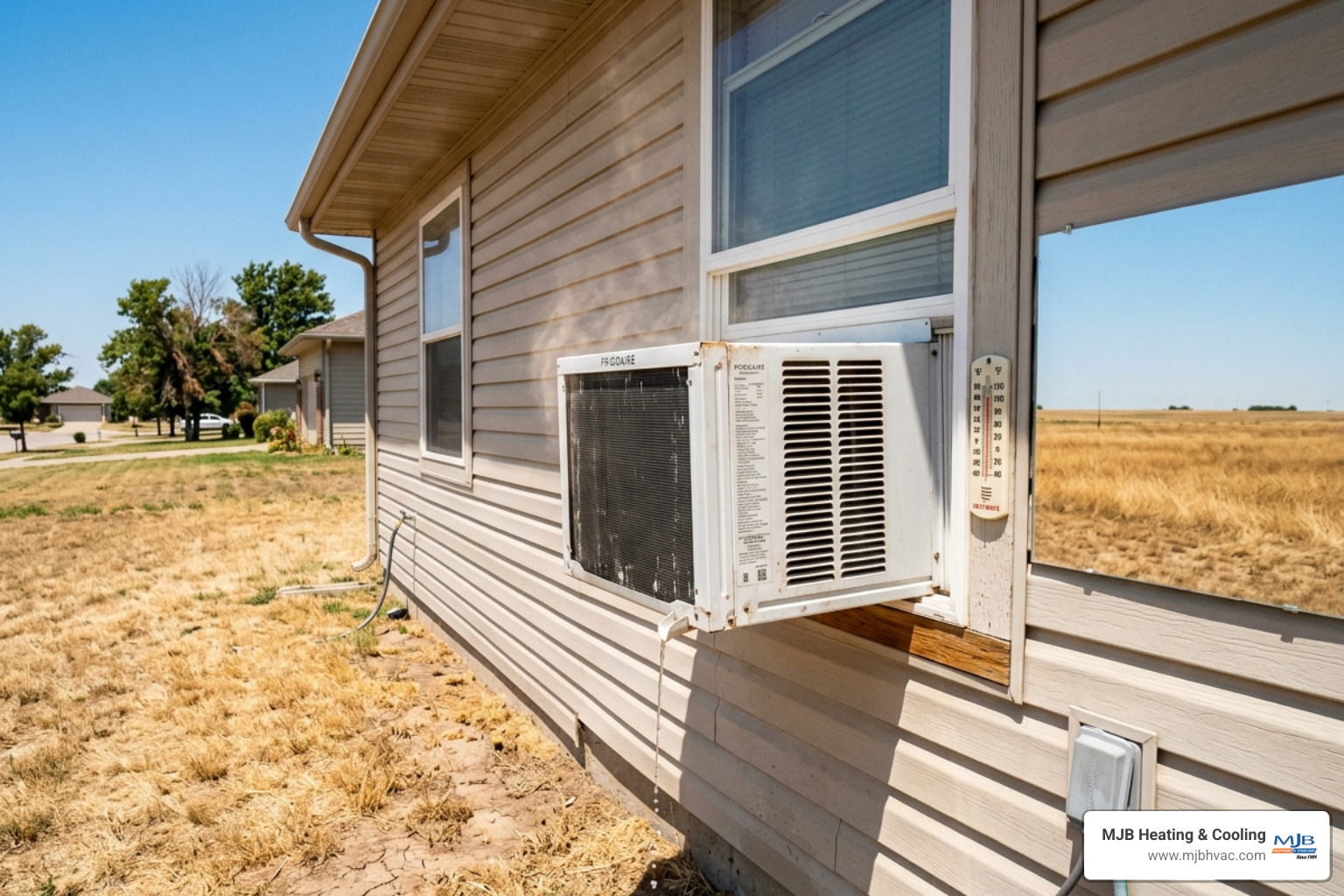

Signs your ac needs repair are often easier to spot than most homeowners realize — if you know what to look for. Here's a quick rundown:
Top signs your AC needs repair:
1. Warm or hot air blowing from vents — possible compressor failure or low refrigerant
2. Weak or reduced airflow — clogged filter, blocked ducts, or failing blower motor
3. Strange noises — grinding, banging, squealing, or hissing from the unit
4. Unusual odors — musty smells suggest mold; burning smells point to electrical issues
5. Frequent on/off cycling (short cycling) — thermostat, refrigerant, or electrical problems
6. Spiking energy bills — system working harder than it should due to worn components
7. Water leaks or excess moisture — clogged drain lines or frozen evaporator coils
8. Uneven cooling — some rooms hot while others stay comfortable
9. System won't turn on — electrical failure, blown fuse, or compressor issue
10. High indoor humidity — AC no longer dehumidifying air properly
In Central Kansas, summer doesn't ease you in gently. When Wichita temperatures climb into the upper 90s and beyond, your air conditioner isn't a luxury — it's a lifeline. The dry, intense heat of the region puts real stress on cooling systems, and a unit that's struggling in June can fail completely by July.
The good news? Your AC almost always gives you warning signs before it quits entirely. Most AC problems are easier and less expensive to fix when caught early. Homeowners who act on early warning signs save an average of $1,500 in repair costs and can extend their system's life by five to seven years — that's a meaningful difference for any household budget.
Whether you've noticed your home feeling warmer than usual, heard a new noise coming from your unit, or seen your power bill creep up without explanation, this guide will help you understand what your system is trying to tell you.

As we head into April 2026, many of us in the Wichita metro area are starting to think about that first big heatwave. If you’re standing by your vents and feeling lukewarm air, you aren't alone. One of the most common signs your ac needs repair is a lack of cold air. This often stems from a failing compressor or low refrigerant levels. In our dry climate, the system has to work incredibly hard to move heat out of your home; if the "heart" of the system (the compressor) is struggling, you'll feel it immediately.
Another red flag is weak airflow. If the air coming out of the registers feels more like a light breeze than a steady stream, you might be dealing with a clogged filter, a failing blower motor, or even leaky ductwork. In fact, research shows that up to 20-30% of conditioned air can escape through holes or poorly connected ducts before it ever reaches your living room.
If you notice that your AC fails during a heatwave, Andover solutions often involve checking the outdoor condenser. Sometimes, you might find that your AC fan isn’t working but the compressor is, which is a clear sign of a localized mechanical or electrical failure that needs professional eyes.
We’ve seen it happen time and again: a small "tick" in the unit goes ignored in May, and by the Fourth of July, the whole system has seized up. Addressing issues early isn't just about comfort; it's a major financial win. On average, homeowners who jump on repairs quickly save about $1,500 compared to those who wait for a total system blowout.
Consider the "domino effect." A dirty air filter is a cheap fix, but if left alone, it restricts airflow so much that the compressor overworks and eventually burns out. Replacing a filter is a few dollars; replacing a compressor can run into the thousands. Furthermore, air conditioning typically accounts for 12-27% of your monthly power bills. When a component starts to fail, the system loses efficiency, causing your bill to spike by 30% or more. That’s essentially throwing $50 to $100 out the window every single month.
A well-maintained central air unit should last 10-15 years. By catching the signs your ac needs repair early, you can push that lifespan toward the 20-year mark. If your AC stops working at night in Andover, it’s often a sign of a stressed system finally giving up under the pressure of a long day. Understanding why your AC stopped working at night can help you realize that these "surprises" are usually the result of long-term wear that could have been caught during a spring tune-up.
Your HVAC system should generally operate with a steady, unobtrusive hum. When it starts sounding like a heavy metal band or smelling like a locker room, it’s trying to tell you something important.
Musty odors are a frequent complaint in our area, often indicating mold or mildew growth within the ductwork or on the evaporator coils. On the other hand, a sharp, acrid burning smell usually points to an electrical issue, such as overheating wires or a motor that is about to seize. If you smell burning, turn the system off at the breaker immediately to avoid a fire hazard. For more details, you can read about what causes unusual AC smells in your home.
Noises are equally telling. Banging or clanking often means a part has come loose inside the blower assembly or compressor. Rattling might just be a loose screw, but it could also be the precursor to a major component failure. If you hear your HVAC system making strange noises, it is always worth a professional inspection before a small rattle becomes a big replacement.
Hissing is almost never a "minor" sound. Usually, it indicates a refrigerant leak. Because refrigerant is under high pressure, it makes a distinct hissing or whistling sound as it escapes through a crack in the coils or lines. Not only does this stop your AC from cooling, but it’s also an environmental hazard and can lead to frozen coils. If you have an AC that’s making hissing sounds in Haysville, you need a licensed technician to find the leak and recharge the system.
A loud grinding or screeching noise is typically the sound of metal-on-metal friction. This usually happens when the bearings in the fan motor have worn out. These bearings require lubrication and care; once they fail, the motor isn't far behind. If your AC starts making grinding noises in Haysville, shut it down. Continuing to run a grinding motor can cause it to burn out entirely, leading to a much more expensive repair.
If your AC kicks on, runs for three minutes, shuts off, and then repeats the process ten minutes later, you are experiencing "short cycling." This is one of the most damaging behaviors an HVAC system can exhibit. Every time your AC starts up, it uses a massive surge of electricity and puts significant strain on the compressor.
Short cycling can reduce your system's total lifespan by as much as 50%. It is often caused by:
• An oversized AC unit for the home.
• Low refrigerant levels.
• A malfunctioning thermostat that is misreading the room temperature.
• Iced-up evaporator coils.
If you notice your AC mini split making clicking noises along with frequent starts and stops, it could be an electrical relay struggling to stay engaged. This is often linked to why your AC circuit breaker keeps tripping — the system is drawing too much power as it struggles to stay running.
Beyond the mechanical wear, short cycling prevents your home from properly dehumidifying. Even in dry climates, we still have moisture in the air that needs to be removed for comfort. If the system doesn't run long enough to complete a full cooling cycle, your house will feel "sticky." Furthermore, the constant on-and-off can cause the coils to freeze over. Learning how to address a frozen AC unit in your home is important, but preventing the freeze by fixing the short cycling is even better.
While we live in a relatively dry area, moisture is still a key part of the cooling process. Your AC removes humidity from the air, which condenses into water and drains away through a condensate line. If you see water pooling around the base of your indoor unit, you likely have a clogged drain line. Dust and debris can create a "sludge" that blocks the pipe, causing water to back up and overflow the drain pan.
Ignoring water leaks is dangerous. Not only can it cause structural damage to your floors and drywall, but it also creates a breeding ground for mold. In our experience, why AC is leaking water inside your home is usually a simple fix if caught early, like clearing a blockage or repairing a cracked pan. For those with modern systems, you might need to fix AC mini split drainage problems in Haysville to ensure the internal pump or gravity drain is functioning correctly.
We love a good DIY project as much as anyone, but when it comes to the signs your ac needs repair, there is a fine line between a "quick fix" and a "dangerous mistake."
About 30% of all AC service calls could be avoided if homeowners checked their air filters. A dirty filter is the number one cause of poor airflow and system strain. Before calling us, always check your filter, ensure your thermostat is set to "cool" (and has fresh batteries), and check your circuit breaker.
However, anything involving the refrigerant, the electrical high-voltage lines, or the internal motor components requires a professional. Refrigerant is a regulated chemical that requires a license to handle, and DIY attempts can lead to system damage or personal injury.
• Changing Air Filters — DIY Friendly?: Yes! — Why?: Easy to do, saves money, and solves 30% of issues.
• Clearing Debris from Outdoor Unit — DIY Friendly?: Yes — Why?: Keeping 2 feet of clearance helps the unit "breathe."
• Thermostat Battery Replacement — DIY Friendly?: Yes — Why?: Often the cause of a "dead" system.
• Refrigerant Recharge — DIY Friendly?: No — Why?: Requires EPA certification and specialized gauges.
• Electrical Component Repair — DIY Friendly?: No — Why?: High voltage risks and fire hazards.
• Cleaning Evaporator Coils — DIY Friendly?: No — Why?: Coils are fragile and easy to damage without the right tools.
If you are trying to resolve poor airflow issues with a ductless AC, you can start by cleaning the filters. But if your AC mini split is displaying error codes, it’s usually time to call in the experts who can interpret those manufacturer-specific signals.
This is usually caused by one of three things: a refrigerant leak, a failed compressor, or a dirty evaporator coil. In some cases, it’s as simple as a thermostat set to "fan" instead of "cool," so check your settings first! If the settings are correct, you likely have a mechanical failure that is preventing the heat exchange process.
Most systems last between 10 and 15 years. We often use the "$5,000 Rule": multiply the age of the unit by the cost of the repair. If the total is more than $5,000, it’s usually more cost-effective to replace the unit with a newer, more efficient model. Also, if your system still uses R-22 refrigerant (which was phased out in 2020), repairs will be significantly more expensive due to the high cost of the remaining supply.
If your usage habits haven't changed but your bill has jumped by 20% or 30%, your AC is losing efficiency. This could be due to a failing motor drawing more power, a refrigerant leak causing the system to run longer, or duct leaks allowing 20-30% of your cold air to escape into the attic or crawlspace.
At MJB Heating & Cooling, we’ve been keeping Central Kansas comfortable since 1984. As a family-owned business with deep roots in Derby, we pride ourselves on an honest, "quality-first" approach to every job. We know that when you're looking for the signs your ac needs repair, you want clear answers and a technician you can trust.
Whether you're in Wichita, Andover, Newton, or any of our surrounding communities, we are here to help you navigate the summer heat with ease. Don't wait for a total breakdown in the middle of a July scorcher. If you've noticed any of the red flags we've discussed today—from strange noises to spiking bills—give us a call.
Schedule your professional AC repair service today and let our experienced team ensure your home stays the cool sanctuary it’s meant to be.
Signs your ac needs repair are often easier to spot than most homeowners realize — if you know what to look for. Here's a quick rundown:
Top signs your AC needs repair:
In Central Kansas, summer doesn't ease you in gently. When Wichita temperatures climb into the upper 90s and beyond, your air conditioner isn't a luxury — it's a lifeline. The dry, intense heat of the region puts real stress on cooling systems, and a unit that's struggling in June can fail completely by July.
The good news? Your AC almost always gives you warning signs before it quits entirely. Most AC problems are easier and less expensive to fix when caught early. Homeowners who act on early warning signs save an average of $1,500 in repair costs and can extend their system's life by five to seven years — that's a meaningful difference for any household budget.
Whether you've noticed your home feeling warmer than usual, heard a new noise coming from your unit, or seen your power bill creep up without explanation, this guide will help you understand what your system is trying to tell you.
As we head into April 2026, many of us in the Wichita metro area are starting to think about that first big heatwave. If you’re standing by your vents and feeling lukewarm air, you aren't alone. One of the most common signs your ac needs repair is a lack of cold air. This often stems from a failing compressor or low refrigerant levels. In our dry climate, the system has to work incredibly hard to move heat out of your home; if the "heart" of the system (the compressor) is struggling, you'll feel it immediately.
Another red flag is weak airflow. If the air coming out of the registers feels more like a light breeze than a steady stream, you might be dealing with a clogged filter, a failing blower motor, or even leaky ductwork. In fact, research shows that up to 20-30% of conditioned air can escape through holes or poorly connected ducts before it ever reaches your living room.
If you notice that your AC fails during a heatwave, Andover solutions often involve checking the outdoor condenser. Sometimes, you might find that your AC fan isn’t working but the compressor is, which is a clear sign of a localized mechanical or electrical failure that needs professional eyes.
We’ve seen it happen time and again: a small "tick" in the unit goes ignored in May, and by the Fourth of July, the whole system has seized up. Addressing issues early isn't just about comfort; it's a major financial win. On average, homeowners who jump on repairs quickly save about $1,500 compared to those who wait for a total system blowout.
Consider the "domino effect." A dirty air filter is a cheap fix, but if left alone, it restricts airflow so much that the compressor overworks and eventually burns out. Replacing a filter is a few dollars; replacing a compressor can run into the thousands. Furthermore, air conditioning typically accounts for 12-27% of your monthly power bills. When a component starts to fail, the system loses efficiency, causing your bill to spike by 30% or more. That’s essentially throwing $50 to $100 out the window every single month.
A well-maintained central air unit should last 10-15 years. By catching the signs your ac needs repair early, you can push that lifespan toward the 20-year mark. If your AC stops working at night in Andover, it’s often a sign of a stressed system finally giving up under the pressure of a long day. Understanding why your AC stopped working at night can help you realize that these "surprises" are usually the result of long-term wear that could have been caught during a spring tune-up.
Your HVAC system should generally operate with a steady, unobtrusive hum. When it starts sounding like a heavy metal band or smelling like a locker room, it’s trying to tell you something important.
Musty odors are a frequent complaint in our area, often indicating mold or mildew growth within the ductwork or on the evaporator coils. On the other hand, a sharp, acrid burning smell usually points to an electrical issue, such as overheating wires or a motor that is about to seize. If you smell burning, turn the system off at the breaker immediately to avoid a fire hazard. For more details, you can read about what causes unusual AC smells in your home.
Noises are equally telling. Banging or clanking often means a part has come loose inside the blower assembly or compressor. Rattling might just be a loose screw, but it could also be the precursor to a major component failure. If you hear your HVAC system making strange noises, it is always worth a professional inspection before a small rattle becomes a big replacement.
Hissing is almost never a "minor" sound. Usually, it indicates a refrigerant leak. Because refrigerant is under high pressure, it makes a distinct hissing or whistling sound as it escapes through a crack in the coils or lines. Not only does this stop your AC from cooling, but it’s also an environmental hazard and can lead to frozen coils. If you have an AC that’s making hissing sounds in Haysville, you need a licensed technician to find the leak and recharge the system.
A loud grinding or screeching noise is typically the sound of metal-on-metal friction. This usually happens when the bearings in the fan motor have worn out. These bearings require lubrication and care; once they fail, the motor isn't far behind. If your AC starts making grinding noises in Haysville, shut it down. Continuing to run a grinding motor can cause it to burn out entirely, leading to a much more expensive repair.
If your AC kicks on, runs for three minutes, shuts off, and then repeats the process ten minutes later, you are experiencing "short cycling." This is one of the most damaging behaviors an HVAC system can exhibit. Every time your AC starts up, it uses a massive surge of electricity and puts significant strain on the compressor.
Short cycling can reduce your system's total lifespan by as much as 50%. It is often caused by:
If you notice your AC mini split making clicking noises along with frequent starts and stops, it could be an electrical relay struggling to stay engaged. This is often linked to why your AC circuit breaker keeps tripping — the system is drawing too much power as it struggles to stay running.
Beyond the mechanical wear, short cycling prevents your home from properly dehumidifying. Even in dry climates, we still have moisture in the air that needs to be removed for comfort. If the system doesn't run long enough to complete a full cooling cycle, your house will feel "sticky." Furthermore, the constant on-and-off can cause the coils to freeze over. Learning how to address a frozen AC unit in your home is important, but preventing the freeze by fixing the short cycling is even better.
While we live in a relatively dry area, moisture is still a key part of the cooling process. Your AC removes humidity from the air, which condenses into water and drains away through a condensate line. If you see water pooling around the base of your indoor unit, you likely have a clogged drain line. Dust and debris can create a "sludge" that blocks the pipe, causing water to back up and overflow the drain pan.
Ignoring water leaks is dangerous. Not only can it cause structural damage to your floors and drywall, but it also creates a breeding ground for mold. In our experience, why AC is leaking water inside your home is usually a simple fix if caught early, like clearing a blockage or repairing a cracked pan. For those with modern systems, you might need to fix AC mini split drainage problems in Haysville to ensure the internal pump or gravity drain is functioning correctly.
We love a good DIY project as much as anyone, but when it comes to the signs your ac needs repair, there is a fine line between a "quick fix" and a "dangerous mistake."
About 30% of all AC service calls could be avoided if homeowners checked their air filters. A dirty filter is the number one cause of poor airflow and system strain. Before calling us, always check your filter, ensure your thermostat is set to "cool" (and has fresh batteries), and check your circuit breaker.
However, anything involving the refrigerant, the electrical high-voltage lines, or the internal motor components requires a professional. Refrigerant is a regulated chemical that requires a license to handle, and DIY attempts can lead to system damage or personal injury.
| Task | DIY Friendly? | Why? |
|---|---|---|
| Changing Air Filters | Yes! | Easy to do, saves money, and solves 30% of issues. |
| Clearing Debris from Outdoor Unit | Yes | Keeping 2 feet of clearance helps the unit "breathe." |
| Thermostat Battery Replacement | Yes | Often the cause of a "dead" system. |
| Refrigerant Recharge | No | Requires EPA certification and specialized gauges. |
| Electrical Component Repair | No | High voltage risks and fire hazards. |
| Cleaning Evaporator Coils | No | Coils are fragile and easy to damage without the right tools. |
If you are trying to resolve poor airflow issues with a ductless AC, you can start by cleaning the filters. But if your AC mini split is displaying error codes, it’s usually time to call in the experts who can interpret those manufacturer-specific signals.
This is usually caused by one of three things: a refrigerant leak, a failed compressor, or a dirty evaporator coil. In some cases, it’s as simple as a thermostat set to "fan" instead of "cool," so check your settings first! If the settings are correct, you likely have a mechanical failure that is preventing the heat exchange process.
Most systems last between 10 and 15 years. We often use the "$5,000 Rule": multiply the age of the unit by the cost of the repair. If the total is more than $5,000, it’s usually more cost-effective to replace the unit with a newer, more efficient model. Also, if your system still uses R-22 refrigerant (which was phased out in 2020), repairs will be significantly more expensive due to the high cost of the remaining supply.
If your usage habits haven't changed but your bill has jumped by 20% or 30%, your AC is losing efficiency. This could be due to a failing motor drawing more power, a refrigerant leak causing the system to run longer, or duct leaks allowing 20-30% of your cold air to escape into the attic or crawlspace.
At MJB Heating & Cooling, we’ve been keeping Central Kansas comfortable since 1984. As a family-owned business with deep roots in Derby, we pride ourselves on an honest, "quality-first" approach to every job. We know that when you're looking for the signs your ac needs repair, you want clear answers and a technician you can trust.
Whether you're in Wichita, Andover, Newton, or any of our surrounding communities, we are here to help you navigate the summer heat with ease. Don't wait for a total breakdown in the middle of a July scorcher. If you've noticed any of the red flags we've discussed today—from strange noises to spiking bills—give us a call.
Schedule your professional AC repair service today and let our experienced team ensure your home stays the cool sanctuary it’s meant to be.


Our A/C stopped working on a Sunday and due to health issues, we needed to find a service company available on a Sunday. I called MJB and left a message on their emergency voice mail. Within 10 minutes Tom Buck called me to hear my description of the symptoms. He was just finishing an appointment in Wichita and would be on his way to my home on the south end of Derby. He arrived within 30 minutes! From start to finish he was the perfect example of what you could ever hope for in an HVAC tech and a human being. His evaluation of our system inside and out was as thorough as I could ever imagine and once he was done with the repair, our system is running as well or better than ever. Well worth the price for the evaluation, parts, and labor. Thank you again Tom for an awesome experience.
Our AC went out during the hottest days of the year, and they were out next day! We have been jerked around by a shoddy home warranty for years. We finally had a chance to pick our own repair people, and MJB came highly recommended. I can see why! I was impressed with the honesty and speed at which they fixed our AC unit!
Our commercial building had a lightening/electrical strike and damaged our 20 ton AC unit. No one could find us a new unit before the end of September. Imagining going all of August and September with no AC in Kansas and working inside near 100 degree temps is less than thrilling. Dale and the team at MJB called around and saved the day. They had us a new unit 5 weeks earlier than other could promise and I now have happy employees. The unit is amazingly quiet, super cold and so much more energy efficient. Thank you for being our super hero!
Came out and installed my new furnace. Was very polite and affordable. They are very acknowledgeable and I highly recommend!
Thank you very much. We had our 1st warm night in 3weeks. MJB took the time and effort to find the real problem. And the employees were kind and thoughtful and explained things very well. I cannot thank you and all of MJB. Will recommend you highly. Thanks again Marjorie Herman Oxford Kansas
We had a new system installed and I was so impressed with how quick they were in come out and install it, in the middle of a hot summer day. They were so friendly & very professional. I had a small problem with a weird sound and they came over immediately and fixed it. Love them!


