.avif)





Blogs
Stay updated with our latest blog posts.


The October first cold snap always seems to arrive overnight in Kansas. One afternoon you are running the air conditioner, and by the next evening, you are rushing to the thermostat to turn on the heat. At MJB Heating & Cooling, we receive a flood of calls during this exact window. If you are looking for reliable home maintenance tips and troubleshooting, the first heating cycle of the year is exactly when you need them most. That familiar click of the thermostat is often followed by a noticeable burning smell filling your living room, leaving you wondering if your system is in trouble.
Deciding whether to ignore the odor or call for professional HVAC services depends on knowing what is harmless and what is hazardous. Some quirks are perfectly normal as a heating system wakes up from a long summer slumber, but safety should never be left to guesswork. Drawing from our years of local experience, this guide will help you navigate your fall furnace startup, separating harmless seasonal burn-off from real dangers.
Throughout the hot, humid summer, your furnace sits completely idle. During these long months, standard household dust, pet dander, and airborne particles naturally settle onto the heating elements and the heat exchanger inside the cabinet. When you finally turn the system on for the season, those components rapidly heat up to hundreds of degrees, incinerating the accumulated debris.
The 30-minute rule: As local experts serving Derby KS area homes, our technicians use a simple, non-alarmist threshold to evaluate startup smells. A slight dusty, singed odor is completely normal, provided it dissipates within 15 to 30 minutes of the first continuous heating cycle.
If the smell persists beyond this half-hour window, or if it grows stronger rather than fading, it crosses the threshold from normal to abnormal. You can open a window briefly to ventilate the harmless dust smell, but you should never ignore an odor that lingers.
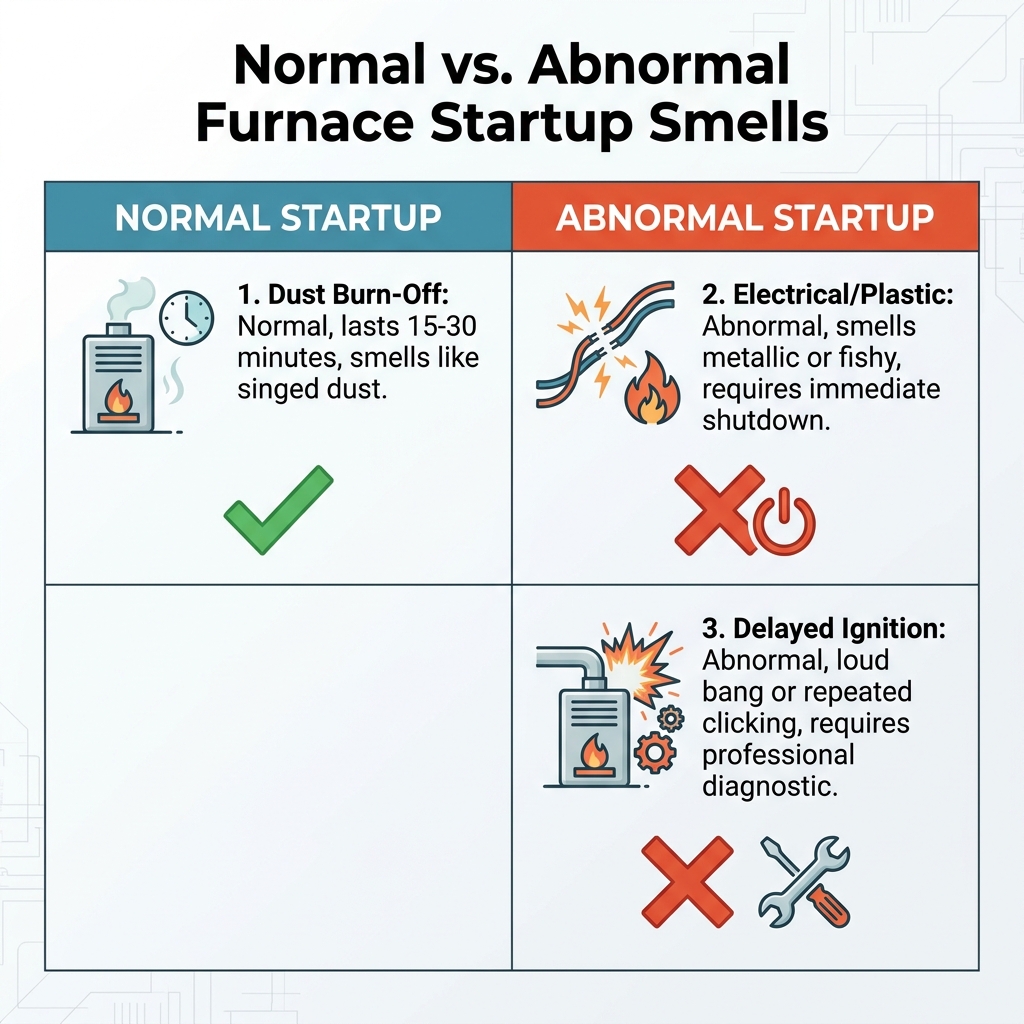
• Odor Profile — Normal Dust Burn-Off: Smells like singed dust, dry earth, or warm air. — Abnormal Warning Sign: Smells like melting plastic, burning rubber, or fishy/metallic odors.
• Duration — Normal Dust Burn-Off: Fades away completely within 15 to 30 minutes. — Abnormal Warning Sign: Persists for hours or returns every time the system cycles on.
• Air Quality — Normal Dust Burn-Off: Barely noticeable in most rooms; no visible smoke. — Abnormal Warning Sign: Strong, headache-inducing smell; possible light haze near vents.
• System Sounds — Normal Dust Burn-Off: Standard blower motor hum and gentle airflow. — Abnormal Warning Sign: Loud bangs, grinding noises, or repeated clicking before ignition.
While burning dust is harmless, other odors indicate a serious malfunction. Knowing how to identify dangerous smells can protect your home during that unpredictable October first cold snap. If you detect the sharp, acrid scent of melting plastic or burning electrical wires, your system requires immediate attention.
Electrical burning is often described as having a metallic, metallic-sweet, or unusually "fishy" odor. This typically means that a wire's insulation is melting due to excessive heat or a short circuit. The National Fire Protection Association (NFPA) notes that heating equipment requires careful monitoring to prevent fire hazards, emphasizing that electrical burning smells should never be ignored.
Over our years of providing HVAC services in the area, our team has found that one of the most frequent culprits behind an overheating furnace is a severely clogged air filter. When the blower motor cannot pull enough air through a dirty filter, the heat generated by the burners cannot be pushed out into your home. The heat builds up inside the furnace cabinet, causing safety limit switches to trip or, worse, melting internal plastic components and wire casings.
Immediate action required: If you smell burning plastic or electrical components, do not wait to see if it goes away. Walk to your thermostat and switch the system to "OFF" immediately. Do not run the system again until it has been professionally evaluated.
Another common issue homeowners face during the first cold snap is a heater that refuses to light right away. This is known as delayed ignition, and it is a mechanical failure that requires prompt attention.
Delayed ignition usually presents itself in one of two ways. You might hear the system click repeatedly as it tries to spark, followed by a sudden, loud "popping" or "banging" noise when the furnace finally catches. Alternatively, the system may just click endlessly without producing any heat at all, eventually locking itself out as a safety precaution.
In many Derby KS area homes, our service team notices the high humidity of summer plays a significant role in this failure. While the furnace sits unused, moisture and airborne grime settle on the burners, the pilot assembly, and the flame sensor. When the thermostat finally calls for heat, this microscopic layer of corrosion prevents the igniter from lighting the gas immediately. As the gas continues to flow into the combustion chamber, it pools up. When the spark finally catches, all that accumulated gas ignites at once, creating a miniature explosion—the loud bang you hear.
We strongly warn against attempting to clean burners, scrub flame sensors, or adjust gas valves manually. Modern heating systems operate using combustible gas and high voltage, meaning these repairs strictly require a licensed professional. If you operate a dual-fuel system, the heat pump component might struggle before the gas furnace takes over, which can trigger specific diagnostic alerts on your thermostat. Understanding your heat pump error codes can help you provide better information to your technician when you call for service. Furthermore, having a professional maintain your equipment can often help you qualify for various utility incentive programs or energy rebates designed to reward efficient home heating.
Mid-fall in the Midwest is notoriously unpredictable. Our dispatch board at MJB Heating & Cooling often reflects these massive day-to-night temperature fluctuations, where you might need the air conditioner running at 2:00 PM and the furnace blasting by 2:00 AM. This rapid switching places a unique strain on your HVAC equipment.
When a system is forced to alternate between cooling and heating modes within the same 24-hour period, it stresses internal components like the reversing valve (in heat pumps) and forces thermal expansion and contraction on the heat exchanger. This rapid cycling can expose underlying maintenance needs that were not apparent during the steady heat of summer.
Signs of weather-related stress:
• Short cycling: The system turns on, runs for only two or three minutes, and shuts off before the house reaches the target temperature.
• Thermostat confusion: The indoor temperature reading drops rapidly during the October first cold snap, but the system struggles to keep up with the sudden demand.
• Uneven heating: Some rooms feel sweltering while others remain freezing, indicating airflow or ductwork issues exacerbated by rapid temperature drops.
Because the regional climate demands so much flexibility from your equipment, having a local team that understands these specific regional demands is vital. Technicians familiar with Derby and surrounding service areas know exactly how to calibrate systems to handle the extreme weather swings typical of our fall season.
Observing your system during its first run is smart, but there is a firm line between monitoring a harmless quirk and allowing a hazardous situation to continue. If you notice any of the following red flags in your Derby KS area home, it is time to stop observing and take action.
• Persistent odors: Any dust smell lasting longer than 30 minutes, or any smell of electrical burning, melting plastic, or raw gas.
• Aggressive noises: Loud bangs upon ignition, metallic screeching from the blower motor, or heavy rumbling vibrations.
• Failure to sustain heat: A system that clicks repeatedly but won't light, or one that lights but shuts down immediately.
• Safety alerts: Carbon monoxide detectors sounding or diagnostic error codes flashing on the thermostat.
If you encounter any of these issues, shutting off the system at the thermostat is the safest immediate action you can take. Our technicians have seen the costly—and sometimes dangerous—results of homeowners attempting to fix these issues themselves. Heating systems involve combustible gas, open flames, and high-voltage electricity. DIY repairs on internal components are highly dangerous and can void your manufacturer warranty. Instead of taking risks, contact our diagnostic team for a professional evaluation to ensure your equipment will operate safely for the rest of the winter.
A normal burning smell typically lasts between 15 to 30 minutes during the first heating cycle. It is simply the dust and debris that settled over the summer burning off the heat exchanger. If the odor continues past half an hour, shut the system down and call a professional.
An electrical issue smells like melting plastic, burning rubber, or has a sharp, metallic, fishy odor. This is absolutely not normal and requires immediate system shutdown at the thermostat. Continuing to run a furnace with an electrical smell can lead to severe component damage or a house fire.
Delayed ignition is often caused by dirty burners, a faulty igniter, or a blocked pilot assembly. Because the system cannot light the gas immediately, the gas builds up in the chamber and creates a loud 'bang' when it finally catches. This requires a licensed technician to clean and recalibrate the ignition assembly safely.
Standard household dust burning off during the first October first cold snap is not typically a fire hazard. However, severe neglect or a heavily clogged air filter can cause the system to overheat significantly. Always change your filter before starting the furnace for the season to prevent dangerous heat buildup.
Yes, opening a window for the first 20 minutes can help ventilate the harmless dust smell and improve indoor air quality. If the smell remains strong after you have aired out the house and closed the windows, that indicates an ongoing problem that requires a professional inspection.
Heating systems should be inspected annually, ideally in the early fall before the first major cold snap hits. Regular checks prevent delayed ignition, catch failing electrical components early, and keep the system operating safely throughout the coldest months of the year.
True peace of mind is the most important part of home comfort for Derby KS area homes. Professional oversight prevents minor seasonal quirks from turning into mid-winter breakdowns when you need heat the most. Secure your comfort and safety by scheduling a preventative maintenance plan before the freezing temperatures become permanent.


Our A/C stopped working on a Sunday and due to health issues, we needed to find a service company available on a Sunday. I called MJB and left a message on their emergency voice mail. Within 10 minutes Tom Buck called me to hear my description of the symptoms. He was just finishing an appointment in Wichita and would be on his way to my home on the south end of Derby. He arrived within 30 minutes! From start to finish he was the perfect example of what you could ever hope for in an HVAC tech and a human being. His evaluation of our system inside and out was as thorough as I could ever imagine and once he was done with the repair, our system is running as well or better than ever. Well worth the price for the evaluation, parts, and labor. Thank you again Tom for an awesome experience.
Our AC went out during the hottest days of the year, and they were out next day! We have been jerked around by a shoddy home warranty for years. We finally had a chance to pick our own repair people, and MJB came highly recommended. I can see why! I was impressed with the honesty and speed at which they fixed our AC unit!
Our commercial building had a lightening/electrical strike and damaged our 20 ton AC unit. No one could find us a new unit before the end of September. Imagining going all of August and September with no AC in Kansas and working inside near 100 degree temps is less than thrilling. Dale and the team at MJB called around and saved the day. They had us a new unit 5 weeks earlier than other could promise and I now have happy employees. The unit is amazingly quiet, super cold and so much more energy efficient. Thank you for being our super hero!
Came out and installed my new furnace. Was very polite and affordable. They are very acknowledgeable and I highly recommend!
Thank you very much. We had our 1st warm night in 3weeks. MJB took the time and effort to find the real problem. And the employees were kind and thoughtful and explained things very well. I cannot thank you and all of MJB. Will recommend you highly. Thanks again Marjorie Herman Oxford Kansas
We had a new system installed and I was so impressed with how quick they were in come out and install it, in the middle of a hot summer day. They were so friendly & very professional. I had a small problem with a weird sound and they came over immediately and fixed it. Love them!