.avif)





Blogs
Stay updated with our latest blog posts.

The first October cold snap is finally here, and as thermostats across the region switch from cooling to heating, our team at MJB Heating & Cooling knows that getting common homeowner questions answered becomes a top priority for families noticing a strange odor coming from their vents. In our years of keeping local homes comfortable, we have seen firsthand how unsettling it is to turn on your furnace for the first time in months, only to be greeted by a smell resembling smoke or burning material. Your immediate reaction might be panic, and it is completely natural to worry about the safety of your home.
Here is the thing: while a burning smell should never be entirely ignored, it does not always mean your house is in danger. The critical decision point you face right now is distinguishing between harmless seasonal dust burn-off and a serious electrical or combustion failure that requires immediate attention. Taking a calm, sensory-based evaluation of the situation is the best first step you can take. By understanding what normal operation smells like versus what an emergency smells like, you can protect your equipment and your peace of mind.
If you are ever in doubt, reaching out for professional HVAC services is the safest way to quickly resolve uncertainties without risking your family's safety.
To understand why your heating system produces odors after sitting dormant, it helps to look at the mechanical processes happening inside the cabinet. For roughly half the year, your furnace or heat pump air handler sits idle while your air conditioner does the heavy lifting. During those months, the heating components act as a resting place for airborne particles moving through your ductwork.
In our experience servicing Derby KS area homes, we consistently see how high summer humidity causes airborne dust, pet dander, and microscopic debris to cake more heavily onto inactive heating components like the heat exchanger or auxiliary heating coils. The moisture in the air acts almost like an adhesive, allowing a thicker layer of particulate matter to build up than you might see in a dry climate.
When you finally switch your thermostat to "heat," the system's burners ignite, and the heat exchanger rapidly reaches extremely high temperatures. As the metal heats up, that accumulated layer of caked-on dust is instantly incinerated. This flash-incineration process produces a very distinct scent. Most people describe it as toasted dust, similar to the smell of a hot clothes iron left on a board, or occasionally like faintly singed hair.
What you need to know:
• It is a normal operational quirk: This burn-off is a standard part of the seasonal transition, not a sign of system failure.
• It happens to almost everyone: Even homes with rigorous cleaning schedules will experience some level of dust settlement inside the closed HVAC cabinet.
• It relies on temperature: The smell only occurs because the internal components get hot enough to vaporize the debris all at once.
Understanding this mechanical reality helps lower the anxiety of that first startup, but it is equally important to know when a smell falls outside this normal scientific process.
Because the first October cold snap often catches homeowners off guard, our technicians always emphasize having clear, sensory-based criteria for evaluating whether a smell is harmless or hazardous. Your nose is actually one of the best diagnostic tools you have for your HVAC system, provided you know exactly what to sniff for.
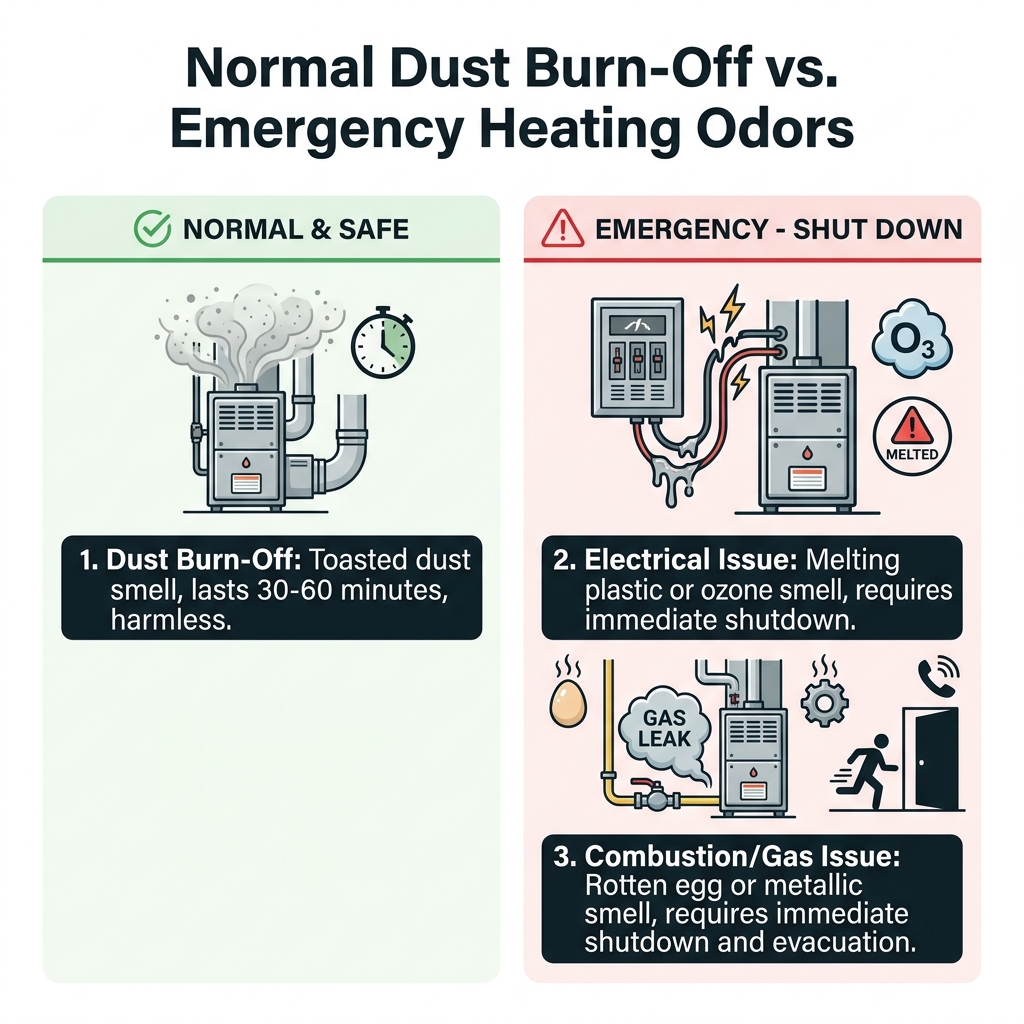
The smells associated with normal operation are generally mild and temporary. A toasted dust smell is the most common, often accompanied by a slight, stale mustiness that clears out of the vents within a few minutes of the blower fan kicking on. These odors do not sting the eyes, and they do not fill the room with a visible haze. If the smell is purely dusty and only happens during the very first time the heater runs for the season, our team typically advises that it is safe to let the cycle finish.
Emergency odors are distinct, sharp, and highly unnatural. If you detect an acrid smell like melting plastic or burning rubber, this often points to failing wire insulation or a seized blower motor overheating. An electrical ozone smell—similar to the scent of a lightning storm or a sparking model train—indicates arcing electricity or a failing circuit board. Finally, any smell resembling rotten eggs (sulfur) or a harsh metallic burning indicates a potential gas leak or a severely cracked heat exchanger.
You must draw a strict boundary: if the smell causes physical discomfort, smells like chemicals, or produces visible smoke, you must stop investigating and prioritize safety immediately.
• Toasted dust or hot metal — Probable Cause: Normal seasonal dust burn-off — Action Required: Monitor for 30-60 minutes; should dissipate.
• Melting plastic or rubber — Probable Cause: Overheating motor or melting wire insulation — Action Required: Shut down system immediately at thermostat.
• Electrical ozone or sparking scent — Probable Cause: Failing circuit board or electrical arcing — Action Required: Shut down system; turn off breaker.
• Rotten eggs (sulfur) — Probable Cause: Natural gas leak — Action Required: Evacuate home and call gas company/911.
• Harsh metallic burning — Probable Cause: Cracked heat exchanger or major friction — Action Required: Shut down system immediately and call for service.
Even when you identify a smell as normal dust burn-off, it is important to know the acceptable timeframe for that odor to linger. Complacency can be dangerous if a seemingly harmless smell stretches on for days. When our team performs early fall heating start-ups, we remind homeowners that the standard timeframe for typical dust burn-off to completely dissipate is between 30 to 60 minutes of the very first continuous heating cycle.
For many Derby KS area homes, the initial burn-off can be quite noticeable, especially if the system is located in a central closet or basement. To help clear the harmless odor faster, you can open a few windows to increase cross-ventilation, turn on ceiling fans, or run exhaust fans in your kitchen and bathrooms. This helps cycle the dusty air out of your living space while the heat exchanger finishes its self-cleaning process.
The warning signs of a prolonged issue:
• It lasts beyond the first day: If the smell persists beyond the first few cycles, or if it takes hours to fade, the system is likely dealing with more than just surface dust.
• It returns later in the season: Dust burn-off is a one-time seasonal event. If you smell toasted dust again in December or January, it indicates a severe airflow restriction, such as a completely clogged air filter causing the unit to overheat.
• It grows stronger over time: A fading smell is normal; an intensifying smell means a component is actively failing.
Never ignore a persistent heating smell. What starts as a dusty odor that refuses to go away could actually be early warning signs of a cracked heat exchanger leaking combustion gases, or a blower motor slowly burning out due to restricted airflow.
If your sensory evaluation during that first October cold snap points to an emergency odor, or if a normal smell persists far beyond the one-hour mark, you must take decisive action to protect your home. Knowing exactly what to do—and more importantly, what never to do—is vital for homeowner safety.
At MJB Heating & Cooling, we instruct all our customers to follow these explicit safety steps if they suspect a dangerous heating issue:
1. Turn off the system at the thermostat: Immediately switch your thermostat from "Heat" to the "Off" position. This stops the call for heating and halts the flow of gas or electricity to the main heating components.
2. Shut off the breaker if necessary: If you smell melting plastic, ozone, or suspect an electrical fire, locate your home's main electrical panel and flip the dedicated breaker for your HVAC system to the "Off" position. This severs all power to the unit.
3. Evacuate if you smell gas: If you detect the rotten egg smell of natural gas, do not touch any electrical switches (including the thermostat). Evacuate the house immediately and call your local gas provider from a safe distance.
4. Call for professional diagnostics: Once the system is safely powered down, contact a licensed technician to inspect the unit and identify the root cause of the burning odor.
The Never-Do Rule for Homeowners: Never attempt to open the furnace cabinet, inspect internal wiring, or patch a cracked heat exchanger yourself. These components handle high-voltage electricity, combustible gases, and extreme temperatures. Diagnosing and repairing internal heating components requires specialized tools and a licensed professional to handle safely.
If a professional determines that your older system is unsafe to operate or that the heat exchanger is beyond repair, you do not have to panic about unexpected costs. Exploring options for flexible HVAC financing—as well as checking if federal tax credits or utility incentive programs may apply to qualifying high-efficiency installations—can help you secure a safe, reliable replacement without straining your household budget.
While traditional gas furnaces are common, our team installs and maintains heat pumps for many Derby KS area homes seeking year-round comfort. Heat pumps operate differently than gas furnaces, and understanding this transition is key to knowing what odors to expect when the weather turns harsh.
A heat pump provides both cooling and heating by reversing the flow of refrigerant. During mild fall days, the heat pump simply extracts ambient heat from the outside air and moves it indoors. Because this process does not rely on combustion or extremely hot heat exchangers, the initial transition from cooling to mild heating often produces very little odor.
However, when extreme winter weather hits and temperatures drop near freezing, a heat pump must rely on its auxiliary heating strips (often called emergency heat). These electric resistance coils sit inside the air handler and act very much like the glowing coils inside a toaster. Because these strips are rarely used during mild weather, they can accumulate a significant amount of dust over the summer and early fall.
When the auxiliary heat finally kicks on during a severe temperature drop, it instantly incinerates months of built-up dust, producing a sudden and strong burning smell that can easily alarm a homeowner who thought their system was already "broken in" for the season.
This is where local expertise matters. MJB Heating & Cooling operates as a trusted local installer deeply familiar with how extreme Kansas weather impacts system performance. We understand the specific operational quirks of high-efficiency systems and can quickly diagnose whether a sudden odor is just the auxiliary strips firing up for the first time, or a sign of a failing defrost control board. If you are considering upgrading your system to handle these temperature swings more reliably, learning how Daikin compares to other HVAC brands can highlight the benefits of advanced heat pump technology designed for extreme climates.
The best way to handle the anxiety of a burning smell during the first October cold snap is to prevent it from happening in the first place. Transitioning from reacting to a problem to proactively preventing it is the hallmark of a well-maintained home.
Professional pre-season maintenance is designed to address the root causes of startup odors before you ever touch the thermostat. When our licensed technicians perform a fall tune-up, we thoroughly clean the interior of the HVAC cabinet. By carefully vacuuming and wiping down the heat exchanger, burner assembly, and blower motor, our team removes the caked-on dust that causes that initial toasted smell. When you turn the heat on later, the system runs clean and odor-free.
More importantly, routine maintenance prevents emergency odors. During a comprehensive inspection, a technician tightens loose electrical connections to prevent the arcing that causes ozone smells. They inspect the wire insulation to ensure nothing is rubbing against hot components and causing a melting plastic odor. They also perform rigorous safety checks on the heat exchanger to ensure there are no microscopic cracks that could leak carbon monoxide or produce harsh metallic smells.
Routine care does more than just eliminate nuisance odors; it extends the overall lifespan of your equipment, reduces winter energy consumption, and ensures safe operation all season long. Enrolling in a preventative maintenance plan takes the guesswork out of seasonal preparation, guaranteeing your system is cleaned, inspected, and ready for whatever winter brings.
When the temperatures drop, the phones at MJB Heating & Cooling ring with homeowners seeking reassurance. We have compiled the most frequent questions our team receives from Derby KS area homes regarding heating odors to help you quickly find the answers you need.
Yes, a brief burning smell is entirely normal during the first heating cycle of the season. This odor is caused by the system incinerating dust and debris that has settled on the heat exchanger over the summer months. As long as the smell resembles toasted dust and fades relatively quickly, it is a standard operational quirk and not a cause for alarm.
A normal dust burn-off smell should last between 30 to 60 minutes after the system begins its first continuous heating cycle. You can help clear the odor faster by opening a few windows to ventilate the house. If the smell persists for several hours or returns days later, it is no longer normal dust and requires professional inspection.
A cracked heat exchanger often produces a harsh, metallic burning smell, and in severe cases, it can emit odors resembling formaldehyde or sulfur. Because a cracked heat exchanger allows dangerous combustion gases like carbon monoxide to mix with your breathing air, any metallic or chemical smell should prompt an immediate system shutdown and a call to a professional.
While the light layer of dust that causes the initial seasonal burn-off smell is generally safe, severe neglect can pose a fire hazard. If a furnace is left unmaintained for years, heavy accumulations of lint, pet hair, and debris around the burner assembly or blower motor can ignite or cause the system to severely overheat.
You should worry and take immediate action if you smell melting plastic, burning rubber, electrical ozone, or rotten eggs. These odors indicate failing electrical components, overheating motors, or active gas leaks. If a smell causes your eyes to water, produces visible smoke, or makes you feel physically unwell, shut the system off immediately.
A heat pump often produces no smell when transitioning to mild heating, but it can produce a sudden burning dust smell later in the season when extreme cold forces the electric auxiliary heating strips to turn on for the first time. Because these strips sit unused for long periods, they gather dust that burns off rapidly when finally activated, smelling very similar to a dusty space heater.
Navigating the first October cold snap does not have to be a stressful experience. Having clear, safe criteria to distinguish a normal, temporary dust smell from a dangerous electrical or combustion issue brings true peace of mind. By trusting your senses and knowing exactly when it is time to turn the unit off and rely on a professional, you are taking the right steps to protect your household.
As the cold season begins, prioritizing your safety and comfort is paramount. Getting common homeowner questions answered proactively ensures you are never left guessing in the middle of a freezing night. If you are experiencing persistent odors, looking to upgrade an aging system, or simply want the reassurance of a professional inspection, do not wait for the weather to worsen. Reach out to schedule a heat pump consultation today, and let our team at MJB Heating & Cooling ensure your home remains a warm, safe haven all winter long.


Our A/C stopped working on a Sunday and due to health issues, we needed to find a service company available on a Sunday. I called MJB and left a message on their emergency voice mail. Within 10 minutes Tom Buck called me to hear my description of the symptoms. He was just finishing an appointment in Wichita and would be on his way to my home on the south end of Derby. He arrived within 30 minutes! From start to finish he was the perfect example of what you could ever hope for in an HVAC tech and a human being. His evaluation of our system inside and out was as thorough as I could ever imagine and once he was done with the repair, our system is running as well or better than ever. Well worth the price for the evaluation, parts, and labor. Thank you again Tom for an awesome experience.
Our AC went out during the hottest days of the year, and they were out next day! We have been jerked around by a shoddy home warranty for years. We finally had a chance to pick our own repair people, and MJB came highly recommended. I can see why! I was impressed with the honesty and speed at which they fixed our AC unit!
Our commercial building had a lightening/electrical strike and damaged our 20 ton AC unit. No one could find us a new unit before the end of September. Imagining going all of August and September with no AC in Kansas and working inside near 100 degree temps is less than thrilling. Dale and the team at MJB called around and saved the day. They had us a new unit 5 weeks earlier than other could promise and I now have happy employees. The unit is amazingly quiet, super cold and so much more energy efficient. Thank you for being our super hero!
Came out and installed my new furnace. Was very polite and affordable. They are very acknowledgeable and I highly recommend!
Thank you very much. We had our 1st warm night in 3weeks. MJB took the time and effort to find the real problem. And the employees were kind and thoughtful and explained things very well. I cannot thank you and all of MJB. Will recommend you highly. Thanks again Marjorie Herman Oxford Kansas
We had a new system installed and I was so impressed with how quick they were in come out and install it, in the middle of a hot summer day. They were so friendly & very professional. I had a small problem with a weird sound and they came over immediately and fixed it. Love them!