.avif)





Blogs
Stay updated with our latest blog posts.
When it comes to a daikin vs other hvac brands comparison, here is a quick breakdown of how the major players stack up:
| Brand | Max SEER2 | Warranty | Key Strength |
|---|---|---|---|
| Daikin | 24.5 | 12-year parts | Inverter tech, R-32 refrigerant, value |
| Carrier | 26 | 10-year parts | Smart features, humidity control |
| Trane | 22 | 10-year parts | Durability, cold-climate reliability |
| Lennox | 26 | 10-year parts | Quiet operation, efficiency |
| Rheem | 20 | 10-year parts | Budget-friendly reliability |
| Goodman | 18 | 10-year parts | Low upfront cost |
| Mitsubishi | 28 (ductless) | 12-year parts | Extreme cold, ductless performance |
Choosing a new HVAC system for your home is one of the biggest comfort decisions you will make. Get it right and you enjoy lower energy bills, reliable heating and cooling, and peace of mind for years to come. Get it wrong and you could be looking at frequent repairs, high utility costs, and a warranty that does not deliver what you expected.
Daikin is the world's largest HVAC manufacturer by revenue - bigger than Carrier, Trane, and Mitsubishi - yet many homeowners in the Wichita area have never heard of the brand. That gap between reputation and reality is exactly what this guide is here to close.
From efficiency ratings and cold-weather performance to warranty length and refrigerant technology, we will walk you through what actually separates these brands so you can make a confident, informed decision.
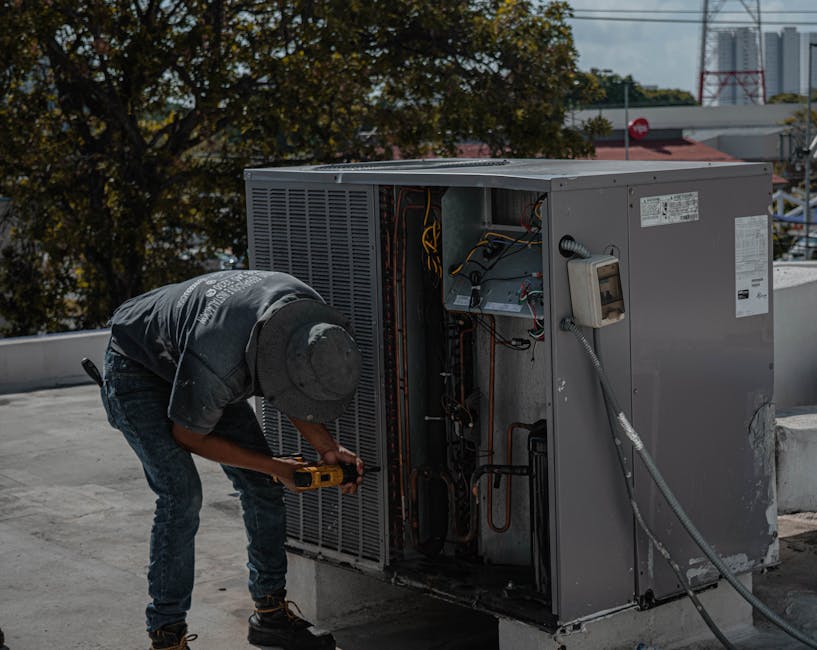
To truly understand how Daikin measures up against household names like Carrier, Trane, and Lennox, we have to look past the marketing slogans and focus on the engineering.
For decades, traditional American HVAC systems operated on a simple on-and-off cycle. When your thermostat detected a temperature change, the system turned on at 100% capacity, ran until the target temperature was reached, and then shut completely off. This frequent cycling is highly inefficient, much like driving a car in stop-and-go city traffic.
Daikin approached home comfort differently by pioneering and scaling variable-speed inverter technology. Instead of turning completely on and off, an inverter-driven compressor adjusts its speed continuously in tiny increments. It runs at lower, quieter capacities on mild days and ramps up only when extreme weather hits. This allows the system to maintain a highly consistent indoor temperature while using only a fraction of the electricity required by traditional systems.
While other major brands have introduced their own variable-speed compressors in recent years, Daikin's decades of experience in inverter design give it a distinct engineering advantage. When Choosing the Right HVAC Brand for Your Home, it is helpful to look at how vertically integrated a manufacturer is. Daikin manufactures its own compressors and refrigerants, allowing for exceptional quality control and system integration. You can read more about these proprietary engineering choices in our guide on What Makes Daikin HVAC Systems Different.
When digging into the mechanical components, two key innovations set Daikin apart from its competitors: swing compressors and the transition to R-32 refrigerant.
Efficiency is typically measured using two key metrics: SEER2 (Seasonal Energy Efficiency Ratio 2) for cooling and HSPF2 (Heating Seasonal Performance Factor 2) for heating. Understanding these ratings is essential for managing your monthly utility bills. For a deeper dive into these numbers, take a look at our guide on Efficiency Ratings Explained for Homeowners.
In a head-to-head comparison, Daikin holds its own against the absolute highest-tier premium brands:
While Carrier and Lennox boast slightly higher peak cooling efficiency numbers on paper, Daikin represents a sweet spot for real-world performance. Daikin’s inverter technology is highly optimized for part-load efficiency, meaning it excels during the mild spring and autumn months we experience here in Central Kansas.
Additionally, Daikin’s heating efficiency is incredibly strong. By checking out our article to Discover Energy Savings with Daikin's HSPF Rating Insights, you can see how Daikin’s heating cycles are engineered to extract maximum warmth from the outdoor air with minimal electrical draw.
| Efficiency & Warranty Metric | Daikin Baseline | Standard Industry Baseline |
|---|---|---|
| Max Cooling Efficiency | Up to 24.5 SEER2 | 14 to 18 SEER2 |
| Refrigerant Technology | Eco-friendly R-32 | R-410A (legacy) |
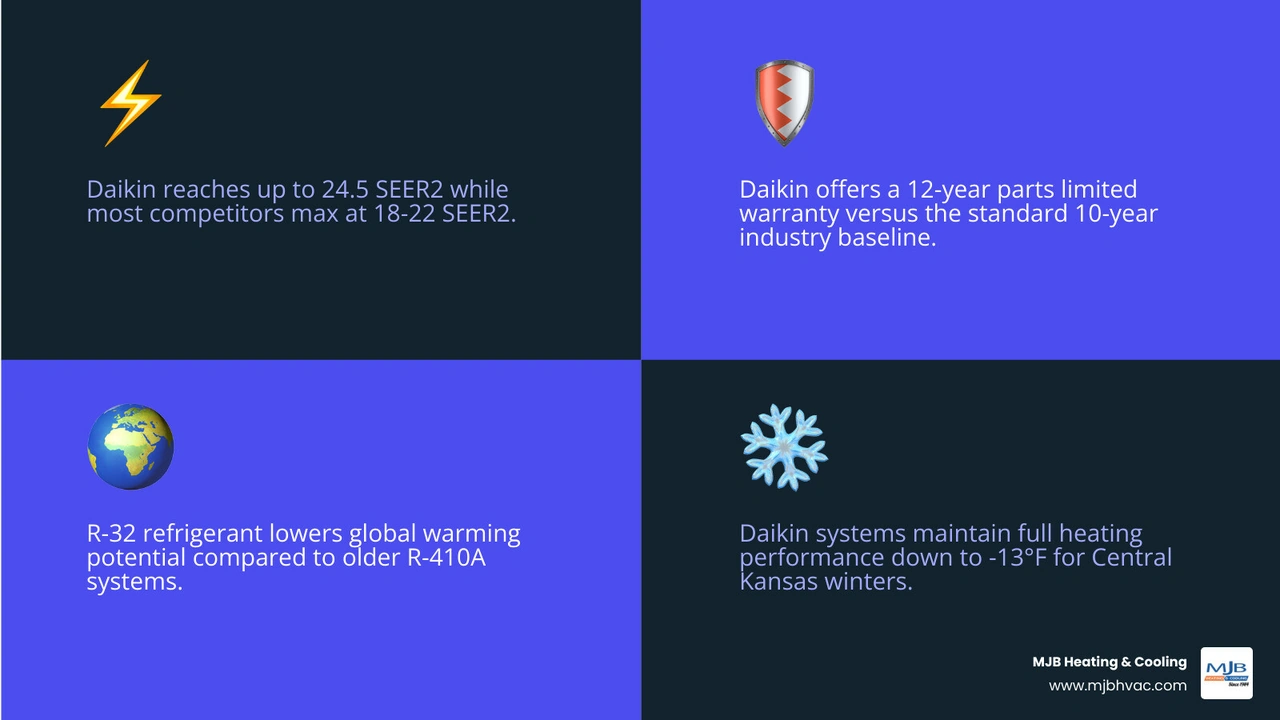
| Standard Parts Warranty | 12 Years (with registration) | 10 Years |
| Compressor Protection | Unit Replacement Pledge (select models) | Parts-only replacement |
Central Kansas is known for its dramatic weather swings. From scorching, humid July afternoons in Wichita and Andover to freezing, snow-packed January mornings in Haysville and Derby, your HVAC system has to be incredibly resilient.
Historically, heat pumps were only recommended for moderate, southern climates because they struggled to extract heat from freezing outdoor air. That is no longer the case. Daikin’s cold-climate heat pumps, particularly the Aurora series, are engineered to deliver reliable, energy-efficient heating even when outdoor temperatures plunge to -13°F.
In contrast, many standard heat pumps from competing brands begin to lose efficiency rapidly once temperatures drop below freezing, forcing them to rely on expensive auxiliary electric heat strips. For homeowners looking for ultimate peace of mind during a severe Kansas blizzard, Daikin systems can also be configured as dual-fuel setups, pairing an ultra-efficient heat pump with a highly reliable gas furnace.
Depending on your home's layout, you may also be weighing the choice between traditional ducted systems and ductless options. To understand how these configurations distribute air differently, read our Central AC vs Ductless Mini Split Comparison.
Every home in our service area is unique. A historic home in Newton or Winfield might lack the ductwork required for a traditional central air conditioner, while a modern two-story home in Goddard or Maize might have stubborn hot and cold spots that a single thermostat cannot resolve.
Daikin excels at providing flexible solutions for these varied layouts:
When evaluating a daikin vs other hvac brands comparison, looking at the upfront price is only one part of the equation. The true value of an HVAC system is measured by its total cost of ownership over its 15-to-20-year lifespan.
Daikin consistently delivers exceptional long-term value. Because of its advanced inverter technology, a Daikin system can significantly lower your monthly utility bills compared to older, single-stage equipment. To see how these monthly savings accumulate over time, read our analysis on How Much Does a High Efficiency System Save. Additionally, upgrading to a modern, efficient system is a smart investment in your property; you can learn more about this in our article on How a New HVAC System Increases Home Value.
Another critical element of long-term value is warranty protection. While the industry standard offered by brands like Carrier, Trane, and Rheem is a 10-year parts warranty, Daikin stands out by offering a 12-year parts limited warranty on many of its registered residential systems. On select premium models (like the Daikin Fit and Aurora series), Daikin also includes a Unit Replacement Limited Warranty. If the compressor fails within the first 12 years, Daikin will provide a completely new outdoor unit rather than just replacing the broken internal part.
To make these high-efficiency upgrades even more accessible, homeowners in our region can take advantage of various local and federal incentives. For a detailed breakdown of available financial support, check out our guide on Kansas Energy Rebates for HVAC Upgrades.
To learn more about how Daikin’s heating efficiency translates to long-term financial savings, you can Discover Energy Savings with Daikin's HSPF Rating Insights.
No matter how advanced an HVAC system is, its real-world performance is entirely dependent on the quality of its installation. In fact, research indicates that roughly 80% of a system's long-term efficiency and reliability comes down to proper design, sizing, and installation practices.
At MJB Heating & Cooling, we ensure your system is perfectly matched to your home by performing a detailed Manual J load calculation. This calculation takes into account your home’s square footage, wall insulation, window orientations, and local climate trends to determine the exact heating and cooling capacity your home requires. An oversized system will cycle on and off too quickly, leaving your home humid and drafty, while an undersized system will run constantly, driving up your utility bills and wearing out the compressor prematurely.
By choosing a qualified, factory-trained installer, you ensure that every electrical connection, refrigerant line, and duct connection is executed to the manufacturer's exact specifications. You can learn more about why this matters by reading How Daikin Certification Ensures Quality Installation. If you are currently dealing with an unreliable system and trying to decide your next steps, our guide on Should I Repair or Replace My HVAC System can help you weigh your options.
Daikin offers one of the strongest warranty programs in the residential HVAC industry. While most major competitors provide a standard 10-year parts warranty, Daikin offers a 12-year parts limited warranty on select registered systems. To qualify for this extended coverage, the system must be installed by a professional contractor and registered online within 60 days of installation. On select premium models, Daikin also includes a Unit Replacement pledge, which provides a brand-new outdoor unit if the compressor fails within the warranty window.
Yes. Thanks to advanced inverter-driven compressors and cold-climate engineering, Daikin's Aurora series heat pumps can operate efficiently at outdoor temperatures as low as -13°F. For extreme winter blizzards, these systems can also be paired with a gas furnace in a dual-fuel configuration, ensuring your home remains perfectly cozy no matter how low the temperature drops.
R-32 is a next-generation refrigerant that offers two major advantages:
When you weigh a daikin vs other hvac brands comparison, Daikin emerges as a clear leader in inverter technology, environmental sustainability, and long-term warranty protection. Whether you are looking to install a compact Daikin Fit system in Maize, a cold-climate Aurora heat pump in Derby, or a multi-zone ductless system in Wichita, choosing the right brand is only the first step.
Since 1984, MJB Heating & Cooling has been a trusted, family-owned name across the Wichita metro area. We pride ourselves on an honest, straightforward business approach and quality workmanship. We are here to help you select, design, and install the perfect system for your family's needs.
Ready to take control of your home's comfort and utility bills? Discover Energy Savings with Daikin's HSPF Rating Insights and reach out to our friendly team today to schedule a professional consultation.
When it comes to a daikin vs other hvac brands comparison, here is a quick breakdown of how the major players stack up:
| Brand | Max SEER2 | Warranty | Key Strength |
|---|---|---|---|
| Daikin | 24.5 | 12-year parts | Inverter tech, R-32 refrigerant, value |
| Carrier | 26 | 10-year parts | Smart features, humidity control |
| Trane | 22 | 10-year parts | Durability, cold-climate reliability |
| Lennox | 26 | 10-year parts | Quiet operation, efficiency |
| Rheem | 20 | 10-year parts | Budget-friendly reliability |
| Goodman | 18 | 10-year parts | Low upfront cost |
| Mitsubishi | 28 (ductless) | 12-year parts | Extreme cold, ductless performance |
Choosing a new HVAC system for your home is one of the biggest comfort decisions you will make. Get it right and you enjoy lower energy bills, reliable heating and cooling, and peace of mind for years to come. Get it wrong and you could be looking at frequent repairs, high utility costs, and a warranty that does not deliver what you expected.
Daikin is the world's largest HVAC manufacturer by revenue - bigger than Carrier, Trane, and Mitsubishi - yet many homeowners in the Wichita area have never heard of the brand. That gap between reputation and reality is exactly what this guide is here to close.
From efficiency ratings and cold-weather performance to warranty length and refrigerant technology, we will walk you through what actually separates these brands so you can make a confident, informed decision.
To truly understand how Daikin measures up against household names like Carrier, Trane, and Lennox, we have to look past the marketing slogans and focus on the engineering.
For decades, traditional American HVAC systems operated on a simple on-and-off cycle. When your thermostat detected a temperature change, the system turned on at 100% capacity, ran until the target temperature was reached, and then shut completely off. This frequent cycling is highly inefficient, much like driving a car in stop-and-go city traffic.
Daikin approached home comfort differently by pioneering and scaling variable-speed inverter technology. Instead of turning completely on and off, an inverter-driven compressor adjusts its speed continuously in tiny increments. It runs at lower, quieter capacities on mild days and ramps up only when extreme weather hits. This allows the system to maintain a highly consistent indoor temperature while using only a fraction of the electricity required by traditional systems.
While other major brands have introduced their own variable-speed compressors in recent years, Daikin's decades of experience in inverter design give it a distinct engineering advantage. When Choosing the Right HVAC Brand for Your Home, it is helpful to look at how vertically integrated a manufacturer is. Daikin manufactures its own compressors and refrigerants, allowing for exceptional quality control and system integration. You can read more about these proprietary engineering choices in our guide on What Makes Daikin HVAC Systems Different.
When digging into the mechanical components, two key innovations set Daikin apart from its competitors: swing compressors and the transition to R-32 refrigerant.
Efficiency is typically measured using two key metrics: SEER2 (Seasonal Energy Efficiency Ratio 2) for cooling and HSPF2 (Heating Seasonal Performance Factor 2) for heating. Understanding these ratings is essential for managing your monthly utility bills. For a deeper dive into these numbers, take a look at our guide on Efficiency Ratings Explained for Homeowners.
In a head-to-head comparison, Daikin holds its own against the absolute highest-tier premium brands:
While Carrier and Lennox boast slightly higher peak cooling efficiency numbers on paper, Daikin represents a sweet spot for real-world performance. Daikin’s inverter technology is highly optimized for part-load efficiency, meaning it excels during the mild spring and autumn months we experience here in Central Kansas.
Additionally, Daikin’s heating efficiency is incredibly strong. By checking out our article to Discover Energy Savings with Daikin's HSPF Rating Insights, you can see how Daikin’s heating cycles are engineered to extract maximum warmth from the outdoor air with minimal electrical draw.
| Efficiency & Warranty Metric | Daikin Baseline | Standard Industry Baseline |
|---|---|---|
| Max Cooling Efficiency | Up to 24.5 SEER2 | 14 to 18 SEER2 |
| Refrigerant Technology | Eco-friendly R-32 | R-410A (legacy) |
| Standard Parts Warranty | 12 Years (with registration) | 10 Years |
| Compressor Protection | Unit Replacement Pledge (select models) | Parts-only replacement |
Central Kansas is known for its dramatic weather swings. From scorching, humid July afternoons in Wichita and Andover to freezing, snow-packed January mornings in Haysville and Derby, your HVAC system has to be incredibly resilient.
Historically, heat pumps were only recommended for moderate, southern climates because they struggled to extract heat from freezing outdoor air. That is no longer the case. Daikin’s cold-climate heat pumps, particularly the Aurora series, are engineered to deliver reliable, energy-efficient heating even when outdoor temperatures plunge to -13°F.
In contrast, many standard heat pumps from competing brands begin to lose efficiency rapidly once temperatures drop below freezing, forcing them to rely on expensive auxiliary electric heat strips. For homeowners looking for ultimate peace of mind during a severe Kansas blizzard, Daikin systems can also be configured as dual-fuel setups, pairing an ultra-efficient heat pump with a highly reliable gas furnace.
Depending on your home's layout, you may also be weighing the choice between traditional ducted systems and ductless options. To understand how these configurations distribute air differently, read our Central AC vs Ductless Mini Split Comparison.
Every home in our service area is unique. A historic home in Newton or Winfield might lack the ductwork required for a traditional central air conditioner, while a modern two-story home in Goddard or Maize might have stubborn hot and cold spots that a single thermostat cannot resolve.
Daikin excels at providing flexible solutions for these varied layouts:
When evaluating a daikin vs other hvac brands comparison, looking at the upfront price is only one part of the equation. The true value of an HVAC system is measured by its total cost of ownership over its 15-to-20-year lifespan.
Daikin consistently delivers exceptional long-term value. Because of its advanced inverter technology, a Daikin system can significantly lower your monthly utility bills compared to older, single-stage equipment. To see how these monthly savings accumulate over time, read our analysis on How Much Does a High Efficiency System Save. Additionally, upgrading to a modern, efficient system is a smart investment in your property; you can learn more about this in our article on How a New HVAC System Increases Home Value.
Another critical element of long-term value is warranty protection. While the industry standard offered by brands like Carrier, Trane, and Rheem is a 10-year parts warranty, Daikin stands out by offering a 12-year parts limited warranty on many of its registered residential systems. On select premium models (like the Daikin Fit and Aurora series), Daikin also includes a Unit Replacement Limited Warranty. If the compressor fails within the first 12 years, Daikin will provide a completely new outdoor unit rather than just replacing the broken internal part.
To make these high-efficiency upgrades even more accessible, homeowners in our region can take advantage of various local and federal incentives. For a detailed breakdown of available financial support, check out our guide on Kansas Energy Rebates for HVAC Upgrades.
To learn more about how Daikin’s heating efficiency translates to long-term financial savings, you can Discover Energy Savings with Daikin's HSPF Rating Insights.
No matter how advanced an HVAC system is, its real-world performance is entirely dependent on the quality of its installation. In fact, research indicates that roughly 80% of a system's long-term efficiency and reliability comes down to proper design, sizing, and installation practices.
At MJB Heating & Cooling, we ensure your system is perfectly matched to your home by performing a detailed Manual J load calculation. This calculation takes into account your home’s square footage, wall insulation, window orientations, and local climate trends to determine the exact heating and cooling capacity your home requires. An oversized system will cycle on and off too quickly, leaving your home humid and drafty, while an undersized system will run constantly, driving up your utility bills and wearing out the compressor prematurely.
By choosing a qualified, factory-trained installer, you ensure that every electrical connection, refrigerant line, and duct connection is executed to the manufacturer's exact specifications. You can learn more about why this matters by reading How Daikin Certification Ensures Quality Installation. If you are currently dealing with an unreliable system and trying to decide your next steps, our guide on Should I Repair or Replace My HVAC System can help you weigh your options.
Daikin offers one of the strongest warranty programs in the residential HVAC industry. While most major competitors provide a standard 10-year parts warranty, Daikin offers a 12-year parts limited warranty on select registered systems. To qualify for this extended coverage, the system must be installed by a professional contractor and registered online within 60 days of installation. On select premium models, Daikin also includes a Unit Replacement pledge, which provides a brand-new outdoor unit if the compressor fails within the warranty window.
Yes. Thanks to advanced inverter-driven compressors and cold-climate engineering, Daikin's Aurora series heat pumps can operate efficiently at outdoor temperatures as low as -13°F. For extreme winter blizzards, these systems can also be paired with a gas furnace in a dual-fuel configuration, ensuring your home remains perfectly cozy no matter how low the temperature drops.
R-32 is a next-generation refrigerant that offers two major advantages:
When you weigh a daikin vs other hvac brands comparison, Daikin emerges as a clear leader in inverter technology, environmental sustainability, and long-term warranty protection. Whether you are looking to install a compact Daikin Fit system in Maize, a cold-climate Aurora heat pump in Derby, or a multi-zone ductless system in Wichita, choosing the right brand is only the first step.
Since 1984, MJB Heating & Cooling has been a trusted, family-owned name across the Wichita metro area. We pride ourselves on an honest, straightforward business approach and quality workmanship. We are here to help you select, design, and install the perfect system for your family's needs.
Ready to take control of your home's comfort and utility bills? Discover Energy Savings with Daikin's HSPF Rating Insights and reach out to our friendly team today to schedule a professional consultation.
When it comes to a daikin vs other hvac brands comparison, here is a quick breakdown of how the major players stack up:
| Brand | Max SEER2 | Warranty | Key Strength |
|---|---|---|---|
| Daikin | 24.5 | 12-year parts | Inverter tech, R-32 refrigerant, value |
| Carrier | 26 | 10-year parts | Smart features, humidity control |
| Trane | 22 | 10-year parts | Durability, cold-climate reliability |
| Lennox | 26 | 10-year parts | Quiet operation, efficiency |
| Rheem | 20 | 10-year parts | Budget-friendly reliability |
| Goodman | 18 | 10-year parts | Low upfront cost |
| Mitsubishi | 28 (ductless) | 12-year parts | Extreme cold, ductless performance |
Choosing a new HVAC system for your home is one of the biggest comfort decisions you will make. Get it right and you enjoy lower energy bills, reliable heating and cooling, and peace of mind for years to come. Get it wrong and you could be looking at frequent repairs, high utility costs, and a warranty that does not deliver what you expected.
Daikin is the world's largest HVAC manufacturer by revenue - bigger than Carrier, Trane, and Mitsubishi - yet many homeowners in the Wichita area have never heard of the brand. That gap between reputation and reality is exactly what this guide is here to close.
From efficiency ratings and cold-weather performance to warranty length and refrigerant technology, we will walk you through what actually separates these brands so you can make a confident, informed decision.
To truly understand how Daikin measures up against household names like Carrier, Trane, and Lennox, we have to look past the marketing slogans and focus on the engineering.
For decades, traditional American HVAC systems operated on a simple on-and-off cycle. When your thermostat detected a temperature change, the system turned on at 100% capacity, ran until the target temperature was reached, and then shut completely off. This frequent cycling is highly inefficient, much like driving a car in stop-and-go city traffic.
Daikin approached home comfort differently by pioneering and scaling variable-speed inverter technology. Instead of turning completely on and off, an inverter-driven compressor adjusts its speed continuously in tiny increments. It runs at lower, quieter capacities on mild days and ramps up only when extreme weather hits. This allows the system to maintain a highly consistent indoor temperature while using only a fraction of the electricity required by traditional systems.
While other major brands have introduced their own variable-speed compressors in recent years, Daikin's decades of experience in inverter design give it a distinct engineering advantage. When Choosing the Right HVAC Brand for Your Home, it is helpful to look at how vertically integrated a manufacturer is. Daikin manufactures its own compressors and refrigerants, allowing for exceptional quality control and system integration. You can read more about these proprietary engineering choices in our guide on What Makes Daikin HVAC Systems Different.
When digging into the mechanical components, two key innovations set Daikin apart from its competitors: swing compressors and the transition to R-32 refrigerant.
Efficiency is typically measured using two key metrics: SEER2 (Seasonal Energy Efficiency Ratio 2) for cooling and HSPF2 (Heating Seasonal Performance Factor 2) for heating. Understanding these ratings is essential for managing your monthly utility bills. For a deeper dive into these numbers, take a look at our guide on Efficiency Ratings Explained for Homeowners.
In a head-to-head comparison, Daikin holds its own against the absolute highest-tier premium brands:
While Carrier and Lennox boast slightly higher peak cooling efficiency numbers on paper, Daikin represents a sweet spot for real-world performance. Daikin’s inverter technology is highly optimized for part-load efficiency, meaning it excels during the mild spring and autumn months we experience here in Central Kansas.
Additionally, Daikin’s heating efficiency is incredibly strong. By checking out our article to Discover Energy Savings with Daikin's HSPF Rating Insights, you can see how Daikin’s heating cycles are engineered to extract maximum warmth from the outdoor air with minimal electrical draw.
| Efficiency & Warranty Metric | Daikin Baseline | Standard Industry Baseline |
|---|---|---|
| Max Cooling Efficiency | Up to 24.5 SEER2 | 14 to 18 SEER2 |
| Refrigerant Technology | Eco-friendly R-32 | R-410A (legacy) |
| Standard Parts Warranty | 12 Years (with registration) | 10 Years |
| Compressor Protection | Unit Replacement Pledge (select models) | Parts-only replacement |
Central Kansas is known for its dramatic weather swings. From scorching, humid July afternoons in Wichita and Andover to freezing, snow-packed January mornings in Haysville and Derby, your HVAC system has to be incredibly resilient.
Historically, heat pumps were only recommended for moderate, southern climates because they struggled to extract heat from freezing outdoor air. That is no longer the case. Daikin’s cold-climate heat pumps, particularly the Aurora series, are engineered to deliver reliable, energy-efficient heating even when outdoor temperatures plunge to -13°F.
In contrast, many standard heat pumps from competing brands begin to lose efficiency rapidly once temperatures drop below freezing, forcing them to rely on expensive auxiliary electric heat strips. For homeowners looking for ultimate peace of mind during a severe Kansas blizzard, Daikin systems can also be configured as dual-fuel setups, pairing an ultra-efficient heat pump with a highly reliable gas furnace.
Depending on your home's layout, you may also be weighing the choice between traditional ducted systems and ductless options. To understand how these configurations distribute air differently, read our Central AC vs Ductless Mini Split Comparison.
Every home in our service area is unique. A historic home in Newton or Winfield might lack the ductwork required for a traditional central air conditioner, while a modern two-story home in Goddard or Maize might have stubborn hot and cold spots that a single thermostat cannot resolve.
Daikin excels at providing flexible solutions for these varied layouts:
When evaluating a daikin vs other hvac brands comparison, looking at the upfront price is only one part of the equation. The true value of an HVAC system is measured by its total cost of ownership over its 15-to-20-year lifespan.
Daikin consistently delivers exceptional long-term value. Because of its advanced inverter technology, a Daikin system can significantly lower your monthly utility bills compared to older, single-stage equipment. To see how these monthly savings accumulate over time, read our analysis on How Much Does a High Efficiency System Save. Additionally, upgrading to a modern, efficient system is a smart investment in your property; you can learn more about this in our article on How a New HVAC System Increases Home Value.
Another critical element of long-term value is warranty protection. While the industry standard offered by brands like Carrier, Trane, and Rheem is a 10-year parts warranty, Daikin stands out by offering a 12-year parts limited warranty on many of its registered residential systems. On select premium models (like the Daikin Fit and Aurora series), Daikin also includes a Unit Replacement Limited Warranty. If the compressor fails within the first 12 years, Daikin will provide a completely new outdoor unit rather than just replacing the broken internal part.
To make these high-efficiency upgrades even more accessible, homeowners in our region can take advantage of various local and federal incentives. For a detailed breakdown of available financial support, check out our guide on Kansas Energy Rebates for HVAC Upgrades.
To learn more about how Daikin’s heating efficiency translates to long-term financial savings, you can Discover Energy Savings with Daikin's HSPF Rating Insights.
No matter how advanced an HVAC system is, its real-world performance is entirely dependent on the quality of its installation. In fact, research indicates that roughly 80% of a system's long-term efficiency and reliability comes down to proper design, sizing, and installation practices.
At MJB Heating & Cooling, we ensure your system is perfectly matched to your home by performing a detailed Manual J load calculation. This calculation takes into account your home’s square footage, wall insulation, window orientations, and local climate trends to determine the exact heating and cooling capacity your home requires. An oversized system will cycle on and off too quickly, leaving your home humid and drafty, while an undersized system will run constantly, driving up your utility bills and wearing out the compressor prematurely.
By choosing a qualified, factory-trained installer, you ensure that every electrical connection, refrigerant line, and duct connection is executed to the manufacturer's exact specifications. You can learn more about why this matters by reading How Daikin Certification Ensures Quality Installation. If you are currently dealing with an unreliable system and trying to decide your next steps, our guide on Should I Repair or Replace My HVAC System can help you weigh your options.
Daikin offers one of the strongest warranty programs in the residential HVAC industry. While most major competitors provide a standard 10-year parts warranty, Daikin offers a 12-year parts limited warranty on select registered systems. To qualify for this extended coverage, the system must be installed by a professional contractor and registered online within 60 days of installation. On select premium models, Daikin also includes a Unit Replacement pledge, which provides a brand-new outdoor unit if the compressor fails within the warranty window.
Yes. Thanks to advanced inverter-driven compressors and cold-climate engineering, Daikin's Aurora series heat pumps can operate efficiently at outdoor temperatures as low as -13°F. For extreme winter blizzards, these systems can also be paired with a gas furnace in a dual-fuel configuration, ensuring your home remains perfectly cozy no matter how low the temperature drops.
R-32 is a next-generation refrigerant that offers two major advantages:
When you weigh a daikin vs other hvac brands comparison, Daikin emerges as a clear leader in inverter technology, environmental sustainability, and long-term warranty protection. Whether you are looking to install a compact Daikin Fit system in Maize, a cold-climate Aurora heat pump in Derby, or a multi-zone ductless system in Wichita, choosing the right brand is only the first step.
Since 1984, MJB Heating & Cooling has been a trusted, family-owned name across the Wichita metro area. We pride ourselves on an honest, straightforward business approach and quality workmanship. We are here to help you select, design, and install the perfect system for your family's needs.
Ready to take control of your home's comfort and utility bills? Discover Energy Savings with Daikin's HSPF Rating Insights and reach out to our friendly team today to schedule a professional consultation.

When it comes to a daikin vs other hvac brands comparison, here is a quick breakdown of how the major players stack up:
| Brand | Max SEER2 | Warranty | Key Strength |
|---|---|---|---|
| Daikin | 24.5 | 12-year parts | Inverter tech, R-32 refrigerant, value |
| Carrier | 26 | 10-year parts | Smart features, humidity control |
| Trane | 22 | 10-year parts | Durability, cold-climate reliability |
| Lennox | 26 | 10-year parts | Quiet operation, efficiency |
| Rheem | 20 | 10-year parts | Budget-friendly reliability |
| Goodman | 18 | 10-year parts | Low upfront cost |
| Mitsubishi | 28 (ductless) | 12-year parts | Extreme cold, ductless performance |
Choosing a new HVAC system for your home is one of the biggest comfort decisions you will make. Get it right and you enjoy lower energy bills, reliable heating and cooling, and peace of mind for years to come. Get it wrong and you could be looking at frequent repairs, high utility costs, and a warranty that does not deliver what you expected.
Daikin is the world's largest HVAC manufacturer by revenue - bigger than Carrier, Trane, and Mitsubishi - yet many homeowners in the Wichita area have never heard of the brand. That gap between reputation and reality is exactly what this guide is here to close.
From efficiency ratings and cold-weather performance to warranty length and refrigerant technology, we will walk you through what actually separates these brands so you can make a confident, informed decision.
To truly understand how Daikin measures up against household names like Carrier, Trane, and Lennox, we have to look past the marketing slogans and focus on the engineering.
For decades, traditional American HVAC systems operated on a simple on-and-off cycle. When your thermostat detected a temperature change, the system turned on at 100% capacity, ran until the target temperature was reached, and then shut completely off. This frequent cycling is highly inefficient, much like driving a car in stop-and-go city traffic.
Daikin approached home comfort differently by pioneering and scaling variable-speed inverter technology. Instead of turning completely on and off, an inverter-driven compressor adjusts its speed continuously in tiny increments. It runs at lower, quieter capacities on mild days and ramps up only when extreme weather hits. This allows the system to maintain a highly consistent indoor temperature while using only a fraction of the electricity required by traditional systems.
While other major brands have introduced their own variable-speed compressors in recent years, Daikin's decades of experience in inverter design give it a distinct engineering advantage. When Choosing the Right HVAC Brand for Your Home, it is helpful to look at how vertically integrated a manufacturer is. Daikin manufactures its own compressors and refrigerants, allowing for exceptional quality control and system integration. You can read more about these proprietary engineering choices in our guide on What Makes Daikin HVAC Systems Different.
When digging into the mechanical components, two key innovations set Daikin apart from its competitors: swing compressors and the transition to R-32 refrigerant.
Efficiency is typically measured using two key metrics: SEER2 (Seasonal Energy Efficiency Ratio 2) for cooling and HSPF2 (Heating Seasonal Performance Factor 2) for heating. Understanding these ratings is essential for managing your monthly utility bills. For a deeper dive into these numbers, take a look at our guide on Efficiency Ratings Explained for Homeowners.
In a head-to-head comparison, Daikin holds its own against the absolute highest-tier premium brands:
While Carrier and Lennox boast slightly higher peak cooling efficiency numbers on paper, Daikin represents a sweet spot for real-world performance. Daikin’s inverter technology is highly optimized for part-load efficiency, meaning it excels during the mild spring and autumn months we experience here in Central Kansas.
Additionally, Daikin’s heating efficiency is incredibly strong. By checking out our article to Discover Energy Savings with Daikin's HSPF Rating Insights, you can see how Daikin’s heating cycles are engineered to extract maximum warmth from the outdoor air with minimal electrical draw.
| Efficiency & Warranty Metric | Daikin Baseline | Standard Industry Baseline |
|---|---|---|
| Max Cooling Efficiency | Up to 24.5 SEER2 | 14 to 18 SEER2 |
| Refrigerant Technology | Eco-friendly R-32 | R-410A (legacy) |
| Standard Parts Warranty | 12 Years (with registration) | 10 Years |
| Compressor Protection | Unit Replacement Pledge (select models) | Parts-only replacement |
Central Kansas is known for its dramatic weather swings. From scorching, humid July afternoons in Wichita and Andover to freezing, snow-packed January mornings in Haysville and Derby, your HVAC system has to be incredibly resilient.
Historically, heat pumps were only recommended for moderate, southern climates because they struggled to extract heat from freezing outdoor air. That is no longer the case. Daikin’s cold-climate heat pumps, particularly the Aurora series, are engineered to deliver reliable, energy-efficient heating even when outdoor temperatures plunge to -13°F.
In contrast, many standard heat pumps from competing brands begin to lose efficiency rapidly once temperatures drop below freezing, forcing them to rely on expensive auxiliary electric heat strips. For homeowners looking for ultimate peace of mind during a severe Kansas blizzard, Daikin systems can also be configured as dual-fuel setups, pairing an ultra-efficient heat pump with a highly reliable gas furnace.
Depending on your home's layout, you may also be weighing the choice between traditional ducted systems and ductless options. To understand how these configurations distribute air differently, read our Central AC vs Ductless Mini Split Comparison.
Every home in our service area is unique. A historic home in Newton or Winfield might lack the ductwork required for a traditional central air conditioner, while a modern two-story home in Goddard or Maize might have stubborn hot and cold spots that a single thermostat cannot resolve.
Daikin excels at providing flexible solutions for these varied layouts:
When evaluating a daikin vs other hvac brands comparison, looking at the upfront price is only one part of the equation. The true value of an HVAC system is measured by its total cost of ownership over its 15-to-20-year lifespan.
Daikin consistently delivers exceptional long-term value. Because of its advanced inverter technology, a Daikin system can significantly lower your monthly utility bills compared to older, single-stage equipment. To see how these monthly savings accumulate over time, read our analysis on How Much Does a High Efficiency System Save. Additionally, upgrading to a modern, efficient system is a smart investment in your property; you can learn more about this in our article on How a New HVAC System Increases Home Value.
Another critical element of long-term value is warranty protection. While the industry standard offered by brands like Carrier, Trane, and Rheem is a 10-year parts warranty, Daikin stands out by offering a 12-year parts limited warranty on many of its registered residential systems. On select premium models (like the Daikin Fit and Aurora series), Daikin also includes a Unit Replacement Limited Warranty. If the compressor fails within the first 12 years, Daikin will provide a completely new outdoor unit rather than just replacing the broken internal part.
To make these high-efficiency upgrades even more accessible, homeowners in our region can take advantage of various local and federal incentives. For a detailed breakdown of available financial support, check out our guide on Kansas Energy Rebates for HVAC Upgrades.
To learn more about how Daikin’s heating efficiency translates to long-term financial savings, you can Discover Energy Savings with Daikin's HSPF Rating Insights.
No matter how advanced an HVAC system is, its real-world performance is entirely dependent on the quality of its installation. In fact, research indicates that roughly 80% of a system's long-term efficiency and reliability comes down to proper design, sizing, and installation practices.
At MJB Heating & Cooling, we ensure your system is perfectly matched to your home by performing a detailed Manual J load calculation. This calculation takes into account your home’s square footage, wall insulation, window orientations, and local climate trends to determine the exact heating and cooling capacity your home requires. An oversized system will cycle on and off too quickly, leaving your home humid and drafty, while an undersized system will run constantly, driving up your utility bills and wearing out the compressor prematurely.
By choosing a qualified, factory-trained installer, you ensure that every electrical connection, refrigerant line, and duct connection is executed to the manufacturer's exact specifications. You can learn more about why this matters by reading How Daikin Certification Ensures Quality Installation. If you are currently dealing with an unreliable system and trying to decide your next steps, our guide on Should I Repair or Replace My HVAC System can help you weigh your options.
Daikin offers one of the strongest warranty programs in the residential HVAC industry. While most major competitors provide a standard 10-year parts warranty, Daikin offers a 12-year parts limited warranty on select registered systems. To qualify for this extended coverage, the system must be installed by a professional contractor and registered online within 60 days of installation. On select premium models, Daikin also includes a Unit Replacement pledge, which provides a brand-new outdoor unit if the compressor fails within the warranty window.
Yes. Thanks to advanced inverter-driven compressors and cold-climate engineering, Daikin's Aurora series heat pumps can operate efficiently at outdoor temperatures as low as -13°F. For extreme winter blizzards, these systems can also be paired with a gas furnace in a dual-fuel configuration, ensuring your home remains perfectly cozy no matter how low the temperature drops.
R-32 is a next-generation refrigerant that offers two major advantages:
When you weigh a daikin vs other hvac brands comparison, Daikin emerges as a clear leader in inverter technology, environmental sustainability, and long-term warranty protection. Whether you are looking to install a compact Daikin Fit system in Maize, a cold-climate Aurora heat pump in Derby, or a multi-zone ductless system in Wichita, choosing the right brand is only the first step.
Since 1984, MJB Heating & Cooling has been a trusted, family-owned name across the Wichita metro area. We pride ourselves on an honest, straightforward business approach and quality workmanship. We are here to help you select, design, and install the perfect system for your family's needs.
Ready to take control of your home's comfort and utility bills? Discover Energy Savings with Daikin's HSPF Rating Insights and reach out to our friendly team today to schedule a professional consultation.
When it comes to a daikin vs other hvac brands comparison, here is a quick breakdown of how the major players stack up:
| Brand | Max SEER2 | Warranty | Key Strength |
|---|---|---|---|
| Daikin | 24.5 | 12-year parts | Inverter tech, R-32 refrigerant, value |
| Carrier | 26 | 10-year parts | Smart features, humidity control |
| Trane | 22 | 10-year parts | Durability, cold-climate reliability |
| Lennox | 26 | 10-year parts | Quiet operation, efficiency |
| Rheem | 20 | 10-year parts | Budget-friendly reliability |
| Goodman | 18 | 10-year parts | Low upfront cost |
| Mitsubishi | 28 (ductless) | 12-year parts | Extreme cold, ductless performance |
Choosing a new HVAC system for your home is one of the biggest comfort decisions you will make. Get it right and you enjoy lower energy bills, reliable heating and cooling, and peace of mind for years to come. Get it wrong and you could be looking at frequent repairs, high utility costs, and a warranty that does not deliver what you expected.
Daikin is the world's largest HVAC manufacturer by revenue - bigger than Carrier, Trane, and Mitsubishi - yet many homeowners in the Wichita area have never heard of the brand. That gap between reputation and reality is exactly what this guide is here to close.
From efficiency ratings and cold-weather performance to warranty length and refrigerant technology, we will walk you through what actually separates these brands so you can make a confident, informed decision.
To truly understand how Daikin measures up against household names like Carrier, Trane, and Lennox, we have to look past the marketing slogans and focus on the engineering.
For decades, traditional American HVAC systems operated on a simple on-and-off cycle. When your thermostat detected a temperature change, the system turned on at 100% capacity, ran until the target temperature was reached, and then shut completely off. This frequent cycling is highly inefficient, much like driving a car in stop-and-go city traffic.
Daikin approached home comfort differently by pioneering and scaling variable-speed inverter technology. Instead of turning completely on and off, an inverter-driven compressor adjusts its speed continuously in tiny increments. It runs at lower, quieter capacities on mild days and ramps up only when extreme weather hits. This allows the system to maintain a highly consistent indoor temperature while using only a fraction of the electricity required by traditional systems.
While other major brands have introduced their own variable-speed compressors in recent years, Daikin's decades of experience in inverter design give it a distinct engineering advantage. When Choosing the Right HVAC Brand for Your Home, it is helpful to look at how vertically integrated a manufacturer is. Daikin manufactures its own compressors and refrigerants, allowing for exceptional quality control and system integration. You can read more about these proprietary engineering choices in our guide on What Makes Daikin HVAC Systems Different.
When digging into the mechanical components, two key innovations set Daikin apart from its competitors: swing compressors and the transition to R-32 refrigerant.
Efficiency is typically measured using two key metrics: SEER2 (Seasonal Energy Efficiency Ratio 2) for cooling and HSPF2 (Heating Seasonal Performance Factor 2) for heating. Understanding these ratings is essential for managing your monthly utility bills. For a deeper dive into these numbers, take a look at our guide on Efficiency Ratings Explained for Homeowners.
In a head-to-head comparison, Daikin holds its own against the absolute highest-tier premium brands:
While Carrier and Lennox boast slightly higher peak cooling efficiency numbers on paper, Daikin represents a sweet spot for real-world performance. Daikin’s inverter technology is highly optimized for part-load efficiency, meaning it excels during the mild spring and autumn months we experience here in Central Kansas.
Additionally, Daikin’s heating efficiency is incredibly strong. By checking out our article to Discover Energy Savings with Daikin's HSPF Rating Insights, you can see how Daikin’s heating cycles are engineered to extract maximum warmth from the outdoor air with minimal electrical draw.
| Efficiency & Warranty Metric | Daikin Baseline | Standard Industry Baseline |
|---|---|---|
| Max Cooling Efficiency | Up to 24.5 SEER2 | 14 to 18 SEER2 |
| Refrigerant Technology | Eco-friendly R-32 | R-410A (legacy) |
| Standard Parts Warranty | 12 Years (with registration) | 10 Years |
| Compressor Protection | Unit Replacement Pledge (select models) | Parts-only replacement |
Central Kansas is known for its dramatic weather swings. From scorching, humid July afternoons in Wichita and Andover to freezing, snow-packed January mornings in Haysville and Derby, your HVAC system has to be incredibly resilient.
Historically, heat pumps were only recommended for moderate, southern climates because they struggled to extract heat from freezing outdoor air. That is no longer the case. Daikin’s cold-climate heat pumps, particularly the Aurora series, are engineered to deliver reliable, energy-efficient heating even when outdoor temperatures plunge to -13°F.
In contrast, many standard heat pumps from competing brands begin to lose efficiency rapidly once temperatures drop below freezing, forcing them to rely on expensive auxiliary electric heat strips. For homeowners looking for ultimate peace of mind during a severe Kansas blizzard, Daikin systems can also be configured as dual-fuel setups, pairing an ultra-efficient heat pump with a highly reliable gas furnace.
Depending on your home's layout, you may also be weighing the choice between traditional ducted systems and ductless options. To understand how these configurations distribute air differently, read our Central AC vs Ductless Mini Split Comparison.
Every home in our service area is unique. A historic home in Newton or Winfield might lack the ductwork required for a traditional central air conditioner, while a modern two-story home in Goddard or Maize might have stubborn hot and cold spots that a single thermostat cannot resolve.
Daikin excels at providing flexible solutions for these varied layouts:
When evaluating a daikin vs other hvac brands comparison, looking at the upfront price is only one part of the equation. The true value of an HVAC system is measured by its total cost of ownership over its 15-to-20-year lifespan.
Daikin consistently delivers exceptional long-term value. Because of its advanced inverter technology, a Daikin system can significantly lower your monthly utility bills compared to older, single-stage equipment. To see how these monthly savings accumulate over time, read our analysis on How Much Does a High Efficiency System Save. Additionally, upgrading to a modern, efficient system is a smart investment in your property; you can learn more about this in our article on How a New HVAC System Increases Home Value.
Another critical element of long-term value is warranty protection. While the industry standard offered by brands like Carrier, Trane, and Rheem is a 10-year parts warranty, Daikin stands out by offering a 12-year parts limited warranty on many of its registered residential systems. On select premium models (like the Daikin Fit and Aurora series), Daikin also includes a Unit Replacement Limited Warranty. If the compressor fails within the first 12 years, Daikin will provide a completely new outdoor unit rather than just replacing the broken internal part.
To make these high-efficiency upgrades even more accessible, homeowners in our region can take advantage of various local and federal incentives. For a detailed breakdown of available financial support, check out our guide on Kansas Energy Rebates for HVAC Upgrades.
To learn more about how Daikin’s heating efficiency translates to long-term financial savings, you can Discover Energy Savings with Daikin's HSPF Rating Insights.
No matter how advanced an HVAC system is, its real-world performance is entirely dependent on the quality of its installation. In fact, research indicates that roughly 80% of a system's long-term efficiency and reliability comes down to proper design, sizing, and installation practices.
At MJB Heating & Cooling, we ensure your system is perfectly matched to your home by performing a detailed Manual J load calculation. This calculation takes into account your home’s square footage, wall insulation, window orientations, and local climate trends to determine the exact heating and cooling capacity your home requires. An oversized system will cycle on and off too quickly, leaving your home humid and drafty, while an undersized system will run constantly, driving up your utility bills and wearing out the compressor prematurely.
By choosing a qualified, factory-trained installer, you ensure that every electrical connection, refrigerant line, and duct connection is executed to the manufacturer's exact specifications. You can learn more about why this matters by reading How Daikin Certification Ensures Quality Installation. If you are currently dealing with an unreliable system and trying to decide your next steps, our guide on Should I Repair or Replace My HVAC System can help you weigh your options.
Daikin offers one of the strongest warranty programs in the residential HVAC industry. While most major competitors provide a standard 10-year parts warranty, Daikin offers a 12-year parts limited warranty on select registered systems. To qualify for this extended coverage, the system must be installed by a professional contractor and registered online within 60 days of installation. On select premium models, Daikin also includes a Unit Replacement pledge, which provides a brand-new outdoor unit if the compressor fails within the warranty window.
Yes. Thanks to advanced inverter-driven compressors and cold-climate engineering, Daikin's Aurora series heat pumps can operate efficiently at outdoor temperatures as low as -13°F. For extreme winter blizzards, these systems can also be paired with a gas furnace in a dual-fuel configuration, ensuring your home remains perfectly cozy no matter how low the temperature drops.
R-32 is a next-generation refrigerant that offers two major advantages:
When you weigh a daikin vs other hvac brands comparison, Daikin emerges as a clear leader in inverter technology, environmental sustainability, and long-term warranty protection. Whether you are looking to install a compact Daikin Fit system in Maize, a cold-climate Aurora heat pump in Derby, or a multi-zone ductless system in Wichita, choosing the right brand is only the first step.
Since 1984, MJB Heating & Cooling has been a trusted, family-owned name across the Wichita metro area. We pride ourselves on an honest, straightforward business approach and quality workmanship. We are here to help you select, design, and install the perfect system for your family's needs.
Ready to take control of your home's comfort and utility bills? Discover Energy Savings with Daikin's HSPF Rating Insights and reach out to our friendly team today to schedule a professional consultation.


Our A/C stopped working on a Sunday and due to health issues, we needed to find a service company available on a Sunday. I called MJB and left a message on their emergency voice mail. Within 10 minutes Tom Buck called me to hear my description of the symptoms. He was just finishing an appointment in Wichita and would be on his way to my home on the south end of Derby. He arrived within 30 minutes! From start to finish he was the perfect example of what you could ever hope for in an HVAC tech and a human being. His evaluation of our system inside and out was as thorough as I could ever imagine and once he was done with the repair, our system is running as well or better than ever. Well worth the price for the evaluation, parts, and labor. Thank you again Tom for an awesome experience.
Our AC went out during the hottest days of the year, and they were out next day! We have been jerked around by a shoddy home warranty for years. We finally had a chance to pick our own repair people, and MJB came highly recommended. I can see why! I was impressed with the honesty and speed at which they fixed our AC unit!
Our commercial building had a lightening/electrical strike and damaged our 20 ton AC unit. No one could find us a new unit before the end of September. Imagining going all of August and September with no AC in Kansas and working inside near 100 degree temps is less than thrilling. Dale and the team at MJB called around and saved the day. They had us a new unit 5 weeks earlier than other could promise and I now have happy employees. The unit is amazingly quiet, super cold and so much more energy efficient. Thank you for being our super hero!
Came out and installed my new furnace. Was very polite and affordable. They are very acknowledgeable and I highly recommend!
Thank you very much. We had our 1st warm night in 3weeks. MJB took the time and effort to find the real problem. And the employees were kind and thoughtful and explained things very well. I cannot thank you and all of MJB. Will recommend you highly. Thanks again Marjorie Herman Oxford Kansas
We had a new system installed and I was so impressed with how quick they were in come out and install it, in the middle of a hot summer day. They were so friendly & very professional. I had a small problem with a weird sound and they came over immediately and fixed it. Love them!