.avif)





Blogs
Stay updated with our latest blog posts.
Choosing the right HVAC brand for your home comes down to more than just picking a famous name off a list. Here's a quick breakdown of what actually matters:
How to choose the right HVAC brand — at a glance:
For Wichita-area homeowners, the stakes are especially real. Central Kansas dishes out hot, humid summers and cold winters — a combination that demands a system sized and installed correctly, not just branded well. According to Consumer Reports data collected from over 13,000 central AC units, roughly 19% encountered at least one problem between 2009 and 2024, and nearly a quarter of those units stopped working properly altogether. That's a sobering reminder that what happens during and after installation matters just as much as the brand name on the box.
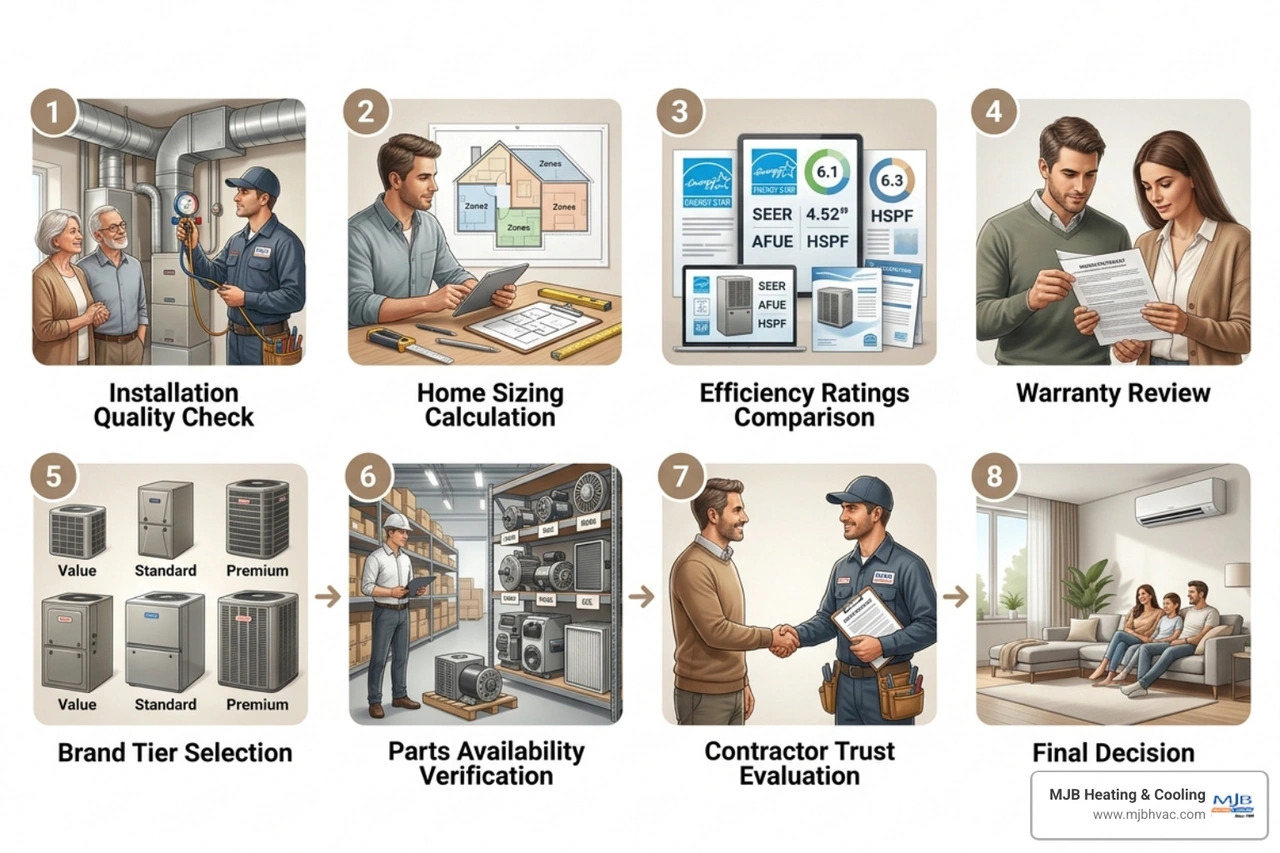
This guide walks you through everything you need to make a confident, informed decision — from decoding efficiency ratings to comparing warranty terms to knowing exactly what questions to ask your contractor before a single bolt is turned.
When we sit down with families in Derby or Andover to discuss a new system, the first question is almost always: "Which brand is the best?" It’s a natural starting point, but as experts who have been in the Central Kansas trenches since 1984, we can tell you that the logo on the outdoor unit is only about 20% of the equation.
The most sophisticated Trane or Carrier unit in the world will underperform a budget-friendly Goodman if it isn't installed correctly. Think of it like a high-performance sports car engine; if you put that engine into a frame with a leaky fuel line and mismatched tires, you aren't going to get the performance you paid for. In the HVAC world, those "mismatched tires" are poor ductwork, and the "leaky fuel line" is an amateur installation.
At MJB Heating & Cooling, we emphasize that Service begins long before the first day of installation. It starts with a comprehensive evaluation of your home’s "envelope"—its insulation, window quality, and sun orientation. You can see the results of this attention to detail in our Reviews, where homeowners often note that their new systems finally solved comfort issues that had plagued them for years.
Why are we so obsessed with installation? Because the data doesn't lie. Research shows that roughly 19% of central AC systems encounter problems within the first several years, and 24% of those problematic units fail to work properly or stop entirely. Most of these issues aren't "factory defects"—they are installation defects.
Proper sizing is the biggest culprit. Many contractors use a "rule of thumb" based on square footage, but this often leads to oversized systems. An oversized unit "short-cycles," meaning it turns on and off rapidly. This prevents the system from running long enough to remove humidity from the air, leaving you with a home that feels "clammy" even if the temperature is low. Furthermore, short-cycling puts immense stress on the compressor, significantly shortening the system's lifespan. A system that should last 15–20 years might only make it to 10 if it’s constantly fighting an improper installation.
Whether you are in Wichita, Augusta, or Haysville, our Service Areas coverage ensures that you get a technician who understands that the airflow through your ducts is just as vital as the unit itself.
Wichita weather is notoriously fickle. We deal with "The Big Three": extreme summer heat, bone-chilling winter winds, and high humidity. About Us: We are a family-owned business founded in Derby, KS, so we’ve lived through every ice storm and heatwave Kansas has thrown at us for over 40 years.
For our climate, we often recommend systems that excel in dehumidification. In the summer, Kansas humidity can make 90 degrees feel like 105. Brands that offer variable-speed blowers and multi-stage compressors are excellent for our region because they can run at lower speeds for longer periods, pulling moisture out of the air more effectively than a standard "on/off" system. When choosing the right hvac brand for your home, look for those that have a strong local parts distribution network in Kansas. If your system goes down during a July heatwave in Wellington or El Dorado, you don't want to hear that the replacement coil is backordered for two weeks from a warehouse in another state.
If you’ve started looking at brochures, you’ve likely seen a "soup" of acronyms: SEER2, AFUE, and HSPF2. These aren't just marketing jargon; they are the metrics that determine how much of your hard-earned money goes to the utility company every month.
Here is the simple breakdown of what these numbers mean for your Central Kansas home:
Energy Star certification is a great "shortcut" for homeowners. These systems meet strict efficiency guidelines set by the EPA. However, efficiency is easily lost. Leaky or poorly designed ductwork can lose up to 20-30% of your conditioned air before it even reaches your living room. This is why we recommend a Maintenance Plan to ensure your high-efficiency investment stays efficient year after year.
When choosing the right hvac brand for your home, you’ll find that the industry is divided into tiers.
The Premium Tier (Trane, Carrier, Lennox): These brands are the innovators. They often have the quietest units (some as low as 54-56 dB, which is quieter than a normal conversation) and the most advanced smart-home integrations. Trane is consistently ranked as one of "America's Most Trusted® HVAC Brands" due to its legendary durability. Carrier, the company that literally invented modern air conditioning, is known for its "Infinity" series that offers incredible humidity control.
The Mid-Range Tier (Rheem, Daikin, York): These brands offer a fantastic balance of performance and value. Daikin is currently the world’s largest HVAC manufacturer and offers some of the best warranties in the business. Rheem is often praised by technicians for its straightforward design, which makes it easier to service. Check out our Promotions to see if we have any current offers on these reliable mid-range systems.
The Value Tier (Goodman, Amana): Don't let the "value" label fool you. Since Daikin acquired Goodman in 2012, their quality has improved significantly. They are often the most affordable upfront and are great options for rental properties or for homeowners who plan to move within a few years.
A warranty is your safety net. When you are looking at different brands, you need to look past the "10-Year" headline and read the fine print.
Most reputable brands offer a 10-year parts warranty, but there are two major "gotchas" you need to know:
Some brands, like Daikin, go a step further by offering unit replacement warranties. If a major component like the heat exchanger or compressor fails within a certain timeframe, they don't just replace the part—they replace the entire outdoor or indoor unit. We offer various Financing options to help homeowners invest in these higher-tier systems that provide better long-term protection.
It is tempting to choose the system with the lowest price tag, but in Kansas, that can be a costly mistake. A low-efficiency, single-stage system will cost much more to operate over its 15-year life than a high-efficiency model.
We recommend looking at "Inverter-driven" or "Variable-speed" compressors. Traditional units are either 100% on or 100% off. It’s like driving your car by flooring the gas and then slamming on the brakes. Variable-speed systems can "throttle" down to 25% or 30% capacity, maintaining a perfectly steady temperature and using a fraction of the electricity. They also run much more quietly—top-tier units operate at 54-56 dB, whereas older or budget units can roar at mid-to-upper 60s dB.
Based on real-world reliability data from sources like Consumer Reports and Lifestory Research, Trane and Carrier consistently lead the pack for premium reliability. American Standard (which is the sister company to Trane) also ranks very high. Among value brands, Goodman has seen a significant rise in reliability rankings over the last decade. However, "reliability" is heavily influenced by how often the system is maintained.
Brand selection is secondary to a Manual J load calculation. This calculation considers your home’s square footage, window types, insulation levels, and local climate (like our 100-degree Wichita summers). If a brand you like doesn't offer a unit in the exact size your Manual J report calls for, you should switch brands rather than "sizing up." An oversized unit will lead to short-cycling, poor humidity control, and potential mold growth in your ductwork.
If your budget allows, yes. Variable-speed technology is the single biggest leap in home comfort in the last 20 years. It provides even temperatures (no more hot or cold spots in different rooms), superior dehumidification, and significantly lower utility bills. It also operates much more quietly, which is a major plus if your outdoor unit is located near a bedroom window or a backyard patio.
Choosing the right hvac brand for your home is a big decision, but you don't have to make it alone. At MJB Heating & Cooling, we’ve spent over four decades helping our neighbors in the Wichita metro area—from Newton down to Winfield and everywhere in between—find the perfect balance of comfort and value.
We aren't just here to sell you a box; we are here to ensure that box is sized perfectly, installed with "quality workmanship," and backed by an "honest business approach." Whether you need a high-efficiency furnace in Hutchinson or a whisper-quiet AC unit in Maize, we are your local experts.
Ready to find your home’s new best friend? Contact Us today for a professional consultation. And for more tips on maximizing your home's efficiency, Discover Energy Savings with Daikin's HSPF Rating Insights. We look forward to keeping your family comfortable for years to come!
Choosing the right HVAC brand for your home comes down to more than just picking a famous name off a list. Here's a quick breakdown of what actually matters:
How to choose the right HVAC brand — at a glance:
For Wichita-area homeowners, the stakes are especially real. Central Kansas dishes out hot, humid summers and cold winters — a combination that demands a system sized and installed correctly, not just branded well. According to Consumer Reports data collected from over 13,000 central AC units, roughly 19% encountered at least one problem between 2009 and 2024, and nearly a quarter of those units stopped working properly altogether. That's a sobering reminder that what happens during and after installation matters just as much as the brand name on the box.
This guide walks you through everything you need to make a confident, informed decision — from decoding efficiency ratings to comparing warranty terms to knowing exactly what questions to ask your contractor before a single bolt is turned.
When we sit down with families in Derby or Andover to discuss a new system, the first question is almost always: "Which brand is the best?" It’s a natural starting point, but as experts who have been in the Central Kansas trenches since 1984, we can tell you that the logo on the outdoor unit is only about 20% of the equation.
The most sophisticated Trane or Carrier unit in the world will underperform a budget-friendly Goodman if it isn't installed correctly. Think of it like a high-performance sports car engine; if you put that engine into a frame with a leaky fuel line and mismatched tires, you aren't going to get the performance you paid for. In the HVAC world, those "mismatched tires" are poor ductwork, and the "leaky fuel line" is an amateur installation.
At MJB Heating & Cooling, we emphasize that Service begins long before the first day of installation. It starts with a comprehensive evaluation of your home’s "envelope"—its insulation, window quality, and sun orientation. You can see the results of this attention to detail in our Reviews, where homeowners often note that their new systems finally solved comfort issues that had plagued them for years.
Why are we so obsessed with installation? Because the data doesn't lie. Research shows that roughly 19% of central AC systems encounter problems within the first several years, and 24% of those problematic units fail to work properly or stop entirely. Most of these issues aren't "factory defects"—they are installation defects.
Proper sizing is the biggest culprit. Many contractors use a "rule of thumb" based on square footage, but this often leads to oversized systems. An oversized unit "short-cycles," meaning it turns on and off rapidly. This prevents the system from running long enough to remove humidity from the air, leaving you with a home that feels "clammy" even if the temperature is low. Furthermore, short-cycling puts immense stress on the compressor, significantly shortening the system's lifespan. A system that should last 15–20 years might only make it to 10 if it’s constantly fighting an improper installation.
Whether you are in Wichita, Augusta, or Haysville, our Service Areas coverage ensures that you get a technician who understands that the airflow through your ducts is just as vital as the unit itself.
Wichita weather is notoriously fickle. We deal with "The Big Three": extreme summer heat, bone-chilling winter winds, and high humidity. About Us: We are a family-owned business founded in Derby, KS, so we’ve lived through every ice storm and heatwave Kansas has thrown at us for over 40 years.
For our climate, we often recommend systems that excel in dehumidification. In the summer, Kansas humidity can make 90 degrees feel like 105. Brands that offer variable-speed blowers and multi-stage compressors are excellent for our region because they can run at lower speeds for longer periods, pulling moisture out of the air more effectively than a standard "on/off" system. When choosing the right hvac brand for your home, look for those that have a strong local parts distribution network in Kansas. If your system goes down during a July heatwave in Wellington or El Dorado, you don't want to hear that the replacement coil is backordered for two weeks from a warehouse in another state.
If you’ve started looking at brochures, you’ve likely seen a "soup" of acronyms: SEER2, AFUE, and HSPF2. These aren't just marketing jargon; they are the metrics that determine how much of your hard-earned money goes to the utility company every month.
Here is the simple breakdown of what these numbers mean for your Central Kansas home:
Energy Star certification is a great "shortcut" for homeowners. These systems meet strict efficiency guidelines set by the EPA. However, efficiency is easily lost. Leaky or poorly designed ductwork can lose up to 20-30% of your conditioned air before it even reaches your living room. This is why we recommend a Maintenance Plan to ensure your high-efficiency investment stays efficient year after year.
When choosing the right hvac brand for your home, you’ll find that the industry is divided into tiers.
The Premium Tier (Trane, Carrier, Lennox): These brands are the innovators. They often have the quietest units (some as low as 54-56 dB, which is quieter than a normal conversation) and the most advanced smart-home integrations. Trane is consistently ranked as one of "America's Most Trusted® HVAC Brands" due to its legendary durability. Carrier, the company that literally invented modern air conditioning, is known for its "Infinity" series that offers incredible humidity control.
The Mid-Range Tier (Rheem, Daikin, York): These brands offer a fantastic balance of performance and value. Daikin is currently the world’s largest HVAC manufacturer and offers some of the best warranties in the business. Rheem is often praised by technicians for its straightforward design, which makes it easier to service. Check out our Promotions to see if we have any current offers on these reliable mid-range systems.
The Value Tier (Goodman, Amana): Don't let the "value" label fool you. Since Daikin acquired Goodman in 2012, their quality has improved significantly. They are often the most affordable upfront and are great options for rental properties or for homeowners who plan to move within a few years.
A warranty is your safety net. When you are looking at different brands, you need to look past the "10-Year" headline and read the fine print.
Most reputable brands offer a 10-year parts warranty, but there are two major "gotchas" you need to know:
Some brands, like Daikin, go a step further by offering unit replacement warranties. If a major component like the heat exchanger or compressor fails within a certain timeframe, they don't just replace the part—they replace the entire outdoor or indoor unit. We offer various Financing options to help homeowners invest in these higher-tier systems that provide better long-term protection.
It is tempting to choose the system with the lowest price tag, but in Kansas, that can be a costly mistake. A low-efficiency, single-stage system will cost much more to operate over its 15-year life than a high-efficiency model.
We recommend looking at "Inverter-driven" or "Variable-speed" compressors. Traditional units are either 100% on or 100% off. It’s like driving your car by flooring the gas and then slamming on the brakes. Variable-speed systems can "throttle" down to 25% or 30% capacity, maintaining a perfectly steady temperature and using a fraction of the electricity. They also run much more quietly—top-tier units operate at 54-56 dB, whereas older or budget units can roar at mid-to-upper 60s dB.
Based on real-world reliability data from sources like Consumer Reports and Lifestory Research, Trane and Carrier consistently lead the pack for premium reliability. American Standard (which is the sister company to Trane) also ranks very high. Among value brands, Goodman has seen a significant rise in reliability rankings over the last decade. However, "reliability" is heavily influenced by how often the system is maintained.
Brand selection is secondary to a Manual J load calculation. This calculation considers your home’s square footage, window types, insulation levels, and local climate (like our 100-degree Wichita summers). If a brand you like doesn't offer a unit in the exact size your Manual J report calls for, you should switch brands rather than "sizing up." An oversized unit will lead to short-cycling, poor humidity control, and potential mold growth in your ductwork.
If your budget allows, yes. Variable-speed technology is the single biggest leap in home comfort in the last 20 years. It provides even temperatures (no more hot or cold spots in different rooms), superior dehumidification, and significantly lower utility bills. It also operates much more quietly, which is a major plus if your outdoor unit is located near a bedroom window or a backyard patio.
Choosing the right hvac brand for your home is a big decision, but you don't have to make it alone. At MJB Heating & Cooling, we’ve spent over four decades helping our neighbors in the Wichita metro area—from Newton down to Winfield and everywhere in between—find the perfect balance of comfort and value.
We aren't just here to sell you a box; we are here to ensure that box is sized perfectly, installed with "quality workmanship," and backed by an "honest business approach." Whether you need a high-efficiency furnace in Hutchinson or a whisper-quiet AC unit in Maize, we are your local experts.
Ready to find your home’s new best friend? Contact Us today for a professional consultation. And for more tips on maximizing your home's efficiency, Discover Energy Savings with Daikin's HSPF Rating Insights. We look forward to keeping your family comfortable for years to come!
Choosing the right HVAC brand for your home comes down to more than just picking a famous name off a list. Here's a quick breakdown of what actually matters:
How to choose the right HVAC brand — at a glance:
For Wichita-area homeowners, the stakes are especially real. Central Kansas dishes out hot, humid summers and cold winters — a combination that demands a system sized and installed correctly, not just branded well. According to Consumer Reports data collected from over 13,000 central AC units, roughly 19% encountered at least one problem between 2009 and 2024, and nearly a quarter of those units stopped working properly altogether. That's a sobering reminder that what happens during and after installation matters just as much as the brand name on the box.
This guide walks you through everything you need to make a confident, informed decision — from decoding efficiency ratings to comparing warranty terms to knowing exactly what questions to ask your contractor before a single bolt is turned.
When we sit down with families in Derby or Andover to discuss a new system, the first question is almost always: "Which brand is the best?" It’s a natural starting point, but as experts who have been in the Central Kansas trenches since 1984, we can tell you that the logo on the outdoor unit is only about 20% of the equation.
The most sophisticated Trane or Carrier unit in the world will underperform a budget-friendly Goodman if it isn't installed correctly. Think of it like a high-performance sports car engine; if you put that engine into a frame with a leaky fuel line and mismatched tires, you aren't going to get the performance you paid for. In the HVAC world, those "mismatched tires" are poor ductwork, and the "leaky fuel line" is an amateur installation.
At MJB Heating & Cooling, we emphasize that Service begins long before the first day of installation. It starts with a comprehensive evaluation of your home’s "envelope"—its insulation, window quality, and sun orientation. You can see the results of this attention to detail in our Reviews, where homeowners often note that their new systems finally solved comfort issues that had plagued them for years.
Why are we so obsessed with installation? Because the data doesn't lie. Research shows that roughly 19% of central AC systems encounter problems within the first several years, and 24% of those problematic units fail to work properly or stop entirely. Most of these issues aren't "factory defects"—they are installation defects.
Proper sizing is the biggest culprit. Many contractors use a "rule of thumb" based on square footage, but this often leads to oversized systems. An oversized unit "short-cycles," meaning it turns on and off rapidly. This prevents the system from running long enough to remove humidity from the air, leaving you with a home that feels "clammy" even if the temperature is low. Furthermore, short-cycling puts immense stress on the compressor, significantly shortening the system's lifespan. A system that should last 15–20 years might only make it to 10 if it’s constantly fighting an improper installation.
Whether you are in Wichita, Augusta, or Haysville, our Service Areas coverage ensures that you get a technician who understands that the airflow through your ducts is just as vital as the unit itself.
Wichita weather is notoriously fickle. We deal with "The Big Three": extreme summer heat, bone-chilling winter winds, and high humidity. About Us: We are a family-owned business founded in Derby, KS, so we’ve lived through every ice storm and heatwave Kansas has thrown at us for over 40 years.
For our climate, we often recommend systems that excel in dehumidification. In the summer, Kansas humidity can make 90 degrees feel like 105. Brands that offer variable-speed blowers and multi-stage compressors are excellent for our region because they can run at lower speeds for longer periods, pulling moisture out of the air more effectively than a standard "on/off" system. When choosing the right hvac brand for your home, look for those that have a strong local parts distribution network in Kansas. If your system goes down during a July heatwave in Wellington or El Dorado, you don't want to hear that the replacement coil is backordered for two weeks from a warehouse in another state.
If you’ve started looking at brochures, you’ve likely seen a "soup" of acronyms: SEER2, AFUE, and HSPF2. These aren't just marketing jargon; they are the metrics that determine how much of your hard-earned money goes to the utility company every month.
Here is the simple breakdown of what these numbers mean for your Central Kansas home:
Energy Star certification is a great "shortcut" for homeowners. These systems meet strict efficiency guidelines set by the EPA. However, efficiency is easily lost. Leaky or poorly designed ductwork can lose up to 20-30% of your conditioned air before it even reaches your living room. This is why we recommend a Maintenance Plan to ensure your high-efficiency investment stays efficient year after year.
When choosing the right hvac brand for your home, you’ll find that the industry is divided into tiers.
The Premium Tier (Trane, Carrier, Lennox): These brands are the innovators. They often have the quietest units (some as low as 54-56 dB, which is quieter than a normal conversation) and the most advanced smart-home integrations. Trane is consistently ranked as one of "America's Most Trusted® HVAC Brands" due to its legendary durability. Carrier, the company that literally invented modern air conditioning, is known for its "Infinity" series that offers incredible humidity control.
The Mid-Range Tier (Rheem, Daikin, York): These brands offer a fantastic balance of performance and value. Daikin is currently the world’s largest HVAC manufacturer and offers some of the best warranties in the business. Rheem is often praised by technicians for its straightforward design, which makes it easier to service. Check out our Promotions to see if we have any current offers on these reliable mid-range systems.
The Value Tier (Goodman, Amana): Don't let the "value" label fool you. Since Daikin acquired Goodman in 2012, their quality has improved significantly. They are often the most affordable upfront and are great options for rental properties or for homeowners who plan to move within a few years.
A warranty is your safety net. When you are looking at different brands, you need to look past the "10-Year" headline and read the fine print.
Most reputable brands offer a 10-year parts warranty, but there are two major "gotchas" you need to know:
Some brands, like Daikin, go a step further by offering unit replacement warranties. If a major component like the heat exchanger or compressor fails within a certain timeframe, they don't just replace the part—they replace the entire outdoor or indoor unit. We offer various Financing options to help homeowners invest in these higher-tier systems that provide better long-term protection.
It is tempting to choose the system with the lowest price tag, but in Kansas, that can be a costly mistake. A low-efficiency, single-stage system will cost much more to operate over its 15-year life than a high-efficiency model.
We recommend looking at "Inverter-driven" or "Variable-speed" compressors. Traditional units are either 100% on or 100% off. It’s like driving your car by flooring the gas and then slamming on the brakes. Variable-speed systems can "throttle" down to 25% or 30% capacity, maintaining a perfectly steady temperature and using a fraction of the electricity. They also run much more quietly—top-tier units operate at 54-56 dB, whereas older or budget units can roar at mid-to-upper 60s dB.
Based on real-world reliability data from sources like Consumer Reports and Lifestory Research, Trane and Carrier consistently lead the pack for premium reliability. American Standard (which is the sister company to Trane) also ranks very high. Among value brands, Goodman has seen a significant rise in reliability rankings over the last decade. However, "reliability" is heavily influenced by how often the system is maintained.
Brand selection is secondary to a Manual J load calculation. This calculation considers your home’s square footage, window types, insulation levels, and local climate (like our 100-degree Wichita summers). If a brand you like doesn't offer a unit in the exact size your Manual J report calls for, you should switch brands rather than "sizing up." An oversized unit will lead to short-cycling, poor humidity control, and potential mold growth in your ductwork.
If your budget allows, yes. Variable-speed technology is the single biggest leap in home comfort in the last 20 years. It provides even temperatures (no more hot or cold spots in different rooms), superior dehumidification, and significantly lower utility bills. It also operates much more quietly, which is a major plus if your outdoor unit is located near a bedroom window or a backyard patio.
Choosing the right hvac brand for your home is a big decision, but you don't have to make it alone. At MJB Heating & Cooling, we’ve spent over four decades helping our neighbors in the Wichita metro area—from Newton down to Winfield and everywhere in between—find the perfect balance of comfort and value.
We aren't just here to sell you a box; we are here to ensure that box is sized perfectly, installed with "quality workmanship," and backed by an "honest business approach." Whether you need a high-efficiency furnace in Hutchinson or a whisper-quiet AC unit in Maize, we are your local experts.
Ready to find your home’s new best friend? Contact Us today for a professional consultation. And for more tips on maximizing your home's efficiency, Discover Energy Savings with Daikin's HSPF Rating Insights. We look forward to keeping your family comfortable for years to come!


Choosing the right HVAC brand for your home comes down to more than just picking a famous name off a list. Here's a quick breakdown of what actually matters:
How to choose the right HVAC brand — at a glance:
For Wichita-area homeowners, the stakes are especially real. Central Kansas dishes out hot, humid summers and cold winters — a combination that demands a system sized and installed correctly, not just branded well. According to Consumer Reports data collected from over 13,000 central AC units, roughly 19% encountered at least one problem between 2009 and 2024, and nearly a quarter of those units stopped working properly altogether. That's a sobering reminder that what happens during and after installation matters just as much as the brand name on the box.
This guide walks you through everything you need to make a confident, informed decision — from decoding efficiency ratings to comparing warranty terms to knowing exactly what questions to ask your contractor before a single bolt is turned.
When we sit down with families in Derby or Andover to discuss a new system, the first question is almost always: "Which brand is the best?" It’s a natural starting point, but as experts who have been in the Central Kansas trenches since 1984, we can tell you that the logo on the outdoor unit is only about 20% of the equation.
The most sophisticated Trane or Carrier unit in the world will underperform a budget-friendly Goodman if it isn't installed correctly. Think of it like a high-performance sports car engine; if you put that engine into a frame with a leaky fuel line and mismatched tires, you aren't going to get the performance you paid for. In the HVAC world, those "mismatched tires" are poor ductwork, and the "leaky fuel line" is an amateur installation.
At MJB Heating & Cooling, we emphasize that Service begins long before the first day of installation. It starts with a comprehensive evaluation of your home’s "envelope"—its insulation, window quality, and sun orientation. You can see the results of this attention to detail in our Reviews, where homeowners often note that their new systems finally solved comfort issues that had plagued them for years.
Why are we so obsessed with installation? Because the data doesn't lie. Research shows that roughly 19% of central AC systems encounter problems within the first several years, and 24% of those problematic units fail to work properly or stop entirely. Most of these issues aren't "factory defects"—they are installation defects.
Proper sizing is the biggest culprit. Many contractors use a "rule of thumb" based on square footage, but this often leads to oversized systems. An oversized unit "short-cycles," meaning it turns on and off rapidly. This prevents the system from running long enough to remove humidity from the air, leaving you with a home that feels "clammy" even if the temperature is low. Furthermore, short-cycling puts immense stress on the compressor, significantly shortening the system's lifespan. A system that should last 15–20 years might only make it to 10 if it’s constantly fighting an improper installation.
Whether you are in Wichita, Augusta, or Haysville, our Service Areas coverage ensures that you get a technician who understands that the airflow through your ducts is just as vital as the unit itself.
Wichita weather is notoriously fickle. We deal with "The Big Three": extreme summer heat, bone-chilling winter winds, and high humidity. About Us: We are a family-owned business founded in Derby, KS, so we’ve lived through every ice storm and heatwave Kansas has thrown at us for over 40 years.
For our climate, we often recommend systems that excel in dehumidification. In the summer, Kansas humidity can make 90 degrees feel like 105. Brands that offer variable-speed blowers and multi-stage compressors are excellent for our region because they can run at lower speeds for longer periods, pulling moisture out of the air more effectively than a standard "on/off" system. When choosing the right hvac brand for your home, look for those that have a strong local parts distribution network in Kansas. If your system goes down during a July heatwave in Wellington or El Dorado, you don't want to hear that the replacement coil is backordered for two weeks from a warehouse in another state.
If you’ve started looking at brochures, you’ve likely seen a "soup" of acronyms: SEER2, AFUE, and HSPF2. These aren't just marketing jargon; they are the metrics that determine how much of your hard-earned money goes to the utility company every month.
Here is the simple breakdown of what these numbers mean for your Central Kansas home:
Energy Star certification is a great "shortcut" for homeowners. These systems meet strict efficiency guidelines set by the EPA. However, efficiency is easily lost. Leaky or poorly designed ductwork can lose up to 20-30% of your conditioned air before it even reaches your living room. This is why we recommend a Maintenance Plan to ensure your high-efficiency investment stays efficient year after year.
When choosing the right hvac brand for your home, you’ll find that the industry is divided into tiers.
The Premium Tier (Trane, Carrier, Lennox): These brands are the innovators. They often have the quietest units (some as low as 54-56 dB, which is quieter than a normal conversation) and the most advanced smart-home integrations. Trane is consistently ranked as one of "America's Most Trusted® HVAC Brands" due to its legendary durability. Carrier, the company that literally invented modern air conditioning, is known for its "Infinity" series that offers incredible humidity control.
The Mid-Range Tier (Rheem, Daikin, York): These brands offer a fantastic balance of performance and value. Daikin is currently the world’s largest HVAC manufacturer and offers some of the best warranties in the business. Rheem is often praised by technicians for its straightforward design, which makes it easier to service. Check out our Promotions to see if we have any current offers on these reliable mid-range systems.
The Value Tier (Goodman, Amana): Don't let the "value" label fool you. Since Daikin acquired Goodman in 2012, their quality has improved significantly. They are often the most affordable upfront and are great options for rental properties or for homeowners who plan to move within a few years.
A warranty is your safety net. When you are looking at different brands, you need to look past the "10-Year" headline and read the fine print.
Most reputable brands offer a 10-year parts warranty, but there are two major "gotchas" you need to know:
Some brands, like Daikin, go a step further by offering unit replacement warranties. If a major component like the heat exchanger or compressor fails within a certain timeframe, they don't just replace the part—they replace the entire outdoor or indoor unit. We offer various Financing options to help homeowners invest in these higher-tier systems that provide better long-term protection.
It is tempting to choose the system with the lowest price tag, but in Kansas, that can be a costly mistake. A low-efficiency, single-stage system will cost much more to operate over its 15-year life than a high-efficiency model.
We recommend looking at "Inverter-driven" or "Variable-speed" compressors. Traditional units are either 100% on or 100% off. It’s like driving your car by flooring the gas and then slamming on the brakes. Variable-speed systems can "throttle" down to 25% or 30% capacity, maintaining a perfectly steady temperature and using a fraction of the electricity. They also run much more quietly—top-tier units operate at 54-56 dB, whereas older or budget units can roar at mid-to-upper 60s dB.
Based on real-world reliability data from sources like Consumer Reports and Lifestory Research, Trane and Carrier consistently lead the pack for premium reliability. American Standard (which is the sister company to Trane) also ranks very high. Among value brands, Goodman has seen a significant rise in reliability rankings over the last decade. However, "reliability" is heavily influenced by how often the system is maintained.
Brand selection is secondary to a Manual J load calculation. This calculation considers your home’s square footage, window types, insulation levels, and local climate (like our 100-degree Wichita summers). If a brand you like doesn't offer a unit in the exact size your Manual J report calls for, you should switch brands rather than "sizing up." An oversized unit will lead to short-cycling, poor humidity control, and potential mold growth in your ductwork.
If your budget allows, yes. Variable-speed technology is the single biggest leap in home comfort in the last 20 years. It provides even temperatures (no more hot or cold spots in different rooms), superior dehumidification, and significantly lower utility bills. It also operates much more quietly, which is a major plus if your outdoor unit is located near a bedroom window or a backyard patio.
Choosing the right hvac brand for your home is a big decision, but you don't have to make it alone. At MJB Heating & Cooling, we’ve spent over four decades helping our neighbors in the Wichita metro area—from Newton down to Winfield and everywhere in between—find the perfect balance of comfort and value.
We aren't just here to sell you a box; we are here to ensure that box is sized perfectly, installed with "quality workmanship," and backed by an "honest business approach." Whether you need a high-efficiency furnace in Hutchinson or a whisper-quiet AC unit in Maize, we are your local experts.
Ready to find your home’s new best friend? Contact Us today for a professional consultation. And for more tips on maximizing your home's efficiency, Discover Energy Savings with Daikin's HSPF Rating Insights. We look forward to keeping your family comfortable for years to come!
Choosing the right HVAC brand for your home comes down to more than just picking a famous name off a list. Here's a quick breakdown of what actually matters:
How to choose the right HVAC brand — at a glance:
For Wichita-area homeowners, the stakes are especially real. Central Kansas dishes out hot, humid summers and cold winters — a combination that demands a system sized and installed correctly, not just branded well. According to Consumer Reports data collected from over 13,000 central AC units, roughly 19% encountered at least one problem between 2009 and 2024, and nearly a quarter of those units stopped working properly altogether. That's a sobering reminder that what happens during and after installation matters just as much as the brand name on the box.
This guide walks you through everything you need to make a confident, informed decision — from decoding efficiency ratings to comparing warranty terms to knowing exactly what questions to ask your contractor before a single bolt is turned.
When we sit down with families in Derby or Andover to discuss a new system, the first question is almost always: "Which brand is the best?" It’s a natural starting point, but as experts who have been in the Central Kansas trenches since 1984, we can tell you that the logo on the outdoor unit is only about 20% of the equation.
The most sophisticated Trane or Carrier unit in the world will underperform a budget-friendly Goodman if it isn't installed correctly. Think of it like a high-performance sports car engine; if you put that engine into a frame with a leaky fuel line and mismatched tires, you aren't going to get the performance you paid for. In the HVAC world, those "mismatched tires" are poor ductwork, and the "leaky fuel line" is an amateur installation.
At MJB Heating & Cooling, we emphasize that Service begins long before the first day of installation. It starts with a comprehensive evaluation of your home’s "envelope"—its insulation, window quality, and sun orientation. You can see the results of this attention to detail in our Reviews, where homeowners often note that their new systems finally solved comfort issues that had plagued them for years.
Why are we so obsessed with installation? Because the data doesn't lie. Research shows that roughly 19% of central AC systems encounter problems within the first several years, and 24% of those problematic units fail to work properly or stop entirely. Most of these issues aren't "factory defects"—they are installation defects.
Proper sizing is the biggest culprit. Many contractors use a "rule of thumb" based on square footage, but this often leads to oversized systems. An oversized unit "short-cycles," meaning it turns on and off rapidly. This prevents the system from running long enough to remove humidity from the air, leaving you with a home that feels "clammy" even if the temperature is low. Furthermore, short-cycling puts immense stress on the compressor, significantly shortening the system's lifespan. A system that should last 15–20 years might only make it to 10 if it’s constantly fighting an improper installation.
Whether you are in Wichita, Augusta, or Haysville, our Service Areas coverage ensures that you get a technician who understands that the airflow through your ducts is just as vital as the unit itself.
Wichita weather is notoriously fickle. We deal with "The Big Three": extreme summer heat, bone-chilling winter winds, and high humidity. About Us: We are a family-owned business founded in Derby, KS, so we’ve lived through every ice storm and heatwave Kansas has thrown at us for over 40 years.
For our climate, we often recommend systems that excel in dehumidification. In the summer, Kansas humidity can make 90 degrees feel like 105. Brands that offer variable-speed blowers and multi-stage compressors are excellent for our region because they can run at lower speeds for longer periods, pulling moisture out of the air more effectively than a standard "on/off" system. When choosing the right hvac brand for your home, look for those that have a strong local parts distribution network in Kansas. If your system goes down during a July heatwave in Wellington or El Dorado, you don't want to hear that the replacement coil is backordered for two weeks from a warehouse in another state.
If you’ve started looking at brochures, you’ve likely seen a "soup" of acronyms: SEER2, AFUE, and HSPF2. These aren't just marketing jargon; they are the metrics that determine how much of your hard-earned money goes to the utility company every month.
Here is the simple breakdown of what these numbers mean for your Central Kansas home:
Energy Star certification is a great "shortcut" for homeowners. These systems meet strict efficiency guidelines set by the EPA. However, efficiency is easily lost. Leaky or poorly designed ductwork can lose up to 20-30% of your conditioned air before it even reaches your living room. This is why we recommend a Maintenance Plan to ensure your high-efficiency investment stays efficient year after year.
When choosing the right hvac brand for your home, you’ll find that the industry is divided into tiers.
The Premium Tier (Trane, Carrier, Lennox): These brands are the innovators. They often have the quietest units (some as low as 54-56 dB, which is quieter than a normal conversation) and the most advanced smart-home integrations. Trane is consistently ranked as one of "America's Most Trusted® HVAC Brands" due to its legendary durability. Carrier, the company that literally invented modern air conditioning, is known for its "Infinity" series that offers incredible humidity control.
The Mid-Range Tier (Rheem, Daikin, York): These brands offer a fantastic balance of performance and value. Daikin is currently the world’s largest HVAC manufacturer and offers some of the best warranties in the business. Rheem is often praised by technicians for its straightforward design, which makes it easier to service. Check out our Promotions to see if we have any current offers on these reliable mid-range systems.
The Value Tier (Goodman, Amana): Don't let the "value" label fool you. Since Daikin acquired Goodman in 2012, their quality has improved significantly. They are often the most affordable upfront and are great options for rental properties or for homeowners who plan to move within a few years.
A warranty is your safety net. When you are looking at different brands, you need to look past the "10-Year" headline and read the fine print.
Most reputable brands offer a 10-year parts warranty, but there are two major "gotchas" you need to know:
Some brands, like Daikin, go a step further by offering unit replacement warranties. If a major component like the heat exchanger or compressor fails within a certain timeframe, they don't just replace the part—they replace the entire outdoor or indoor unit. We offer various Financing options to help homeowners invest in these higher-tier systems that provide better long-term protection.
It is tempting to choose the system with the lowest price tag, but in Kansas, that can be a costly mistake. A low-efficiency, single-stage system will cost much more to operate over its 15-year life than a high-efficiency model.
We recommend looking at "Inverter-driven" or "Variable-speed" compressors. Traditional units are either 100% on or 100% off. It’s like driving your car by flooring the gas and then slamming on the brakes. Variable-speed systems can "throttle" down to 25% or 30% capacity, maintaining a perfectly steady temperature and using a fraction of the electricity. They also run much more quietly—top-tier units operate at 54-56 dB, whereas older or budget units can roar at mid-to-upper 60s dB.
Based on real-world reliability data from sources like Consumer Reports and Lifestory Research, Trane and Carrier consistently lead the pack for premium reliability. American Standard (which is the sister company to Trane) also ranks very high. Among value brands, Goodman has seen a significant rise in reliability rankings over the last decade. However, "reliability" is heavily influenced by how often the system is maintained.
Brand selection is secondary to a Manual J load calculation. This calculation considers your home’s square footage, window types, insulation levels, and local climate (like our 100-degree Wichita summers). If a brand you like doesn't offer a unit in the exact size your Manual J report calls for, you should switch brands rather than "sizing up." An oversized unit will lead to short-cycling, poor humidity control, and potential mold growth in your ductwork.
If your budget allows, yes. Variable-speed technology is the single biggest leap in home comfort in the last 20 years. It provides even temperatures (no more hot or cold spots in different rooms), superior dehumidification, and significantly lower utility bills. It also operates much more quietly, which is a major plus if your outdoor unit is located near a bedroom window or a backyard patio.
Choosing the right hvac brand for your home is a big decision, but you don't have to make it alone. At MJB Heating & Cooling, we’ve spent over four decades helping our neighbors in the Wichita metro area—from Newton down to Winfield and everywhere in between—find the perfect balance of comfort and value.
We aren't just here to sell you a box; we are here to ensure that box is sized perfectly, installed with "quality workmanship," and backed by an "honest business approach." Whether you need a high-efficiency furnace in Hutchinson or a whisper-quiet AC unit in Maize, we are your local experts.
Ready to find your home’s new best friend? Contact Us today for a professional consultation. And for more tips on maximizing your home's efficiency, Discover Energy Savings with Daikin's HSPF Rating Insights. We look forward to keeping your family comfortable for years to come!


Our A/C stopped working on a Sunday and due to health issues, we needed to find a service company available on a Sunday. I called MJB and left a message on their emergency voice mail. Within 10 minutes Tom Buck called me to hear my description of the symptoms. He was just finishing an appointment in Wichita and would be on his way to my home on the south end of Derby. He arrived within 30 minutes! From start to finish he was the perfect example of what you could ever hope for in an HVAC tech and a human being. His evaluation of our system inside and out was as thorough as I could ever imagine and once he was done with the repair, our system is running as well or better than ever. Well worth the price for the evaluation, parts, and labor. Thank you again Tom for an awesome experience.
Our AC went out during the hottest days of the year, and they were out next day! We have been jerked around by a shoddy home warranty for years. We finally had a chance to pick our own repair people, and MJB came highly recommended. I can see why! I was impressed with the honesty and speed at which they fixed our AC unit!
Our commercial building had a lightening/electrical strike and damaged our 20 ton AC unit. No one could find us a new unit before the end of September. Imagining going all of August and September with no AC in Kansas and working inside near 100 degree temps is less than thrilling. Dale and the team at MJB called around and saved the day. They had us a new unit 5 weeks earlier than other could promise and I now have happy employees. The unit is amazingly quiet, super cold and so much more energy efficient. Thank you for being our super hero!
Came out and installed my new furnace. Was very polite and affordable. They are very acknowledgeable and I highly recommend!
Thank you very much. We had our 1st warm night in 3weeks. MJB took the time and effort to find the real problem. And the employees were kind and thoughtful and explained things very well. I cannot thank you and all of MJB. Will recommend you highly. Thanks again Marjorie Herman Oxford Kansas
We had a new system installed and I was so impressed with how quick they were in come out and install it, in the middle of a hot summer day. They were so friendly & very professional. I had a small problem with a weird sound and they came over immediately and fixed it. Love them!