





Blogs
Stay updated with our latest blog posts.


Are you noticing a clammy, heavy feeling in your home during those unseasonably warm fall afternoons? When seeking out local service expertise and area tips, the first thing you should know is that a humid house in autumn is more than just a minor nuisance. In our region, we frequently experience "weather whiplash"—wild temperature swings where your HVAC system has to toggle rapidly between cooling the house during a warm afternoon and heating it overnight. If your heat pump is failing to pull moisture out of the air right now, it is sending you a critical warning signal.
This early symptom often points to underlying airflow or refrigerant issues. The decision point you face right now is determining whether this is a simple, safe homeowner fix—like a clogged air filter—or a red flag that requires a licensed diagnostic before severe weather hits. Ignoring poor dehumidification today means risking a complete system failure when the Late November first hard freezes arrive.
To protect your home's comfort and catch these transitional issues early, the safest approach is to secure a routine HVAC maintenance plan. Getting ahead of the problem now ensures you aren't left shivering when the temperatures inevitably plummet.
To understand why your home feels like a swamp in late fall, it helps to understand the mechanics of how your system handles moisture. A heat pump naturally dehumidifies your home, but it only does so actively when it is running in cooling mode. When warm, humid indoor air is pulled through your return vents, it passes over the cold indoor evaporator coil.
As the warm air hits the chilled metal of the coil, the moisture suspended in the air condenses into liquid water. Think of a glass of ice water sitting on your patio on a warm day—beads of sweat form on the outside of the glass. Your heat pump does the exact same thing on a massive scale. That condensed moisture drips into a drain pan and is carried safely out of your home. However, this delicate process requires perfect airflow and precise refrigerant temperatures to work correctly across Derby and South Central Kansas.
If any part of this sequence is disrupted, the air cools slightly but holds onto its moisture, leaving your living space feeling sticky and uncomfortable. When these mechanical processes start breaking down, relying on professional HVAC services ensures the root cause is identified accurately.
A common point of confusion is how a heat pump handles humidity differently depending on the season. Here is a breakdown of what your system is actually doing:
• Cooling Mode (Summer/Warm Fall) — Dehumidification Status: Active Dehumidification — How It Works: The indoor coil is cold. Warm indoor air passes over it, moisture condenses, and water drains away.
• Heating Mode (Winter/Cold Nights) — Dehumidification Status: No Active Dehumidification — How It Works: The indoor coil is hot. The system adds heat to the air but does not extract moisture.
Because your system does not actively dehumidify in heating mode, high indoor humidity during the winter usually points to poor home ventilation rather than a mechanical cooling-mode failure. But if you are running the AC during a warm fall afternoon and the humidity stays high, you have a mechanical issue on your hands.
A failure to dehumidify during a warm fall afternoon is rarely an isolated cooling problem. Because a heat pump uses the exact same components to heat your home as it does to cool it, a struggle with humidity is often a dual-mode problem. The system uses a reversing valve to switch the flow of refrigerant, turning your indoor cooling coil into an indoor heating coil.
If your system cannot extract moisture today, it means the indoor coil is not reaching the correct temperature, or air is not flowing over it properly. Those same underlying issues—restricted airflow or incorrect refrigerant charge—will severely impact the system's heating performance tomorrow. When Derby's specific temperature swings force your unit to switch back and forth, any weakness in the system is magnified.
A typical pattern we see is a homeowner ignoring the clammy fall air, only to have the heat pump short-cycle and shut down entirely when the Late November first hard freezes hit. Short-cycling occurs when the system turns on and off rapidly without completing a full temperature cycle, putting massive strain on the compressor. Addressing the humidity warning sign now is the most effective way to ensure pre-winter readiness before holiday gatherings begin.
Before you panic about a failing compressor, there are several safe, straightforward troubleshooting steps you can take. Many dehumidification issues stem from simple airflow restrictions or incorrect settings that you can correct yourself.
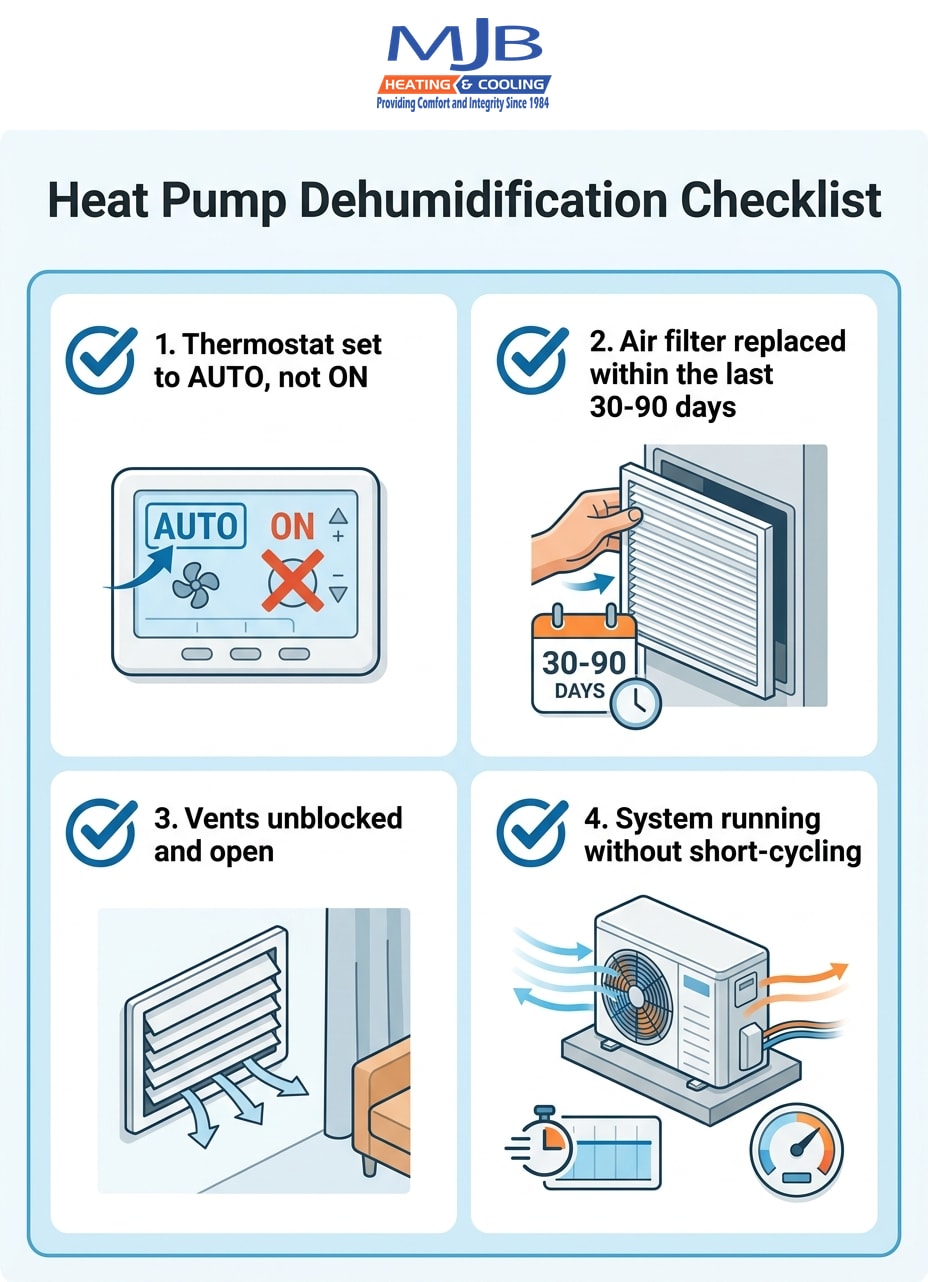
• Check the thermostat fan setting: Ensure your fan is set to "AUTO" and not "ON." This is the single most common cause of high indoor humidity during transitional weather.
• Inspect and replace dirty air filters: A clogged filter chokes the system, preventing enough air from passing over the coil to extract moisture efficiently. Check your filter every 30 to 90 days.
• Check for blocked return vents: Walk through your home and ensure rugs, furniture, or curtains are not blocking the return grilles. The system needs to breathe to remove humidity.
• Monitor for unusual behavior: Listen for strange noises, watch for short-cycling, and check your thermostat for any blinking lights. If you notice error codes, you can often cross-reference them to understand the severity of the issue.
If your system is displaying specific faults, understanding heat pump error codes and solutions can help you communicate clearly with a technician. These simple checks are the best starting point for any homeowner in Derby and South Central Kansas.
Leaving your thermostat fan set to "ON" might seem like a good way to circulate air, but it actively fights dehumidification. When the fan is set to "AUTO," it only blows air when the cooling cycle is actively running and the coil is cold.
When you switch it to "ON," the fan continues running continuously, even after the cooling cycle ends. The moisture that was just pulled out of the air and is sitting on the indoor coil doesn't have time to drain away. Instead, the continuously running fan evaporates that water right back into your living space, leaving your home feeling sticky and damp.
If you have corrected your thermostat and replaced the filter but the house still feels humid, the problem lies deeper within the system. At this stage, the culprits are highly technical and require specialized tools to diagnose and repair.
One primary cause of poor dehumidification is low refrigerant. Refrigerant is the lifeblood of your heat pump; it absorbs heat from inside your home and moves it outside. If there is a leak and the system is undercharged, the evaporator coil cannot get cold enough to pull moisture out of the air. Alternatively, severe airflow restrictions can cause that same coil to freeze solid into a block of ice. A frozen coil blocks airflow entirely, stopping the dehumidification process in its tracks.
Another complex issue is an oversized system. If a heat pump is too large for the square footage of the home, it cools the air too quickly and shuts off before it has time to run a long, steady dehumidification cycle. This leads to a cold but clammy house. Handling refrigerant, diagnosing coil freezing, and evaluating system sizing across our Kansas service areas always requires a licensed professional.
Low refrigerant doesn't just ruin your home's dehumidification; it destroys the system's ability to generate heat. Because the heat pump relies on that exact same refrigerant to absorb ambient heat from the outdoor air in winter, a low charge means the system will struggle to warm your home. Operating a heat pump with low refrigerant during the Late November first hard freezes forces the compressor to work overtime, risking a catastrophic, permanent compressor failure.
There is a definitive threshold where DIY troubleshooting must end. If changing the filter and adjusting the thermostat to "AUTO" doesn't resolve the sticky, humid feeling in your home, it is time to call an expert. Relying on guesswork right before the severe winter season begins is a gamble that often leads to emergency breakdowns during the coldest nights of the year.
This is where MJB Heating & Cooling's specialized diagnostic expertise makes the difference. Identifying complex heat pump airflow and refrigerant issues requires precise measurements. Professionals use advanced diagnostic tools to check the superheat and subcooling of the refrigerant, measure the static pressure of the ductwork, and test the electrical draw of the compressor. This level of detail ensures the system is truly ready for severe Kansas winters, rather than just applying a temporary bandage.
We understand that unexpected HVAC repairs before the holidays can be stressful. That is why professional diagnostics and necessary repairs can often be managed with flexible financing options, allowing you to secure your home's comfort without compromising your peace of mind anywhere in Derby and South Central Kansas.
The most common reasons are a thermostat set to "ON" instead of "AUTO," a dirty air filter, or low refrigerant. When the thermostat is set to "ON," the fan blows moisture back into the home. If the filter is clean and the fan is set correctly, you likely have a refrigerant or coil issue that requires professional attention.
No, a heat pump does not actively dehumidify the air while operating in heating mode. Dehumidification relies on the indoor coil being cold enough to condense moisture. In winter, the indoor coil is hot to provide warmth, so high indoor humidity during cold months usually indicates a lack of fresh air ventilation in the home.
Yes, low refrigerant directly impacts your system's ability to dehumidify. Without the correct refrigerant charge, the indoor evaporator coil cannot reach the precise cold temperature needed to pull moisture out of the air. This leaves your home feeling cool but clammy and sticky.
If your house is humid while the heat pump is cooling, the system is likely short-cycling or suffering from restricted airflow. Short-cycling means the unit turns off before it has run long enough to extract humidity. A clogged filter or blocked vents can also prevent enough air from passing over the coil to be dehumidified.
The best thermostat setting for dehumidification is "AUTO." This setting ensures the blower fan only runs when the cooling cycle is active. This allows the condensed moisture on the indoor coil to drain away safely, rather than being blown back into your living space by a continuously running fan.
Yes, an oversized heat pump is a major cause of high indoor humidity. A unit that is too large for the home will drop the indoor temperature very quickly and shut off. Because it doesn't run for a long enough cycle, it never gets the chance to slowly and steadily extract the humidity from the air across Derby and South Central Kansas.
Poor dehumidification during a warm fall afternoon is more than a comfort issue—it is a glaring warning sign for winter heating failures. If your system is struggling to manage moisture now, those same airflow and refrigerant weaknesses will leave you vulnerable when the Late November first hard freezes arrive.
By taking a few minutes to verify your thermostat settings and change your air filters, you can rule out the most basic culprits safely. But if the heavy, humid air persists, do not wait for a breakdown. Schedule a professional inspection today to ensure you have reliable, consistent heating and complete peace of mind before your winter holiday gatherings begin.


Our A/C stopped working on a Sunday and due to health issues, we needed to find a service company available on a Sunday. I called MJB and left a message on their emergency voice mail. Within 10 minutes Tom Buck called me to hear my description of the symptoms. He was just finishing an appointment in Wichita and would be on his way to my home on the south end of Derby. He arrived within 30 minutes! From start to finish he was the perfect example of what you could ever hope for in an HVAC tech and a human being. His evaluation of our system inside and out was as thorough as I could ever imagine and once he was done with the repair, our system is running as well or better than ever. Well worth the price for the evaluation, parts, and labor. Thank you again Tom for an awesome experience.
Our AC went out during the hottest days of the year, and they were out next day! We have been jerked around by a shoddy home warranty for years. We finally had a chance to pick our own repair people, and MJB came highly recommended. I can see why! I was impressed with the honesty and speed at which they fixed our AC unit!
Our commercial building had a lightening/electrical strike and damaged our 20 ton AC unit. No one could find us a new unit before the end of September. Imagining going all of August and September with no AC in Kansas and working inside near 100 degree temps is less than thrilling. Dale and the team at MJB called around and saved the day. They had us a new unit 5 weeks earlier than other could promise and I now have happy employees. The unit is amazingly quiet, super cold and so much more energy efficient. Thank you for being our super hero!
Came out and installed my new furnace. Was very polite and affordable. They are very acknowledgeable and I highly recommend!
Thank you very much. We had our 1st warm night in 3weeks. MJB took the time and effort to find the real problem. And the employees were kind and thoughtful and explained things very well. I cannot thank you and all of MJB. Will recommend you highly. Thanks again Marjorie Herman Oxford Kansas
We had a new system installed and I was so impressed with how quick they were in come out and install it, in the middle of a hot summer day. They were so friendly & very professional. I had a small problem with a weird sound and they came over immediately and fixed it. Love them!


