.avif)





Blogs
Stay updated with our latest blog posts.

That first chilly October evening arrives, and instead of warm air filling your home, you are met with cold drafts and strange mechanical noises—a scenario that frequently sends homeowners searching for home maintenance tips and troubleshooting. Here at MJB Heating & Cooling, our team sees this exact situation play out every autumn across Derby KS. A mid-fall heating startup is a critical test for your system. After sitting idle for months while your equipment focused entirely on cooling, the sudden shift to heating mode places immense mechanical stress on internal components. In our experience, waiting until the first freezing night to discover a failing reversing valve or a clogged filter often leads to uncomfortable nights and emergency service calls.
To ensure your system is fully prepared, explore our comprehensive HVAC Services or learn more about professional Derby heat pump repair and installation.
Preparing your home for winter requires a safety-first methodology. We always remind our customers that there is a distinct line between what you can safely inspect yourself and what requires the specialized tools of a licensed technician. A proactive approach means verifying basic airflow and thermostat communication on a mild autumn afternoon, rather than waiting for a blizzard to expose a hidden malfunction. Here is how this process works and why validating your system's integrity early is the best way to protect your home.
Modern heating equipment is highly sophisticated, and comparing Daikin to other HVAC brands reveals a distinct engineering approach focused on continuous, variable-speed operation. Daikin inverter technology does not simply turn on and off at full blast. Instead, the compressor continuously adjusts its speed to match the exact heating demands of your home. This capability requires precise sensor calibration and unrestricted airflow to function correctly. If internal sensors are coated in summer dust or if airflow is choked, the inverter compressor will overwork, leading to premature wear.
In the Derby KS area, our technicians know firsthand that the climate transition from hot, humid summers to freezing winters demands exceptional performance from your outdoor unit. The reversing valve, which physically shifts the flow of refrigerant to provide heat instead of air conditioning, must actuate flawlessly. Furthermore, the auxiliary heating elements must be tested and ready to assist when the ambient temperature drops below freezing.
One of the most critical functions our team inspects during the winter is the defrost cycle. When operating in heating mode during freezing weather, moisture in the air can freeze on the outdoor coil, creating a layer of ice that blocks heat transfer. The defrost board actively monitors this ice buildup. When necessary, the system temporarily reverses back into cooling mode—sending hot refrigerant to the outdoor coil to melt the ice—while simultaneously activating auxiliary heat strips indoors so you do not feel a cold draft.
Why testing matters: If the defrost board or sensors fail, the outdoor unit will become encased in a solid block of ice. Testing this cycle during a mid-fall heating startup prevents catastrophic winter freeze-ups that can crush delicate coil fins and destroy the compressor.
Your Daikin system was rated with a specific High Heating Seasonal Performance Factor (HSPF) when it left the factory. This rating measures heating efficiency over an entire season. However, that factory rating assumes the equipment is clean and well-maintained. A pattern we see often is that neglected internal components, such as a dirty indoor blower motor or a debris-clogged outdoor coil, force the system to consume significantly more electricity to produce the same amount of heat. Proper airflow and clean surfaces are non-negotiable for maintaining that high efficiency and protecting the lifespan of the inverter compressor.
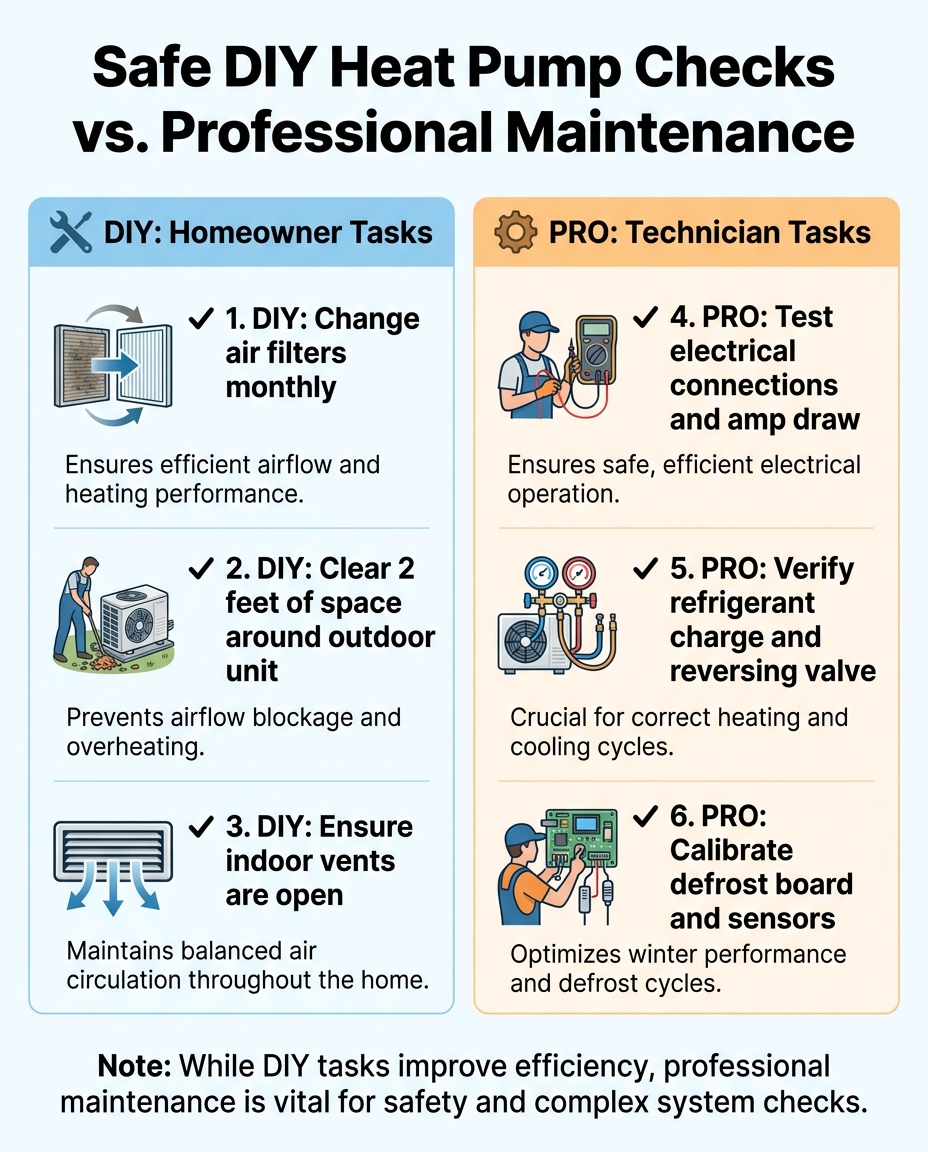
Before scheduling a professional inspection with our team, there are several safe, straightforward steps you can take to prepare your system for the cold. Our technicians always appreciate when homeowners complete these basic tasks, as they form the foundation of any mid-fall heating startup and help ensure that when we arrive, we can focus on complex diagnostics rather than basic housekeeping.
1. Inspect and replace the indoor air filter: A dirty filter is the most common cause of poor heating performance. Locate your return air filter and hold it up to a light source. If you cannot see light passing through, it is time for a replacement. Always ensure the airflow arrow on the new filter points toward the equipment.
2. Clear the outdoor unit's perimeter: Summer storms and fall foliage often leave branches, leaves, and tall grass crowded against the outdoor condenser. Carefully remove any vegetation or debris to establish a clear two-foot perimeter around the entire unit.
3. Verify open indoor vents: Walk through your home and check every supply and return register. Ensure they are fully open and not blocked by furniture, rugs, or heavy curtains. Closing vents in unused rooms actually disrupts the system's static pressure and forces the blower motor to work harder.
4. Perform a mild-weather test run: Do not wait for a freezing night. On a mild autumn day, switch your thermostat to "Heat" and raise the setpoint a few degrees above the current room temperature. Listen for the system to engage and monitor the vents to ensure warm air begins flowing within a few minutes.
The outdoor unit functions as the lungs of your heating system. During the winter, it absorbs ambient heat from the outside air and transfers it indoors. If the intake fins are choked with wet autumn leaves, grass clippings, or encroaching shrubs, the system cannot breathe. Maintaining that strict two-foot clearance zone prevents airflow starvation and allows the unit to operate at its intended efficiency. We recommend using a soft brush to gently sweep away loose debris from the exterior louvers, but never use a high-pressure washer, which can bend the delicate aluminum fins.
Testing the thermostat transition is a critical step in your mid-fall heating startup. When you switch the thermostat to heating mode, you should hear a distinct "whoosh" or clicking sound from the outdoor unit. This is the reversing valve engaging to change the flow of refrigerant. Allow the system to run for at least fifteen minutes. The initial air may feel lukewarm as the ductwork heats up, but it should steadily rise to a comfortable, warm temperature. If the air remains cold after twenty minutes, turn the system off to prevent compressor damage.
While clearing leaves and changing filters are safe homeowner tasks, modern HVAC equipment contains high-voltage electrical components and pressurized chemicals. Crossing the boundary from basic maintenance into DIY repairs is not only dangerous, but it can also severely damage the equipment. In the Derby KS area, our team at MJB Heating & Cooling takes pride in being a Certified Daikin Comfort Pro Dealer. Working with us ensures expert installation and diagnostics, protecting the equipment and keeping the Daikin Comfort Promise warranty intact.
Never open the equipment cabinet or attempt to clean internal electrical components yourself. The capacitors inside the outdoor unit store lethal amounts of high-voltage electricity and remain fully charged even after the power is disconnected at the breaker. Additionally, testing refrigerant levels requires specialized gauges, a deep understanding of pressure-temperature relationships, and strict adherence to federal laws. Handling refrigerant is strictly regulated by the Environmental Protection Agency (EPA), and unauthorized tampering is illegal and hazardous.
Manufacturers require professional maintenance to keep their warranties valid. If a compressor fails and the manufacturer discovers that the system was altered, repaired, or serviced by an unlicensed individual, they will void the warranty entirely. A documented history of professional mid-fall heating startup inspections proves that the system was maintained according to factory specifications, ensuring you are protected if a major component fails.
Even with proper preparation, you might encounter unexpected behavior during your mid-fall heating startup. Based on the hundreds of service calls we handle each season, understanding the difference between normal operation and a genuine malfunction helps you avoid unnecessary panic while knowing exactly when to call our professionals for help. Here is a breakdown of common symptoms we see, their typical causes, and the correct solutions.
• System blows cool air briefly in winter — Probable Cause: Normal defrost cycle operation — Recommended Action: Wait 10-15 minutes. The auxiliary heat should engage shortly.
• Persistent cold air from vents — Probable Cause: Stuck reversing valve or low refrigerant — Recommended Action: Turn system off immediately. Call a licensed professional.
• Brief "burning dust" smell on first startup — Probable Cause: Dust burning off auxiliary heat strips — Recommended Action: Normal. Odor should dissipate within 30 minutes.
• Loud grinding or metal-on-metal noise — Probable Cause: Failing blower motor bearings or debris in fan — Recommended Action: Shut off power at the thermostat. Request emergency service.
• Thermostat screen is blank — Probable Cause: Dead batteries or tripped breaker — Recommended Action: Replace batteries and check the electrical panel first.
One of the most frequent concerns we hear during a mid-fall heating startup is feeling cool air coming from the registers. As mentioned earlier, if the system is running a normal defrost cycle to melt outdoor ice, it will temporarily blow cooler air. However, if the system blows cold air persistently for more than twenty minutes, this points to a mechanical failure. A stuck reversing valve, a failed compressor, or a significant refrigerant leak will prevent the system from absorbing outdoor heat. In these cases, running the system will only cause further damage.
When you turn on the heat for the first time in months, a slight burning smell is entirely normal. Over the summer, dust settles on the indoor auxiliary heat strips. When those strips heat up for the first time, that dust burns off, creating a distinct odor that should vanish within twenty to thirty minutes. However, if you smell melting plastic, acrid electrical smoke, or sulfur, shut the system down immediately at the breaker. Electrical odors require immediate professional attention to prevent fire hazards.
Routine maintenance is not an arbitrary recommendation; it is a proven strategy for reducing household expenses. According to the U.S. Department of Energy, proper seasonal maintenance reduces HVAC energy consumption by 10% to 20%. In the Derby KS area, where winter temperatures demand heavy system usage, that efficiency translates directly to more manageable utility bills. Enrolling in an HVAC maintenance plan with MJB Heating & Cooling ensures that your system receives this necessary attention every fall without you having to remember to schedule it.
During a professional tune-up, our technicians perform tasks that directly impact your system's efficiency. We clean the micro-channel coils, ensuring maximum heat transfer. We verify the exact refrigerant charge, as even a slightly undercharged system forces the compressor to run longer cycles. We also tighten electrical connections and measure the amp draw of the motors. When all these components operate within their factory specifications, the system uses less electricity to produce the same amount of heat, preserving your monthly budget.
The compounding cost of running a neglected system goes beyond utility bills. Minor wear and tear—like a pitted electrical contactor or a slightly degraded capacitor—often goes unnoticed by homeowners. However, when the first major winter storm hits, the added strain causes these weakened components to fail completely. Our professional mid-fall heating startup inspections catch these minor issues before they cascade into complete system failures. The peace of mind that comes with a documented professional inspection means you can trust your system to perform when you need it most.
Sometimes, a mid-fall heating startup inspection reveals that an older system requires significant repairs. When facing a major component failure, such as a dead compressor or a severe refrigerant leak in an aging unit, homeowners must make a strategic decision. Dropping significant funds into a system that is over twelve years old is rarely a sound investment. Instead, it is time to evaluate the long-term benefits of upgrading to a newer, more efficient Daikin model.
When weighing a repair against a replacement, our comfort advisors recommend considering the age of your current system, the frequency of past repairs, and the efficiency gains of modern inverter technology. A pattern we see often is that a system breaking down every season is signaling the end of its operational life. Upgrading to a new Daikin heat pump provides improved comfort, quieter operation, and significantly lower energy consumption. To make this transition easier, exploring flexible financing options allows you to invest in high-quality equipment while managing the upfront costs comfortably.
Upgrading to a high-efficiency system often comes with financial advantages beyond monthly energy savings. General federal tax credits, state energy rebates, and local utility incentive programs may apply to qualifying heat pump installations. These programs are designed to encourage homeowners to adopt energy-efficient technology. Because these programs frequently change, it is important to consult with your HVAC provider and a qualified tax professional to verify which current programs you may qualify for before making your final purchase decision.
Preparing your home for the colder months requires a balanced approach. By performing safe DIY tasks—like changing filters and clearing outdoor debris—you set the stage for success. However, the complex mechanics of inverter technology and the high-voltage demands of winter heating require expert validation. Ensuring your system's integrity during a mid-fall heating startup in the Derby KS area is the single best way to guarantee uninterrupted comfort.
Do not wait for the first freezing night to discover your system is struggling. Take proactive steps today to secure your winter comfort. Schedule your professional inspection with our certified experts to finalize your preparations and enjoy the season with total confidence.
How do I prepare my heat pump for winter?
Start by replacing your indoor air filter and clearing all leaves, grass, and debris from around the outdoor unit to ensure a two-foot clearance. Next, test the system on a mild day by switching the thermostat to heating mode and verifying that warm air flows from the vents. Finally, schedule a professional mid-fall heating startup inspection to test internal electrical and refrigerant components.
What maintenance does a Daikin heat pump need?
A Daikin heat pump requires monthly homeowner filter changes and biannual professional maintenance. A certified technician must verify the inverter compressor's amp draw, calibrate the defrost board sensors, and clean the delicate outdoor coils. This specialized maintenance ensures the system maintains its high efficiency and protects the factory warranty.
Why is my heat pump not blowing hot air?
If the system is running a defrost cycle, it will temporarily blow cooler air to melt ice off the outdoor unit, which is normal. However, if it blows cold air persistently for more than twenty minutes, you likely have a malfunctioning reversing valve, a refrigerant leak, or a failing compressor. Turn the system off and contact a licensed professional immediately to prevent further damage.
Can I service my own heat pump?
You can and should handle basic maintenance like changing air filters, keeping the outdoor unit clear of debris, and ensuring indoor vents are open. However, you should never attempt to open the equipment cabinet, test electrical components, or check refrigerant levels. These tasks require specialized tools, carry severe high-voltage safety risks, and must be performed by a licensed professional to keep your warranty valid.
What should I check before turning on my heat pump for heating?
Before switching to heating mode, verify that your air filter is clean and that no furniture or rugs are blocking your indoor supply and return registers. Outside, ensure the condenser unit is completely free of fall foliage, dirt, and overgrown vegetation. Once these checks are complete, you can safely test the thermostat transition.
What is a Daikin Comfort Pro and why does it matter?
As a Daikin Comfort Pro ourselves, MJB Heating & Cooling has met rigorous standards for technical expertise, customer service, and advanced training on Daikin inverter systems. Working with a Comfort Pro ensures that your equipment is diagnosed and maintained exactly to manufacturer specifications. This level of expertise protects the lifespan of your system and ensures the Daikin Comfort Promise warranty remains fully intact.


Our A/C stopped working on a Sunday and due to health issues, we needed to find a service company available on a Sunday. I called MJB and left a message on their emergency voice mail. Within 10 minutes Tom Buck called me to hear my description of the symptoms. He was just finishing an appointment in Wichita and would be on his way to my home on the south end of Derby. He arrived within 30 minutes! From start to finish he was the perfect example of what you could ever hope for in an HVAC tech and a human being. His evaluation of our system inside and out was as thorough as I could ever imagine and once he was done with the repair, our system is running as well or better than ever. Well worth the price for the evaluation, parts, and labor. Thank you again Tom for an awesome experience.
Our AC went out during the hottest days of the year, and they were out next day! We have been jerked around by a shoddy home warranty for years. We finally had a chance to pick our own repair people, and MJB came highly recommended. I can see why! I was impressed with the honesty and speed at which they fixed our AC unit!
Our commercial building had a lightening/electrical strike and damaged our 20 ton AC unit. No one could find us a new unit before the end of September. Imagining going all of August and September with no AC in Kansas and working inside near 100 degree temps is less than thrilling. Dale and the team at MJB called around and saved the day. They had us a new unit 5 weeks earlier than other could promise and I now have happy employees. The unit is amazingly quiet, super cold and so much more energy efficient. Thank you for being our super hero!
Came out and installed my new furnace. Was very polite and affordable. They are very acknowledgeable and I highly recommend!
Thank you very much. We had our 1st warm night in 3weeks. MJB took the time and effort to find the real problem. And the employees were kind and thoughtful and explained things very well. I cannot thank you and all of MJB. Will recommend you highly. Thanks again Marjorie Herman Oxford Kansas
We had a new system installed and I was so impressed with how quick they were in come out and install it, in the middle of a hot summer day. They were so friendly & very professional. I had a small problem with a weird sound and they came over immediately and fixed it. Love them!