.avif)





Blogs
Stay updated with our latest blog posts.


October in the Derby area brings a sudden chill to the evening air, and if you are looking up home maintenance tips and troubleshooting for the season, your heating system is likely at the top of the list. Here at MJB Heating & Cooling, we know that when you switch your thermostat from cooling to heating for the very first time, wait for the familiar hum of the blower, and then it hits you with a distinct, alarming smell of something burning, it can be terrifying. The transition from late-summer cooling directly into chilly fall nights often catches homeowners completely off guard. Only a few weeks ago, you might have been dealing with a late-season heatwave where needing to schedule an emergency AC repair felt like a distinct possibility because your AC stops working at night. Now, you are faced with a completely different kind of panic.
When you turn on the heat and immediately smell burning, it is incredibly easy to assume the worst. A mid-fall October heating startup often comes with a few sensory surprises, but knowing exactly what is normal versus what requires expert intervention is the key to keeping your home safe. A brief burning odor is often just a harmless rite of passage for the season. However, understanding the mechanics behind that smell will help you determine if you need to shut the system down and call our team for professional HVAC services. By taking a neutral, safety-first approach to troubleshooting, you can confidently navigate this seasonal transition without unnecessary stress.
To understand why your furnace smells like it is on fire during its first run of the year, you have to look at what the system has been doing for the past several months: absolutely nothing. The heat exchanger, which is the core component responsible for safely heating the air that blows into your rooms, sits completely idle throughout the long cooling season. While your air conditioner works overtime to keep you comfortable, the heating side of your HVAC equipment is dormant, acting as a passive pathway for circulating air.
The Problem: Even though the furnace burners are off, the blower motor is still pulling air through the shared ductwork. This air carries microscopic airborne particles, pet dander, lint, and household dust. Over the span of several months, a fine layer of this debris settles directly onto the cold metal surfaces of the heat exchanger and the burner assembly.
The Cause: The local climate plays a significant role in this accumulation. In our years of servicing homes across the region, our team has seen how Derby's long, hot, and humid summers mean that furnaces sit idle for many months. The high indoor humidity levels can actually cause dust particles to become slightly sticky, making them adhere more stubbornly to the internal metal components of the furnace than they would in a drier, cooler climate. By the time the mid-fall October heating startup arrives, that layer of dust is firmly baked onto the heat exchanger.
The Solution: When the thermostat finally calls for heat, the burners ignite, and the heat exchanger rapidly warms up to hundreds of degrees. That accumulated layer of dust is instantly incinerated. The burning smell that fills your home is literally the scent of summer dust flashing into carbon. As we frequently remind homeowners in Derby and surrounding service areas, this initial burn-off is a standard, expected mechanical process, not necessarily a fire hazard. The key is knowing how long it should last.
Because central HVAC systems share the same ductwork for both heating and cooling, the furnace cabinet is never truly sealed off from the home's airflow. Every time the AC kicks on in July or August, a small amount of household dust bypasses the filter and settles on the dormant heating parts. The longer the system goes without running a heating cycle, the thicker that layer of dust becomes, resulting in a much stronger odor when the system finally fires up in the fall.
Not all burning smells are created equal. While incinerated dust is a normal byproduct of the season changing, other odors indicate serious mechanical failures or immediate safety hazards. Knowing how to categorize these smells can save your equipment from catastrophic damage and protect your family from danger.
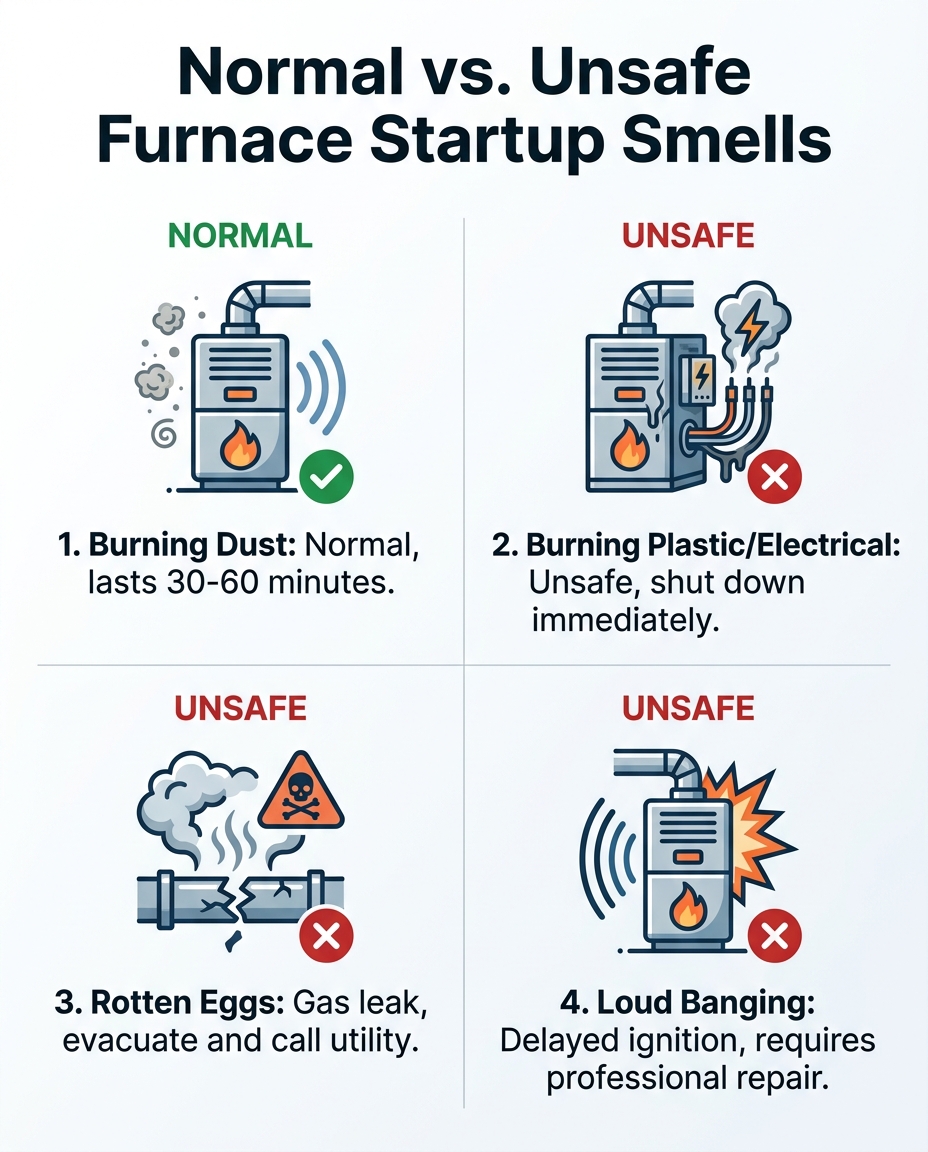
• Dry, hot clothing iron — Likely Cause: Normal dust burning off the heat exchanger. — Safety Level: Harmless — Required Action: Monitor for 60 minutes. Open a window if needed.
• Burning plastic or rubber — Likely Cause: Melting wire insulation or a foreign object in the ducts. — Safety Level: Hazardous — Required Action: Shut off the furnace immediately and call a professional.
• Sharp, metallic electrical odor — Likely Cause: Overheating blower motor or failing sequence board. — Safety Level: Hazardous — Required Action: Turn off power at the breaker and request service.
• Rotten eggs (Sulfur) — Likely Cause: Natural gas leak (Mercaptan additive). — Safety Level: Critical Emergency — Required Action: Evacuate the home instantly and call the utility company.
Our technicians always advise customers that the most important diagnostic tool you have is the clock. A harmless dust burn-off should noticeably fade within the very first heating cycle. Typically, the smell will peak in the first ten minutes and then rapidly dissipate during the first 30 to 60 minutes of operation. If the smell persists, grows stronger, or fills the house with visible smoke after an hour of running, you are no longer dealing with simple dust. At that point, the safest course of action is to turn the thermostat to the "off" position and contact a licensed technician.
Smells are not the only thing that can cause alarm during a mid-fall October heating startup. After sitting idle all summer, the mechanical components of your furnace might protest a bit when called back into action. In our experience, while a gentle hum and the rush of air are normal, certain loud noises point directly to specific component failures.
1. Continuous Clicking Without Heat: A few clicks at the beginning of the cycle are completely normal. This is the sound of the spark igniter attempting to light the burners. However, if the clicking continues for several minutes and the blower never kicks on with warm air, the system is failing to ignite. This usually points to a dirty flame sensor, a faulty igniter, or a closed gas valve. The furnace will eventually lock itself out for safety.
2. A Loud Bang or Boom: This is one of the most concerning sounds a furnace can make. It is known as "delayed ignition." When the igniter fails to spark immediately, natural gas continues to build up inside the combustion chamber. When the spark finally catches, it ignites a larger-than-normal cloud of gas, creating a small explosion. This bang can actually crack the heat exchanger over time and requires immediate professional repair.
3. High-Pitched Squealing or Grinding: Mechanical shrieks usually originate from the blower motor or the draft inducer motor. A squeal often indicates a loose or worn-out blower belt (in older models) or dry motor bearings that are failing. A harsh, metal-on-metal grinding sound means the bearings are completely shot, and the motor is destroying itself. Turn the system off to prevent further damage.
4. Popping in the Ductwork: Unlike the internal noises mentioned above, a dull popping or banging sound coming from the walls or ceilings is usually just the sheet metal ductwork expanding and contracting as hot air hits the cold metal. While occasionally annoying, this thermal expansion is generally harmless and normal for a seasonal startup.
When faced with a strange smell or a disturbing noise, it is tempting to grab a screwdriver, pull off the furnace cabinet door, and poke around to see what is wrong. However, our team at MJB Heating & Cooling strongly advises against this. Heating equipment is a leading cause of home fires in the United States, and safety must always be the absolute priority. Modern furnaces are not simple metal boxes with a pilot light; they are highly complex machines.
Inside that cabinet, you will find intricate sequence control boards, high-voltage electrical components, and combustible gas lines. An accidental slip of a tool can easily short out a control board, create a dangerous electrical hazard, or worse, compromise a gas fitting. Because the stakes are so high, the only DIY steps a homeowner should ever take are checking the thermostat settings to ensure they are correct and replacing a dirty air filter.
Everything beyond the filter slot requires specialized training, diagnostic meters, and a deep understanding of combustion safety. If a burning smell persists beyond the first 30 to 60 minutes of operation, the smartest move is to leave the cabinet closed. Investing in a preventative HVAC maintenance plan ensures that all of these internal components are thoroughly cleaned, inspected, and tested safely by a licensed technician long before the first freezing night arrives.
There is a distinct line between observing a concerning symptom and deciding to trigger an after-hours dispatch protocol. If you turn on your heater on a chilly Friday evening and notice a faint dust smell, you can likely monitor it safely. But if that smell turns into burning plastic, or if the furnace fires up with a violent bang and then shuts down completely, you have crossed into emergency territory.
Criteria for Immediate Shutdown: You should immediately cut power to the furnace if you experience persistent electrical smells, loud mechanical banging, or a complete failure to produce heat after the initial cycle. Waiting out a mechanical failure overnight while October temperatures drop rapidly can lead to extreme discomfort for your family and even risk frozen pipes if a sudden cold snap hits.
The situation is very similar to summer cooling emergencies. Just as you would urgently research why your AC stopped working at night during a July heatwave, a furnace failing on a cold autumn evening requires prompt, professional attention. You do not want to be left shivering in the dark hoping the system fixes itself.
With MJB Heating & Cooling's reliable after-hours dispatch protocol, local residents do not have to wait until Monday morning to ensure their home is safe and warm. For example, our team recently had a local homeowner reach out on a frigid winter day when their heater completely failed to turn on. One of our technicians arrived within ten minutes, quickly repaired the primary heating failure, and even identified a hot water tank pipe that was not up to code—addressing a secondary safety issue on the spot. That level of rapid response provides crucial peace of mind when your heating system behaves unpredictably during its first 30 to 60 minutes of operation.
The shift from cooling to heating is a major event for your home's infrastructure. While a brief burning dust smell is a completely normal rite of passage for a mid-fall October heating startup, it is vital to remain observant. Trust your senses: if something smells like melting wire, sounds like grinding metal, or feels unsafe, it probably is.
By monitoring the system closely during its first full cycle, you can easily distinguish between harmless seasonal burn-off and a serious mechanical issue. As your local Derby heating professionals, we always prioritize a clear, safety-first checklist over attempting to fix internal components yourself. If you have any doubts about the sounds or smells coming from your vents this season, lean on professional home maintenance tips and troubleshooting, and reach out to our local experts who can ensure your system is primed for a safe, warm, and reliable winter.
Is it normal for a heater to smell like burning on first use?
Yes, our team at MJB Heating & Cooling assures customers that a brief burning smell is entirely normal the first time you turn on your heater in the fall. Over the summer, dust and airborne particles settle on the dormant heat exchanger and burners. When the system ignites, this layer of dust is quickly incinerated, producing a dry, hot odor similar to a clothing iron. This is a standard mechanical process and is generally harmless.
How long does the burning smell last when you turn on the heater?
The normal smell of burning dust should dissipate quickly, usually fading within the first 30 to 60 minutes of operation. The odor will typically peak during the first ten minutes as the heat exchanger reaches its maximum temperature. If the burning smell persists for several hours, grows significantly stronger, or produces visible smoke, you should turn the system off and contact a professional.
Why does my furnace make a loud bang when it turns on?
A loud bang or boom during startup is caused by delayed ignition, which is a serious issue. It occurs when the igniter fails to spark immediately, allowing natural gas to build up inside the combustion chamber. When the spark finally catches, it ignites the accumulated gas all at once, creating a small explosion that can damage your heat exchanger over time.
What does a cracked heat exchanger smell like?
A cracked heat exchanger often produces a sharp, unpleasant odor similar to formaldehyde or a strong, metallic exhaust smell. Because a crack allows dangerous combustion gases—including carbon monoxide—to mix with your home's breathing air, it is a severe safety hazard. If you notice these chemical exhaust smells and experience headaches or nausea, evacuate immediately.
Can a dirty air filter cause a burning smell?
Yes, a severely clogged air filter can cause a burning smell by restricting airflow over the heat exchanger. When the system cannot move enough air to cool the internal components, the furnace can overheat, causing the blower motor to strain and emit a hot, electrical odor. Replacing your filter regularly is one of the most effective ways to prevent overheating issues.
At what point should I turn off my furnace if it smells bad?
You should turn off your furnace immediately if the smell resembles burning plastic, melting rubber, or electrical wires. You should also shut the system down if a normal dust smell lasts longer than an hour or is accompanied by loud grinding or banging noises. If you ever smell rotten eggs, leave the house instantly, as this indicates a dangerous natural gas leak.


Our A/C stopped working on a Sunday and due to health issues, we needed to find a service company available on a Sunday. I called MJB and left a message on their emergency voice mail. Within 10 minutes Tom Buck called me to hear my description of the symptoms. He was just finishing an appointment in Wichita and would be on his way to my home on the south end of Derby. He arrived within 30 minutes! From start to finish he was the perfect example of what you could ever hope for in an HVAC tech and a human being. His evaluation of our system inside and out was as thorough as I could ever imagine and once he was done with the repair, our system is running as well or better than ever. Well worth the price for the evaluation, parts, and labor. Thank you again Tom for an awesome experience.
Our AC went out during the hottest days of the year, and they were out next day! We have been jerked around by a shoddy home warranty for years. We finally had a chance to pick our own repair people, and MJB came highly recommended. I can see why! I was impressed with the honesty and speed at which they fixed our AC unit!
Our commercial building had a lightening/electrical strike and damaged our 20 ton AC unit. No one could find us a new unit before the end of September. Imagining going all of August and September with no AC in Kansas and working inside near 100 degree temps is less than thrilling. Dale and the team at MJB called around and saved the day. They had us a new unit 5 weeks earlier than other could promise and I now have happy employees. The unit is amazingly quiet, super cold and so much more energy efficient. Thank you for being our super hero!
Came out and installed my new furnace. Was very polite and affordable. They are very acknowledgeable and I highly recommend!
Thank you very much. We had our 1st warm night in 3weeks. MJB took the time and effort to find the real problem. And the employees were kind and thoughtful and explained things very well. I cannot thank you and all of MJB. Will recommend you highly. Thanks again Marjorie Herman Oxford Kansas
We had a new system installed and I was so impressed with how quick they were in come out and install it, in the middle of a hot summer day. They were so friendly & very professional. I had a small problem with a weird sound and they came over immediately and fixed it. Love them!