.avif)





Blogs
Stay updated with our latest blog posts.
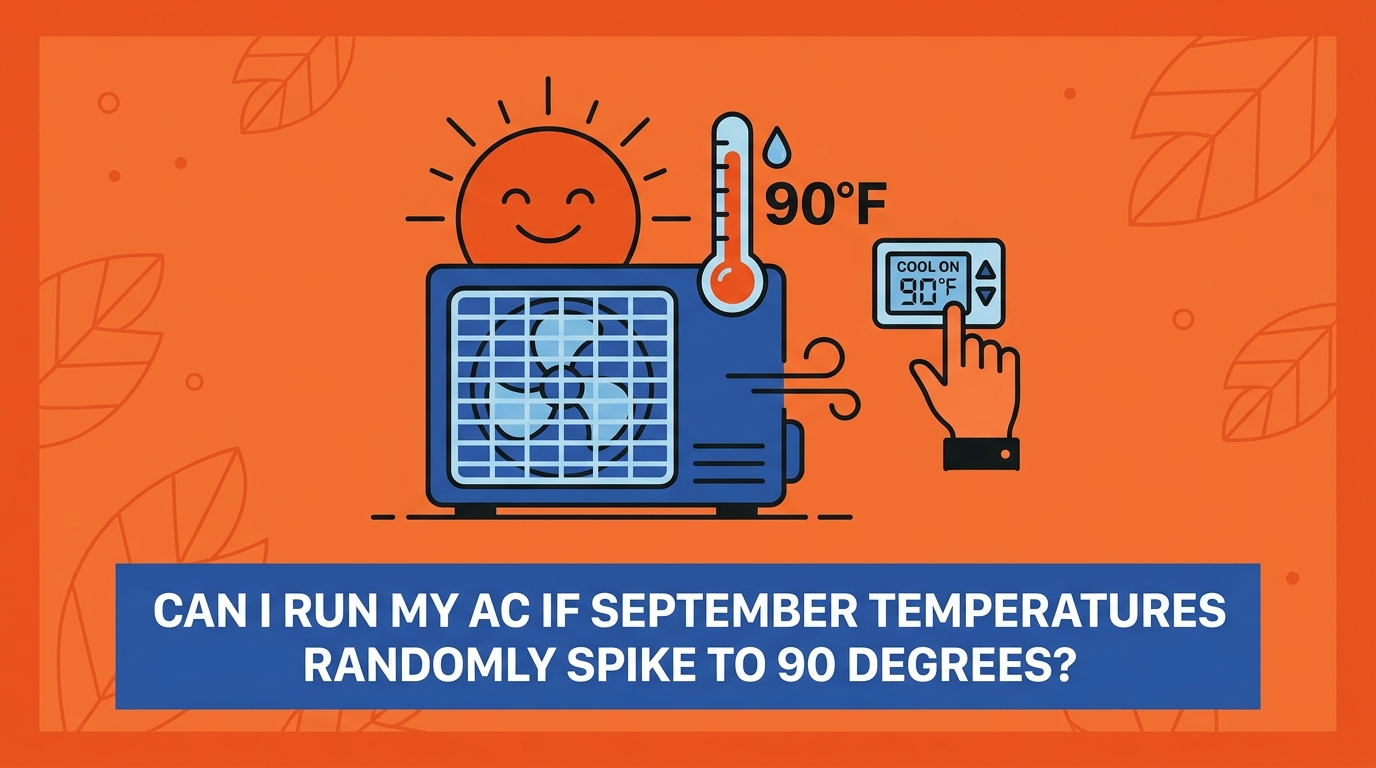

Are you staring at your thermostat, sweating through an unexpected late-season heatwave right after you just finished prepping your furnace for winter? If you are living in the Midwest, you are likely no stranger to this frustrating seasonal whiplash. The transition from crisp autumn mornings back to sweltering summer afternoons happens in the blink of an eye, leaving many homeowners wondering: can I run my AC if September temperatures randomly spike to 90 degrees?
It is a completely valid hesitation. You just spent time and energy cleaning up the yard, changing filters, and preparing your heating equipment for the cold months ahead. The last thing you want to do is undo those fall preparations or, worse, cause mechanical damage to your compressor by forcing it back into action.
The concrete problem is that a sudden 90-degree heat spike in early autumn forces you to make a choice between indoor comfort and equipment safety. Fortunately, modern heating and cooling systems are engineered to handle this exact scenario. With the right professional HVAC services and a basic understanding of how your equipment operates, you can easily bridge the gap between seasons without putting your system at risk.
The short answer is yes: it is completely safe to run your air conditioner during a September heat spike. Modern HVAC systems are not fragile, single-season appliances; they are robust mechanical systems built for rapid mode switching. Running your cooling system for a few days in the middle of autumn will not "undo" the internal mechanical preparations your furnace has undergone for winter.
Homeowners in Derby, KS, frequently experience these dramatic weather shifts. Our localized expertise in guiding residents through the unique stresses that Kansas transitional weather places on HVAC equipment has shown us that the real danger isn't switching modes—it is neglecting routine care. Maintaining a comprehensive preventative maintenance plan ensures your system's electrical components and refrigerant levels are optimized to handle sudden transitions without excessive wear and tear.
One of the most persistent myths in the HVAC world is that switching back and forth between heating and cooling will shatter or jam the system's reversing valve. If you own a heat pump, this valve is the exact component responsible for changing the direction of the refrigerant flow, allowing the unit to provide both heat and air conditioning.
Heat pumps and modern AC/furnace combinations are explicitly designed to swap modes on demand. You might hear a distinct "whoosh" or a mild clunking sound from the outdoor unit when the reversing valve shifts position. This is a normal operational sound, not a sign of mechanical failure. The valve is built to shift thousands of times over its lifespan, making it perfectly capable of accommodating September 'false fall' heat spikes.
If you have ever switched your thermostat from "Heat" to "Cool" and noticed that nothing happens for a few minutes, you might have panicked, assuming the system broke during the transition. In reality, you are witnessing a critical safety feature in action.
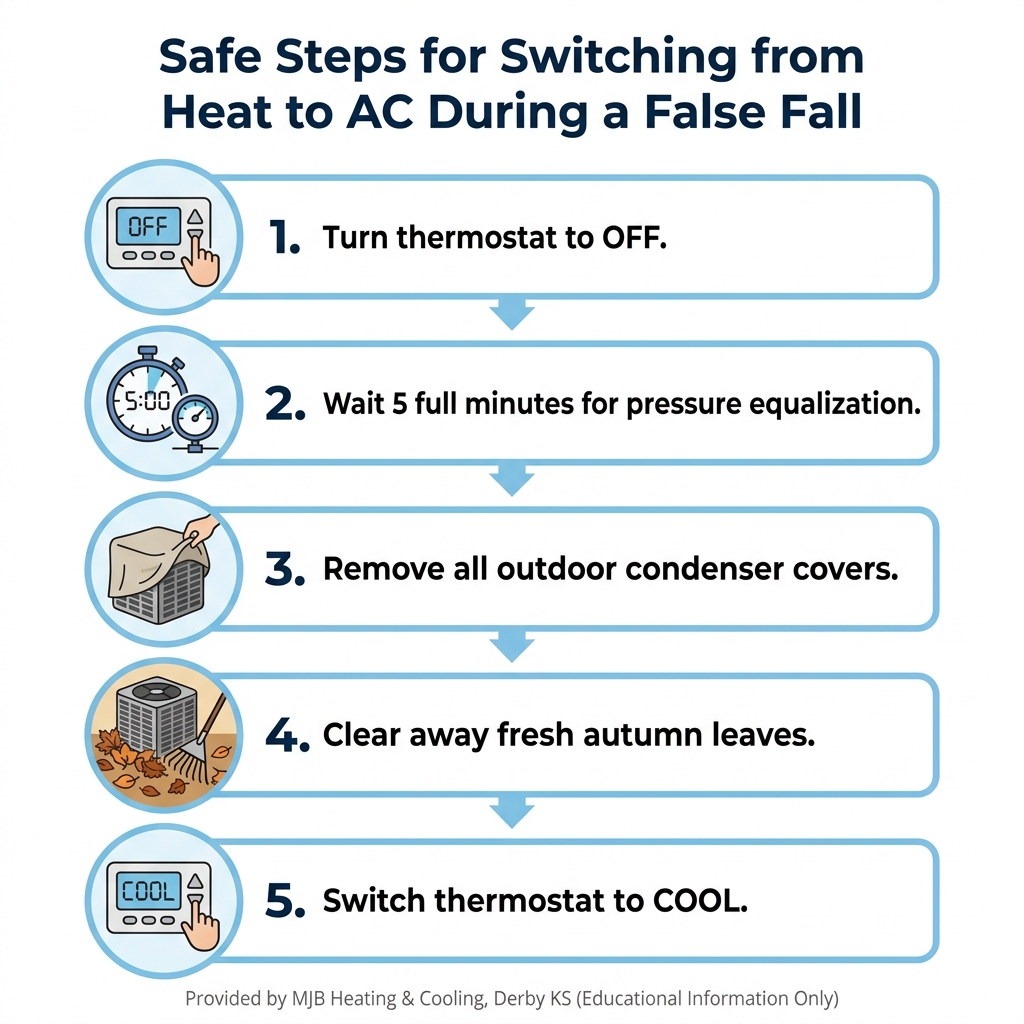
Almost all modern thermostats (including smart models from Nest, Ecobee, and Honeywell) feature a built-in time delay—typically lasting about five minutes. This delay is crucial for equalizing refrigerant pressure before the compressor restarts.
When an air conditioner shuts off, the refrigerant pressure inside the compressor is incredibly high. If the system were to immediately try to turn back on against that high head pressure, the compressor motor could stall, overheat, or blow a capacitor. The five-minute delay gives the high and low-pressure sides of the system time to balance out, ensuring a smooth, safe start-up.
What you need to know about the delay:
• Do not flip the switch repeatedly: If the system doesn't kick on immediately, wait. Flipping the thermostat on and off will only reset the five-minute timer.
• Look for the flashing indicator: Many digital thermostats will display a flashing "Cool On" or a blinking snowflake icon to let you know the system is in its mandatory waiting period.
• Listen for the indoor fan: Sometimes, the indoor blower will start circulating air a minute or two before the outdoor condenser kicks on. This is normal operation during September 'false fall' heat spikes.
• Flashing "Cool On" or Snowflake — What It Means: The 5-minute compressor protection delay is active. — Action Required: Wait patiently. Do not adjust the temperature.
• Solid "Cool On" but no air blowing — What It Means: The thermostat is calling for cooling, but the equipment is unresponsive. — Action Required: Check your electrical panel for a tripped breaker.
• System clicks repeatedly but doesn't start — What It Means: Potential capacitor failure or contactor issue. — Action Required: Turn the system off and call a professional.
While the internal mechanics of your system are perfectly fine with a sudden switch to cooling, the physical state of your outdoor unit might not be. If you have already performed your autumn yard cleanup in Derby, KS, you must perform a few critical visual checks outside before adjusting the thermostat.
The essential pre-cooling checklist:
• Remove all physical covers: If you placed a canvas cover, a plastic tarp, or a piece of plywood over the top of your outdoor condenser to protect it from falling branches or snow, you must remove it immediately. Running an air conditioner with a cover on restricts airflow entirely, causing the compressor to rapidly overheat and potentially suffer catastrophic failure.
• Clear away fresh autumn debris: A sudden heat wave in late September often coincides with the first major leaf drop. Do a quick visual sweep around the base of the condenser and brush away any accumulated leaves, twigs, or grass clippings that could block the aluminum fins.
• Check the outdoor disconnect switch: If you fully winterized your system by pulling the outdoor electrical disconnect block or flipping the dedicated AC breaker in your main panel, remember to restore power before calling for cooling.
• Leave the internal mechanics to the pros: While clearing leaves and removing covers are safe tasks for any homeowner, any internal mechanical adjustments, electrical testing, or refrigerant checks must be left to licensed professionals.

When September 'false fall' heat spikes hit the Midwest, they rarely bring dry heat. Instead, these 90-degree days often drag heavy, uncomfortable humidity back into the region. Extreme 30-degree temperature swings are common in Derby, KS Septembers, and they can cause a home to become uncomfortably sticky in a matter of hours.
Your air conditioner does more than just lower the temperature; it acts as a powerful whole-home dehumidifier. As warm indoor air passes over the freezing cold evaporator coil, moisture is pulled out of the air, condensed into water, and drained away safely. Choosing to leave the AC off and "tough it out" can lead to rapidly rising indoor humidity, which makes the air feel much hotter than the thermostat reads.
Excessive humidity also poses a risk to your home's structure. One local homeowner experienced extensive condensation damage in their basement during a period of peak humidity because their old cooling system couldn't keep up. As new customers with an immediate need, they reached out for help. They were provided with multiple options and had a new, highly efficient system installed within days, allowing them to finally sleep comfortably without worrying about moisture damage.
Reliable cooling is absolutely essential for sleep comfort and indoor air quality during these prolonged, muggy heat waves. We proudly support service areas across Derby and surrounding communities, ensuring that when the humidity spikes, your home remains a dry, comfortable sanctuary.
Once the heat wave breaks, you will need to transition back to a heating mindset. The key to navigating unpredictable fall weather in Derby, KS, is setting a comfortable baseline temperature that prevents your system from constantly short-cycling between heating and cooling modes.
As the weather permanently shifts toward winter, you will need to know when to shut down your AC and test the furnace for the final time. Pay close attention to how your equipment performs during these late-season heat spikes. If you notice unusual grinding noises, weak airflow, or a system that runs non-stop without actually cooling the house, do not ignore it. The stress of a false fall often exposes underlying mechanical weaknesses.
Another local homeowner found themselves dealing with an AC that failed to work for almost a week during a severe heat stretch. After a rapid response team arrived to fix the immediate issue and restore their cooling, they eventually decided that repairing the aging unit wasn't cost-effective and opted to install a new, more resilient system. If your current setup is struggling to keep up with the volatility of Kansas weather, exploring flexible financing options for a system upgrade might be a smart, proactive move before the freezing winter weather arrives.
Managing your thermostat correctly can save you money and reduce wear on your equipment during volatile weather weeks.
• Use 'Auto' mode cautiously: Many smart thermostats have an "Auto" feature that switches between heat and cool automatically. During a volatile week, ensure your "deadband" (the temperature gap between heating and cooling triggers) is set at least 3 to 4 degrees apart. Otherwise, your system might run the furnace in the chilly morning and the AC in the warm afternoon, wasting significant energy.
• Rely on ceiling fans: On moderate 75-degree days following a major heat spike, leave the AC off and use ceiling fans to bridge the comfort gap. Moving air feels cooler on your skin, allowing you to save on utility costs without sacrificing comfort.
No, it is not bad for modern systems, provided you allow the thermostat to execute its standard safety delay. HVAC systems are designed for this exact type of operational flexibility. As long as you wait a few minutes between shutting off the furnace and engaging the air conditioner, the compressor will not suffer any damage.
You should wait at least 5 minutes after turning the heat off before activating the AC. This brief pause allows the high-pressure refrigerant in the system to equalize. Most digital thermostats enforce this waiting period automatically, but if you have an older manual thermostat, you must time this delay yourself to protect the compressor.
No, unless the system is already severely compromised or you intentionally bypass safety delays, normal switching will not break the unit. The reversing valves in heat pumps and the control boards in split systems are engineered to manage these transitions seamlessly during September 'false fall' heat spikes.
If the outdoor unit is covered with a tarp or canvas, it will rapidly overheat and potentially destroy the compressor due to a complete lack of airflow. If the unit is uncovered, visually inspected for autumn debris, and the power disconnect is restored, it will run normally without issue.
Running the AC does not undo any internal cleaning, filter changes, or mechanical tune-ups performed on the furnace side of your HVAC system. The two systems operate independently (even if they share the same blower motor), so your heating system will remain fully prepped and ready for winter.
Kansas weather is notoriously unpredictable, but your indoor comfort shouldn't be. Whether you are dealing with a sudden September heatwave in Derby, KS, or prepping for the first deep freeze of the year, knowing your system can handle the transition brings invaluable peace of mind.
If your air conditioner behaved strangely during a recent heat spike, or if you want to ensure your furnace is truly ready for the cold months ahead, do not wait for a complete breakdown. Reach out to a local expert for a thorough inspection to secure reliable, efficient comfort for your home all season long.


Our A/C stopped working on a Sunday and due to health issues, we needed to find a service company available on a Sunday. I called MJB and left a message on their emergency voice mail. Within 10 minutes Tom Buck called me to hear my description of the symptoms. He was just finishing an appointment in Wichita and would be on his way to my home on the south end of Derby. He arrived within 30 minutes! From start to finish he was the perfect example of what you could ever hope for in an HVAC tech and a human being. His evaluation of our system inside and out was as thorough as I could ever imagine and once he was done with the repair, our system is running as well or better than ever. Well worth the price for the evaluation, parts, and labor. Thank you again Tom for an awesome experience.
Our AC went out during the hottest days of the year, and they were out next day! We have been jerked around by a shoddy home warranty for years. We finally had a chance to pick our own repair people, and MJB came highly recommended. I can see why! I was impressed with the honesty and speed at which they fixed our AC unit!
Our commercial building had a lightening/electrical strike and damaged our 20 ton AC unit. No one could find us a new unit before the end of September. Imagining going all of August and September with no AC in Kansas and working inside near 100 degree temps is less than thrilling. Dale and the team at MJB called around and saved the day. They had us a new unit 5 weeks earlier than other could promise and I now have happy employees. The unit is amazingly quiet, super cold and so much more energy efficient. Thank you for being our super hero!
Came out and installed my new furnace. Was very polite and affordable. They are very acknowledgeable and I highly recommend!
Thank you very much. We had our 1st warm night in 3weeks. MJB took the time and effort to find the real problem. And the employees were kind and thoughtful and explained things very well. I cannot thank you and all of MJB. Will recommend you highly. Thanks again Marjorie Herman Oxford Kansas
We had a new system installed and I was so impressed with how quick they were in come out and install it, in the middle of a hot summer day. They were so friendly & very professional. I had a small problem with a weird sound and they came over immediately and fixed it. Love them!