.avif)





Blogs
Stay updated with our latest blog posts.

As the September ragweed and harvest season approaches, choosing the right system—specifically weighing media filters vs. electronic air cleaners for fall allergy relief—becomes a top priority for homeowners looking to breathe easier. The shift in seasons brings a noticeable drop in temperatures, naturally pushing families indoors. At the exact same time, outdoor airborne irritants reach their peak. When you seal up your windows to keep the evening chill out, you are also trapping all those seasonal allergens inside your living spaces. At MJB Heating & Cooling, we see this create a concrete problem for many households: finding a highly effective way to capture these airborne irritants without adding a mountain of excessive maintenance chores to your weekly routine.
If you are looking for professional guidance on keeping your indoor air pristine, exploring our comprehensive HVAC services is a great first step.
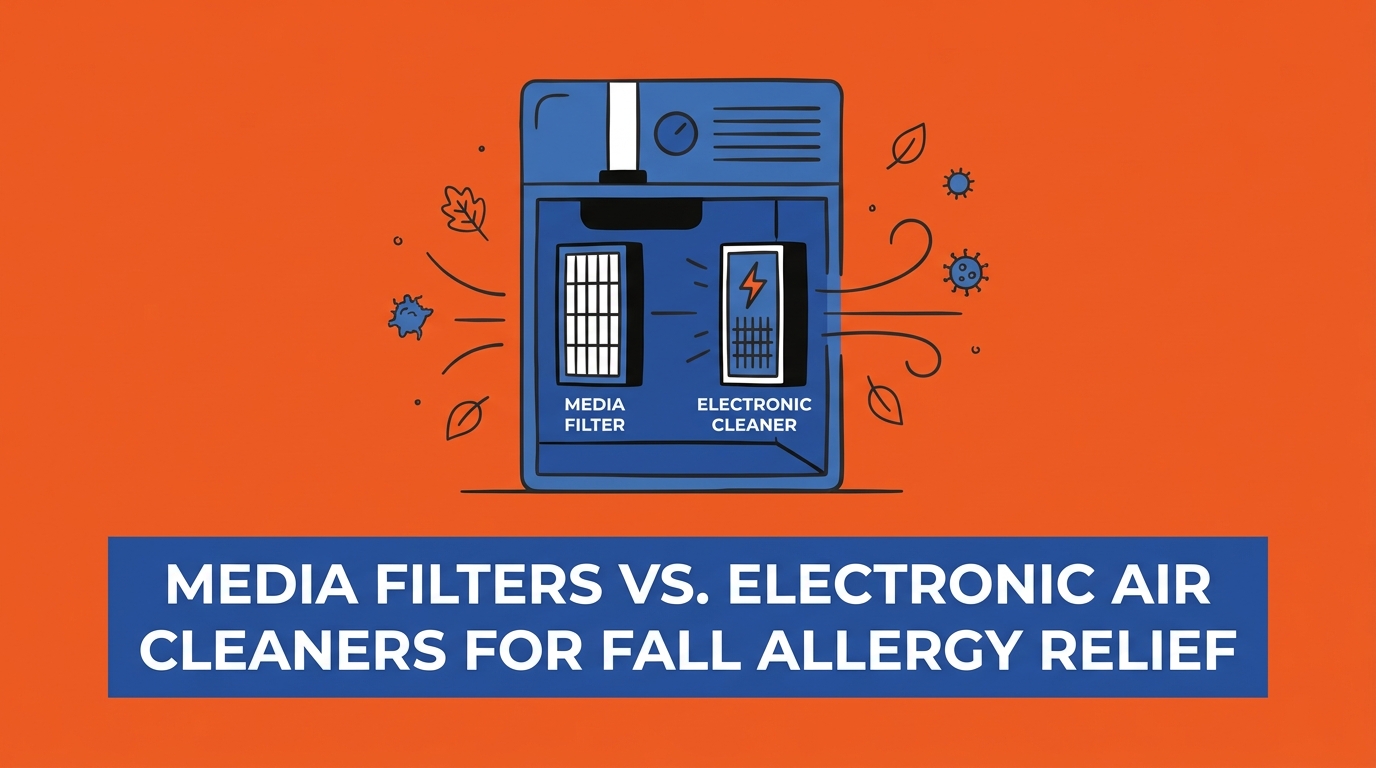
The primary decision point for most homeowners comes down to evaluating two distinct technologies. On one side, you have the high potential efficiency of an electronic air cleaner, which uses electrical charges to zap and trap particles. On the other side, you have the set-and-forget reliability of a thick media filter cabinet, which relies on massive surface area to physically block debris. Both systems offer significant upgrades over standard filtration, but they require very different commitments from the homeowner. Making the right choice means understanding how each system handles the specific demands of the autumn season, how much maintenance you are willing to perform, and what our technicians know your HVAC system needs to operate smoothly through the winter.
To truly understand which filtration system will work best, you have to look at the specific environmental factors stressing your HVAC system. In Derby KS and surrounding Sedgwick County, our technicians witness firsthand how the fall season creates a worst-case scenario for indoor air quality. It is not just about a little extra dust; it is a heavy, continuous burden created by a unique combination of local climate factors.
Here is a breakdown of the specific airborne threats we see your filtration system handling during the Midwest fall:
1. Intense Agricultural Dust: As local farms begin their harvest operations, massive amounts of fine agricultural dust are kicked up into the atmosphere. This dust is incredibly pervasive and finds its way into homes through tiny gaps around doors, windows, and rooflines.
2. Peak Ragweed Pollen: September is notorious for ragweed pollen. A single ragweed plant can produce up to a billion grains of pollen per season, and these microscopic grains travel easily on the breeze, triggering severe allergic reactions for those sensitive to them.
3. High Fall Winds: The transition from summer to fall brings strong, gusty winds across the plains. These winds exacerbate the spread of both harvest dust and pollen, driving them forcefully toward residential neighborhoods and increasing the particulate load on your home's exterior.
Because of this heavy burden, we constantly remind our customers that standard 1-inch fiberglass filters are entirely inadequate. Those thin, temporary filters are designed merely to stop large debris like pet hair and lint from damaging your furnace blower motor; they do very little to improve indoor air quality or capture microscopic allergens. They clog rapidly when faced with harvest dust, leading to restricted airflow and increased energy bills. If you live within our Derby service areas, upgrading to a system capable of handling high-volume, heavy-particulate environments is not just a luxury—it is a necessity for maintaining a clean, comfortable home.
Electronic air cleaners are sophisticated devices that take an active approach to purifying your indoor air. Instead of just putting a physical barrier in the way of the airflow, they use electricity to alter the charge of the particles passing through your ductwork. Understanding this mechanism is key to knowing whether this system fits your lifestyle.
The process begins with an ionizing wire. As dust, pollen, and dander enter the air cleaner, they pass through a high-voltage electrical field that strips electrons away, giving the particles a positive electrical charge. Immediately after, the air flows past a series of collector plates that carry a negative charge. Just like a magnet, the positively charged particles are pulled out of the air stream and stick tightly to the negatively charged plates. When the collector plates are perfectly clean, this system boasts exceptionally high initial efficiency ratings, capturing incredibly small microscopic irritants.
However, electronic air cleaners have a critical flaw when placed in heavy-dust environments like the September ragweed and harvest season. The system's efficiency relies entirely on the electrical charge of the plates being exposed to the passing air. As those plates capture agricultural dust and pollen, the debris acts as an insulator.
The saturation effect: The thicker the layer of dust on the collector plates, the weaker the magnetic pull becomes. This saturation happens rapidly during peak harvest times. We regularly respond to fall service calls where homeowners complain of poor air quality, only for our team to discover a completely saturated electronic air cleaner. Once the plates are coated, new particles simply bypass the filter entirely, flowing straight through the electronic air cleaner and blowing back into your home's ductwork and living spaces. What starts as a highly efficient system can drop to the performance level of a cheap fiberglass filter in a matter of weeks if not meticulously maintained.
Additionally, it is important to note the trace ozone generation risks associated with this technology. The ionization process naturally produces small amounts of ozone. While modern units are designed to stay well below EPA guidelines, older or poorly maintained electronic models can produce enough trace ozone to irritate sensitive lungs—which is counterproductive when you are trying to relieve fall allergies.
For homeowners who want exceptional air quality without the technical complexities of electrical ionization, thick media filter cabinets offer a highly effective alternative. This is exactly why our team at MJB Heating & Cooling frequently recommends these systems as the go-to solution for Sedgwick County homes. They take the concept of a traditional air filter and scale it up significantly to handle heavy particulate loads.
The physical structure of 4-inch or 5-inch media filter cabinets is what sets them apart. Unlike standard 1-inch filters that sit inside your return grill, a media cabinet is professionally installed directly into the ductwork next to your furnace. Inside this cabinet sits a deep-pleated filter. The deep pleats are the secret to its success. If you were to take the filter material and stretch it out flat, it would cover a massive amount of square footage. This immense surface area allows the filter to capture a staggering volume of airborne debris without severely restricting the HVAC system's airflow.
When trying to find the best air filter for dusty climates, consistency is key. This is where media cabinets truly shine. Unlike electronic plates that lose their trapping power as they get dirty, media filters maintain their efficiency. In fact, as a media filter slowly loads with dust, the tiny gaps in the fabric become even smaller, actually increasing its ability to trap microscopic particles until the filter is completely full. They physically block pollen, harvest dust, mold spores, and pet dander 24 hours a day, completely independent of electricity and with zero risk of generating ozone.
The biggest difference between these two systems—and the factor that our technicians find usually determines a homeowner's final decision—is the ongoing maintenance requirement. Manufacturers often provide maintenance guidelines based on average, controlled environments, but the reality of heavy-dust seasons dictates a much more demanding schedule.
During a typical Kansas autumn, an electronic air cleaner requires frequent attention. Because the collector plates lose efficiency as they get coated in dust, they must be cleaned regularly to remain effective. In peak harvest season, this often means maintenance every two to four weeks.
The electronic cleaning process involves:
• Turning off the HVAC system and waiting for the electrical charge to dissipate.
• Carefully sliding out the heavy aluminum collector cells.
• Soaking the cells in a specialized detergent or washing them thoroughly in a utility sink to remove baked-on dust.
• Crucial step: Allowing the plates to dry completely. If you reinstall plates that are even slightly damp, the electrical components will arc, making a loud snapping noise and potentially damaging the power supply.
In our experience, busy homeowners rarely have the time to keep up with this demanding routine. Contrast this with the set-and-forget nature of 4-inch or 5-inch media filter cabinets. Because of their massive surface area, these thick filters can hold an enormous amount of debris before they restrict airflow. For most homes, maintenance simply involves opening the cabinet door, sliding out the old, dirty filter, sliding in a brand-new one, and throwing the old one in the trash. This process takes less than two minutes and typically only needs to be done every 6 to 12 months, depending on your home's specific dust load.
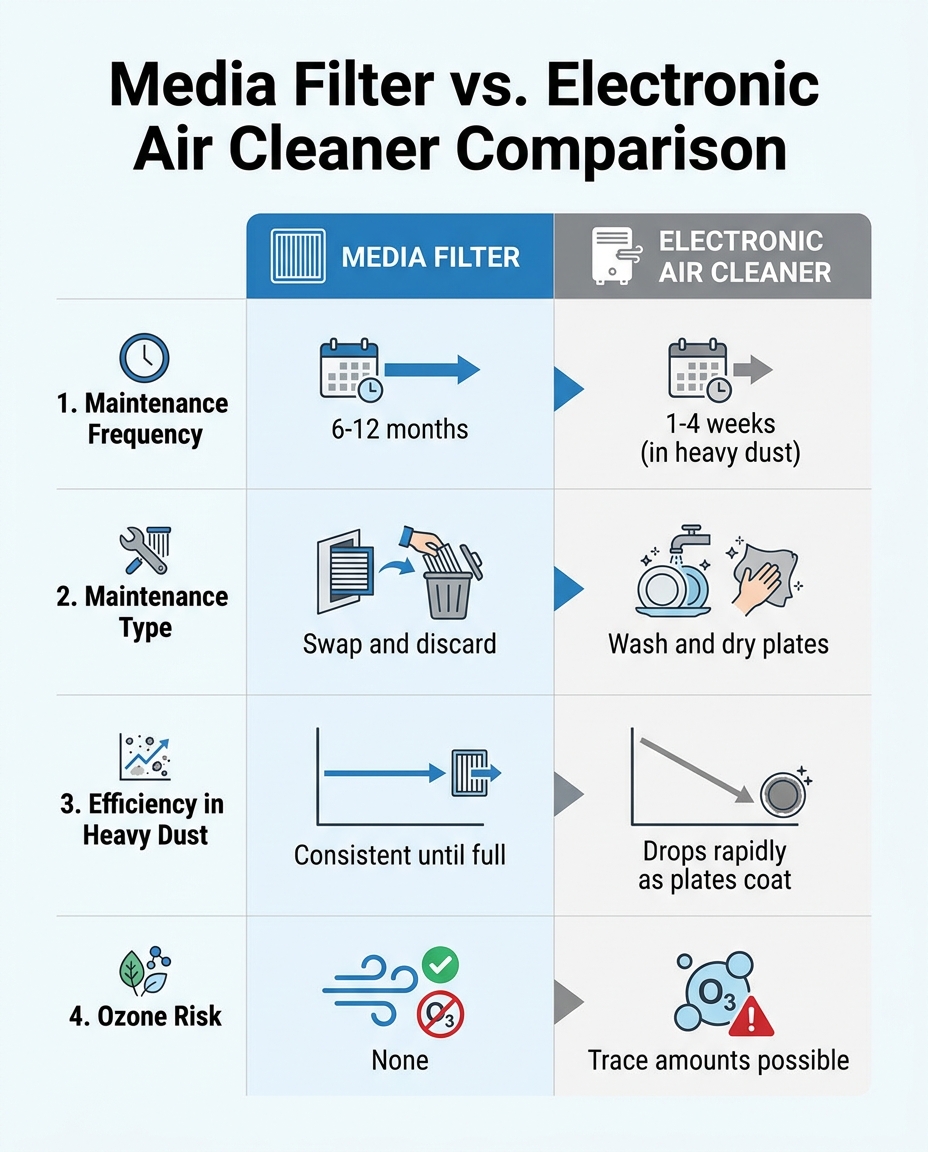
• Frequency (Heavy Dust) — Electronic Air Cleaner: Every 2 to 4 weeks — Media Filter Cabinet (4"-5"): Every 6 to 12 months
• Task Required — Electronic Air Cleaner: Remove, wash, soak, and completely air-dry collector plates — Media Filter Cabinet (4"-5"): Slide out old filter, discard, slide in new filter
• Efficiency Over Time — Electronic Air Cleaner: Drops rapidly as plates coat with dust — Media Filter Cabinet (4"-5"): Remains consistent, physically trapping particles until full
• Ozone Risk — Electronic Air Cleaner: Trace amounts possible, especially if poorly maintained — Media Filter Cabinet (4"-5"): None (Zero electrical components)
For a busy homeowner managing the hectic back-to-school schedule and the busy fall season, the simplicity of a media filter cabinet usually wins out. It provides peace of mind knowing your air is being filtered consistently without adding another demanding chore to your weekend list.
If you are tired of struggling with poor indoor air quality, early fall is the absolute optimal time to evaluate and upgrade your filtration system. Taking action now ensures your home is protected before the worst of the September ragweed and harvest season infiltrates your living space, and before you turn your heating system on for the winter.
Upgrading your filtration is not a standalone chore; our team finds it pairs perfectly with routine seasonal preparation. Here is how we recommend you time the process:
1. Schedule a Pre-Heating Tune-Up: Having a technician inspect your furnace before the first freeze is essential. During this visit, they can evaluate your current air flow and ductwork capabilities.
2. Assess Your Current Blower Motor: A primary job of any air filter is to keep dust off your furnace's blower motor and heat exchanger. Heavy agricultural dust can coat these components, causing the motor to overheat and the heat exchanger to lose efficiency. A professional can tell you if your current 1-inch filter is failing to protect the equipment.
3. Execute Professional Duct Modifications: Installing a thick media cabinet or an electronic air cleaner requires modifying the sheet metal of your return ductwork. This is not a DIY project. The cabinet must be sealed airtight; if there are gaps, the powerful suction of the blower motor will pull dirty, unfiltered air from the basement or attic directly into your system, bypassing the expensive filter entirely.
As local HVAC experts familiar with Kansas allergens, MJB Heating & Cooling provides tailored advice on which filtration systems best handle regional dust and pollen, ensuring the chosen system matches your home's specific needs. Integrating this installation with a comprehensive HVAC maintenance plan guarantees your system is clean, sealed, and ready to deliver warm, purified air all winter long.
The short answer is that it depends entirely on your maintenance habits. Electronic air cleaners have a high initial efficiency for trapping microscopic particles when perfectly clean, but they lose that efficiency rapidly as dust coats their plates. Our team typically recommends media filters because they provide more consistent, reliable filtration over time without requiring you to constantly wash components, making them the better choice for most busy homeowners.
Yes, the ionization process used by electronic air cleaners naturally produces trace amounts of ozone. While modern units are regulated to keep ozone emission below EPA safety guidelines, older units or systems that are not cleaned properly can produce enough ozone to act as a lung irritant, which can aggravate asthma and allergies.
During peak harvest times when agricultural dust and pollen are heavy, you may need to wash the collector plates every two to four weeks. If you wait longer, the heavy dust acts as an insulator over the electrical charge, causing the system to stop trapping particles entirely and allowing debris to bypass into your ductwork.
For significant allergy relief, a filter with a MERV rating between 11 and 13 is highly recommended. Filters in this range are dense enough to trap fine ragweed pollen, pet dander, and fine agricultural dust. However, you must use a 4-inch or 5-inch media cabinet for these high MERV ratings to ensure you do not restrict the necessary airflow to your furnace.
Deep-pleated 4-inch or 5-inch media filter cabinets are widely considered the best option for heavy dust environments. Their massive surface area allows them to hold a tremendous volume of agricultural debris and pollen without clogging quickly, providing consistent physical filtration that outlasts standard filters and electronic models.
When properly installed, a 4-inch media filter actually provides better airflow than a dirty 1-inch filter. Because the thick filter is deeply pleated, it contains significantly more surface area for the air to pass through. As long as your HVAC professional matches the cabinet size correctly to your blower motor's capacity, airflow restriction will not be an issue.
When it comes down to choosing between media filters vs. electronic air cleaners for fall allergy relief, the decision hinges on balancing efficiency with realistic maintenance. While both systems offer a massive improvement over standard 1-inch fiberglass filters, thick media cabinets provide superior, consistent reliability against heavy regional dust without forcing you to scrub electrical plates every few weeks.
Living in Derby KS and surrounding Sedgwick County means accepting that agricultural dust and ragweed are part of the seasonal shift, but they do not have to live inside your home. By understanding the clear differences in maintenance routines and particulate-trapping efficiency, you can make an informed choice that perfectly fits your lifestyle. If you are ready to secure your indoor air quality and protect your HVAC equipment before the winter cold sets in, consult with our professional team to evaluate your ductwork and find the exact filtration upgrade that will keep your family breathing comfortably all season long.


Our A/C stopped working on a Sunday and due to health issues, we needed to find a service company available on a Sunday. I called MJB and left a message on their emergency voice mail. Within 10 minutes Tom Buck called me to hear my description of the symptoms. He was just finishing an appointment in Wichita and would be on his way to my home on the south end of Derby. He arrived within 30 minutes! From start to finish he was the perfect example of what you could ever hope for in an HVAC tech and a human being. His evaluation of our system inside and out was as thorough as I could ever imagine and once he was done with the repair, our system is running as well or better than ever. Well worth the price for the evaluation, parts, and labor. Thank you again Tom for an awesome experience.
Our AC went out during the hottest days of the year, and they were out next day! We have been jerked around by a shoddy home warranty for years. We finally had a chance to pick our own repair people, and MJB came highly recommended. I can see why! I was impressed with the honesty and speed at which they fixed our AC unit!
Our commercial building had a lightening/electrical strike and damaged our 20 ton AC unit. No one could find us a new unit before the end of September. Imagining going all of August and September with no AC in Kansas and working inside near 100 degree temps is less than thrilling. Dale and the team at MJB called around and saved the day. They had us a new unit 5 weeks earlier than other could promise and I now have happy employees. The unit is amazingly quiet, super cold and so much more energy efficient. Thank you for being our super hero!
Came out and installed my new furnace. Was very polite and affordable. They are very acknowledgeable and I highly recommend!
Thank you very much. We had our 1st warm night in 3weeks. MJB took the time and effort to find the real problem. And the employees were kind and thoughtful and explained things very well. I cannot thank you and all of MJB. Will recommend you highly. Thanks again Marjorie Herman Oxford Kansas
We had a new system installed and I was so impressed with how quick they were in come out and install it, in the middle of a hot summer day. They were so friendly & very professional. I had a small problem with a weird sound and they came over immediately and fixed it. Love them!