.avif)





Blogs
Stay updated with our latest blog posts.
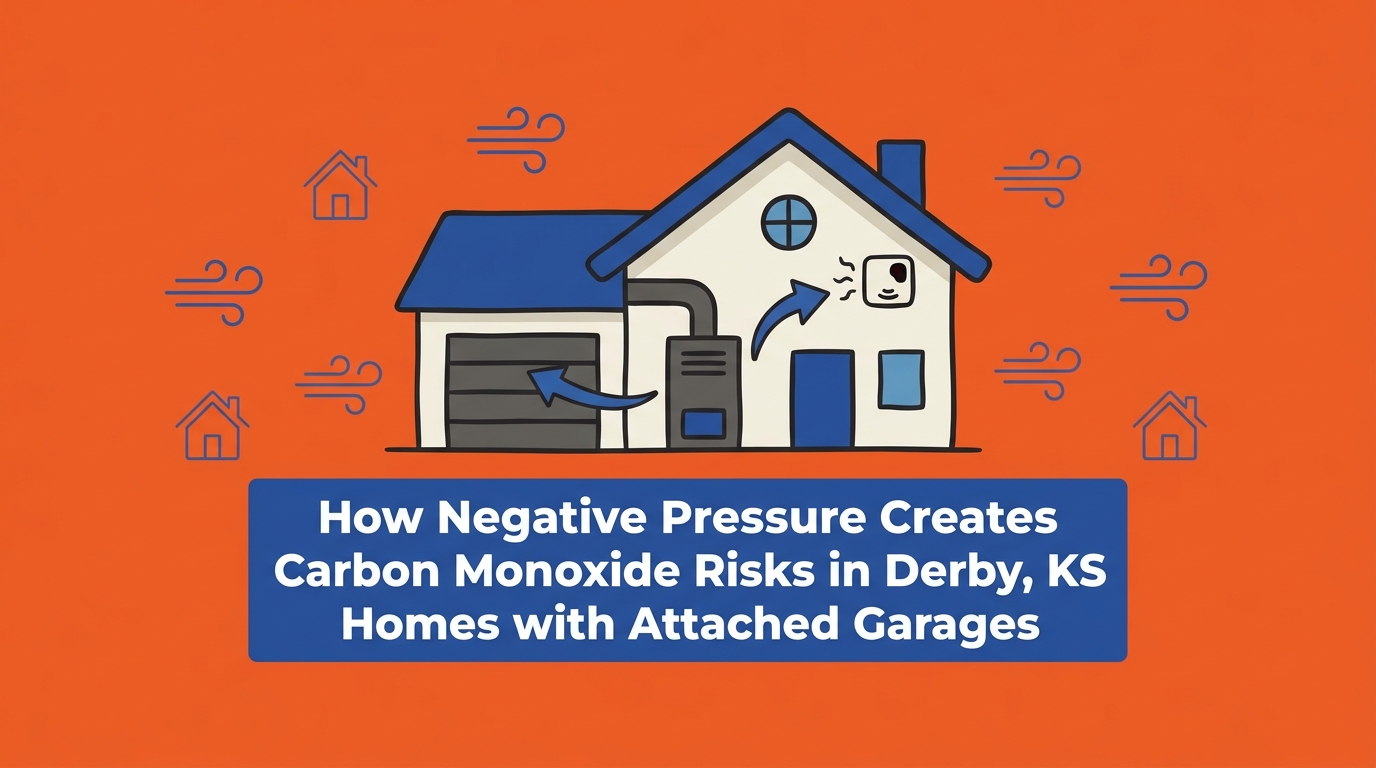

When addressing carbon monoxide risks in Derby homes with attached garages, the root of the problem often starts with an invisible force you cannot even feel: negative air pressure. You might notice a strange draft near the door leading out to your vehicles, or perhaps a lingering smell of exhaust in the laundry room, but these are merely symptoms of a much larger mechanical imbalance. Negative air pressure acts as a silent driver of severe indoor air quality issues, quietly turning the safe haven of your living space into a vacuum that pulls in whatever surrounds it.
Most homeowners assume that carbon monoxide threats only originate from a cracked heat exchanger inside a failing furnace. While that is a valid concern, significant carbon monoxide risks frequently originate entirely outside the heating equipment. Vehicles warming up, stored lawn equipment, and portable generators in adjacent spaces can quickly fill an enclosed area with toxic fumes. If your house is depressurized, those fumes will not stay outside. In our years of providing Derby property owners with comprehensive HVAC services, the team at MJB Heating & Cooling has learned that understanding this airflow dynamic is the first step in protecting your family.
As we approach the September pre-heating-season, establishing proper airflow balance becomes an urgent priority. You are likely preparing to seal your house for the upcoming winter—shutting windows, adding weatherstripping, and blocking drafts. While this improves energy efficiency, it also traps air inside and amplifies any existing pressure imbalances. Addressing these airflow issues now, before your furnace runs continuously, is the only way to ensure that your home remains both warm and safe throughout the freezing months ahead.
To fully grasp why your indoor air quality might be compromised, you must first understand the basic science of how residential heating and cooling systems move air. In simple terms, your blower motor pushes conditioned air into your rooms through supply vents and pulls existing air back through return grilles to be heated or cooled again. When everything operates perfectly, the amount of air pushed out matches the amount of air pulled in, creating a neutral pressure environment.
However, if your system pulls more air out of the main living areas than it supplies back into them, it creates negative air pressure. This depressurization effectively turns your house into a giant, low-level vacuum. Because nature abhors a vacuum, the house will attempt to replace that missing air by pulling "make-up air" from anywhere it can. In typical Derby suburban homes with attached garages, the path of least resistance is often through the shared walls and doors connecting the house to the garage.
This dynamic becomes exceptionally dangerous because carbon monoxide is entirely colorless and odorless. Without specialized detection equipment, it is impossible to know when your depressurized home is actively pulling toxic exhaust from the garage into your living room. If you ever suspect that your system is compromised and pulling in dangerous fumes, seeking emergency furnace repair in Derby is a critical step to halt the mechanical imbalance.
Your ductwork configuration plays a massive role in dictating the pressure of your home. A few common scenarios frequently trigger these dangerous imbalances:
1. Oversized return ducts: If the return side of your ductwork pulls air too aggressively from a central hallway, it can easily depressurize the adjacent rooms.
2. Closed supply registers: Closing vents in unused bedrooms might seem like a smart way to save energy, but it actually starves those rooms of supply air while the returns continue pulling, creating localized negative pressure zones.
3. Clogged air filters: A severely restricted filter forces the blower motor to work harder, altering the static pressure of the entire duct system and often pulling unconditioned air through tiny leaks in the return duct seams.
4. The vacuum effect on adjacent spaces: Once the main living area drops into negative pressure, the home will aggressively suck air through unsealed electrical outlets, plumbing penetrations, and door frames connected to unconditioned spaces.
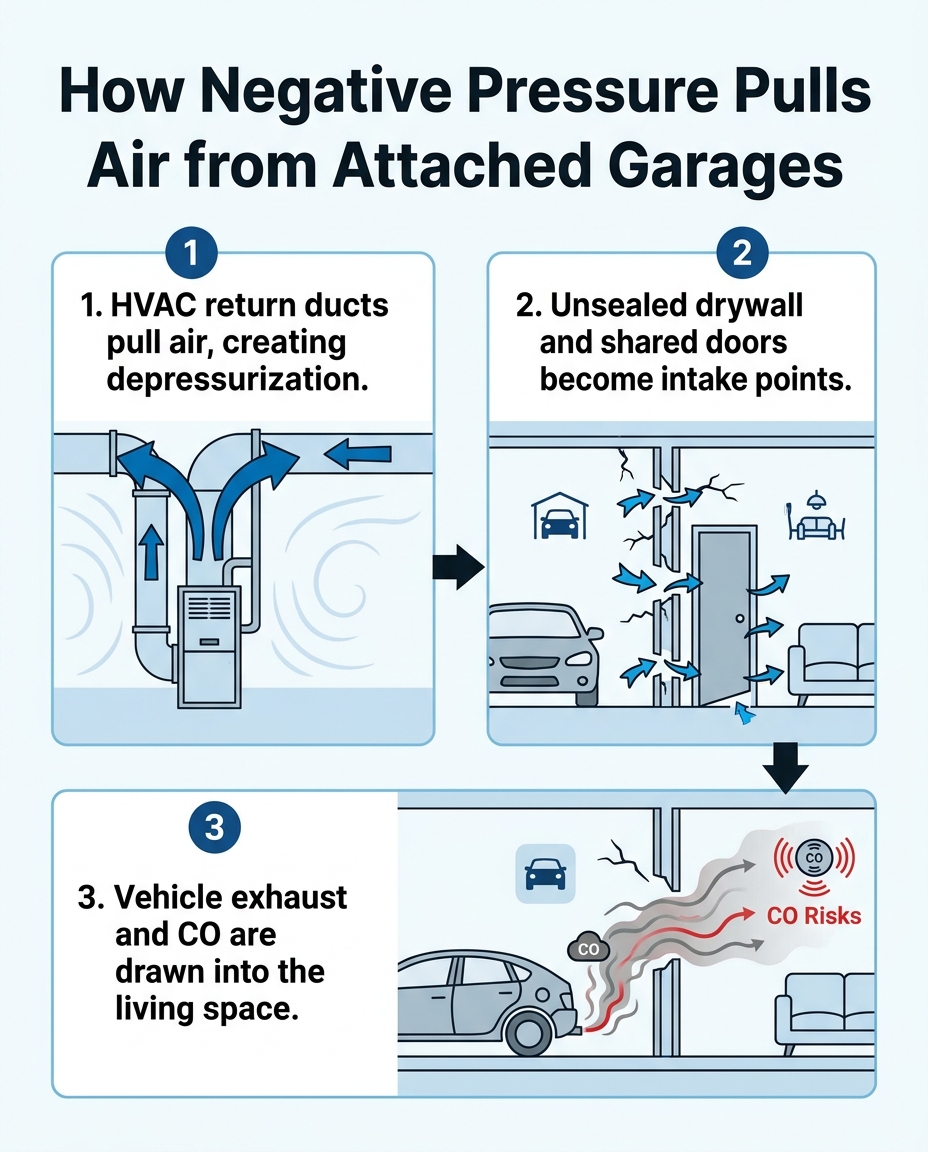
Attached garages are incredibly convenient, especially during harsh Midwestern winters, but they act as concentrated holding tanks for some of the most dangerous airborne pollutants in a residential setting. Because these spaces are rarely climate-controlled or actively ventilated, any gases released inside them linger for hours. When a home falls into negative pressure, the garage essentially becomes a toxic supply reservoir for the house.
Consider the most common sources of carbon monoxide found just on the other side of your interior garage door. Warming up a vehicle for even a few minutes with the garage door open can still trap a massive volume of exhaust against the back wall. Portable generators operated too close to the structure, gas-powered lawnmowers cooling down after a late-season trim, and stored chemical solvents all off-gas heavily. If your house is depressurized, the HVAC system will pull these concentrated fumes through the walls and distribute them through your ductwork into every bedroom and living space.
• Vehicle Exhaust — Common Garage Activity: Warming up cars on cold mornings — Risk Factor During Depressurization: Extremely High: Produces massive CO volumes rapidly.
• Gas-Powered Equipment — Common Garage Activity: Storing warm mowers or snowblowers — Risk Factor During Depressurization: Moderate: Off-gasses as engines cool down in enclosed spaces.
• Portable Generators — Common Garage Activity: Running backup power near the garage door — Risk Factor During Depressurization: Severe: Deadly levels of CO can backdraft into the home instantly.
• Water Heaters / Furnaces — Common Garage Activity: Early-fall testing of garage-located units — Risk Factor During Depressurization: High: Starved combustion air can cause immediate backdrafting.
Furthermore, early-fall furnace testing can inadvertently create severe backdrafts. If your heating equipment is located in or near the garage and the area is starved for combustion air, the equipment may pull its required air down the exhaust flue instead of venting safely outward. This backdrafting spills raw carbon monoxide directly into the surrounding space. The Environmental Protection Agency (EPA) explicitly warns against the indoor air quality dangers of attached structures, noting that airborne pollutants transfer easily when pressure boundaries are compromised. In typical Derby suburban homes with attached garages, this threat is a daily reality that requires proactive management.
The shift from summer to winter fundamentally changes how a house breathes. During the warmer months, windows are occasionally opened, doors are frequently used, and the home experiences a degree of natural ventilation. However, the rapid transition to cold Kansas winters causes homeowners to seal their houses tight in September, which heavily exacerbates negative pressure effects the moment the furnace kicks on.
This seasonal shift involves a flurry of weatherproofing activities. You likely spend weekends adding fresh weatherstripping to exterior doors, caulking drafty window frames, and ensuring the attic access is closed off. While these steps are excellent for reducing your energy footprint, they create a much "tighter" home envelope. A tight home is incredibly unforgiving of HVAC airflow imbalances. When the blower motor activates in a tightly sealed house, any discrepancy between supply and return air immediately spikes the negative pressure because there are no longer any natural drafts to provide make-up air.
This creates a critical vulnerability window during the September pre-heating-season. Your home is already sealed against the impending cold, but your heating system is just beginning its heavy operational cycles. If the ductwork is unbalanced, the furnace will aggressively hunt for air, pulling fiercely against the garage boundary walls. Addressing this before the deep freezes arrive ensures that your weatherproofing efforts keep you warm without accidentally trapping hazardous gases inside.
Understanding exactly how air travels from a garage into a living room requires a close look at local building practices. During our countless service calls throughout the area, our technicians have noticed a distinct pattern: many Derby suburban homes with attached garages feature shared HVAC boundary walls that span the entire length of the house. These walls are supposed to act as impenetrable barriers, but over time, settling foundations, thermal expansion, and simple wear and tear create microscopic pathways for depressurized air to travel through.
Even a well-built home has structural weak points that succumb to the pull of negative pressure. When our MJB Heating & Cooling team is planning for a safe furnace installation or a system upgrade, we always meticulously assess these common vulnerabilities to ensure the new blower motor does not overpower the home's structural envelope.
• Unsealed drywall gaps: The seams where the garage ceiling meets the shared interior wall often develop hairline cracks. Under negative pressure, these tiny gaps act like straws, pulling contaminated air directly into the wall cavities and eventually into the house.
• Utility penetrations: Plumbers and electricians drill holes through the shared boundary wall to run pipes and wiring. If these penetrations are not meticulously sealed with fire-rated foam or caulk, they become high-volume air leaks.
• The entry door threshold: The door leading from the house to the garage is one of the most common culprits. Worn weatherstripping or a missing bottom sweep allows a constant stream of garage air to slide underneath the door whenever the HVAC blower activates.
• Attic access hatches: If your garage features a push-up hatch leading to a shared attic space, negative pressure in the house can pull garage air up into the attic, where it then seeps down into the living areas through recessed lighting fixtures and ceiling fans.
• Ductwork routing: In some layouts, supply or return ducts are routed through the unconditioned ceiling of the garage. If the joints on these metal trunks are compromised, the return side will actively suck vehicle exhaust directly into the duct system.
Preventing dangerous airflow imbalances is not just a matter of comfort; it is heavily regulated by building and mechanical codes designed to protect human life. Strict adherence to local codes is the primary defense against carbon monoxide backdrafting. Professional code compliance ensures that firewalls remain intact, combustion equipment receives adequate make-up air, and duct systems are sealed according to rigid safety standards.
Local building codes mandate specific firewall integrity and air sealing between garages and living spaces. This includes using specialized drywall, self-closing fire doors, and approved sealants around all utility penetrations. When these codes are ignored or bypassed during renovations, the home's pressure boundary is destroyed. At MJB Heating & Cooling, we pride ourselves on our deep local expertise in Derby's specific suburban home architectures and our strict adherence to Kansas safety and venting codes. Understanding how these distinct home layouts age and shift allows our trained technicians to spot vulnerabilities that typical visual inspections miss.
A professional inspection goes far beyond just changing a filter; it involves verifying that every mechanical component interacts safely with the home's architecture. During a recent winter, our team responded when a local homeowner reached out on a frigid day because their heater completely stopped working. One of our technicians arrived within 10 minutes, restored the heat, and crucially, identified a venting pipe that was no longer up to code. Addressing that code violation immediately prevented a potential backdrafting disaster, ensuring the system vented safely outward and earning MJB Heating & Cooling a customer for life. This level of thorough, code-compliant inspection is what we believe separates a safe home from a hazardous one.
Generic advice often suggests simply opening a window or changing a filter to improve air quality, but mechanical negative pressure requires mechanical solutions. Duct balancing, static pressure testing, and combustion air verification are complex procedures that require specialized manometers, airflow hoods, and licensed professionals. Attempting to modify ductwork or adjust blower speeds without the proper diagnostic tools can easily worsen the depressurization.
Before the deep cold sets in during the September pre-heating-season, our team highly recommends securing a comprehensive fall HVAC safety inspection as the most effective way to protect your property. If you need professional furnace repair or seasonal maintenance, ensure your technician performs a full safety protocol.
A comprehensive safety check should include:
• Testing static pressure: Measuring the exact airflow balance between the supply and return sides of the ductwork to identify hidden vacuums.
• Inspecting heat exchangers: Utilizing specialized cameras to check for microscopic cracks that could leak combustion gases into the airstream.
• Verifying safe venting: Ensuring that the flue pipes have the correct upward slope and are free from blockages that could cause backdrafting.
• Evaluating combustion air: Confirming that the heating equipment has a dedicated, unimpeded source of fresh air so it does not pull from the surrounding room.
• Checking the home envelope: Identifying major air leaks along the garage boundary walls that could serve as intake points for exhaust fumes.
As a secondary line of defense, proper placement of carbon monoxide detectors is vital. Detectors should be installed on every level of the home, but specifically, one should be placed within 10 feet of the door leading to the attached garage. This ensures that if negative pressure does pull fumes inside, the alarm will sound before the gas reaches the bedrooms.
Before answering these common questions—and while our team frequently assists homeowners with topics like comparing Daikin to other HVAC brands—we want to address the most pressing concerns regarding indoor air quality and safety in typical Derby suburban homes with attached garages.
Yes, carbon monoxide can easily travel from an attached garage into a house, especially if the home is experiencing negative air pressure. The gas moves through unsealed gaps in the drywall, around poorly weatherstripped doors, and through utility penetrations in the shared wall. Because carbon monoxide is colorless and odorless, it can fill the living space entirely undetected without proper alarms.
Fixing negative air pressure requires balancing the HVAC system so that the amount of air supplied matches the amount of air returned. This is typically achieved by adjusting blower motor speeds, resizing restrictive return ducts, unblocking supply registers, or installing a dedicated make-up air system. Because this involves precise airflow calculations, it requires specialized diagnostic tools and a licensed professional.
Your HVAC system pulls air from the garage because the main living area is depressurized, creating a vacuum that seeks air from the path of least resistance. If the boundary wall between the house and the garage has unsealed gaps or a poorly fitted door, the system will suck the unconditioned garage air inside. This usually indicates that your return ducts are pulling too much air or your supply vents are restricted.
Attached garages are safe when proper building codes are strictly followed and the home maintains neutral air pressure. Safety depends on an intact, sealed firewall between the garage and the living space, as well as an unbalanced HVAC system not creating a vacuum effect. Regular inspections and proper carbon monoxide detector placement are necessary to maintain this safety.
You should have your home's static pressure and airflow tested at least once a year during your annual fall HVAC maintenance. It is also highly recommended to test the pressure anytime you make significant changes to the home's envelope, such as installing new weatherstripping, upgrading windows, or remodeling adjacent spaces.
Negative air pressure is a serious hazard, but it is ultimately a solvable mechanical issue. You do not have to spend the winter worrying about whether your home is pulling dangerous exhaust fumes through the walls. By understanding the mechanics of your ductwork and the vulnerabilities of your garage boundary, you are already equipped to make informed decisions about your indoor air quality.
The critical window of the September pre-heating-season is the perfect time to act. Do not wait until the furnace is running around the clock to find out that your home's airflow is dangerously unbalanced. Schedule a professional airflow and safety inspection today to ensure your system is properly calibrated, your boundary walls are secure, and your family is safe from hidden carbon monoxide risks all winter long.


Our A/C stopped working on a Sunday and due to health issues, we needed to find a service company available on a Sunday. I called MJB and left a message on their emergency voice mail. Within 10 minutes Tom Buck called me to hear my description of the symptoms. He was just finishing an appointment in Wichita and would be on his way to my home on the south end of Derby. He arrived within 30 minutes! From start to finish he was the perfect example of what you could ever hope for in an HVAC tech and a human being. His evaluation of our system inside and out was as thorough as I could ever imagine and once he was done with the repair, our system is running as well or better than ever. Well worth the price for the evaluation, parts, and labor. Thank you again Tom for an awesome experience.
Our AC went out during the hottest days of the year, and they were out next day! We have been jerked around by a shoddy home warranty for years. We finally had a chance to pick our own repair people, and MJB came highly recommended. I can see why! I was impressed with the honesty and speed at which they fixed our AC unit!
Our commercial building had a lightening/electrical strike and damaged our 20 ton AC unit. No one could find us a new unit before the end of September. Imagining going all of August and September with no AC in Kansas and working inside near 100 degree temps is less than thrilling. Dale and the team at MJB called around and saved the day. They had us a new unit 5 weeks earlier than other could promise and I now have happy employees. The unit is amazingly quiet, super cold and so much more energy efficient. Thank you for being our super hero!
Came out and installed my new furnace. Was very polite and affordable. They are very acknowledgeable and I highly recommend!
Thank you very much. We had our 1st warm night in 3weeks. MJB took the time and effort to find the real problem. And the employees were kind and thoughtful and explained things very well. I cannot thank you and all of MJB. Will recommend you highly. Thanks again Marjorie Herman Oxford Kansas
We had a new system installed and I was so impressed with how quick they were in come out and install it, in the middle of a hot summer day. They were so friendly & very professional. I had a small problem with a weird sound and they came over immediately and fixed it. Love them!