.avif)





Blogs
Stay updated with our latest blog posts.

Is that strange, rattling noise coming from your basement just a minor hiccup, or a warning that you are facing the choice between Repairing a Draft Inducer Motor vs. Replacing an Aging Furnace? When you turn your heating system on for the first time during the September pre-heating season, discovering a mechanical issue can be stressful. The draft inducer motor is often the culprit behind those loud, grinding startup sounds you hear before the warm air ever starts blowing. But before you simply swap out the failing part, you have to decide if a localized fix makes sense for your home, or if it is time to look at the bigger picture.
For reliable guidance to help you navigate this choice, explore our professional HVAC services or learn about our flexible financing options for new furnaces.
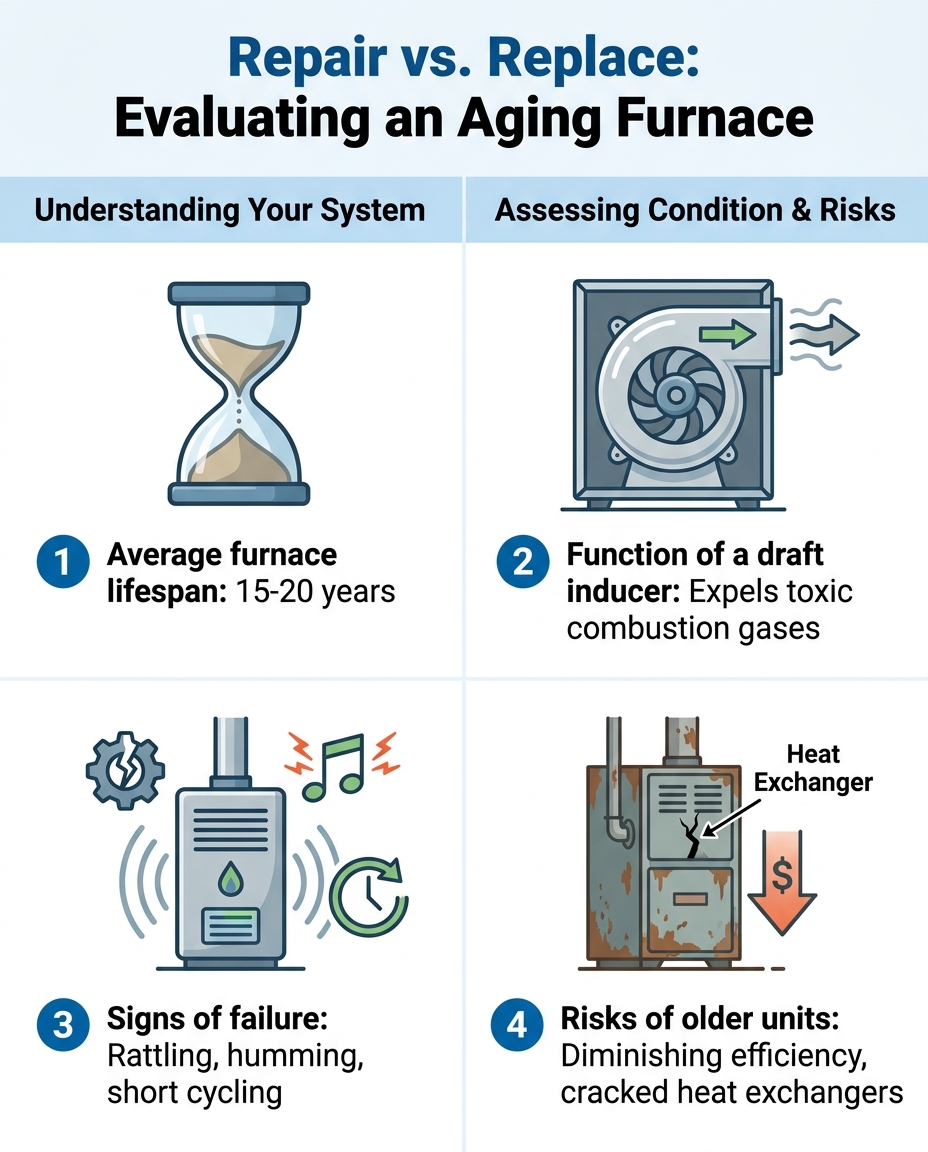
Most homeowners do not realize that the draft inducer motor is one of the most important safety mechanisms inside a modern heating system. Before your furnace even attempts to ignite the burners, this small but powerful fan kicks on. Its primary job is to clear the heat exchanger of any lingering gases from the previous heating cycle and establish a strong, steady draft that will pull fresh combustion gases—including toxic carbon monoxide—safely out of your home through the exhaust flue.
Because it plays such a vital role in protecting your indoor air quality, the inducer is tied directly to your furnace's safety sequence. If the motor fails to create enough suction, a safety sensor called the pressure switch will detect the lack of draft and completely lock down the ignition process. Your system simply will not run. While replacing this motor is a standard procedure for a qualified technician, experiencing this failure on a 15-year-old gas furnace is often a symptom of much broader system wear and tear.
A critical safety warning: Because the draft inducer is directly responsible for venting deadly carbon monoxide out of your living space, replacing or repairing this component is never a do-it-yourself project. Improper installation or a failure to properly seal the venting system can result in severe health hazards. Always rely on a licensed professional to handle combustion-related repairs.
1. Initiates the heating cycle safely: By starting first, it ensures the combustion chamber is entirely clear of leftover, potentially explosive gases before the spark igniter or hot surface igniter activates.
2. Prevents toxic gas buildup: It forces carbon monoxide and other harmful byproducts of the combustion process up and out of the exhaust flue, preventing them from mixing with the air circulated into your living rooms.
3. Communicates with the pressure switch: It provides the necessary negative pressure required to close the pressure switch, which acts as the ultimate safety gatekeeper for your furnace's gas valve.
How do you know if the inducer is actually the root of your heating problems? Because this motor is the very first component to activate when your thermostat calls for heat, its symptoms are usually quite distinct and occur at the very beginning of the cycle. Catching these signs early—especially during the September pre-heating season—gives you time to evaluate your options without the pressure of a freezing house.
• Loud rattling or vibrating: If you hear a distinct rattling noise as soon as the furnace tries to start, the inducer fan wheel inside the housing may be loose, cracked, or unbalanced.
• A continuous humming sound: A low hum without any fan movement usually points to a seized motor bearing or a failed electrical capacitor. The motor is receiving power, but it cannot physically spin.
• Harsh grinding or screeching: This is the classic sound of metal-on-metal friction, indicating that the bearings inside the draft inducer motor are completely worn out and the part is nearing total failure.
• Short cycling without ignition: If you hear the furnace click on, the fan run briefly, and then the entire system shuts down before producing any heat, the inducer is likely failing to generate enough draft to satisfy the pressure switch.
If you notice any of these distinct warning signs, the smartest next step is to schedule a furnace inspection. A professional diagnostic will confirm whether the inducer is the sole issue or if other components are also failing.
Here is the thing: replacing a draft inducer motor is not inherently a bad investment. In many scenarios, it is the most logical and cost-effective choice you can make. The decision heavily depends on the age, condition, and maintenance history of your current heating system.
If your furnace is less than ten years old and has been consistently maintained, a localized repair usually makes perfect sense. In these younger systems, the core components—specifically the heat exchanger and the primary blower motor—are likely still in excellent condition and have many years of reliable service left. Swapping out the inducer motor restores the safety sequence and gets your system back to peak performance without requiring a massive financial commitment.
However, the math changes drastically when you are dealing with a 15-year-old gas furnace. The average lifespan of a standard residential gas furnace is between 15 and 20 years. When a major component like the inducer fails at this late stage, it is rarely an isolated incident. Investing in a significant repair on a unit that is already nearing the end of its functional life carries substantial financial risk, as you are essentially resetting the clock on just one small part while the rest of the machine continues to age.
When you are evaluating a repair on an older unit, you have to look beyond the immediate fix. The concept of diminishing returns applies perfectly to aging HVAC equipment. Fixing one component on a system that has been running for a decade and a half often precedes a rapid cascade of other mechanical failures. You might replace the inducer motor today, only to have the primary blower motor fail next month, or the gas valve fail mid-winter.
The most severe risk of nursing an old system along is the condition of the heat exchanger. The heat exchanger undergoes extreme thermal stress every time the furnace cycles on and off. Over 15 to 20 years, this constant expansion and contraction causes the metal to fatigue. Eventually, hairline cracks develop. A cracked heat exchanger is a critical failure that poses a direct carbon monoxide threat to your home. If a technician discovers a cracked heat exchanger while replacing your inducer motor, the furnace is legally and safely dead—it must be shut down immediately.
Furthermore, efficiency degrades significantly over time. A 15-year-old gas furnace that was rated at 80% AFUE (Annual Fuel Utilization Efficiency) when it was brand new is likely operating at a much lower efficiency today due to wear, tear, and dirt accumulation. This means an older unit costs noticeably more to operate every single month, even when it is fully repaired. While keeping up with a preventative HVAC maintenance plan is crucial for safety and performance, no amount of tune-ups can reverse the fundamental aging process of a two-decade-old machine.
When one part fails on an older furnace, others are usually close behind. Here is what typically follows a late-stage inducer failure:
• Blower motor wear and tear: The main fan that pushes warm air through your ducts operates under heavy load and often burns out shortly after other motors begin to fail.
• Ignition system degradation: Hot surface igniters become brittle and weak over thousands of heating cycles, eventually failing to light the burners.
• Heat exchanger fatigue and cracking: The ultimate system-ender. Once the metal fatigues and cracks, the entire furnace must be replaced to ensure your family's safety.
To make the best decision for your home, it helps to look at the facts objectively. Comparing the short-term fix of a motor replacement against the long-term investment of a full system upgrade clarifies the true cost of each option. If you decide that an upgrade is the right path, we highly recommend comparing Daikin to other major HVAC brands to understand the advanced features available on modern equipment.
• Upfront Cost — Repairing the Inducer Motor: Lower initial investment; pays only for the specific part and labor. — Replacing the Aging Furnace: Higher initial investment, but secures heating for the next 15-20 years.
• Long-Term Value — Repairing the Inducer Motor: Low on older units. High risk of subsequent component failures. — Replacing the Aging Furnace: High. Resets the lifespan of your entire heating system with a new warranty.
• Safety Profile — Repairing the Inducer Motor: Restores venting, but leaves an aging heat exchanger in place. — Replacing the Aging Furnace: Maximum safety. Pristine heat exchanger and modern, highly sensitive safety controls.
• Energy Efficiency — Repairing the Inducer Motor: No improvement. You continue paying to run an inefficient, older system. — Replacing the Aging Furnace: Significant improvement. Modern AFUE ratings lower monthly bills, and generic federal tax credits or utility incentives may apply to qualifying high-efficiency models.
• Peace of Mind — Repairing the Inducer Motor: Temporary relief, often accompanied by worry about what will break next. — Replacing the Aging Furnace: Complete confidence that your home will stay warm through the harshest winter nights.
The window to make a calm, calculated decision is right now, during the September pre-heating season. Once the first freeze arrives, HVAC schedules become completely overwhelmed with emergency no-heat calls. Waiting until your furnace completely fails in the middle of a cold snap limits your options, increases your stress, and often forces you into a rushed decision.
With the reality of Derby, KS freezing winter temperatures, uninterrupted heating is not just a matter of comfort—it is a critical safety requirement. A mid-winter breakdown can quickly lead to frozen, bursting pipes, extensive property damage, and a dangerously cold environment for your family. We see this pattern frequently. For example, one local homeowner reached out to us on a frigid winter day when their heater completely stopped working. A technician was able to arrive quickly and restore the heat, but during the repair, they also identified an out-of-code hot water tank pipe that posed an additional risk. Emergency situations often reveal broader safety issues that could have been addressed calmly during the fall.
A planned replacement in the autumn is always smoother than an emergency swap during a blizzard. You have the time to research your options, compare high-efficiency models, and schedule the installation at your convenience, rather than huddling in blankets waiting for an emergency service window.
Ultimately, the choice between repairing a draft inducer motor and replacing an aging furnace comes down to a careful evaluation of safety, unit age, and long-term reliability. If your system is approaching the 15-year mark, a noisy inducer motor is often the warning bell that it is time to upgrade before the harsh weather sets in.
At MJB Heating & Cooling, our commitment is to provide transparent, honest recommendations. We do not push unnecessary replacements, but we also will not recommend a band-aid fix if it compromises your long-term safety. If you are unsure about the condition of your heating equipment, reach out to us for an objective, safety-focused evaluation. Let's ensure you have a clear, reliable plan to keep your home warm and secure all winter long.
Is it worth replacing an inducer motor on an old furnace?
The short answer is that it depends heavily on the age and overall condition of the unit. If the furnace is under 10 years old and the heat exchanger is in great shape, replacing the motor is usually a smart, cost-effective repair. However, if the unit is 15 to 20 years old, investing in a new motor is often a risky choice, as other major components are likely nearing failure.
What are the signs of a failing draft inducer motor?
The most common signs occur right when the thermostat calls for heat, before the blower fan turns on. You will typically hear loud rattling, a persistent humming without ignition, or harsh grinding noises. Additionally, if your furnace attempts to start but shuts down after a few seconds (short cycling), the inducer may be failing to create the necessary draft.
When should you replace a 15-year-old gas furnace?
You should strongly consider replacing a 15-year-old gas furnace when it requires a major, expensive repair like a draft inducer motor, blower motor, or control board replacement. At this age, the system has reached its average life expectancy, efficiency has likely degraded, and the risk of a dangerous cracked heat exchanger increases significantly with every passing season.
Can a furnace run without a draft inducer?
No, a modern gas furnace cannot and will not run without a functioning draft inducer. The inducer creates a negative pressure that is detected by a safety pressure switch; if the inducer fails, the pressure switch remains open, and the furnace's control board will completely lock out the ignition sequence to prevent toxic gases from backing up into your home.
What happens when a furnace inducer motor goes bad?
When the inducer motor goes bad, your heating system loses the ability to safely vent combustion exhaust. The furnace's built-in safety mechanisms will detect this failure immediately and prevent the gas valve from opening. As a result, your furnace will fail to produce any heat, leaving your home cold until the motor is professionally repaired or the unit is replaced.
Are there energy incentives available for upgrading an aging furnace?
Yes, upgrading from an old, inefficient furnace to a modern, high-efficiency heating system often qualifies for various incentives. Generic federal tax credits and local utility rebate programs may apply to qualifying installations, helping to offset the initial investment. We always recommend checking with your local utility provider or a tax professional to verify current programs and eligibility requirements.


Our A/C stopped working on a Sunday and due to health issues, we needed to find a service company available on a Sunday. I called MJB and left a message on their emergency voice mail. Within 10 minutes Tom Buck called me to hear my description of the symptoms. He was just finishing an appointment in Wichita and would be on his way to my home on the south end of Derby. He arrived within 30 minutes! From start to finish he was the perfect example of what you could ever hope for in an HVAC tech and a human being. His evaluation of our system inside and out was as thorough as I could ever imagine and once he was done with the repair, our system is running as well or better than ever. Well worth the price for the evaluation, parts, and labor. Thank you again Tom for an awesome experience.
Our AC went out during the hottest days of the year, and they were out next day! We have been jerked around by a shoddy home warranty for years. We finally had a chance to pick our own repair people, and MJB came highly recommended. I can see why! I was impressed with the honesty and speed at which they fixed our AC unit!
Our commercial building had a lightening/electrical strike and damaged our 20 ton AC unit. No one could find us a new unit before the end of September. Imagining going all of August and September with no AC in Kansas and working inside near 100 degree temps is less than thrilling. Dale and the team at MJB called around and saved the day. They had us a new unit 5 weeks earlier than other could promise and I now have happy employees. The unit is amazingly quiet, super cold and so much more energy efficient. Thank you for being our super hero!
Came out and installed my new furnace. Was very polite and affordable. They are very acknowledgeable and I highly recommend!
Thank you very much. We had our 1st warm night in 3weeks. MJB took the time and effort to find the real problem. And the employees were kind and thoughtful and explained things very well. I cannot thank you and all of MJB. Will recommend you highly. Thanks again Marjorie Herman Oxford Kansas
We had a new system installed and I was so impressed with how quick they were in come out and install it, in the middle of a hot summer day. They were so friendly & very professional. I had a small problem with a weird sound and they came over immediately and fixed it. Love them!