


.avif)





Blogs
Stay updated with our latest blog posts.
How kansas climate affects your hvac system is one of the most important things Central Kansas homeowners need to understand — because few places in the country put heating and cooling equipment through a harder annual test.
Here is a quick breakdown of the key ways Kansas weather strains your HVAC:
Wichita has recorded a high of 114°F and a low of -22°F — a swing of 136 degrees. That range alone tells you everything about why your HVAC system in Central Kansas faces challenges that systems in milder climates simply never encounter.
Understanding these pressures helps you make smarter decisions about your equipment, your maintenance schedule, and when it is time to call for help.
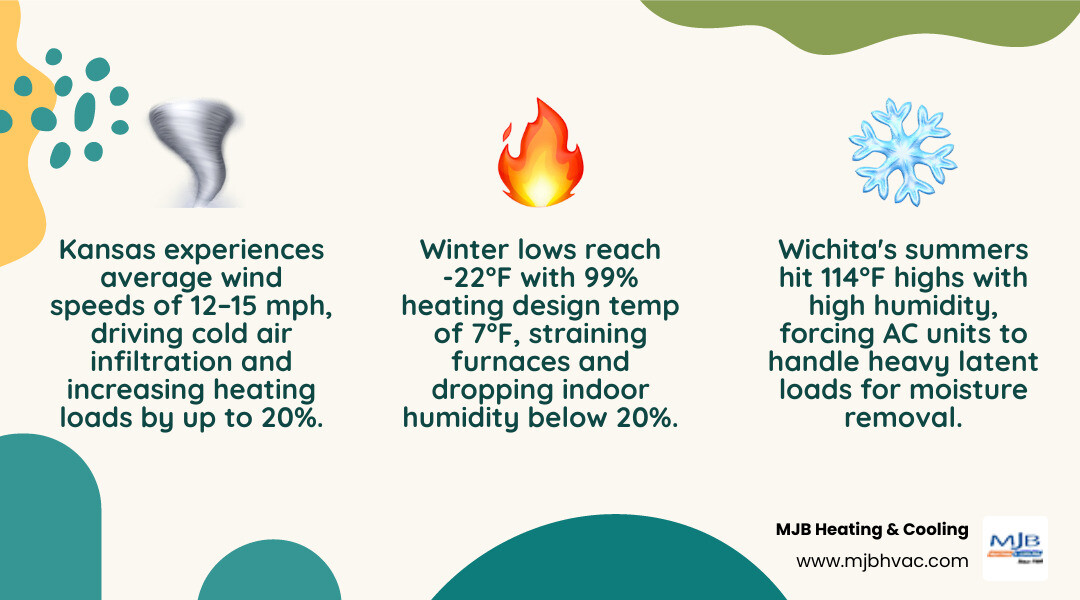
When the "blue northers" roll through Central Kansas, your heating system transforms from a comfort feature into survival equipment. In areas like Derby and Haysville, we often see temperatures drop into the teens or even below zero. This is where the "99% heating design temperature" comes into play. For Wichita, that number is 7°F—meaning your system is engineered to keep up with the cold 99% of the time, but those record-breaking nights push it into overdrive.
Gas furnaces generally thrive in these conditions, but they aren't without stress. The constant operation can lead to Heating System Is Causing Dry Air Problems, as the combustion process and constant air movement strip moisture from your home. This dry air doesn't just make your skin itchy; it actually makes the air feel colder, often tempting homeowners to crank the thermostat even higher, which further strains the unit.
For those using air-source heat pumps, the "balance point" is a critical concept. This is the outdoor temperature where the heat pump can no longer pull enough heat from the outside air to keep your home warm. In Kansas, once we hit the low 30s or 20s, many standard heat pumps struggle. They may trigger frequent defrost cycles to melt ice off the outdoor coils, or switch over to expensive "emergency" electric resistance heat. Furthermore, Kansas wind-driven infiltration—with average speeds of 12-15 mph—forces frigid air through tiny gaps in your siding and windows, significantly increasing the workload on your furnace.
If the winter is a test of raw power, the Kansas summer is a test of endurance and moisture control. In places like Andover and Augusta, we don't just deal with high temperatures; we deal with "latent load." This is the energy required to remove moisture from the air, rather than just lowering the temperature.
When humidity levels spike above 50%, your air conditioner has to run longer cycles to wring that water out of the air. If your system is oversized—a common mistake in some older Kansas homes—it might "short cycle," cooling the air too quickly and shutting off before it has a chance to dehumidify. This leaves you feeling clammy and uncomfortable. You might even find that your Heat Pump Isnt Dehumidifying Properly, leading to that musty "basement smell" in your living room.
Extreme heat waves can also lead to mechanical failure. When the thermometer hits 100°F, your outdoor condenser unit struggles to dissipate heat. If the coils are dirty or the airflow is restricted, the system can overheat and shut down entirely. We often see cases where Ac Fails During A Heatwave Andover Solutions are needed because the evaporator coil froze over. It sounds counterintuitive, but low refrigerant or restricted airflow causes the indoor coil to drop below freezing, turning condensation into a block of ice that stops all cooling in its tracks.
Kansas is famous for its "bipolar" weather. It is not uncommon to need the furnace at 6:00 AM and the air conditioner by 3:00 PM. These rapid shifts are brutal on HVAC components. One of the most common issues we see in the Wichita metro area is "short cycling," where the system turns on and off too frequently. This doesn't just waste energy; it puts massive wear and tear on the blower motor and the compressor.
If you start noticing your Hvac System Making Strange Noises, it’s often a sign that these temperature swings have taken their toll. In Haysville, we’ve found that Hvac Making Strange Noises In Haysville often points to expanding and contracting metal ducts or failing limit switches. The limit switch is a safety device that shuts the furnace off if it gets too hot; in a Kansas winter, if your air filter is clogged and the furnace is running non-stop, that switch can wear out prematurely.
Wind is another silent killer of efficiency. In our open prairie landscape, wind-driven infiltration can account for 25% to 40% of your energy loss. If your ductwork is located in an unconditioned attic or crawlspace—common in many 1970s-era Kansas homes—leaks can pull in dusty, hot, or freezing air directly into your breathing space. This also confuses your thermostat. If your thermostat is misplaced near a drafty window or a supply vent, it may "read" the wrong temperature, causing the system to cycle incorrectly and leaving some rooms like a sauna while others feel like an icebox.
Given how how kansas climate affects your hvac system, choosing the right replacement is a high-stakes decision. At MJB Heating & Cooling, we’ve spent decades helping neighbors in places like Mulvane and El Dorado find the perfect balance.
| System Type | Best For | Kansas Pros | Kansas Cons |
|---|---|---|---|
| Gas Furnace + AC | Most Central KS Homes | Reliable heat in sub-zero temps; low fuel costs. | Dry indoor air in winter; requires gas lines. |
| Air-Source Heat Pump | Well-insulated newer homes | High efficiency in spring/fall; one system for both. | Struggles below 25°F; needs backup heat. |
| Dual-Fuel (Hybrid) | The "Kansas Gold Standard" | Switches between electric and gas for peak efficiency. | Higher initial setup than a single system. |
| Geothermal | Large lots / Rural properties | Uses stable 55°F ground temp; lowest operating cost. | Requires land for ground loops or wells. |
For many of our customers in Wichita and Goddard, a Dual-Fuel system is the ultimate winner. It uses an electric heat pump for those mild 40-50°F days and automatically kicks over to the gas furnace when a cold front drops the temperature into the teens. This prevents the Heat Pump Performance Issues During Spring that many homeowners face when the weather is unpredictable.
We also see a growing interest in Geothermal heat pumps. While the air temperature in Kansas swings 136 degrees, the ground temperature just 10 feet down stays a constant 55°F to 60°F year-round. Geothermal systems use 25% to 50% less electricity than conventional systems because they don't have to "fight" the outdoor air. With federal tax credits available for high-efficiency upgrades and SEER2-compliant equipment, these systems are becoming more accessible for Kansas families looking for long-term savings.
Because of the extreme environment, "optional" maintenance doesn't exist in Kansas. If you skip a tune-up, the weather will eventually find the weakest link in your system. We recommend a semi-annual schedule: a cooling check in the spring and a heating safety inspection in the fall.
Following Essential Hvac Maintenance Tips For Your Furnace And Ac can extend your system's life by 3 to 5 years. In our area, this includes checking for hail damage. Kansas thunderstorms can flatten the delicate aluminum fins on your outdoor unit, choking off airflow and killing your efficiency. Installing hail guards is a smart move for any homeowner in the "Tornado Alley" corridor.
Air quality is another major factor. Between the agricultural dust in Newton and the pollen in the Wichita suburbs, your filters work overtime. We are often asked How Often Should Hvac Air Filters Be Changed. In Kansas, the answer is usually every 1 to 3 months. If you have pets or allergies, a high-quality filter or a whole-home Air Purification system can help eliminate summer allergens and keep your indoor air fresh when the house is sealed tight against the heat.
Finally, don't ignore your ducts. Leaky ducts in a hot Kansas attic can waste 30% of your cooling capacity. Sealing and insulating those lines ensures that the air you pay to cool actually makes it to your bedroom.
Heat pumps work by moving heat, not creating it. When the temperature drops below freezing, there is simply less heat available in the outdoor air to "grab." Most standard heat pumps hit their "balance point" around 25-30°F. Below this, they rely on supplemental electric heat strips, which are much less efficient. Additionally, the high moisture content in some Kansas winter storms can cause the outdoor unit to frost over, forcing it into frequent defrost cycles that interrupt the heating of your home.
In a humid climate like ours in the eastern half of the state, your AC has two jobs: lowering the temperature (sensible cooling) and removing moisture (latent cooling). High humidity forces the system to run longer cycles to pull gallons of water out of the air. This increases your energy bills and puts more wear on the compressor. If your home feels "sticky" even when the AC is running, it’s likely that the system is struggling with the latent load or is incorrectly sized for the home's moisture levels.
A dual-fuel system is ideal for almost any home in the Central Kansas region. If you currently have a gas furnace but want to lower your carbon footprint and take advantage of high-efficiency electric cooling, a hybrid is the way to go. It’s especially useful in Wichita because it handles our "shoulder seasons" (spring and fall) with the efficiency of a heat pump but provides the "scorching" heat of a gas furnace when the January deep freeze arrives. It offers the best of both worlds: comfort and cost-control.
At MJB Heating & Cooling, we don't just see ourselves as technicians; we see ourselves as your neighbors. Being a family-owned business founded in Derby, we’ve lived through the same ice storms and heatwaves that you have since 1984. We know that in Central Kansas, a working HVAC system isn't just a luxury—it's a necessity for your family's safety and comfort.
Whether you are in Wichita, Maize, or all the way out in Hutchinson, our team is committed to quality workmanship and an honest, "no-nonsense" approach to repairs and installations. We understand the unique ways the Kansas climate challenges your home, and we have the local expertise to keep your system running through the worst of it.
If you’re worried about how the upcoming season will affect your comfort, or if your system is making noises that have you concerned, don't wait for a total breakdown. Reach out to us for more info about our HVAC services and let us help you stay ahead of the weather. We serve a massive range of communities—from Andover to Winfield—and we’re ready to bring our 40+ years of experience to your front door.
How kansas climate affects your hvac system is one of the most important things Central Kansas homeowners need to understand — because few places in the country put heating and cooling equipment through a harder annual test.
Here is a quick breakdown of the key ways Kansas weather strains your HVAC:
Wichita has recorded a high of 114°F and a low of -22°F — a swing of 136 degrees. That range alone tells you everything about why your HVAC system in Central Kansas faces challenges that systems in milder climates simply never encounter.
Understanding these pressures helps you make smarter decisions about your equipment, your maintenance schedule, and when it is time to call for help.
When the "blue northers" roll through Central Kansas, your heating system transforms from a comfort feature into survival equipment. In areas like Derby and Haysville, we often see temperatures drop into the teens or even below zero. This is where the "99% heating design temperature" comes into play. For Wichita, that number is 7°F—meaning your system is engineered to keep up with the cold 99% of the time, but those record-breaking nights push it into overdrive.
Gas furnaces generally thrive in these conditions, but they aren't without stress. The constant operation can lead to Heating System Is Causing Dry Air Problems, as the combustion process and constant air movement strip moisture from your home. This dry air doesn't just make your skin itchy; it actually makes the air feel colder, often tempting homeowners to crank the thermostat even higher, which further strains the unit.
For those using air-source heat pumps, the "balance point" is a critical concept. This is the outdoor temperature where the heat pump can no longer pull enough heat from the outside air to keep your home warm. In Kansas, once we hit the low 30s or 20s, many standard heat pumps struggle. They may trigger frequent defrost cycles to melt ice off the outdoor coils, or switch over to expensive "emergency" electric resistance heat. Furthermore, Kansas wind-driven infiltration—with average speeds of 12-15 mph—forces frigid air through tiny gaps in your siding and windows, significantly increasing the workload on your furnace.
If the winter is a test of raw power, the Kansas summer is a test of endurance and moisture control. In places like Andover and Augusta, we don't just deal with high temperatures; we deal with "latent load." This is the energy required to remove moisture from the air, rather than just lowering the temperature.
When humidity levels spike above 50%, your air conditioner has to run longer cycles to wring that water out of the air. If your system is oversized—a common mistake in some older Kansas homes—it might "short cycle," cooling the air too quickly and shutting off before it has a chance to dehumidify. This leaves you feeling clammy and uncomfortable. You might even find that your Heat Pump Isnt Dehumidifying Properly, leading to that musty "basement smell" in your living room.
Extreme heat waves can also lead to mechanical failure. When the thermometer hits 100°F, your outdoor condenser unit struggles to dissipate heat. If the coils are dirty or the airflow is restricted, the system can overheat and shut down entirely. We often see cases where Ac Fails During A Heatwave Andover Solutions are needed because the evaporator coil froze over. It sounds counterintuitive, but low refrigerant or restricted airflow causes the indoor coil to drop below freezing, turning condensation into a block of ice that stops all cooling in its tracks.
Kansas is famous for its "bipolar" weather. It is not uncommon to need the furnace at 6:00 AM and the air conditioner by 3:00 PM. These rapid shifts are brutal on HVAC components. One of the most common issues we see in the Wichita metro area is "short cycling," where the system turns on and off too frequently. This doesn't just waste energy; it puts massive wear and tear on the blower motor and the compressor.
If you start noticing your Hvac System Making Strange Noises, it’s often a sign that these temperature swings have taken their toll. In Haysville, we’ve found that Hvac Making Strange Noises In Haysville often points to expanding and contracting metal ducts or failing limit switches. The limit switch is a safety device that shuts the furnace off if it gets too hot; in a Kansas winter, if your air filter is clogged and the furnace is running non-stop, that switch can wear out prematurely.
Wind is another silent killer of efficiency. In our open prairie landscape, wind-driven infiltration can account for 25% to 40% of your energy loss. If your ductwork is located in an unconditioned attic or crawlspace—common in many 1970s-era Kansas homes—leaks can pull in dusty, hot, or freezing air directly into your breathing space. This also confuses your thermostat. If your thermostat is misplaced near a drafty window or a supply vent, it may "read" the wrong temperature, causing the system to cycle incorrectly and leaving some rooms like a sauna while others feel like an icebox.
Given how how kansas climate affects your hvac system, choosing the right replacement is a high-stakes decision. At MJB Heating & Cooling, we’ve spent decades helping neighbors in places like Mulvane and El Dorado find the perfect balance.
| System Type | Best For | Kansas Pros | Kansas Cons |
|---|---|---|---|
| Gas Furnace + AC | Most Central KS Homes | Reliable heat in sub-zero temps; low fuel costs. | Dry indoor air in winter; requires gas lines. |
| Air-Source Heat Pump | Well-insulated newer homes | High efficiency in spring/fall; one system for both. | Struggles below 25°F; needs backup heat. |
| Dual-Fuel (Hybrid) | The "Kansas Gold Standard" | Switches between electric and gas for peak efficiency. | Higher initial setup than a single system. |
| Geothermal | Large lots / Rural properties | Uses stable 55°F ground temp; lowest operating cost. | Requires land for ground loops or wells. |
For many of our customers in Wichita and Goddard, a Dual-Fuel system is the ultimate winner. It uses an electric heat pump for those mild 40-50°F days and automatically kicks over to the gas furnace when a cold front drops the temperature into the teens. This prevents the Heat Pump Performance Issues During Spring that many homeowners face when the weather is unpredictable.
We also see a growing interest in Geothermal heat pumps. While the air temperature in Kansas swings 136 degrees, the ground temperature just 10 feet down stays a constant 55°F to 60°F year-round. Geothermal systems use 25% to 50% less electricity than conventional systems because they don't have to "fight" the outdoor air. With federal tax credits available for high-efficiency upgrades and SEER2-compliant equipment, these systems are becoming more accessible for Kansas families looking for long-term savings.
Because of the extreme environment, "optional" maintenance doesn't exist in Kansas. If you skip a tune-up, the weather will eventually find the weakest link in your system. We recommend a semi-annual schedule: a cooling check in the spring and a heating safety inspection in the fall.
Following Essential Hvac Maintenance Tips For Your Furnace And Ac can extend your system's life by 3 to 5 years. In our area, this includes checking for hail damage. Kansas thunderstorms can flatten the delicate aluminum fins on your outdoor unit, choking off airflow and killing your efficiency. Installing hail guards is a smart move for any homeowner in the "Tornado Alley" corridor.
Air quality is another major factor. Between the agricultural dust in Newton and the pollen in the Wichita suburbs, your filters work overtime. We are often asked How Often Should Hvac Air Filters Be Changed. In Kansas, the answer is usually every 1 to 3 months. If you have pets or allergies, a high-quality filter or a whole-home Air Purification system can help eliminate summer allergens and keep your indoor air fresh when the house is sealed tight against the heat.
Finally, don't ignore your ducts. Leaky ducts in a hot Kansas attic can waste 30% of your cooling capacity. Sealing and insulating those lines ensures that the air you pay to cool actually makes it to your bedroom.
Heat pumps work by moving heat, not creating it. When the temperature drops below freezing, there is simply less heat available in the outdoor air to "grab." Most standard heat pumps hit their "balance point" around 25-30°F. Below this, they rely on supplemental electric heat strips, which are much less efficient. Additionally, the high moisture content in some Kansas winter storms can cause the outdoor unit to frost over, forcing it into frequent defrost cycles that interrupt the heating of your home.
In a humid climate like ours in the eastern half of the state, your AC has two jobs: lowering the temperature (sensible cooling) and removing moisture (latent cooling). High humidity forces the system to run longer cycles to pull gallons of water out of the air. This increases your energy bills and puts more wear on the compressor. If your home feels "sticky" even when the AC is running, it’s likely that the system is struggling with the latent load or is incorrectly sized for the home's moisture levels.
A dual-fuel system is ideal for almost any home in the Central Kansas region. If you currently have a gas furnace but want to lower your carbon footprint and take advantage of high-efficiency electric cooling, a hybrid is the way to go. It’s especially useful in Wichita because it handles our "shoulder seasons" (spring and fall) with the efficiency of a heat pump but provides the "scorching" heat of a gas furnace when the January deep freeze arrives. It offers the best of both worlds: comfort and cost-control.
At MJB Heating & Cooling, we don't just see ourselves as technicians; we see ourselves as your neighbors. Being a family-owned business founded in Derby, we’ve lived through the same ice storms and heatwaves that you have since 1984. We know that in Central Kansas, a working HVAC system isn't just a luxury—it's a necessity for your family's safety and comfort.
Whether you are in Wichita, Maize, or all the way out in Hutchinson, our team is committed to quality workmanship and an honest, "no-nonsense" approach to repairs and installations. We understand the unique ways the Kansas climate challenges your home, and we have the local expertise to keep your system running through the worst of it.
If you’re worried about how the upcoming season will affect your comfort, or if your system is making noises that have you concerned, don't wait for a total breakdown. Reach out to us for more info about our HVAC services and let us help you stay ahead of the weather. We serve a massive range of communities—from Andover to Winfield—and we’re ready to bring our 40+ years of experience to your front door.
How kansas climate affects your hvac system is one of the most important things Central Kansas homeowners need to understand — because few places in the country put heating and cooling equipment through a harder annual test.
Here is a quick breakdown of the key ways Kansas weather strains your HVAC:
Wichita has recorded a high of 114°F and a low of -22°F — a swing of 136 degrees. That range alone tells you everything about why your HVAC system in Central Kansas faces challenges that systems in milder climates simply never encounter.
Understanding these pressures helps you make smarter decisions about your equipment, your maintenance schedule, and when it is time to call for help.
When the "blue northers" roll through Central Kansas, your heating system transforms from a comfort feature into survival equipment. In areas like Derby and Haysville, we often see temperatures drop into the teens or even below zero. This is where the "99% heating design temperature" comes into play. For Wichita, that number is 7°F—meaning your system is engineered to keep up with the cold 99% of the time, but those record-breaking nights push it into overdrive.
Gas furnaces generally thrive in these conditions, but they aren't without stress. The constant operation can lead to Heating System Is Causing Dry Air Problems, as the combustion process and constant air movement strip moisture from your home. This dry air doesn't just make your skin itchy; it actually makes the air feel colder, often tempting homeowners to crank the thermostat even higher, which further strains the unit.
For those using air-source heat pumps, the "balance point" is a critical concept. This is the outdoor temperature where the heat pump can no longer pull enough heat from the outside air to keep your home warm. In Kansas, once we hit the low 30s or 20s, many standard heat pumps struggle. They may trigger frequent defrost cycles to melt ice off the outdoor coils, or switch over to expensive "emergency" electric resistance heat. Furthermore, Kansas wind-driven infiltration—with average speeds of 12-15 mph—forces frigid air through tiny gaps in your siding and windows, significantly increasing the workload on your furnace.
If the winter is a test of raw power, the Kansas summer is a test of endurance and moisture control. In places like Andover and Augusta, we don't just deal with high temperatures; we deal with "latent load." This is the energy required to remove moisture from the air, rather than just lowering the temperature.
When humidity levels spike above 50%, your air conditioner has to run longer cycles to wring that water out of the air. If your system is oversized—a common mistake in some older Kansas homes—it might "short cycle," cooling the air too quickly and shutting off before it has a chance to dehumidify. This leaves you feeling clammy and uncomfortable. You might even find that your Heat Pump Isnt Dehumidifying Properly, leading to that musty "basement smell" in your living room.
Extreme heat waves can also lead to mechanical failure. When the thermometer hits 100°F, your outdoor condenser unit struggles to dissipate heat. If the coils are dirty or the airflow is restricted, the system can overheat and shut down entirely. We often see cases where Ac Fails During A Heatwave Andover Solutions are needed because the evaporator coil froze over. It sounds counterintuitive, but low refrigerant or restricted airflow causes the indoor coil to drop below freezing, turning condensation into a block of ice that stops all cooling in its tracks.
Kansas is famous for its "bipolar" weather. It is not uncommon to need the furnace at 6:00 AM and the air conditioner by 3:00 PM. These rapid shifts are brutal on HVAC components. One of the most common issues we see in the Wichita metro area is "short cycling," where the system turns on and off too frequently. This doesn't just waste energy; it puts massive wear and tear on the blower motor and the compressor.
If you start noticing your Hvac System Making Strange Noises, it’s often a sign that these temperature swings have taken their toll. In Haysville, we’ve found that Hvac Making Strange Noises In Haysville often points to expanding and contracting metal ducts or failing limit switches. The limit switch is a safety device that shuts the furnace off if it gets too hot; in a Kansas winter, if your air filter is clogged and the furnace is running non-stop, that switch can wear out prematurely.
Wind is another silent killer of efficiency. In our open prairie landscape, wind-driven infiltration can account for 25% to 40% of your energy loss. If your ductwork is located in an unconditioned attic or crawlspace—common in many 1970s-era Kansas homes—leaks can pull in dusty, hot, or freezing air directly into your breathing space. This also confuses your thermostat. If your thermostat is misplaced near a drafty window or a supply vent, it may "read" the wrong temperature, causing the system to cycle incorrectly and leaving some rooms like a sauna while others feel like an icebox.
Given how how kansas climate affects your hvac system, choosing the right replacement is a high-stakes decision. At MJB Heating & Cooling, we’ve spent decades helping neighbors in places like Mulvane and El Dorado find the perfect balance.
| System Type | Best For | Kansas Pros | Kansas Cons |
|---|---|---|---|
| Gas Furnace + AC | Most Central KS Homes | Reliable heat in sub-zero temps; low fuel costs. | Dry indoor air in winter; requires gas lines. |
| Air-Source Heat Pump | Well-insulated newer homes | High efficiency in spring/fall; one system for both. | Struggles below 25°F; needs backup heat. |
| Dual-Fuel (Hybrid) | The "Kansas Gold Standard" | Switches between electric and gas for peak efficiency. | Higher initial setup than a single system. |
| Geothermal | Large lots / Rural properties | Uses stable 55°F ground temp; lowest operating cost. | Requires land for ground loops or wells. |
For many of our customers in Wichita and Goddard, a Dual-Fuel system is the ultimate winner. It uses an electric heat pump for those mild 40-50°F days and automatically kicks over to the gas furnace when a cold front drops the temperature into the teens. This prevents the Heat Pump Performance Issues During Spring that many homeowners face when the weather is unpredictable.
We also see a growing interest in Geothermal heat pumps. While the air temperature in Kansas swings 136 degrees, the ground temperature just 10 feet down stays a constant 55°F to 60°F year-round. Geothermal systems use 25% to 50% less electricity than conventional systems because they don't have to "fight" the outdoor air. With federal tax credits available for high-efficiency upgrades and SEER2-compliant equipment, these systems are becoming more accessible for Kansas families looking for long-term savings.
Because of the extreme environment, "optional" maintenance doesn't exist in Kansas. If you skip a tune-up, the weather will eventually find the weakest link in your system. We recommend a semi-annual schedule: a cooling check in the spring and a heating safety inspection in the fall.
Following Essential Hvac Maintenance Tips For Your Furnace And Ac can extend your system's life by 3 to 5 years. In our area, this includes checking for hail damage. Kansas thunderstorms can flatten the delicate aluminum fins on your outdoor unit, choking off airflow and killing your efficiency. Installing hail guards is a smart move for any homeowner in the "Tornado Alley" corridor.
Air quality is another major factor. Between the agricultural dust in Newton and the pollen in the Wichita suburbs, your filters work overtime. We are often asked How Often Should Hvac Air Filters Be Changed. In Kansas, the answer is usually every 1 to 3 months. If you have pets or allergies, a high-quality filter or a whole-home Air Purification system can help eliminate summer allergens and keep your indoor air fresh when the house is sealed tight against the heat.
Finally, don't ignore your ducts. Leaky ducts in a hot Kansas attic can waste 30% of your cooling capacity. Sealing and insulating those lines ensures that the air you pay to cool actually makes it to your bedroom.
Heat pumps work by moving heat, not creating it. When the temperature drops below freezing, there is simply less heat available in the outdoor air to "grab." Most standard heat pumps hit their "balance point" around 25-30°F. Below this, they rely on supplemental electric heat strips, which are much less efficient. Additionally, the high moisture content in some Kansas winter storms can cause the outdoor unit to frost over, forcing it into frequent defrost cycles that interrupt the heating of your home.
In a humid climate like ours in the eastern half of the state, your AC has two jobs: lowering the temperature (sensible cooling) and removing moisture (latent cooling). High humidity forces the system to run longer cycles to pull gallons of water out of the air. This increases your energy bills and puts more wear on the compressor. If your home feels "sticky" even when the AC is running, it’s likely that the system is struggling with the latent load or is incorrectly sized for the home's moisture levels.
A dual-fuel system is ideal for almost any home in the Central Kansas region. If you currently have a gas furnace but want to lower your carbon footprint and take advantage of high-efficiency electric cooling, a hybrid is the way to go. It’s especially useful in Wichita because it handles our "shoulder seasons" (spring and fall) with the efficiency of a heat pump but provides the "scorching" heat of a gas furnace when the January deep freeze arrives. It offers the best of both worlds: comfort and cost-control.
At MJB Heating & Cooling, we don't just see ourselves as technicians; we see ourselves as your neighbors. Being a family-owned business founded in Derby, we’ve lived through the same ice storms and heatwaves that you have since 1984. We know that in Central Kansas, a working HVAC system isn't just a luxury—it's a necessity for your family's safety and comfort.
Whether you are in Wichita, Maize, or all the way out in Hutchinson, our team is committed to quality workmanship and an honest, "no-nonsense" approach to repairs and installations. We understand the unique ways the Kansas climate challenges your home, and we have the local expertise to keep your system running through the worst of it.
If you’re worried about how the upcoming season will affect your comfort, or if your system is making noises that have you concerned, don't wait for a total breakdown. Reach out to us for more info about our HVAC services and let us help you stay ahead of the weather. We serve a massive range of communities—from Andover to Winfield—and we’re ready to bring our 40+ years of experience to your front door.


How kansas climate affects your hvac system is one of the most important things Central Kansas homeowners need to understand — because few places in the country put heating and cooling equipment through a harder annual test.
Here is a quick breakdown of the key ways Kansas weather strains your HVAC:
• Extreme winter cold — Wichita's 99% heating design temperature sits around 7°F, pushing furnaces to their limits and causing heat pumps to lose efficiency fast
• Scorching, humid summers — Summer heat regularly tops 100°F, and eastern Kansas humidity forces air conditioners to work harder to remove moisture, not just heat
• Wild temperature swings — Kansas can see 40°F shifts within a single day, causing short cycling, component wear, and uneven comfort throughout your home
• Relentless wind — Average wind speeds of 12–15 mph drive cold air through gaps in your home's envelope, raising heating loads significantly
• Seasonal humidity extremes — High outdoor humidity in summer strains your AC, while dry winter heating drops indoor humidity to uncomfortable and damaging levels
• Wide climate zone variation — Southeast Kansas sits in IECC Zone 4A (mixed-humid) while the northwest falls in Zone 5A (cold), meaning system needs vary across the state
Wichita has recorded a high of 114°F and a low of -22°F — a swing of 136 degrees. That range alone tells you everything about why your HVAC system in Central Kansas faces challenges that systems in milder climates simply never encounter.
Understanding these pressures helps you make smarter decisions about your equipment, your maintenance schedule, and when it is time to call for help.

When the "blue northers" roll through Central Kansas, your heating system transforms from a comfort feature into survival equipment. In areas like Derby and Haysville, we often see temperatures drop into the teens or even below zero. This is where the "99% heating design temperature" comes into play. For Wichita, that number is 7°F—meaning your system is engineered to keep up with the cold 99% of the time, but those record-breaking nights push it into overdrive.
Gas furnaces generally thrive in these conditions, but they aren't without stress. The constant operation can lead to Heating System Is Causing Dry Air Problems, as the combustion process and constant air movement strip moisture from your home. This dry air doesn't just make your skin itchy; it actually makes the air feel colder, often tempting homeowners to crank the thermostat even higher, which further strains the unit.
For those using air-source heat pumps, the "balance point" is a critical concept. This is the outdoor temperature where the heat pump can no longer pull enough heat from the outside air to keep your home warm. In Kansas, once we hit the low 30s or 20s, many standard heat pumps struggle. They may trigger frequent defrost cycles to melt ice off the outdoor coils, or switch over to expensive "emergency" electric resistance heat. Furthermore, Kansas wind-driven infiltration—with average speeds of 12-15 mph—forces frigid air through tiny gaps in your siding and windows, significantly increasing the workload on your furnace.
If the winter is a test of raw power, the Kansas summer is a test of endurance and moisture control. In places like Andover and Augusta, we don't just deal with high temperatures; we deal with "latent load." This is the energy required to remove moisture from the air, rather than just lowering the temperature.
When humidity levels spike above 50%, your air conditioner has to run longer cycles to wring that water out of the air. If your system is oversized—a common mistake in some older Kansas homes—it might "short cycle," cooling the air too quickly and shutting off before it has a chance to dehumidify. This leaves you feeling clammy and uncomfortable. You might even find that your Heat Pump Isnt Dehumidifying Properly, leading to that musty "basement smell" in your living room.
Extreme heat waves can also lead to mechanical failure. When the thermometer hits 100°F, your outdoor condenser unit struggles to dissipate heat. If the coils are dirty or the airflow is restricted, the system can overheat and shut down entirely. We often see cases where Ac Fails During A Heatwave Andover Solutions are needed because the evaporator coil froze over. It sounds counterintuitive, but low refrigerant or restricted airflow causes the indoor coil to drop below freezing, turning condensation into a block of ice that stops all cooling in its tracks.
Kansas is famous for its "bipolar" weather. It is not uncommon to need the furnace at 6:00 AM and the air conditioner by 3:00 PM. These rapid shifts are brutal on HVAC components. One of the most common issues we see in the Wichita metro area is "short cycling," where the system turns on and off too frequently. This doesn't just waste energy; it puts massive wear and tear on the blower motor and the compressor.
If you start noticing your Hvac System Making Strange Noises, it’s often a sign that these temperature swings have taken their toll. In Haysville, we’ve found that Hvac Making Strange Noises In Haysville often points to expanding and contracting metal ducts or failing limit switches. The limit switch is a safety device that shuts the furnace off if it gets too hot; in a Kansas winter, if your air filter is clogged and the furnace is running non-stop, that switch can wear out prematurely.
Wind is another silent killer of efficiency. In our open prairie landscape, wind-driven infiltration can account for 25% to 40% of your energy loss. If your ductwork is located in an unconditioned attic or crawlspace—common in many 1970s-era Kansas homes—leaks can pull in dusty, hot, or freezing air directly into your breathing space. This also confuses your thermostat. If your thermostat is misplaced near a drafty window or a supply vent, it may "read" the wrong temperature, causing the system to cycle incorrectly and leaving some rooms like a sauna while others feel like an icebox.
Given how how kansas climate affects your hvac system, choosing the right replacement is a high-stakes decision. At MJB Heating & Cooling, we’ve spent decades helping neighbors in places like Mulvane and El Dorado find the perfect balance.
• Gas Furnace + AC — Best For: Most Central KS Homes — Kansas Pros: Reliable heat in sub-zero temps; low fuel costs. — Kansas Cons: Dry indoor air in winter; requires gas lines.
• Air-Source Heat Pump — Best For: Well-insulated newer homes — Kansas Pros: High efficiency in spring/fall; one system for both. — Kansas Cons: Struggles below 25°F; needs backup heat.
• Dual-Fuel (Hybrid) — Best For: The "Kansas Gold Standard" — Kansas Pros: Switches between electric and gas for peak efficiency. — Kansas Cons: Higher initial setup than a single system.
• Geothermal — Best For: Large lots / Rural properties — Kansas Pros: Uses stable 55°F ground temp; lowest operating cost. — Kansas Cons: Requires land for ground loops or wells.
For many of our customers in Wichita and Goddard, a Dual-Fuel system is the ultimate winner. It uses an electric heat pump for those mild 40-50°F days and automatically kicks over to the gas furnace when a cold front drops the temperature into the teens. This prevents the Heat Pump Performance Issues During Spring that many homeowners face when the weather is unpredictable.
We also see a growing interest in Geothermal heat pumps. While the air temperature in Kansas swings 136 degrees, the ground temperature just 10 feet down stays a constant 55°F to 60°F year-round. Geothermal systems use 25% to 50% less electricity than conventional systems because they don't have to "fight" the outdoor air. With federal tax credits available for high-efficiency upgrades and SEER2-compliant equipment, these systems are becoming more accessible for Kansas families looking for long-term savings.
Because of the extreme environment, "optional" maintenance doesn't exist in Kansas. If you skip a tune-up, the weather will eventually find the weakest link in your system. We recommend a semi-annual schedule: a cooling check in the spring and a heating safety inspection in the fall.
Following Essential Hvac Maintenance Tips For Your Furnace And Ac can extend your system's life by 3 to 5 years. In our area, this includes checking for hail damage. Kansas thunderstorms can flatten the delicate aluminum fins on your outdoor unit, choking off airflow and killing your efficiency. Installing hail guards is a smart move for any homeowner in the "Tornado Alley" corridor.
Air quality is another major factor. Between the agricultural dust in Newton and the pollen in the Wichita suburbs, your filters work overtime. We are often asked How Often Should Hvac Air Filters Be Changed. In Kansas, the answer is usually every 1 to 3 months. If you have pets or allergies, a high-quality filter or a whole-home Air Purification system can help eliminate summer allergens and keep your indoor air fresh when the house is sealed tight against the heat.
Finally, don't ignore your ducts. Leaky ducts in a hot Kansas attic can waste 30% of your cooling capacity. Sealing and insulating those lines ensures that the air you pay to cool actually makes it to your bedroom.
Heat pumps work by moving heat, not creating it. When the temperature drops below freezing, there is simply less heat available in the outdoor air to "grab." Most standard heat pumps hit their "balance point" around 25-30°F. Below this, they rely on supplemental electric heat strips, which are much less efficient. Additionally, the high moisture content in some Kansas winter storms can cause the outdoor unit to frost over, forcing it into frequent defrost cycles that interrupt the heating of your home.
In a humid climate like ours in the eastern half of the state, your AC has two jobs: lowering the temperature (sensible cooling) and removing moisture (latent cooling). High humidity forces the system to run longer cycles to pull gallons of water out of the air. This increases your energy bills and puts more wear on the compressor. If your home feels "sticky" even when the AC is running, it’s likely that the system is struggling with the latent load or is incorrectly sized for the home's moisture levels.
A dual-fuel system is ideal for almost any home in the Central Kansas region. If you currently have a gas furnace but want to lower your carbon footprint and take advantage of high-efficiency electric cooling, a hybrid is the way to go. It’s especially useful in Wichita because it handles our "shoulder seasons" (spring and fall) with the efficiency of a heat pump but provides the "scorching" heat of a gas furnace when the January deep freeze arrives. It offers the best of both worlds: comfort and cost-control.
At MJB Heating & Cooling, we don't just see ourselves as technicians; we see ourselves as your neighbors. Being a family-owned business founded in Derby, we’ve lived through the same ice storms and heatwaves that you have since 1984. We know that in Central Kansas, a working HVAC system isn't just a luxury—it's a necessity for your family's safety and comfort.
Whether you are in Wichita, Maize, or all the way out in Hutchinson, our team is committed to quality workmanship and an honest, "no-nonsense" approach to repairs and installations. We understand the unique ways the Kansas climate challenges your home, and we have the local expertise to keep your system running through the worst of it.
If you’re worried about how the upcoming season will affect your comfort, or if your system is making noises that have you concerned, don't wait for a total breakdown. Reach out to us for more info about our HVAC services and let us help you stay ahead of the weather. We serve a massive range of communities—from Andover to Winfield—and we’re ready to bring our 40+ years of experience to your front door.
How kansas climate affects your hvac system is one of the most important things Central Kansas homeowners need to understand — because few places in the country put heating and cooling equipment through a harder annual test.
Here is a quick breakdown of the key ways Kansas weather strains your HVAC:
Wichita has recorded a high of 114°F and a low of -22°F — a swing of 136 degrees. That range alone tells you everything about why your HVAC system in Central Kansas faces challenges that systems in milder climates simply never encounter.
Understanding these pressures helps you make smarter decisions about your equipment, your maintenance schedule, and when it is time to call for help.
When the "blue northers" roll through Central Kansas, your heating system transforms from a comfort feature into survival equipment. In areas like Derby and Haysville, we often see temperatures drop into the teens or even below zero. This is where the "99% heating design temperature" comes into play. For Wichita, that number is 7°F—meaning your system is engineered to keep up with the cold 99% of the time, but those record-breaking nights push it into overdrive.
Gas furnaces generally thrive in these conditions, but they aren't without stress. The constant operation can lead to Heating System Is Causing Dry Air Problems, as the combustion process and constant air movement strip moisture from your home. This dry air doesn't just make your skin itchy; it actually makes the air feel colder, often tempting homeowners to crank the thermostat even higher, which further strains the unit.
For those using air-source heat pumps, the "balance point" is a critical concept. This is the outdoor temperature where the heat pump can no longer pull enough heat from the outside air to keep your home warm. In Kansas, once we hit the low 30s or 20s, many standard heat pumps struggle. They may trigger frequent defrost cycles to melt ice off the outdoor coils, or switch over to expensive "emergency" electric resistance heat. Furthermore, Kansas wind-driven infiltration—with average speeds of 12-15 mph—forces frigid air through tiny gaps in your siding and windows, significantly increasing the workload on your furnace.
If the winter is a test of raw power, the Kansas summer is a test of endurance and moisture control. In places like Andover and Augusta, we don't just deal with high temperatures; we deal with "latent load." This is the energy required to remove moisture from the air, rather than just lowering the temperature.
When humidity levels spike above 50%, your air conditioner has to run longer cycles to wring that water out of the air. If your system is oversized—a common mistake in some older Kansas homes—it might "short cycle," cooling the air too quickly and shutting off before it has a chance to dehumidify. This leaves you feeling clammy and uncomfortable. You might even find that your Heat Pump Isnt Dehumidifying Properly, leading to that musty "basement smell" in your living room.
Extreme heat waves can also lead to mechanical failure. When the thermometer hits 100°F, your outdoor condenser unit struggles to dissipate heat. If the coils are dirty or the airflow is restricted, the system can overheat and shut down entirely. We often see cases where Ac Fails During A Heatwave Andover Solutions are needed because the evaporator coil froze over. It sounds counterintuitive, but low refrigerant or restricted airflow causes the indoor coil to drop below freezing, turning condensation into a block of ice that stops all cooling in its tracks.
Kansas is famous for its "bipolar" weather. It is not uncommon to need the furnace at 6:00 AM and the air conditioner by 3:00 PM. These rapid shifts are brutal on HVAC components. One of the most common issues we see in the Wichita metro area is "short cycling," where the system turns on and off too frequently. This doesn't just waste energy; it puts massive wear and tear on the blower motor and the compressor.
If you start noticing your Hvac System Making Strange Noises, it’s often a sign that these temperature swings have taken their toll. In Haysville, we’ve found that Hvac Making Strange Noises In Haysville often points to expanding and contracting metal ducts or failing limit switches. The limit switch is a safety device that shuts the furnace off if it gets too hot; in a Kansas winter, if your air filter is clogged and the furnace is running non-stop, that switch can wear out prematurely.
Wind is another silent killer of efficiency. In our open prairie landscape, wind-driven infiltration can account for 25% to 40% of your energy loss. If your ductwork is located in an unconditioned attic or crawlspace—common in many 1970s-era Kansas homes—leaks can pull in dusty, hot, or freezing air directly into your breathing space. This also confuses your thermostat. If your thermostat is misplaced near a drafty window or a supply vent, it may "read" the wrong temperature, causing the system to cycle incorrectly and leaving some rooms like a sauna while others feel like an icebox.
Given how how kansas climate affects your hvac system, choosing the right replacement is a high-stakes decision. At MJB Heating & Cooling, we’ve spent decades helping neighbors in places like Mulvane and El Dorado find the perfect balance.
| System Type | Best For | Kansas Pros | Kansas Cons |
|---|---|---|---|
| Gas Furnace + AC | Most Central KS Homes | Reliable heat in sub-zero temps; low fuel costs. | Dry indoor air in winter; requires gas lines. |
| Air-Source Heat Pump | Well-insulated newer homes | High efficiency in spring/fall; one system for both. | Struggles below 25°F; needs backup heat. |
| Dual-Fuel (Hybrid) | The "Kansas Gold Standard" | Switches between electric and gas for peak efficiency. | Higher initial setup than a single system. |
| Geothermal | Large lots / Rural properties | Uses stable 55°F ground temp; lowest operating cost. | Requires land for ground loops or wells. |
For many of our customers in Wichita and Goddard, a Dual-Fuel system is the ultimate winner. It uses an electric heat pump for those mild 40-50°F days and automatically kicks over to the gas furnace when a cold front drops the temperature into the teens. This prevents the Heat Pump Performance Issues During Spring that many homeowners face when the weather is unpredictable.
We also see a growing interest in Geothermal heat pumps. While the air temperature in Kansas swings 136 degrees, the ground temperature just 10 feet down stays a constant 55°F to 60°F year-round. Geothermal systems use 25% to 50% less electricity than conventional systems because they don't have to "fight" the outdoor air. With federal tax credits available for high-efficiency upgrades and SEER2-compliant equipment, these systems are becoming more accessible for Kansas families looking for long-term savings.
Because of the extreme environment, "optional" maintenance doesn't exist in Kansas. If you skip a tune-up, the weather will eventually find the weakest link in your system. We recommend a semi-annual schedule: a cooling check in the spring and a heating safety inspection in the fall.
Following Essential Hvac Maintenance Tips For Your Furnace And Ac can extend your system's life by 3 to 5 years. In our area, this includes checking for hail damage. Kansas thunderstorms can flatten the delicate aluminum fins on your outdoor unit, choking off airflow and killing your efficiency. Installing hail guards is a smart move for any homeowner in the "Tornado Alley" corridor.
Air quality is another major factor. Between the agricultural dust in Newton and the pollen in the Wichita suburbs, your filters work overtime. We are often asked How Often Should Hvac Air Filters Be Changed. In Kansas, the answer is usually every 1 to 3 months. If you have pets or allergies, a high-quality filter or a whole-home Air Purification system can help eliminate summer allergens and keep your indoor air fresh when the house is sealed tight against the heat.
Finally, don't ignore your ducts. Leaky ducts in a hot Kansas attic can waste 30% of your cooling capacity. Sealing and insulating those lines ensures that the air you pay to cool actually makes it to your bedroom.
Heat pumps work by moving heat, not creating it. When the temperature drops below freezing, there is simply less heat available in the outdoor air to "grab." Most standard heat pumps hit their "balance point" around 25-30°F. Below this, they rely on supplemental electric heat strips, which are much less efficient. Additionally, the high moisture content in some Kansas winter storms can cause the outdoor unit to frost over, forcing it into frequent defrost cycles that interrupt the heating of your home.
In a humid climate like ours in the eastern half of the state, your AC has two jobs: lowering the temperature (sensible cooling) and removing moisture (latent cooling). High humidity forces the system to run longer cycles to pull gallons of water out of the air. This increases your energy bills and puts more wear on the compressor. If your home feels "sticky" even when the AC is running, it’s likely that the system is struggling with the latent load or is incorrectly sized for the home's moisture levels.
A dual-fuel system is ideal for almost any home in the Central Kansas region. If you currently have a gas furnace but want to lower your carbon footprint and take advantage of high-efficiency electric cooling, a hybrid is the way to go. It’s especially useful in Wichita because it handles our "shoulder seasons" (spring and fall) with the efficiency of a heat pump but provides the "scorching" heat of a gas furnace when the January deep freeze arrives. It offers the best of both worlds: comfort and cost-control.
At MJB Heating & Cooling, we don't just see ourselves as technicians; we see ourselves as your neighbors. Being a family-owned business founded in Derby, we’ve lived through the same ice storms and heatwaves that you have since 1984. We know that in Central Kansas, a working HVAC system isn't just a luxury—it's a necessity for your family's safety and comfort.
Whether you are in Wichita, Maize, or all the way out in Hutchinson, our team is committed to quality workmanship and an honest, "no-nonsense" approach to repairs and installations. We understand the unique ways the Kansas climate challenges your home, and we have the local expertise to keep your system running through the worst of it.
If you’re worried about how the upcoming season will affect your comfort, or if your system is making noises that have you concerned, don't wait for a total breakdown. Reach out to us for more info about our HVAC services and let us help you stay ahead of the weather. We serve a massive range of communities—from Andover to Winfield—and we’re ready to bring our 40+ years of experience to your front door.


Our A/C stopped working on a Sunday and due to health issues, we needed to find a service company available on a Sunday. I called MJB and left a message on their emergency voice mail. Within 10 minutes Tom Buck called me to hear my description of the symptoms. He was just finishing an appointment in Wichita and would be on his way to my home on the south end of Derby. He arrived within 30 minutes! From start to finish he was the perfect example of what you could ever hope for in an HVAC tech and a human being. His evaluation of our system inside and out was as thorough as I could ever imagine and once he was done with the repair, our system is running as well or better than ever. Well worth the price for the evaluation, parts, and labor. Thank you again Tom for an awesome experience.
Our AC went out during the hottest days of the year, and they were out next day! We have been jerked around by a shoddy home warranty for years. We finally had a chance to pick our own repair people, and MJB came highly recommended. I can see why! I was impressed with the honesty and speed at which they fixed our AC unit!
Our commercial building had a lightening/electrical strike and damaged our 20 ton AC unit. No one could find us a new unit before the end of September. Imagining going all of August and September with no AC in Kansas and working inside near 100 degree temps is less than thrilling. Dale and the team at MJB called around and saved the day. They had us a new unit 5 weeks earlier than other could promise and I now have happy employees. The unit is amazingly quiet, super cold and so much more energy efficient. Thank you for being our super hero!
Came out and installed my new furnace. Was very polite and affordable. They are very acknowledgeable and I highly recommend!
Thank you very much. We had our 1st warm night in 3weeks. MJB took the time and effort to find the real problem. And the employees were kind and thoughtful and explained things very well. I cannot thank you and all of MJB. Will recommend you highly. Thanks again Marjorie Herman Oxford Kansas
We had a new system installed and I was so impressed with how quick they were in come out and install it, in the middle of a hot summer day. They were so friendly & very professional. I had a small problem with a weird sound and they came over immediately and fixed it. Love them!


