


.avif)





Blogs
Stay updated with our latest blog posts.
How your HVAC system prevents mold in four season climates comes down to one core function: controlling moisture before mold ever gets a chance to grow. Here's a quick breakdown of how it works across every season:
Kansas weather does not play nice with your home. Wichita homeowners deal with humid Gulf-moisture summers that routinely push outdoor humidity above 70%, followed by dry, bitter winters that seal homes tight and trap whatever moisture lingers inside. Then spring and fall arrive with rapid temperature swings that can flip 40 degrees in a single day.
That kind of climate is a mold problem waiting to happen — and your HVAC system is either your best defense or, if neglected, part of the problem. Mold spores are always present in your home at low levels. They only need two things to explode into a real infestation: moisture and time. Research shows mold can begin colonizing a damp surface in as little as 24 to 48 hours. That narrow window is exactly why consistent humidity control through your HVAC system matters every single month of the year — not just during the summer cooling season.

When we talk about mold prevention, we are really talking about moisture management. In a volatile climate like ours, your HVAC system acts as a mechanical "lung" for your home. It doesn't just change the temperature; it processes the air to ensure the relative humidity (RH) stays within the "Goldilocks zone" of 30% to 50%.
According to the CDC, keeping indoor humidity below 50% is the single most effective way to stop mold spores from colonizing. But achieving this in a place like Maize or El Dorado requires more than just a thermostat. We have to look at two scientific concepts: Sensible Load (the actual temperature of the air) and Latent Load (the amount of moisture in the air).
A standard air conditioner is designed to handle both, but in four-season climates, the balance shifts constantly. For instance, on a 75-degree day in Wichita with 85% humidity, the "sensible load" is low, so your AC might not run long enough to handle the massive "latent load." This is why understanding the Kansas climate HVAC guide is essential for local homeowners.
Another critical factor is building pressurization. If your HVAC system isn't balanced, it can create negative pressure, literally sucking humid outdoor air through the cracks in your walls and windows. By maintaining a slight positive pressure, your system ensures that air leaks out of your home rather than pulling moist air in, which protects your wall cavities from hidden mold growth.
| Season | Primary Mold Risk | HVAC Defense Strategy |
|---|---|---|
| Summer | High outdoor humidity (>70%) | Active dehumidification via cooling cycles |
| Fall | Dormant spores in idle ducts | Consistent airflow and filtration |
| Winter | Condensation on cold surfaces | Managed humidity and thermal insulation |
| Spring | High moisture, mild temps | Whole-home dehumidification |
Summer in the Wichita metro area is the "heavy air" season. When the temperature climbs to 95 degrees, your air conditioner becomes your primary mold fighter. As air passes over the freezing cold evaporator coils, moisture condenses into liquid water and drains away. This process is how your system manages the latent load.
However, a common issue we see in homes from Haysville to Park City is short-cycling. This often happens with oversized units. If a system is too big for the house, it reaches the target temperature so quickly that it shuts off before it has a chance to pull the humidity out of the air. You’re left with a home that is cool but "clammy." This trapped moisture is a buffet for mold. Understanding how Kansas severe weather affects your HVAC system can help you realize that bigger isn't always better when it comes to HVAC sizing.
You might think winter is too dry for mold, but that’s a dangerous misconception. In fact, winter is a hidden peak season for mold in many Kansas homes. Because we seal our homes tight to keep the heat in, we also trap moisture from cooking, showering, and breathing.
The biggest risk here is condensation. When warm, humid air from your furnace travels through metal ductwork located in a freezing attic or crawl space, the temperature difference causes the ducts to "sweat." This liquid water, combined with the dust inside your ducts, creates the perfect environment for mold. Furthermore, rapid thermal expansion and contraction can cause gaps to open in your ductwork, allowing moisture to seep in. This is why how indoor air quality affects your health is such a vital topic during the colder months when we spend 90% of our time indoors.
Modern technology has given us some incredible tools to supplement standard heating and cooling. If you live in an area prone to moisture, like Goddard or Valley Center, upgrading your system with specific mold-fighting features can save you thousands in remediation costs down the road.
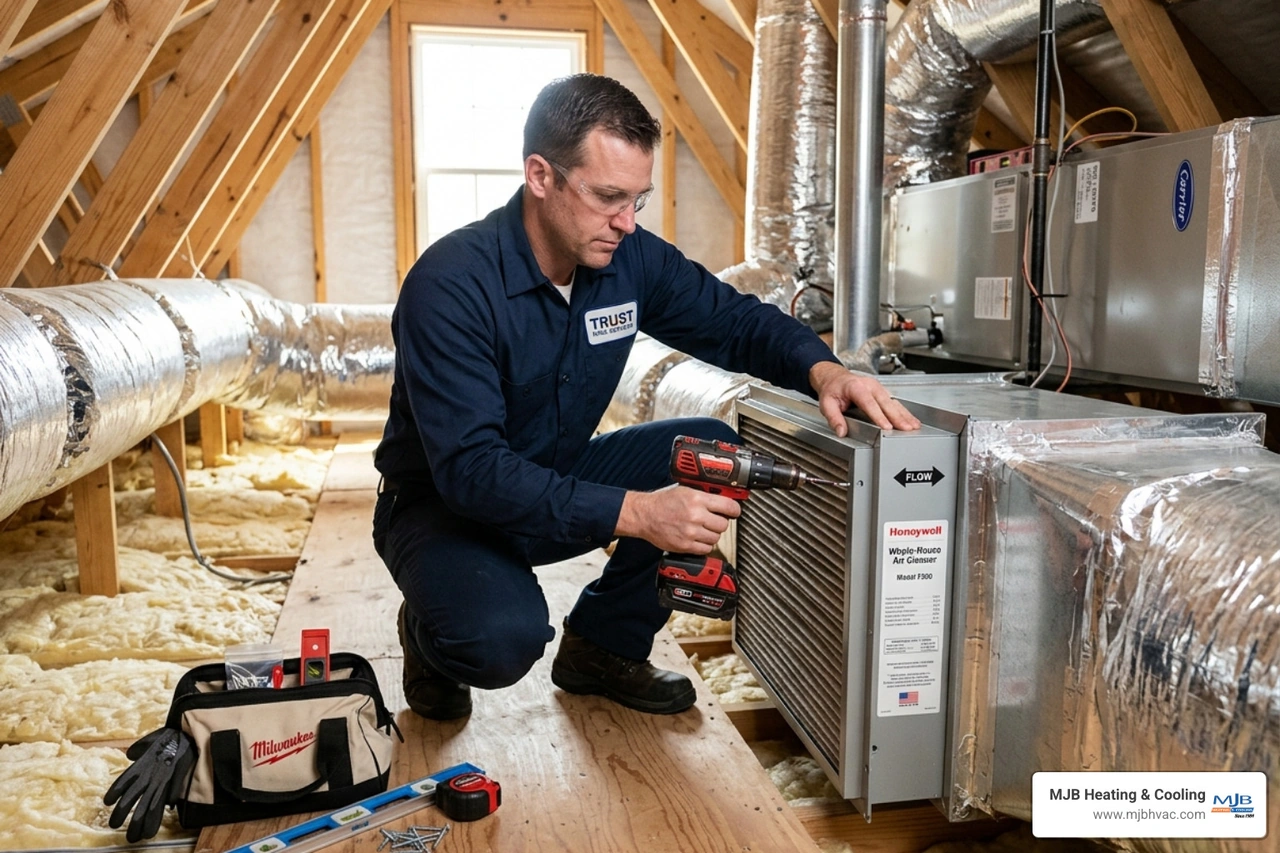
One of the best upgrades is a variable-speed air handler. Unlike standard motors that are either "on" or "off," variable-speed motors can run at lower speeds for longer periods. This provides much more consistent dehumidification and prevents the "stagnant air" pockets where mold loves to hide.
Top Mold-Fighting HVAC Upgrades:
If you've ever wondered is a whole house air purifier worth it, the answer is a resounding yes if you are concerned about biological growth and allergens.
The "shoulder seasons"—those weeks in May and September when it's not quite hot enough for the AC but too humid to be comfortable—are the most dangerous times for mold. A whole-house dehumidifier works independently of your cooling system. It can pull up to 120 pints of water from your air every day, even when the AC isn't running.
By using a dedicated humidistat, you can set your home to a permanent 45% humidity level and forget it. This is particularly helpful for homeowners looking for whole house air purification in Haysville, KS, where moisture levels can fluctuate wildly near the river.
Mold doesn't just grow in your house; it can grow inside your HVAC unit. The evaporator coil is always damp during the summer, making it a prime target. UV-C lights are installed directly over the coil. They emit a specific wavelength of light that disrupts the DNA of mold spores, preventing them from reproducing.
Pairing this with a high-MERV filter (we recommend MERV 11 to 13) ensures that any spores already in the air are trapped rather than recirculated. For those seeking whole house air purification in Andover, KS, this "one-two punch" of UV light and high-efficiency filtration is the gold standard for clean air.
Prevention is always cheaper than a cure. You don't need a degree in mechanical engineering to support your HVAC system; you just need a consistent maintenance schedule.
The most important DIY step you can take is the simplest: change your filters. A dirty filter blocks airflow, leading to stagnant, humid air. It also provides an "organic food source" (dust and hair) for mold to feed on. We recommend checking your filter every 30 days, especially during the heavy agricultural harvest seasons in Kansas. If you aren't sure of the timing, check out our guide on how often should you change your HVAC air filter.
Over time, dust and debris bypass even the best filters and settle on your coils and inside your ducts. This buildup acts like a sponge, holding onto moisture and providing a breeding ground for microbial growth.
Professional cleaning involves more than just a vacuum. We use specialized tools to scrub the coils and sanitize the surfaces. For families in the southern metro area, whole house air purification in Derby, KS often starts with a deep clean of the ductwork to remove years of accumulated "food" for mold.
Your AC produces gallons of water every day. That water has to go somewhere. If your condensate drain line gets clogged with "algae slime" or dust, that water backs up into the drain pan. Standing water in a dark HVAC cabinet is essentially a mold factory.
We recommend flushing your drain line with a simple cup of white vinegar once a season to keep it clear. If your system is in a basement or a low-lying area, ensure your condensate pump is functioning correctly. how your HVAC system affects the air you breathe is directly tied to how well that water is moving out of your home.
Mold is a master of hide-and-seek. It often starts in the dark corners of your ductwork or behind the air handler before it becomes visible. However, it usually leaves a few clues.
One of the most common signs is the "wet sock" or "cheesy" smell. If you notice a musty odor the moment the air kicks on, it’s a sign that mold is likely growing on the coils or inside the ducts. Another red flag is "black dust" or fuzzy splotches appearing on your vent grilles. This isn't just dirt; it's often mold feeding on the dust trapped at the register. Many homeowners find that air purification eliminates summer allergens and these musty scents simultaneously.
Sometimes your body knows there is mold before your eyes do. If you find yourself sneezing, having itchy eyes, or experiencing unexplained headaches only when you're at home, your HVAC system might be distributing spores.
Mold exposure can be particularly hard on those with asthma or compromised immune systems. Understanding how air purification removes allergens, dust, and pollutants can help you connect the dots between your system’s health and your family’s well-being.
Keep a flashlight handy and check your vents periodically. Look for:
By staying vigilant, you can use air purification to remove indoor pollutants before they become a structural threat to your home.
For our specific climate, we recommend keeping your indoor relative humidity between 30% and 50%. During the summer, try to stay closer to 45-50% to balance comfort and energy costs. In the winter, you may need to drop it to 30-35% to prevent condensation on your windows during extreme cold snaps.
We generally advise against DIY duct cleaning for mold. Mold spores are microscopic (3 to 100 microns). If you go in with a standard shop vac, you are likely to just disturb the colonies and send millions of spores flying into your living room. Professional remediation uses HEPA-filtered vacuums and antimicrobial fogging to ensure the mold is actually gone, not just moved around.
This is often caused by summer moisture that sat dormant in your ducts during the humid August days. When you switch to heat for the first time in October, that dried-out mold is "blasted" by the warm air, which releases spores and odors into the house. A pre-season heater tune-up can catch this before you turn the system on for the year.
At MJB Heating & Cooling, we’ve been helping our neighbors in the Wichita metro area stay comfortable since 1984. As a family-owned business founded in Derby, KS, we understand the "yo-yo" weather patterns of the Central Plains better than anyone. Whether you're in Augusta, Newton, or Clearwater, we believe in quality workmanship and an honest approach to every job.
Your HVAC system is the most powerful tool you have to protect your home from the structural and health risks of mold. Don't wait for a musty smell to take action. From whole-home dehumidifiers to precision tune-ups, we have the local expertise to keep your air clean and your home safe.
If you’re concerned about humidity levels or want to upgrade your home’s defenses, schedule professional HVAC service in Central Kansas with our team today. We’re here to ensure you breathe easy, no matter what the Kansas sky throws your way.
How your HVAC system prevents mold in four season climates comes down to one core function: controlling moisture before mold ever gets a chance to grow. Here's a quick breakdown of how it works across every season:
Kansas weather does not play nice with your home. Wichita homeowners deal with humid Gulf-moisture summers that routinely push outdoor humidity above 70%, followed by dry, bitter winters that seal homes tight and trap whatever moisture lingers inside. Then spring and fall arrive with rapid temperature swings that can flip 40 degrees in a single day.
That kind of climate is a mold problem waiting to happen — and your HVAC system is either your best defense or, if neglected, part of the problem. Mold spores are always present in your home at low levels. They only need two things to explode into a real infestation: moisture and time. Research shows mold can begin colonizing a damp surface in as little as 24 to 48 hours. That narrow window is exactly why consistent humidity control through your HVAC system matters every single month of the year — not just during the summer cooling season.
When we talk about mold prevention, we are really talking about moisture management. In a volatile climate like ours, your HVAC system acts as a mechanical "lung" for your home. It doesn't just change the temperature; it processes the air to ensure the relative humidity (RH) stays within the "Goldilocks zone" of 30% to 50%.
According to the CDC, keeping indoor humidity below 50% is the single most effective way to stop mold spores from colonizing. But achieving this in a place like Maize or El Dorado requires more than just a thermostat. We have to look at two scientific concepts: Sensible Load (the actual temperature of the air) and Latent Load (the amount of moisture in the air).
A standard air conditioner is designed to handle both, but in four-season climates, the balance shifts constantly. For instance, on a 75-degree day in Wichita with 85% humidity, the "sensible load" is low, so your AC might not run long enough to handle the massive "latent load." This is why understanding the Kansas climate HVAC guide is essential for local homeowners.
Another critical factor is building pressurization. If your HVAC system isn't balanced, it can create negative pressure, literally sucking humid outdoor air through the cracks in your walls and windows. By maintaining a slight positive pressure, your system ensures that air leaks out of your home rather than pulling moist air in, which protects your wall cavities from hidden mold growth.
| Season | Primary Mold Risk | HVAC Defense Strategy |
|---|---|---|
| Summer | High outdoor humidity (>70%) | Active dehumidification via cooling cycles |
| Fall | Dormant spores in idle ducts | Consistent airflow and filtration |
| Winter | Condensation on cold surfaces | Managed humidity and thermal insulation |
| Spring | High moisture, mild temps | Whole-home dehumidification |
Summer in the Wichita metro area is the "heavy air" season. When the temperature climbs to 95 degrees, your air conditioner becomes your primary mold fighter. As air passes over the freezing cold evaporator coils, moisture condenses into liquid water and drains away. This process is how your system manages the latent load.
However, a common issue we see in homes from Haysville to Park City is short-cycling. This often happens with oversized units. If a system is too big for the house, it reaches the target temperature so quickly that it shuts off before it has a chance to pull the humidity out of the air. You’re left with a home that is cool but "clammy." This trapped moisture is a buffet for mold. Understanding how Kansas severe weather affects your HVAC system can help you realize that bigger isn't always better when it comes to HVAC sizing.
You might think winter is too dry for mold, but that’s a dangerous misconception. In fact, winter is a hidden peak season for mold in many Kansas homes. Because we seal our homes tight to keep the heat in, we also trap moisture from cooking, showering, and breathing.
The biggest risk here is condensation. When warm, humid air from your furnace travels through metal ductwork located in a freezing attic or crawl space, the temperature difference causes the ducts to "sweat." This liquid water, combined with the dust inside your ducts, creates the perfect environment for mold. Furthermore, rapid thermal expansion and contraction can cause gaps to open in your ductwork, allowing moisture to seep in. This is why how indoor air quality affects your health is such a vital topic during the colder months when we spend 90% of our time indoors.
Modern technology has given us some incredible tools to supplement standard heating and cooling. If you live in an area prone to moisture, like Goddard or Valley Center, upgrading your system with specific mold-fighting features can save you thousands in remediation costs down the road.
One of the best upgrades is a variable-speed air handler. Unlike standard motors that are either "on" or "off," variable-speed motors can run at lower speeds for longer periods. This provides much more consistent dehumidification and prevents the "stagnant air" pockets where mold loves to hide.
Top Mold-Fighting HVAC Upgrades:
If you've ever wondered is a whole house air purifier worth it, the answer is a resounding yes if you are concerned about biological growth and allergens.
The "shoulder seasons"—those weeks in May and September when it's not quite hot enough for the AC but too humid to be comfortable—are the most dangerous times for mold. A whole-house dehumidifier works independently of your cooling system. It can pull up to 120 pints of water from your air every day, even when the AC isn't running.
By using a dedicated humidistat, you can set your home to a permanent 45% humidity level and forget it. This is particularly helpful for homeowners looking for whole house air purification in Haysville, KS, where moisture levels can fluctuate wildly near the river.
Mold doesn't just grow in your house; it can grow inside your HVAC unit. The evaporator coil is always damp during the summer, making it a prime target. UV-C lights are installed directly over the coil. They emit a specific wavelength of light that disrupts the DNA of mold spores, preventing them from reproducing.
Pairing this with a high-MERV filter (we recommend MERV 11 to 13) ensures that any spores already in the air are trapped rather than recirculated. For those seeking whole house air purification in Andover, KS, this "one-two punch" of UV light and high-efficiency filtration is the gold standard for clean air.
Prevention is always cheaper than a cure. You don't need a degree in mechanical engineering to support your HVAC system; you just need a consistent maintenance schedule.
The most important DIY step you can take is the simplest: change your filters. A dirty filter blocks airflow, leading to stagnant, humid air. It also provides an "organic food source" (dust and hair) for mold to feed on. We recommend checking your filter every 30 days, especially during the heavy agricultural harvest seasons in Kansas. If you aren't sure of the timing, check out our guide on how often should you change your HVAC air filter.
Over time, dust and debris bypass even the best filters and settle on your coils and inside your ducts. This buildup acts like a sponge, holding onto moisture and providing a breeding ground for microbial growth.
Professional cleaning involves more than just a vacuum. We use specialized tools to scrub the coils and sanitize the surfaces. For families in the southern metro area, whole house air purification in Derby, KS often starts with a deep clean of the ductwork to remove years of accumulated "food" for mold.
Your AC produces gallons of water every day. That water has to go somewhere. If your condensate drain line gets clogged with "algae slime" or dust, that water backs up into the drain pan. Standing water in a dark HVAC cabinet is essentially a mold factory.
We recommend flushing your drain line with a simple cup of white vinegar once a season to keep it clear. If your system is in a basement or a low-lying area, ensure your condensate pump is functioning correctly. how your HVAC system affects the air you breathe is directly tied to how well that water is moving out of your home.
Mold is a master of hide-and-seek. It often starts in the dark corners of your ductwork or behind the air handler before it becomes visible. However, it usually leaves a few clues.
One of the most common signs is the "wet sock" or "cheesy" smell. If you notice a musty odor the moment the air kicks on, it’s a sign that mold is likely growing on the coils or inside the ducts. Another red flag is "black dust" or fuzzy splotches appearing on your vent grilles. This isn't just dirt; it's often mold feeding on the dust trapped at the register. Many homeowners find that air purification eliminates summer allergens and these musty scents simultaneously.
Sometimes your body knows there is mold before your eyes do. If you find yourself sneezing, having itchy eyes, or experiencing unexplained headaches only when you're at home, your HVAC system might be distributing spores.
Mold exposure can be particularly hard on those with asthma or compromised immune systems. Understanding how air purification removes allergens, dust, and pollutants can help you connect the dots between your system’s health and your family’s well-being.
Keep a flashlight handy and check your vents periodically. Look for:
By staying vigilant, you can use air purification to remove indoor pollutants before they become a structural threat to your home.
For our specific climate, we recommend keeping your indoor relative humidity between 30% and 50%. During the summer, try to stay closer to 45-50% to balance comfort and energy costs. In the winter, you may need to drop it to 30-35% to prevent condensation on your windows during extreme cold snaps.
We generally advise against DIY duct cleaning for mold. Mold spores are microscopic (3 to 100 microns). If you go in with a standard shop vac, you are likely to just disturb the colonies and send millions of spores flying into your living room. Professional remediation uses HEPA-filtered vacuums and antimicrobial fogging to ensure the mold is actually gone, not just moved around.
This is often caused by summer moisture that sat dormant in your ducts during the humid August days. When you switch to heat for the first time in October, that dried-out mold is "blasted" by the warm air, which releases spores and odors into the house. A pre-season heater tune-up can catch this before you turn the system on for the year.
At MJB Heating & Cooling, we’ve been helping our neighbors in the Wichita metro area stay comfortable since 1984. As a family-owned business founded in Derby, KS, we understand the "yo-yo" weather patterns of the Central Plains better than anyone. Whether you're in Augusta, Newton, or Clearwater, we believe in quality workmanship and an honest approach to every job.
Your HVAC system is the most powerful tool you have to protect your home from the structural and health risks of mold. Don't wait for a musty smell to take action. From whole-home dehumidifiers to precision tune-ups, we have the local expertise to keep your air clean and your home safe.
If you’re concerned about humidity levels or want to upgrade your home’s defenses, schedule professional HVAC service in Central Kansas with our team today. We’re here to ensure you breathe easy, no matter what the Kansas sky throws your way.
How your HVAC system prevents mold in four season climates comes down to one core function: controlling moisture before mold ever gets a chance to grow. Here's a quick breakdown of how it works across every season:
Kansas weather does not play nice with your home. Wichita homeowners deal with humid Gulf-moisture summers that routinely push outdoor humidity above 70%, followed by dry, bitter winters that seal homes tight and trap whatever moisture lingers inside. Then spring and fall arrive with rapid temperature swings that can flip 40 degrees in a single day.
That kind of climate is a mold problem waiting to happen — and your HVAC system is either your best defense or, if neglected, part of the problem. Mold spores are always present in your home at low levels. They only need two things to explode into a real infestation: moisture and time. Research shows mold can begin colonizing a damp surface in as little as 24 to 48 hours. That narrow window is exactly why consistent humidity control through your HVAC system matters every single month of the year — not just during the summer cooling season.
When we talk about mold prevention, we are really talking about moisture management. In a volatile climate like ours, your HVAC system acts as a mechanical "lung" for your home. It doesn't just change the temperature; it processes the air to ensure the relative humidity (RH) stays within the "Goldilocks zone" of 30% to 50%.
According to the CDC, keeping indoor humidity below 50% is the single most effective way to stop mold spores from colonizing. But achieving this in a place like Maize or El Dorado requires more than just a thermostat. We have to look at two scientific concepts: Sensible Load (the actual temperature of the air) and Latent Load (the amount of moisture in the air).
A standard air conditioner is designed to handle both, but in four-season climates, the balance shifts constantly. For instance, on a 75-degree day in Wichita with 85% humidity, the "sensible load" is low, so your AC might not run long enough to handle the massive "latent load." This is why understanding the Kansas climate HVAC guide is essential for local homeowners.
Another critical factor is building pressurization. If your HVAC system isn't balanced, it can create negative pressure, literally sucking humid outdoor air through the cracks in your walls and windows. By maintaining a slight positive pressure, your system ensures that air leaks out of your home rather than pulling moist air in, which protects your wall cavities from hidden mold growth.
| Season | Primary Mold Risk | HVAC Defense Strategy |
|---|---|---|
| Summer | High outdoor humidity (>70%) | Active dehumidification via cooling cycles |
| Fall | Dormant spores in idle ducts | Consistent airflow and filtration |
| Winter | Condensation on cold surfaces | Managed humidity and thermal insulation |
| Spring | High moisture, mild temps | Whole-home dehumidification |
Summer in the Wichita metro area is the "heavy air" season. When the temperature climbs to 95 degrees, your air conditioner becomes your primary mold fighter. As air passes over the freezing cold evaporator coils, moisture condenses into liquid water and drains away. This process is how your system manages the latent load.
However, a common issue we see in homes from Haysville to Park City is short-cycling. This often happens with oversized units. If a system is too big for the house, it reaches the target temperature so quickly that it shuts off before it has a chance to pull the humidity out of the air. You’re left with a home that is cool but "clammy." This trapped moisture is a buffet for mold. Understanding how Kansas severe weather affects your HVAC system can help you realize that bigger isn't always better when it comes to HVAC sizing.
You might think winter is too dry for mold, but that’s a dangerous misconception. In fact, winter is a hidden peak season for mold in many Kansas homes. Because we seal our homes tight to keep the heat in, we also trap moisture from cooking, showering, and breathing.
The biggest risk here is condensation. When warm, humid air from your furnace travels through metal ductwork located in a freezing attic or crawl space, the temperature difference causes the ducts to "sweat." This liquid water, combined with the dust inside your ducts, creates the perfect environment for mold. Furthermore, rapid thermal expansion and contraction can cause gaps to open in your ductwork, allowing moisture to seep in. This is why how indoor air quality affects your health is such a vital topic during the colder months when we spend 90% of our time indoors.
Modern technology has given us some incredible tools to supplement standard heating and cooling. If you live in an area prone to moisture, like Goddard or Valley Center, upgrading your system with specific mold-fighting features can save you thousands in remediation costs down the road.
One of the best upgrades is a variable-speed air handler. Unlike standard motors that are either "on" or "off," variable-speed motors can run at lower speeds for longer periods. This provides much more consistent dehumidification and prevents the "stagnant air" pockets where mold loves to hide.
Top Mold-Fighting HVAC Upgrades:
If you've ever wondered is a whole house air purifier worth it, the answer is a resounding yes if you are concerned about biological growth and allergens.
The "shoulder seasons"—those weeks in May and September when it's not quite hot enough for the AC but too humid to be comfortable—are the most dangerous times for mold. A whole-house dehumidifier works independently of your cooling system. It can pull up to 120 pints of water from your air every day, even when the AC isn't running.
By using a dedicated humidistat, you can set your home to a permanent 45% humidity level and forget it. This is particularly helpful for homeowners looking for whole house air purification in Haysville, KS, where moisture levels can fluctuate wildly near the river.
Mold doesn't just grow in your house; it can grow inside your HVAC unit. The evaporator coil is always damp during the summer, making it a prime target. UV-C lights are installed directly over the coil. They emit a specific wavelength of light that disrupts the DNA of mold spores, preventing them from reproducing.
Pairing this with a high-MERV filter (we recommend MERV 11 to 13) ensures that any spores already in the air are trapped rather than recirculated. For those seeking whole house air purification in Andover, KS, this "one-two punch" of UV light and high-efficiency filtration is the gold standard for clean air.
Prevention is always cheaper than a cure. You don't need a degree in mechanical engineering to support your HVAC system; you just need a consistent maintenance schedule.
The most important DIY step you can take is the simplest: change your filters. A dirty filter blocks airflow, leading to stagnant, humid air. It also provides an "organic food source" (dust and hair) for mold to feed on. We recommend checking your filter every 30 days, especially during the heavy agricultural harvest seasons in Kansas. If you aren't sure of the timing, check out our guide on how often should you change your HVAC air filter.
Over time, dust and debris bypass even the best filters and settle on your coils and inside your ducts. This buildup acts like a sponge, holding onto moisture and providing a breeding ground for microbial growth.
Professional cleaning involves more than just a vacuum. We use specialized tools to scrub the coils and sanitize the surfaces. For families in the southern metro area, whole house air purification in Derby, KS often starts with a deep clean of the ductwork to remove years of accumulated "food" for mold.
Your AC produces gallons of water every day. That water has to go somewhere. If your condensate drain line gets clogged with "algae slime" or dust, that water backs up into the drain pan. Standing water in a dark HVAC cabinet is essentially a mold factory.
We recommend flushing your drain line with a simple cup of white vinegar once a season to keep it clear. If your system is in a basement or a low-lying area, ensure your condensate pump is functioning correctly. how your HVAC system affects the air you breathe is directly tied to how well that water is moving out of your home.
Mold is a master of hide-and-seek. It often starts in the dark corners of your ductwork or behind the air handler before it becomes visible. However, it usually leaves a few clues.
One of the most common signs is the "wet sock" or "cheesy" smell. If you notice a musty odor the moment the air kicks on, it’s a sign that mold is likely growing on the coils or inside the ducts. Another red flag is "black dust" or fuzzy splotches appearing on your vent grilles. This isn't just dirt; it's often mold feeding on the dust trapped at the register. Many homeowners find that air purification eliminates summer allergens and these musty scents simultaneously.
Sometimes your body knows there is mold before your eyes do. If you find yourself sneezing, having itchy eyes, or experiencing unexplained headaches only when you're at home, your HVAC system might be distributing spores.
Mold exposure can be particularly hard on those with asthma or compromised immune systems. Understanding how air purification removes allergens, dust, and pollutants can help you connect the dots between your system’s health and your family’s well-being.
Keep a flashlight handy and check your vents periodically. Look for:
By staying vigilant, you can use air purification to remove indoor pollutants before they become a structural threat to your home.
For our specific climate, we recommend keeping your indoor relative humidity between 30% and 50%. During the summer, try to stay closer to 45-50% to balance comfort and energy costs. In the winter, you may need to drop it to 30-35% to prevent condensation on your windows during extreme cold snaps.
We generally advise against DIY duct cleaning for mold. Mold spores are microscopic (3 to 100 microns). If you go in with a standard shop vac, you are likely to just disturb the colonies and send millions of spores flying into your living room. Professional remediation uses HEPA-filtered vacuums and antimicrobial fogging to ensure the mold is actually gone, not just moved around.
This is often caused by summer moisture that sat dormant in your ducts during the humid August days. When you switch to heat for the first time in October, that dried-out mold is "blasted" by the warm air, which releases spores and odors into the house. A pre-season heater tune-up can catch this before you turn the system on for the year.
At MJB Heating & Cooling, we’ve been helping our neighbors in the Wichita metro area stay comfortable since 1984. As a family-owned business founded in Derby, KS, we understand the "yo-yo" weather patterns of the Central Plains better than anyone. Whether you're in Augusta, Newton, or Clearwater, we believe in quality workmanship and an honest approach to every job.
Your HVAC system is the most powerful tool you have to protect your home from the structural and health risks of mold. Don't wait for a musty smell to take action. From whole-home dehumidifiers to precision tune-ups, we have the local expertise to keep your air clean and your home safe.
If you’re concerned about humidity levels or want to upgrade your home’s defenses, schedule professional HVAC service in Central Kansas with our team today. We’re here to ensure you breathe easy, no matter what the Kansas sky throws your way.


How your HVAC system prevents mold in four season climates comes down to one core function: controlling moisture before mold ever gets a chance to grow. Here's a quick breakdown of how it works across every season:
Kansas weather does not play nice with your home. Wichita homeowners deal with humid Gulf-moisture summers that routinely push outdoor humidity above 70%, followed by dry, bitter winters that seal homes tight and trap whatever moisture lingers inside. Then spring and fall arrive with rapid temperature swings that can flip 40 degrees in a single day.
That kind of climate is a mold problem waiting to happen — and your HVAC system is either your best defense or, if neglected, part of the problem. Mold spores are always present in your home at low levels. They only need two things to explode into a real infestation: moisture and time. Research shows mold can begin colonizing a damp surface in as little as 24 to 48 hours. That narrow window is exactly why consistent humidity control through your HVAC system matters every single month of the year — not just during the summer cooling season.
When we talk about mold prevention, we are really talking about moisture management. In a volatile climate like ours, your HVAC system acts as a mechanical "lung" for your home. It doesn't just change the temperature; it processes the air to ensure the relative humidity (RH) stays within the "Goldilocks zone" of 30% to 50%.
According to the CDC, keeping indoor humidity below 50% is the single most effective way to stop mold spores from colonizing. But achieving this in a place like Maize or El Dorado requires more than just a thermostat. We have to look at two scientific concepts: Sensible Load (the actual temperature of the air) and Latent Load (the amount of moisture in the air).
A standard air conditioner is designed to handle both, but in four-season climates, the balance shifts constantly. For instance, on a 75-degree day in Wichita with 85% humidity, the "sensible load" is low, so your AC might not run long enough to handle the massive "latent load." This is why understanding the Kansas climate HVAC guide is essential for local homeowners.
Another critical factor is building pressurization. If your HVAC system isn't balanced, it can create negative pressure, literally sucking humid outdoor air through the cracks in your walls and windows. By maintaining a slight positive pressure, your system ensures that air leaks out of your home rather than pulling moist air in, which protects your wall cavities from hidden mold growth.
| Season | Primary Mold Risk | HVAC Defense Strategy |
|---|---|---|
| Summer | High outdoor humidity (>70%) | Active dehumidification via cooling cycles |
| Fall | Dormant spores in idle ducts | Consistent airflow and filtration |
| Winter | Condensation on cold surfaces | Managed humidity and thermal insulation |
| Spring | High moisture, mild temps | Whole-home dehumidification |
Summer in the Wichita metro area is the "heavy air" season. When the temperature climbs to 95 degrees, your air conditioner becomes your primary mold fighter. As air passes over the freezing cold evaporator coils, moisture condenses into liquid water and drains away. This process is how your system manages the latent load.
However, a common issue we see in homes from Haysville to Park City is short-cycling. This often happens with oversized units. If a system is too big for the house, it reaches the target temperature so quickly that it shuts off before it has a chance to pull the humidity out of the air. You’re left with a home that is cool but "clammy." This trapped moisture is a buffet for mold. Understanding how Kansas severe weather affects your HVAC system can help you realize that bigger isn't always better when it comes to HVAC sizing.
You might think winter is too dry for mold, but that’s a dangerous misconception. In fact, winter is a hidden peak season for mold in many Kansas homes. Because we seal our homes tight to keep the heat in, we also trap moisture from cooking, showering, and breathing.
The biggest risk here is condensation. When warm, humid air from your furnace travels through metal ductwork located in a freezing attic or crawl space, the temperature difference causes the ducts to "sweat." This liquid water, combined with the dust inside your ducts, creates the perfect environment for mold. Furthermore, rapid thermal expansion and contraction can cause gaps to open in your ductwork, allowing moisture to seep in. This is why how indoor air quality affects your health is such a vital topic during the colder months when we spend 90% of our time indoors.
Modern technology has given us some incredible tools to supplement standard heating and cooling. If you live in an area prone to moisture, like Goddard or Valley Center, upgrading your system with specific mold-fighting features can save you thousands in remediation costs down the road.
One of the best upgrades is a variable-speed air handler. Unlike standard motors that are either "on" or "off," variable-speed motors can run at lower speeds for longer periods. This provides much more consistent dehumidification and prevents the "stagnant air" pockets where mold loves to hide.
Top Mold-Fighting HVAC Upgrades:
If you've ever wondered is a whole house air purifier worth it, the answer is a resounding yes if you are concerned about biological growth and allergens.
The "shoulder seasons"—those weeks in May and September when it's not quite hot enough for the AC but too humid to be comfortable—are the most dangerous times for mold. A whole-house dehumidifier works independently of your cooling system. It can pull up to 120 pints of water from your air every day, even when the AC isn't running.
By using a dedicated humidistat, you can set your home to a permanent 45% humidity level and forget it. This is particularly helpful for homeowners looking for whole house air purification in Haysville, KS, where moisture levels can fluctuate wildly near the river.
Mold doesn't just grow in your house; it can grow inside your HVAC unit. The evaporator coil is always damp during the summer, making it a prime target. UV-C lights are installed directly over the coil. They emit a specific wavelength of light that disrupts the DNA of mold spores, preventing them from reproducing.
Pairing this with a high-MERV filter (we recommend MERV 11 to 13) ensures that any spores already in the air are trapped rather than recirculated. For those seeking whole house air purification in Andover, KS, this "one-two punch" of UV light and high-efficiency filtration is the gold standard for clean air.
Prevention is always cheaper than a cure. You don't need a degree in mechanical engineering to support your HVAC system; you just need a consistent maintenance schedule.
The most important DIY step you can take is the simplest: change your filters. A dirty filter blocks airflow, leading to stagnant, humid air. It also provides an "organic food source" (dust and hair) for mold to feed on. We recommend checking your filter every 30 days, especially during the heavy agricultural harvest seasons in Kansas. If you aren't sure of the timing, check out our guide on how often should you change your HVAC air filter.
Over time, dust and debris bypass even the best filters and settle on your coils and inside your ducts. This buildup acts like a sponge, holding onto moisture and providing a breeding ground for microbial growth.
Professional cleaning involves more than just a vacuum. We use specialized tools to scrub the coils and sanitize the surfaces. For families in the southern metro area, whole house air purification in Derby, KS often starts with a deep clean of the ductwork to remove years of accumulated "food" for mold.
Your AC produces gallons of water every day. That water has to go somewhere. If your condensate drain line gets clogged with "algae slime" or dust, that water backs up into the drain pan. Standing water in a dark HVAC cabinet is essentially a mold factory.
We recommend flushing your drain line with a simple cup of white vinegar once a season to keep it clear. If your system is in a basement or a low-lying area, ensure your condensate pump is functioning correctly. how your HVAC system affects the air you breathe is directly tied to how well that water is moving out of your home.
Mold is a master of hide-and-seek. It often starts in the dark corners of your ductwork or behind the air handler before it becomes visible. However, it usually leaves a few clues.
One of the most common signs is the "wet sock" or "cheesy" smell. If you notice a musty odor the moment the air kicks on, it’s a sign that mold is likely growing on the coils or inside the ducts. Another red flag is "black dust" or fuzzy splotches appearing on your vent grilles. This isn't just dirt; it's often mold feeding on the dust trapped at the register. Many homeowners find that air purification eliminates summer allergens and these musty scents simultaneously.
Sometimes your body knows there is mold before your eyes do. If you find yourself sneezing, having itchy eyes, or experiencing unexplained headaches only when you're at home, your HVAC system might be distributing spores.
Mold exposure can be particularly hard on those with asthma or compromised immune systems. Understanding how air purification removes allergens, dust, and pollutants can help you connect the dots between your system’s health and your family’s well-being.
Keep a flashlight handy and check your vents periodically. Look for:
By staying vigilant, you can use air purification to remove indoor pollutants before they become a structural threat to your home.
For our specific climate, we recommend keeping your indoor relative humidity between 30% and 50%. During the summer, try to stay closer to 45-50% to balance comfort and energy costs. In the winter, you may need to drop it to 30-35% to prevent condensation on your windows during extreme cold snaps.
We generally advise against DIY duct cleaning for mold. Mold spores are microscopic (3 to 100 microns). If you go in with a standard shop vac, you are likely to just disturb the colonies and send millions of spores flying into your living room. Professional remediation uses HEPA-filtered vacuums and antimicrobial fogging to ensure the mold is actually gone, not just moved around.
This is often caused by summer moisture that sat dormant in your ducts during the humid August days. When you switch to heat for the first time in October, that dried-out mold is "blasted" by the warm air, which releases spores and odors into the house. A pre-season heater tune-up can catch this before you turn the system on for the year.
At MJB Heating & Cooling, we’ve been helping our neighbors in the Wichita metro area stay comfortable since 1984. As a family-owned business founded in Derby, KS, we understand the "yo-yo" weather patterns of the Central Plains better than anyone. Whether you're in Augusta, Newton, or Clearwater, we believe in quality workmanship and an honest approach to every job.
Your HVAC system is the most powerful tool you have to protect your home from the structural and health risks of mold. Don't wait for a musty smell to take action. From whole-home dehumidifiers to precision tune-ups, we have the local expertise to keep your air clean and your home safe.
If you’re concerned about humidity levels or want to upgrade your home’s defenses, schedule professional HVAC service in Central Kansas with our team today. We’re here to ensure you breathe easy, no matter what the Kansas sky throws your way.
How your HVAC system prevents mold in four season climates comes down to one core function: controlling moisture before mold ever gets a chance to grow. Here's a quick breakdown of how it works across every season:
Kansas weather does not play nice with your home. Wichita homeowners deal with humid Gulf-moisture summers that routinely push outdoor humidity above 70%, followed by dry, bitter winters that seal homes tight and trap whatever moisture lingers inside. Then spring and fall arrive with rapid temperature swings that can flip 40 degrees in a single day.
That kind of climate is a mold problem waiting to happen — and your HVAC system is either your best defense or, if neglected, part of the problem. Mold spores are always present in your home at low levels. They only need two things to explode into a real infestation: moisture and time. Research shows mold can begin colonizing a damp surface in as little as 24 to 48 hours. That narrow window is exactly why consistent humidity control through your HVAC system matters every single month of the year — not just during the summer cooling season.
When we talk about mold prevention, we are really talking about moisture management. In a volatile climate like ours, your HVAC system acts as a mechanical "lung" for your home. It doesn't just change the temperature; it processes the air to ensure the relative humidity (RH) stays within the "Goldilocks zone" of 30% to 50%.
According to the CDC, keeping indoor humidity below 50% is the single most effective way to stop mold spores from colonizing. But achieving this in a place like Maize or El Dorado requires more than just a thermostat. We have to look at two scientific concepts: Sensible Load (the actual temperature of the air) and Latent Load (the amount of moisture in the air).
A standard air conditioner is designed to handle both, but in four-season climates, the balance shifts constantly. For instance, on a 75-degree day in Wichita with 85% humidity, the "sensible load" is low, so your AC might not run long enough to handle the massive "latent load." This is why understanding the Kansas climate HVAC guide is essential for local homeowners.
Another critical factor is building pressurization. If your HVAC system isn't balanced, it can create negative pressure, literally sucking humid outdoor air through the cracks in your walls and windows. By maintaining a slight positive pressure, your system ensures that air leaks out of your home rather than pulling moist air in, which protects your wall cavities from hidden mold growth.
| Season | Primary Mold Risk | HVAC Defense Strategy |
|---|---|---|
| Summer | High outdoor humidity (>70%) | Active dehumidification via cooling cycles |
| Fall | Dormant spores in idle ducts | Consistent airflow and filtration |
| Winter | Condensation on cold surfaces | Managed humidity and thermal insulation |
| Spring | High moisture, mild temps | Whole-home dehumidification |
Summer in the Wichita metro area is the "heavy air" season. When the temperature climbs to 95 degrees, your air conditioner becomes your primary mold fighter. As air passes over the freezing cold evaporator coils, moisture condenses into liquid water and drains away. This process is how your system manages the latent load.
However, a common issue we see in homes from Haysville to Park City is short-cycling. This often happens with oversized units. If a system is too big for the house, it reaches the target temperature so quickly that it shuts off before it has a chance to pull the humidity out of the air. You’re left with a home that is cool but "clammy." This trapped moisture is a buffet for mold. Understanding how Kansas severe weather affects your HVAC system can help you realize that bigger isn't always better when it comes to HVAC sizing.
You might think winter is too dry for mold, but that’s a dangerous misconception. In fact, winter is a hidden peak season for mold in many Kansas homes. Because we seal our homes tight to keep the heat in, we also trap moisture from cooking, showering, and breathing.
The biggest risk here is condensation. When warm, humid air from your furnace travels through metal ductwork located in a freezing attic or crawl space, the temperature difference causes the ducts to "sweat." This liquid water, combined with the dust inside your ducts, creates the perfect environment for mold. Furthermore, rapid thermal expansion and contraction can cause gaps to open in your ductwork, allowing moisture to seep in. This is why how indoor air quality affects your health is such a vital topic during the colder months when we spend 90% of our time indoors.
Modern technology has given us some incredible tools to supplement standard heating and cooling. If you live in an area prone to moisture, like Goddard or Valley Center, upgrading your system with specific mold-fighting features can save you thousands in remediation costs down the road.
One of the best upgrades is a variable-speed air handler. Unlike standard motors that are either "on" or "off," variable-speed motors can run at lower speeds for longer periods. This provides much more consistent dehumidification and prevents the "stagnant air" pockets where mold loves to hide.
Top Mold-Fighting HVAC Upgrades:
If you've ever wondered is a whole house air purifier worth it, the answer is a resounding yes if you are concerned about biological growth and allergens.
The "shoulder seasons"—those weeks in May and September when it's not quite hot enough for the AC but too humid to be comfortable—are the most dangerous times for mold. A whole-house dehumidifier works independently of your cooling system. It can pull up to 120 pints of water from your air every day, even when the AC isn't running.
By using a dedicated humidistat, you can set your home to a permanent 45% humidity level and forget it. This is particularly helpful for homeowners looking for whole house air purification in Haysville, KS, where moisture levels can fluctuate wildly near the river.
Mold doesn't just grow in your house; it can grow inside your HVAC unit. The evaporator coil is always damp during the summer, making it a prime target. UV-C lights are installed directly over the coil. They emit a specific wavelength of light that disrupts the DNA of mold spores, preventing them from reproducing.
Pairing this with a high-MERV filter (we recommend MERV 11 to 13) ensures that any spores already in the air are trapped rather than recirculated. For those seeking whole house air purification in Andover, KS, this "one-two punch" of UV light and high-efficiency filtration is the gold standard for clean air.
Prevention is always cheaper than a cure. You don't need a degree in mechanical engineering to support your HVAC system; you just need a consistent maintenance schedule.
The most important DIY step you can take is the simplest: change your filters. A dirty filter blocks airflow, leading to stagnant, humid air. It also provides an "organic food source" (dust and hair) for mold to feed on. We recommend checking your filter every 30 days, especially during the heavy agricultural harvest seasons in Kansas. If you aren't sure of the timing, check out our guide on how often should you change your HVAC air filter.
Over time, dust and debris bypass even the best filters and settle on your coils and inside your ducts. This buildup acts like a sponge, holding onto moisture and providing a breeding ground for microbial growth.
Professional cleaning involves more than just a vacuum. We use specialized tools to scrub the coils and sanitize the surfaces. For families in the southern metro area, whole house air purification in Derby, KS often starts with a deep clean of the ductwork to remove years of accumulated "food" for mold.
Your AC produces gallons of water every day. That water has to go somewhere. If your condensate drain line gets clogged with "algae slime" or dust, that water backs up into the drain pan. Standing water in a dark HVAC cabinet is essentially a mold factory.
We recommend flushing your drain line with a simple cup of white vinegar once a season to keep it clear. If your system is in a basement or a low-lying area, ensure your condensate pump is functioning correctly. how your HVAC system affects the air you breathe is directly tied to how well that water is moving out of your home.
Mold is a master of hide-and-seek. It often starts in the dark corners of your ductwork or behind the air handler before it becomes visible. However, it usually leaves a few clues.
One of the most common signs is the "wet sock" or "cheesy" smell. If you notice a musty odor the moment the air kicks on, it’s a sign that mold is likely growing on the coils or inside the ducts. Another red flag is "black dust" or fuzzy splotches appearing on your vent grilles. This isn't just dirt; it's often mold feeding on the dust trapped at the register. Many homeowners find that air purification eliminates summer allergens and these musty scents simultaneously.
Sometimes your body knows there is mold before your eyes do. If you find yourself sneezing, having itchy eyes, or experiencing unexplained headaches only when you're at home, your HVAC system might be distributing spores.
Mold exposure can be particularly hard on those with asthma or compromised immune systems. Understanding how air purification removes allergens, dust, and pollutants can help you connect the dots between your system’s health and your family’s well-being.
Keep a flashlight handy and check your vents periodically. Look for:
By staying vigilant, you can use air purification to remove indoor pollutants before they become a structural threat to your home.
For our specific climate, we recommend keeping your indoor relative humidity between 30% and 50%. During the summer, try to stay closer to 45-50% to balance comfort and energy costs. In the winter, you may need to drop it to 30-35% to prevent condensation on your windows during extreme cold snaps.
We generally advise against DIY duct cleaning for mold. Mold spores are microscopic (3 to 100 microns). If you go in with a standard shop vac, you are likely to just disturb the colonies and send millions of spores flying into your living room. Professional remediation uses HEPA-filtered vacuums and antimicrobial fogging to ensure the mold is actually gone, not just moved around.
This is often caused by summer moisture that sat dormant in your ducts during the humid August days. When you switch to heat for the first time in October, that dried-out mold is "blasted" by the warm air, which releases spores and odors into the house. A pre-season heater tune-up can catch this before you turn the system on for the year.
At MJB Heating & Cooling, we’ve been helping our neighbors in the Wichita metro area stay comfortable since 1984. As a family-owned business founded in Derby, KS, we understand the "yo-yo" weather patterns of the Central Plains better than anyone. Whether you're in Augusta, Newton, or Clearwater, we believe in quality workmanship and an honest approach to every job.
Your HVAC system is the most powerful tool you have to protect your home from the structural and health risks of mold. Don't wait for a musty smell to take action. From whole-home dehumidifiers to precision tune-ups, we have the local expertise to keep your air clean and your home safe.
If you’re concerned about humidity levels or want to upgrade your home’s defenses, schedule professional HVAC service in Central Kansas with our team today. We’re here to ensure you breathe easy, no matter what the Kansas sky throws your way.


Our A/C stopped working on a Sunday and due to health issues, we needed to find a service company available on a Sunday. I called MJB and left a message on their emergency voice mail. Within 10 minutes Tom Buck called me to hear my description of the symptoms. He was just finishing an appointment in Wichita and would be on his way to my home on the south end of Derby. He arrived within 30 minutes! From start to finish he was the perfect example of what you could ever hope for in an HVAC tech and a human being. His evaluation of our system inside and out was as thorough as I could ever imagine and once he was done with the repair, our system is running as well or better than ever. Well worth the price for the evaluation, parts, and labor. Thank you again Tom for an awesome experience.
Our AC went out during the hottest days of the year, and they were out next day! We have been jerked around by a shoddy home warranty for years. We finally had a chance to pick our own repair people, and MJB came highly recommended. I can see why! I was impressed with the honesty and speed at which they fixed our AC unit!
Our commercial building had a lightening/electrical strike and damaged our 20 ton AC unit. No one could find us a new unit before the end of September. Imagining going all of August and September with no AC in Kansas and working inside near 100 degree temps is less than thrilling. Dale and the team at MJB called around and saved the day. They had us a new unit 5 weeks earlier than other could promise and I now have happy employees. The unit is amazingly quiet, super cold and so much more energy efficient. Thank you for being our super hero!
Came out and installed my new furnace. Was very polite and affordable. They are very acknowledgeable and I highly recommend!
Thank you very much. We had our 1st warm night in 3weeks. MJB took the time and effort to find the real problem. And the employees were kind and thoughtful and explained things very well. I cannot thank you and all of MJB. Will recommend you highly. Thanks again Marjorie Herman Oxford Kansas
We had a new system installed and I was so impressed with how quick they were in come out and install it, in the middle of a hot summer day. They were so friendly & very professional. I had a small problem with a weird sound and they came over immediately and fixed it. Love them!


