


.avif)





Blogs
Stay updated with our latest blog posts.
How Kansas severe weather affects your HVAC system is something every Central Kansas homeowner needs to understand — because the damage can be sudden, costly, and easy to miss until your system stops working entirely.
Kansas sits squarely in some of the most punishing weather territory in the country. Summers regularly push past 95°F with humidity climbing to 65-70%. Winters bring sub-zero wind chills, ice storms, and freezing rain. In between, Tornado Alley delivers hail, high winds, and lightning that can damage or destroy outdoor HVAC equipment in minutes. Your heating and cooling system takes a hit in every season.
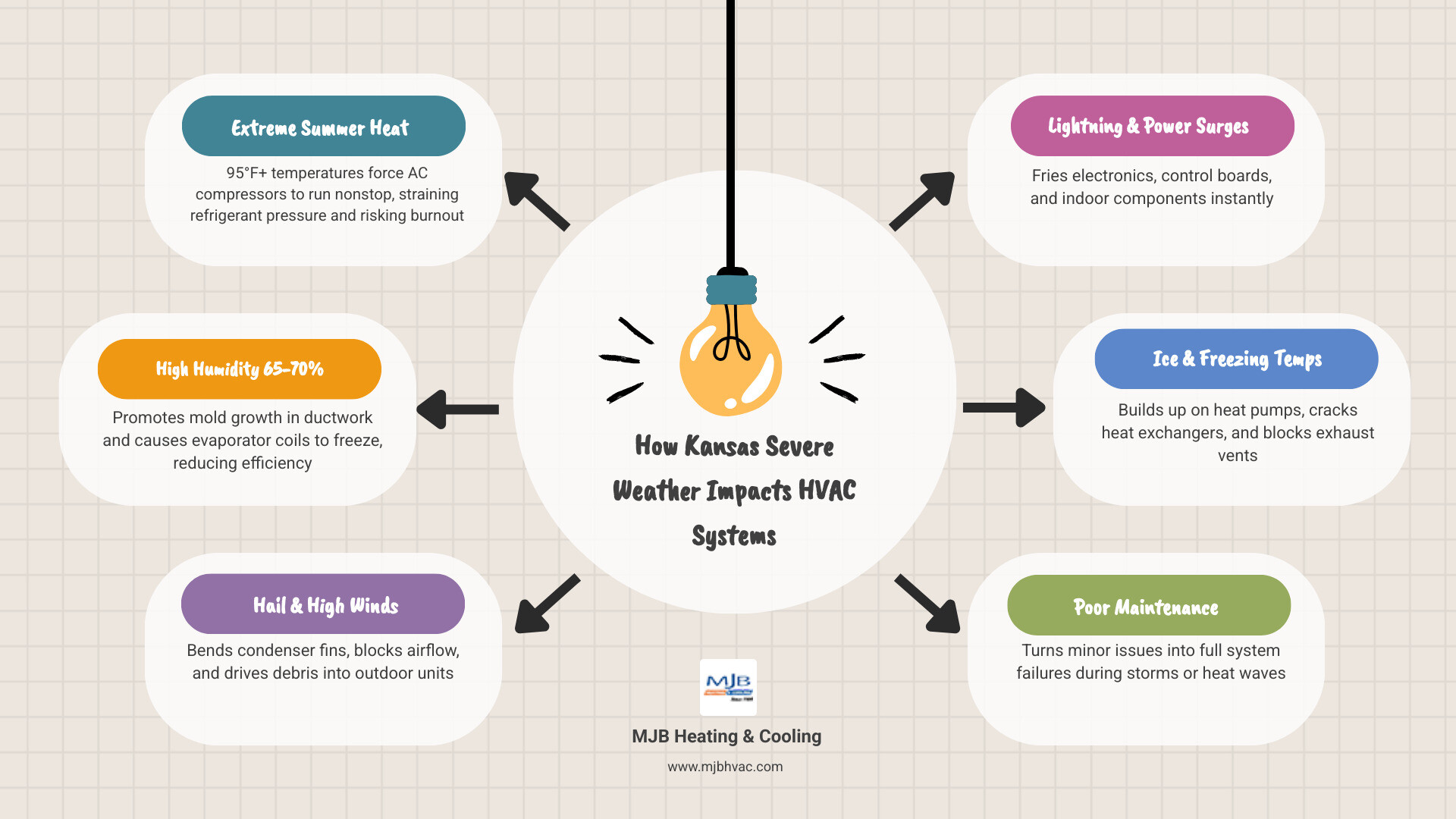
Here's a quick overview of the main ways Kansas weather stresses your HVAC:
If your system is already overworked or overdue for service, a single bad storm or heat wave can push it over the edge. The good news is that most of this damage is preventable — or at least manageable — when you know what to look for and act early.
Living in the Wichita metro area means being prepared for anything. We often joke that if you don’t like the weather in Kansas, just wait five minutes. While that unpredictability makes for interesting conversation, it’s incredibly hard on your mechanical systems. How Kansas severe weather affects your HVAC system starts with the sheer volatility of our climate.
Kansas is famous for being part of "Tornado Alley," but even when a funnel cloud isn't in sight, the high winds that accompany our thunderstorms can be devastating. Winds exceeding 60 or 70 mph can uproot heavy branches or send unsecured patio furniture flying directly into your outdoor condenser. This physical impact is a leading cause for 24 Hour Ac Repair Wichita Ks during the spring and summer months.
Beyond the wind, the extreme temperature swings we experience in April 2026 are a major stressor. It’s not uncommon to see a 40-degree temperature drop in a single afternoon. These rapid shifts cause metal components in your furnace and air conditioner to expand and contract quickly, which can lead to premature wear, loose electrical connections, and even cracks in critical components like the heat exchanger. When these failures happen at midnight during a storm, you need Emergency Hvac Repair Haysville Ks to restore safety to your home.
In Central Kansas, the heat is only half the story; the humidity is the real villain. During our peak summer months, humidity levels regularly hit 65-70%. This moisture doesn't just make you feel sticky; it fundamentally changes how your air conditioner operates.
Your AC has two jobs: lowering the temperature and removing moisture from the air. When humidity is high, the system spends a massive amount of energy on "latent cooling" (removing water). If your system is low on refrigerant or has a dirty filter, this extra workload often leads to the evaporator coils dropping below freezing. This results in a block of ice forming over the coils, which stops all airflow. If you find yourself in this situation, knowing How To Address A Frozen Ac Unit In Home is vital to prevent compressor damage.
Furthermore, that high humidity can wreak havoc on your home’s infrastructure. Moisture can cause crawl space insulation to sag and lose its R-value, and it provides the perfect breeding ground for mold in your ductwork. This is a common reason why Ac Fails During A Heatwave Andover Solutions are so frequently sought after — the system simply cannot keep up with the moisture load and the heat simultaneously.
Once the sirens stop and the sky clears, your first instinct might be to check your roof or windows, but your HVAC system should be high on your priority list. Before you even turn the thermostat back on, perform a visual inspection of the outdoor unit. Check for:
If the power went out during the storm, your system may have suffered an electrical surge. If your AC won't start once power is restored, check your circuit breaker panel. A tripped breaker is a common safety response to a surge. However, if it trips again immediately, do not keep flipping it; this indicates a short circuit that requires 24 Hour Ac Repair Derby Ks.
Listen closely when the system starts up. If you hear banging, screeching, or whistling, shut it down immediately. A Hvac System Making Strange Noises after a storm often points to a fan motor that has been knocked out of alignment or debris that has entered the cabinet.
When the Kansas sun beats down on Andover or El Dorado and temperatures soar past 95°F, your air conditioner is pushed to its absolute mechanical limit. In these conditions, the refrigerant inside your system operates at much higher pressures than normal. If your coils are even slightly dirty, the system can’t shed heat effectively, causing the compressor to overheat and potentially shut down permanently.
This is a peak time for service calls across the Wichita metro. Many homeowners find that their systems were working "just fine" when it was 80°F, but the first true heatwave of the season exposes every hidden weakness. This is also when we see Heat Pump Performance Issues During Spring transition into full-blown summer breakdowns. If you are in need of 24 Hour Ac Repair Andover Ks, it is usually because the combination of high head pressure and non-stop run times has caused a capacitor or motor to fail.
While we can't control the Kansas sun, we can control how our homes respond to it. To reduce the strain on your HVAC system during record heat, we recommend several proactive steps:
If your home still feels like a sauna despite these efforts, you may need 24 Hour Ac Repair Haysville Ks to check your refrigerant levels or duct integrity.
Hail is perhaps the most visible way how Kansas severe weather affects your HVAC system. Kansas is famous for "golf ball" and "baseball" sized hail that can shred the delicate aluminum fins on your outdoor unit. These fins are responsible for heat exchange; when they are flattened by hail, airflow is restricted, and your system's efficiency plummets. In severe cases, the restricted airflow can lead to the compressor "slugging" and failing.
High winds also carry dust and agricultural debris common in areas like Mulvane and Belle Plaine. This debris acts like a blanket, clogging the coils and forcing the system to work harder. If you notice your Hvac Making Strange Noises In Haysville, it could be a sign that debris has bent a fan blade or entered the electrical compartment.
Electrical surges are the "silent killer" of HVAC systems. A nearby lightning strike can send a massive surge through the power lines, frying the sensitive control boards in modern high-efficiency units. We strongly recommend installing a whole-home surge protector to safeguard your investment from these unpredictable Kansas storms.
While we often focus on summer, Kansas winters are equally brutal. Freezing rain and ice storms are common in Sedgwick County. For homeowners with heat pumps, ice is a major concern. Heat pumps have a "defrost cycle" designed to melt ice off the outdoor coils, but during a heavy Kansas ice storm, the accumulation can happen faster than the system can melt it.
If your unit becomes completely encased in ice, it can't extract heat from the air, and your home will rely entirely on expensive "heat strips" or backup heat. If you see When Your Heat Pump Freezes Up In Haysville, it’s a sign that either the defrost board is failing or the weather has simply outpaced the machine. In these moments, consulting a Heat Pump Repair 24 Hour Sedgwick Ks Guide can help you determine if you need professional intervention.
When the temperature drops into the teens — which happens frequently during a typical Kansas January — your furnace becomes the most important appliance in your home. One of the most dangerous ways how Kansas severe weather affects your HVAC system involves your furnace's exhaust. Heavy snow or drifting ice can block the plastic PVC vents that exit the side of many modern homes in Wichita and Derby. If these vents are blocked, combustion gases (including carbon monoxide) can back up into your home or cause the furnace to shut down as a safety precaution.
Extreme cold also puts immense stress on the heat exchanger. The constant cycling on and off during a sub-zero night causes the metal to expand and contract repeatedly. In older systems (15-20 years old), this can lead to cracks. A cracked heat exchanger is a serious safety hazard and usually requires Emergency Furnace Repair Derby Ks or Furnace Repair 24 Hour In Andover Ks to ensure your family isn't exposed to dangerous fumes.
Efficiency isn't just about saving money; it's about system longevity. During a Kansas cold snap, a clogged air filter is the number one cause of furnace failure. Because the furnace is running almost constantly, a dirty filter restricts airflow, causing the internal temperature to rise until the "limit switch" trips and shuts the system down.
For those using gas furnaces, pay attention to your pilot light or burner flame. A healthy flame should be a steady, crisp blue. A yellow or flickering flame indicates incomplete combustion, often caused by dust or dirt buildup, and is a major warning sign.
Additionally, high-efficiency furnaces produce condensation. In unheated crawl spaces or attics, these drain lines can freeze, causing water to back up into the furnace cabinet. This can lead to electrical shorts or rust. If you are experiencing these issues, getting Heat Pump Repair 24 Hour In Wichita Ks or furnace service can prevent a total system lockout.
The best way to handle Kansas weather is to be proactive. Waiting until a storm hits to think about your HVAC is a recipe for an uncomfortable week. Use the following table to understand what you can do yourself and when you need to call the pros at MJB Heating & Cooling.
| Task | DIY or Professional? | Frequency |
|---|---|---|
| Change Air Filters | DIY | Every 30-90 days |
| Clear Debris from Outdoor Unit | DIY | After every major storm |
| Check Thermostat Batteries | DIY | Annually |
| Clear Snow from Vents | DIY | After every snowfall |
| Clean Evaporator & Condenser Coils | Professional | Annually |
| Check Refrigerant Levels | Professional | Annually |
| Inspect Heat Exchanger for Cracks | Professional | Annually (Fall) |
| Electrical Component Testing | Professional | Annually |
Regular maintenance is like an oil change for your car; it prevents a "domino effect" of failures. For example, a clean coil prevents the compressor from overworking, which in turn prevents electrical failure. If you have a heat pump, following a Heat Pump Repair 24 Hour Sedgwick Ks Guide ensures your defrost cycle is ready for the first ice storm.
Even if your system is running, it might be struggling. Watch for these "silent" signs of storm damage:
If you notice any of these, especially Hvac System Making Strange Noises, it’s time to shut it down and give us a call before a small repair turns into a full replacement.
The most common signs include visible "hail hits" on the aluminum fins, debris (like leaves or twigs) visible inside the top of the unit, and a tripped circuit breaker. You should also listen for any new rattling or buzzing sounds when the unit starts up, as this can indicate that the fan or motor was impacted by the storm.
High humidity forces your air conditioner to run longer cycles to remove moisture from the air. This increased "run time" leads to faster wear and tear on the compressor and fan motor. Additionally, excessive moisture can lead to biological growth inside the unit and ductwork, which can restrict airflow and cause the system to work harder, ultimately shortening its overall lifespan by several years if not properly maintained.
Generally, no. Most manufacturers design outdoor units to withstand the elements. However, if you have a furnace and use a central AC (not a heat pump), you can use a cover that only covers the top to prevent ice from falling into the fan blades. Crucially, if you have a heat pump, you must never cover it during the winter, as it needs to move air to heat your home and perform its defrost cycle. Covering a running heat pump can cause catastrophic damage.
At MJB Heating & Cooling, we’ve been helping our neighbors across the Wichita metro area navigate how Kansas severe weather affects your HVAC system since 1984. From our roots in Derby to serving communities like Andover, Augusta, Haysville, and beyond, we understand the specific challenges our climate poses to your comfort.
We are a family-owned business built on the foundation of honest service and quality workmanship. We don't believe in "band-aid" fixes; we believe in doing the job right the first time so you can have peace of mind whether it’s a 100-degree July afternoon or a sub-zero January night.
Don’t wait for the next Kansas supercell or heatwave to test your system’s limits. Whether you need an emergency repair, a seasonal tune-up, or a full system upgrade to a more resilient high-efficiency model, our licensed technicians are ready to help.
Schedule your professional HVAC service today and let us ensure your home stays the comfortable sanctuary it's meant to be, no matter what the Kansas sky decides to do next.
How Kansas severe weather affects your HVAC system is something every Central Kansas homeowner needs to understand — because the damage can be sudden, costly, and easy to miss until your system stops working entirely.
Kansas sits squarely in some of the most punishing weather territory in the country. Summers regularly push past 95°F with humidity climbing to 65-70%. Winters bring sub-zero wind chills, ice storms, and freezing rain. In between, Tornado Alley delivers hail, high winds, and lightning that can damage or destroy outdoor HVAC equipment in minutes. Your heating and cooling system takes a hit in every season.
Here's a quick overview of the main ways Kansas weather stresses your HVAC:
If your system is already overworked or overdue for service, a single bad storm or heat wave can push it over the edge. The good news is that most of this damage is preventable — or at least manageable — when you know what to look for and act early.
Living in the Wichita metro area means being prepared for anything. We often joke that if you don’t like the weather in Kansas, just wait five minutes. While that unpredictability makes for interesting conversation, it’s incredibly hard on your mechanical systems. How Kansas severe weather affects your HVAC system starts with the sheer volatility of our climate.
Kansas is famous for being part of "Tornado Alley," but even when a funnel cloud isn't in sight, the high winds that accompany our thunderstorms can be devastating. Winds exceeding 60 or 70 mph can uproot heavy branches or send unsecured patio furniture flying directly into your outdoor condenser. This physical impact is a leading cause for 24 Hour Ac Repair Wichita Ks during the spring and summer months.
Beyond the wind, the extreme temperature swings we experience in April 2026 are a major stressor. It’s not uncommon to see a 40-degree temperature drop in a single afternoon. These rapid shifts cause metal components in your furnace and air conditioner to expand and contract quickly, which can lead to premature wear, loose electrical connections, and even cracks in critical components like the heat exchanger. When these failures happen at midnight during a storm, you need Emergency Hvac Repair Haysville Ks to restore safety to your home.
In Central Kansas, the heat is only half the story; the humidity is the real villain. During our peak summer months, humidity levels regularly hit 65-70%. This moisture doesn't just make you feel sticky; it fundamentally changes how your air conditioner operates.
Your AC has two jobs: lowering the temperature and removing moisture from the air. When humidity is high, the system spends a massive amount of energy on "latent cooling" (removing water). If your system is low on refrigerant or has a dirty filter, this extra workload often leads to the evaporator coils dropping below freezing. This results in a block of ice forming over the coils, which stops all airflow. If you find yourself in this situation, knowing How To Address A Frozen Ac Unit In Home is vital to prevent compressor damage.
Furthermore, that high humidity can wreak havoc on your home’s infrastructure. Moisture can cause crawl space insulation to sag and lose its R-value, and it provides the perfect breeding ground for mold in your ductwork. This is a common reason why Ac Fails During A Heatwave Andover Solutions are so frequently sought after — the system simply cannot keep up with the moisture load and the heat simultaneously.
Once the sirens stop and the sky clears, your first instinct might be to check your roof or windows, but your HVAC system should be high on your priority list. Before you even turn the thermostat back on, perform a visual inspection of the outdoor unit. Check for:
If the power went out during the storm, your system may have suffered an electrical surge. If your AC won't start once power is restored, check your circuit breaker panel. A tripped breaker is a common safety response to a surge. However, if it trips again immediately, do not keep flipping it; this indicates a short circuit that requires 24 Hour Ac Repair Derby Ks.
Listen closely when the system starts up. If you hear banging, screeching, or whistling, shut it down immediately. A Hvac System Making Strange Noises after a storm often points to a fan motor that has been knocked out of alignment or debris that has entered the cabinet.
When the Kansas sun beats down on Andover or El Dorado and temperatures soar past 95°F, your air conditioner is pushed to its absolute mechanical limit. In these conditions, the refrigerant inside your system operates at much higher pressures than normal. If your coils are even slightly dirty, the system can’t shed heat effectively, causing the compressor to overheat and potentially shut down permanently.
This is a peak time for service calls across the Wichita metro. Many homeowners find that their systems were working "just fine" when it was 80°F, but the first true heatwave of the season exposes every hidden weakness. This is also when we see Heat Pump Performance Issues During Spring transition into full-blown summer breakdowns. If you are in need of 24 Hour Ac Repair Andover Ks, it is usually because the combination of high head pressure and non-stop run times has caused a capacitor or motor to fail.
While we can't control the Kansas sun, we can control how our homes respond to it. To reduce the strain on your HVAC system during record heat, we recommend several proactive steps:
If your home still feels like a sauna despite these efforts, you may need 24 Hour Ac Repair Haysville Ks to check your refrigerant levels or duct integrity.
Hail is perhaps the most visible way how Kansas severe weather affects your HVAC system. Kansas is famous for "golf ball" and "baseball" sized hail that can shred the delicate aluminum fins on your outdoor unit. These fins are responsible for heat exchange; when they are flattened by hail, airflow is restricted, and your system's efficiency plummets. In severe cases, the restricted airflow can lead to the compressor "slugging" and failing.
High winds also carry dust and agricultural debris common in areas like Mulvane and Belle Plaine. This debris acts like a blanket, clogging the coils and forcing the system to work harder. If you notice your Hvac Making Strange Noises In Haysville, it could be a sign that debris has bent a fan blade or entered the electrical compartment.
Electrical surges are the "silent killer" of HVAC systems. A nearby lightning strike can send a massive surge through the power lines, frying the sensitive control boards in modern high-efficiency units. We strongly recommend installing a whole-home surge protector to safeguard your investment from these unpredictable Kansas storms.
While we often focus on summer, Kansas winters are equally brutal. Freezing rain and ice storms are common in Sedgwick County. For homeowners with heat pumps, ice is a major concern. Heat pumps have a "defrost cycle" designed to melt ice off the outdoor coils, but during a heavy Kansas ice storm, the accumulation can happen faster than the system can melt it.
If your unit becomes completely encased in ice, it can't extract heat from the air, and your home will rely entirely on expensive "heat strips" or backup heat. If you see When Your Heat Pump Freezes Up In Haysville, it’s a sign that either the defrost board is failing or the weather has simply outpaced the machine. In these moments, consulting a Heat Pump Repair 24 Hour Sedgwick Ks Guide can help you determine if you need professional intervention.
When the temperature drops into the teens — which happens frequently during a typical Kansas January — your furnace becomes the most important appliance in your home. One of the most dangerous ways how Kansas severe weather affects your HVAC system involves your furnace's exhaust. Heavy snow or drifting ice can block the plastic PVC vents that exit the side of many modern homes in Wichita and Derby. If these vents are blocked, combustion gases (including carbon monoxide) can back up into your home or cause the furnace to shut down as a safety precaution.
Extreme cold also puts immense stress on the heat exchanger. The constant cycling on and off during a sub-zero night causes the metal to expand and contract repeatedly. In older systems (15-20 years old), this can lead to cracks. A cracked heat exchanger is a serious safety hazard and usually requires Emergency Furnace Repair Derby Ks or Furnace Repair 24 Hour In Andover Ks to ensure your family isn't exposed to dangerous fumes.
Efficiency isn't just about saving money; it's about system longevity. During a Kansas cold snap, a clogged air filter is the number one cause of furnace failure. Because the furnace is running almost constantly, a dirty filter restricts airflow, causing the internal temperature to rise until the "limit switch" trips and shuts the system down.
For those using gas furnaces, pay attention to your pilot light or burner flame. A healthy flame should be a steady, crisp blue. A yellow or flickering flame indicates incomplete combustion, often caused by dust or dirt buildup, and is a major warning sign.
Additionally, high-efficiency furnaces produce condensation. In unheated crawl spaces or attics, these drain lines can freeze, causing water to back up into the furnace cabinet. This can lead to electrical shorts or rust. If you are experiencing these issues, getting Heat Pump Repair 24 Hour In Wichita Ks or furnace service can prevent a total system lockout.
The best way to handle Kansas weather is to be proactive. Waiting until a storm hits to think about your HVAC is a recipe for an uncomfortable week. Use the following table to understand what you can do yourself and when you need to call the pros at MJB Heating & Cooling.
| Task | DIY or Professional? | Frequency |
|---|---|---|
| Change Air Filters | DIY | Every 30-90 days |
| Clear Debris from Outdoor Unit | DIY | After every major storm |
| Check Thermostat Batteries | DIY | Annually |
| Clear Snow from Vents | DIY | After every snowfall |
| Clean Evaporator & Condenser Coils | Professional | Annually |
| Check Refrigerant Levels | Professional | Annually |
| Inspect Heat Exchanger for Cracks | Professional | Annually (Fall) |
| Electrical Component Testing | Professional | Annually |
Regular maintenance is like an oil change for your car; it prevents a "domino effect" of failures. For example, a clean coil prevents the compressor from overworking, which in turn prevents electrical failure. If you have a heat pump, following a Heat Pump Repair 24 Hour Sedgwick Ks Guide ensures your defrost cycle is ready for the first ice storm.
Even if your system is running, it might be struggling. Watch for these "silent" signs of storm damage:
If you notice any of these, especially Hvac System Making Strange Noises, it’s time to shut it down and give us a call before a small repair turns into a full replacement.
The most common signs include visible "hail hits" on the aluminum fins, debris (like leaves or twigs) visible inside the top of the unit, and a tripped circuit breaker. You should also listen for any new rattling or buzzing sounds when the unit starts up, as this can indicate that the fan or motor was impacted by the storm.
High humidity forces your air conditioner to run longer cycles to remove moisture from the air. This increased "run time" leads to faster wear and tear on the compressor and fan motor. Additionally, excessive moisture can lead to biological growth inside the unit and ductwork, which can restrict airflow and cause the system to work harder, ultimately shortening its overall lifespan by several years if not properly maintained.
Generally, no. Most manufacturers design outdoor units to withstand the elements. However, if you have a furnace and use a central AC (not a heat pump), you can use a cover that only covers the top to prevent ice from falling into the fan blades. Crucially, if you have a heat pump, you must never cover it during the winter, as it needs to move air to heat your home and perform its defrost cycle. Covering a running heat pump can cause catastrophic damage.
At MJB Heating & Cooling, we’ve been helping our neighbors across the Wichita metro area navigate how Kansas severe weather affects your HVAC system since 1984. From our roots in Derby to serving communities like Andover, Augusta, Haysville, and beyond, we understand the specific challenges our climate poses to your comfort.
We are a family-owned business built on the foundation of honest service and quality workmanship. We don't believe in "band-aid" fixes; we believe in doing the job right the first time so you can have peace of mind whether it’s a 100-degree July afternoon or a sub-zero January night.
Don’t wait for the next Kansas supercell or heatwave to test your system’s limits. Whether you need an emergency repair, a seasonal tune-up, or a full system upgrade to a more resilient high-efficiency model, our licensed technicians are ready to help.
Schedule your professional HVAC service today and let us ensure your home stays the comfortable sanctuary it's meant to be, no matter what the Kansas sky decides to do next.
How Kansas severe weather affects your HVAC system is something every Central Kansas homeowner needs to understand — because the damage can be sudden, costly, and easy to miss until your system stops working entirely.
Kansas sits squarely in some of the most punishing weather territory in the country. Summers regularly push past 95°F with humidity climbing to 65-70%. Winters bring sub-zero wind chills, ice storms, and freezing rain. In between, Tornado Alley delivers hail, high winds, and lightning that can damage or destroy outdoor HVAC equipment in minutes. Your heating and cooling system takes a hit in every season.
Here's a quick overview of the main ways Kansas weather stresses your HVAC:
If your system is already overworked or overdue for service, a single bad storm or heat wave can push it over the edge. The good news is that most of this damage is preventable — or at least manageable — when you know what to look for and act early.
Living in the Wichita metro area means being prepared for anything. We often joke that if you don’t like the weather in Kansas, just wait five minutes. While that unpredictability makes for interesting conversation, it’s incredibly hard on your mechanical systems. How Kansas severe weather affects your HVAC system starts with the sheer volatility of our climate.
Kansas is famous for being part of "Tornado Alley," but even when a funnel cloud isn't in sight, the high winds that accompany our thunderstorms can be devastating. Winds exceeding 60 or 70 mph can uproot heavy branches or send unsecured patio furniture flying directly into your outdoor condenser. This physical impact is a leading cause for 24 Hour Ac Repair Wichita Ks during the spring and summer months.
Beyond the wind, the extreme temperature swings we experience in April 2026 are a major stressor. It’s not uncommon to see a 40-degree temperature drop in a single afternoon. These rapid shifts cause metal components in your furnace and air conditioner to expand and contract quickly, which can lead to premature wear, loose electrical connections, and even cracks in critical components like the heat exchanger. When these failures happen at midnight during a storm, you need Emergency Hvac Repair Haysville Ks to restore safety to your home.
In Central Kansas, the heat is only half the story; the humidity is the real villain. During our peak summer months, humidity levels regularly hit 65-70%. This moisture doesn't just make you feel sticky; it fundamentally changes how your air conditioner operates.
Your AC has two jobs: lowering the temperature and removing moisture from the air. When humidity is high, the system spends a massive amount of energy on "latent cooling" (removing water). If your system is low on refrigerant or has a dirty filter, this extra workload often leads to the evaporator coils dropping below freezing. This results in a block of ice forming over the coils, which stops all airflow. If you find yourself in this situation, knowing How To Address A Frozen Ac Unit In Home is vital to prevent compressor damage.
Furthermore, that high humidity can wreak havoc on your home’s infrastructure. Moisture can cause crawl space insulation to sag and lose its R-value, and it provides the perfect breeding ground for mold in your ductwork. This is a common reason why Ac Fails During A Heatwave Andover Solutions are so frequently sought after — the system simply cannot keep up with the moisture load and the heat simultaneously.
Once the sirens stop and the sky clears, your first instinct might be to check your roof or windows, but your HVAC system should be high on your priority list. Before you even turn the thermostat back on, perform a visual inspection of the outdoor unit. Check for:
If the power went out during the storm, your system may have suffered an electrical surge. If your AC won't start once power is restored, check your circuit breaker panel. A tripped breaker is a common safety response to a surge. However, if it trips again immediately, do not keep flipping it; this indicates a short circuit that requires 24 Hour Ac Repair Derby Ks.
Listen closely when the system starts up. If you hear banging, screeching, or whistling, shut it down immediately. A Hvac System Making Strange Noises after a storm often points to a fan motor that has been knocked out of alignment or debris that has entered the cabinet.
When the Kansas sun beats down on Andover or El Dorado and temperatures soar past 95°F, your air conditioner is pushed to its absolute mechanical limit. In these conditions, the refrigerant inside your system operates at much higher pressures than normal. If your coils are even slightly dirty, the system can’t shed heat effectively, causing the compressor to overheat and potentially shut down permanently.
This is a peak time for service calls across the Wichita metro. Many homeowners find that their systems were working "just fine" when it was 80°F, but the first true heatwave of the season exposes every hidden weakness. This is also when we see Heat Pump Performance Issues During Spring transition into full-blown summer breakdowns. If you are in need of 24 Hour Ac Repair Andover Ks, it is usually because the combination of high head pressure and non-stop run times has caused a capacitor or motor to fail.
While we can't control the Kansas sun, we can control how our homes respond to it. To reduce the strain on your HVAC system during record heat, we recommend several proactive steps:
If your home still feels like a sauna despite these efforts, you may need 24 Hour Ac Repair Haysville Ks to check your refrigerant levels or duct integrity.
Hail is perhaps the most visible way how Kansas severe weather affects your HVAC system. Kansas is famous for "golf ball" and "baseball" sized hail that can shred the delicate aluminum fins on your outdoor unit. These fins are responsible for heat exchange; when they are flattened by hail, airflow is restricted, and your system's efficiency plummets. In severe cases, the restricted airflow can lead to the compressor "slugging" and failing.
High winds also carry dust and agricultural debris common in areas like Mulvane and Belle Plaine. This debris acts like a blanket, clogging the coils and forcing the system to work harder. If you notice your Hvac Making Strange Noises In Haysville, it could be a sign that debris has bent a fan blade or entered the electrical compartment.
Electrical surges are the "silent killer" of HVAC systems. A nearby lightning strike can send a massive surge through the power lines, frying the sensitive control boards in modern high-efficiency units. We strongly recommend installing a whole-home surge protector to safeguard your investment from these unpredictable Kansas storms.
While we often focus on summer, Kansas winters are equally brutal. Freezing rain and ice storms are common in Sedgwick County. For homeowners with heat pumps, ice is a major concern. Heat pumps have a "defrost cycle" designed to melt ice off the outdoor coils, but during a heavy Kansas ice storm, the accumulation can happen faster than the system can melt it.
If your unit becomes completely encased in ice, it can't extract heat from the air, and your home will rely entirely on expensive "heat strips" or backup heat. If you see When Your Heat Pump Freezes Up In Haysville, it’s a sign that either the defrost board is failing or the weather has simply outpaced the machine. In these moments, consulting a Heat Pump Repair 24 Hour Sedgwick Ks Guide can help you determine if you need professional intervention.
When the temperature drops into the teens — which happens frequently during a typical Kansas January — your furnace becomes the most important appliance in your home. One of the most dangerous ways how Kansas severe weather affects your HVAC system involves your furnace's exhaust. Heavy snow or drifting ice can block the plastic PVC vents that exit the side of many modern homes in Wichita and Derby. If these vents are blocked, combustion gases (including carbon monoxide) can back up into your home or cause the furnace to shut down as a safety precaution.
Extreme cold also puts immense stress on the heat exchanger. The constant cycling on and off during a sub-zero night causes the metal to expand and contract repeatedly. In older systems (15-20 years old), this can lead to cracks. A cracked heat exchanger is a serious safety hazard and usually requires Emergency Furnace Repair Derby Ks or Furnace Repair 24 Hour In Andover Ks to ensure your family isn't exposed to dangerous fumes.
Efficiency isn't just about saving money; it's about system longevity. During a Kansas cold snap, a clogged air filter is the number one cause of furnace failure. Because the furnace is running almost constantly, a dirty filter restricts airflow, causing the internal temperature to rise until the "limit switch" trips and shuts the system down.
For those using gas furnaces, pay attention to your pilot light or burner flame. A healthy flame should be a steady, crisp blue. A yellow or flickering flame indicates incomplete combustion, often caused by dust or dirt buildup, and is a major warning sign.
Additionally, high-efficiency furnaces produce condensation. In unheated crawl spaces or attics, these drain lines can freeze, causing water to back up into the furnace cabinet. This can lead to electrical shorts or rust. If you are experiencing these issues, getting Heat Pump Repair 24 Hour In Wichita Ks or furnace service can prevent a total system lockout.
The best way to handle Kansas weather is to be proactive. Waiting until a storm hits to think about your HVAC is a recipe for an uncomfortable week. Use the following table to understand what you can do yourself and when you need to call the pros at MJB Heating & Cooling.
| Task | DIY or Professional? | Frequency |
|---|---|---|
| Change Air Filters | DIY | Every 30-90 days |
| Clear Debris from Outdoor Unit | DIY | After every major storm |
| Check Thermostat Batteries | DIY | Annually |
| Clear Snow from Vents | DIY | After every snowfall |
| Clean Evaporator & Condenser Coils | Professional | Annually |
| Check Refrigerant Levels | Professional | Annually |
| Inspect Heat Exchanger for Cracks | Professional | Annually (Fall) |
| Electrical Component Testing | Professional | Annually |
Regular maintenance is like an oil change for your car; it prevents a "domino effect" of failures. For example, a clean coil prevents the compressor from overworking, which in turn prevents electrical failure. If you have a heat pump, following a Heat Pump Repair 24 Hour Sedgwick Ks Guide ensures your defrost cycle is ready for the first ice storm.
Even if your system is running, it might be struggling. Watch for these "silent" signs of storm damage:
If you notice any of these, especially Hvac System Making Strange Noises, it’s time to shut it down and give us a call before a small repair turns into a full replacement.
The most common signs include visible "hail hits" on the aluminum fins, debris (like leaves or twigs) visible inside the top of the unit, and a tripped circuit breaker. You should also listen for any new rattling or buzzing sounds when the unit starts up, as this can indicate that the fan or motor was impacted by the storm.
High humidity forces your air conditioner to run longer cycles to remove moisture from the air. This increased "run time" leads to faster wear and tear on the compressor and fan motor. Additionally, excessive moisture can lead to biological growth inside the unit and ductwork, which can restrict airflow and cause the system to work harder, ultimately shortening its overall lifespan by several years if not properly maintained.
Generally, no. Most manufacturers design outdoor units to withstand the elements. However, if you have a furnace and use a central AC (not a heat pump), you can use a cover that only covers the top to prevent ice from falling into the fan blades. Crucially, if you have a heat pump, you must never cover it during the winter, as it needs to move air to heat your home and perform its defrost cycle. Covering a running heat pump can cause catastrophic damage.
At MJB Heating & Cooling, we’ve been helping our neighbors across the Wichita metro area navigate how Kansas severe weather affects your HVAC system since 1984. From our roots in Derby to serving communities like Andover, Augusta, Haysville, and beyond, we understand the specific challenges our climate poses to your comfort.
We are a family-owned business built on the foundation of honest service and quality workmanship. We don't believe in "band-aid" fixes; we believe in doing the job right the first time so you can have peace of mind whether it’s a 100-degree July afternoon or a sub-zero January night.
Don’t wait for the next Kansas supercell or heatwave to test your system’s limits. Whether you need an emergency repair, a seasonal tune-up, or a full system upgrade to a more resilient high-efficiency model, our licensed technicians are ready to help.
Schedule your professional HVAC service today and let us ensure your home stays the comfortable sanctuary it's meant to be, no matter what the Kansas sky decides to do next.
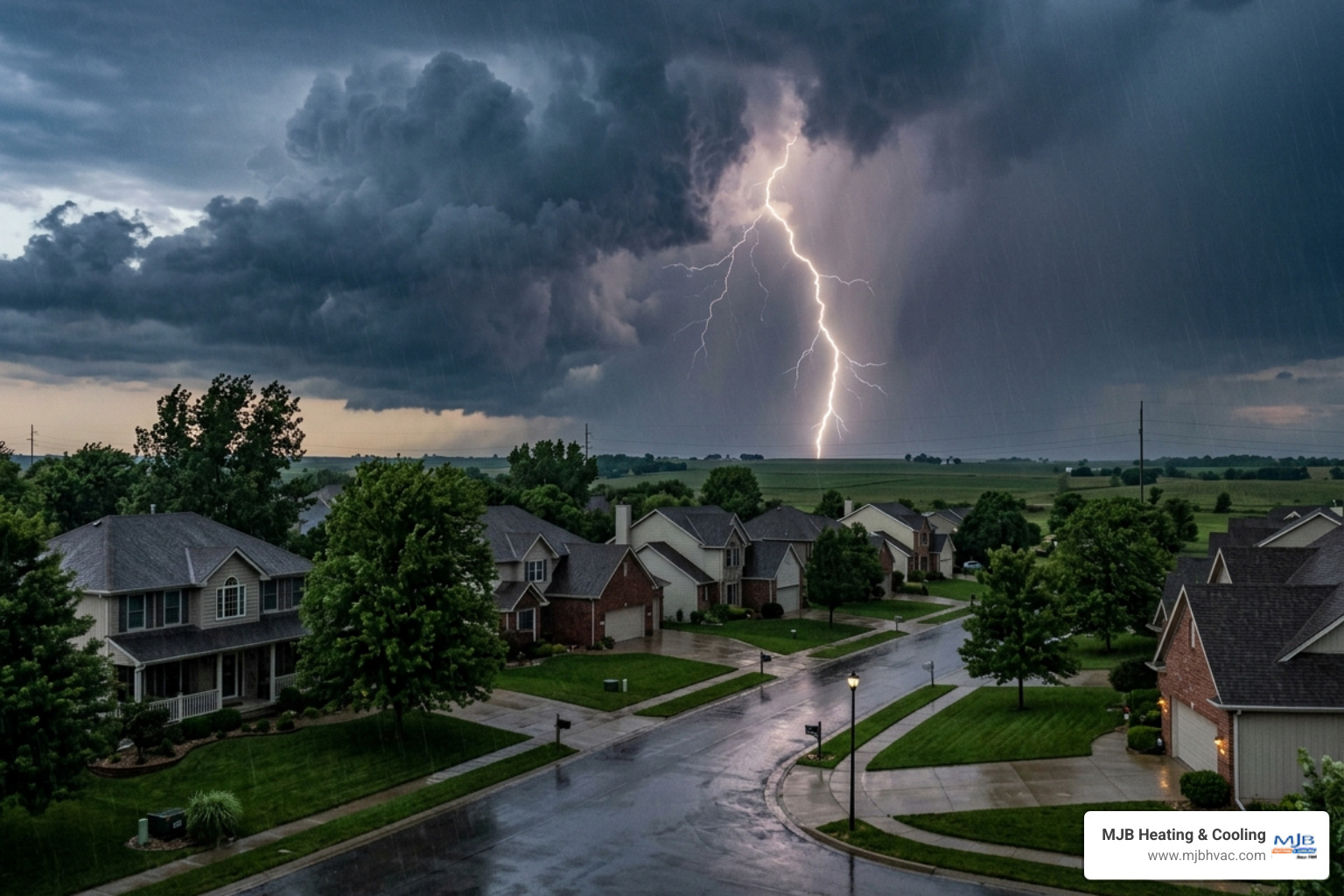

How Kansas severe weather affects your HVAC system is something every Central Kansas homeowner needs to understand — because the damage can be sudden, costly, and easy to miss until your system stops working entirely.
Kansas sits squarely in some of the most punishing weather territory in the country. Summers regularly push past 95°F with humidity climbing to 65-70%. Winters bring sub-zero wind chills, ice storms, and freezing rain. In between, Tornado Alley delivers hail, high winds, and lightning that can damage or destroy outdoor HVAC equipment in minutes. Your heating and cooling system takes a hit in every season.
Here's a quick overview of the main ways Kansas weather stresses your HVAC:
• Extreme summer heat forces air conditioners to run nonstop, straining compressors and driving up refrigerant pressure
• High humidity (65-70%) promotes mold growth in ductwork and causes evaporator coils to freeze
• Hail and high winds bend condenser fins, block airflow, and send debris into outdoor units
• Lightning and power surges can fry HVAC electronics and control boards instantly
• Ice and freezing temperatures cause heat pumps to struggle, crack heat exchangers, and block exhaust vents
• Poor maintenance heading into severe weather turns minor issues into full system failures
If your system is already overworked or overdue for service, a single bad storm or heat wave can push it over the edge. The good news is that most of this damage is preventable — or at least manageable — when you know what to look for and act early.

Living in the Wichita metro area means being prepared for anything. We often joke that if you don’t like the weather in Kansas, just wait five minutes. While that unpredictability makes for interesting conversation, it’s incredibly hard on your mechanical systems. How Kansas severe weather affects your HVAC system starts with the sheer volatility of our climate.
Kansas is famous for being part of "Tornado Alley," but even when a funnel cloud isn't in sight, the high winds that accompany our thunderstorms can be devastating. Winds exceeding 60 or 70 mph can uproot heavy branches or send unsecured patio furniture flying directly into your outdoor condenser. This physical impact is a leading cause for 24 Hour Ac Repair Wichita Ks during the spring and summer months.
Beyond the wind, the extreme temperature swings we experience in April 2026 are a major stressor. It’s not uncommon to see a 40-degree temperature drop in a single afternoon. These rapid shifts cause metal components in your furnace and air conditioner to expand and contract quickly, which can lead to premature wear, loose electrical connections, and even cracks in critical components like the heat exchanger. When these failures happen at midnight during a storm, you need Emergency Hvac Repair Haysville Ks to restore safety to your home.
In Central Kansas, the heat is only half the story; the humidity is the real villain. During our peak summer months, humidity levels regularly hit 65-70%. This moisture doesn't just make you feel sticky; it fundamentally changes how your air conditioner operates.
Your AC has two jobs: lowering the temperature and removing moisture from the air. When humidity is high, the system spends a massive amount of energy on "latent cooling" (removing water). If your system is low on refrigerant or has a dirty filter, this extra workload often leads to the evaporator coils dropping below freezing. This results in a block of ice forming over the coils, which stops all airflow. If you find yourself in this situation, knowing How To Address A Frozen Ac Unit In Home is vital to prevent compressor damage.
Furthermore, that high humidity can wreak havoc on your home’s infrastructure. Moisture can cause crawl space insulation to sag and lose its R-value, and it provides the perfect breeding ground for mold in your ductwork. This is a common reason why Ac Fails During A Heatwave Andover Solutions are so frequently sought after — the system simply cannot keep up with the moisture load and the heat simultaneously.
Once the sirens stop and the sky clears, your first instinct might be to check your roof or windows, but your HVAC system should be high on your priority list. Before you even turn the thermostat back on, perform a visual inspection of the outdoor unit. Check for:
• Large branches or debris wedged in the fan blades.
• Hail indentations on the "fins" (the thin metal slats on the sides).
• Standing water around the base of the unit.
If the power went out during the storm, your system may have suffered an electrical surge. If your AC won't start once power is restored, check your circuit breaker panel. A tripped breaker is a common safety response to a surge. However, if it trips again immediately, do not keep flipping it; this indicates a short circuit that requires 24 Hour Ac Repair Derby Ks.
Listen closely when the system starts up. If you hear banging, screeching, or whistling, shut it down immediately. A Hvac System Making Strange Noises after a storm often points to a fan motor that has been knocked out of alignment or debris that has entered the cabinet.
When the Kansas sun beats down on Andover or El Dorado and temperatures soar past 95°F, your air conditioner is pushed to its absolute mechanical limit. In these conditions, the refrigerant inside your system operates at much higher pressures than normal. If your coils are even slightly dirty, the system can’t shed heat effectively, causing the compressor to overheat and potentially shut down permanently.
This is a peak time for service calls across the Wichita metro. Many homeowners find that their systems were working "just fine" when it was 80°F, but the first true heatwave of the season exposes every hidden weakness. This is also when we see Heat Pump Performance Issues During Spring transition into full-blown summer breakdowns. If you are in need of 24 Hour Ac Repair Andover Ks, it is usually because the combination of high head pressure and non-stop run times has caused a capacitor or motor to fail.
While we can't control the Kansas sun, we can control how our homes respond to it. To reduce the strain on your HVAC system during record heat, we recommend several proactive steps:
• Thermostat Management: Avoid "cranking it down" to 65°F. Your AC can generally only cool a home to about 20 degrees lower than the outside temperature. Setting it too low just keeps the compressor running longer without achieving the desired result.
• Air Sealing and Insulation: Research shows that air sealing and upgrading insulation can save homeowners an average of 15% on heating and cooling costs. In a 95°F Kansas summer, quality insulation acts as a heat shield, potentially cutting cooling costs by 15-20%.
• Ceiling Fans: Ensure your fans are rotating counter-clockwise to create a wind-chill effect, allowing you to raise the thermostat by about 4 degrees without losing comfort.
If your home still feels like a sauna despite these efforts, you may need 24 Hour Ac Repair Haysville Ks to check your refrigerant levels or duct integrity.
Hail is perhaps the most visible way how Kansas severe weather affects your HVAC system. Kansas is famous for "golf ball" and "baseball" sized hail that can shred the delicate aluminum fins on your outdoor unit. These fins are responsible for heat exchange; when they are flattened by hail, airflow is restricted, and your system's efficiency plummets. In severe cases, the restricted airflow can lead to the compressor "slugging" and failing.
High winds also carry dust and agricultural debris common in areas like Mulvane and Belle Plaine. This debris acts like a blanket, clogging the coils and forcing the system to work harder. If you notice your Hvac Making Strange Noises In Haysville, it could be a sign that debris has bent a fan blade or entered the electrical compartment.
Electrical surges are the "silent killer" of HVAC systems. A nearby lightning strike can send a massive surge through the power lines, frying the sensitive control boards in modern high-efficiency units. We strongly recommend installing a whole-home surge protector to safeguard your investment from these unpredictable Kansas storms.
While we often focus on summer, Kansas winters are equally brutal. Freezing rain and ice storms are common in Sedgwick County. For homeowners with heat pumps, ice is a major concern. Heat pumps have a "defrost cycle" designed to melt ice off the outdoor coils, but during a heavy Kansas ice storm, the accumulation can happen faster than the system can melt it.
If your unit becomes completely encased in ice, it can't extract heat from the air, and your home will rely entirely on expensive "heat strips" or backup heat. If you see When Your Heat Pump Freezes Up In Haysville, it’s a sign that either the defrost board is failing or the weather has simply outpaced the machine. In these moments, consulting a Heat Pump Repair 24 Hour Sedgwick Ks Guide can help you determine if you need professional intervention.
When the temperature drops into the teens — which happens frequently during a typical Kansas January — your furnace becomes the most important appliance in your home. One of the most dangerous ways how Kansas severe weather affects your HVAC system involves your furnace's exhaust. Heavy snow or drifting ice can block the plastic PVC vents that exit the side of many modern homes in Wichita and Derby. If these vents are blocked, combustion gases (including carbon monoxide) can back up into your home or cause the furnace to shut down as a safety precaution.
Extreme cold also puts immense stress on the heat exchanger. The constant cycling on and off during a sub-zero night causes the metal to expand and contract repeatedly. In older systems (15-20 years old), this can lead to cracks. A cracked heat exchanger is a serious safety hazard and usually requires Emergency Furnace Repair Derby Ks or Furnace Repair 24 Hour In Andover Ks to ensure your family isn't exposed to dangerous fumes.
Efficiency isn't just about saving money; it's about system longevity. During a Kansas cold snap, a clogged air filter is the number one cause of furnace failure. Because the furnace is running almost constantly, a dirty filter restricts airflow, causing the internal temperature to rise until the "limit switch" trips and shuts the system down.
For those using gas furnaces, pay attention to your pilot light or burner flame. A healthy flame should be a steady, crisp blue. A yellow or flickering flame indicates incomplete combustion, often caused by dust or dirt buildup, and is a major warning sign.
Additionally, high-efficiency furnaces produce condensation. In unheated crawl spaces or attics, these drain lines can freeze, causing water to back up into the furnace cabinet. This can lead to electrical shorts or rust. If you are experiencing these issues, getting Heat Pump Repair 24 Hour In Wichita Ks or furnace service can prevent a total system lockout.
The best way to handle Kansas weather is to be proactive. Waiting until a storm hits to think about your HVAC is a recipe for an uncomfortable week. Use the following table to understand what you can do yourself and when you need to call the pros at MJB Heating & Cooling.
• Change Air Filters — DIY or Professional?: DIY — Frequency: Every 30-90 days
• Clear Debris from Outdoor Unit — DIY or Professional?: DIY — Frequency: After every major storm
• Check Thermostat Batteries — DIY or Professional?: DIY — Frequency: Annually
• Clear Snow from Vents — DIY or Professional?: DIY — Frequency: After every snowfall
• Clean Evaporator & Condenser Coils — DIY or Professional?: Professional — Frequency: Annually
• Check Refrigerant Levels — DIY or Professional?: Professional — Frequency: Annually
• Inspect Heat Exchanger for Cracks — DIY or Professional?: Professional — Frequency: Annually (Fall)
• Electrical Component Testing — DIY or Professional?: Professional — Frequency: Annually
Regular maintenance is like an oil change for your car; it prevents a "domino effect" of failures. For example, a clean coil prevents the compressor from overworking, which in turn prevents electrical failure. If you have a heat pump, following a Heat Pump Repair 24 Hour Sedgwick Ks Guide ensures your defrost cycle is ready for the first ice storm.
Even if your system is running, it might be struggling. Watch for these "silent" signs of storm damage:
1. Strange Noises: Banging, buzzing, or humming that wasn't there before the storm.
2. Weak Airflow: If the air coming out of your vents feels "lazy," your outdoor unit might be clogged with debris or hail-damaged.
3. Ice on Coils: Even in summer, ice on your indoor or outdoor lines is a major red flag.
4. Rising Energy Bills: If your utility bill jumps significantly without a change in weather, your system is likely losing efficiency due to damage.
5. Short Cycling: If the system turns on and off every few minutes, it may be overheating or suffering from an electrical issue.
If you notice any of these, especially Hvac System Making Strange Noises, it’s time to shut it down and give us a call before a small repair turns into a full replacement.
The most common signs include visible "hail hits" on the aluminum fins, debris (like leaves or twigs) visible inside the top of the unit, and a tripped circuit breaker. You should also listen for any new rattling or buzzing sounds when the unit starts up, as this can indicate that the fan or motor was impacted by the storm.
High humidity forces your air conditioner to run longer cycles to remove moisture from the air. This increased "run time" leads to faster wear and tear on the compressor and fan motor. Additionally, excessive moisture can lead to biological growth inside the unit and ductwork, which can restrict airflow and cause the system to work harder, ultimately shortening its overall lifespan by several years if not properly maintained.
Generally, no. Most manufacturers design outdoor units to withstand the elements. However, if you have a furnace and use a central AC (not a heat pump), you can use a cover that only covers the top to prevent ice from falling into the fan blades. Crucially, if you have a heat pump, you must never cover it during the winter, as it needs to move air to heat your home and perform its defrost cycle. Covering a running heat pump can cause catastrophic damage.
At MJB Heating & Cooling, we’ve been helping our neighbors across the Wichita metro area navigate how Kansas severe weather affects your HVAC system since 1984. From our roots in Derby to serving communities like Andover, Augusta, Haysville, and beyond, we understand the specific challenges our climate poses to your comfort.
We are a family-owned business built on the foundation of honest service and quality workmanship. We don't believe in "band-aid" fixes; we believe in doing the job right the first time so you can have peace of mind whether it’s a 100-degree July afternoon or a sub-zero January night.
Don’t wait for the next Kansas supercell or heatwave to test your system’s limits. Whether you need an emergency repair, a seasonal tune-up, or a full system upgrade to a more resilient high-efficiency model, our licensed technicians are ready to help.
Schedule your professional HVAC service today and let us ensure your home stays the comfortable sanctuary it's meant to be, no matter what the Kansas sky decides to do next.
How Kansas severe weather affects your HVAC system is something every Central Kansas homeowner needs to understand — because the damage can be sudden, costly, and easy to miss until your system stops working entirely.
Kansas sits squarely in some of the most punishing weather territory in the country. Summers regularly push past 95°F with humidity climbing to 65-70%. Winters bring sub-zero wind chills, ice storms, and freezing rain. In between, Tornado Alley delivers hail, high winds, and lightning that can damage or destroy outdoor HVAC equipment in minutes. Your heating and cooling system takes a hit in every season.
Here's a quick overview of the main ways Kansas weather stresses your HVAC:
If your system is already overworked or overdue for service, a single bad storm or heat wave can push it over the edge. The good news is that most of this damage is preventable — or at least manageable — when you know what to look for and act early.
Living in the Wichita metro area means being prepared for anything. We often joke that if you don’t like the weather in Kansas, just wait five minutes. While that unpredictability makes for interesting conversation, it’s incredibly hard on your mechanical systems. How Kansas severe weather affects your HVAC system starts with the sheer volatility of our climate.
Kansas is famous for being part of "Tornado Alley," but even when a funnel cloud isn't in sight, the high winds that accompany our thunderstorms can be devastating. Winds exceeding 60 or 70 mph can uproot heavy branches or send unsecured patio furniture flying directly into your outdoor condenser. This physical impact is a leading cause for 24 Hour Ac Repair Wichita Ks during the spring and summer months.
Beyond the wind, the extreme temperature swings we experience in April 2026 are a major stressor. It’s not uncommon to see a 40-degree temperature drop in a single afternoon. These rapid shifts cause metal components in your furnace and air conditioner to expand and contract quickly, which can lead to premature wear, loose electrical connections, and even cracks in critical components like the heat exchanger. When these failures happen at midnight during a storm, you need Emergency Hvac Repair Haysville Ks to restore safety to your home.
In Central Kansas, the heat is only half the story; the humidity is the real villain. During our peak summer months, humidity levels regularly hit 65-70%. This moisture doesn't just make you feel sticky; it fundamentally changes how your air conditioner operates.
Your AC has two jobs: lowering the temperature and removing moisture from the air. When humidity is high, the system spends a massive amount of energy on "latent cooling" (removing water). If your system is low on refrigerant or has a dirty filter, this extra workload often leads to the evaporator coils dropping below freezing. This results in a block of ice forming over the coils, which stops all airflow. If you find yourself in this situation, knowing How To Address A Frozen Ac Unit In Home is vital to prevent compressor damage.
Furthermore, that high humidity can wreak havoc on your home’s infrastructure. Moisture can cause crawl space insulation to sag and lose its R-value, and it provides the perfect breeding ground for mold in your ductwork. This is a common reason why Ac Fails During A Heatwave Andover Solutions are so frequently sought after — the system simply cannot keep up with the moisture load and the heat simultaneously.
Once the sirens stop and the sky clears, your first instinct might be to check your roof or windows, but your HVAC system should be high on your priority list. Before you even turn the thermostat back on, perform a visual inspection of the outdoor unit. Check for:
If the power went out during the storm, your system may have suffered an electrical surge. If your AC won't start once power is restored, check your circuit breaker panel. A tripped breaker is a common safety response to a surge. However, if it trips again immediately, do not keep flipping it; this indicates a short circuit that requires 24 Hour Ac Repair Derby Ks.
Listen closely when the system starts up. If you hear banging, screeching, or whistling, shut it down immediately. A Hvac System Making Strange Noises after a storm often points to a fan motor that has been knocked out of alignment or debris that has entered the cabinet.
When the Kansas sun beats down on Andover or El Dorado and temperatures soar past 95°F, your air conditioner is pushed to its absolute mechanical limit. In these conditions, the refrigerant inside your system operates at much higher pressures than normal. If your coils are even slightly dirty, the system can’t shed heat effectively, causing the compressor to overheat and potentially shut down permanently.
This is a peak time for service calls across the Wichita metro. Many homeowners find that their systems were working "just fine" when it was 80°F, but the first true heatwave of the season exposes every hidden weakness. This is also when we see Heat Pump Performance Issues During Spring transition into full-blown summer breakdowns. If you are in need of 24 Hour Ac Repair Andover Ks, it is usually because the combination of high head pressure and non-stop run times has caused a capacitor or motor to fail.
While we can't control the Kansas sun, we can control how our homes respond to it. To reduce the strain on your HVAC system during record heat, we recommend several proactive steps:
If your home still feels like a sauna despite these efforts, you may need 24 Hour Ac Repair Haysville Ks to check your refrigerant levels or duct integrity.
Hail is perhaps the most visible way how Kansas severe weather affects your HVAC system. Kansas is famous for "golf ball" and "baseball" sized hail that can shred the delicate aluminum fins on your outdoor unit. These fins are responsible for heat exchange; when they are flattened by hail, airflow is restricted, and your system's efficiency plummets. In severe cases, the restricted airflow can lead to the compressor "slugging" and failing.
High winds also carry dust and agricultural debris common in areas like Mulvane and Belle Plaine. This debris acts like a blanket, clogging the coils and forcing the system to work harder. If you notice your Hvac Making Strange Noises In Haysville, it could be a sign that debris has bent a fan blade or entered the electrical compartment.
Electrical surges are the "silent killer" of HVAC systems. A nearby lightning strike can send a massive surge through the power lines, frying the sensitive control boards in modern high-efficiency units. We strongly recommend installing a whole-home surge protector to safeguard your investment from these unpredictable Kansas storms.
While we often focus on summer, Kansas winters are equally brutal. Freezing rain and ice storms are common in Sedgwick County. For homeowners with heat pumps, ice is a major concern. Heat pumps have a "defrost cycle" designed to melt ice off the outdoor coils, but during a heavy Kansas ice storm, the accumulation can happen faster than the system can melt it.
If your unit becomes completely encased in ice, it can't extract heat from the air, and your home will rely entirely on expensive "heat strips" or backup heat. If you see When Your Heat Pump Freezes Up In Haysville, it’s a sign that either the defrost board is failing or the weather has simply outpaced the machine. In these moments, consulting a Heat Pump Repair 24 Hour Sedgwick Ks Guide can help you determine if you need professional intervention.
When the temperature drops into the teens — which happens frequently during a typical Kansas January — your furnace becomes the most important appliance in your home. One of the most dangerous ways how Kansas severe weather affects your HVAC system involves your furnace's exhaust. Heavy snow or drifting ice can block the plastic PVC vents that exit the side of many modern homes in Wichita and Derby. If these vents are blocked, combustion gases (including carbon monoxide) can back up into your home or cause the furnace to shut down as a safety precaution.
Extreme cold also puts immense stress on the heat exchanger. The constant cycling on and off during a sub-zero night causes the metal to expand and contract repeatedly. In older systems (15-20 years old), this can lead to cracks. A cracked heat exchanger is a serious safety hazard and usually requires Emergency Furnace Repair Derby Ks or Furnace Repair 24 Hour In Andover Ks to ensure your family isn't exposed to dangerous fumes.
Efficiency isn't just about saving money; it's about system longevity. During a Kansas cold snap, a clogged air filter is the number one cause of furnace failure. Because the furnace is running almost constantly, a dirty filter restricts airflow, causing the internal temperature to rise until the "limit switch" trips and shuts the system down.
For those using gas furnaces, pay attention to your pilot light or burner flame. A healthy flame should be a steady, crisp blue. A yellow or flickering flame indicates incomplete combustion, often caused by dust or dirt buildup, and is a major warning sign.
Additionally, high-efficiency furnaces produce condensation. In unheated crawl spaces or attics, these drain lines can freeze, causing water to back up into the furnace cabinet. This can lead to electrical shorts or rust. If you are experiencing these issues, getting Heat Pump Repair 24 Hour In Wichita Ks or furnace service can prevent a total system lockout.
The best way to handle Kansas weather is to be proactive. Waiting until a storm hits to think about your HVAC is a recipe for an uncomfortable week. Use the following table to understand what you can do yourself and when you need to call the pros at MJB Heating & Cooling.
| Task | DIY or Professional? | Frequency |
|---|---|---|
| Change Air Filters | DIY | Every 30-90 days |
| Clear Debris from Outdoor Unit | DIY | After every major storm |
| Check Thermostat Batteries | DIY | Annually |
| Clear Snow from Vents | DIY | After every snowfall |
| Clean Evaporator & Condenser Coils | Professional | Annually |
| Check Refrigerant Levels | Professional | Annually |
| Inspect Heat Exchanger for Cracks | Professional | Annually (Fall) |
| Electrical Component Testing | Professional | Annually |
Regular maintenance is like an oil change for your car; it prevents a "domino effect" of failures. For example, a clean coil prevents the compressor from overworking, which in turn prevents electrical failure. If you have a heat pump, following a Heat Pump Repair 24 Hour Sedgwick Ks Guide ensures your defrost cycle is ready for the first ice storm.
Even if your system is running, it might be struggling. Watch for these "silent" signs of storm damage:
If you notice any of these, especially Hvac System Making Strange Noises, it’s time to shut it down and give us a call before a small repair turns into a full replacement.
The most common signs include visible "hail hits" on the aluminum fins, debris (like leaves or twigs) visible inside the top of the unit, and a tripped circuit breaker. You should also listen for any new rattling or buzzing sounds when the unit starts up, as this can indicate that the fan or motor was impacted by the storm.
High humidity forces your air conditioner to run longer cycles to remove moisture from the air. This increased "run time" leads to faster wear and tear on the compressor and fan motor. Additionally, excessive moisture can lead to biological growth inside the unit and ductwork, which can restrict airflow and cause the system to work harder, ultimately shortening its overall lifespan by several years if not properly maintained.
Generally, no. Most manufacturers design outdoor units to withstand the elements. However, if you have a furnace and use a central AC (not a heat pump), you can use a cover that only covers the top to prevent ice from falling into the fan blades. Crucially, if you have a heat pump, you must never cover it during the winter, as it needs to move air to heat your home and perform its defrost cycle. Covering a running heat pump can cause catastrophic damage.
At MJB Heating & Cooling, we’ve been helping our neighbors across the Wichita metro area navigate how Kansas severe weather affects your HVAC system since 1984. From our roots in Derby to serving communities like Andover, Augusta, Haysville, and beyond, we understand the specific challenges our climate poses to your comfort.
We are a family-owned business built on the foundation of honest service and quality workmanship. We don't believe in "band-aid" fixes; we believe in doing the job right the first time so you can have peace of mind whether it’s a 100-degree July afternoon or a sub-zero January night.
Don’t wait for the next Kansas supercell or heatwave to test your system’s limits. Whether you need an emergency repair, a seasonal tune-up, or a full system upgrade to a more resilient high-efficiency model, our licensed technicians are ready to help.
Schedule your professional HVAC service today and let us ensure your home stays the comfortable sanctuary it's meant to be, no matter what the Kansas sky decides to do next.


Our A/C stopped working on a Sunday and due to health issues, we needed to find a service company available on a Sunday. I called MJB and left a message on their emergency voice mail. Within 10 minutes Tom Buck called me to hear my description of the symptoms. He was just finishing an appointment in Wichita and would be on his way to my home on the south end of Derby. He arrived within 30 minutes! From start to finish he was the perfect example of what you could ever hope for in an HVAC tech and a human being. His evaluation of our system inside and out was as thorough as I could ever imagine and once he was done with the repair, our system is running as well or better than ever. Well worth the price for the evaluation, parts, and labor. Thank you again Tom for an awesome experience.
Our AC went out during the hottest days of the year, and they were out next day! We have been jerked around by a shoddy home warranty for years. We finally had a chance to pick our own repair people, and MJB came highly recommended. I can see why! I was impressed with the honesty and speed at which they fixed our AC unit!
Our commercial building had a lightening/electrical strike and damaged our 20 ton AC unit. No one could find us a new unit before the end of September. Imagining going all of August and September with no AC in Kansas and working inside near 100 degree temps is less than thrilling. Dale and the team at MJB called around and saved the day. They had us a new unit 5 weeks earlier than other could promise and I now have happy employees. The unit is amazingly quiet, super cold and so much more energy efficient. Thank you for being our super hero!
Came out and installed my new furnace. Was very polite and affordable. They are very acknowledgeable and I highly recommend!
Thank you very much. We had our 1st warm night in 3weeks. MJB took the time and effort to find the real problem. And the employees were kind and thoughtful and explained things very well. I cannot thank you and all of MJB. Will recommend you highly. Thanks again Marjorie Herman Oxford Kansas
We had a new system installed and I was so impressed with how quick they were in come out and install it, in the middle of a hot summer day. They were so friendly & very professional. I had a small problem with a weird sound and they came over immediately and fixed it. Love them!


