.avif)





Blogs
Stay updated with our latest blog posts.
How does a heat pump work is one of the most common questions homeowners in Wichita, KS ask when they're shopping for a smarter, more efficient way to heat and cool their home year-round.
Here's the short answer:
A heat pump moves heat from one place to another — it doesn't create heat by burning fuel.
That efficiency advantage is a big deal for Central Kansas homeowners dealing with hot summers and cold winters alike. Unlike a gas furnace that burns fuel to create warmth, or a standard air conditioner that only cools, a heat pump handles both jobs with a single system. Modern cold-climate models can even keep working efficiently at temperatures as low as -22°F.
The rest of this guide breaks down exactly how the mechanics work, what types are available, and how to keep your system running at its best.
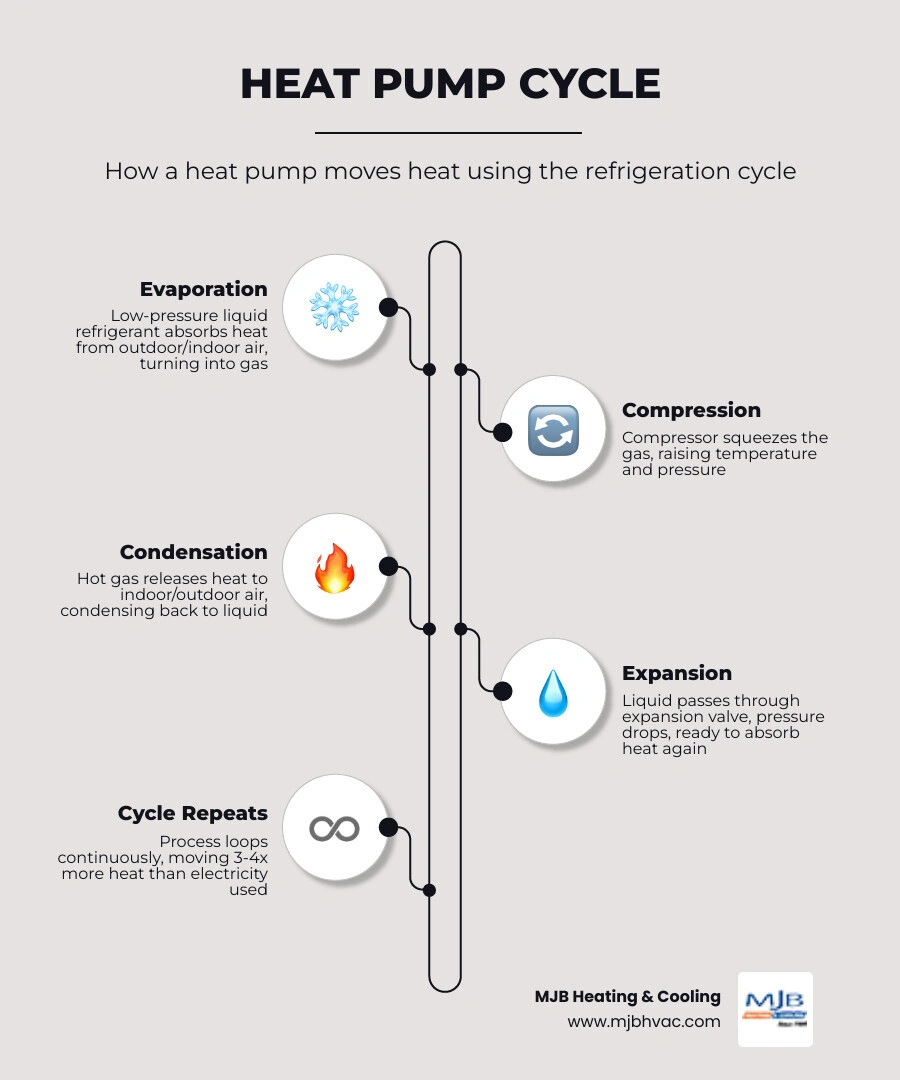
To understand how does a heat pump work, we have to look at a little bit of physics—but don't worry, we’ll keep it simple! The entire process relies on the second law of thermodynamics, which states that heat naturally flows from a high-temperature area to a lower-temperature area. A heat pump essentially "tricks" nature by using energy to reverse that flow.
The secret sauce is the refrigeration cycle. This cycle uses a special fluid called refrigerant that circulates through copper coils. Refrigerant is unique because it has an incredibly low boiling point. While water boils at 212°F, some refrigerants can boil and turn into a gas at temperatures well below zero. This allows the system to find heat even in the middle of a January night in Andover or Wichita.
When the refrigerant changes from a liquid to a gas (evaporation), it absorbs a massive amount of "latent heat." When it changes back from a gas to a liquid (condensation), it releases that heat. By controlling where these phase changes happen, we can decide whether we’re pulling heat out of your living room or pushing it into your bedroom. If you're considering an upgrade, our team specializes in Heat Pump Installation Andover KS to ensure your system is sized perfectly for this scientific process.
Every heat pump relies on a "closed loop" containing four heavy hitters that do all the work:
In April 2026, the HVAC industry is more focused than ever on environmental impact and efficiency. Modern heat pumps use advanced refrigerants that are designed to have a lower Global Warming Potential (GWP) while maintaining high heat-transfer capabilities. These fluids are the lifeblood of the vapor-compression cycle. Without the specific boiling points of these modern refrigerants, a heat pump wouldn't be able to extract heat from 30°F air and turn it into 90°F air for your vents.
The most impressive part of a heat pump is its versatility. Most people are surprised to learn that a heat pump is essentially an air conditioner that can run backward. The component that makes this possible is the reversing valve.
The reversing valve is a four-way valve that changes the direction of the refrigerant flow. With the flip of a switch on your thermostat, your system goes from a heater to a cooler. This dual functionality is why many homeowners choose a Heat Pump Installation Derby KS when their old central AC finally gives up the ghost.
In heating mode, the reversing valve directs the hot, pressurized gas from the compressor straight to the indoor coil.
When the Kansas summer hits and temperatures climb toward 100°F, the reversing valve flips.
Not all heat pumps are built the same. Depending on your property in Haysville, Derby, or El Dorado, one type might be significantly more beneficial than another.
| Heat Pump Type | Heat Source | Efficiency (COP) | Best For |
|---|---|---|---|
| Air-Source (ASHP) | Outdoor Air | 3.0 - 4.5 | Most residential homes; easy to install. |
| Ground-Source (GSHP) | Earth / Ground | 3.0 - 6.0 | Long-term savings; stable temperatures. |
| Water-Source | Lake / Well Water | 3.0 - 5.0 | Properties near a significant water body. |
| Absorption | Solar / Gas / Geothermal | 1.2 (Heating) | Homes with alternative fuel sources. |
Air-Source Heat Pumps are the most common in our area. They are relatively easy to install and work with existing ductwork. For those without ducts, ductless mini-splits are a fantastic option, allowing for "zoned" comfort in specific rooms. If you’re in a neighborhood like Haysville, a Heat Pump Installation Haysville KS is often the quickest way to upgrade your efficiency.
Ground-Source (Geothermal) Heat Pumps are the "gold standard." While they require more work upfront because we have to bury "loops" of pipe in your yard, they are incredibly efficient. Since the ground stays a constant 50-55°F year-round in Kansas, the heat pump doesn't have to work nearly as hard to find heat in the winter or dump it in the summer. These systems are famous for their longevity—the indoor parts last 25 years, and the underground loops can last over 50!
When we talk about heat pumps, we use a few specific ratings. You’ve likely heard of SEER2 (Seasonal Energy Efficiency Ratio), which measures cooling efficiency. For heating, we look at HSPF2 (Heating Seasonal Performance Factor). Generally, you want to look for a SEER2 between 14 and 18 and an HSPF2 between 8 and 10 for the best balance of performance.
One of the biggest myths we hear in the Wichita metro area is that heat pumps don't work in the cold. While it’s true that older models struggled when the mercury dipped below 30°F, modern technology has changed the game.
Cold Climate Performance: Many modern units are designed to maintain high efficiency even at -5°F. However, when it gets really cold, the system may enter a defrost cycle to melt ice off the outdoor coils. During these brief periods, or during extreme cold snaps, a supplemental heat source (like electric heat strips or a backup gas furnace in a "hybrid" system) kicks in to keep you cozy. If your system seems to be struggling when the seasons change, it might be time for Heat Pump Repair Haysville KS to check your sensors and defrost board.
At MJB Heating & Cooling, we’ve been serving Central Kansas since 1984, and we’ve seen that the secret to a 20-year heat pump is simple: maintenance. Because these systems work year-round, they experience more "mileage" than a furnace that sits idle all summer.
Here are a few things you can do to keep your system happy:
Sometimes, despite your best efforts, things go wrong. We've put together several guides to help you identify common issues:
A gas furnace has a maximum efficiency of about 98%—meaning for every dollar you spend, 98 cents becomes heat. A heat pump, however, can have a COP of 4.0, which means it is 400% efficient. This is because it isn't creating heat from fuel; it’s simply using a little bit of electricity to move a lot of existing heat from the outdoors into your home.
Most standard air-source heat pumps start to lose significant efficiency once temperatures drop below 25°F to 40°F. However, "Cold Climate" heat pumps (CCHP) are now available that remain highly efficient well below zero. In Kansas, we often recommend a "Dual Fuel" or hybrid system that uses a gas furnace as a backup for those rare sub-zero nights.
Yes! That is their primary advantage. By using a reversing valve to change the direction of the refrigerant, a single heat pump replaces both your central air conditioner and your furnace (or at least handles the bulk of the heating work).
Understanding how does a heat pump work is the first step toward a more comfortable and energy-efficient home. Whether you are in Derby, Andover, or anywhere in the Wichita metro area, these systems offer a versatile solution for our unpredictable Kansas weather.
At MJB Heating & Cooling, we pride ourselves on quality workmanship and an honest business approach. As a family-owned company founded in Derby, KS, we’ve been helping our neighbors stay comfortable since 1984. We believe in providing reliable HVAC solutions that fit your specific needs and budget. If you’re ready to experience the benefits of a modern system, contact us today for a professional Heat Pump Installation Derby KS. We’re here to help you move heat like a pro!
How does a heat pump work is one of the most common questions homeowners in Wichita, KS ask when they're shopping for a smarter, more efficient way to heat and cool their home year-round.
Here's the short answer:
A heat pump moves heat from one place to another — it doesn't create heat by burning fuel.
That efficiency advantage is a big deal for Central Kansas homeowners dealing with hot summers and cold winters alike. Unlike a gas furnace that burns fuel to create warmth, or a standard air conditioner that only cools, a heat pump handles both jobs with a single system. Modern cold-climate models can even keep working efficiently at temperatures as low as -22°F.
The rest of this guide breaks down exactly how the mechanics work, what types are available, and how to keep your system running at its best.
To understand how does a heat pump work, we have to look at a little bit of physics—but don't worry, we’ll keep it simple! The entire process relies on the second law of thermodynamics, which states that heat naturally flows from a high-temperature area to a lower-temperature area. A heat pump essentially "tricks" nature by using energy to reverse that flow.
The secret sauce is the refrigeration cycle. This cycle uses a special fluid called refrigerant that circulates through copper coils. Refrigerant is unique because it has an incredibly low boiling point. While water boils at 212°F, some refrigerants can boil and turn into a gas at temperatures well below zero. This allows the system to find heat even in the middle of a January night in Andover or Wichita.
When the refrigerant changes from a liquid to a gas (evaporation), it absorbs a massive amount of "latent heat." When it changes back from a gas to a liquid (condensation), it releases that heat. By controlling where these phase changes happen, we can decide whether we’re pulling heat out of your living room or pushing it into your bedroom. If you're considering an upgrade, our team specializes in Heat Pump Installation Andover KS to ensure your system is sized perfectly for this scientific process.
Every heat pump relies on a "closed loop" containing four heavy hitters that do all the work:
In April 2026, the HVAC industry is more focused than ever on environmental impact and efficiency. Modern heat pumps use advanced refrigerants that are designed to have a lower Global Warming Potential (GWP) while maintaining high heat-transfer capabilities. These fluids are the lifeblood of the vapor-compression cycle. Without the specific boiling points of these modern refrigerants, a heat pump wouldn't be able to extract heat from 30°F air and turn it into 90°F air for your vents.
The most impressive part of a heat pump is its versatility. Most people are surprised to learn that a heat pump is essentially an air conditioner that can run backward. The component that makes this possible is the reversing valve.
The reversing valve is a four-way valve that changes the direction of the refrigerant flow. With the flip of a switch on your thermostat, your system goes from a heater to a cooler. This dual functionality is why many homeowners choose a Heat Pump Installation Derby KS when their old central AC finally gives up the ghost.
In heating mode, the reversing valve directs the hot, pressurized gas from the compressor straight to the indoor coil.
When the Kansas summer hits and temperatures climb toward 100°F, the reversing valve flips.
Not all heat pumps are built the same. Depending on your property in Haysville, Derby, or El Dorado, one type might be significantly more beneficial than another.
| Heat Pump Type | Heat Source | Efficiency (COP) | Best For |
|---|---|---|---|
| Air-Source (ASHP) | Outdoor Air | 3.0 - 4.5 | Most residential homes; easy to install. |
| Ground-Source (GSHP) | Earth / Ground | 3.0 - 6.0 | Long-term savings; stable temperatures. |
| Water-Source | Lake / Well Water | 3.0 - 5.0 | Properties near a significant water body. |
| Absorption | Solar / Gas / Geothermal | 1.2 (Heating) | Homes with alternative fuel sources. |
Air-Source Heat Pumps are the most common in our area. They are relatively easy to install and work with existing ductwork. For those without ducts, ductless mini-splits are a fantastic option, allowing for "zoned" comfort in specific rooms. If you’re in a neighborhood like Haysville, a Heat Pump Installation Haysville KS is often the quickest way to upgrade your efficiency.
Ground-Source (Geothermal) Heat Pumps are the "gold standard." While they require more work upfront because we have to bury "loops" of pipe in your yard, they are incredibly efficient. Since the ground stays a constant 50-55°F year-round in Kansas, the heat pump doesn't have to work nearly as hard to find heat in the winter or dump it in the summer. These systems are famous for their longevity—the indoor parts last 25 years, and the underground loops can last over 50!
When we talk about heat pumps, we use a few specific ratings. You’ve likely heard of SEER2 (Seasonal Energy Efficiency Ratio), which measures cooling efficiency. For heating, we look at HSPF2 (Heating Seasonal Performance Factor). Generally, you want to look for a SEER2 between 14 and 18 and an HSPF2 between 8 and 10 for the best balance of performance.
One of the biggest myths we hear in the Wichita metro area is that heat pumps don't work in the cold. While it’s true that older models struggled when the mercury dipped below 30°F, modern technology has changed the game.
Cold Climate Performance: Many modern units are designed to maintain high efficiency even at -5°F. However, when it gets really cold, the system may enter a defrost cycle to melt ice off the outdoor coils. During these brief periods, or during extreme cold snaps, a supplemental heat source (like electric heat strips or a backup gas furnace in a "hybrid" system) kicks in to keep you cozy. If your system seems to be struggling when the seasons change, it might be time for Heat Pump Repair Haysville KS to check your sensors and defrost board.
At MJB Heating & Cooling, we’ve been serving Central Kansas since 1984, and we’ve seen that the secret to a 20-year heat pump is simple: maintenance. Because these systems work year-round, they experience more "mileage" than a furnace that sits idle all summer.
Here are a few things you can do to keep your system happy:
Sometimes, despite your best efforts, things go wrong. We've put together several guides to help you identify common issues:
A gas furnace has a maximum efficiency of about 98%—meaning for every dollar you spend, 98 cents becomes heat. A heat pump, however, can have a COP of 4.0, which means it is 400% efficient. This is because it isn't creating heat from fuel; it’s simply using a little bit of electricity to move a lot of existing heat from the outdoors into your home.
Most standard air-source heat pumps start to lose significant efficiency once temperatures drop below 25°F to 40°F. However, "Cold Climate" heat pumps (CCHP) are now available that remain highly efficient well below zero. In Kansas, we often recommend a "Dual Fuel" or hybrid system that uses a gas furnace as a backup for those rare sub-zero nights.
Yes! That is their primary advantage. By using a reversing valve to change the direction of the refrigerant, a single heat pump replaces both your central air conditioner and your furnace (or at least handles the bulk of the heating work).
Understanding how does a heat pump work is the first step toward a more comfortable and energy-efficient home. Whether you are in Derby, Andover, or anywhere in the Wichita metro area, these systems offer a versatile solution for our unpredictable Kansas weather.
At MJB Heating & Cooling, we pride ourselves on quality workmanship and an honest business approach. As a family-owned company founded in Derby, KS, we’ve been helping our neighbors stay comfortable since 1984. We believe in providing reliable HVAC solutions that fit your specific needs and budget. If you’re ready to experience the benefits of a modern system, contact us today for a professional Heat Pump Installation Derby KS. We’re here to help you move heat like a pro!
How does a heat pump work is one of the most common questions homeowners in Wichita, KS ask when they're shopping for a smarter, more efficient way to heat and cool their home year-round.
Here's the short answer:
A heat pump moves heat from one place to another — it doesn't create heat by burning fuel.
That efficiency advantage is a big deal for Central Kansas homeowners dealing with hot summers and cold winters alike. Unlike a gas furnace that burns fuel to create warmth, or a standard air conditioner that only cools, a heat pump handles both jobs with a single system. Modern cold-climate models can even keep working efficiently at temperatures as low as -22°F.
The rest of this guide breaks down exactly how the mechanics work, what types are available, and how to keep your system running at its best.
To understand how does a heat pump work, we have to look at a little bit of physics—but don't worry, we’ll keep it simple! The entire process relies on the second law of thermodynamics, which states that heat naturally flows from a high-temperature area to a lower-temperature area. A heat pump essentially "tricks" nature by using energy to reverse that flow.
The secret sauce is the refrigeration cycle. This cycle uses a special fluid called refrigerant that circulates through copper coils. Refrigerant is unique because it has an incredibly low boiling point. While water boils at 212°F, some refrigerants can boil and turn into a gas at temperatures well below zero. This allows the system to find heat even in the middle of a January night in Andover or Wichita.
When the refrigerant changes from a liquid to a gas (evaporation), it absorbs a massive amount of "latent heat." When it changes back from a gas to a liquid (condensation), it releases that heat. By controlling where these phase changes happen, we can decide whether we’re pulling heat out of your living room or pushing it into your bedroom. If you're considering an upgrade, our team specializes in Heat Pump Installation Andover KS to ensure your system is sized perfectly for this scientific process.
Every heat pump relies on a "closed loop" containing four heavy hitters that do all the work:
In April 2026, the HVAC industry is more focused than ever on environmental impact and efficiency. Modern heat pumps use advanced refrigerants that are designed to have a lower Global Warming Potential (GWP) while maintaining high heat-transfer capabilities. These fluids are the lifeblood of the vapor-compression cycle. Without the specific boiling points of these modern refrigerants, a heat pump wouldn't be able to extract heat from 30°F air and turn it into 90°F air for your vents.
The most impressive part of a heat pump is its versatility. Most people are surprised to learn that a heat pump is essentially an air conditioner that can run backward. The component that makes this possible is the reversing valve.
The reversing valve is a four-way valve that changes the direction of the refrigerant flow. With the flip of a switch on your thermostat, your system goes from a heater to a cooler. This dual functionality is why many homeowners choose a Heat Pump Installation Derby KS when their old central AC finally gives up the ghost.
In heating mode, the reversing valve directs the hot, pressurized gas from the compressor straight to the indoor coil.
When the Kansas summer hits and temperatures climb toward 100°F, the reversing valve flips.
Not all heat pumps are built the same. Depending on your property in Haysville, Derby, or El Dorado, one type might be significantly more beneficial than another.
| Heat Pump Type | Heat Source | Efficiency (COP) | Best For |
|---|---|---|---|
| Air-Source (ASHP) | Outdoor Air | 3.0 - 4.5 | Most residential homes; easy to install. |
| Ground-Source (GSHP) | Earth / Ground | 3.0 - 6.0 | Long-term savings; stable temperatures. |
| Water-Source | Lake / Well Water | 3.0 - 5.0 | Properties near a significant water body. |
| Absorption | Solar / Gas / Geothermal | 1.2 (Heating) | Homes with alternative fuel sources. |
Air-Source Heat Pumps are the most common in our area. They are relatively easy to install and work with existing ductwork. For those without ducts, ductless mini-splits are a fantastic option, allowing for "zoned" comfort in specific rooms. If you’re in a neighborhood like Haysville, a Heat Pump Installation Haysville KS is often the quickest way to upgrade your efficiency.
Ground-Source (Geothermal) Heat Pumps are the "gold standard." While they require more work upfront because we have to bury "loops" of pipe in your yard, they are incredibly efficient. Since the ground stays a constant 50-55°F year-round in Kansas, the heat pump doesn't have to work nearly as hard to find heat in the winter or dump it in the summer. These systems are famous for their longevity—the indoor parts last 25 years, and the underground loops can last over 50!
When we talk about heat pumps, we use a few specific ratings. You’ve likely heard of SEER2 (Seasonal Energy Efficiency Ratio), which measures cooling efficiency. For heating, we look at HSPF2 (Heating Seasonal Performance Factor). Generally, you want to look for a SEER2 between 14 and 18 and an HSPF2 between 8 and 10 for the best balance of performance.
One of the biggest myths we hear in the Wichita metro area is that heat pumps don't work in the cold. While it’s true that older models struggled when the mercury dipped below 30°F, modern technology has changed the game.
Cold Climate Performance: Many modern units are designed to maintain high efficiency even at -5°F. However, when it gets really cold, the system may enter a defrost cycle to melt ice off the outdoor coils. During these brief periods, or during extreme cold snaps, a supplemental heat source (like electric heat strips or a backup gas furnace in a "hybrid" system) kicks in to keep you cozy. If your system seems to be struggling when the seasons change, it might be time for Heat Pump Repair Haysville KS to check your sensors and defrost board.
At MJB Heating & Cooling, we’ve been serving Central Kansas since 1984, and we’ve seen that the secret to a 20-year heat pump is simple: maintenance. Because these systems work year-round, they experience more "mileage" than a furnace that sits idle all summer.
Here are a few things you can do to keep your system happy:
Sometimes, despite your best efforts, things go wrong. We've put together several guides to help you identify common issues:
A gas furnace has a maximum efficiency of about 98%—meaning for every dollar you spend, 98 cents becomes heat. A heat pump, however, can have a COP of 4.0, which means it is 400% efficient. This is because it isn't creating heat from fuel; it’s simply using a little bit of electricity to move a lot of existing heat from the outdoors into your home.
Most standard air-source heat pumps start to lose significant efficiency once temperatures drop below 25°F to 40°F. However, "Cold Climate" heat pumps (CCHP) are now available that remain highly efficient well below zero. In Kansas, we often recommend a "Dual Fuel" or hybrid system that uses a gas furnace as a backup for those rare sub-zero nights.
Yes! That is their primary advantage. By using a reversing valve to change the direction of the refrigerant, a single heat pump replaces both your central air conditioner and your furnace (or at least handles the bulk of the heating work).
Understanding how does a heat pump work is the first step toward a more comfortable and energy-efficient home. Whether you are in Derby, Andover, or anywhere in the Wichita metro area, these systems offer a versatile solution for our unpredictable Kansas weather.
At MJB Heating & Cooling, we pride ourselves on quality workmanship and an honest business approach. As a family-owned company founded in Derby, KS, we’ve been helping our neighbors stay comfortable since 1984. We believe in providing reliable HVAC solutions that fit your specific needs and budget. If you’re ready to experience the benefits of a modern system, contact us today for a professional Heat Pump Installation Derby KS. We’re here to help you move heat like a pro!
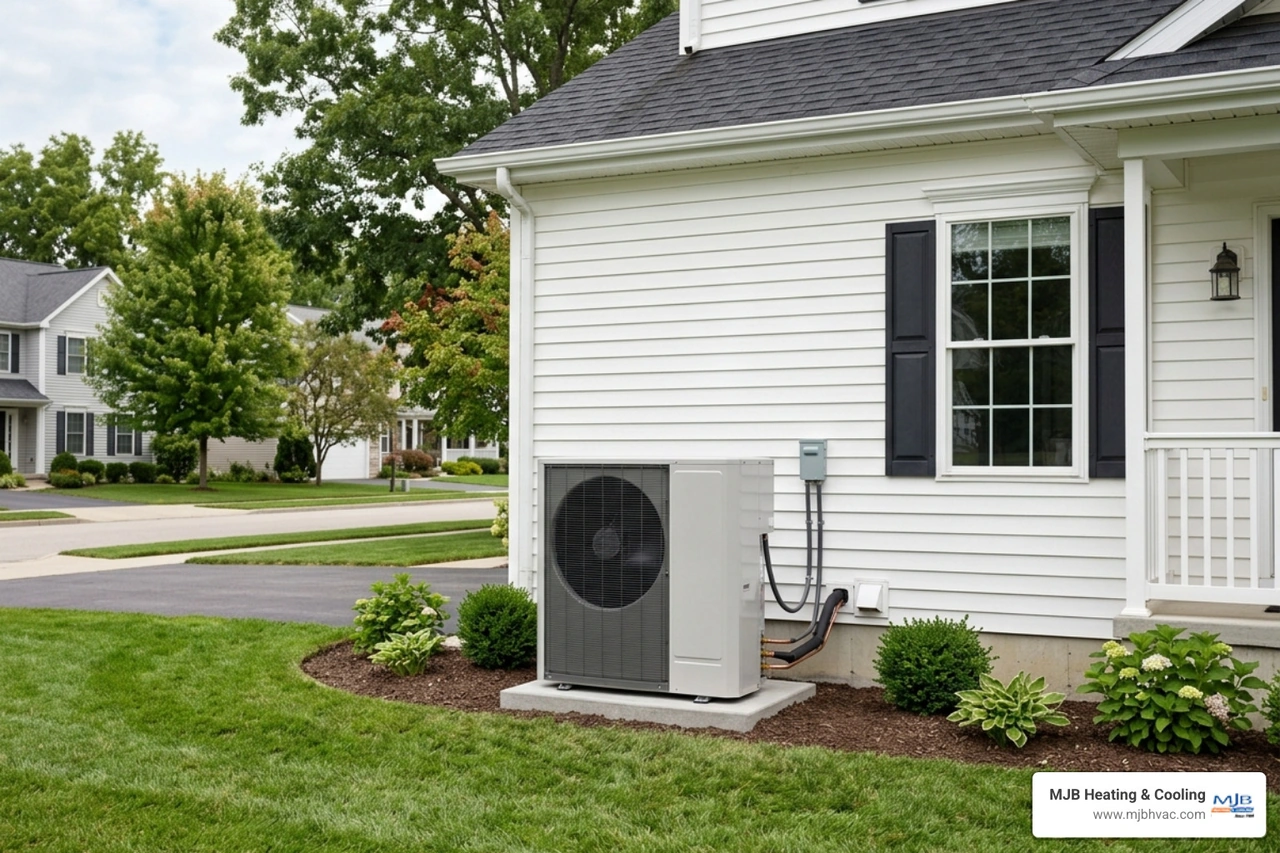

How does a heat pump work is one of the most common questions homeowners in Wichita, KS ask when they're shopping for a smarter, more efficient way to heat and cool their home year-round.
Here's the short answer:
A heat pump moves heat from one place to another — it doesn't create heat by burning fuel.
That efficiency advantage is a big deal for Central Kansas homeowners dealing with hot summers and cold winters alike. Unlike a gas furnace that burns fuel to create warmth, or a standard air conditioner that only cools, a heat pump handles both jobs with a single system. Modern cold-climate models can even keep working efficiently at temperatures as low as -22°F.
The rest of this guide breaks down exactly how the mechanics work, what types are available, and how to keep your system running at its best.
To understand how does a heat pump work, we have to look at a little bit of physics—but don't worry, we’ll keep it simple! The entire process relies on the second law of thermodynamics, which states that heat naturally flows from a high-temperature area to a lower-temperature area. A heat pump essentially "tricks" nature by using energy to reverse that flow.
The secret sauce is the refrigeration cycle. This cycle uses a special fluid called refrigerant that circulates through copper coils. Refrigerant is unique because it has an incredibly low boiling point. While water boils at 212°F, some refrigerants can boil and turn into a gas at temperatures well below zero. This allows the system to find heat even in the middle of a January night in Andover or Wichita.
When the refrigerant changes from a liquid to a gas (evaporation), it absorbs a massive amount of "latent heat." When it changes back from a gas to a liquid (condensation), it releases that heat. By controlling where these phase changes happen, we can decide whether we’re pulling heat out of your living room or pushing it into your bedroom. If you're considering an upgrade, our team specializes in Heat Pump Installation Andover KS to ensure your system is sized perfectly for this scientific process.
Every heat pump relies on a "closed loop" containing four heavy hitters that do all the work:
In April 2026, the HVAC industry is more focused than ever on environmental impact and efficiency. Modern heat pumps use advanced refrigerants that are designed to have a lower Global Warming Potential (GWP) while maintaining high heat-transfer capabilities. These fluids are the lifeblood of the vapor-compression cycle. Without the specific boiling points of these modern refrigerants, a heat pump wouldn't be able to extract heat from 30°F air and turn it into 90°F air for your vents.
The most impressive part of a heat pump is its versatility. Most people are surprised to learn that a heat pump is essentially an air conditioner that can run backward. The component that makes this possible is the reversing valve.
The reversing valve is a four-way valve that changes the direction of the refrigerant flow. With the flip of a switch on your thermostat, your system goes from a heater to a cooler. This dual functionality is why many homeowners choose a Heat Pump Installation Derby KS when their old central AC finally gives up the ghost.
In heating mode, the reversing valve directs the hot, pressurized gas from the compressor straight to the indoor coil.
When the Kansas summer hits and temperatures climb toward 100°F, the reversing valve flips.
Not all heat pumps are built the same. Depending on your property in Haysville, Derby, or El Dorado, one type might be significantly more beneficial than another.
| Heat Pump Type | Heat Source | Efficiency (COP) | Best For |
|---|---|---|---|
| Air-Source (ASHP) | Outdoor Air | 3.0 - 4.5 | Most residential homes; easy to install. |
| Ground-Source (GSHP) | Earth / Ground | 3.0 - 6.0 | Long-term savings; stable temperatures. |
| Water-Source | Lake / Well Water | 3.0 - 5.0 | Properties near a significant water body. |
| Absorption | Solar / Gas / Geothermal | 1.2 (Heating) | Homes with alternative fuel sources. |
Air-Source Heat Pumps are the most common in our area. They are relatively easy to install and work with existing ductwork. For those without ducts, ductless mini-splits are a fantastic option, allowing for "zoned" comfort in specific rooms. If you’re in a neighborhood like Haysville, a Heat Pump Installation Haysville KS is often the quickest way to upgrade your efficiency.
Ground-Source (Geothermal) Heat Pumps are the "gold standard." While they require more work upfront because we have to bury "loops" of pipe in your yard, they are incredibly efficient. Since the ground stays a constant 50-55°F year-round in Kansas, the heat pump doesn't have to work nearly as hard to find heat in the winter or dump it in the summer. These systems are famous for their longevity—the indoor parts last 25 years, and the underground loops can last over 50!
When we talk about heat pumps, we use a few specific ratings. You’ve likely heard of SEER2 (Seasonal Energy Efficiency Ratio), which measures cooling efficiency. For heating, we look at HSPF2 (Heating Seasonal Performance Factor). Generally, you want to look for a SEER2 between 14 and 18 and an HSPF2 between 8 and 10 for the best balance of performance.
One of the biggest myths we hear in the Wichita metro area is that heat pumps don't work in the cold. While it’s true that older models struggled when the mercury dipped below 30°F, modern technology has changed the game.
Cold Climate Performance: Many modern units are designed to maintain high efficiency even at -5°F. However, when it gets really cold, the system may enter a defrost cycle to melt ice off the outdoor coils. During these brief periods, or during extreme cold snaps, a supplemental heat source (like electric heat strips or a backup gas furnace in a "hybrid" system) kicks in to keep you cozy. If your system seems to be struggling when the seasons change, it might be time for Heat Pump Repair Haysville KS to check your sensors and defrost board.
At MJB Heating & Cooling, we’ve been serving Central Kansas since 1984, and we’ve seen that the secret to a 20-year heat pump is simple: maintenance. Because these systems work year-round, they experience more "mileage" than a furnace that sits idle all summer.
Here are a few things you can do to keep your system happy:
Sometimes, despite your best efforts, things go wrong. We've put together several guides to help you identify common issues:
A gas furnace has a maximum efficiency of about 98%—meaning for every dollar you spend, 98 cents becomes heat. A heat pump, however, can have a COP of 4.0, which means it is 400% efficient. This is because it isn't creating heat from fuel; it’s simply using a little bit of electricity to move a lot of existing heat from the outdoors into your home.
Most standard air-source heat pumps start to lose significant efficiency once temperatures drop below 25°F to 40°F. However, "Cold Climate" heat pumps (CCHP) are now available that remain highly efficient well below zero. In Kansas, we often recommend a "Dual Fuel" or hybrid system that uses a gas furnace as a backup for those rare sub-zero nights.
Yes! That is their primary advantage. By using a reversing valve to change the direction of the refrigerant, a single heat pump replaces both your central air conditioner and your furnace (or at least handles the bulk of the heating work).
Understanding how does a heat pump work is the first step toward a more comfortable and energy-efficient home. Whether you are in Derby, Andover, or anywhere in the Wichita metro area, these systems offer a versatile solution for our unpredictable Kansas weather.
At MJB Heating & Cooling, we pride ourselves on quality workmanship and an honest business approach. As a family-owned company founded in Derby, KS, we’ve been helping our neighbors stay comfortable since 1984. We believe in providing reliable HVAC solutions that fit your specific needs and budget. If you’re ready to experience the benefits of a modern system, contact us today for a professional Heat Pump Installation Derby KS. We’re here to help you move heat like a pro!
How does a heat pump work is one of the most common questions homeowners in Wichita, KS ask when they're shopping for a smarter, more efficient way to heat and cool their home year-round.
Here's the short answer:
A heat pump moves heat from one place to another — it doesn't create heat by burning fuel.
That efficiency advantage is a big deal for Central Kansas homeowners dealing with hot summers and cold winters alike. Unlike a gas furnace that burns fuel to create warmth, or a standard air conditioner that only cools, a heat pump handles both jobs with a single system. Modern cold-climate models can even keep working efficiently at temperatures as low as -22°F.
The rest of this guide breaks down exactly how the mechanics work, what types are available, and how to keep your system running at its best.
To understand how does a heat pump work, we have to look at a little bit of physics—but don't worry, we’ll keep it simple! The entire process relies on the second law of thermodynamics, which states that heat naturally flows from a high-temperature area to a lower-temperature area. A heat pump essentially "tricks" nature by using energy to reverse that flow.
The secret sauce is the refrigeration cycle. This cycle uses a special fluid called refrigerant that circulates through copper coils. Refrigerant is unique because it has an incredibly low boiling point. While water boils at 212°F, some refrigerants can boil and turn into a gas at temperatures well below zero. This allows the system to find heat even in the middle of a January night in Andover or Wichita.
When the refrigerant changes from a liquid to a gas (evaporation), it absorbs a massive amount of "latent heat." When it changes back from a gas to a liquid (condensation), it releases that heat. By controlling where these phase changes happen, we can decide whether we’re pulling heat out of your living room or pushing it into your bedroom. If you're considering an upgrade, our team specializes in Heat Pump Installation Andover KS to ensure your system is sized perfectly for this scientific process.
Every heat pump relies on a "closed loop" containing four heavy hitters that do all the work:
In April 2026, the HVAC industry is more focused than ever on environmental impact and efficiency. Modern heat pumps use advanced refrigerants that are designed to have a lower Global Warming Potential (GWP) while maintaining high heat-transfer capabilities. These fluids are the lifeblood of the vapor-compression cycle. Without the specific boiling points of these modern refrigerants, a heat pump wouldn't be able to extract heat from 30°F air and turn it into 90°F air for your vents.
The most impressive part of a heat pump is its versatility. Most people are surprised to learn that a heat pump is essentially an air conditioner that can run backward. The component that makes this possible is the reversing valve.
The reversing valve is a four-way valve that changes the direction of the refrigerant flow. With the flip of a switch on your thermostat, your system goes from a heater to a cooler. This dual functionality is why many homeowners choose a Heat Pump Installation Derby KS when their old central AC finally gives up the ghost.
In heating mode, the reversing valve directs the hot, pressurized gas from the compressor straight to the indoor coil.
When the Kansas summer hits and temperatures climb toward 100°F, the reversing valve flips.
Not all heat pumps are built the same. Depending on your property in Haysville, Derby, or El Dorado, one type might be significantly more beneficial than another.
| Heat Pump Type | Heat Source | Efficiency (COP) | Best For |
|---|---|---|---|
| Air-Source (ASHP) | Outdoor Air | 3.0 - 4.5 | Most residential homes; easy to install. |
| Ground-Source (GSHP) | Earth / Ground | 3.0 - 6.0 | Long-term savings; stable temperatures. |
| Water-Source | Lake / Well Water | 3.0 - 5.0 | Properties near a significant water body. |
| Absorption | Solar / Gas / Geothermal | 1.2 (Heating) | Homes with alternative fuel sources. |
Air-Source Heat Pumps are the most common in our area. They are relatively easy to install and work with existing ductwork. For those without ducts, ductless mini-splits are a fantastic option, allowing for "zoned" comfort in specific rooms. If you’re in a neighborhood like Haysville, a Heat Pump Installation Haysville KS is often the quickest way to upgrade your efficiency.
Ground-Source (Geothermal) Heat Pumps are the "gold standard." While they require more work upfront because we have to bury "loops" of pipe in your yard, they are incredibly efficient. Since the ground stays a constant 50-55°F year-round in Kansas, the heat pump doesn't have to work nearly as hard to find heat in the winter or dump it in the summer. These systems are famous for their longevity—the indoor parts last 25 years, and the underground loops can last over 50!
When we talk about heat pumps, we use a few specific ratings. You’ve likely heard of SEER2 (Seasonal Energy Efficiency Ratio), which measures cooling efficiency. For heating, we look at HSPF2 (Heating Seasonal Performance Factor). Generally, you want to look for a SEER2 between 14 and 18 and an HSPF2 between 8 and 10 for the best balance of performance.
One of the biggest myths we hear in the Wichita metro area is that heat pumps don't work in the cold. While it’s true that older models struggled when the mercury dipped below 30°F, modern technology has changed the game.
Cold Climate Performance: Many modern units are designed to maintain high efficiency even at -5°F. However, when it gets really cold, the system may enter a defrost cycle to melt ice off the outdoor coils. During these brief periods, or during extreme cold snaps, a supplemental heat source (like electric heat strips or a backup gas furnace in a "hybrid" system) kicks in to keep you cozy. If your system seems to be struggling when the seasons change, it might be time for Heat Pump Repair Haysville KS to check your sensors and defrost board.
At MJB Heating & Cooling, we’ve been serving Central Kansas since 1984, and we’ve seen that the secret to a 20-year heat pump is simple: maintenance. Because these systems work year-round, they experience more "mileage" than a furnace that sits idle all summer.
Here are a few things you can do to keep your system happy:
Sometimes, despite your best efforts, things go wrong. We've put together several guides to help you identify common issues:
A gas furnace has a maximum efficiency of about 98%—meaning for every dollar you spend, 98 cents becomes heat. A heat pump, however, can have a COP of 4.0, which means it is 400% efficient. This is because it isn't creating heat from fuel; it’s simply using a little bit of electricity to move a lot of existing heat from the outdoors into your home.
Most standard air-source heat pumps start to lose significant efficiency once temperatures drop below 25°F to 40°F. However, "Cold Climate" heat pumps (CCHP) are now available that remain highly efficient well below zero. In Kansas, we often recommend a "Dual Fuel" or hybrid system that uses a gas furnace as a backup for those rare sub-zero nights.
Yes! That is their primary advantage. By using a reversing valve to change the direction of the refrigerant, a single heat pump replaces both your central air conditioner and your furnace (or at least handles the bulk of the heating work).
Understanding how does a heat pump work is the first step toward a more comfortable and energy-efficient home. Whether you are in Derby, Andover, or anywhere in the Wichita metro area, these systems offer a versatile solution for our unpredictable Kansas weather.
At MJB Heating & Cooling, we pride ourselves on quality workmanship and an honest business approach. As a family-owned company founded in Derby, KS, we’ve been helping our neighbors stay comfortable since 1984. We believe in providing reliable HVAC solutions that fit your specific needs and budget. If you’re ready to experience the benefits of a modern system, contact us today for a professional Heat Pump Installation Derby KS. We’re here to help you move heat like a pro!


Our A/C stopped working on a Sunday and due to health issues, we needed to find a service company available on a Sunday. I called MJB and left a message on their emergency voice mail. Within 10 minutes Tom Buck called me to hear my description of the symptoms. He was just finishing an appointment in Wichita and would be on his way to my home on the south end of Derby. He arrived within 30 minutes! From start to finish he was the perfect example of what you could ever hope for in an HVAC tech and a human being. His evaluation of our system inside and out was as thorough as I could ever imagine and once he was done with the repair, our system is running as well or better than ever. Well worth the price for the evaluation, parts, and labor. Thank you again Tom for an awesome experience.
Our AC went out during the hottest days of the year, and they were out next day! We have been jerked around by a shoddy home warranty for years. We finally had a chance to pick our own repair people, and MJB came highly recommended. I can see why! I was impressed with the honesty and speed at which they fixed our AC unit!
Our commercial building had a lightening/electrical strike and damaged our 20 ton AC unit. No one could find us a new unit before the end of September. Imagining going all of August and September with no AC in Kansas and working inside near 100 degree temps is less than thrilling. Dale and the team at MJB called around and saved the day. They had us a new unit 5 weeks earlier than other could promise and I now have happy employees. The unit is amazingly quiet, super cold and so much more energy efficient. Thank you for being our super hero!
Came out and installed my new furnace. Was very polite and affordable. They are very acknowledgeable and I highly recommend!
Thank you very much. We had our 1st warm night in 3weeks. MJB took the time and effort to find the real problem. And the employees were kind and thoughtful and explained things very well. I cannot thank you and all of MJB. Will recommend you highly. Thanks again Marjorie Herman Oxford Kansas
We had a new system installed and I was so impressed with how quick they were in come out and install it, in the middle of a hot summer day. They were so friendly & very professional. I had a small problem with a weird sound and they came over immediately and fixed it. Love them!