.avif)





Blogs
Stay updated with our latest blog posts.
When we talk about how tornadoes and hail damage HVAC equipment, we have to start with the sheer power of Kansas wind. In the Wichita metro area, it isn't just the 100+ mph winds of a tornado that cause problems; even straight-line winds during a severe thunderstorm can reach 60 to 70 mph.
At these speeds, your outdoor condenser unit becomes a target for "wind-borne debris." This is a polite way of saying that your neighbor’s patio umbrella, a stray tree limb, or even a piece of loose siding can become a high-speed projectile. When these objects strike your unit, they don't just leave a scratch. They can dislodge the heavy metal panels that protect the internal components, or worse, crush the top grille and bend the fan assembly.
If the wind is strong enough—as is common during a tornado—the entire unit can be shifted or even toppled off its concrete pad. This is a critical failure because the outdoor unit is connected to your indoor system by copper refrigerant lines. When the unit moves, those lines are pulled, twisted, or snapped. This leads to immediate refrigerant leaks, which are not only bad for the environment but can also lead to compressor failure if the system tries to run without proper pressure. You can learn more about these risks in our guide on how Kansas severe weather affects your HVAC system.
The structural integrity of your HVAC system is surprisingly delicate. While the outer casing looks tough, it is designed for airflow, not impact resistance. Here is how physical damage usually manifests:
Hail is perhaps the most common "silent killer" of AC units in places like Derby and Andover. While we all worry about the windows on our cars, our air conditioners are actually much more vulnerable.
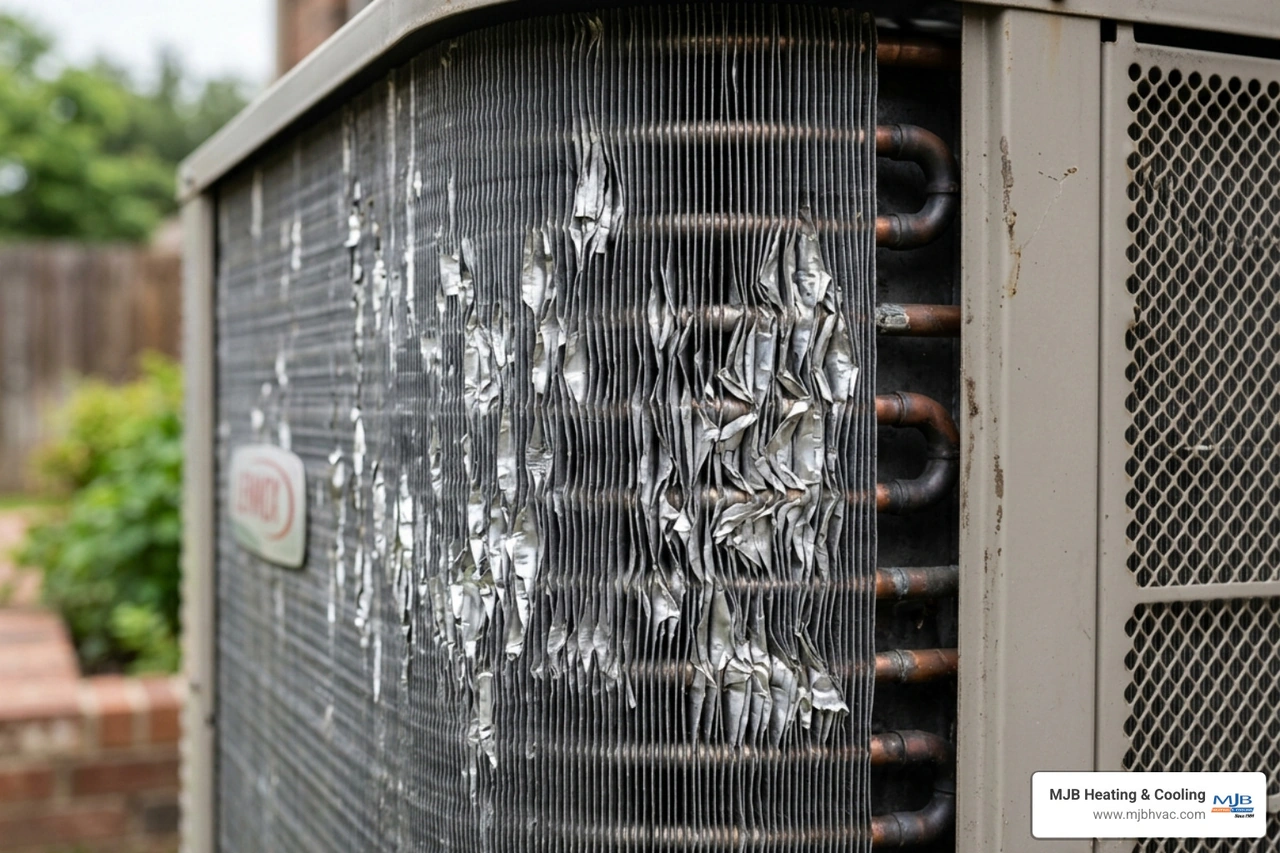
The outdoor unit is wrapped in thousands of tiny, paper-thin aluminum "fins." These fins are responsible for releasing heat from the refrigerant into the outside air. Because they are so thin, even small hail can flatten them. When the fins are flattened, air can no longer pass through the coils. This is a major part of how tornadoes and hail damage HVAC equipment—it effectively "chokes" the machine.
Without proper airflow, the system has to work twice as hard to cool your home. This leads to a massive spike in your energy bills and puts extreme stress on the compressor. If your fins look like they’ve been hit by a hammer, your system is likely losing efficiency every minute it runs. For a deeper look at how our local environment affects these components, check out our Kansas climate HVAC guide.
It can be hard to tell if you need a repair or just have a few "battle scars." Use the table below to evaluate your unit:
| Type of Damage | Appearance | Impact on System | Action Needed |
|---|---|---|---|
| Cosmetic | Small pings on the heavy outer metal lid or base. | None; purely visual. | None; document for records. |
| Minor Functional | Scattered areas of flattened aluminum fins (less than 10%). | Slight loss of efficiency; higher bills. | Fin combing by a professional. |
| Major Functional | Large "matted" areas of fins; visible copper tube dents. | Overheating; compressor risk; high bills. | Professional repair or coil replacement. |
| Critical | Punctured coils; leaking oil or refrigerant; broken fan. | System will not cool; potential total failure. | Immediate shutdown and professional service. |
In extreme Kansas storms, we see hail the size of grapefruits. At that size, hail doesn't just bend fins; it can actually puncture the copper tubing that carries the refrigerant. If you notice a hissing sound after a storm, or if you see an oily residue on the unit, you likely have a refrigerant leak.
A system with a leak will become unresponsive. It might blow air, but that air won't be cold. Running a system in this state is dangerous for the compressor, which relies on the refrigerant to stay cool. If the compressor "slugs" or overheats due to a leak, you are looking at a much more expensive replacement rather than a simple repair.
While wind and hail get all the headlines, water and electricity are just as dangerous. In areas like Wichita and Haysville, heavy spring rains can lead to localized flooding. Most outdoor units are installed on a raised pad, but if the water rises higher than the base of the unit, you have a serious problem.
HVAC units are designed to handle rain falling from above, but they are not designed to be submerged. If the bottom of the unit sits in standing water, the fan motor, capacitors, and contactors can be ruined. Even after the water recedes, the damage continues in the form of rust and corrosion on internal electrical connections. Furthermore, moisture trapped in the ductwork or near the indoor coil can lead to mold growth, which compromises your indoor air quality.
Lightning doesn't have to hit your house to destroy your AC. A strike nearby can send a high voltage surge through the power lines. This is one of the most frequent causes of loss we see at MJB Heating & Cooling.
These surges target the "brains" of your system. Modern HVAC units use sensitive control boards that can be "fried" instantly by a voltage spike. Capacitors, which help start the motor, are also highly susceptible.
Watch out for these electrical red flags after a storm:
Generally, yes. Most standard homeowners' insurance policies in Kansas cover damage caused by "perils" like wind, hail, and lightning. However, the process can be tricky. Insurance companies often look for "wear and tear" as an excuse to deny a claim. This is why professional documentation is vital.
Interestingly, data from major HVAC evaluators shows that more than 25% of systems involved in insurance claims after major storms were actually found to be working as designed, while only 31% needed a full replacement. This means there is a high chance your system can be saved with the right repairs. Always take photos of the unit immediately after a storm and keep your maintenance records handy to prove the unit was in good shape before the weather hit.
Yes, absolutely. If a severe weather warning is issued for your area (like Derby or El Dorado), the safest move is to turn your system off at the thermostat. If you have time, you should also flip the circuit breaker to the "off" position.
Turning off the power prevents the system from trying to run while it's being pelted by hail or if the power is flickering. A "brownout" (low voltage) can be just as damaging to a motor as a "surge" (high voltage). By cutting the power, you protect the control boards and the compressor from electrical fluctuations.
Once the "all clear" is given and it is safe to go outside, perform a visual inspection.
If anything seems "off," turn it back off immediately and call a professional. Running a damaged unit for even an hour can turn a small repair into a total system failure.
Understanding how tornadoes and hail damage HVAC equipment is the first step in protecting your home's most expensive appliance. From the high winds of a Kansas tornado to the relentless pounding of a hailstorm, your HVAC system is on the front lines.
At MJB Heating & Cooling, we’ve been helping our neighbors in Wichita, Derby, Andover, and throughout Central Kansas since 1984. We are a family-owned business that believes in an honest approach and quality workmanship. If a storm has recently rolled through your neighborhood, don't leave your comfort to chance. Our licensed technicians can provide a thorough, professional inspection to ensure your system is safe, efficient, and ready for the summer heat.
Don't wait for your system to fail on the hottest day of the year. Schedule your storm damage assessment with MJB Heating & Cooling today and let us give you the peace of mind you deserve.
When we talk about how tornadoes and hail damage HVAC equipment, we have to start with the sheer power of Kansas wind. In the Wichita metro area, it isn't just the 100+ mph winds of a tornado that cause problems; even straight-line winds during a severe thunderstorm can reach 60 to 70 mph.
At these speeds, your outdoor condenser unit becomes a target for "wind-borne debris." This is a polite way of saying that your neighbor’s patio umbrella, a stray tree limb, or even a piece of loose siding can become a high-speed projectile. When these objects strike your unit, they don't just leave a scratch. They can dislodge the heavy metal panels that protect the internal components, or worse, crush the top grille and bend the fan assembly.
If the wind is strong enough—as is common during a tornado—the entire unit can be shifted or even toppled off its concrete pad. This is a critical failure because the outdoor unit is connected to your indoor system by copper refrigerant lines. When the unit moves, those lines are pulled, twisted, or snapped. This leads to immediate refrigerant leaks, which are not only bad for the environment but can also lead to compressor failure if the system tries to run without proper pressure. You can learn more about these risks in our guide on how Kansas severe weather affects your HVAC system.
The structural integrity of your HVAC system is surprisingly delicate. While the outer casing looks tough, it is designed for airflow, not impact resistance. Here is how physical damage usually manifests:
Hail is perhaps the most common "silent killer" of AC units in places like Derby and Andover. While we all worry about the windows on our cars, our air conditioners are actually much more vulnerable.
The outdoor unit is wrapped in thousands of tiny, paper-thin aluminum "fins." These fins are responsible for releasing heat from the refrigerant into the outside air. Because they are so thin, even small hail can flatten them. When the fins are flattened, air can no longer pass through the coils. This is a major part of how tornadoes and hail damage HVAC equipment—it effectively "chokes" the machine.
Without proper airflow, the system has to work twice as hard to cool your home. This leads to a massive spike in your energy bills and puts extreme stress on the compressor. If your fins look like they’ve been hit by a hammer, your system is likely losing efficiency every minute it runs. For a deeper look at how our local environment affects these components, check out our Kansas climate HVAC guide.
It can be hard to tell if you need a repair or just have a few "battle scars." Use the table below to evaluate your unit:
| Type of Damage | Appearance | Impact on System | Action Needed |
|---|---|---|---|
| Cosmetic | Small pings on the heavy outer metal lid or base. | None; purely visual. | None; document for records. |
| Minor Functional | Scattered areas of flattened aluminum fins (less than 10%). | Slight loss of efficiency; higher bills. | Fin combing by a professional. |
| Major Functional | Large "matted" areas of fins; visible copper tube dents. | Overheating; compressor risk; high bills. | Professional repair or coil replacement. |
| Critical | Punctured coils; leaking oil or refrigerant; broken fan. | System will not cool; potential total failure. | Immediate shutdown and professional service. |
In extreme Kansas storms, we see hail the size of grapefruits. At that size, hail doesn't just bend fins; it can actually puncture the copper tubing that carries the refrigerant. If you notice a hissing sound after a storm, or if you see an oily residue on the unit, you likely have a refrigerant leak.
A system with a leak will become unresponsive. It might blow air, but that air won't be cold. Running a system in this state is dangerous for the compressor, which relies on the refrigerant to stay cool. If the compressor "slugs" or overheats due to a leak, you are looking at a much more expensive replacement rather than a simple repair.
While wind and hail get all the headlines, water and electricity are just as dangerous. In areas like Wichita and Haysville, heavy spring rains can lead to localized flooding. Most outdoor units are installed on a raised pad, but if the water rises higher than the base of the unit, you have a serious problem.
HVAC units are designed to handle rain falling from above, but they are not designed to be submerged. If the bottom of the unit sits in standing water, the fan motor, capacitors, and contactors can be ruined. Even after the water recedes, the damage continues in the form of rust and corrosion on internal electrical connections. Furthermore, moisture trapped in the ductwork or near the indoor coil can lead to mold growth, which compromises your indoor air quality.
Lightning doesn't have to hit your house to destroy your AC. A strike nearby can send a high voltage surge through the power lines. This is one of the most frequent causes of loss we see at MJB Heating & Cooling.
These surges target the "brains" of your system. Modern HVAC units use sensitive control boards that can be "fried" instantly by a voltage spike. Capacitors, which help start the motor, are also highly susceptible.
Watch out for these electrical red flags after a storm:
Generally, yes. Most standard homeowners' insurance policies in Kansas cover damage caused by "perils" like wind, hail, and lightning. However, the process can be tricky. Insurance companies often look for "wear and tear" as an excuse to deny a claim. This is why professional documentation is vital.
Interestingly, data from major HVAC evaluators shows that more than 25% of systems involved in insurance claims after major storms were actually found to be working as designed, while only 31% needed a full replacement. This means there is a high chance your system can be saved with the right repairs. Always take photos of the unit immediately after a storm and keep your maintenance records handy to prove the unit was in good shape before the weather hit.
Yes, absolutely. If a severe weather warning is issued for your area (like Derby or El Dorado), the safest move is to turn your system off at the thermostat. If you have time, you should also flip the circuit breaker to the "off" position.
Turning off the power prevents the system from trying to run while it's being pelted by hail or if the power is flickering. A "brownout" (low voltage) can be just as damaging to a motor as a "surge" (high voltage). By cutting the power, you protect the control boards and the compressor from electrical fluctuations.
Once the "all clear" is given and it is safe to go outside, perform a visual inspection.
If anything seems "off," turn it back off immediately and call a professional. Running a damaged unit for even an hour can turn a small repair into a total system failure.
Understanding how tornadoes and hail damage HVAC equipment is the first step in protecting your home's most expensive appliance. From the high winds of a Kansas tornado to the relentless pounding of a hailstorm, your HVAC system is on the front lines.
At MJB Heating & Cooling, we’ve been helping our neighbors in Wichita, Derby, Andover, and throughout Central Kansas since 1984. We are a family-owned business that believes in an honest approach and quality workmanship. If a storm has recently rolled through your neighborhood, don't leave your comfort to chance. Our licensed technicians can provide a thorough, professional inspection to ensure your system is safe, efficient, and ready for the summer heat.
Don't wait for your system to fail on the hottest day of the year. Schedule your storm damage assessment with MJB Heating & Cooling today and let us give you the peace of mind you deserve.
When we talk about how tornadoes and hail damage HVAC equipment, we have to start with the sheer power of Kansas wind. In the Wichita metro area, it isn't just the 100+ mph winds of a tornado that cause problems; even straight-line winds during a severe thunderstorm can reach 60 to 70 mph.
At these speeds, your outdoor condenser unit becomes a target for "wind-borne debris." This is a polite way of saying that your neighbor’s patio umbrella, a stray tree limb, or even a piece of loose siding can become a high-speed projectile. When these objects strike your unit, they don't just leave a scratch. They can dislodge the heavy metal panels that protect the internal components, or worse, crush the top grille and bend the fan assembly.
If the wind is strong enough—as is common during a tornado—the entire unit can be shifted or even toppled off its concrete pad. This is a critical failure because the outdoor unit is connected to your indoor system by copper refrigerant lines. When the unit moves, those lines are pulled, twisted, or snapped. This leads to immediate refrigerant leaks, which are not only bad for the environment but can also lead to compressor failure if the system tries to run without proper pressure. You can learn more about these risks in our guide on how Kansas severe weather affects your HVAC system.
The structural integrity of your HVAC system is surprisingly delicate. While the outer casing looks tough, it is designed for airflow, not impact resistance. Here is how physical damage usually manifests:
Hail is perhaps the most common "silent killer" of AC units in places like Derby and Andover. While we all worry about the windows on our cars, our air conditioners are actually much more vulnerable.
The outdoor unit is wrapped in thousands of tiny, paper-thin aluminum "fins." These fins are responsible for releasing heat from the refrigerant into the outside air. Because they are so thin, even small hail can flatten them. When the fins are flattened, air can no longer pass through the coils. This is a major part of how tornadoes and hail damage HVAC equipment—it effectively "chokes" the machine.
Without proper airflow, the system has to work twice as hard to cool your home. This leads to a massive spike in your energy bills and puts extreme stress on the compressor. If your fins look like they’ve been hit by a hammer, your system is likely losing efficiency every minute it runs. For a deeper look at how our local environment affects these components, check out our Kansas climate HVAC guide.
It can be hard to tell if you need a repair or just have a few "battle scars." Use the table below to evaluate your unit:
| Type of Damage | Appearance | Impact on System | Action Needed |
|---|---|---|---|
| Cosmetic | Small pings on the heavy outer metal lid or base. | None; purely visual. | None; document for records. |
| Minor Functional | Scattered areas of flattened aluminum fins (less than 10%). | Slight loss of efficiency; higher bills. | Fin combing by a professional. |
| Major Functional | Large "matted" areas of fins; visible copper tube dents. | Overheating; compressor risk; high bills. | Professional repair or coil replacement. |
| Critical | Punctured coils; leaking oil or refrigerant; broken fan. | System will not cool; potential total failure. | Immediate shutdown and professional service. |
In extreme Kansas storms, we see hail the size of grapefruits. At that size, hail doesn't just bend fins; it can actually puncture the copper tubing that carries the refrigerant. If you notice a hissing sound after a storm, or if you see an oily residue on the unit, you likely have a refrigerant leak.
A system with a leak will become unresponsive. It might blow air, but that air won't be cold. Running a system in this state is dangerous for the compressor, which relies on the refrigerant to stay cool. If the compressor "slugs" or overheats due to a leak, you are looking at a much more expensive replacement rather than a simple repair.
While wind and hail get all the headlines, water and electricity are just as dangerous. In areas like Wichita and Haysville, heavy spring rains can lead to localized flooding. Most outdoor units are installed on a raised pad, but if the water rises higher than the base of the unit, you have a serious problem.
HVAC units are designed to handle rain falling from above, but they are not designed to be submerged. If the bottom of the unit sits in standing water, the fan motor, capacitors, and contactors can be ruined. Even after the water recedes, the damage continues in the form of rust and corrosion on internal electrical connections. Furthermore, moisture trapped in the ductwork or near the indoor coil can lead to mold growth, which compromises your indoor air quality.
Lightning doesn't have to hit your house to destroy your AC. A strike nearby can send a high voltage surge through the power lines. This is one of the most frequent causes of loss we see at MJB Heating & Cooling.
These surges target the "brains" of your system. Modern HVAC units use sensitive control boards that can be "fried" instantly by a voltage spike. Capacitors, which help start the motor, are also highly susceptible.
Watch out for these electrical red flags after a storm:
Generally, yes. Most standard homeowners' insurance policies in Kansas cover damage caused by "perils" like wind, hail, and lightning. However, the process can be tricky. Insurance companies often look for "wear and tear" as an excuse to deny a claim. This is why professional documentation is vital.
Interestingly, data from major HVAC evaluators shows that more than 25% of systems involved in insurance claims after major storms were actually found to be working as designed, while only 31% needed a full replacement. This means there is a high chance your system can be saved with the right repairs. Always take photos of the unit immediately after a storm and keep your maintenance records handy to prove the unit was in good shape before the weather hit.
Yes, absolutely. If a severe weather warning is issued for your area (like Derby or El Dorado), the safest move is to turn your system off at the thermostat. If you have time, you should also flip the circuit breaker to the "off" position.
Turning off the power prevents the system from trying to run while it's being pelted by hail or if the power is flickering. A "brownout" (low voltage) can be just as damaging to a motor as a "surge" (high voltage). By cutting the power, you protect the control boards and the compressor from electrical fluctuations.
Once the "all clear" is given and it is safe to go outside, perform a visual inspection.
If anything seems "off," turn it back off immediately and call a professional. Running a damaged unit for even an hour can turn a small repair into a total system failure.
Understanding how tornadoes and hail damage HVAC equipment is the first step in protecting your home's most expensive appliance. From the high winds of a Kansas tornado to the relentless pounding of a hailstorm, your HVAC system is on the front lines.
At MJB Heating & Cooling, we’ve been helping our neighbors in Wichita, Derby, Andover, and throughout Central Kansas since 1984. We are a family-owned business that believes in an honest approach and quality workmanship. If a storm has recently rolled through your neighborhood, don't leave your comfort to chance. Our licensed technicians can provide a thorough, professional inspection to ensure your system is safe, efficient, and ready for the summer heat.
Don't wait for your system to fail on the hottest day of the year. Schedule your storm damage assessment with MJB Heating & Cooling today and let us give you the peace of mind you deserve.
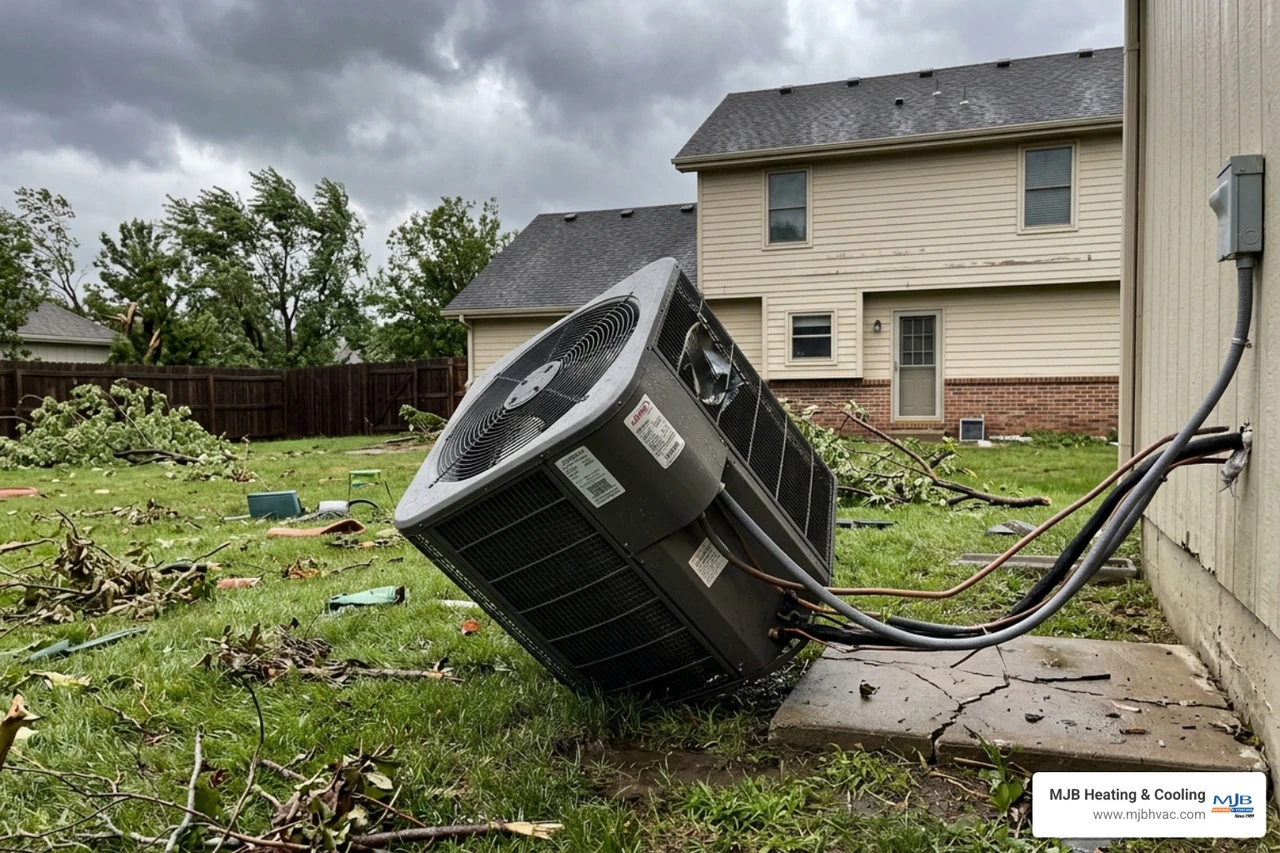

When we talk about how tornadoes and hail damage HVAC equipment, we have to start with the sheer power of Kansas wind. In the Wichita metro area, it isn't just the 100+ mph winds of a tornado that cause problems; even straight-line winds during a severe thunderstorm can reach 60 to 70 mph.
At these speeds, your outdoor condenser unit becomes a target for "wind-borne debris." This is a polite way of saying that your neighbor’s patio umbrella, a stray tree limb, or even a piece of loose siding can become a high-speed projectile. When these objects strike your unit, they don't just leave a scratch. They can dislodge the heavy metal panels that protect the internal components, or worse, crush the top grille and bend the fan assembly.
If the wind is strong enough—as is common during a tornado—the entire unit can be shifted or even toppled off its concrete pad. This is a critical failure because the outdoor unit is connected to your indoor system by copper refrigerant lines. When the unit moves, those lines are pulled, twisted, or snapped. This leads to immediate refrigerant leaks, which are not only bad for the environment but can also lead to compressor failure if the system tries to run without proper pressure. You can learn more about these risks in our guide on how Kansas severe weather affects your HVAC system.
The structural integrity of your HVAC system is surprisingly delicate. While the outer casing looks tough, it is designed for airflow, not impact resistance. Here is how physical damage usually manifests:
Hail is perhaps the most common "silent killer" of AC units in places like Derby and Andover. While we all worry about the windows on our cars, our air conditioners are actually much more vulnerable.
The outdoor unit is wrapped in thousands of tiny, paper-thin aluminum "fins." These fins are responsible for releasing heat from the refrigerant into the outside air. Because they are so thin, even small hail can flatten them. When the fins are flattened, air can no longer pass through the coils. This is a major part of how tornadoes and hail damage HVAC equipment—it effectively "chokes" the machine.
Without proper airflow, the system has to work twice as hard to cool your home. This leads to a massive spike in your energy bills and puts extreme stress on the compressor. If your fins look like they’ve been hit by a hammer, your system is likely losing efficiency every minute it runs. For a deeper look at how our local environment affects these components, check out our Kansas climate HVAC guide.
It can be hard to tell if you need a repair or just have a few "battle scars." Use the table below to evaluate your unit:
| Type of Damage | Appearance | Impact on System | Action Needed |
|---|---|---|---|
| Cosmetic | Small pings on the heavy outer metal lid or base. | None; purely visual. | None; document for records. |
| Minor Functional | Scattered areas of flattened aluminum fins (less than 10%). | Slight loss of efficiency; higher bills. | Fin combing by a professional. |
| Major Functional | Large "matted" areas of fins; visible copper tube dents. | Overheating; compressor risk; high bills. | Professional repair or coil replacement. |
| Critical | Punctured coils; leaking oil or refrigerant; broken fan. | System will not cool; potential total failure. | Immediate shutdown and professional service. |
In extreme Kansas storms, we see hail the size of grapefruits. At that size, hail doesn't just bend fins; it can actually puncture the copper tubing that carries the refrigerant. If you notice a hissing sound after a storm, or if you see an oily residue on the unit, you likely have a refrigerant leak.
A system with a leak will become unresponsive. It might blow air, but that air won't be cold. Running a system in this state is dangerous for the compressor, which relies on the refrigerant to stay cool. If the compressor "slugs" or overheats due to a leak, you are looking at a much more expensive replacement rather than a simple repair.
While wind and hail get all the headlines, water and electricity are just as dangerous. In areas like Wichita and Haysville, heavy spring rains can lead to localized flooding. Most outdoor units are installed on a raised pad, but if the water rises higher than the base of the unit, you have a serious problem.
HVAC units are designed to handle rain falling from above, but they are not designed to be submerged. If the bottom of the unit sits in standing water, the fan motor, capacitors, and contactors can be ruined. Even after the water recedes, the damage continues in the form of rust and corrosion on internal electrical connections. Furthermore, moisture trapped in the ductwork or near the indoor coil can lead to mold growth, which compromises your indoor air quality.
Lightning doesn't have to hit your house to destroy your AC. A strike nearby can send a high voltage surge through the power lines. This is one of the most frequent causes of loss we see at MJB Heating & Cooling.
These surges target the "brains" of your system. Modern HVAC units use sensitive control boards that can be "fried" instantly by a voltage spike. Capacitors, which help start the motor, are also highly susceptible.
Watch out for these electrical red flags after a storm:
Generally, yes. Most standard homeowners' insurance policies in Kansas cover damage caused by "perils" like wind, hail, and lightning. However, the process can be tricky. Insurance companies often look for "wear and tear" as an excuse to deny a claim. This is why professional documentation is vital.
Interestingly, data from major HVAC evaluators shows that more than 25% of systems involved in insurance claims after major storms were actually found to be working as designed, while only 31% needed a full replacement. This means there is a high chance your system can be saved with the right repairs. Always take photos of the unit immediately after a storm and keep your maintenance records handy to prove the unit was in good shape before the weather hit.
Yes, absolutely. If a severe weather warning is issued for your area (like Derby or El Dorado), the safest move is to turn your system off at the thermostat. If you have time, you should also flip the circuit breaker to the "off" position.
Turning off the power prevents the system from trying to run while it's being pelted by hail or if the power is flickering. A "brownout" (low voltage) can be just as damaging to a motor as a "surge" (high voltage). By cutting the power, you protect the control boards and the compressor from electrical fluctuations.
Once the "all clear" is given and it is safe to go outside, perform a visual inspection.
If anything seems "off," turn it back off immediately and call a professional. Running a damaged unit for even an hour can turn a small repair into a total system failure.
Understanding how tornadoes and hail damage HVAC equipment is the first step in protecting your home's most expensive appliance. From the high winds of a Kansas tornado to the relentless pounding of a hailstorm, your HVAC system is on the front lines.
At MJB Heating & Cooling, we’ve been helping our neighbors in Wichita, Derby, Andover, and throughout Central Kansas since 1984. We are a family-owned business that believes in an honest approach and quality workmanship. If a storm has recently rolled through your neighborhood, don't leave your comfort to chance. Our licensed technicians can provide a thorough, professional inspection to ensure your system is safe, efficient, and ready for the summer heat.
Don't wait for your system to fail on the hottest day of the year. Schedule your storm damage assessment with MJB Heating & Cooling today and let us give you the peace of mind you deserve.
When we talk about how tornadoes and hail damage HVAC equipment, we have to start with the sheer power of Kansas wind. In the Wichita metro area, it isn't just the 100+ mph winds of a tornado that cause problems; even straight-line winds during a severe thunderstorm can reach 60 to 70 mph.
At these speeds, your outdoor condenser unit becomes a target for "wind-borne debris." This is a polite way of saying that your neighbor’s patio umbrella, a stray tree limb, or even a piece of loose siding can become a high-speed projectile. When these objects strike your unit, they don't just leave a scratch. They can dislodge the heavy metal panels that protect the internal components, or worse, crush the top grille and bend the fan assembly.
If the wind is strong enough—as is common during a tornado—the entire unit can be shifted or even toppled off its concrete pad. This is a critical failure because the outdoor unit is connected to your indoor system by copper refrigerant lines. When the unit moves, those lines are pulled, twisted, or snapped. This leads to immediate refrigerant leaks, which are not only bad for the environment but can also lead to compressor failure if the system tries to run without proper pressure. You can learn more about these risks in our guide on how Kansas severe weather affects your HVAC system.
The structural integrity of your HVAC system is surprisingly delicate. While the outer casing looks tough, it is designed for airflow, not impact resistance. Here is how physical damage usually manifests:
Hail is perhaps the most common "silent killer" of AC units in places like Derby and Andover. While we all worry about the windows on our cars, our air conditioners are actually much more vulnerable.
The outdoor unit is wrapped in thousands of tiny, paper-thin aluminum "fins." These fins are responsible for releasing heat from the refrigerant into the outside air. Because they are so thin, even small hail can flatten them. When the fins are flattened, air can no longer pass through the coils. This is a major part of how tornadoes and hail damage HVAC equipment—it effectively "chokes" the machine.
Without proper airflow, the system has to work twice as hard to cool your home. This leads to a massive spike in your energy bills and puts extreme stress on the compressor. If your fins look like they’ve been hit by a hammer, your system is likely losing efficiency every minute it runs. For a deeper look at how our local environment affects these components, check out our Kansas climate HVAC guide.
It can be hard to tell if you need a repair or just have a few "battle scars." Use the table below to evaluate your unit:
| Type of Damage | Appearance | Impact on System | Action Needed |
|---|---|---|---|
| Cosmetic | Small pings on the heavy outer metal lid or base. | None; purely visual. | None; document for records. |
| Minor Functional | Scattered areas of flattened aluminum fins (less than 10%). | Slight loss of efficiency; higher bills. | Fin combing by a professional. |
| Major Functional | Large "matted" areas of fins; visible copper tube dents. | Overheating; compressor risk; high bills. | Professional repair or coil replacement. |
| Critical | Punctured coils; leaking oil or refrigerant; broken fan. | System will not cool; potential total failure. | Immediate shutdown and professional service. |
In extreme Kansas storms, we see hail the size of grapefruits. At that size, hail doesn't just bend fins; it can actually puncture the copper tubing that carries the refrigerant. If you notice a hissing sound after a storm, or if you see an oily residue on the unit, you likely have a refrigerant leak.
A system with a leak will become unresponsive. It might blow air, but that air won't be cold. Running a system in this state is dangerous for the compressor, which relies on the refrigerant to stay cool. If the compressor "slugs" or overheats due to a leak, you are looking at a much more expensive replacement rather than a simple repair.
While wind and hail get all the headlines, water and electricity are just as dangerous. In areas like Wichita and Haysville, heavy spring rains can lead to localized flooding. Most outdoor units are installed on a raised pad, but if the water rises higher than the base of the unit, you have a serious problem.
HVAC units are designed to handle rain falling from above, but they are not designed to be submerged. If the bottom of the unit sits in standing water, the fan motor, capacitors, and contactors can be ruined. Even after the water recedes, the damage continues in the form of rust and corrosion on internal electrical connections. Furthermore, moisture trapped in the ductwork or near the indoor coil can lead to mold growth, which compromises your indoor air quality.
Lightning doesn't have to hit your house to destroy your AC. A strike nearby can send a high voltage surge through the power lines. This is one of the most frequent causes of loss we see at MJB Heating & Cooling.
These surges target the "brains" of your system. Modern HVAC units use sensitive control boards that can be "fried" instantly by a voltage spike. Capacitors, which help start the motor, are also highly susceptible.
Watch out for these electrical red flags after a storm:
Generally, yes. Most standard homeowners' insurance policies in Kansas cover damage caused by "perils" like wind, hail, and lightning. However, the process can be tricky. Insurance companies often look for "wear and tear" as an excuse to deny a claim. This is why professional documentation is vital.
Interestingly, data from major HVAC evaluators shows that more than 25% of systems involved in insurance claims after major storms were actually found to be working as designed, while only 31% needed a full replacement. This means there is a high chance your system can be saved with the right repairs. Always take photos of the unit immediately after a storm and keep your maintenance records handy to prove the unit was in good shape before the weather hit.
Yes, absolutely. If a severe weather warning is issued for your area (like Derby or El Dorado), the safest move is to turn your system off at the thermostat. If you have time, you should also flip the circuit breaker to the "off" position.
Turning off the power prevents the system from trying to run while it's being pelted by hail or if the power is flickering. A "brownout" (low voltage) can be just as damaging to a motor as a "surge" (high voltage). By cutting the power, you protect the control boards and the compressor from electrical fluctuations.
Once the "all clear" is given and it is safe to go outside, perform a visual inspection.
If anything seems "off," turn it back off immediately and call a professional. Running a damaged unit for even an hour can turn a small repair into a total system failure.
Understanding how tornadoes and hail damage HVAC equipment is the first step in protecting your home's most expensive appliance. From the high winds of a Kansas tornado to the relentless pounding of a hailstorm, your HVAC system is on the front lines.
At MJB Heating & Cooling, we’ve been helping our neighbors in Wichita, Derby, Andover, and throughout Central Kansas since 1984. We are a family-owned business that believes in an honest approach and quality workmanship. If a storm has recently rolled through your neighborhood, don't leave your comfort to chance. Our licensed technicians can provide a thorough, professional inspection to ensure your system is safe, efficient, and ready for the summer heat.
Don't wait for your system to fail on the hottest day of the year. Schedule your storm damage assessment with MJB Heating & Cooling today and let us give you the peace of mind you deserve.


Our A/C stopped working on a Sunday and due to health issues, we needed to find a service company available on a Sunday. I called MJB and left a message on their emergency voice mail. Within 10 minutes Tom Buck called me to hear my description of the symptoms. He was just finishing an appointment in Wichita and would be on his way to my home on the south end of Derby. He arrived within 30 minutes! From start to finish he was the perfect example of what you could ever hope for in an HVAC tech and a human being. His evaluation of our system inside and out was as thorough as I could ever imagine and once he was done with the repair, our system is running as well or better than ever. Well worth the price for the evaluation, parts, and labor. Thank you again Tom for an awesome experience.
Our AC went out during the hottest days of the year, and they were out next day! We have been jerked around by a shoddy home warranty for years. We finally had a chance to pick our own repair people, and MJB came highly recommended. I can see why! I was impressed with the honesty and speed at which they fixed our AC unit!
Our commercial building had a lightening/electrical strike and damaged our 20 ton AC unit. No one could find us a new unit before the end of September. Imagining going all of August and September with no AC in Kansas and working inside near 100 degree temps is less than thrilling. Dale and the team at MJB called around and saved the day. They had us a new unit 5 weeks earlier than other could promise and I now have happy employees. The unit is amazingly quiet, super cold and so much more energy efficient. Thank you for being our super hero!
Came out and installed my new furnace. Was very polite and affordable. They are very acknowledgeable and I highly recommend!
Thank you very much. We had our 1st warm night in 3weeks. MJB took the time and effort to find the real problem. And the employees were kind and thoughtful and explained things very well. I cannot thank you and all of MJB. Will recommend you highly. Thanks again Marjorie Herman Oxford Kansas
We had a new system installed and I was so impressed with how quick they were in come out and install it, in the middle of a hot summer day. They were so friendly & very professional. I had a small problem with a weird sound and they came over immediately and fixed it. Love them!