.avif)





Blogs
Stay updated with our latest blog posts.
Heat pump efficiency in hot summers and cold winters is genuinely impressive by the numbers — and the data backs it up across both extremes.
Here's a quick summary before we dive deeper:
| Condition | Heat Pump Performance |
|---|---|
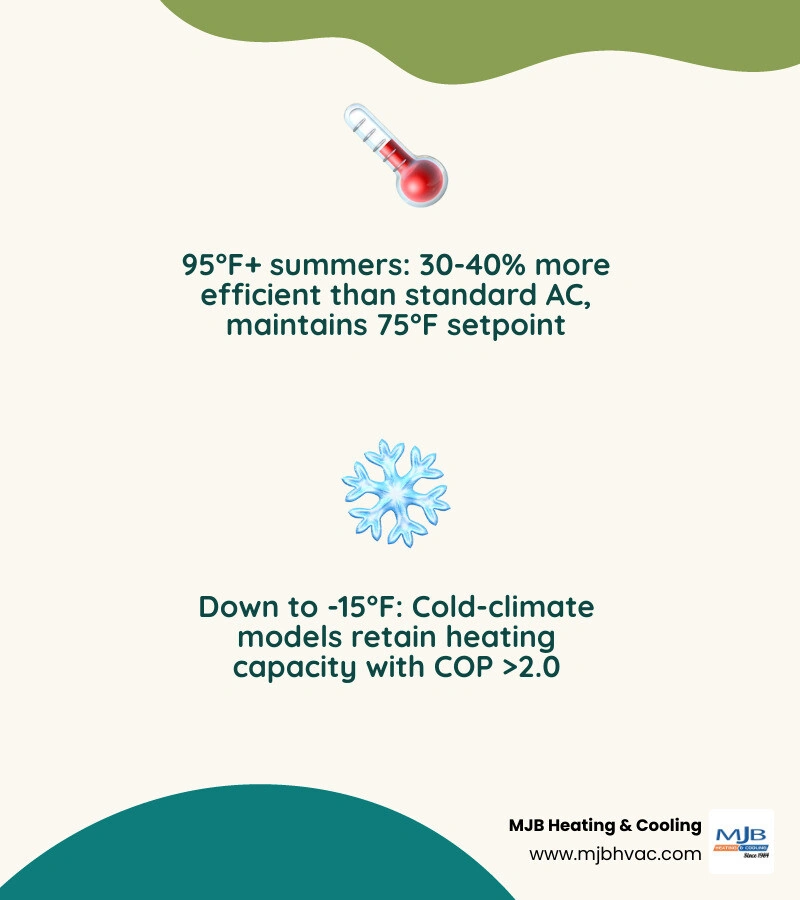
| Extreme summer heat (95°F+) | Maintains indoor setpoint; 30-40% more efficient than standard AC |
| Moderate cold (17°F–47°F) | COP of 2–3 (200–300% efficient) |
| Sub-freezing cold (down to -15°F) | Cold-climate models maintain useful heating capacity |
| vs. Gas furnace (heating) | Up to 3x more efficient at typical winter temps |
| vs. Electric baseboard | Up to 50% energy savings |
| vs. AC + gas furnace combo | ~$228 less per year to operate; 25% lower CO2 emissions |
If you've ever wondered whether a single HVAC system can realistically handle both a sweltering Kansas summer and a hard Central Kansas freeze, you're not alone. That's one of the most common questions homeowners in the Wichita metro area ask before replacing aging equipment.
The short answer is yes — modern heat pumps are built for exactly that challenge. They don't just cool your home in summer the way a traditional air conditioner does. They also reverse direction in winter, pulling heat from outdoor air and moving it inside, even when temperatures drop well below freezing.
During the brutal Pacific Northwest heat wave of June 2021 — where outdoor temperatures hit 108°F — physics-based modeling showed that a variable-speed heat pump held a steady 75°F indoor setpoint while using 18.6% less energy than a high-capacity 4-ton AC unit on the worst day. On the cold side, field studies across Central Europe, Minnesota, and even Alaska confirm that modern heat pumps maintain a Coefficient of Performance (COP) well above 2.0 at sub-zero temperatures — meaning they're still delivering twice the heat energy they consume in electricity, even in brutal cold.
For Central Kansas homeowners dealing with summer highs near 93°F and January lows that can dip into the teens or lower, that kind of year-round reliability matters.
To understand why we're so excited about these systems at MJB Heating & Cooling, you have to look at the metrics. In the HVAC world, we use specific "grades" to measure performance. For cooling, we look at SEER2 (Seasonal Energy Efficiency Ratio). For heating, we use HSPF2 (Heating Seasonal Performance Factor).
Traditional systems are "one-way streets." An air conditioner only moves heat out of your house. A furnace generates heat by burning fuel. A heat pump is a "two-way street" thanks to a clever component called a reversing valve. In the summer, it acts exactly like a high-efficiency AC. In the winter, it flips the script and brings heat in.
Discover Energy Savings with Daikin's HSPF Rating Insights to see how these ratings translate into lower monthly bills. Because heat pumps move heat rather than creating it, they can achieve a Coefficient of Performance (COP) of 3.0 or higher. This means for every watt of electricity you put in, you get three watts of heat out. Compare that to a high-efficiency gas furnace, which has a COP of about 0.95 (95% efficient), and the winner is clear.
| System Type | Summer Efficiency (SEER2) | Winter Efficiency (HSPF2/COP) |
|---|---|---|
| Standard Air Conditioner | 13.4 - 16 | N/A (Requires Furnace) |
| High-Efficiency Heat Pump | 18 - 22+ | 9.0 - 11.0 / COP 3.0+ |
| Gas Furnace | N/A | 80% - 96% AFUE |
| Electric Baseboard | N/A | 100% (COP 1.0) |
When the Wichita sun starts beating down in July, many homeowners worry that a heat pump won't keep up. The truth is, modern heat pumps are often 30-40% more efficient in cooling mode than traditional AC units. For a 2,000-square-foot home in our area, that could mean saving $50 a month just on cooling costs.
One of the biggest advantages is variable-speed compressor technology. Traditional AC units are either "on" or "off"—like flooring the gas pedal and then slamming on the brakes. A variable-speed heat pump is more like cruise control. It adjusts its speed to match the cooling needs of your home precisely. This leads to better dehumidification and a rock-solid 75°F indoor temperature, even when it’s 100°F outside.
If you ever notice your heat pump that's blowing warm air in summer, it’s usually a sign of a simple maintenance issue rather than a lack of power. Similarly, if your home feels sticky, you might wonder why your heat pump isn't dehumidifying properly. Often, this comes down to airflow or settings that we can easily optimize during a service call.
Efficiency isn't just about the machine; it's about the fit. At MJB Heating & Cooling, we don't just guess what size you need. We perform a Manual J load calculation. This takes into account your home’s insulation, window types, and square footage to ensure the system isn't too big or too small.
How proper HVAC sizing affects comfort and efficiency cannot be overstated. An oversized unit will "short cycle," turning on and off so fast it never removes humidity. An undersized unit will run forever and never reach your setpoint. Getting it "just right" is the key to maximizing heat pump efficiency in hot summers and cold winters.
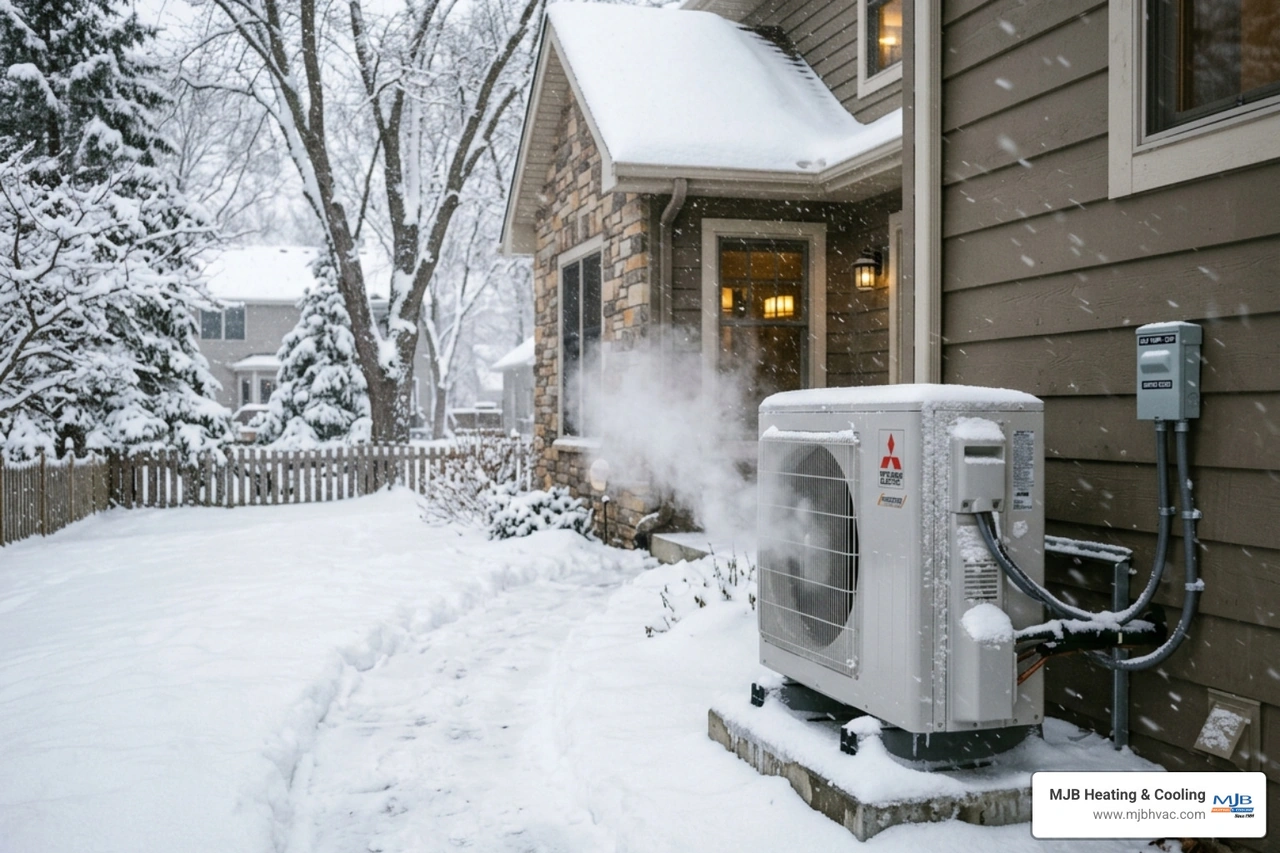
This is the "Cold Hard Truth" part. Older heat pumps used to struggle once the temperature hit freezing. But we live in a new era of HVAC technology. Cold-climate heat pumps (CCHPs) are now engineered to provide comfortable heating even when the outdoor air is -15°F.
In places like the Northeast and even Scandinavia, these units are meeting 100% of the heating needs for homes. They do this by using advanced refrigerants and compressors that can extract thermal energy from air that feels "freezing" to us. Even at 5°F, many high-end models maintain 70% of their heating capacity.
Our Kansas Climate HVAC Guide explains how these systems navigate our specific weather patterns. The benefits are hard to ignore:
Switching from an old oil furnace or electric baseboard heaters to a heat pump can save you up to 50% on your energy costs. On average, homeowners see savings of over $500 annually. Beyond the wallet, there's the environmental impact. A heat pump can reduce your home's CO2 emissions by 25% compared to a traditional AC and gas furnace combo.
If you’re in a town like Andover and notice a heat pump with declining efficiency, it’s often due to age or lack of maintenance. Keeping the coils clean and the filters fresh ensures you keep those 300% efficiency ratings all winter long.
What makes this all possible? Two big technical advancements: Inverter technology and Enhanced Vapor Injection (EVI).
Inverters allow the compressor to run at any speed, which is why they are so much more efficient than old "on/off" systems. EVI is like a turbocharger for your heat pump; it injects a bit of refrigerant vapor into the compression cycle, allowing the unit to pump out high-temperature air even when the outdoor thermometer is in the negatives.
When shopping for a system, look for NEEP certification. The Northeast Energy Efficiency Partnerships (NEEP) maintains a list of units that have been rigorously tested in cold weather. Combining this tech with a smart thermostat allows the system to manage itself perfectly through the changing seasons. Just keep an eye out for heat pump performance issues during spring as the system transitions between modes; a quick check-up can keep things running smoothly.
Yes! Modern cold-climate models are designed to work effectively down to -15°F. While their efficiency (COP) drops as it gets colder, they are still significantly more efficient than electric resistance heaters (like space heaters or baseboards). For those rare nights in Kansas when it hits -20°F, most systems include a backup electric heat strip to ensure you stay warm no matter what.
Absolutely. In fact, they are often more effective. Because many heat pumps use variable-speed fans and compressors, they are better at maintaining a consistent temperature and removing humidity than a standard single-stage AC. Data from real-world heat waves shows they use about 18.6% less energy than high-capacity AC units while keeping the house at a perfect 75°F.
A dual-fuel (or hybrid) system pairs an electric heat pump with a gas furnace. The heat pump handles the cooling in summer and the heating during the fall and most of the winter. When the temperature drops below a certain "balance point" (usually around 15°F or 20°F), the system automatically switches to the gas furnace. This is a popular choice in the Wichita metro area because it gives you the efficiency of a heat pump with the high-intensity heat of gas for those extreme cold snaps.
At MJB Heating & Cooling, we've seen HVAC technology come a long way since we started in Derby, KS, back in 1984. The "cold hard truth" is that heat pump efficiency in hot summers and cold winters has made these systems the smartest choice for most Central Kansas homes. Whether you're in Wichita, Hutchinson, or El Dorado, you deserve a system that provides year-round comfort without breaking the bank.
We pride ourselves on quality workmanship and an honest, family-owned approach. We don't just sell equipment; we build long-term relationships with our neighbors by ensuring their homes stay comfortable in every season. If you're ready to see how much you could save with a modern upgrade, we're here to help.
Schedule your professional heat pump installation in Derby, KS today and experience the difference that expert service and cutting-edge technology can make for your home.
Heat pump efficiency in hot summers and cold winters is genuinely impressive by the numbers — and the data backs it up across both extremes.
Here's a quick summary before we dive deeper:
| Condition | Heat Pump Performance |
|---|---|
| Extreme summer heat (95°F+) | Maintains indoor setpoint; 30-40% more efficient than standard AC |
| Moderate cold (17°F–47°F) | COP of 2–3 (200–300% efficient) |
| Sub-freezing cold (down to -15°F) | Cold-climate models maintain useful heating capacity |
| vs. Gas furnace (heating) | Up to 3x more efficient at typical winter temps |
| vs. Electric baseboard | Up to 50% energy savings |
| vs. AC + gas furnace combo | ~$228 less per year to operate; 25% lower CO2 emissions |
If you've ever wondered whether a single HVAC system can realistically handle both a sweltering Kansas summer and a hard Central Kansas freeze, you're not alone. That's one of the most common questions homeowners in the Wichita metro area ask before replacing aging equipment.
The short answer is yes — modern heat pumps are built for exactly that challenge. They don't just cool your home in summer the way a traditional air conditioner does. They also reverse direction in winter, pulling heat from outdoor air and moving it inside, even when temperatures drop well below freezing.
During the brutal Pacific Northwest heat wave of June 2021 — where outdoor temperatures hit 108°F — physics-based modeling showed that a variable-speed heat pump held a steady 75°F indoor setpoint while using 18.6% less energy than a high-capacity 4-ton AC unit on the worst day. On the cold side, field studies across Central Europe, Minnesota, and even Alaska confirm that modern heat pumps maintain a Coefficient of Performance (COP) well above 2.0 at sub-zero temperatures — meaning they're still delivering twice the heat energy they consume in electricity, even in brutal cold.
For Central Kansas homeowners dealing with summer highs near 93°F and January lows that can dip into the teens or lower, that kind of year-round reliability matters.
To understand why we're so excited about these systems at MJB Heating & Cooling, you have to look at the metrics. In the HVAC world, we use specific "grades" to measure performance. For cooling, we look at SEER2 (Seasonal Energy Efficiency Ratio). For heating, we use HSPF2 (Heating Seasonal Performance Factor).
Traditional systems are "one-way streets." An air conditioner only moves heat out of your house. A furnace generates heat by burning fuel. A heat pump is a "two-way street" thanks to a clever component called a reversing valve. In the summer, it acts exactly like a high-efficiency AC. In the winter, it flips the script and brings heat in.
Discover Energy Savings with Daikin's HSPF Rating Insights to see how these ratings translate into lower monthly bills. Because heat pumps move heat rather than creating it, they can achieve a Coefficient of Performance (COP) of 3.0 or higher. This means for every watt of electricity you put in, you get three watts of heat out. Compare that to a high-efficiency gas furnace, which has a COP of about 0.95 (95% efficient), and the winner is clear.
| System Type | Summer Efficiency (SEER2) | Winter Efficiency (HSPF2/COP) |
|---|---|---|
| Standard Air Conditioner | 13.4 - 16 | N/A (Requires Furnace) |
| High-Efficiency Heat Pump | 18 - 22+ | 9.0 - 11.0 / COP 3.0+ |
| Gas Furnace | N/A | 80% - 96% AFUE |
| Electric Baseboard | N/A | 100% (COP 1.0) |
When the Wichita sun starts beating down in July, many homeowners worry that a heat pump won't keep up. The truth is, modern heat pumps are often 30-40% more efficient in cooling mode than traditional AC units. For a 2,000-square-foot home in our area, that could mean saving $50 a month just on cooling costs.
One of the biggest advantages is variable-speed compressor technology. Traditional AC units are either "on" or "off"—like flooring the gas pedal and then slamming on the brakes. A variable-speed heat pump is more like cruise control. It adjusts its speed to match the cooling needs of your home precisely. This leads to better dehumidification and a rock-solid 75°F indoor temperature, even when it’s 100°F outside.
If you ever notice your heat pump that's blowing warm air in summer, it’s usually a sign of a simple maintenance issue rather than a lack of power. Similarly, if your home feels sticky, you might wonder why your heat pump isn't dehumidifying properly. Often, this comes down to airflow or settings that we can easily optimize during a service call.
Efficiency isn't just about the machine; it's about the fit. At MJB Heating & Cooling, we don't just guess what size you need. We perform a Manual J load calculation. This takes into account your home’s insulation, window types, and square footage to ensure the system isn't too big or too small.
How proper HVAC sizing affects comfort and efficiency cannot be overstated. An oversized unit will "short cycle," turning on and off so fast it never removes humidity. An undersized unit will run forever and never reach your setpoint. Getting it "just right" is the key to maximizing heat pump efficiency in hot summers and cold winters.
This is the "Cold Hard Truth" part. Older heat pumps used to struggle once the temperature hit freezing. But we live in a new era of HVAC technology. Cold-climate heat pumps (CCHPs) are now engineered to provide comfortable heating even when the outdoor air is -15°F.
In places like the Northeast and even Scandinavia, these units are meeting 100% of the heating needs for homes. They do this by using advanced refrigerants and compressors that can extract thermal energy from air that feels "freezing" to us. Even at 5°F, many high-end models maintain 70% of their heating capacity.
Our Kansas Climate HVAC Guide explains how these systems navigate our specific weather patterns. The benefits are hard to ignore:
Switching from an old oil furnace or electric baseboard heaters to a heat pump can save you up to 50% on your energy costs. On average, homeowners see savings of over $500 annually. Beyond the wallet, there's the environmental impact. A heat pump can reduce your home's CO2 emissions by 25% compared to a traditional AC and gas furnace combo.
If you’re in a town like Andover and notice a heat pump with declining efficiency, it’s often due to age or lack of maintenance. Keeping the coils clean and the filters fresh ensures you keep those 300% efficiency ratings all winter long.
What makes this all possible? Two big technical advancements: Inverter technology and Enhanced Vapor Injection (EVI).
Inverters allow the compressor to run at any speed, which is why they are so much more efficient than old "on/off" systems. EVI is like a turbocharger for your heat pump; it injects a bit of refrigerant vapor into the compression cycle, allowing the unit to pump out high-temperature air even when the outdoor thermometer is in the negatives.
When shopping for a system, look for NEEP certification. The Northeast Energy Efficiency Partnerships (NEEP) maintains a list of units that have been rigorously tested in cold weather. Combining this tech with a smart thermostat allows the system to manage itself perfectly through the changing seasons. Just keep an eye out for heat pump performance issues during spring as the system transitions between modes; a quick check-up can keep things running smoothly.
Yes! Modern cold-climate models are designed to work effectively down to -15°F. While their efficiency (COP) drops as it gets colder, they are still significantly more efficient than electric resistance heaters (like space heaters or baseboards). For those rare nights in Kansas when it hits -20°F, most systems include a backup electric heat strip to ensure you stay warm no matter what.
Absolutely. In fact, they are often more effective. Because many heat pumps use variable-speed fans and compressors, they are better at maintaining a consistent temperature and removing humidity than a standard single-stage AC. Data from real-world heat waves shows they use about 18.6% less energy than high-capacity AC units while keeping the house at a perfect 75°F.
A dual-fuel (or hybrid) system pairs an electric heat pump with a gas furnace. The heat pump handles the cooling in summer and the heating during the fall and most of the winter. When the temperature drops below a certain "balance point" (usually around 15°F or 20°F), the system automatically switches to the gas furnace. This is a popular choice in the Wichita metro area because it gives you the efficiency of a heat pump with the high-intensity heat of gas for those extreme cold snaps.
At MJB Heating & Cooling, we've seen HVAC technology come a long way since we started in Derby, KS, back in 1984. The "cold hard truth" is that heat pump efficiency in hot summers and cold winters has made these systems the smartest choice for most Central Kansas homes. Whether you're in Wichita, Hutchinson, or El Dorado, you deserve a system that provides year-round comfort without breaking the bank.
We pride ourselves on quality workmanship and an honest, family-owned approach. We don't just sell equipment; we build long-term relationships with our neighbors by ensuring their homes stay comfortable in every season. If you're ready to see how much you could save with a modern upgrade, we're here to help.
Schedule your professional heat pump installation in Derby, KS today and experience the difference that expert service and cutting-edge technology can make for your home.
Heat pump efficiency in hot summers and cold winters is genuinely impressive by the numbers — and the data backs it up across both extremes.
Here's a quick summary before we dive deeper:
| Condition | Heat Pump Performance |
|---|---|
| Extreme summer heat (95°F+) | Maintains indoor setpoint; 30-40% more efficient than standard AC |
| Moderate cold (17°F–47°F) | COP of 2–3 (200–300% efficient) |
| Sub-freezing cold (down to -15°F) | Cold-climate models maintain useful heating capacity |
| vs. Gas furnace (heating) | Up to 3x more efficient at typical winter temps |
| vs. Electric baseboard | Up to 50% energy savings |
| vs. AC + gas furnace combo | ~$228 less per year to operate; 25% lower CO2 emissions |
If you've ever wondered whether a single HVAC system can realistically handle both a sweltering Kansas summer and a hard Central Kansas freeze, you're not alone. That's one of the most common questions homeowners in the Wichita metro area ask before replacing aging equipment.
The short answer is yes — modern heat pumps are built for exactly that challenge. They don't just cool your home in summer the way a traditional air conditioner does. They also reverse direction in winter, pulling heat from outdoor air and moving it inside, even when temperatures drop well below freezing.
During the brutal Pacific Northwest heat wave of June 2021 — where outdoor temperatures hit 108°F — physics-based modeling showed that a variable-speed heat pump held a steady 75°F indoor setpoint while using 18.6% less energy than a high-capacity 4-ton AC unit on the worst day. On the cold side, field studies across Central Europe, Minnesota, and even Alaska confirm that modern heat pumps maintain a Coefficient of Performance (COP) well above 2.0 at sub-zero temperatures — meaning they're still delivering twice the heat energy they consume in electricity, even in brutal cold.
For Central Kansas homeowners dealing with summer highs near 93°F and January lows that can dip into the teens or lower, that kind of year-round reliability matters.
To understand why we're so excited about these systems at MJB Heating & Cooling, you have to look at the metrics. In the HVAC world, we use specific "grades" to measure performance. For cooling, we look at SEER2 (Seasonal Energy Efficiency Ratio). For heating, we use HSPF2 (Heating Seasonal Performance Factor).
Traditional systems are "one-way streets." An air conditioner only moves heat out of your house. A furnace generates heat by burning fuel. A heat pump is a "two-way street" thanks to a clever component called a reversing valve. In the summer, it acts exactly like a high-efficiency AC. In the winter, it flips the script and brings heat in.
Discover Energy Savings with Daikin's HSPF Rating Insights to see how these ratings translate into lower monthly bills. Because heat pumps move heat rather than creating it, they can achieve a Coefficient of Performance (COP) of 3.0 or higher. This means for every watt of electricity you put in, you get three watts of heat out. Compare that to a high-efficiency gas furnace, which has a COP of about 0.95 (95% efficient), and the winner is clear.
| System Type | Summer Efficiency (SEER2) | Winter Efficiency (HSPF2/COP) |
|---|---|---|
| Standard Air Conditioner | 13.4 - 16 | N/A (Requires Furnace) |
| High-Efficiency Heat Pump | 18 - 22+ | 9.0 - 11.0 / COP 3.0+ |
| Gas Furnace | N/A | 80% - 96% AFUE |
| Electric Baseboard | N/A | 100% (COP 1.0) |
When the Wichita sun starts beating down in July, many homeowners worry that a heat pump won't keep up. The truth is, modern heat pumps are often 30-40% more efficient in cooling mode than traditional AC units. For a 2,000-square-foot home in our area, that could mean saving $50 a month just on cooling costs.
One of the biggest advantages is variable-speed compressor technology. Traditional AC units are either "on" or "off"—like flooring the gas pedal and then slamming on the brakes. A variable-speed heat pump is more like cruise control. It adjusts its speed to match the cooling needs of your home precisely. This leads to better dehumidification and a rock-solid 75°F indoor temperature, even when it’s 100°F outside.
If you ever notice your heat pump that's blowing warm air in summer, it’s usually a sign of a simple maintenance issue rather than a lack of power. Similarly, if your home feels sticky, you might wonder why your heat pump isn't dehumidifying properly. Often, this comes down to airflow or settings that we can easily optimize during a service call.
Efficiency isn't just about the machine; it's about the fit. At MJB Heating & Cooling, we don't just guess what size you need. We perform a Manual J load calculation. This takes into account your home’s insulation, window types, and square footage to ensure the system isn't too big or too small.
How proper HVAC sizing affects comfort and efficiency cannot be overstated. An oversized unit will "short cycle," turning on and off so fast it never removes humidity. An undersized unit will run forever and never reach your setpoint. Getting it "just right" is the key to maximizing heat pump efficiency in hot summers and cold winters.
This is the "Cold Hard Truth" part. Older heat pumps used to struggle once the temperature hit freezing. But we live in a new era of HVAC technology. Cold-climate heat pumps (CCHPs) are now engineered to provide comfortable heating even when the outdoor air is -15°F.
In places like the Northeast and even Scandinavia, these units are meeting 100% of the heating needs for homes. They do this by using advanced refrigerants and compressors that can extract thermal energy from air that feels "freezing" to us. Even at 5°F, many high-end models maintain 70% of their heating capacity.
Our Kansas Climate HVAC Guide explains how these systems navigate our specific weather patterns. The benefits are hard to ignore:
Switching from an old oil furnace or electric baseboard heaters to a heat pump can save you up to 50% on your energy costs. On average, homeowners see savings of over $500 annually. Beyond the wallet, there's the environmental impact. A heat pump can reduce your home's CO2 emissions by 25% compared to a traditional AC and gas furnace combo.
If you’re in a town like Andover and notice a heat pump with declining efficiency, it’s often due to age or lack of maintenance. Keeping the coils clean and the filters fresh ensures you keep those 300% efficiency ratings all winter long.
What makes this all possible? Two big technical advancements: Inverter technology and Enhanced Vapor Injection (EVI).
Inverters allow the compressor to run at any speed, which is why they are so much more efficient than old "on/off" systems. EVI is like a turbocharger for your heat pump; it injects a bit of refrigerant vapor into the compression cycle, allowing the unit to pump out high-temperature air even when the outdoor thermometer is in the negatives.
When shopping for a system, look for NEEP certification. The Northeast Energy Efficiency Partnerships (NEEP) maintains a list of units that have been rigorously tested in cold weather. Combining this tech with a smart thermostat allows the system to manage itself perfectly through the changing seasons. Just keep an eye out for heat pump performance issues during spring as the system transitions between modes; a quick check-up can keep things running smoothly.
Yes! Modern cold-climate models are designed to work effectively down to -15°F. While their efficiency (COP) drops as it gets colder, they are still significantly more efficient than electric resistance heaters (like space heaters or baseboards). For those rare nights in Kansas when it hits -20°F, most systems include a backup electric heat strip to ensure you stay warm no matter what.
Absolutely. In fact, they are often more effective. Because many heat pumps use variable-speed fans and compressors, they are better at maintaining a consistent temperature and removing humidity than a standard single-stage AC. Data from real-world heat waves shows they use about 18.6% less energy than high-capacity AC units while keeping the house at a perfect 75°F.
A dual-fuel (or hybrid) system pairs an electric heat pump with a gas furnace. The heat pump handles the cooling in summer and the heating during the fall and most of the winter. When the temperature drops below a certain "balance point" (usually around 15°F or 20°F), the system automatically switches to the gas furnace. This is a popular choice in the Wichita metro area because it gives you the efficiency of a heat pump with the high-intensity heat of gas for those extreme cold snaps.
At MJB Heating & Cooling, we've seen HVAC technology come a long way since we started in Derby, KS, back in 1984. The "cold hard truth" is that heat pump efficiency in hot summers and cold winters has made these systems the smartest choice for most Central Kansas homes. Whether you're in Wichita, Hutchinson, or El Dorado, you deserve a system that provides year-round comfort without breaking the bank.
We pride ourselves on quality workmanship and an honest, family-owned approach. We don't just sell equipment; we build long-term relationships with our neighbors by ensuring their homes stay comfortable in every season. If you're ready to see how much you could save with a modern upgrade, we're here to help.
Schedule your professional heat pump installation in Derby, KS today and experience the difference that expert service and cutting-edge technology can make for your home.


Heat pump efficiency in hot summers and cold winters is genuinely impressive by the numbers — and the data backs it up across both extremes.
Here's a quick summary before we dive deeper:
| Condition | Heat Pump Performance |
|---|---|
| Extreme summer heat (95°F+) | Maintains indoor setpoint; 30-40% more efficient than standard AC |
| Moderate cold (17°F–47°F) | COP of 2–3 (200–300% efficient) |
| Sub-freezing cold (down to -15°F) | Cold-climate models maintain useful heating capacity |
| vs. Gas furnace (heating) | Up to 3x more efficient at typical winter temps |
| vs. Electric baseboard | Up to 50% energy savings |
| vs. AC + gas furnace combo | ~$228 less per year to operate; 25% lower CO2 emissions |
If you've ever wondered whether a single HVAC system can realistically handle both a sweltering Kansas summer and a hard Central Kansas freeze, you're not alone. That's one of the most common questions homeowners in the Wichita metro area ask before replacing aging equipment.
The short answer is yes — modern heat pumps are built for exactly that challenge. They don't just cool your home in summer the way a traditional air conditioner does. They also reverse direction in winter, pulling heat from outdoor air and moving it inside, even when temperatures drop well below freezing.
During the brutal Pacific Northwest heat wave of June 2021 — where outdoor temperatures hit 108°F — physics-based modeling showed that a variable-speed heat pump held a steady 75°F indoor setpoint while using 18.6% less energy than a high-capacity 4-ton AC unit on the worst day. On the cold side, field studies across Central Europe, Minnesota, and even Alaska confirm that modern heat pumps maintain a Coefficient of Performance (COP) well above 2.0 at sub-zero temperatures — meaning they're still delivering twice the heat energy they consume in electricity, even in brutal cold.
For Central Kansas homeowners dealing with summer highs near 93°F and January lows that can dip into the teens or lower, that kind of year-round reliability matters.
To understand why we're so excited about these systems at MJB Heating & Cooling, you have to look at the metrics. In the HVAC world, we use specific "grades" to measure performance. For cooling, we look at SEER2 (Seasonal Energy Efficiency Ratio). For heating, we use HSPF2 (Heating Seasonal Performance Factor).
Traditional systems are "one-way streets." An air conditioner only moves heat out of your house. A furnace generates heat by burning fuel. A heat pump is a "two-way street" thanks to a clever component called a reversing valve. In the summer, it acts exactly like a high-efficiency AC. In the winter, it flips the script and brings heat in.
Discover Energy Savings with Daikin's HSPF Rating Insights to see how these ratings translate into lower monthly bills. Because heat pumps move heat rather than creating it, they can achieve a Coefficient of Performance (COP) of 3.0 or higher. This means for every watt of electricity you put in, you get three watts of heat out. Compare that to a high-efficiency gas furnace, which has a COP of about 0.95 (95% efficient), and the winner is clear.
| System Type | Summer Efficiency (SEER2) | Winter Efficiency (HSPF2/COP) |
|---|---|---|
| Standard Air Conditioner | 13.4 - 16 | N/A (Requires Furnace) |
| High-Efficiency Heat Pump | 18 - 22+ | 9.0 - 11.0 / COP 3.0+ |
| Gas Furnace | N/A | 80% - 96% AFUE |
| Electric Baseboard | N/A | 100% (COP 1.0) |
When the Wichita sun starts beating down in July, many homeowners worry that a heat pump won't keep up. The truth is, modern heat pumps are often 30-40% more efficient in cooling mode than traditional AC units. For a 2,000-square-foot home in our area, that could mean saving $50 a month just on cooling costs.
One of the biggest advantages is variable-speed compressor technology. Traditional AC units are either "on" or "off"—like flooring the gas pedal and then slamming on the brakes. A variable-speed heat pump is more like cruise control. It adjusts its speed to match the cooling needs of your home precisely. This leads to better dehumidification and a rock-solid 75°F indoor temperature, even when it’s 100°F outside.
If you ever notice your heat pump that's blowing warm air in summer, it’s usually a sign of a simple maintenance issue rather than a lack of power. Similarly, if your home feels sticky, you might wonder why your heat pump isn't dehumidifying properly. Often, this comes down to airflow or settings that we can easily optimize during a service call.
Efficiency isn't just about the machine; it's about the fit. At MJB Heating & Cooling, we don't just guess what size you need. We perform a Manual J load calculation. This takes into account your home’s insulation, window types, and square footage to ensure the system isn't too big or too small.
How proper HVAC sizing affects comfort and efficiency cannot be overstated. An oversized unit will "short cycle," turning on and off so fast it never removes humidity. An undersized unit will run forever and never reach your setpoint. Getting it "just right" is the key to maximizing heat pump efficiency in hot summers and cold winters.
This is the "Cold Hard Truth" part. Older heat pumps used to struggle once the temperature hit freezing. But we live in a new era of HVAC technology. Cold-climate heat pumps (CCHPs) are now engineered to provide comfortable heating even when the outdoor air is -15°F.
In places like the Northeast and even Scandinavia, these units are meeting 100% of the heating needs for homes. They do this by using advanced refrigerants and compressors that can extract thermal energy from air that feels "freezing" to us. Even at 5°F, many high-end models maintain 70% of their heating capacity.
Our Kansas Climate HVAC Guide explains how these systems navigate our specific weather patterns. The benefits are hard to ignore:
Switching from an old oil furnace or electric baseboard heaters to a heat pump can save you up to 50% on your energy costs. On average, homeowners see savings of over $500 annually. Beyond the wallet, there's the environmental impact. A heat pump can reduce your home's CO2 emissions by 25% compared to a traditional AC and gas furnace combo.
If you’re in a town like Andover and notice a heat pump with declining efficiency, it’s often due to age or lack of maintenance. Keeping the coils clean and the filters fresh ensures you keep those 300% efficiency ratings all winter long.
What makes this all possible? Two big technical advancements: Inverter technology and Enhanced Vapor Injection (EVI).
Inverters allow the compressor to run at any speed, which is why they are so much more efficient than old "on/off" systems. EVI is like a turbocharger for your heat pump; it injects a bit of refrigerant vapor into the compression cycle, allowing the unit to pump out high-temperature air even when the outdoor thermometer is in the negatives.
When shopping for a system, look for NEEP certification. The Northeast Energy Efficiency Partnerships (NEEP) maintains a list of units that have been rigorously tested in cold weather. Combining this tech with a smart thermostat allows the system to manage itself perfectly through the changing seasons. Just keep an eye out for heat pump performance issues during spring as the system transitions between modes; a quick check-up can keep things running smoothly.
Yes! Modern cold-climate models are designed to work effectively down to -15°F. While their efficiency (COP) drops as it gets colder, they are still significantly more efficient than electric resistance heaters (like space heaters or baseboards). For those rare nights in Kansas when it hits -20°F, most systems include a backup electric heat strip to ensure you stay warm no matter what.
Absolutely. In fact, they are often more effective. Because many heat pumps use variable-speed fans and compressors, they are better at maintaining a consistent temperature and removing humidity than a standard single-stage AC. Data from real-world heat waves shows they use about 18.6% less energy than high-capacity AC units while keeping the house at a perfect 75°F.
A dual-fuel (or hybrid) system pairs an electric heat pump with a gas furnace. The heat pump handles the cooling in summer and the heating during the fall and most of the winter. When the temperature drops below a certain "balance point" (usually around 15°F or 20°F), the system automatically switches to the gas furnace. This is a popular choice in the Wichita metro area because it gives you the efficiency of a heat pump with the high-intensity heat of gas for those extreme cold snaps.
At MJB Heating & Cooling, we've seen HVAC technology come a long way since we started in Derby, KS, back in 1984. The "cold hard truth" is that heat pump efficiency in hot summers and cold winters has made these systems the smartest choice for most Central Kansas homes. Whether you're in Wichita, Hutchinson, or El Dorado, you deserve a system that provides year-round comfort without breaking the bank.
We pride ourselves on quality workmanship and an honest, family-owned approach. We don't just sell equipment; we build long-term relationships with our neighbors by ensuring their homes stay comfortable in every season. If you're ready to see how much you could save with a modern upgrade, we're here to help.
Schedule your professional heat pump installation in Derby, KS today and experience the difference that expert service and cutting-edge technology can make for your home.
Heat pump efficiency in hot summers and cold winters is genuinely impressive by the numbers — and the data backs it up across both extremes.
Here's a quick summary before we dive deeper:
| Condition | Heat Pump Performance |
|---|---|
| Extreme summer heat (95°F+) | Maintains indoor setpoint; 30-40% more efficient than standard AC |
| Moderate cold (17°F–47°F) | COP of 2–3 (200–300% efficient) |
| Sub-freezing cold (down to -15°F) | Cold-climate models maintain useful heating capacity |
| vs. Gas furnace (heating) | Up to 3x more efficient at typical winter temps |
| vs. Electric baseboard | Up to 50% energy savings |
| vs. AC + gas furnace combo | ~$228 less per year to operate; 25% lower CO2 emissions |
If you've ever wondered whether a single HVAC system can realistically handle both a sweltering Kansas summer and a hard Central Kansas freeze, you're not alone. That's one of the most common questions homeowners in the Wichita metro area ask before replacing aging equipment.
The short answer is yes — modern heat pumps are built for exactly that challenge. They don't just cool your home in summer the way a traditional air conditioner does. They also reverse direction in winter, pulling heat from outdoor air and moving it inside, even when temperatures drop well below freezing.
During the brutal Pacific Northwest heat wave of June 2021 — where outdoor temperatures hit 108°F — physics-based modeling showed that a variable-speed heat pump held a steady 75°F indoor setpoint while using 18.6% less energy than a high-capacity 4-ton AC unit on the worst day. On the cold side, field studies across Central Europe, Minnesota, and even Alaska confirm that modern heat pumps maintain a Coefficient of Performance (COP) well above 2.0 at sub-zero temperatures — meaning they're still delivering twice the heat energy they consume in electricity, even in brutal cold.
For Central Kansas homeowners dealing with summer highs near 93°F and January lows that can dip into the teens or lower, that kind of year-round reliability matters.
To understand why we're so excited about these systems at MJB Heating & Cooling, you have to look at the metrics. In the HVAC world, we use specific "grades" to measure performance. For cooling, we look at SEER2 (Seasonal Energy Efficiency Ratio). For heating, we use HSPF2 (Heating Seasonal Performance Factor).
Traditional systems are "one-way streets." An air conditioner only moves heat out of your house. A furnace generates heat by burning fuel. A heat pump is a "two-way street" thanks to a clever component called a reversing valve. In the summer, it acts exactly like a high-efficiency AC. In the winter, it flips the script and brings heat in.
Discover Energy Savings with Daikin's HSPF Rating Insights to see how these ratings translate into lower monthly bills. Because heat pumps move heat rather than creating it, they can achieve a Coefficient of Performance (COP) of 3.0 or higher. This means for every watt of electricity you put in, you get three watts of heat out. Compare that to a high-efficiency gas furnace, which has a COP of about 0.95 (95% efficient), and the winner is clear.
| System Type | Summer Efficiency (SEER2) | Winter Efficiency (HSPF2/COP) |
|---|---|---|
| Standard Air Conditioner | 13.4 - 16 | N/A (Requires Furnace) |
| High-Efficiency Heat Pump | 18 - 22+ | 9.0 - 11.0 / COP 3.0+ |
| Gas Furnace | N/A | 80% - 96% AFUE |
| Electric Baseboard | N/A | 100% (COP 1.0) |
When the Wichita sun starts beating down in July, many homeowners worry that a heat pump won't keep up. The truth is, modern heat pumps are often 30-40% more efficient in cooling mode than traditional AC units. For a 2,000-square-foot home in our area, that could mean saving $50 a month just on cooling costs.
One of the biggest advantages is variable-speed compressor technology. Traditional AC units are either "on" or "off"—like flooring the gas pedal and then slamming on the brakes. A variable-speed heat pump is more like cruise control. It adjusts its speed to match the cooling needs of your home precisely. This leads to better dehumidification and a rock-solid 75°F indoor temperature, even when it’s 100°F outside.
If you ever notice your heat pump that's blowing warm air in summer, it’s usually a sign of a simple maintenance issue rather than a lack of power. Similarly, if your home feels sticky, you might wonder why your heat pump isn't dehumidifying properly. Often, this comes down to airflow or settings that we can easily optimize during a service call.
Efficiency isn't just about the machine; it's about the fit. At MJB Heating & Cooling, we don't just guess what size you need. We perform a Manual J load calculation. This takes into account your home’s insulation, window types, and square footage to ensure the system isn't too big or too small.
How proper HVAC sizing affects comfort and efficiency cannot be overstated. An oversized unit will "short cycle," turning on and off so fast it never removes humidity. An undersized unit will run forever and never reach your setpoint. Getting it "just right" is the key to maximizing heat pump efficiency in hot summers and cold winters.
This is the "Cold Hard Truth" part. Older heat pumps used to struggle once the temperature hit freezing. But we live in a new era of HVAC technology. Cold-climate heat pumps (CCHPs) are now engineered to provide comfortable heating even when the outdoor air is -15°F.
In places like the Northeast and even Scandinavia, these units are meeting 100% of the heating needs for homes. They do this by using advanced refrigerants and compressors that can extract thermal energy from air that feels "freezing" to us. Even at 5°F, many high-end models maintain 70% of their heating capacity.
Our Kansas Climate HVAC Guide explains how these systems navigate our specific weather patterns. The benefits are hard to ignore:
Switching from an old oil furnace or electric baseboard heaters to a heat pump can save you up to 50% on your energy costs. On average, homeowners see savings of over $500 annually. Beyond the wallet, there's the environmental impact. A heat pump can reduce your home's CO2 emissions by 25% compared to a traditional AC and gas furnace combo.
If you’re in a town like Andover and notice a heat pump with declining efficiency, it’s often due to age or lack of maintenance. Keeping the coils clean and the filters fresh ensures you keep those 300% efficiency ratings all winter long.
What makes this all possible? Two big technical advancements: Inverter technology and Enhanced Vapor Injection (EVI).
Inverters allow the compressor to run at any speed, which is why they are so much more efficient than old "on/off" systems. EVI is like a turbocharger for your heat pump; it injects a bit of refrigerant vapor into the compression cycle, allowing the unit to pump out high-temperature air even when the outdoor thermometer is in the negatives.
When shopping for a system, look for NEEP certification. The Northeast Energy Efficiency Partnerships (NEEP) maintains a list of units that have been rigorously tested in cold weather. Combining this tech with a smart thermostat allows the system to manage itself perfectly through the changing seasons. Just keep an eye out for heat pump performance issues during spring as the system transitions between modes; a quick check-up can keep things running smoothly.
Yes! Modern cold-climate models are designed to work effectively down to -15°F. While their efficiency (COP) drops as it gets colder, they are still significantly more efficient than electric resistance heaters (like space heaters or baseboards). For those rare nights in Kansas when it hits -20°F, most systems include a backup electric heat strip to ensure you stay warm no matter what.
Absolutely. In fact, they are often more effective. Because many heat pumps use variable-speed fans and compressors, they are better at maintaining a consistent temperature and removing humidity than a standard single-stage AC. Data from real-world heat waves shows they use about 18.6% less energy than high-capacity AC units while keeping the house at a perfect 75°F.
A dual-fuel (or hybrid) system pairs an electric heat pump with a gas furnace. The heat pump handles the cooling in summer and the heating during the fall and most of the winter. When the temperature drops below a certain "balance point" (usually around 15°F or 20°F), the system automatically switches to the gas furnace. This is a popular choice in the Wichita metro area because it gives you the efficiency of a heat pump with the high-intensity heat of gas for those extreme cold snaps.
At MJB Heating & Cooling, we've seen HVAC technology come a long way since we started in Derby, KS, back in 1984. The "cold hard truth" is that heat pump efficiency in hot summers and cold winters has made these systems the smartest choice for most Central Kansas homes. Whether you're in Wichita, Hutchinson, or El Dorado, you deserve a system that provides year-round comfort without breaking the bank.
We pride ourselves on quality workmanship and an honest, family-owned approach. We don't just sell equipment; we build long-term relationships with our neighbors by ensuring their homes stay comfortable in every season. If you're ready to see how much you could save with a modern upgrade, we're here to help.
Schedule your professional heat pump installation in Derby, KS today and experience the difference that expert service and cutting-edge technology can make for your home.


Our A/C stopped working on a Sunday and due to health issues, we needed to find a service company available on a Sunday. I called MJB and left a message on their emergency voice mail. Within 10 minutes Tom Buck called me to hear my description of the symptoms. He was just finishing an appointment in Wichita and would be on his way to my home on the south end of Derby. He arrived within 30 minutes! From start to finish he was the perfect example of what you could ever hope for in an HVAC tech and a human being. His evaluation of our system inside and out was as thorough as I could ever imagine and once he was done with the repair, our system is running as well or better than ever. Well worth the price for the evaluation, parts, and labor. Thank you again Tom for an awesome experience.
Our AC went out during the hottest days of the year, and they were out next day! We have been jerked around by a shoddy home warranty for years. We finally had a chance to pick our own repair people, and MJB came highly recommended. I can see why! I was impressed with the honesty and speed at which they fixed our AC unit!
Our commercial building had a lightening/electrical strike and damaged our 20 ton AC unit. No one could find us a new unit before the end of September. Imagining going all of August and September with no AC in Kansas and working inside near 100 degree temps is less than thrilling. Dale and the team at MJB called around and saved the day. They had us a new unit 5 weeks earlier than other could promise and I now have happy employees. The unit is amazingly quiet, super cold and so much more energy efficient. Thank you for being our super hero!
Came out and installed my new furnace. Was very polite and affordable. They are very acknowledgeable and I highly recommend!
Thank you very much. We had our 1st warm night in 3weeks. MJB took the time and effort to find the real problem. And the employees were kind and thoughtful and explained things very well. I cannot thank you and all of MJB. Will recommend you highly. Thanks again Marjorie Herman Oxford Kansas
We had a new system installed and I was so impressed with how quick they were in come out and install it, in the middle of a hot summer day. They were so friendly & very professional. I had a small problem with a weird sound and they came over immediately and fixed it. Love them!