.avif)





Blogs
Stay updated with our latest blog posts.
While the general rule of thumb for many homeowners is the 90-day mark, the truth is that there is no "one-size-fits-all" answer. The question of how often should you change your hvac air filter depends heavily on the specific material of the filter itself. Think of the air filter as the "lungs" of your home; just as you wouldn’t want to breathe through a clogged mask, your furnace and AC shouldn't have to struggle through a wall of dust. In the Wichita metro area, our HVAC systems face unique challenges. From the heavy pollen of a Kansas spring to the fine dust kicked up by summer winds in places like Maize or Park City, your air filter is the first line of defense. It doesn't just keep your air clean; it prevents the delicate internal components of your furnace and air conditioner from becoming coated in grime, which can lead to premature wear and tear.
These are the most basic and affordable options you’ll find at the hardware store. They are designed primarily to protect the HVAC equipment from large debris rather than purifying the air you breathe. Because they have less surface area to trap particles, they clog quickly. If you use these, we recommend a replacement every 30 days or less.
Most modern homes in the Wichita metro area use pleated filters. These are made of folded paper or polyester, which creates a much larger surface area to trap dust and allergens. High-quality pleated filters are excellent for maintaining indoor air quality and typically last between 60 to 90 days. You can learn more about specific timing in our guide on how often should HVAC air filters be changed.
HEPA (High-Efficiency Particulate Air) filters are the heavy hitters of the filtration world. They can trap 99.97% of particles, including microscopic bacteria and viruses. Because they are much denser, they often come in thicknesses of 4 to 5 inches. These robust filters can last anywhere from 6 to 12 months, though they require a specific housing in your HVAC system to handle the increased airflow resistance.
While most people use disposable filters, some choose washable versions. While these might seem eco-friendly, they require monthly cleaning and must be completely dry before being reinstalled to prevent mold growth. In our experience serving Central Kansas since 1984, high-quality disposable pleated filters remain the most reliable choice for most residential systems.

Beyond the filter type, your specific living situation in places like Andover or Derby, KS, plays a massive role. If you live alone in a brand-new, tightly sealed home, your filter will stay clean much longer than a house full of kids and pets. Environmental factors are also a major player; high Wichita dust levels or smoke from regional wildfires can cut a filter's lifespan in half almost overnight. In areas like Newton or Hutchinson, agricultural activity can also contribute to higher levels of airborne particulates that find their way into your return ducts. To keep your system in top shape, check out these essential HVAC maintenance tips for your furnace and AC.
We love our furry friends, but their hair and dander are the natural enemies of a clean air filter. If you have one cat or dog, we recommend moving your replacement schedule up to every 60 days. If you have multiple pets—especially those that shed heavily—or if someone in your home suffers from allergies, that window shrinks to every 20-45 days. Pet dander is sticky and microscopic, meaning it fills up the tiny pores of a pleated filter much faster than standard household dust.
In Central Kansas, our weather is rarely "mild." During a scorching Wichita summer or a freezing winter night in Newton, your HVAC system is running almost constantly. The more air that passes through the filter, the more dust it collects. We suggest performing a monthly visual inspection during these peak seasons. If the AC is running 12 hours a day to fight the Kansas heat, that filter is working overtime and will likely need to be swapped out sooner than it would in the spring or fall.
When you go to buy a new filter, you’ll see a MERV (Minimum Efficiency Reporting Value) rating. This scale ranges from 1 to 20 and measures how effectively the filter traps particles.
| Filter Thickness | Typical MERV Rating | Recommended Replacement |
|---|---|---|
| 1-inch | MERV 1-8 | 1-3 Months |
| 1-inch (High Efficiency) | MERV 11-13 | 1-2 Months |
| 4-5 inch | MERV 11-16 | 6-12 Months |
A higher MERV rating means the filter can catch smaller particles, which is great for allergies. However, a filter that is too restrictive can cause significant airflow issues. Choosing the right MERV rating is a balancing act. While a MERV 16 filter might sound like the best option for health, it can act like a brick wall for your airflow if your system isn't designed for it. At MJB Heating & Cooling, we often see systems in Derby and Andover struggling because a homeowner installed a high-efficiency filter without realizing their blower motor wasn't rated for that level of resistance. This leads to "static pressure" issues, which can shorten the lifespan of your equipment significantly. If your blower motor has to "suck" too hard to get air through a dense filter, it can lead to overheating. It is vital to know how to spot HVAC air flow problems before they turn into expensive repairs. Generally, for most residential systems in the Wichita area, a MERV rating between 8 and 11 provides a perfect balance of filtration and airflow.

What happens if you forget? It’s a common mistake, but the consequences can be costly. A clogged filter creates a "bottleneck" in your system. This leads to:
If you aren't sure if it's time for a change, use the light test. Take the filter out and hold it up to a bright light source or a window. If you can clearly see light passing through the material, it still has some life left. If the light is blocked or the filter looks gray and "fuzzy," it’s time to toss it and put in a fresh one.
The short answer is: No. You can run it for a few minutes while you go to the store to buy a new one, but never run it long-term without a filter. Without that barrier, dust, hair, and debris will get sucked directly into the sensitive internal components of your furnace or AC. This can coat the blower motor and the coils, leading to a total system failure that costs much more than a box of filters.
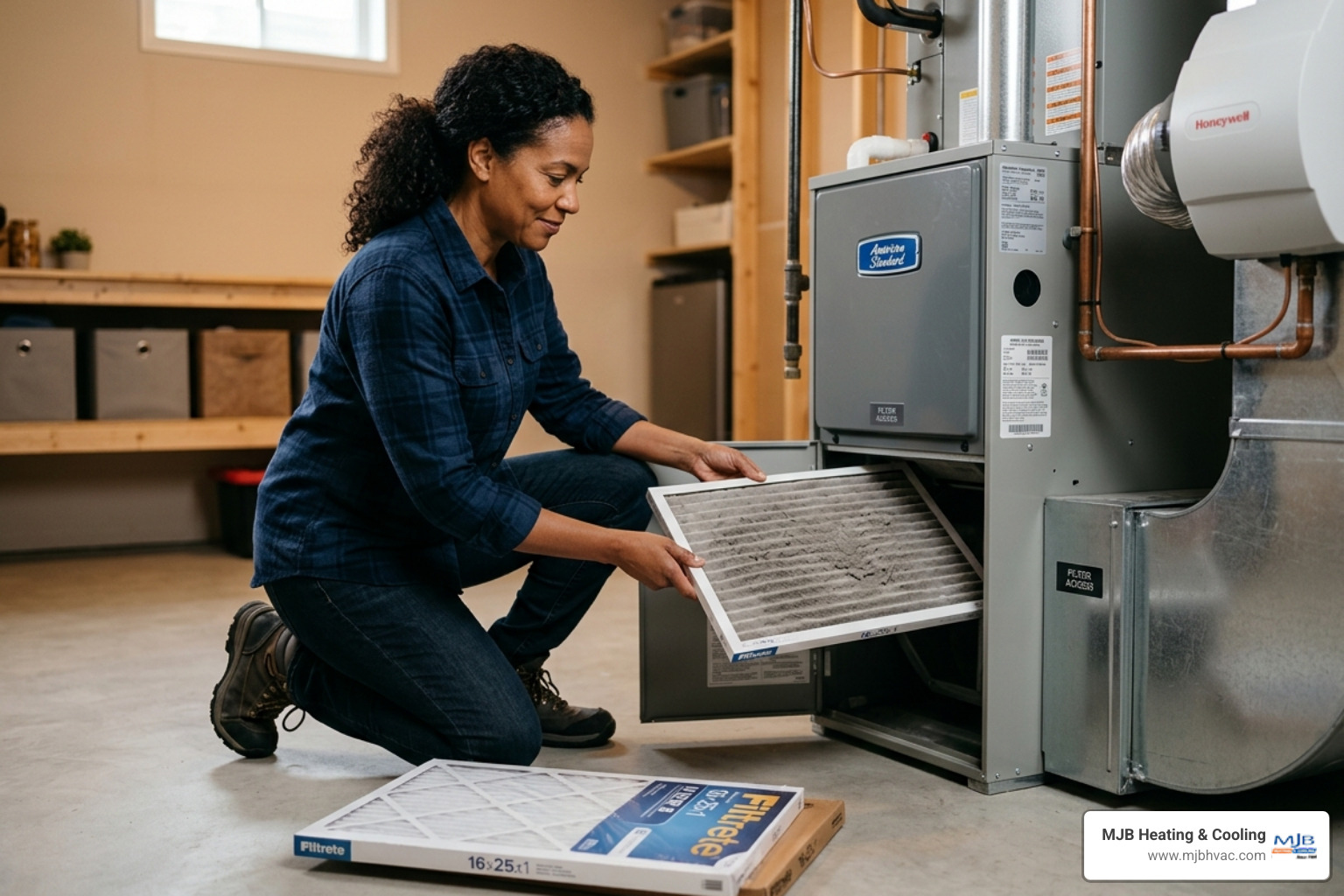
Yes, we always recommend turning the system off at the thermostat before swapping the filter. If the fan is running while you pull the old filter out, the suction can pull loose dust and debris directly into the unit. It also makes it much easier to slide the new filter into the slot without fighting the air pressure.
Almost all air filters have a small arrow printed on the side of the frame. This arrow indicates the direction of the airflow. The arrow should always point toward the HVAC unit (the furnace or the air handler) and away from the return duct. Installing a filter backward can restrict airflow and reduce the filter's structural integrity, sometimes causing it to collapse into the unit.
Taking the time to understand how often should you change your hvac air filter is one of the best ways to ensure your home stays comfortable and your energy bills stay low. Whether you are in Wichita, Maize, or Park City, the local climate demands a lot from your heating and cooling system. By following a regular schedule—and adjusting for pets and peak seasons—you can avoid the stress of a mid-summer breakdown. Our team serves a wide range of communities, including Goddard, Colwich, Bel Aire, Haysville, Mulvane, Augusta, and El Dorado, ensuring that every neighbor receives the same high standard of care we've provided since 1984.
At MJB Heating & Cooling, we’ve been the trusted name in Central Kansas HVAC service since 1984. As a family-owned business, we pride ourselves on quality workmanship and an honest approach to every job. If you’ve noticed your system is struggling even after a filter change, it might be time for a professional look. Schedule professional HVAC maintenance in Central Kansas with us today, and let our experienced technicians ensure your home stays a haven of comfort all year long.
While the general rule of thumb for many homeowners is the 90-day mark, the truth is that there is no "one-size-fits-all" answer. The question of how often should you change your hvac air filter depends heavily on the specific material of the filter itself. Think of the air filter as the "lungs" of your home; just as you wouldn’t want to breathe through a clogged mask, your furnace and AC shouldn't have to struggle through a wall of dust. In the Wichita metro area, our HVAC systems face unique challenges. From the heavy pollen of a Kansas spring to the fine dust kicked up by summer winds in places like Maize or Park City, your air filter is the first line of defense. It doesn't just keep your air clean; it prevents the delicate internal components of your furnace and air conditioner from becoming coated in grime, which can lead to premature wear and tear.
These are the most basic and affordable options you’ll find at the hardware store. They are designed primarily to protect the HVAC equipment from large debris rather than purifying the air you breathe. Because they have less surface area to trap particles, they clog quickly. If you use these, we recommend a replacement every 30 days or less.
Most modern homes in the Wichita metro area use pleated filters. These are made of folded paper or polyester, which creates a much larger surface area to trap dust and allergens. High-quality pleated filters are excellent for maintaining indoor air quality and typically last between 60 to 90 days. You can learn more about specific timing in our guide on how often should HVAC air filters be changed.
HEPA (High-Efficiency Particulate Air) filters are the heavy hitters of the filtration world. They can trap 99.97% of particles, including microscopic bacteria and viruses. Because they are much denser, they often come in thicknesses of 4 to 5 inches. These robust filters can last anywhere from 6 to 12 months, though they require a specific housing in your HVAC system to handle the increased airflow resistance.
While most people use disposable filters, some choose washable versions. While these might seem eco-friendly, they require monthly cleaning and must be completely dry before being reinstalled to prevent mold growth. In our experience serving Central Kansas since 1984, high-quality disposable pleated filters remain the most reliable choice for most residential systems.
Beyond the filter type, your specific living situation in places like Andover or Derby, KS, plays a massive role. If you live alone in a brand-new, tightly sealed home, your filter will stay clean much longer than a house full of kids and pets. Environmental factors are also a major player; high Wichita dust levels or smoke from regional wildfires can cut a filter's lifespan in half almost overnight. In areas like Newton or Hutchinson, agricultural activity can also contribute to higher levels of airborne particulates that find their way into your return ducts. To keep your system in top shape, check out these essential HVAC maintenance tips for your furnace and AC.
We love our furry friends, but their hair and dander are the natural enemies of a clean air filter. If you have one cat or dog, we recommend moving your replacement schedule up to every 60 days. If you have multiple pets—especially those that shed heavily—or if someone in your home suffers from allergies, that window shrinks to every 20-45 days. Pet dander is sticky and microscopic, meaning it fills up the tiny pores of a pleated filter much faster than standard household dust.
In Central Kansas, our weather is rarely "mild." During a scorching Wichita summer or a freezing winter night in Newton, your HVAC system is running almost constantly. The more air that passes through the filter, the more dust it collects. We suggest performing a monthly visual inspection during these peak seasons. If the AC is running 12 hours a day to fight the Kansas heat, that filter is working overtime and will likely need to be swapped out sooner than it would in the spring or fall.
When you go to buy a new filter, you’ll see a MERV (Minimum Efficiency Reporting Value) rating. This scale ranges from 1 to 20 and measures how effectively the filter traps particles.
| Filter Thickness | Typical MERV Rating | Recommended Replacement |
|---|---|---|
| 1-inch | MERV 1-8 | 1-3 Months |
| 1-inch (High Efficiency) | MERV 11-13 | 1-2 Months |
| 4-5 inch | MERV 11-16 | 6-12 Months |
A higher MERV rating means the filter can catch smaller particles, which is great for allergies. However, a filter that is too restrictive can cause significant airflow issues. Choosing the right MERV rating is a balancing act. While a MERV 16 filter might sound like the best option for health, it can act like a brick wall for your airflow if your system isn't designed for it. At MJB Heating & Cooling, we often see systems in Derby and Andover struggling because a homeowner installed a high-efficiency filter without realizing their blower motor wasn't rated for that level of resistance. This leads to "static pressure" issues, which can shorten the lifespan of your equipment significantly. If your blower motor has to "suck" too hard to get air through a dense filter, it can lead to overheating. It is vital to know how to spot HVAC air flow problems before they turn into expensive repairs. Generally, for most residential systems in the Wichita area, a MERV rating between 8 and 11 provides a perfect balance of filtration and airflow.
What happens if you forget? It’s a common mistake, but the consequences can be costly. A clogged filter creates a "bottleneck" in your system. This leads to:
If you aren't sure if it's time for a change, use the light test. Take the filter out and hold it up to a bright light source or a window. If you can clearly see light passing through the material, it still has some life left. If the light is blocked or the filter looks gray and "fuzzy," it’s time to toss it and put in a fresh one.
The short answer is: No. You can run it for a few minutes while you go to the store to buy a new one, but never run it long-term without a filter. Without that barrier, dust, hair, and debris will get sucked directly into the sensitive internal components of your furnace or AC. This can coat the blower motor and the coils, leading to a total system failure that costs much more than a box of filters.
Yes, we always recommend turning the system off at the thermostat before swapping the filter. If the fan is running while you pull the old filter out, the suction can pull loose dust and debris directly into the unit. It also makes it much easier to slide the new filter into the slot without fighting the air pressure.
Almost all air filters have a small arrow printed on the side of the frame. This arrow indicates the direction of the airflow. The arrow should always point toward the HVAC unit (the furnace or the air handler) and away from the return duct. Installing a filter backward can restrict airflow and reduce the filter's structural integrity, sometimes causing it to collapse into the unit.
Taking the time to understand how often should you change your hvac air filter is one of the best ways to ensure your home stays comfortable and your energy bills stay low. Whether you are in Wichita, Maize, or Park City, the local climate demands a lot from your heating and cooling system. By following a regular schedule—and adjusting for pets and peak seasons—you can avoid the stress of a mid-summer breakdown. Our team serves a wide range of communities, including Goddard, Colwich, Bel Aire, Haysville, Mulvane, Augusta, and El Dorado, ensuring that every neighbor receives the same high standard of care we've provided since 1984.
At MJB Heating & Cooling, we’ve been the trusted name in Central Kansas HVAC service since 1984. As a family-owned business, we pride ourselves on quality workmanship and an honest approach to every job. If you’ve noticed your system is struggling even after a filter change, it might be time for a professional look. Schedule professional HVAC maintenance in Central Kansas with us today, and let our experienced technicians ensure your home stays a haven of comfort all year long.
While the general rule of thumb for many homeowners is the 90-day mark, the truth is that there is no "one-size-fits-all" answer. The question of how often should you change your hvac air filter depends heavily on the specific material of the filter itself. Think of the air filter as the "lungs" of your home; just as you wouldn’t want to breathe through a clogged mask, your furnace and AC shouldn't have to struggle through a wall of dust. In the Wichita metro area, our HVAC systems face unique challenges. From the heavy pollen of a Kansas spring to the fine dust kicked up by summer winds in places like Maize or Park City, your air filter is the first line of defense. It doesn't just keep your air clean; it prevents the delicate internal components of your furnace and air conditioner from becoming coated in grime, which can lead to premature wear and tear.
These are the most basic and affordable options you’ll find at the hardware store. They are designed primarily to protect the HVAC equipment from large debris rather than purifying the air you breathe. Because they have less surface area to trap particles, they clog quickly. If you use these, we recommend a replacement every 30 days or less.
Most modern homes in the Wichita metro area use pleated filters. These are made of folded paper or polyester, which creates a much larger surface area to trap dust and allergens. High-quality pleated filters are excellent for maintaining indoor air quality and typically last between 60 to 90 days. You can learn more about specific timing in our guide on how often should HVAC air filters be changed.
HEPA (High-Efficiency Particulate Air) filters are the heavy hitters of the filtration world. They can trap 99.97% of particles, including microscopic bacteria and viruses. Because they are much denser, they often come in thicknesses of 4 to 5 inches. These robust filters can last anywhere from 6 to 12 months, though they require a specific housing in your HVAC system to handle the increased airflow resistance.
While most people use disposable filters, some choose washable versions. While these might seem eco-friendly, they require monthly cleaning and must be completely dry before being reinstalled to prevent mold growth. In our experience serving Central Kansas since 1984, high-quality disposable pleated filters remain the most reliable choice for most residential systems.
Beyond the filter type, your specific living situation in places like Andover or Derby, KS, plays a massive role. If you live alone in a brand-new, tightly sealed home, your filter will stay clean much longer than a house full of kids and pets. Environmental factors are also a major player; high Wichita dust levels or smoke from regional wildfires can cut a filter's lifespan in half almost overnight. In areas like Newton or Hutchinson, agricultural activity can also contribute to higher levels of airborne particulates that find their way into your return ducts. To keep your system in top shape, check out these essential HVAC maintenance tips for your furnace and AC.
We love our furry friends, but their hair and dander are the natural enemies of a clean air filter. If you have one cat or dog, we recommend moving your replacement schedule up to every 60 days. If you have multiple pets—especially those that shed heavily—or if someone in your home suffers from allergies, that window shrinks to every 20-45 days. Pet dander is sticky and microscopic, meaning it fills up the tiny pores of a pleated filter much faster than standard household dust.
In Central Kansas, our weather is rarely "mild." During a scorching Wichita summer or a freezing winter night in Newton, your HVAC system is running almost constantly. The more air that passes through the filter, the more dust it collects. We suggest performing a monthly visual inspection during these peak seasons. If the AC is running 12 hours a day to fight the Kansas heat, that filter is working overtime and will likely need to be swapped out sooner than it would in the spring or fall.
When you go to buy a new filter, you’ll see a MERV (Minimum Efficiency Reporting Value) rating. This scale ranges from 1 to 20 and measures how effectively the filter traps particles.
| Filter Thickness | Typical MERV Rating | Recommended Replacement |
|---|---|---|
| 1-inch | MERV 1-8 | 1-3 Months |
| 1-inch (High Efficiency) | MERV 11-13 | 1-2 Months |
| 4-5 inch | MERV 11-16 | 6-12 Months |
A higher MERV rating means the filter can catch smaller particles, which is great for allergies. However, a filter that is too restrictive can cause significant airflow issues. Choosing the right MERV rating is a balancing act. While a MERV 16 filter might sound like the best option for health, it can act like a brick wall for your airflow if your system isn't designed for it. At MJB Heating & Cooling, we often see systems in Derby and Andover struggling because a homeowner installed a high-efficiency filter without realizing their blower motor wasn't rated for that level of resistance. This leads to "static pressure" issues, which can shorten the lifespan of your equipment significantly. If your blower motor has to "suck" too hard to get air through a dense filter, it can lead to overheating. It is vital to know how to spot HVAC air flow problems before they turn into expensive repairs. Generally, for most residential systems in the Wichita area, a MERV rating between 8 and 11 provides a perfect balance of filtration and airflow.
What happens if you forget? It’s a common mistake, but the consequences can be costly. A clogged filter creates a "bottleneck" in your system. This leads to:
If you aren't sure if it's time for a change, use the light test. Take the filter out and hold it up to a bright light source or a window. If you can clearly see light passing through the material, it still has some life left. If the light is blocked or the filter looks gray and "fuzzy," it’s time to toss it and put in a fresh one.
The short answer is: No. You can run it for a few minutes while you go to the store to buy a new one, but never run it long-term without a filter. Without that barrier, dust, hair, and debris will get sucked directly into the sensitive internal components of your furnace or AC. This can coat the blower motor and the coils, leading to a total system failure that costs much more than a box of filters.
Yes, we always recommend turning the system off at the thermostat before swapping the filter. If the fan is running while you pull the old filter out, the suction can pull loose dust and debris directly into the unit. It also makes it much easier to slide the new filter into the slot without fighting the air pressure.
Almost all air filters have a small arrow printed on the side of the frame. This arrow indicates the direction of the airflow. The arrow should always point toward the HVAC unit (the furnace or the air handler) and away from the return duct. Installing a filter backward can restrict airflow and reduce the filter's structural integrity, sometimes causing it to collapse into the unit.
Taking the time to understand how often should you change your hvac air filter is one of the best ways to ensure your home stays comfortable and your energy bills stay low. Whether you are in Wichita, Maize, or Park City, the local climate demands a lot from your heating and cooling system. By following a regular schedule—and adjusting for pets and peak seasons—you can avoid the stress of a mid-summer breakdown. Our team serves a wide range of communities, including Goddard, Colwich, Bel Aire, Haysville, Mulvane, Augusta, and El Dorado, ensuring that every neighbor receives the same high standard of care we've provided since 1984.
At MJB Heating & Cooling, we’ve been the trusted name in Central Kansas HVAC service since 1984. As a family-owned business, we pride ourselves on quality workmanship and an honest approach to every job. If you’ve noticed your system is struggling even after a filter change, it might be time for a professional look. Schedule professional HVAC maintenance in Central Kansas with us today, and let our experienced technicians ensure your home stays a haven of comfort all year long.

While the general rule of thumb for many homeowners is the 90-day mark, the truth is that there is no "one-size-fits-all" answer. The question of how often should you change your hvac air filter depends heavily on the specific material of the filter itself. Think of the air filter as the "lungs" of your home; just as you wouldn’t want to breathe through a clogged mask, your furnace and AC shouldn't have to struggle through a wall of dust. In the Wichita metro area, our HVAC systems face unique challenges. From the heavy pollen of a Kansas spring to the fine dust kicked up by summer winds in places like Maize or Park City, your air filter is the first line of defense. It doesn't just keep your air clean; it prevents the delicate internal components of your furnace and air conditioner from becoming coated in grime, which can lead to premature wear and tear.
These are the most basic and affordable options you’ll find at the hardware store. They are designed primarily to protect the HVAC equipment from large debris rather than purifying the air you breathe. Because they have less surface area to trap particles, they clog quickly. If you use these, we recommend a replacement every 30 days or less.
Most modern homes in the Wichita metro area use pleated filters. These are made of folded paper or polyester, which creates a much larger surface area to trap dust and allergens. High-quality pleated filters are excellent for maintaining indoor air quality and typically last between 60 to 90 days. You can learn more about specific timing in our guide on how often should HVAC air filters be changed.
HEPA (High-Efficiency Particulate Air) filters are the heavy hitters of the filtration world. They can trap 99.97% of particles, including microscopic bacteria and viruses. Because they are much denser, they often come in thicknesses of 4 to 5 inches. These robust filters can last anywhere from 6 to 12 months, though they require a specific housing in your HVAC system to handle the increased airflow resistance.
While most people use disposable filters, some choose washable versions. While these might seem eco-friendly, they require monthly cleaning and must be completely dry before being reinstalled to prevent mold growth. In our experience serving Central Kansas since 1984, high-quality disposable pleated filters remain the most reliable choice for most residential systems.

Beyond the filter type, your specific living situation in places like Andover or Derby, KS, plays a massive role. If you live alone in a brand-new, tightly sealed home, your filter will stay clean much longer than a house full of kids and pets. Environmental factors are also a major player; high Wichita dust levels or smoke from regional wildfires can cut a filter's lifespan in half almost overnight. In areas like Newton or Hutchinson, agricultural activity can also contribute to higher levels of airborne particulates that find their way into your return ducts. To keep your system in top shape, check out these essential HVAC maintenance tips for your furnace and AC.
We love our furry friends, but their hair and dander are the natural enemies of a clean air filter. If you have one cat or dog, we recommend moving your replacement schedule up to every 60 days. If you have multiple pets—especially those that shed heavily—or if someone in your home suffers from allergies, that window shrinks to every 20-45 days. Pet dander is sticky and microscopic, meaning it fills up the tiny pores of a pleated filter much faster than standard household dust.
In Central Kansas, our weather is rarely "mild." During a scorching Wichita summer or a freezing winter night in Newton, your HVAC system is running almost constantly. The more air that passes through the filter, the more dust it collects. We suggest performing a monthly visual inspection during these peak seasons. If the AC is running 12 hours a day to fight the Kansas heat, that filter is working overtime and will likely need to be swapped out sooner than it would in the spring or fall.
When you go to buy a new filter, you’ll see a MERV (Minimum Efficiency Reporting Value) rating. This scale ranges from 1 to 20 and measures how effectively the filter traps particles.
• 1-inch — Typical MERV Rating: MERV 1-8 — Recommended Replacement: 1-3 Months
• 1-inch (High Efficiency) — Typical MERV Rating: MERV 11-13 — Recommended Replacement: 1-2 Months
• 4-5 inch — Typical MERV Rating: MERV 11-16 — Recommended Replacement: 6-12 Months
A higher MERV rating means the filter can catch smaller particles, which is great for allergies. However, a filter that is too restrictive can cause significant airflow issues. Choosing the right MERV rating is a balancing act. While a MERV 16 filter might sound like the best option for health, it can act like a brick wall for your airflow if your system isn't designed for it. At MJB Heating & Cooling, we often see systems in Derby and Andover struggling because a homeowner installed a high-efficiency filter without realizing their blower motor wasn't rated for that level of resistance. This leads to "static pressure" issues, which can shorten the lifespan of your equipment significantly. If your blower motor has to "suck" too hard to get air through a dense filter, it can lead to overheating. It is vital to know how to spot HVAC air flow problems before they turn into expensive repairs. Generally, for most residential systems in the Wichita area, a MERV rating between 8 and 11 provides a perfect balance of filtration and airflow.

What happens if you forget? It’s a common mistake, but the consequences can be costly. A clogged filter creates a "bottleneck" in your system. This leads to:
• Reduced Energy Efficiency: Your system runs longer to reach the thermostat setting, spiking your utility bills.
• System Overheating: Without enough cool air flowing over the heat exchanger or across the cooling coils, the system can hit safety limits and shut down.
• Frozen AC Coils: In the summer, restricted airflow can actually cause your indoor cooling coils to turn into a block of ice.
• Poor Air Quality: Eventually, a dirty filter can't hold any more dust, and that debris starts to bypass the filter or settle in your ductwork. You might even need to clear blocked air ducts in Andover home if the problem persists for years.
If you aren't sure if it's time for a change, use the light test. Take the filter out and hold it up to a bright light source or a window. If you can clearly see light passing through the material, it still has some life left. If the light is blocked or the filter looks gray and "fuzzy," it’s time to toss it and put in a fresh one.
The short answer is: No. You can run it for a few minutes while you go to the store to buy a new one, but never run it long-term without a filter. Without that barrier, dust, hair, and debris will get sucked directly into the sensitive internal components of your furnace or AC. This can coat the blower motor and the coils, leading to a total system failure that costs much more than a box of filters.
Yes, we always recommend turning the system off at the thermostat before swapping the filter. If the fan is running while you pull the old filter out, the suction can pull loose dust and debris directly into the unit. It also makes it much easier to slide the new filter into the slot without fighting the air pressure.
Almost all air filters have a small arrow printed on the side of the frame. This arrow indicates the direction of the airflow. The arrow should always point toward the HVAC unit (the furnace or the air handler) and away from the return duct. Installing a filter backward can restrict airflow and reduce the filter's structural integrity, sometimes causing it to collapse into the unit.
Taking the time to understand how often should you change your hvac air filter is one of the best ways to ensure your home stays comfortable and your energy bills stay low. Whether you are in Wichita, Maize, or Park City, the local climate demands a lot from your heating and cooling system. By following a regular schedule—and adjusting for pets and peak seasons—you can avoid the stress of a mid-summer breakdown. Our team serves a wide range of communities, including Goddard, Colwich, Bel Aire, Haysville, Mulvane, Augusta, and El Dorado, ensuring that every neighbor receives the same high standard of care we've provided since 1984.
At MJB Heating & Cooling, we’ve been the trusted name in Central Kansas HVAC service since 1984. As a family-owned business, we pride ourselves on quality workmanship and an honest approach to every job. If you’ve noticed your system is struggling even after a filter change, it might be time for a professional look. Schedule professional HVAC maintenance in Central Kansas with us today, and let our experienced technicians ensure your home stays a haven of comfort all year long.
While the general rule of thumb for many homeowners is the 90-day mark, the truth is that there is no "one-size-fits-all" answer. The question of how often should you change your hvac air filter depends heavily on the specific material of the filter itself. Think of the air filter as the "lungs" of your home; just as you wouldn’t want to breathe through a clogged mask, your furnace and AC shouldn't have to struggle through a wall of dust. In the Wichita metro area, our HVAC systems face unique challenges. From the heavy pollen of a Kansas spring to the fine dust kicked up by summer winds in places like Maize or Park City, your air filter is the first line of defense. It doesn't just keep your air clean; it prevents the delicate internal components of your furnace and air conditioner from becoming coated in grime, which can lead to premature wear and tear.
These are the most basic and affordable options you’ll find at the hardware store. They are designed primarily to protect the HVAC equipment from large debris rather than purifying the air you breathe. Because they have less surface area to trap particles, they clog quickly. If you use these, we recommend a replacement every 30 days or less.
Most modern homes in the Wichita metro area use pleated filters. These are made of folded paper or polyester, which creates a much larger surface area to trap dust and allergens. High-quality pleated filters are excellent for maintaining indoor air quality and typically last between 60 to 90 days. You can learn more about specific timing in our guide on how often should HVAC air filters be changed.
HEPA (High-Efficiency Particulate Air) filters are the heavy hitters of the filtration world. They can trap 99.97% of particles, including microscopic bacteria and viruses. Because they are much denser, they often come in thicknesses of 4 to 5 inches. These robust filters can last anywhere from 6 to 12 months, though they require a specific housing in your HVAC system to handle the increased airflow resistance.
While most people use disposable filters, some choose washable versions. While these might seem eco-friendly, they require monthly cleaning and must be completely dry before being reinstalled to prevent mold growth. In our experience serving Central Kansas since 1984, high-quality disposable pleated filters remain the most reliable choice for most residential systems.
Beyond the filter type, your specific living situation in places like Andover or Derby, KS, plays a massive role. If you live alone in a brand-new, tightly sealed home, your filter will stay clean much longer than a house full of kids and pets. Environmental factors are also a major player; high Wichita dust levels or smoke from regional wildfires can cut a filter's lifespan in half almost overnight. In areas like Newton or Hutchinson, agricultural activity can also contribute to higher levels of airborne particulates that find their way into your return ducts. To keep your system in top shape, check out these essential HVAC maintenance tips for your furnace and AC.
We love our furry friends, but their hair and dander are the natural enemies of a clean air filter. If you have one cat or dog, we recommend moving your replacement schedule up to every 60 days. If you have multiple pets—especially those that shed heavily—or if someone in your home suffers from allergies, that window shrinks to every 20-45 days. Pet dander is sticky and microscopic, meaning it fills up the tiny pores of a pleated filter much faster than standard household dust.
In Central Kansas, our weather is rarely "mild." During a scorching Wichita summer or a freezing winter night in Newton, your HVAC system is running almost constantly. The more air that passes through the filter, the more dust it collects. We suggest performing a monthly visual inspection during these peak seasons. If the AC is running 12 hours a day to fight the Kansas heat, that filter is working overtime and will likely need to be swapped out sooner than it would in the spring or fall.
When you go to buy a new filter, you’ll see a MERV (Minimum Efficiency Reporting Value) rating. This scale ranges from 1 to 20 and measures how effectively the filter traps particles.
| Filter Thickness | Typical MERV Rating | Recommended Replacement |
|---|---|---|
| 1-inch | MERV 1-8 | 1-3 Months |
| 1-inch (High Efficiency) | MERV 11-13 | 1-2 Months |
| 4-5 inch | MERV 11-16 | 6-12 Months |
A higher MERV rating means the filter can catch smaller particles, which is great for allergies. However, a filter that is too restrictive can cause significant airflow issues. Choosing the right MERV rating is a balancing act. While a MERV 16 filter might sound like the best option for health, it can act like a brick wall for your airflow if your system isn't designed for it. At MJB Heating & Cooling, we often see systems in Derby and Andover struggling because a homeowner installed a high-efficiency filter without realizing their blower motor wasn't rated for that level of resistance. This leads to "static pressure" issues, which can shorten the lifespan of your equipment significantly. If your blower motor has to "suck" too hard to get air through a dense filter, it can lead to overheating. It is vital to know how to spot HVAC air flow problems before they turn into expensive repairs. Generally, for most residential systems in the Wichita area, a MERV rating between 8 and 11 provides a perfect balance of filtration and airflow.
What happens if you forget? It’s a common mistake, but the consequences can be costly. A clogged filter creates a "bottleneck" in your system. This leads to:
If you aren't sure if it's time for a change, use the light test. Take the filter out and hold it up to a bright light source or a window. If you can clearly see light passing through the material, it still has some life left. If the light is blocked or the filter looks gray and "fuzzy," it’s time to toss it and put in a fresh one.
The short answer is: No. You can run it for a few minutes while you go to the store to buy a new one, but never run it long-term without a filter. Without that barrier, dust, hair, and debris will get sucked directly into the sensitive internal components of your furnace or AC. This can coat the blower motor and the coils, leading to a total system failure that costs much more than a box of filters.
Yes, we always recommend turning the system off at the thermostat before swapping the filter. If the fan is running while you pull the old filter out, the suction can pull loose dust and debris directly into the unit. It also makes it much easier to slide the new filter into the slot without fighting the air pressure.
Almost all air filters have a small arrow printed on the side of the frame. This arrow indicates the direction of the airflow. The arrow should always point toward the HVAC unit (the furnace or the air handler) and away from the return duct. Installing a filter backward can restrict airflow and reduce the filter's structural integrity, sometimes causing it to collapse into the unit.
Taking the time to understand how often should you change your hvac air filter is one of the best ways to ensure your home stays comfortable and your energy bills stay low. Whether you are in Wichita, Maize, or Park City, the local climate demands a lot from your heating and cooling system. By following a regular schedule—and adjusting for pets and peak seasons—you can avoid the stress of a mid-summer breakdown. Our team serves a wide range of communities, including Goddard, Colwich, Bel Aire, Haysville, Mulvane, Augusta, and El Dorado, ensuring that every neighbor receives the same high standard of care we've provided since 1984.
At MJB Heating & Cooling, we’ve been the trusted name in Central Kansas HVAC service since 1984. As a family-owned business, we pride ourselves on quality workmanship and an honest approach to every job. If you’ve noticed your system is struggling even after a filter change, it might be time for a professional look. Schedule professional HVAC maintenance in Central Kansas with us today, and let our experienced technicians ensure your home stays a haven of comfort all year long.


Our A/C stopped working on a Sunday and due to health issues, we needed to find a service company available on a Sunday. I called MJB and left a message on their emergency voice mail. Within 10 minutes Tom Buck called me to hear my description of the symptoms. He was just finishing an appointment in Wichita and would be on his way to my home on the south end of Derby. He arrived within 30 minutes! From start to finish he was the perfect example of what you could ever hope for in an HVAC tech and a human being. His evaluation of our system inside and out was as thorough as I could ever imagine and once he was done with the repair, our system is running as well or better than ever. Well worth the price for the evaluation, parts, and labor. Thank you again Tom for an awesome experience.
Our AC went out during the hottest days of the year, and they were out next day! We have been jerked around by a shoddy home warranty for years. We finally had a chance to pick our own repair people, and MJB came highly recommended. I can see why! I was impressed with the honesty and speed at which they fixed our AC unit!
Our commercial building had a lightening/electrical strike and damaged our 20 ton AC unit. No one could find us a new unit before the end of September. Imagining going all of August and September with no AC in Kansas and working inside near 100 degree temps is less than thrilling. Dale and the team at MJB called around and saved the day. They had us a new unit 5 weeks earlier than other could promise and I now have happy employees. The unit is amazingly quiet, super cold and so much more energy efficient. Thank you for being our super hero!
Came out and installed my new furnace. Was very polite and affordable. They are very acknowledgeable and I highly recommend!
Thank you very much. We had our 1st warm night in 3weeks. MJB took the time and effort to find the real problem. And the employees were kind and thoughtful and explained things very well. I cannot thank you and all of MJB. Will recommend you highly. Thanks again Marjorie Herman Oxford Kansas
We had a new system installed and I was so impressed with how quick they were in come out and install it, in the middle of a hot summer day. They were so friendly & very professional. I had a small problem with a weird sound and they came over immediately and fixed it. Love them!