


.avif)





Blogs
Stay updated with our latest blog posts.
Knowing how to apply for energy rebates in Kansas can save you hundreds of dollars on heating and cooling upgrades — but the process looks different depending on which program you qualify for. Here's a quick overview:
Quick Answer: How to Apply for Kansas Energy Rebates
Kansas homeowners in the Wichita metro — including Derby, Andover, Bel Aire, and surrounding communities — have access to several energy rebate programs right now, and more are on the way. Utility rebates through Evergy and rural electric cooperatives are active today. A major federally funded program backed by $105.6 million in Inflation Reduction Act dollars is still pending launch. And income-based assistance through LIEAP and the Kansas Weatherization Assistance Program helps lower-income households reduce energy costs with little or no out-of-pocket expense.
The challenge is that each program has its own eligibility rules, application steps, income thresholds, and deadlines. Missing a step — like skipping a required home assessment before installation — can disqualify you entirely. This guide breaks it all down clearly so you know exactly where to start.

Basic how to apply for energy rebates in kansas glossary:
If you are looking to upgrade your heating and cooling system right now, active utility rebate programs are your best and most reliable path to immediate savings. In Central Kansas, these programs are primarily run by Evergy and the various rural electric cooperatives under the Kansas Electric Power Cooperative (KEPCo) umbrella.
These rebates are designed to incentivize homeowners to choose high-efficiency HVAC equipment over standard models. Because high-efficiency systems draw less power, they reduce strain on the local electrical grid while lowering your monthly operating costs.
To qualify for these rebates, your new equipment must meet specific energy efficiency thresholds, which are measured using standardized industry metrics:
In addition to meeting these ratings, your equipment must be certified by the Air-Conditioning, Heating, and Refrigeration Institute (AHRI). An AHRI certificate proves that the specific combination of your outdoor unit, indoor coil, and furnace or air handler has been tested to perform at its rated efficiency. When we install a new system for you, we provide this certificate as part of your completed installation paperwork.
Before purchasing any equipment, it is critical to verify that your contractor is authorized to participate in your utility's rebate program. Many utility programs require the installation to be performed by an approved professional to ensure the system is sized and charged correctly.
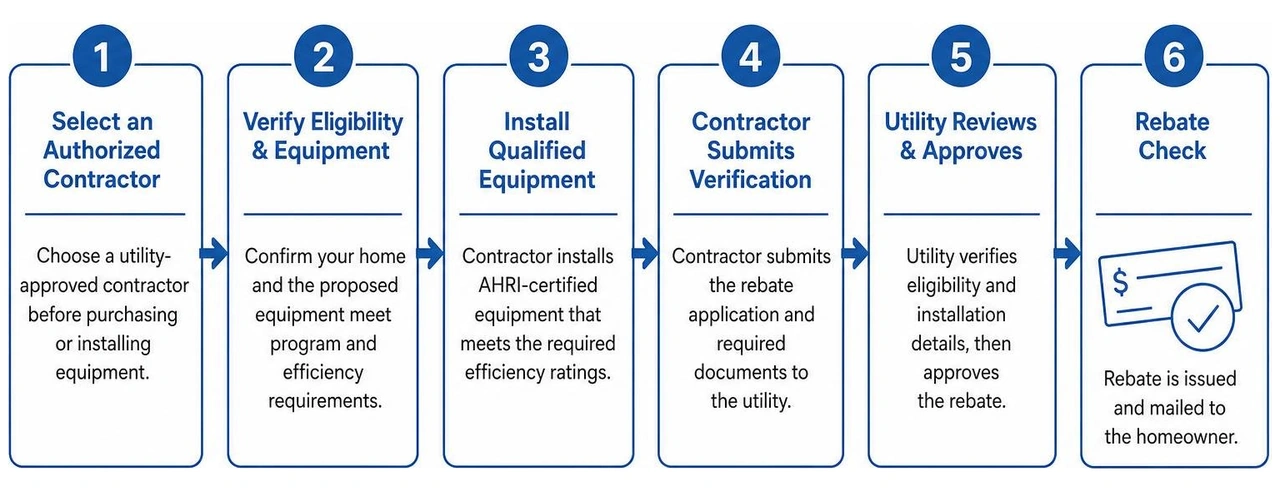
Evergy’s residential rebate program, authorized under the Kansas Energy Efficiency Investment Act (KEEIA), is fully active and scheduled to run through December 31, 2027. This program offers substantial incentives for homeowners who upgrade to energy-efficient cooling and heating systems.
To get a sense of how these metrics affect your long-term comfort and utility bills, you can read our guide on Efficiency Ratings Explained for Homeowners.
Here is the current rebate structure for Evergy customers in Kansas:
How to Apply for Evergy Rebates:
If you live in a rural area surrounding the Wichita metro—such as parts of Butler, Sumner, or Cowley counties—your electricity may be supplied by a rural electric cooperative. Many of these local co-ops are members of the Kansas Electric Power Cooperative (KEPCo), which coordinates energy efficiency rebate programs for its member networks.
KEPCo co-op rebates focus heavily on heat pump installations, especially in homes that rely on expensive propane or standard electric resistance heat. The typical rebate structure includes:
Because these programs are managed locally, the exact application process and bonus incentives can vary slightly from one cooperative to another. For example, some co-ops offer additional rebates for electric water heaters or home energy audits.
To maximize your savings, it helps to understand how modern heat pump technology performs in our local climate. Learn more by reading about how to Discover Energy Savings with Daikin's HSPF Rating Insights.
How to Apply for KEPCo Co-op Rebates:
The Inflation Reduction Act (IRA) allocated a massive $105.6 million to the state of Kansas to fund two major home energy rebate programs: the Home Efficiency Rebates (HOMES) program and the Home Electrification and Appliance Rebates (HEAR) program. These programs are designed to help homeowners, landlords, and renters transition to cleaner, highly efficient electric appliances and whole-home energy upgrades.
The Kansas Corporation Commission (KCC) is responsible for administering these programs, with HORNE serving as the official implementation partner.
Current Status (As of July 2026): The Kansas Home Rebates Program is actively preparing for launch. While the state has received its early administrative funding from the U.S. Department of Energy (DOE) and has begun recruiting and registering local contractors, the consumer portal is not yet open for applications. The official program website (kshomerebates.gov) is live, and residents are strongly encouraged to sign up for email alerts to be notified the moment the application window officially opens.
Because these programs are not yet active, retroactive rebates are not available. If you complete an upgrade before the official program launch, you will not be able to apply for these specific federal rebates later.
The HEAR program (funded with $52.6 million) is designed specifically to help low-to-moderate-income (LMI) households transition to high-efficiency electric appliances.
The HOMES program (funded with $52.9 million) focuses on whole-house energy performance rather than individual appliance replacements.
Unlike the HEAR program, the HOMES program has no income caps, meaning any Kansas homeowner can participate. However, the rebate amounts are tiered to provide larger incentives to lower-income households.
To understand how making these upgrades translates to lower utility bills, check out our analysis: How Much Does a High Efficiency System Save.
For families struggling with high winter heating bills or drafty homes, Kansas offers two essential federally funded assistance programs: the Low Income Energy Assistance Program (LIEAP) and the Kansas Weatherization Assistance Program (WAP).
LIEAP is a federally funded program administered by the Kansas Department for Children and Families (DCF). It provides a one-time annual benefit to help eligible households pay a portion of their winter heating costs. The benefit is paid directly to your energy utility provider (such as Evergy or your gas/propane vendor) and applied as a credit to your account.
While LIEAP helps pay your energy bills, the Weatherization Assistance Program (WAP) focuses on permanently reducing your energy bills by making your home more energy-efficient. This program provides free home energy audits and professional efficiency upgrades to eligible homeowners and renters.
| Program | Primary Purpose | Eligibility Income Limit | Application Method |
|---|---|---|---|
| LIEAP | One-time winter heating bill credit | $\le$ 150% Federal Poverty Level | Online via DCF Self-Service Portal |
| Weatherization (WAP) | Free home efficiency upgrades (insulation, air sealing) | $\le$ 200% Federal Poverty Level | Local community action agency application |
| Utility Rebates (Evergy/KEPCo) | Cash back on high-efficiency HVAC installations | None (open to all customers) | Through authorized HVAC contractor |
| HEAR (Pending IRA) | Point-of-sale discounts on electric appliances/heat pumps | < 150% Area Median Income (AMI) | Registered contractor portal (kshomerebates.gov) |
| HOMES (Pending IRA) | Cash back for measured whole-home energy savings | None (higher incentives for < 80% AMI) | Pre-assessment & registered contractor |
Yes! You can absolutely combine active utility rebates from Evergy or your rural electric cooperative with available federal tax credits.
While the direct IRA-funded state rebates (HEAR and HOMES) are still pending launch, homeowners can take advantage of the Energy Efficient Home Improvement Credit (Section 25C) on their federal tax returns. Under Section 25C, you can claim a tax credit of up to 30% of the cost of qualifying energy-efficiency upgrades, up to an annual limit of $1,200 for general improvements (like insulation or standard ACs) and up to $2,000 specifically for qualifying heat pumps or heat pump water heaters.
When you pair an Evergy heat pump rebate with the 25C tax credit, you can significantly offset the upfront cost of your new system.
No. Neither the upcoming Kansas Home Rebates Program (HEAR/HOMES) nor active utility programs offer retroactive rebates for projects completed before their official guidelines are met.
For utility rebates, the application must be submitted within a strict window (usually 30 to 90 days) following the installation, and the work must be performed by an authorized contractor. For the upcoming federal IRA programs, a home energy assessment must be completed by an approved program contractor before any equipment is installed. If you install a system today, you will not be eligible to claim a HEAR or HOMES rebate retroactively once those programs launch.
Yes, renters can qualify for several of these programs, but there are specific rules:
Navigating energy rebates can feel overwhelming, but taking the time to plan your project correctly ensures you don't leave money on the table. Whether you are taking advantage of active Evergy rebates today, preparing for the upcoming Kansas Home Rebates Program, or applying for winter assistance through LIEAP, the key is to stay informed and work with qualified professionals.
At MJB Heating & Cooling, we have been helping our neighbors throughout the Wichita metro area—including Derby, Andover, Haysville, and surrounding communities—stay comfortable since 1984. As a family-owned local business, we take pride in our honest approach and quality workmanship. We keep up with the latest rebate requirements and efficiency standards so you don't have to.
If you are planning an HVAC upgrade and want to make sure you maximize your utility rebates, we are here to help. Explore our current promotions or contact us today to schedule your consultation!
Knowing how to apply for energy rebates in Kansas can save you hundreds of dollars on heating and cooling upgrades — but the process looks different depending on which program you qualify for. Here's a quick overview:
Quick Answer: How to Apply for Kansas Energy Rebates
Kansas homeowners in the Wichita metro — including Derby, Andover, Bel Aire, and surrounding communities — have access to several energy rebate programs right now, and more are on the way. Utility rebates through Evergy and rural electric cooperatives are active today. A major federally funded program backed by $105.6 million in Inflation Reduction Act dollars is still pending launch. And income-based assistance through LIEAP and the Kansas Weatherization Assistance Program helps lower-income households reduce energy costs with little or no out-of-pocket expense.
The challenge is that each program has its own eligibility rules, application steps, income thresholds, and deadlines. Missing a step — like skipping a required home assessment before installation — can disqualify you entirely. This guide breaks it all down clearly so you know exactly where to start.
Basic how to apply for energy rebates in kansas glossary:
If you are looking to upgrade your heating and cooling system right now, active utility rebate programs are your best and most reliable path to immediate savings. In Central Kansas, these programs are primarily run by Evergy and the various rural electric cooperatives under the Kansas Electric Power Cooperative (KEPCo) umbrella.
These rebates are designed to incentivize homeowners to choose high-efficiency HVAC equipment over standard models. Because high-efficiency systems draw less power, they reduce strain on the local electrical grid while lowering your monthly operating costs.
To qualify for these rebates, your new equipment must meet specific energy efficiency thresholds, which are measured using standardized industry metrics:
In addition to meeting these ratings, your equipment must be certified by the Air-Conditioning, Heating, and Refrigeration Institute (AHRI). An AHRI certificate proves that the specific combination of your outdoor unit, indoor coil, and furnace or air handler has been tested to perform at its rated efficiency. When we install a new system for you, we provide this certificate as part of your completed installation paperwork.
Before purchasing any equipment, it is critical to verify that your contractor is authorized to participate in your utility's rebate program. Many utility programs require the installation to be performed by an approved professional to ensure the system is sized and charged correctly.
Evergy’s residential rebate program, authorized under the Kansas Energy Efficiency Investment Act (KEEIA), is fully active and scheduled to run through December 31, 2027. This program offers substantial incentives for homeowners who upgrade to energy-efficient cooling and heating systems.
To get a sense of how these metrics affect your long-term comfort and utility bills, you can read our guide on Efficiency Ratings Explained for Homeowners.
Here is the current rebate structure for Evergy customers in Kansas:
How to Apply for Evergy Rebates:
If you live in a rural area surrounding the Wichita metro—such as parts of Butler, Sumner, or Cowley counties—your electricity may be supplied by a rural electric cooperative. Many of these local co-ops are members of the Kansas Electric Power Cooperative (KEPCo), which coordinates energy efficiency rebate programs for its member networks.
KEPCo co-op rebates focus heavily on heat pump installations, especially in homes that rely on expensive propane or standard electric resistance heat. The typical rebate structure includes:
Because these programs are managed locally, the exact application process and bonus incentives can vary slightly from one cooperative to another. For example, some co-ops offer additional rebates for electric water heaters or home energy audits.
To maximize your savings, it helps to understand how modern heat pump technology performs in our local climate. Learn more by reading about how to Discover Energy Savings with Daikin's HSPF Rating Insights.
How to Apply for KEPCo Co-op Rebates:
The Inflation Reduction Act (IRA) allocated a massive $105.6 million to the state of Kansas to fund two major home energy rebate programs: the Home Efficiency Rebates (HOMES) program and the Home Electrification and Appliance Rebates (HEAR) program. These programs are designed to help homeowners, landlords, and renters transition to cleaner, highly efficient electric appliances and whole-home energy upgrades.
The Kansas Corporation Commission (KCC) is responsible for administering these programs, with HORNE serving as the official implementation partner.
Current Status (As of July 2026): The Kansas Home Rebates Program is actively preparing for launch. While the state has received its early administrative funding from the U.S. Department of Energy (DOE) and has begun recruiting and registering local contractors, the consumer portal is not yet open for applications. The official program website (kshomerebates.gov) is live, and residents are strongly encouraged to sign up for email alerts to be notified the moment the application window officially opens.
Because these programs are not yet active, retroactive rebates are not available. If you complete an upgrade before the official program launch, you will not be able to apply for these specific federal rebates later.
The HEAR program (funded with $52.6 million) is designed specifically to help low-to-moderate-income (LMI) households transition to high-efficiency electric appliances.
The HOMES program (funded with $52.9 million) focuses on whole-house energy performance rather than individual appliance replacements.
Unlike the HEAR program, the HOMES program has no income caps, meaning any Kansas homeowner can participate. However, the rebate amounts are tiered to provide larger incentives to lower-income households.
To understand how making these upgrades translates to lower utility bills, check out our analysis: How Much Does a High Efficiency System Save.
For families struggling with high winter heating bills or drafty homes, Kansas offers two essential federally funded assistance programs: the Low Income Energy Assistance Program (LIEAP) and the Kansas Weatherization Assistance Program (WAP).
LIEAP is a federally funded program administered by the Kansas Department for Children and Families (DCF). It provides a one-time annual benefit to help eligible households pay a portion of their winter heating costs. The benefit is paid directly to your energy utility provider (such as Evergy or your gas/propane vendor) and applied as a credit to your account.
While LIEAP helps pay your energy bills, the Weatherization Assistance Program (WAP) focuses on permanently reducing your energy bills by making your home more energy-efficient. This program provides free home energy audits and professional efficiency upgrades to eligible homeowners and renters.
| Program | Primary Purpose | Eligibility Income Limit | Application Method |
|---|---|---|---|
| LIEAP | One-time winter heating bill credit | $\le$ 150% Federal Poverty Level | Online via DCF Self-Service Portal |
| Weatherization (WAP) | Free home efficiency upgrades (insulation, air sealing) | $\le$ 200% Federal Poverty Level | Local community action agency application |
| Utility Rebates (Evergy/KEPCo) | Cash back on high-efficiency HVAC installations | None (open to all customers) | Through authorized HVAC contractor |
| HEAR (Pending IRA) | Point-of-sale discounts on electric appliances/heat pumps | < 150% Area Median Income (AMI) | Registered contractor portal (kshomerebates.gov) |
| HOMES (Pending IRA) | Cash back for measured whole-home energy savings | None (higher incentives for < 80% AMI) | Pre-assessment & registered contractor |
Yes! You can absolutely combine active utility rebates from Evergy or your rural electric cooperative with available federal tax credits.
While the direct IRA-funded state rebates (HEAR and HOMES) are still pending launch, homeowners can take advantage of the Energy Efficient Home Improvement Credit (Section 25C) on their federal tax returns. Under Section 25C, you can claim a tax credit of up to 30% of the cost of qualifying energy-efficiency upgrades, up to an annual limit of $1,200 for general improvements (like insulation or standard ACs) and up to $2,000 specifically for qualifying heat pumps or heat pump water heaters.
When you pair an Evergy heat pump rebate with the 25C tax credit, you can significantly offset the upfront cost of your new system.
No. Neither the upcoming Kansas Home Rebates Program (HEAR/HOMES) nor active utility programs offer retroactive rebates for projects completed before their official guidelines are met.
For utility rebates, the application must be submitted within a strict window (usually 30 to 90 days) following the installation, and the work must be performed by an authorized contractor. For the upcoming federal IRA programs, a home energy assessment must be completed by an approved program contractor before any equipment is installed. If you install a system today, you will not be eligible to claim a HEAR or HOMES rebate retroactively once those programs launch.
Yes, renters can qualify for several of these programs, but there are specific rules:
Navigating energy rebates can feel overwhelming, but taking the time to plan your project correctly ensures you don't leave money on the table. Whether you are taking advantage of active Evergy rebates today, preparing for the upcoming Kansas Home Rebates Program, or applying for winter assistance through LIEAP, the key is to stay informed and work with qualified professionals.
At MJB Heating & Cooling, we have been helping our neighbors throughout the Wichita metro area—including Derby, Andover, Haysville, and surrounding communities—stay comfortable since 1984. As a family-owned local business, we take pride in our honest approach and quality workmanship. We keep up with the latest rebate requirements and efficiency standards so you don't have to.
If you are planning an HVAC upgrade and want to make sure you maximize your utility rebates, we are here to help. Explore our current promotions or contact us today to schedule your consultation!
Knowing how to apply for energy rebates in Kansas can save you hundreds of dollars on heating and cooling upgrades — but the process looks different depending on which program you qualify for. Here's a quick overview:
Quick Answer: How to Apply for Kansas Energy Rebates
Kansas homeowners in the Wichita metro — including Derby, Andover, Bel Aire, and surrounding communities — have access to several energy rebate programs right now, and more are on the way. Utility rebates through Evergy and rural electric cooperatives are active today. A major federally funded program backed by $105.6 million in Inflation Reduction Act dollars is still pending launch. And income-based assistance through LIEAP and the Kansas Weatherization Assistance Program helps lower-income households reduce energy costs with little or no out-of-pocket expense.
The challenge is that each program has its own eligibility rules, application steps, income thresholds, and deadlines. Missing a step — like skipping a required home assessment before installation — can disqualify you entirely. This guide breaks it all down clearly so you know exactly where to start.
Basic how to apply for energy rebates in kansas glossary:
If you are looking to upgrade your heating and cooling system right now, active utility rebate programs are your best and most reliable path to immediate savings. In Central Kansas, these programs are primarily run by Evergy and the various rural electric cooperatives under the Kansas Electric Power Cooperative (KEPCo) umbrella.
These rebates are designed to incentivize homeowners to choose high-efficiency HVAC equipment over standard models. Because high-efficiency systems draw less power, they reduce strain on the local electrical grid while lowering your monthly operating costs.
To qualify for these rebates, your new equipment must meet specific energy efficiency thresholds, which are measured using standardized industry metrics:
In addition to meeting these ratings, your equipment must be certified by the Air-Conditioning, Heating, and Refrigeration Institute (AHRI). An AHRI certificate proves that the specific combination of your outdoor unit, indoor coil, and furnace or air handler has been tested to perform at its rated efficiency. When we install a new system for you, we provide this certificate as part of your completed installation paperwork.
Before purchasing any equipment, it is critical to verify that your contractor is authorized to participate in your utility's rebate program. Many utility programs require the installation to be performed by an approved professional to ensure the system is sized and charged correctly.
Evergy’s residential rebate program, authorized under the Kansas Energy Efficiency Investment Act (KEEIA), is fully active and scheduled to run through December 31, 2027. This program offers substantial incentives for homeowners who upgrade to energy-efficient cooling and heating systems.
To get a sense of how these metrics affect your long-term comfort and utility bills, you can read our guide on Efficiency Ratings Explained for Homeowners.
Here is the current rebate structure for Evergy customers in Kansas:
How to Apply for Evergy Rebates:
If you live in a rural area surrounding the Wichita metro—such as parts of Butler, Sumner, or Cowley counties—your electricity may be supplied by a rural electric cooperative. Many of these local co-ops are members of the Kansas Electric Power Cooperative (KEPCo), which coordinates energy efficiency rebate programs for its member networks.
KEPCo co-op rebates focus heavily on heat pump installations, especially in homes that rely on expensive propane or standard electric resistance heat. The typical rebate structure includes:
Because these programs are managed locally, the exact application process and bonus incentives can vary slightly from one cooperative to another. For example, some co-ops offer additional rebates for electric water heaters or home energy audits.
To maximize your savings, it helps to understand how modern heat pump technology performs in our local climate. Learn more by reading about how to Discover Energy Savings with Daikin's HSPF Rating Insights.
How to Apply for KEPCo Co-op Rebates:
The Inflation Reduction Act (IRA) allocated a massive $105.6 million to the state of Kansas to fund two major home energy rebate programs: the Home Efficiency Rebates (HOMES) program and the Home Electrification and Appliance Rebates (HEAR) program. These programs are designed to help homeowners, landlords, and renters transition to cleaner, highly efficient electric appliances and whole-home energy upgrades.
The Kansas Corporation Commission (KCC) is responsible for administering these programs, with HORNE serving as the official implementation partner.
Current Status (As of July 2026): The Kansas Home Rebates Program is actively preparing for launch. While the state has received its early administrative funding from the U.S. Department of Energy (DOE) and has begun recruiting and registering local contractors, the consumer portal is not yet open for applications. The official program website (kshomerebates.gov) is live, and residents are strongly encouraged to sign up for email alerts to be notified the moment the application window officially opens.
Because these programs are not yet active, retroactive rebates are not available. If you complete an upgrade before the official program launch, you will not be able to apply for these specific federal rebates later.
The HEAR program (funded with $52.6 million) is designed specifically to help low-to-moderate-income (LMI) households transition to high-efficiency electric appliances.
The HOMES program (funded with $52.9 million) focuses on whole-house energy performance rather than individual appliance replacements.
Unlike the HEAR program, the HOMES program has no income caps, meaning any Kansas homeowner can participate. However, the rebate amounts are tiered to provide larger incentives to lower-income households.
To understand how making these upgrades translates to lower utility bills, check out our analysis: How Much Does a High Efficiency System Save.
For families struggling with high winter heating bills or drafty homes, Kansas offers two essential federally funded assistance programs: the Low Income Energy Assistance Program (LIEAP) and the Kansas Weatherization Assistance Program (WAP).
LIEAP is a federally funded program administered by the Kansas Department for Children and Families (DCF). It provides a one-time annual benefit to help eligible households pay a portion of their winter heating costs. The benefit is paid directly to your energy utility provider (such as Evergy or your gas/propane vendor) and applied as a credit to your account.
While LIEAP helps pay your energy bills, the Weatherization Assistance Program (WAP) focuses on permanently reducing your energy bills by making your home more energy-efficient. This program provides free home energy audits and professional efficiency upgrades to eligible homeowners and renters.
| Program | Primary Purpose | Eligibility Income Limit | Application Method |
|---|---|---|---|
| LIEAP | One-time winter heating bill credit | $\le$ 150% Federal Poverty Level | Online via DCF Self-Service Portal |
| Weatherization (WAP) | Free home efficiency upgrades (insulation, air sealing) | $\le$ 200% Federal Poverty Level | Local community action agency application |
| Utility Rebates (Evergy/KEPCo) | Cash back on high-efficiency HVAC installations | None (open to all customers) | Through authorized HVAC contractor |
| HEAR (Pending IRA) | Point-of-sale discounts on electric appliances/heat pumps | < 150% Area Median Income (AMI) | Registered contractor portal (kshomerebates.gov) |
| HOMES (Pending IRA) | Cash back for measured whole-home energy savings | None (higher incentives for < 80% AMI) | Pre-assessment & registered contractor |
Yes! You can absolutely combine active utility rebates from Evergy or your rural electric cooperative with available federal tax credits.
While the direct IRA-funded state rebates (HEAR and HOMES) are still pending launch, homeowners can take advantage of the Energy Efficient Home Improvement Credit (Section 25C) on their federal tax returns. Under Section 25C, you can claim a tax credit of up to 30% of the cost of qualifying energy-efficiency upgrades, up to an annual limit of $1,200 for general improvements (like insulation or standard ACs) and up to $2,000 specifically for qualifying heat pumps or heat pump water heaters.
When you pair an Evergy heat pump rebate with the 25C tax credit, you can significantly offset the upfront cost of your new system.
No. Neither the upcoming Kansas Home Rebates Program (HEAR/HOMES) nor active utility programs offer retroactive rebates for projects completed before their official guidelines are met.
For utility rebates, the application must be submitted within a strict window (usually 30 to 90 days) following the installation, and the work must be performed by an authorized contractor. For the upcoming federal IRA programs, a home energy assessment must be completed by an approved program contractor before any equipment is installed. If you install a system today, you will not be eligible to claim a HEAR or HOMES rebate retroactively once those programs launch.
Yes, renters can qualify for several of these programs, but there are specific rules:
Navigating energy rebates can feel overwhelming, but taking the time to plan your project correctly ensures you don't leave money on the table. Whether you are taking advantage of active Evergy rebates today, preparing for the upcoming Kansas Home Rebates Program, or applying for winter assistance through LIEAP, the key is to stay informed and work with qualified professionals.
At MJB Heating & Cooling, we have been helping our neighbors throughout the Wichita metro area—including Derby, Andover, Haysville, and surrounding communities—stay comfortable since 1984. As a family-owned local business, we take pride in our honest approach and quality workmanship. We keep up with the latest rebate requirements and efficiency standards so you don't have to.
If you are planning an HVAC upgrade and want to make sure you maximize your utility rebates, we are here to help. Explore our current promotions or contact us today to schedule your consultation!

Knowing how to apply for energy rebates in Kansas can save you hundreds of dollars on heating and cooling upgrades — but the process looks different depending on which program you qualify for. Here's a quick overview:
Quick Answer: How to Apply for Kansas Energy Rebates
Kansas homeowners in the Wichita metro — including Derby, Andover, Bel Aire, and surrounding communities — have access to several energy rebate programs right now, and more are on the way. Utility rebates through Evergy and rural electric cooperatives are active today. A major federally funded program backed by $105.6 million in Inflation Reduction Act dollars is still pending launch. And income-based assistance through LIEAP and the Kansas Weatherization Assistance Program helps lower-income households reduce energy costs with little or no out-of-pocket expense.
The challenge is that each program has its own eligibility rules, application steps, income thresholds, and deadlines. Missing a step — like skipping a required home assessment before installation — can disqualify you entirely. This guide breaks it all down clearly so you know exactly where to start.
Basic how to apply for energy rebates in kansas glossary:
If you are looking to upgrade your heating and cooling system right now, active utility rebate programs are your best and most reliable path to immediate savings. In Central Kansas, these programs are primarily run by Evergy and the various rural electric cooperatives under the Kansas Electric Power Cooperative (KEPCo) umbrella.
These rebates are designed to incentivize homeowners to choose high-efficiency HVAC equipment over standard models. Because high-efficiency systems draw less power, they reduce strain on the local electrical grid while lowering your monthly operating costs.
To qualify for these rebates, your new equipment must meet specific energy efficiency thresholds, which are measured using standardized industry metrics:
In addition to meeting these ratings, your equipment must be certified by the Air-Conditioning, Heating, and Refrigeration Institute (AHRI). An AHRI certificate proves that the specific combination of your outdoor unit, indoor coil, and furnace or air handler has been tested to perform at its rated efficiency. When we install a new system for you, we provide this certificate as part of your completed installation paperwork.
Before purchasing any equipment, it is critical to verify that your contractor is authorized to participate in your utility's rebate program. Many utility programs require the installation to be performed by an approved professional to ensure the system is sized and charged correctly.
Evergy’s residential rebate program, authorized under the Kansas Energy Efficiency Investment Act (KEEIA), is fully active and scheduled to run through December 31, 2027. This program offers substantial incentives for homeowners who upgrade to energy-efficient cooling and heating systems.
To get a sense of how these metrics affect your long-term comfort and utility bills, you can read our guide on Efficiency Ratings Explained for Homeowners.
Here is the current rebate structure for Evergy customers in Kansas:
How to Apply for Evergy Rebates:
If you live in a rural area surrounding the Wichita metro—such as parts of Butler, Sumner, or Cowley counties—your electricity may be supplied by a rural electric cooperative. Many of these local co-ops are members of the Kansas Electric Power Cooperative (KEPCo), which coordinates energy efficiency rebate programs for its member networks.
KEPCo co-op rebates focus heavily on heat pump installations, especially in homes that rely on expensive propane or standard electric resistance heat. The typical rebate structure includes:
Because these programs are managed locally, the exact application process and bonus incentives can vary slightly from one cooperative to another. For example, some co-ops offer additional rebates for electric water heaters or home energy audits.
To maximize your savings, it helps to understand how modern heat pump technology performs in our local climate. Learn more by reading about how to Discover Energy Savings with Daikin's HSPF Rating Insights.
How to Apply for KEPCo Co-op Rebates:
The Inflation Reduction Act (IRA) allocated a massive $105.6 million to the state of Kansas to fund two major home energy rebate programs: the Home Efficiency Rebates (HOMES) program and the Home Electrification and Appliance Rebates (HEAR) program. These programs are designed to help homeowners, landlords, and renters transition to cleaner, highly efficient electric appliances and whole-home energy upgrades.
The Kansas Corporation Commission (KCC) is responsible for administering these programs, with HORNE serving as the official implementation partner.
Current Status (As of July 2026): The Kansas Home Rebates Program is actively preparing for launch. While the state has received its early administrative funding from the U.S. Department of Energy (DOE) and has begun recruiting and registering local contractors, the consumer portal is not yet open for applications. The official program website (kshomerebates.gov) is live, and residents are strongly encouraged to sign up for email alerts to be notified the moment the application window officially opens.
Because these programs are not yet active, retroactive rebates are not available. If you complete an upgrade before the official program launch, you will not be able to apply for these specific federal rebates later.
The HEAR program (funded with $52.6 million) is designed specifically to help low-to-moderate-income (LMI) households transition to high-efficiency electric appliances.
The HOMES program (funded with $52.9 million) focuses on whole-house energy performance rather than individual appliance replacements.
Unlike the HEAR program, the HOMES program has no income caps, meaning any Kansas homeowner can participate. However, the rebate amounts are tiered to provide larger incentives to lower-income households.
To understand how making these upgrades translates to lower utility bills, check out our analysis: How Much Does a High Efficiency System Save.
For families struggling with high winter heating bills or drafty homes, Kansas offers two essential federally funded assistance programs: the Low Income Energy Assistance Program (LIEAP) and the Kansas Weatherization Assistance Program (WAP).
LIEAP is a federally funded program administered by the Kansas Department for Children and Families (DCF). It provides a one-time annual benefit to help eligible households pay a portion of their winter heating costs. The benefit is paid directly to your energy utility provider (such as Evergy or your gas/propane vendor) and applied as a credit to your account.
While LIEAP helps pay your energy bills, the Weatherization Assistance Program (WAP) focuses on permanently reducing your energy bills by making your home more energy-efficient. This program provides free home energy audits and professional efficiency upgrades to eligible homeowners and renters.
| Program | Primary Purpose | Eligibility Income Limit | Application Method |
|---|---|---|---|
| LIEAP | One-time winter heating bill credit | $\le$ 150% Federal Poverty Level | Online via DCF Self-Service Portal |
| Weatherization (WAP) | Free home efficiency upgrades (insulation, air sealing) | $\le$ 200% Federal Poverty Level | Local community action agency application |
| Utility Rebates (Evergy/KEPCo) | Cash back on high-efficiency HVAC installations | None (open to all customers) | Through authorized HVAC contractor |
| HEAR (Pending IRA) | Point-of-sale discounts on electric appliances/heat pumps | < 150% Area Median Income (AMI) | Registered contractor portal (kshomerebates.gov) |
| HOMES (Pending IRA) | Cash back for measured whole-home energy savings | None (higher incentives for < 80% AMI) | Pre-assessment & registered contractor |
Yes! You can absolutely combine active utility rebates from Evergy or your rural electric cooperative with available federal tax credits.
While the direct IRA-funded state rebates (HEAR and HOMES) are still pending launch, homeowners can take advantage of the Energy Efficient Home Improvement Credit (Section 25C) on their federal tax returns. Under Section 25C, you can claim a tax credit of up to 30% of the cost of qualifying energy-efficiency upgrades, up to an annual limit of $1,200 for general improvements (like insulation or standard ACs) and up to $2,000 specifically for qualifying heat pumps or heat pump water heaters.
When you pair an Evergy heat pump rebate with the 25C tax credit, you can significantly offset the upfront cost of your new system.
No. Neither the upcoming Kansas Home Rebates Program (HEAR/HOMES) nor active utility programs offer retroactive rebates for projects completed before their official guidelines are met.
For utility rebates, the application must be submitted within a strict window (usually 30 to 90 days) following the installation, and the work must be performed by an authorized contractor. For the upcoming federal IRA programs, a home energy assessment must be completed by an approved program contractor before any equipment is installed. If you install a system today, you will not be eligible to claim a HEAR or HOMES rebate retroactively once those programs launch.
Yes, renters can qualify for several of these programs, but there are specific rules:
Navigating energy rebates can feel overwhelming, but taking the time to plan your project correctly ensures you don't leave money on the table. Whether you are taking advantage of active Evergy rebates today, preparing for the upcoming Kansas Home Rebates Program, or applying for winter assistance through LIEAP, the key is to stay informed and work with qualified professionals.
At MJB Heating & Cooling, we have been helping our neighbors throughout the Wichita metro area—including Derby, Andover, Haysville, and surrounding communities—stay comfortable since 1984. As a family-owned local business, we take pride in our honest approach and quality workmanship. We keep up with the latest rebate requirements and efficiency standards so you don't have to.
If you are planning an HVAC upgrade and want to make sure you maximize your utility rebates, we are here to help. Explore our current promotions or contact us today to schedule your consultation!
Knowing how to apply for energy rebates in Kansas can save you hundreds of dollars on heating and cooling upgrades — but the process looks different depending on which program you qualify for. Here's a quick overview:
Quick Answer: How to Apply for Kansas Energy Rebates
Kansas homeowners in the Wichita metro — including Derby, Andover, Bel Aire, and surrounding communities — have access to several energy rebate programs right now, and more are on the way. Utility rebates through Evergy and rural electric cooperatives are active today. A major federally funded program backed by $105.6 million in Inflation Reduction Act dollars is still pending launch. And income-based assistance through LIEAP and the Kansas Weatherization Assistance Program helps lower-income households reduce energy costs with little or no out-of-pocket expense.
The challenge is that each program has its own eligibility rules, application steps, income thresholds, and deadlines. Missing a step — like skipping a required home assessment before installation — can disqualify you entirely. This guide breaks it all down clearly so you know exactly where to start.
Basic how to apply for energy rebates in kansas glossary:
If you are looking to upgrade your heating and cooling system right now, active utility rebate programs are your best and most reliable path to immediate savings. In Central Kansas, these programs are primarily run by Evergy and the various rural electric cooperatives under the Kansas Electric Power Cooperative (KEPCo) umbrella.
These rebates are designed to incentivize homeowners to choose high-efficiency HVAC equipment over standard models. Because high-efficiency systems draw less power, they reduce strain on the local electrical grid while lowering your monthly operating costs.
To qualify for these rebates, your new equipment must meet specific energy efficiency thresholds, which are measured using standardized industry metrics:
In addition to meeting these ratings, your equipment must be certified by the Air-Conditioning, Heating, and Refrigeration Institute (AHRI). An AHRI certificate proves that the specific combination of your outdoor unit, indoor coil, and furnace or air handler has been tested to perform at its rated efficiency. When we install a new system for you, we provide this certificate as part of your completed installation paperwork.
Before purchasing any equipment, it is critical to verify that your contractor is authorized to participate in your utility's rebate program. Many utility programs require the installation to be performed by an approved professional to ensure the system is sized and charged correctly.
Evergy’s residential rebate program, authorized under the Kansas Energy Efficiency Investment Act (KEEIA), is fully active and scheduled to run through December 31, 2027. This program offers substantial incentives for homeowners who upgrade to energy-efficient cooling and heating systems.
To get a sense of how these metrics affect your long-term comfort and utility bills, you can read our guide on Efficiency Ratings Explained for Homeowners.
Here is the current rebate structure for Evergy customers in Kansas:
How to Apply for Evergy Rebates:
If you live in a rural area surrounding the Wichita metro—such as parts of Butler, Sumner, or Cowley counties—your electricity may be supplied by a rural electric cooperative. Many of these local co-ops are members of the Kansas Electric Power Cooperative (KEPCo), which coordinates energy efficiency rebate programs for its member networks.
KEPCo co-op rebates focus heavily on heat pump installations, especially in homes that rely on expensive propane or standard electric resistance heat. The typical rebate structure includes:
Because these programs are managed locally, the exact application process and bonus incentives can vary slightly from one cooperative to another. For example, some co-ops offer additional rebates for electric water heaters or home energy audits.
To maximize your savings, it helps to understand how modern heat pump technology performs in our local climate. Learn more by reading about how to Discover Energy Savings with Daikin's HSPF Rating Insights.
How to Apply for KEPCo Co-op Rebates:
The Inflation Reduction Act (IRA) allocated a massive $105.6 million to the state of Kansas to fund two major home energy rebate programs: the Home Efficiency Rebates (HOMES) program and the Home Electrification and Appliance Rebates (HEAR) program. These programs are designed to help homeowners, landlords, and renters transition to cleaner, highly efficient electric appliances and whole-home energy upgrades.
The Kansas Corporation Commission (KCC) is responsible for administering these programs, with HORNE serving as the official implementation partner.
Current Status (As of July 2026): The Kansas Home Rebates Program is actively preparing for launch. While the state has received its early administrative funding from the U.S. Department of Energy (DOE) and has begun recruiting and registering local contractors, the consumer portal is not yet open for applications. The official program website (kshomerebates.gov) is live, and residents are strongly encouraged to sign up for email alerts to be notified the moment the application window officially opens.
Because these programs are not yet active, retroactive rebates are not available. If you complete an upgrade before the official program launch, you will not be able to apply for these specific federal rebates later.
The HEAR program (funded with $52.6 million) is designed specifically to help low-to-moderate-income (LMI) households transition to high-efficiency electric appliances.
The HOMES program (funded with $52.9 million) focuses on whole-house energy performance rather than individual appliance replacements.
Unlike the HEAR program, the HOMES program has no income caps, meaning any Kansas homeowner can participate. However, the rebate amounts are tiered to provide larger incentives to lower-income households.
To understand how making these upgrades translates to lower utility bills, check out our analysis: How Much Does a High Efficiency System Save.
For families struggling with high winter heating bills or drafty homes, Kansas offers two essential federally funded assistance programs: the Low Income Energy Assistance Program (LIEAP) and the Kansas Weatherization Assistance Program (WAP).
LIEAP is a federally funded program administered by the Kansas Department for Children and Families (DCF). It provides a one-time annual benefit to help eligible households pay a portion of their winter heating costs. The benefit is paid directly to your energy utility provider (such as Evergy or your gas/propane vendor) and applied as a credit to your account.
While LIEAP helps pay your energy bills, the Weatherization Assistance Program (WAP) focuses on permanently reducing your energy bills by making your home more energy-efficient. This program provides free home energy audits and professional efficiency upgrades to eligible homeowners and renters.
| Program | Primary Purpose | Eligibility Income Limit | Application Method |
|---|---|---|---|
| LIEAP | One-time winter heating bill credit | $\le$ 150% Federal Poverty Level | Online via DCF Self-Service Portal |
| Weatherization (WAP) | Free home efficiency upgrades (insulation, air sealing) | $\le$ 200% Federal Poverty Level | Local community action agency application |
| Utility Rebates (Evergy/KEPCo) | Cash back on high-efficiency HVAC installations | None (open to all customers) | Through authorized HVAC contractor |
| HEAR (Pending IRA) | Point-of-sale discounts on electric appliances/heat pumps | < 150% Area Median Income (AMI) | Registered contractor portal (kshomerebates.gov) |
| HOMES (Pending IRA) | Cash back for measured whole-home energy savings | None (higher incentives for < 80% AMI) | Pre-assessment & registered contractor |
Yes! You can absolutely combine active utility rebates from Evergy or your rural electric cooperative with available federal tax credits.
While the direct IRA-funded state rebates (HEAR and HOMES) are still pending launch, homeowners can take advantage of the Energy Efficient Home Improvement Credit (Section 25C) on their federal tax returns. Under Section 25C, you can claim a tax credit of up to 30% of the cost of qualifying energy-efficiency upgrades, up to an annual limit of $1,200 for general improvements (like insulation or standard ACs) and up to $2,000 specifically for qualifying heat pumps or heat pump water heaters.
When you pair an Evergy heat pump rebate with the 25C tax credit, you can significantly offset the upfront cost of your new system.
No. Neither the upcoming Kansas Home Rebates Program (HEAR/HOMES) nor active utility programs offer retroactive rebates for projects completed before their official guidelines are met.
For utility rebates, the application must be submitted within a strict window (usually 30 to 90 days) following the installation, and the work must be performed by an authorized contractor. For the upcoming federal IRA programs, a home energy assessment must be completed by an approved program contractor before any equipment is installed. If you install a system today, you will not be eligible to claim a HEAR or HOMES rebate retroactively once those programs launch.
Yes, renters can qualify for several of these programs, but there are specific rules:
Navigating energy rebates can feel overwhelming, but taking the time to plan your project correctly ensures you don't leave money on the table. Whether you are taking advantage of active Evergy rebates today, preparing for the upcoming Kansas Home Rebates Program, or applying for winter assistance through LIEAP, the key is to stay informed and work with qualified professionals.
At MJB Heating & Cooling, we have been helping our neighbors throughout the Wichita metro area—including Derby, Andover, Haysville, and surrounding communities—stay comfortable since 1984. As a family-owned local business, we take pride in our honest approach and quality workmanship. We keep up with the latest rebate requirements and efficiency standards so you don't have to.
If you are planning an HVAC upgrade and want to make sure you maximize your utility rebates, we are here to help. Explore our current promotions or contact us today to schedule your consultation!


Our A/C stopped working on a Sunday and due to health issues, we needed to find a service company available on a Sunday. I called MJB and left a message on their emergency voice mail. Within 10 minutes Tom Buck called me to hear my description of the symptoms. He was just finishing an appointment in Wichita and would be on his way to my home on the south end of Derby. He arrived within 30 minutes! From start to finish he was the perfect example of what you could ever hope for in an HVAC tech and a human being. His evaluation of our system inside and out was as thorough as I could ever imagine and once he was done with the repair, our system is running as well or better than ever. Well worth the price for the evaluation, parts, and labor. Thank you again Tom for an awesome experience.
Our AC went out during the hottest days of the year, and they were out next day! We have been jerked around by a shoddy home warranty for years. We finally had a chance to pick our own repair people, and MJB came highly recommended. I can see why! I was impressed with the honesty and speed at which they fixed our AC unit!
Our commercial building had a lightening/electrical strike and damaged our 20 ton AC unit. No one could find us a new unit before the end of September. Imagining going all of August and September with no AC in Kansas and working inside near 100 degree temps is less than thrilling. Dale and the team at MJB called around and saved the day. They had us a new unit 5 weeks earlier than other could promise and I now have happy employees. The unit is amazingly quiet, super cold and so much more energy efficient. Thank you for being our super hero!
Came out and installed my new furnace. Was very polite and affordable. They are very acknowledgeable and I highly recommend!
Thank you very much. We had our 1st warm night in 3weeks. MJB took the time and effort to find the real problem. And the employees were kind and thoughtful and explained things very well. I cannot thank you and all of MJB. Will recommend you highly. Thanks again Marjorie Herman Oxford Kansas
We had a new system installed and I was so impressed with how quick they were in come out and install it, in the middle of a hot summer day. They were so friendly & very professional. I had a small problem with a weird sound and they came over immediately and fixed it. Love them!


