


.avif)





Blogs
Stay updated with our latest blog posts.
The inflation reduction act benefits for kansas homeowners are real, significant, and still available in 2026 — but many people don't know exactly what they qualify for or how to claim them. Here's a quick breakdown:
Key IRA Benefits Available to Kansas Homeowners Right Now:
| Upgrade | Tax Credit | Annual Cap |
|---|---|---|
| Heat pump (air-source) | 30% of cost | $2,000 |
| Central AC or gas furnace | 30% of cost | $600 |
| Electrical panel upgrade | 30% of cost | $600 |
| Insulation and air sealing | 30% of cost | $1,200 |
| Energy-efficient windows | 30% of cost | $600 |
| Energy-efficient doors | 30% of cost | $500 total |
| Home energy audit | 30% of cost | $150 |
| Total annual 25C cap | $3,200 |
Kansas electricity prices have risen 11% since 2020, and with heating and cooling accounting for the largest share of most home energy bills, upgrading your HVAC system is one of the smartest moves you can make right now. The IRA's federal tax credits — available to all homeowners regardless of income — combined with income-based rebate programs mean the window to save is wide open.
The challenge is knowing which credits apply to your specific situation, which upgrades qualify, and how to actually claim what you're owed. This guide breaks it all down for Wichita-area homeowners in plain language.
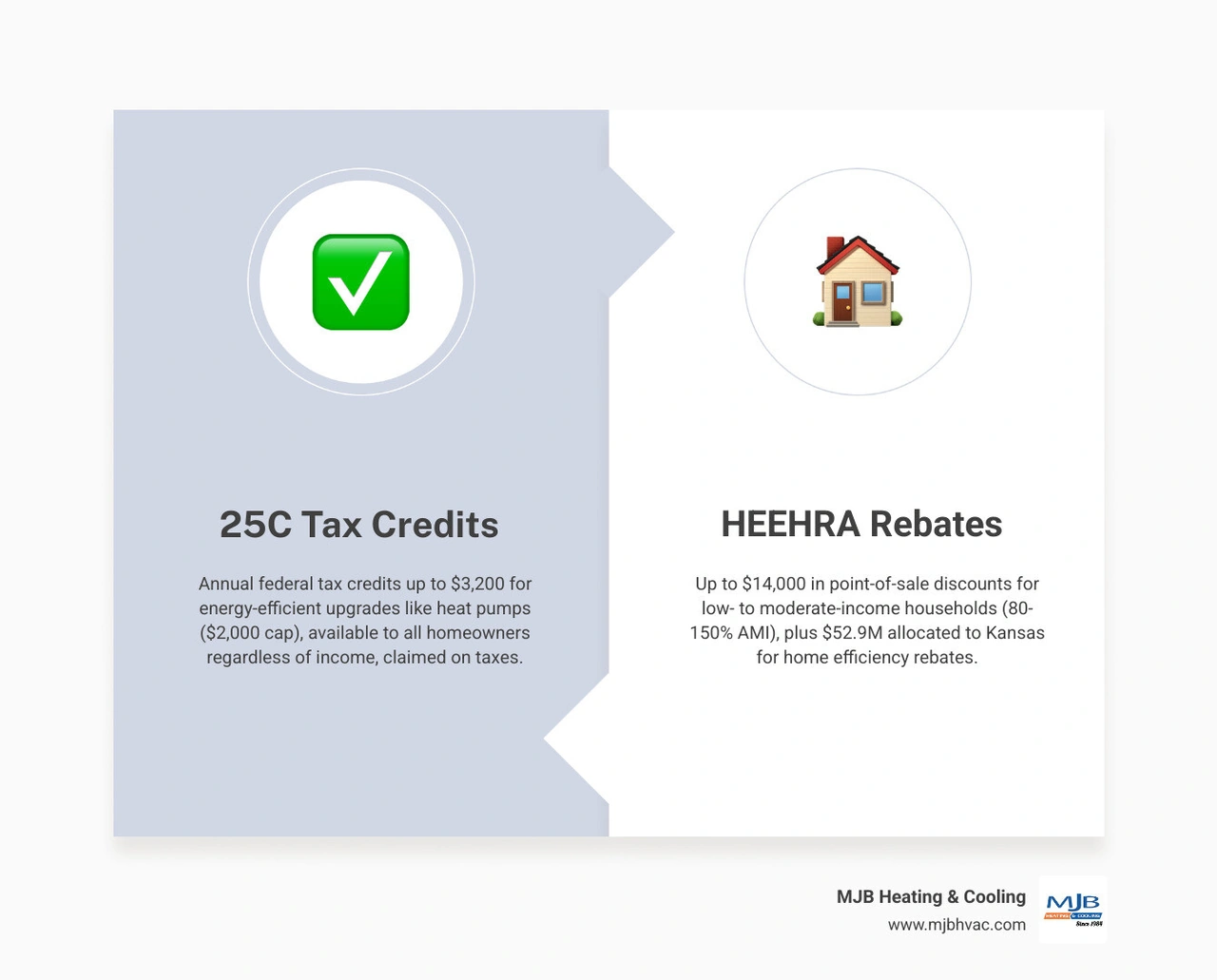

If you have noticed your monthly Evergy or Kansas Gas Service bills creeping up, you are not alone. With electricity prices rising 11% since 2020, many of our neighbors in Derby, Andover, and Wichita are searching for a way to fight back. The primary inflation reduction act benefits for kansas homeowners come in the form of the Energy Efficient Home Improvement Credit (Section 25C).
This isn't a one-time "use it or lose it" deal. The 25C credit is an annual tax credit, meaning you can strategically plan your home upgrades over several years. For example, you could install a high-efficiency heat pump this year and claim a $2,000 credit, then upgrade your windows or insulation next year to claim another portion of the $3,200 annual limit. By taking a phased approach, you can maximize your tax liability offsets while significantly lowering your long-term energy consumption.
Understanding how our local weather plays into these decisions is vital. Our Kansas Climate HVAC Guide explains how the extreme temperature swings in the Wichita metro area put unique stress on your equipment, making high-efficiency units even more valuable for local comfort and savings.
While the 25C tax credits are available to everyone, the IRA also established two major rebate programs that are specifically tied to your household income: the Home Efficiency Rebates (HOMES) and the Home Electrification and Appliance Rebates (HEAR/HEEHRA).
Eligibility for these rebates is determined by your Area Median Income (AMI). In Kansas, the thresholds generally work like this:
The state of Kansas has been working diligently to roll these programs out through the Kansas Corporation Commission. You can check the latest status of these point-of-sale discounts at kshomerebates.gov to see if funds are currently available for your next project.
Claiming your benefits doesn't have to be a headache, but it does require a bit of organization. Here is the standard path we recommend for our customers in Haysville, Bel Aire, and Maize:
If you are looking for ways to bridge the gap between the purchase and the tax season, we offer various Financing options to help get your high-efficiency system installed when you need it most.
In 2026, the heat pump remains the "star of the show" for federal incentives. Because heat pumps move heat rather than creating it through combustion, they are incredibly efficient—even in our wild Kansas winters. The IRA provides a substantial 30% tax credit for air-source heat pumps, capped at $2,000 per year. This is a standalone limit, separate from the $1,200 annual cap for other weatherization upgrades.
For those who prefer traditional systems, there are still incentives available, though the caps are lower. Central air conditioners and gas furnaces generally qualify for a credit of up to $600, provided they meet strict efficiency ratings.
Properly maintaining these systems is the only way to ensure you actually see those energy savings on your monthly bill. We've put together some Hvac Maintenance Tips For Kansas Homeowners to help you protect your investment.
2026 HVAC Tax Credit Comparison Table
| Equipment Type | Max Tax Credit | Efficiency Requirement (Typical) |
|---|---|---|
| Air-Source Heat Pump | $2,000 | ENERGY STAR Most Efficient / CEE Tier 1+ |
| Heat Pump Water Heater | $2,000 | ENERGY STAR Certified |
| Central Air Conditioner | $600 | SEER2 ≥ 16 |
| Gas Furnace | $600 | AFUE ≥ 97% |
| Electrical Panel | $600 | Installed in conjunction with heat pump |
The rebate side of the Inflation Reduction Act is where the savings can become truly transformative. Kansas was allocated over $105 million total for these programs. Unlike tax credits, these rebates are often applied at the point of sale, meaning the discount comes right off the invoice.
The Home Electrification and Appliance Rebates (HEAR) program focuses on switching from fossil fuels to electric. If you are a low-to-moderate income household in El Dorado or Park City, you could see rebates like:
The Home Efficiency Rebates (HOMES) program is slightly different; it rewards you based on the measured or modeled energy savings of your entire home. If your upgrades reduce your home's energy usage by 35% or more, you could qualify for rebates up to $4,000 (or $8,000 for low-income households).
Staying on top of your system's health is critical for these "measured" savings. You might wonder, Is An Hvac Maintenance Plan Worth It? When you consider that a well-tuned system runs more efficiently and helps you maintain the energy reduction levels required for these rebates, the answer is often a resounding yes.
Federal benefits are fantastic, but they aren't the only way to save. In our service areas like Wichita and Goddard, Evergy offers its own set of rebates that can often be "stacked" with federal tax credits. These utility programs usually require equipment to meet specific SEER2 (Seasonal Energy Efficiency Ratio) and HSPF2 (Heating Seasonal Performance Factor) ratings.
To qualify for the maximum federal tax credits in 2026, equipment generally needs to meet the highest non-advanced tier established by the Consortium for Energy Efficiency (CEE). For central air conditioners in the North region (which includes Kansas), this often means a SEER2 rating of 16 or higher.
Our local weather is the ultimate test for these standards. How Kansas Severe Weather Affects Your HVAC System is a great resource for understanding why we recommend certain high-efficiency models over others—it’s not just about the tax credit; it’s about making sure your AC doesn't quit during a 100-degree July heatwave.
There has been some confusion regarding 2025 legislative changes and the so-called "Big Beautiful Bill." To clarify for our Central Kansas customers: the federal residential solar tax credit (Section 25D) was not eliminated. It remains at a robust 30% through 2032. This credit also applies to battery storage systems, even if you don't install solar panels at the same time. While some specific state-level programs across the country have shifted, the federal 30% credit is still a primary driver for energy independence in Kansas.
The IRS relies on standards set by ENERGY STAR and the CEE. For a gas furnace to qualify for the $600 credit, it typically needs an AFUE (Annual Fuel Utilization Efficiency) rating of 97% or higher. For central air conditioners, the requirements vary by system type (split vs. packaged) but generally hover around a SEER2 of 16. We always verify that the specific model we're installing for you in Newton or Augusta meets these exact criteria before we start the job.
Yes! Stacking is one of the best ways to maximize your return on investment. You can claim the federal 25C tax credit on your year-end taxes and still take advantage of immediate rebates from Evergy or Kansas Gas Service. When you combine these with a manufacturer promotion, the "net cost" of a high-efficiency system can often end up being comparable to a standard unit, while saving you hundreds of dollars every year on utilities.
At MJB Heating & Cooling, we've seen a lot of changes in the industry since we started in Derby back in 1984. While the technology has become more advanced and the tax codes more complex, our approach has stayed the same: honest service and quality workmanship. Whether you're in Wichita, Valley Center, or Wellington, our licensed technicians are here to help you navigate these inflation reduction act benefits for kansas homeowners to ensure your home stays comfortable year-round.
Ready to see how much you can save? Check out our latest Promotions and give us a call to schedule your high-efficiency upgrade today. We're proud to serve the entire Wichita metro area, from the heart of the city to our neighbors in Clearwater, Rose Hill, and beyond.
The inflation reduction act benefits for kansas homeowners are real, significant, and still available in 2026 — but many people don't know exactly what they qualify for or how to claim them. Here's a quick breakdown:
Key IRA Benefits Available to Kansas Homeowners Right Now:
| Upgrade | Tax Credit | Annual Cap |
|---|---|---|
| Heat pump (air-source) | 30% of cost | $2,000 |
| Central AC or gas furnace | 30% of cost | $600 |
| Electrical panel upgrade | 30% of cost | $600 |
| Insulation and air sealing | 30% of cost | $1,200 |
| Energy-efficient windows | 30% of cost | $600 |
| Energy-efficient doors | 30% of cost | $500 total |
| Home energy audit | 30% of cost | $150 |
| Total annual 25C cap | $3,200 |
Kansas electricity prices have risen 11% since 2020, and with heating and cooling accounting for the largest share of most home energy bills, upgrading your HVAC system is one of the smartest moves you can make right now. The IRA's federal tax credits — available to all homeowners regardless of income — combined with income-based rebate programs mean the window to save is wide open.
The challenge is knowing which credits apply to your specific situation, which upgrades qualify, and how to actually claim what you're owed. This guide breaks it all down for Wichita-area homeowners in plain language.
If you have noticed your monthly Evergy or Kansas Gas Service bills creeping up, you are not alone. With electricity prices rising 11% since 2020, many of our neighbors in Derby, Andover, and Wichita are searching for a way to fight back. The primary inflation reduction act benefits for kansas homeowners come in the form of the Energy Efficient Home Improvement Credit (Section 25C).
This isn't a one-time "use it or lose it" deal. The 25C credit is an annual tax credit, meaning you can strategically plan your home upgrades over several years. For example, you could install a high-efficiency heat pump this year and claim a $2,000 credit, then upgrade your windows or insulation next year to claim another portion of the $3,200 annual limit. By taking a phased approach, you can maximize your tax liability offsets while significantly lowering your long-term energy consumption.
Understanding how our local weather plays into these decisions is vital. Our Kansas Climate HVAC Guide explains how the extreme temperature swings in the Wichita metro area put unique stress on your equipment, making high-efficiency units even more valuable for local comfort and savings.
While the 25C tax credits are available to everyone, the IRA also established two major rebate programs that are specifically tied to your household income: the Home Efficiency Rebates (HOMES) and the Home Electrification and Appliance Rebates (HEAR/HEEHRA).
Eligibility for these rebates is determined by your Area Median Income (AMI). In Kansas, the thresholds generally work like this:
The state of Kansas has been working diligently to roll these programs out through the Kansas Corporation Commission. You can check the latest status of these point-of-sale discounts at kshomerebates.gov to see if funds are currently available for your next project.
Claiming your benefits doesn't have to be a headache, but it does require a bit of organization. Here is the standard path we recommend for our customers in Haysville, Bel Aire, and Maize:
If you are looking for ways to bridge the gap between the purchase and the tax season, we offer various Financing options to help get your high-efficiency system installed when you need it most.
In 2026, the heat pump remains the "star of the show" for federal incentives. Because heat pumps move heat rather than creating it through combustion, they are incredibly efficient—even in our wild Kansas winters. The IRA provides a substantial 30% tax credit for air-source heat pumps, capped at $2,000 per year. This is a standalone limit, separate from the $1,200 annual cap for other weatherization upgrades.
For those who prefer traditional systems, there are still incentives available, though the caps are lower. Central air conditioners and gas furnaces generally qualify for a credit of up to $600, provided they meet strict efficiency ratings.
Properly maintaining these systems is the only way to ensure you actually see those energy savings on your monthly bill. We've put together some Hvac Maintenance Tips For Kansas Homeowners to help you protect your investment.
2026 HVAC Tax Credit Comparison Table
| Equipment Type | Max Tax Credit | Efficiency Requirement (Typical) |
|---|---|---|
| Air-Source Heat Pump | $2,000 | ENERGY STAR Most Efficient / CEE Tier 1+ |
| Heat Pump Water Heater | $2,000 | ENERGY STAR Certified |
| Central Air Conditioner | $600 | SEER2 ≥ 16 |
| Gas Furnace | $600 | AFUE ≥ 97% |
| Electrical Panel | $600 | Installed in conjunction with heat pump |
The rebate side of the Inflation Reduction Act is where the savings can become truly transformative. Kansas was allocated over $105 million total for these programs. Unlike tax credits, these rebates are often applied at the point of sale, meaning the discount comes right off the invoice.
The Home Electrification and Appliance Rebates (HEAR) program focuses on switching from fossil fuels to electric. If you are a low-to-moderate income household in El Dorado or Park City, you could see rebates like:
The Home Efficiency Rebates (HOMES) program is slightly different; it rewards you based on the measured or modeled energy savings of your entire home. If your upgrades reduce your home's energy usage by 35% or more, you could qualify for rebates up to $4,000 (or $8,000 for low-income households).
Staying on top of your system's health is critical for these "measured" savings. You might wonder, Is An Hvac Maintenance Plan Worth It? When you consider that a well-tuned system runs more efficiently and helps you maintain the energy reduction levels required for these rebates, the answer is often a resounding yes.
Federal benefits are fantastic, but they aren't the only way to save. In our service areas like Wichita and Goddard, Evergy offers its own set of rebates that can often be "stacked" with federal tax credits. These utility programs usually require equipment to meet specific SEER2 (Seasonal Energy Efficiency Ratio) and HSPF2 (Heating Seasonal Performance Factor) ratings.
To qualify for the maximum federal tax credits in 2026, equipment generally needs to meet the highest non-advanced tier established by the Consortium for Energy Efficiency (CEE). For central air conditioners in the North region (which includes Kansas), this often means a SEER2 rating of 16 or higher.
Our local weather is the ultimate test for these standards. How Kansas Severe Weather Affects Your HVAC System is a great resource for understanding why we recommend certain high-efficiency models over others—it’s not just about the tax credit; it’s about making sure your AC doesn't quit during a 100-degree July heatwave.
There has been some confusion regarding 2025 legislative changes and the so-called "Big Beautiful Bill." To clarify for our Central Kansas customers: the federal residential solar tax credit (Section 25D) was not eliminated. It remains at a robust 30% through 2032. This credit also applies to battery storage systems, even if you don't install solar panels at the same time. While some specific state-level programs across the country have shifted, the federal 30% credit is still a primary driver for energy independence in Kansas.
The IRS relies on standards set by ENERGY STAR and the CEE. For a gas furnace to qualify for the $600 credit, it typically needs an AFUE (Annual Fuel Utilization Efficiency) rating of 97% or higher. For central air conditioners, the requirements vary by system type (split vs. packaged) but generally hover around a SEER2 of 16. We always verify that the specific model we're installing for you in Newton or Augusta meets these exact criteria before we start the job.
Yes! Stacking is one of the best ways to maximize your return on investment. You can claim the federal 25C tax credit on your year-end taxes and still take advantage of immediate rebates from Evergy or Kansas Gas Service. When you combine these with a manufacturer promotion, the "net cost" of a high-efficiency system can often end up being comparable to a standard unit, while saving you hundreds of dollars every year on utilities.
At MJB Heating & Cooling, we've seen a lot of changes in the industry since we started in Derby back in 1984. While the technology has become more advanced and the tax codes more complex, our approach has stayed the same: honest service and quality workmanship. Whether you're in Wichita, Valley Center, or Wellington, our licensed technicians are here to help you navigate these inflation reduction act benefits for kansas homeowners to ensure your home stays comfortable year-round.
Ready to see how much you can save? Check out our latest Promotions and give us a call to schedule your high-efficiency upgrade today. We're proud to serve the entire Wichita metro area, from the heart of the city to our neighbors in Clearwater, Rose Hill, and beyond.
The inflation reduction act benefits for kansas homeowners are real, significant, and still available in 2026 — but many people don't know exactly what they qualify for or how to claim them. Here's a quick breakdown:
Key IRA Benefits Available to Kansas Homeowners Right Now:
| Upgrade | Tax Credit | Annual Cap |
|---|---|---|
| Heat pump (air-source) | 30% of cost | $2,000 |
| Central AC or gas furnace | 30% of cost | $600 |
| Electrical panel upgrade | 30% of cost | $600 |
| Insulation and air sealing | 30% of cost | $1,200 |
| Energy-efficient windows | 30% of cost | $600 |
| Energy-efficient doors | 30% of cost | $500 total |
| Home energy audit | 30% of cost | $150 |
| Total annual 25C cap | $3,200 |
Kansas electricity prices have risen 11% since 2020, and with heating and cooling accounting for the largest share of most home energy bills, upgrading your HVAC system is one of the smartest moves you can make right now. The IRA's federal tax credits — available to all homeowners regardless of income — combined with income-based rebate programs mean the window to save is wide open.
The challenge is knowing which credits apply to your specific situation, which upgrades qualify, and how to actually claim what you're owed. This guide breaks it all down for Wichita-area homeowners in plain language.
If you have noticed your monthly Evergy or Kansas Gas Service bills creeping up, you are not alone. With electricity prices rising 11% since 2020, many of our neighbors in Derby, Andover, and Wichita are searching for a way to fight back. The primary inflation reduction act benefits for kansas homeowners come in the form of the Energy Efficient Home Improvement Credit (Section 25C).
This isn't a one-time "use it or lose it" deal. The 25C credit is an annual tax credit, meaning you can strategically plan your home upgrades over several years. For example, you could install a high-efficiency heat pump this year and claim a $2,000 credit, then upgrade your windows or insulation next year to claim another portion of the $3,200 annual limit. By taking a phased approach, you can maximize your tax liability offsets while significantly lowering your long-term energy consumption.
Understanding how our local weather plays into these decisions is vital. Our Kansas Climate HVAC Guide explains how the extreme temperature swings in the Wichita metro area put unique stress on your equipment, making high-efficiency units even more valuable for local comfort and savings.
While the 25C tax credits are available to everyone, the IRA also established two major rebate programs that are specifically tied to your household income: the Home Efficiency Rebates (HOMES) and the Home Electrification and Appliance Rebates (HEAR/HEEHRA).
Eligibility for these rebates is determined by your Area Median Income (AMI). In Kansas, the thresholds generally work like this:
The state of Kansas has been working diligently to roll these programs out through the Kansas Corporation Commission. You can check the latest status of these point-of-sale discounts at kshomerebates.gov to see if funds are currently available for your next project.
Claiming your benefits doesn't have to be a headache, but it does require a bit of organization. Here is the standard path we recommend for our customers in Haysville, Bel Aire, and Maize:
If you are looking for ways to bridge the gap between the purchase and the tax season, we offer various Financing options to help get your high-efficiency system installed when you need it most.
In 2026, the heat pump remains the "star of the show" for federal incentives. Because heat pumps move heat rather than creating it through combustion, they are incredibly efficient—even in our wild Kansas winters. The IRA provides a substantial 30% tax credit for air-source heat pumps, capped at $2,000 per year. This is a standalone limit, separate from the $1,200 annual cap for other weatherization upgrades.
For those who prefer traditional systems, there are still incentives available, though the caps are lower. Central air conditioners and gas furnaces generally qualify for a credit of up to $600, provided they meet strict efficiency ratings.
Properly maintaining these systems is the only way to ensure you actually see those energy savings on your monthly bill. We've put together some Hvac Maintenance Tips For Kansas Homeowners to help you protect your investment.
2026 HVAC Tax Credit Comparison Table
| Equipment Type | Max Tax Credit | Efficiency Requirement (Typical) |
|---|---|---|
| Air-Source Heat Pump | $2,000 | ENERGY STAR Most Efficient / CEE Tier 1+ |
| Heat Pump Water Heater | $2,000 | ENERGY STAR Certified |
| Central Air Conditioner | $600 | SEER2 ≥ 16 |
| Gas Furnace | $600 | AFUE ≥ 97% |
| Electrical Panel | $600 | Installed in conjunction with heat pump |
The rebate side of the Inflation Reduction Act is where the savings can become truly transformative. Kansas was allocated over $105 million total for these programs. Unlike tax credits, these rebates are often applied at the point of sale, meaning the discount comes right off the invoice.
The Home Electrification and Appliance Rebates (HEAR) program focuses on switching from fossil fuels to electric. If you are a low-to-moderate income household in El Dorado or Park City, you could see rebates like:
The Home Efficiency Rebates (HOMES) program is slightly different; it rewards you based on the measured or modeled energy savings of your entire home. If your upgrades reduce your home's energy usage by 35% or more, you could qualify for rebates up to $4,000 (or $8,000 for low-income households).
Staying on top of your system's health is critical for these "measured" savings. You might wonder, Is An Hvac Maintenance Plan Worth It? When you consider that a well-tuned system runs more efficiently and helps you maintain the energy reduction levels required for these rebates, the answer is often a resounding yes.
Federal benefits are fantastic, but they aren't the only way to save. In our service areas like Wichita and Goddard, Evergy offers its own set of rebates that can often be "stacked" with federal tax credits. These utility programs usually require equipment to meet specific SEER2 (Seasonal Energy Efficiency Ratio) and HSPF2 (Heating Seasonal Performance Factor) ratings.
To qualify for the maximum federal tax credits in 2026, equipment generally needs to meet the highest non-advanced tier established by the Consortium for Energy Efficiency (CEE). For central air conditioners in the North region (which includes Kansas), this often means a SEER2 rating of 16 or higher.
Our local weather is the ultimate test for these standards. How Kansas Severe Weather Affects Your HVAC System is a great resource for understanding why we recommend certain high-efficiency models over others—it’s not just about the tax credit; it’s about making sure your AC doesn't quit during a 100-degree July heatwave.
There has been some confusion regarding 2025 legislative changes and the so-called "Big Beautiful Bill." To clarify for our Central Kansas customers: the federal residential solar tax credit (Section 25D) was not eliminated. It remains at a robust 30% through 2032. This credit also applies to battery storage systems, even if you don't install solar panels at the same time. While some specific state-level programs across the country have shifted, the federal 30% credit is still a primary driver for energy independence in Kansas.
The IRS relies on standards set by ENERGY STAR and the CEE. For a gas furnace to qualify for the $600 credit, it typically needs an AFUE (Annual Fuel Utilization Efficiency) rating of 97% or higher. For central air conditioners, the requirements vary by system type (split vs. packaged) but generally hover around a SEER2 of 16. We always verify that the specific model we're installing for you in Newton or Augusta meets these exact criteria before we start the job.
Yes! Stacking is one of the best ways to maximize your return on investment. You can claim the federal 25C tax credit on your year-end taxes and still take advantage of immediate rebates from Evergy or Kansas Gas Service. When you combine these with a manufacturer promotion, the "net cost" of a high-efficiency system can often end up being comparable to a standard unit, while saving you hundreds of dollars every year on utilities.
At MJB Heating & Cooling, we've seen a lot of changes in the industry since we started in Derby back in 1984. While the technology has become more advanced and the tax codes more complex, our approach has stayed the same: honest service and quality workmanship. Whether you're in Wichita, Valley Center, or Wellington, our licensed technicians are here to help you navigate these inflation reduction act benefits for kansas homeowners to ensure your home stays comfortable year-round.
Ready to see how much you can save? Check out our latest Promotions and give us a call to schedule your high-efficiency upgrade today. We're proud to serve the entire Wichita metro area, from the heart of the city to our neighbors in Clearwater, Rose Hill, and beyond.

The inflation reduction act benefits for kansas homeowners are real, significant, and still available in 2026 — but many people don't know exactly what they qualify for or how to claim them. Here's a quick breakdown:
Key IRA Benefits Available to Kansas Homeowners Right Now:
| Upgrade | Tax Credit | Annual Cap |
|---|---|---|
| Heat pump (air-source) | 30% of cost | $2,000 |
| Central AC or gas furnace | 30% of cost | $600 |
| Electrical panel upgrade | 30% of cost | $600 |
| Insulation and air sealing | 30% of cost | $1,200 |
| Energy-efficient windows | 30% of cost | $600 |
| Energy-efficient doors | 30% of cost | $500 total |
| Home energy audit | 30% of cost | $150 |
| Total annual 25C cap | $3,200 |
Kansas electricity prices have risen 11% since 2020, and with heating and cooling accounting for the largest share of most home energy bills, upgrading your HVAC system is one of the smartest moves you can make right now. The IRA's federal tax credits — available to all homeowners regardless of income — combined with income-based rebate programs mean the window to save is wide open.
The challenge is knowing which credits apply to your specific situation, which upgrades qualify, and how to actually claim what you're owed. This guide breaks it all down for Wichita-area homeowners in plain language.
If you have noticed your monthly Evergy or Kansas Gas Service bills creeping up, you are not alone. With electricity prices rising 11% since 2020, many of our neighbors in Derby, Andover, and Wichita are searching for a way to fight back. The primary inflation reduction act benefits for kansas homeowners come in the form of the Energy Efficient Home Improvement Credit (Section 25C).
This isn't a one-time "use it or lose it" deal. The 25C credit is an annual tax credit, meaning you can strategically plan your home upgrades over several years. For example, you could install a high-efficiency heat pump this year and claim a $2,000 credit, then upgrade your windows or insulation next year to claim another portion of the $3,200 annual limit. By taking a phased approach, you can maximize your tax liability offsets while significantly lowering your long-term energy consumption.
Understanding how our local weather plays into these decisions is vital. Our Kansas Climate HVAC Guide explains how the extreme temperature swings in the Wichita metro area put unique stress on your equipment, making high-efficiency units even more valuable for local comfort and savings.
While the 25C tax credits are available to everyone, the IRA also established two major rebate programs that are specifically tied to your household income: the Home Efficiency Rebates (HOMES) and the Home Electrification and Appliance Rebates (HEAR/HEEHRA).
Eligibility for these rebates is determined by your Area Median Income (AMI). In Kansas, the thresholds generally work like this:
The state of Kansas has been working diligently to roll these programs out through the Kansas Corporation Commission. You can check the latest status of these point-of-sale discounts at kshomerebates.gov to see if funds are currently available for your next project.
Claiming your benefits doesn't have to be a headache, but it does require a bit of organization. Here is the standard path we recommend for our customers in Haysville, Bel Aire, and Maize:
If you are looking for ways to bridge the gap between the purchase and the tax season, we offer various Financing options to help get your high-efficiency system installed when you need it most.
In 2026, the heat pump remains the "star of the show" for federal incentives. Because heat pumps move heat rather than creating it through combustion, they are incredibly efficient—even in our wild Kansas winters. The IRA provides a substantial 30% tax credit for air-source heat pumps, capped at $2,000 per year. This is a standalone limit, separate from the $1,200 annual cap for other weatherization upgrades.
For those who prefer traditional systems, there are still incentives available, though the caps are lower. Central air conditioners and gas furnaces generally qualify for a credit of up to $600, provided they meet strict efficiency ratings.
Properly maintaining these systems is the only way to ensure you actually see those energy savings on your monthly bill. We've put together some Hvac Maintenance Tips For Kansas Homeowners to help you protect your investment.
2026 HVAC Tax Credit Comparison Table
| Equipment Type | Max Tax Credit | Efficiency Requirement (Typical) |
|---|---|---|
| Air-Source Heat Pump | $2,000 | ENERGY STAR Most Efficient / CEE Tier 1+ |
| Heat Pump Water Heater | $2,000 | ENERGY STAR Certified |
| Central Air Conditioner | $600 | SEER2 ≥ 16 |
| Gas Furnace | $600 | AFUE ≥ 97% |
| Electrical Panel | $600 | Installed in conjunction with heat pump |
The rebate side of the Inflation Reduction Act is where the savings can become truly transformative. Kansas was allocated over $105 million total for these programs. Unlike tax credits, these rebates are often applied at the point of sale, meaning the discount comes right off the invoice.
The Home Electrification and Appliance Rebates (HEAR) program focuses on switching from fossil fuels to electric. If you are a low-to-moderate income household in El Dorado or Park City, you could see rebates like:
The Home Efficiency Rebates (HOMES) program is slightly different; it rewards you based on the measured or modeled energy savings of your entire home. If your upgrades reduce your home's energy usage by 35% or more, you could qualify for rebates up to $4,000 (or $8,000 for low-income households).
Staying on top of your system's health is critical for these "measured" savings. You might wonder, Is An Hvac Maintenance Plan Worth It? When you consider that a well-tuned system runs more efficiently and helps you maintain the energy reduction levels required for these rebates, the answer is often a resounding yes.
Federal benefits are fantastic, but they aren't the only way to save. In our service areas like Wichita and Goddard, Evergy offers its own set of rebates that can often be "stacked" with federal tax credits. These utility programs usually require equipment to meet specific SEER2 (Seasonal Energy Efficiency Ratio) and HSPF2 (Heating Seasonal Performance Factor) ratings.
To qualify for the maximum federal tax credits in 2026, equipment generally needs to meet the highest non-advanced tier established by the Consortium for Energy Efficiency (CEE). For central air conditioners in the North region (which includes Kansas), this often means a SEER2 rating of 16 or higher.
Our local weather is the ultimate test for these standards. How Kansas Severe Weather Affects Your HVAC System is a great resource for understanding why we recommend certain high-efficiency models over others—it’s not just about the tax credit; it’s about making sure your AC doesn't quit during a 100-degree July heatwave.
There has been some confusion regarding 2025 legislative changes and the so-called "Big Beautiful Bill." To clarify for our Central Kansas customers: the federal residential solar tax credit (Section 25D) was not eliminated. It remains at a robust 30% through 2032. This credit also applies to battery storage systems, even if you don't install solar panels at the same time. While some specific state-level programs across the country have shifted, the federal 30% credit is still a primary driver for energy independence in Kansas.
The IRS relies on standards set by ENERGY STAR and the CEE. For a gas furnace to qualify for the $600 credit, it typically needs an AFUE (Annual Fuel Utilization Efficiency) rating of 97% or higher. For central air conditioners, the requirements vary by system type (split vs. packaged) but generally hover around a SEER2 of 16. We always verify that the specific model we're installing for you in Newton or Augusta meets these exact criteria before we start the job.
Yes! Stacking is one of the best ways to maximize your return on investment. You can claim the federal 25C tax credit on your year-end taxes and still take advantage of immediate rebates from Evergy or Kansas Gas Service. When you combine these with a manufacturer promotion, the "net cost" of a high-efficiency system can often end up being comparable to a standard unit, while saving you hundreds of dollars every year on utilities.
At MJB Heating & Cooling, we've seen a lot of changes in the industry since we started in Derby back in 1984. While the technology has become more advanced and the tax codes more complex, our approach has stayed the same: honest service and quality workmanship. Whether you're in Wichita, Valley Center, or Wellington, our licensed technicians are here to help you navigate these inflation reduction act benefits for kansas homeowners to ensure your home stays comfortable year-round.
Ready to see how much you can save? Check out our latest Promotions and give us a call to schedule your high-efficiency upgrade today. We're proud to serve the entire Wichita metro area, from the heart of the city to our neighbors in Clearwater, Rose Hill, and beyond.
The inflation reduction act benefits for kansas homeowners are real, significant, and still available in 2026 — but many people don't know exactly what they qualify for or how to claim them. Here's a quick breakdown:
Key IRA Benefits Available to Kansas Homeowners Right Now:
| Upgrade | Tax Credit | Annual Cap |
|---|---|---|
| Heat pump (air-source) | 30% of cost | $2,000 |
| Central AC or gas furnace | 30% of cost | $600 |
| Electrical panel upgrade | 30% of cost | $600 |
| Insulation and air sealing | 30% of cost | $1,200 |
| Energy-efficient windows | 30% of cost | $600 |
| Energy-efficient doors | 30% of cost | $500 total |
| Home energy audit | 30% of cost | $150 |
| Total annual 25C cap | $3,200 |
Kansas electricity prices have risen 11% since 2020, and with heating and cooling accounting for the largest share of most home energy bills, upgrading your HVAC system is one of the smartest moves you can make right now. The IRA's federal tax credits — available to all homeowners regardless of income — combined with income-based rebate programs mean the window to save is wide open.
The challenge is knowing which credits apply to your specific situation, which upgrades qualify, and how to actually claim what you're owed. This guide breaks it all down for Wichita-area homeowners in plain language.
If you have noticed your monthly Evergy or Kansas Gas Service bills creeping up, you are not alone. With electricity prices rising 11% since 2020, many of our neighbors in Derby, Andover, and Wichita are searching for a way to fight back. The primary inflation reduction act benefits for kansas homeowners come in the form of the Energy Efficient Home Improvement Credit (Section 25C).
This isn't a one-time "use it or lose it" deal. The 25C credit is an annual tax credit, meaning you can strategically plan your home upgrades over several years. For example, you could install a high-efficiency heat pump this year and claim a $2,000 credit, then upgrade your windows or insulation next year to claim another portion of the $3,200 annual limit. By taking a phased approach, you can maximize your tax liability offsets while significantly lowering your long-term energy consumption.
Understanding how our local weather plays into these decisions is vital. Our Kansas Climate HVAC Guide explains how the extreme temperature swings in the Wichita metro area put unique stress on your equipment, making high-efficiency units even more valuable for local comfort and savings.
While the 25C tax credits are available to everyone, the IRA also established two major rebate programs that are specifically tied to your household income: the Home Efficiency Rebates (HOMES) and the Home Electrification and Appliance Rebates (HEAR/HEEHRA).
Eligibility for these rebates is determined by your Area Median Income (AMI). In Kansas, the thresholds generally work like this:
The state of Kansas has been working diligently to roll these programs out through the Kansas Corporation Commission. You can check the latest status of these point-of-sale discounts at kshomerebates.gov to see if funds are currently available for your next project.
Claiming your benefits doesn't have to be a headache, but it does require a bit of organization. Here is the standard path we recommend for our customers in Haysville, Bel Aire, and Maize:
If you are looking for ways to bridge the gap between the purchase and the tax season, we offer various Financing options to help get your high-efficiency system installed when you need it most.
In 2026, the heat pump remains the "star of the show" for federal incentives. Because heat pumps move heat rather than creating it through combustion, they are incredibly efficient—even in our wild Kansas winters. The IRA provides a substantial 30% tax credit for air-source heat pumps, capped at $2,000 per year. This is a standalone limit, separate from the $1,200 annual cap for other weatherization upgrades.
For those who prefer traditional systems, there are still incentives available, though the caps are lower. Central air conditioners and gas furnaces generally qualify for a credit of up to $600, provided they meet strict efficiency ratings.
Properly maintaining these systems is the only way to ensure you actually see those energy savings on your monthly bill. We've put together some Hvac Maintenance Tips For Kansas Homeowners to help you protect your investment.
2026 HVAC Tax Credit Comparison Table
| Equipment Type | Max Tax Credit | Efficiency Requirement (Typical) |
|---|---|---|
| Air-Source Heat Pump | $2,000 | ENERGY STAR Most Efficient / CEE Tier 1+ |
| Heat Pump Water Heater | $2,000 | ENERGY STAR Certified |
| Central Air Conditioner | $600 | SEER2 ≥ 16 |
| Gas Furnace | $600 | AFUE ≥ 97% |
| Electrical Panel | $600 | Installed in conjunction with heat pump |
The rebate side of the Inflation Reduction Act is where the savings can become truly transformative. Kansas was allocated over $105 million total for these programs. Unlike tax credits, these rebates are often applied at the point of sale, meaning the discount comes right off the invoice.
The Home Electrification and Appliance Rebates (HEAR) program focuses on switching from fossil fuels to electric. If you are a low-to-moderate income household in El Dorado or Park City, you could see rebates like:
The Home Efficiency Rebates (HOMES) program is slightly different; it rewards you based on the measured or modeled energy savings of your entire home. If your upgrades reduce your home's energy usage by 35% or more, you could qualify for rebates up to $4,000 (or $8,000 for low-income households).
Staying on top of your system's health is critical for these "measured" savings. You might wonder, Is An Hvac Maintenance Plan Worth It? When you consider that a well-tuned system runs more efficiently and helps you maintain the energy reduction levels required for these rebates, the answer is often a resounding yes.
Federal benefits are fantastic, but they aren't the only way to save. In our service areas like Wichita and Goddard, Evergy offers its own set of rebates that can often be "stacked" with federal tax credits. These utility programs usually require equipment to meet specific SEER2 (Seasonal Energy Efficiency Ratio) and HSPF2 (Heating Seasonal Performance Factor) ratings.
To qualify for the maximum federal tax credits in 2026, equipment generally needs to meet the highest non-advanced tier established by the Consortium for Energy Efficiency (CEE). For central air conditioners in the North region (which includes Kansas), this often means a SEER2 rating of 16 or higher.
Our local weather is the ultimate test for these standards. How Kansas Severe Weather Affects Your HVAC System is a great resource for understanding why we recommend certain high-efficiency models over others—it’s not just about the tax credit; it’s about making sure your AC doesn't quit during a 100-degree July heatwave.
There has been some confusion regarding 2025 legislative changes and the so-called "Big Beautiful Bill." To clarify for our Central Kansas customers: the federal residential solar tax credit (Section 25D) was not eliminated. It remains at a robust 30% through 2032. This credit also applies to battery storage systems, even if you don't install solar panels at the same time. While some specific state-level programs across the country have shifted, the federal 30% credit is still a primary driver for energy independence in Kansas.
The IRS relies on standards set by ENERGY STAR and the CEE. For a gas furnace to qualify for the $600 credit, it typically needs an AFUE (Annual Fuel Utilization Efficiency) rating of 97% or higher. For central air conditioners, the requirements vary by system type (split vs. packaged) but generally hover around a SEER2 of 16. We always verify that the specific model we're installing for you in Newton or Augusta meets these exact criteria before we start the job.
Yes! Stacking is one of the best ways to maximize your return on investment. You can claim the federal 25C tax credit on your year-end taxes and still take advantage of immediate rebates from Evergy or Kansas Gas Service. When you combine these with a manufacturer promotion, the "net cost" of a high-efficiency system can often end up being comparable to a standard unit, while saving you hundreds of dollars every year on utilities.
At MJB Heating & Cooling, we've seen a lot of changes in the industry since we started in Derby back in 1984. While the technology has become more advanced and the tax codes more complex, our approach has stayed the same: honest service and quality workmanship. Whether you're in Wichita, Valley Center, or Wellington, our licensed technicians are here to help you navigate these inflation reduction act benefits for kansas homeowners to ensure your home stays comfortable year-round.
Ready to see how much you can save? Check out our latest Promotions and give us a call to schedule your high-efficiency upgrade today. We're proud to serve the entire Wichita metro area, from the heart of the city to our neighbors in Clearwater, Rose Hill, and beyond.


Our A/C stopped working on a Sunday and due to health issues, we needed to find a service company available on a Sunday. I called MJB and left a message on their emergency voice mail. Within 10 minutes Tom Buck called me to hear my description of the symptoms. He was just finishing an appointment in Wichita and would be on his way to my home on the south end of Derby. He arrived within 30 minutes! From start to finish he was the perfect example of what you could ever hope for in an HVAC tech and a human being. His evaluation of our system inside and out was as thorough as I could ever imagine and once he was done with the repair, our system is running as well or better than ever. Well worth the price for the evaluation, parts, and labor. Thank you again Tom for an awesome experience.
Our AC went out during the hottest days of the year, and they were out next day! We have been jerked around by a shoddy home warranty for years. We finally had a chance to pick our own repair people, and MJB came highly recommended. I can see why! I was impressed with the honesty and speed at which they fixed our AC unit!
Our commercial building had a lightening/electrical strike and damaged our 20 ton AC unit. No one could find us a new unit before the end of September. Imagining going all of August and September with no AC in Kansas and working inside near 100 degree temps is less than thrilling. Dale and the team at MJB called around and saved the day. They had us a new unit 5 weeks earlier than other could promise and I now have happy employees. The unit is amazingly quiet, super cold and so much more energy efficient. Thank you for being our super hero!
Came out and installed my new furnace. Was very polite and affordable. They are very acknowledgeable and I highly recommend!
Thank you very much. We had our 1st warm night in 3weeks. MJB took the time and effort to find the real problem. And the employees were kind and thoughtful and explained things very well. I cannot thank you and all of MJB. Will recommend you highly. Thanks again Marjorie Herman Oxford Kansas
We had a new system installed and I was so impressed with how quick they were in come out and install it, in the middle of a hot summer day. They were so friendly & very professional. I had a small problem with a weird sound and they came over immediately and fixed it. Love them!


