


.avif)





Blogs
Stay updated with our latest blog posts.
HVAC maintenance tips for Kansas homeowners are essential because the state's climate is genuinely punishing — sub-zero wind chills in January can flip to heat index values above 105°F in July, and your system takes the full force of both extremes every single year.
Here are the most important HVAC maintenance steps Kansas homeowners should follow:
Kansas isn't a place where you can ignore your HVAC and hope for the best. One week it's sweatshirt weather, and the next it's single digits with icy prairie winds — or a stretch of brutal summer humidity that runs your AC around the clock. That kind of stress adds up fast on a system that hasn't been properly maintained.
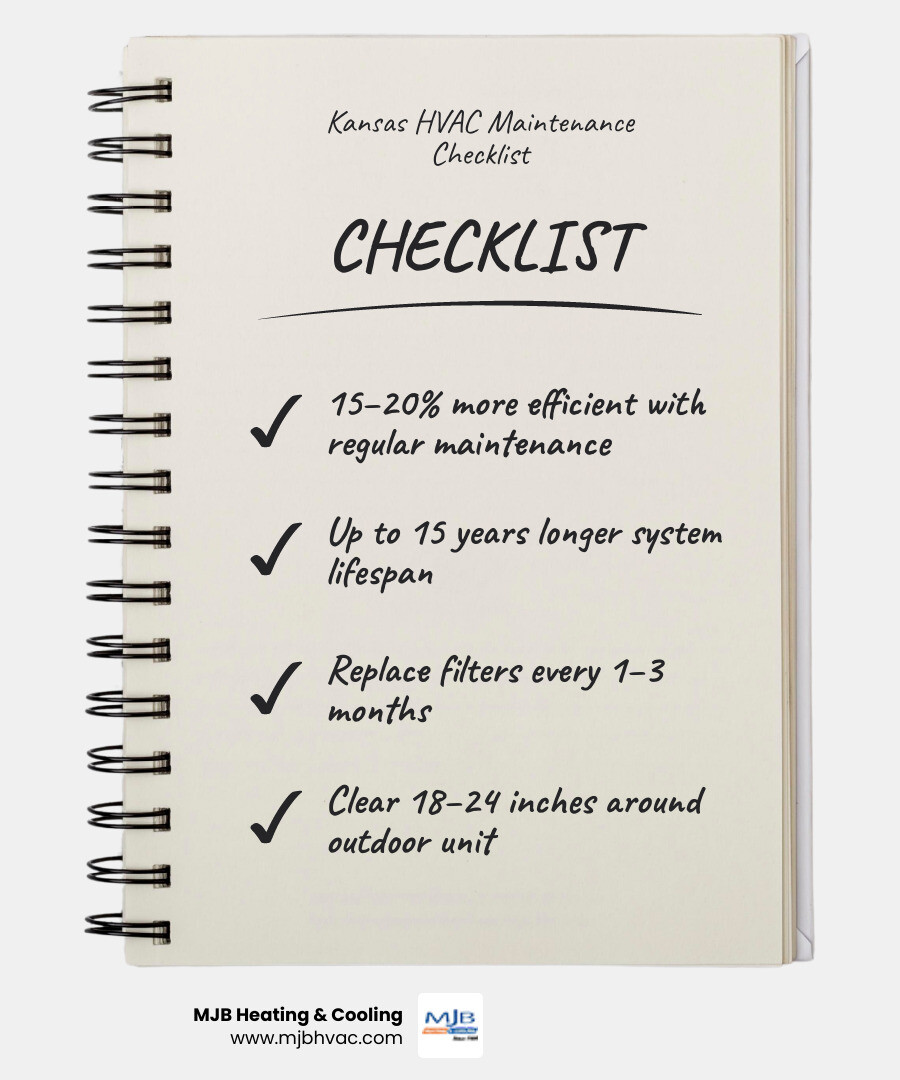
The good news? Regular maintenance makes a real difference. Well-maintained systems run 15–20% more efficiently than neglected ones, and consistent upkeep can extend your system's lifespan by up to 15 years. Skipping it, on the other hand, can mean your system fails 3–5 years earlier than it should — usually at the worst possible moment.
This guide walks you through everything you need to keep your HVAC system running safely and efficiently, season after season, right here in Central Kansas.
Living in the Wichita metro area means we experience the full spectrum of the Midwest's unpredictable weather. From the "blue northers" that bring sudden freezes to the sweltering humidity of July, our heating and cooling systems are the hardest-working appliances in our homes.
When we talk about Essential Hvac Maintenance Tips For Your Furnace And Ac, we aren't just talking about avoiding a breakdown. We are talking about protecting one of your home's most significant investments. Most furnaces are designed to last between 15 and 20 years, but without regular care, that lifespan can be cut short by nearly a third.
Beyond longevity, there is the immediate impact on your wallet. A clean, well-tuned system operates 15% to 20% more efficiently than a neglected one. In a state where the heat index can soar past 105°F, that efficiency translates directly into lower monthly utility bills. By staying proactive, you ensure that your system doesn't have to work overtime just to achieve basic comfort.
While some tasks require a professional touch, there are several things you can do yourself to keep your system breathing easily. The most impactful DIY task is managing your air filters. You might be surprised to learn that simply replacing a dirty filter can lower your air conditioner's energy consumption by 5% to 15%.
In Kansas, where dust from the plains and seasonal pollen can be heavy, knowing How Often Should Hvac Air Filters Be Changed is key. We generally recommend checking them every 30 days during peak summer and winter months. If you have pets or suffer from allergies, you may need to replace them more frequently.
Another vital DIY step is optimizing airflow. Walk through your home and ensure that no furniture, rugs, or curtains are blocking your supply or return vents. Blocked vents create pressure imbalances that can actually damage your furnace's heat exchanger or cause your AC coils to freeze. Use a vacuum to clear away any dust or pet hair that has settled on the registers to keep the air moving freely.
Your outdoor condenser unit is built to be tough, but it still needs a little help to survive a Kansas winter. Before the first snow flies in places like Derby or Maize, take a few minutes to clear the area around your unit.
We recommend maintaining at least 18 to 24 inches of clear space around the entire perimeter of the outdoor unit. This means trimming back any dead summer "volunteer" weeds, removing fallen leaves, and ensuring no patio furniture has been pushed up against it. This clearance is especially critical for heat pumps, which need to pull in outdoor air even during the winter to provide heat.
When those heavy Kansas snowfalls occur, it is a good idea to gently brush snow away from the top and sides of the unit. Ice buildup can interfere with the fan blades and put unnecessary strain on the motor. However, never use sharp objects or boiling water to clear ice, as this can damage the delicate fins on the coils.
In the HVAC world, timing is everything. If you wait until the first 90-degree day in May to find out your AC isn't working, you’ll likely be waiting in a long line for service. The most effective way to manage your home comfort is through a Maintenance Plan. These plans ensure you get on the schedule before the rush, providing peace of mind that your system is ready for whatever the prairie throws at it.
Ideally, you should schedule your "Spring Pre-Cooling" visit in March or April and your "Fall Pre-Heating" visit in September or October. This allows us to verify that all components are operating within the manufacturer's specifications before they are put under heavy mechanical stress.
| Task | Spring (AC Focus) | Fall (Furnace Focus) |
|---|---|---|
| Coil Cleaning | Clean condenser & evaporator coils | Inspect for dust/soot buildup |
| Refrigerant | Check levels and look for leaks | N/A (unless using a heat pump) |
| Safety Check | Test electrical connections | Inspect heat exchanger & gas lines |
| Drainage | Flush condensate drain lines | Inspect humidifier (if applicable) |
| Burners | N/A | Clean and adjust burners |
| Thermostat | Calibrate for cooling cycles | Calibrate for heating cycles |
Don't wait for a "Blue Norther" or a July heatwave to test your system. We encourage homeowners to perform a "test run" a few weeks before the season change. For your furnace, turn the thermostat up a few degrees and listen for the ignition. You should feel warm air coming from the vents within about 15 minutes.
During this test, pay close attention to the air coming out of your registers. Knowing How To Spot Hvac Air Flow Problems early can save you from a mid-season emergency. If the air feels weak or if some rooms are significantly colder than others, it could indicate leaky ductwork or a failing blower motor. Catching these issues in early October or late March means we can fix them while the weather is still mild.
When it comes to your furnace, maintenance isn't just about comfort — it's about safety. In the United States, more than 430 accidental deaths occur each year due to carbon monoxide (CO) poisoning, often linked to malfunctioning gas furnaces.
One of the simplest ways to check your furnace's health is to look at the flame. A healthy furnace flame should be a steady, crisp blue. If you see a yellow or flickering flame, it is a sign of incomplete combustion, which can lead to the production of carbon monoxide. This is often caused by dirty burners or a cracked heat exchanger and requires immediate professional attention.
Every Kansas home should have carbon monoxide detectors installed on every level, especially near sleeping areas. Test these detectors monthly and replace the batteries annually. During a professional safety inspection, we use specialized tools to detect even trace amounts of CO that a standard home detector might miss. These inspections don't just keep you safe; they can also save you up to 30% on your utility bills by ensuring your furnace is burning fuel as efficiently as possible.
While DIY steps are great, there are certain things that only a licensed technician should handle. For example, if you notice your system is "short-cycling" (turning on and off frequently), it could be a sign of anything from an oversized unit to a failing sensor.
Strange sounds are another major red flag. If your Hvac System Making Strange Noises, it is trying to tell you something. Banging or booming often points to delayed ignition in a furnace, while screeching or squealing usually indicates a frayed blower belt or a bearing that needs lubrication. If you are a neighbor in the southern part of the metro and notice your Hvac Making Strange Noises In Haysville, don't wait for the part to fail completely.
Refrigerant levels are another professional-only area. Your AC doesn't "consume" refrigerant; if it’s low, you have a leak. Adding more without fixing the leak is a temporary fix that can lead to a destroyed compressor. We use electronic leak detectors to find the source and repair it properly, keeping your home cool and protecting the environment.
Keep an eye out for these subtle signs that your system needs a tune-up:
For most homes in the Wichita metro, we recommend changing your filter every 1 to 3 months. However, during the height of the summer cooling season or the dead of winter, you should check it every 30 days. If you live in a more rural area like Cheney or Oxford where there might be more dust, or if you have multiple pets, monthly changes are a must.
The best time is during the "shoulder seasons." Schedule your AC tune-up in the early spring (March/April) and your furnace tune-up in the early fall (September/October). This ensures your system is ready before the extreme Kansas temperatures arrive and allows for easier scheduling before our technicians are busy with emergency repair calls.
A yellow flame is a major warning sign. It indicates that the gas is not burning completely, which can produce dangerous carbon monoxide. This is usually caused by dirt, dust, or soot clogging the burners, or a lack of sufficient oxygen for combustion. If you see a yellow flame, turn off your furnace and call us immediately for a safety inspection.
At MJB Heating & Cooling, we’ve been keeping our friends and neighbors in the Wichita metro area comfortable since 1984. As a family-owned business founded in Derby, we know exactly what Kansas weather can do to a home. We pride ourselves on quality workmanship and an honest, "no-nonsense" approach to HVAC service.
Whether you are in Andover, Haysville, Hutchinson, or right here in Wichita, our team of experienced technicians is ready to ensure your system is prepared for the season ahead. Don't wait for the next heatwave or blizzard to find out if your HVAC is up to the task.
Stay proactive, stay comfortable, and remember that a little maintenance today goes a long way toward a worry-free tomorrow. More info about professional HVAC services is just a click away, or give us a call to join our maintenance family.
HVAC maintenance tips for Kansas homeowners are essential because the state's climate is genuinely punishing — sub-zero wind chills in January can flip to heat index values above 105°F in July, and your system takes the full force of both extremes every single year.
Here are the most important HVAC maintenance steps Kansas homeowners should follow:
Kansas isn't a place where you can ignore your HVAC and hope for the best. One week it's sweatshirt weather, and the next it's single digits with icy prairie winds — or a stretch of brutal summer humidity that runs your AC around the clock. That kind of stress adds up fast on a system that hasn't been properly maintained.
The good news? Regular maintenance makes a real difference. Well-maintained systems run 15–20% more efficiently than neglected ones, and consistent upkeep can extend your system's lifespan by up to 15 years. Skipping it, on the other hand, can mean your system fails 3–5 years earlier than it should — usually at the worst possible moment.
This guide walks you through everything you need to keep your HVAC system running safely and efficiently, season after season, right here in Central Kansas.
Living in the Wichita metro area means we experience the full spectrum of the Midwest's unpredictable weather. From the "blue northers" that bring sudden freezes to the sweltering humidity of July, our heating and cooling systems are the hardest-working appliances in our homes.
When we talk about Essential Hvac Maintenance Tips For Your Furnace And Ac, we aren't just talking about avoiding a breakdown. We are talking about protecting one of your home's most significant investments. Most furnaces are designed to last between 15 and 20 years, but without regular care, that lifespan can be cut short by nearly a third.
Beyond longevity, there is the immediate impact on your wallet. A clean, well-tuned system operates 15% to 20% more efficiently than a neglected one. In a state where the heat index can soar past 105°F, that efficiency translates directly into lower monthly utility bills. By staying proactive, you ensure that your system doesn't have to work overtime just to achieve basic comfort.
While some tasks require a professional touch, there are several things you can do yourself to keep your system breathing easily. The most impactful DIY task is managing your air filters. You might be surprised to learn that simply replacing a dirty filter can lower your air conditioner's energy consumption by 5% to 15%.
In Kansas, where dust from the plains and seasonal pollen can be heavy, knowing How Often Should Hvac Air Filters Be Changed is key. We generally recommend checking them every 30 days during peak summer and winter months. If you have pets or suffer from allergies, you may need to replace them more frequently.
Another vital DIY step is optimizing airflow. Walk through your home and ensure that no furniture, rugs, or curtains are blocking your supply or return vents. Blocked vents create pressure imbalances that can actually damage your furnace's heat exchanger or cause your AC coils to freeze. Use a vacuum to clear away any dust or pet hair that has settled on the registers to keep the air moving freely.
Your outdoor condenser unit is built to be tough, but it still needs a little help to survive a Kansas winter. Before the first snow flies in places like Derby or Maize, take a few minutes to clear the area around your unit.
We recommend maintaining at least 18 to 24 inches of clear space around the entire perimeter of the outdoor unit. This means trimming back any dead summer "volunteer" weeds, removing fallen leaves, and ensuring no patio furniture has been pushed up against it. This clearance is especially critical for heat pumps, which need to pull in outdoor air even during the winter to provide heat.
When those heavy Kansas snowfalls occur, it is a good idea to gently brush snow away from the top and sides of the unit. Ice buildup can interfere with the fan blades and put unnecessary strain on the motor. However, never use sharp objects or boiling water to clear ice, as this can damage the delicate fins on the coils.
In the HVAC world, timing is everything. If you wait until the first 90-degree day in May to find out your AC isn't working, you’ll likely be waiting in a long line for service. The most effective way to manage your home comfort is through a Maintenance Plan. These plans ensure you get on the schedule before the rush, providing peace of mind that your system is ready for whatever the prairie throws at it.
Ideally, you should schedule your "Spring Pre-Cooling" visit in March or April and your "Fall Pre-Heating" visit in September or October. This allows us to verify that all components are operating within the manufacturer's specifications before they are put under heavy mechanical stress.
| Task | Spring (AC Focus) | Fall (Furnace Focus) |
|---|---|---|
| Coil Cleaning | Clean condenser & evaporator coils | Inspect for dust/soot buildup |
| Refrigerant | Check levels and look for leaks | N/A (unless using a heat pump) |
| Safety Check | Test electrical connections | Inspect heat exchanger & gas lines |
| Drainage | Flush condensate drain lines | Inspect humidifier (if applicable) |
| Burners | N/A | Clean and adjust burners |
| Thermostat | Calibrate for cooling cycles | Calibrate for heating cycles |
Don't wait for a "Blue Norther" or a July heatwave to test your system. We encourage homeowners to perform a "test run" a few weeks before the season change. For your furnace, turn the thermostat up a few degrees and listen for the ignition. You should feel warm air coming from the vents within about 15 minutes.
During this test, pay close attention to the air coming out of your registers. Knowing How To Spot Hvac Air Flow Problems early can save you from a mid-season emergency. If the air feels weak or if some rooms are significantly colder than others, it could indicate leaky ductwork or a failing blower motor. Catching these issues in early October or late March means we can fix them while the weather is still mild.
When it comes to your furnace, maintenance isn't just about comfort — it's about safety. In the United States, more than 430 accidental deaths occur each year due to carbon monoxide (CO) poisoning, often linked to malfunctioning gas furnaces.
One of the simplest ways to check your furnace's health is to look at the flame. A healthy furnace flame should be a steady, crisp blue. If you see a yellow or flickering flame, it is a sign of incomplete combustion, which can lead to the production of carbon monoxide. This is often caused by dirty burners or a cracked heat exchanger and requires immediate professional attention.
Every Kansas home should have carbon monoxide detectors installed on every level, especially near sleeping areas. Test these detectors monthly and replace the batteries annually. During a professional safety inspection, we use specialized tools to detect even trace amounts of CO that a standard home detector might miss. These inspections don't just keep you safe; they can also save you up to 30% on your utility bills by ensuring your furnace is burning fuel as efficiently as possible.
While DIY steps are great, there are certain things that only a licensed technician should handle. For example, if you notice your system is "short-cycling" (turning on and off frequently), it could be a sign of anything from an oversized unit to a failing sensor.
Strange sounds are another major red flag. If your Hvac System Making Strange Noises, it is trying to tell you something. Banging or booming often points to delayed ignition in a furnace, while screeching or squealing usually indicates a frayed blower belt or a bearing that needs lubrication. If you are a neighbor in the southern part of the metro and notice your Hvac Making Strange Noises In Haysville, don't wait for the part to fail completely.
Refrigerant levels are another professional-only area. Your AC doesn't "consume" refrigerant; if it’s low, you have a leak. Adding more without fixing the leak is a temporary fix that can lead to a destroyed compressor. We use electronic leak detectors to find the source and repair it properly, keeping your home cool and protecting the environment.
Keep an eye out for these subtle signs that your system needs a tune-up:
For most homes in the Wichita metro, we recommend changing your filter every 1 to 3 months. However, during the height of the summer cooling season or the dead of winter, you should check it every 30 days. If you live in a more rural area like Cheney or Oxford where there might be more dust, or if you have multiple pets, monthly changes are a must.
The best time is during the "shoulder seasons." Schedule your AC tune-up in the early spring (March/April) and your furnace tune-up in the early fall (September/October). This ensures your system is ready before the extreme Kansas temperatures arrive and allows for easier scheduling before our technicians are busy with emergency repair calls.
A yellow flame is a major warning sign. It indicates that the gas is not burning completely, which can produce dangerous carbon monoxide. This is usually caused by dirt, dust, or soot clogging the burners, or a lack of sufficient oxygen for combustion. If you see a yellow flame, turn off your furnace and call us immediately for a safety inspection.
At MJB Heating & Cooling, we’ve been keeping our friends and neighbors in the Wichita metro area comfortable since 1984. As a family-owned business founded in Derby, we know exactly what Kansas weather can do to a home. We pride ourselves on quality workmanship and an honest, "no-nonsense" approach to HVAC service.
Whether you are in Andover, Haysville, Hutchinson, or right here in Wichita, our team of experienced technicians is ready to ensure your system is prepared for the season ahead. Don't wait for the next heatwave or blizzard to find out if your HVAC is up to the task.
Stay proactive, stay comfortable, and remember that a little maintenance today goes a long way toward a worry-free tomorrow. More info about professional HVAC services is just a click away, or give us a call to join our maintenance family.
HVAC maintenance tips for Kansas homeowners are essential because the state's climate is genuinely punishing — sub-zero wind chills in January can flip to heat index values above 105°F in July, and your system takes the full force of both extremes every single year.
Here are the most important HVAC maintenance steps Kansas homeowners should follow:
Kansas isn't a place where you can ignore your HVAC and hope for the best. One week it's sweatshirt weather, and the next it's single digits with icy prairie winds — or a stretch of brutal summer humidity that runs your AC around the clock. That kind of stress adds up fast on a system that hasn't been properly maintained.
The good news? Regular maintenance makes a real difference. Well-maintained systems run 15–20% more efficiently than neglected ones, and consistent upkeep can extend your system's lifespan by up to 15 years. Skipping it, on the other hand, can mean your system fails 3–5 years earlier than it should — usually at the worst possible moment.
This guide walks you through everything you need to keep your HVAC system running safely and efficiently, season after season, right here in Central Kansas.
Living in the Wichita metro area means we experience the full spectrum of the Midwest's unpredictable weather. From the "blue northers" that bring sudden freezes to the sweltering humidity of July, our heating and cooling systems are the hardest-working appliances in our homes.
When we talk about Essential Hvac Maintenance Tips For Your Furnace And Ac, we aren't just talking about avoiding a breakdown. We are talking about protecting one of your home's most significant investments. Most furnaces are designed to last between 15 and 20 years, but without regular care, that lifespan can be cut short by nearly a third.
Beyond longevity, there is the immediate impact on your wallet. A clean, well-tuned system operates 15% to 20% more efficiently than a neglected one. In a state where the heat index can soar past 105°F, that efficiency translates directly into lower monthly utility bills. By staying proactive, you ensure that your system doesn't have to work overtime just to achieve basic comfort.
While some tasks require a professional touch, there are several things you can do yourself to keep your system breathing easily. The most impactful DIY task is managing your air filters. You might be surprised to learn that simply replacing a dirty filter can lower your air conditioner's energy consumption by 5% to 15%.
In Kansas, where dust from the plains and seasonal pollen can be heavy, knowing How Often Should Hvac Air Filters Be Changed is key. We generally recommend checking them every 30 days during peak summer and winter months. If you have pets or suffer from allergies, you may need to replace them more frequently.
Another vital DIY step is optimizing airflow. Walk through your home and ensure that no furniture, rugs, or curtains are blocking your supply or return vents. Blocked vents create pressure imbalances that can actually damage your furnace's heat exchanger or cause your AC coils to freeze. Use a vacuum to clear away any dust or pet hair that has settled on the registers to keep the air moving freely.
Your outdoor condenser unit is built to be tough, but it still needs a little help to survive a Kansas winter. Before the first snow flies in places like Derby or Maize, take a few minutes to clear the area around your unit.
We recommend maintaining at least 18 to 24 inches of clear space around the entire perimeter of the outdoor unit. This means trimming back any dead summer "volunteer" weeds, removing fallen leaves, and ensuring no patio furniture has been pushed up against it. This clearance is especially critical for heat pumps, which need to pull in outdoor air even during the winter to provide heat.
When those heavy Kansas snowfalls occur, it is a good idea to gently brush snow away from the top and sides of the unit. Ice buildup can interfere with the fan blades and put unnecessary strain on the motor. However, never use sharp objects or boiling water to clear ice, as this can damage the delicate fins on the coils.
In the HVAC world, timing is everything. If you wait until the first 90-degree day in May to find out your AC isn't working, you’ll likely be waiting in a long line for service. The most effective way to manage your home comfort is through a Maintenance Plan. These plans ensure you get on the schedule before the rush, providing peace of mind that your system is ready for whatever the prairie throws at it.
Ideally, you should schedule your "Spring Pre-Cooling" visit in March or April and your "Fall Pre-Heating" visit in September or October. This allows us to verify that all components are operating within the manufacturer's specifications before they are put under heavy mechanical stress.
| Task | Spring (AC Focus) | Fall (Furnace Focus) |
|---|---|---|
| Coil Cleaning | Clean condenser & evaporator coils | Inspect for dust/soot buildup |
| Refrigerant | Check levels and look for leaks | N/A (unless using a heat pump) |
| Safety Check | Test electrical connections | Inspect heat exchanger & gas lines |
| Drainage | Flush condensate drain lines | Inspect humidifier (if applicable) |
| Burners | N/A | Clean and adjust burners |
| Thermostat | Calibrate for cooling cycles | Calibrate for heating cycles |
Don't wait for a "Blue Norther" or a July heatwave to test your system. We encourage homeowners to perform a "test run" a few weeks before the season change. For your furnace, turn the thermostat up a few degrees and listen for the ignition. You should feel warm air coming from the vents within about 15 minutes.
During this test, pay close attention to the air coming out of your registers. Knowing How To Spot Hvac Air Flow Problems early can save you from a mid-season emergency. If the air feels weak or if some rooms are significantly colder than others, it could indicate leaky ductwork or a failing blower motor. Catching these issues in early October or late March means we can fix them while the weather is still mild.
When it comes to your furnace, maintenance isn't just about comfort — it's about safety. In the United States, more than 430 accidental deaths occur each year due to carbon monoxide (CO) poisoning, often linked to malfunctioning gas furnaces.
One of the simplest ways to check your furnace's health is to look at the flame. A healthy furnace flame should be a steady, crisp blue. If you see a yellow or flickering flame, it is a sign of incomplete combustion, which can lead to the production of carbon monoxide. This is often caused by dirty burners or a cracked heat exchanger and requires immediate professional attention.
Every Kansas home should have carbon monoxide detectors installed on every level, especially near sleeping areas. Test these detectors monthly and replace the batteries annually. During a professional safety inspection, we use specialized tools to detect even trace amounts of CO that a standard home detector might miss. These inspections don't just keep you safe; they can also save you up to 30% on your utility bills by ensuring your furnace is burning fuel as efficiently as possible.
While DIY steps are great, there are certain things that only a licensed technician should handle. For example, if you notice your system is "short-cycling" (turning on and off frequently), it could be a sign of anything from an oversized unit to a failing sensor.
Strange sounds are another major red flag. If your Hvac System Making Strange Noises, it is trying to tell you something. Banging or booming often points to delayed ignition in a furnace, while screeching or squealing usually indicates a frayed blower belt or a bearing that needs lubrication. If you are a neighbor in the southern part of the metro and notice your Hvac Making Strange Noises In Haysville, don't wait for the part to fail completely.
Refrigerant levels are another professional-only area. Your AC doesn't "consume" refrigerant; if it’s low, you have a leak. Adding more without fixing the leak is a temporary fix that can lead to a destroyed compressor. We use electronic leak detectors to find the source and repair it properly, keeping your home cool and protecting the environment.
Keep an eye out for these subtle signs that your system needs a tune-up:
For most homes in the Wichita metro, we recommend changing your filter every 1 to 3 months. However, during the height of the summer cooling season or the dead of winter, you should check it every 30 days. If you live in a more rural area like Cheney or Oxford where there might be more dust, or if you have multiple pets, monthly changes are a must.
The best time is during the "shoulder seasons." Schedule your AC tune-up in the early spring (March/April) and your furnace tune-up in the early fall (September/October). This ensures your system is ready before the extreme Kansas temperatures arrive and allows for easier scheduling before our technicians are busy with emergency repair calls.
A yellow flame is a major warning sign. It indicates that the gas is not burning completely, which can produce dangerous carbon monoxide. This is usually caused by dirt, dust, or soot clogging the burners, or a lack of sufficient oxygen for combustion. If you see a yellow flame, turn off your furnace and call us immediately for a safety inspection.
At MJB Heating & Cooling, we’ve been keeping our friends and neighbors in the Wichita metro area comfortable since 1984. As a family-owned business founded in Derby, we know exactly what Kansas weather can do to a home. We pride ourselves on quality workmanship and an honest, "no-nonsense" approach to HVAC service.
Whether you are in Andover, Haysville, Hutchinson, or right here in Wichita, our team of experienced technicians is ready to ensure your system is prepared for the season ahead. Don't wait for the next heatwave or blizzard to find out if your HVAC is up to the task.
Stay proactive, stay comfortable, and remember that a little maintenance today goes a long way toward a worry-free tomorrow. More info about professional HVAC services is just a click away, or give us a call to join our maintenance family.


HVAC maintenance tips for Kansas homeowners are essential because the state's climate is genuinely punishing — sub-zero wind chills in January can flip to heat index values above 105°F in July, and your system takes the full force of both extremes every single year.
Here are the most important HVAC maintenance steps Kansas homeowners should follow:
Kansas isn't a place where you can ignore your HVAC and hope for the best. One week it's sweatshirt weather, and the next it's single digits with icy prairie winds — or a stretch of brutal summer humidity that runs your AC around the clock. That kind of stress adds up fast on a system that hasn't been properly maintained.
The good news? Regular maintenance makes a real difference. Well-maintained systems run 15–20% more efficiently than neglected ones, and consistent upkeep can extend your system's lifespan by up to 15 years. Skipping it, on the other hand, can mean your system fails 3–5 years earlier than it should — usually at the worst possible moment.
This guide walks you through everything you need to keep your HVAC system running safely and efficiently, season after season, right here in Central Kansas.
Living in the Wichita metro area means we experience the full spectrum of the Midwest's unpredictable weather. From the "blue northers" that bring sudden freezes to the sweltering humidity of July, our heating and cooling systems are the hardest-working appliances in our homes.
When we talk about Essential Hvac Maintenance Tips For Your Furnace And Ac, we aren't just talking about avoiding a breakdown. We are talking about protecting one of your home's most significant investments. Most furnaces are designed to last between 15 and 20 years, but without regular care, that lifespan can be cut short by nearly a third.
Beyond longevity, there is the immediate impact on your wallet. A clean, well-tuned system operates 15% to 20% more efficiently than a neglected one. In a state where the heat index can soar past 105°F, that efficiency translates directly into lower monthly utility bills. By staying proactive, you ensure that your system doesn't have to work overtime just to achieve basic comfort.
While some tasks require a professional touch, there are several things you can do yourself to keep your system breathing easily. The most impactful DIY task is managing your air filters. You might be surprised to learn that simply replacing a dirty filter can lower your air conditioner's energy consumption by 5% to 15%.
In Kansas, where dust from the plains and seasonal pollen can be heavy, knowing How Often Should Hvac Air Filters Be Changed is key. We generally recommend checking them every 30 days during peak summer and winter months. If you have pets or suffer from allergies, you may need to replace them more frequently.
Another vital DIY step is optimizing airflow. Walk through your home and ensure that no furniture, rugs, or curtains are blocking your supply or return vents. Blocked vents create pressure imbalances that can actually damage your furnace's heat exchanger or cause your AC coils to freeze. Use a vacuum to clear away any dust or pet hair that has settled on the registers to keep the air moving freely.
Your outdoor condenser unit is built to be tough, but it still needs a little help to survive a Kansas winter. Before the first snow flies in places like Derby or Maize, take a few minutes to clear the area around your unit.
We recommend maintaining at least 18 to 24 inches of clear space around the entire perimeter of the outdoor unit. This means trimming back any dead summer "volunteer" weeds, removing fallen leaves, and ensuring no patio furniture has been pushed up against it. This clearance is especially critical for heat pumps, which need to pull in outdoor air even during the winter to provide heat.
When those heavy Kansas snowfalls occur, it is a good idea to gently brush snow away from the top and sides of the unit. Ice buildup can interfere with the fan blades and put unnecessary strain on the motor. However, never use sharp objects or boiling water to clear ice, as this can damage the delicate fins on the coils.
In the HVAC world, timing is everything. If you wait until the first 90-degree day in May to find out your AC isn't working, you’ll likely be waiting in a long line for service. The most effective way to manage your home comfort is through a Maintenance Plan. These plans ensure you get on the schedule before the rush, providing peace of mind that your system is ready for whatever the prairie throws at it.
Ideally, you should schedule your "Spring Pre-Cooling" visit in March or April and your "Fall Pre-Heating" visit in September or October. This allows us to verify that all components are operating within the manufacturer's specifications before they are put under heavy mechanical stress.
| Task | Spring (AC Focus) | Fall (Furnace Focus) |
|---|---|---|
| Coil Cleaning | Clean condenser & evaporator coils | Inspect for dust/soot buildup |
| Refrigerant | Check levels and look for leaks | N/A (unless using a heat pump) |
| Safety Check | Test electrical connections | Inspect heat exchanger & gas lines |
| Drainage | Flush condensate drain lines | Inspect humidifier (if applicable) |
| Burners | N/A | Clean and adjust burners |
| Thermostat | Calibrate for cooling cycles | Calibrate for heating cycles |
Don't wait for a "Blue Norther" or a July heatwave to test your system. We encourage homeowners to perform a "test run" a few weeks before the season change. For your furnace, turn the thermostat up a few degrees and listen for the ignition. You should feel warm air coming from the vents within about 15 minutes.
During this test, pay close attention to the air coming out of your registers. Knowing How To Spot Hvac Air Flow Problems early can save you from a mid-season emergency. If the air feels weak or if some rooms are significantly colder than others, it could indicate leaky ductwork or a failing blower motor. Catching these issues in early October or late March means we can fix them while the weather is still mild.
When it comes to your furnace, maintenance isn't just about comfort — it's about safety. In the United States, more than 430 accidental deaths occur each year due to carbon monoxide (CO) poisoning, often linked to malfunctioning gas furnaces.
One of the simplest ways to check your furnace's health is to look at the flame. A healthy furnace flame should be a steady, crisp blue. If you see a yellow or flickering flame, it is a sign of incomplete combustion, which can lead to the production of carbon monoxide. This is often caused by dirty burners or a cracked heat exchanger and requires immediate professional attention.
Every Kansas home should have carbon monoxide detectors installed on every level, especially near sleeping areas. Test these detectors monthly and replace the batteries annually. During a professional safety inspection, we use specialized tools to detect even trace amounts of CO that a standard home detector might miss. These inspections don't just keep you safe; they can also save you up to 30% on your utility bills by ensuring your furnace is burning fuel as efficiently as possible.
While DIY steps are great, there are certain things that only a licensed technician should handle. For example, if you notice your system is "short-cycling" (turning on and off frequently), it could be a sign of anything from an oversized unit to a failing sensor.
Strange sounds are another major red flag. If your Hvac System Making Strange Noises, it is trying to tell you something. Banging or booming often points to delayed ignition in a furnace, while screeching or squealing usually indicates a frayed blower belt or a bearing that needs lubrication. If you are a neighbor in the southern part of the metro and notice your Hvac Making Strange Noises In Haysville, don't wait for the part to fail completely.
Refrigerant levels are another professional-only area. Your AC doesn't "consume" refrigerant; if it’s low, you have a leak. Adding more without fixing the leak is a temporary fix that can lead to a destroyed compressor. We use electronic leak detectors to find the source and repair it properly, keeping your home cool and protecting the environment.
Keep an eye out for these subtle signs that your system needs a tune-up:
For most homes in the Wichita metro, we recommend changing your filter every 1 to 3 months. However, during the height of the summer cooling season or the dead of winter, you should check it every 30 days. If you live in a more rural area like Cheney or Oxford where there might be more dust, or if you have multiple pets, monthly changes are a must.
The best time is during the "shoulder seasons." Schedule your AC tune-up in the early spring (March/April) and your furnace tune-up in the early fall (September/October). This ensures your system is ready before the extreme Kansas temperatures arrive and allows for easier scheduling before our technicians are busy with emergency repair calls.
A yellow flame is a major warning sign. It indicates that the gas is not burning completely, which can produce dangerous carbon monoxide. This is usually caused by dirt, dust, or soot clogging the burners, or a lack of sufficient oxygen for combustion. If you see a yellow flame, turn off your furnace and call us immediately for a safety inspection.
At MJB Heating & Cooling, we’ve been keeping our friends and neighbors in the Wichita metro area comfortable since 1984. As a family-owned business founded in Derby, we know exactly what Kansas weather can do to a home. We pride ourselves on quality workmanship and an honest, "no-nonsense" approach to HVAC service.
Whether you are in Andover, Haysville, Hutchinson, or right here in Wichita, our team of experienced technicians is ready to ensure your system is prepared for the season ahead. Don't wait for the next heatwave or blizzard to find out if your HVAC is up to the task.
Stay proactive, stay comfortable, and remember that a little maintenance today goes a long way toward a worry-free tomorrow. More info about professional HVAC services is just a click away, or give us a call to join our maintenance family.
HVAC maintenance tips for Kansas homeowners are essential because the state's climate is genuinely punishing — sub-zero wind chills in January can flip to heat index values above 105°F in July, and your system takes the full force of both extremes every single year.
Here are the most important HVAC maintenance steps Kansas homeowners should follow:
Kansas isn't a place where you can ignore your HVAC and hope for the best. One week it's sweatshirt weather, and the next it's single digits with icy prairie winds — or a stretch of brutal summer humidity that runs your AC around the clock. That kind of stress adds up fast on a system that hasn't been properly maintained.
The good news? Regular maintenance makes a real difference. Well-maintained systems run 15–20% more efficiently than neglected ones, and consistent upkeep can extend your system's lifespan by up to 15 years. Skipping it, on the other hand, can mean your system fails 3–5 years earlier than it should — usually at the worst possible moment.
This guide walks you through everything you need to keep your HVAC system running safely and efficiently, season after season, right here in Central Kansas.
Living in the Wichita metro area means we experience the full spectrum of the Midwest's unpredictable weather. From the "blue northers" that bring sudden freezes to the sweltering humidity of July, our heating and cooling systems are the hardest-working appliances in our homes.
When we talk about Essential Hvac Maintenance Tips For Your Furnace And Ac, we aren't just talking about avoiding a breakdown. We are talking about protecting one of your home's most significant investments. Most furnaces are designed to last between 15 and 20 years, but without regular care, that lifespan can be cut short by nearly a third.
Beyond longevity, there is the immediate impact on your wallet. A clean, well-tuned system operates 15% to 20% more efficiently than a neglected one. In a state where the heat index can soar past 105°F, that efficiency translates directly into lower monthly utility bills. By staying proactive, you ensure that your system doesn't have to work overtime just to achieve basic comfort.
While some tasks require a professional touch, there are several things you can do yourself to keep your system breathing easily. The most impactful DIY task is managing your air filters. You might be surprised to learn that simply replacing a dirty filter can lower your air conditioner's energy consumption by 5% to 15%.
In Kansas, where dust from the plains and seasonal pollen can be heavy, knowing How Often Should Hvac Air Filters Be Changed is key. We generally recommend checking them every 30 days during peak summer and winter months. If you have pets or suffer from allergies, you may need to replace them more frequently.
Another vital DIY step is optimizing airflow. Walk through your home and ensure that no furniture, rugs, or curtains are blocking your supply or return vents. Blocked vents create pressure imbalances that can actually damage your furnace's heat exchanger or cause your AC coils to freeze. Use a vacuum to clear away any dust or pet hair that has settled on the registers to keep the air moving freely.
Your outdoor condenser unit is built to be tough, but it still needs a little help to survive a Kansas winter. Before the first snow flies in places like Derby or Maize, take a few minutes to clear the area around your unit.
We recommend maintaining at least 18 to 24 inches of clear space around the entire perimeter of the outdoor unit. This means trimming back any dead summer "volunteer" weeds, removing fallen leaves, and ensuring no patio furniture has been pushed up against it. This clearance is especially critical for heat pumps, which need to pull in outdoor air even during the winter to provide heat.
When those heavy Kansas snowfalls occur, it is a good idea to gently brush snow away from the top and sides of the unit. Ice buildup can interfere with the fan blades and put unnecessary strain on the motor. However, never use sharp objects or boiling water to clear ice, as this can damage the delicate fins on the coils.
In the HVAC world, timing is everything. If you wait until the first 90-degree day in May to find out your AC isn't working, you’ll likely be waiting in a long line for service. The most effective way to manage your home comfort is through a Maintenance Plan. These plans ensure you get on the schedule before the rush, providing peace of mind that your system is ready for whatever the prairie throws at it.
Ideally, you should schedule your "Spring Pre-Cooling" visit in March or April and your "Fall Pre-Heating" visit in September or October. This allows us to verify that all components are operating within the manufacturer's specifications before they are put under heavy mechanical stress.
| Task | Spring (AC Focus) | Fall (Furnace Focus) |
|---|---|---|
| Coil Cleaning | Clean condenser & evaporator coils | Inspect for dust/soot buildup |
| Refrigerant | Check levels and look for leaks | N/A (unless using a heat pump) |
| Safety Check | Test electrical connections | Inspect heat exchanger & gas lines |
| Drainage | Flush condensate drain lines | Inspect humidifier (if applicable) |
| Burners | N/A | Clean and adjust burners |
| Thermostat | Calibrate for cooling cycles | Calibrate for heating cycles |
Don't wait for a "Blue Norther" or a July heatwave to test your system. We encourage homeowners to perform a "test run" a few weeks before the season change. For your furnace, turn the thermostat up a few degrees and listen for the ignition. You should feel warm air coming from the vents within about 15 minutes.
During this test, pay close attention to the air coming out of your registers. Knowing How To Spot Hvac Air Flow Problems early can save you from a mid-season emergency. If the air feels weak or if some rooms are significantly colder than others, it could indicate leaky ductwork or a failing blower motor. Catching these issues in early October or late March means we can fix them while the weather is still mild.
When it comes to your furnace, maintenance isn't just about comfort — it's about safety. In the United States, more than 430 accidental deaths occur each year due to carbon monoxide (CO) poisoning, often linked to malfunctioning gas furnaces.
One of the simplest ways to check your furnace's health is to look at the flame. A healthy furnace flame should be a steady, crisp blue. If you see a yellow or flickering flame, it is a sign of incomplete combustion, which can lead to the production of carbon monoxide. This is often caused by dirty burners or a cracked heat exchanger and requires immediate professional attention.
Every Kansas home should have carbon monoxide detectors installed on every level, especially near sleeping areas. Test these detectors monthly and replace the batteries annually. During a professional safety inspection, we use specialized tools to detect even trace amounts of CO that a standard home detector might miss. These inspections don't just keep you safe; they can also save you up to 30% on your utility bills by ensuring your furnace is burning fuel as efficiently as possible.
While DIY steps are great, there are certain things that only a licensed technician should handle. For example, if you notice your system is "short-cycling" (turning on and off frequently), it could be a sign of anything from an oversized unit to a failing sensor.
Strange sounds are another major red flag. If your Hvac System Making Strange Noises, it is trying to tell you something. Banging or booming often points to delayed ignition in a furnace, while screeching or squealing usually indicates a frayed blower belt or a bearing that needs lubrication. If you are a neighbor in the southern part of the metro and notice your Hvac Making Strange Noises In Haysville, don't wait for the part to fail completely.
Refrigerant levels are another professional-only area. Your AC doesn't "consume" refrigerant; if it’s low, you have a leak. Adding more without fixing the leak is a temporary fix that can lead to a destroyed compressor. We use electronic leak detectors to find the source and repair it properly, keeping your home cool and protecting the environment.
Keep an eye out for these subtle signs that your system needs a tune-up:
For most homes in the Wichita metro, we recommend changing your filter every 1 to 3 months. However, during the height of the summer cooling season or the dead of winter, you should check it every 30 days. If you live in a more rural area like Cheney or Oxford where there might be more dust, or if you have multiple pets, monthly changes are a must.
The best time is during the "shoulder seasons." Schedule your AC tune-up in the early spring (March/April) and your furnace tune-up in the early fall (September/October). This ensures your system is ready before the extreme Kansas temperatures arrive and allows for easier scheduling before our technicians are busy with emergency repair calls.
A yellow flame is a major warning sign. It indicates that the gas is not burning completely, which can produce dangerous carbon monoxide. This is usually caused by dirt, dust, or soot clogging the burners, or a lack of sufficient oxygen for combustion. If you see a yellow flame, turn off your furnace and call us immediately for a safety inspection.
At MJB Heating & Cooling, we’ve been keeping our friends and neighbors in the Wichita metro area comfortable since 1984. As a family-owned business founded in Derby, we know exactly what Kansas weather can do to a home. We pride ourselves on quality workmanship and an honest, "no-nonsense" approach to HVAC service.
Whether you are in Andover, Haysville, Hutchinson, or right here in Wichita, our team of experienced technicians is ready to ensure your system is prepared for the season ahead. Don't wait for the next heatwave or blizzard to find out if your HVAC is up to the task.
Stay proactive, stay comfortable, and remember that a little maintenance today goes a long way toward a worry-free tomorrow. More info about professional HVAC services is just a click away, or give us a call to join our maintenance family.


Our A/C stopped working on a Sunday and due to health issues, we needed to find a service company available on a Sunday. I called MJB and left a message on their emergency voice mail. Within 10 minutes Tom Buck called me to hear my description of the symptoms. He was just finishing an appointment in Wichita and would be on his way to my home on the south end of Derby. He arrived within 30 minutes! From start to finish he was the perfect example of what you could ever hope for in an HVAC tech and a human being. His evaluation of our system inside and out was as thorough as I could ever imagine and once he was done with the repair, our system is running as well or better than ever. Well worth the price for the evaluation, parts, and labor. Thank you again Tom for an awesome experience.
Our AC went out during the hottest days of the year, and they were out next day! We have been jerked around by a shoddy home warranty for years. We finally had a chance to pick our own repair people, and MJB came highly recommended. I can see why! I was impressed with the honesty and speed at which they fixed our AC unit!
Our commercial building had a lightening/electrical strike and damaged our 20 ton AC unit. No one could find us a new unit before the end of September. Imagining going all of August and September with no AC in Kansas and working inside near 100 degree temps is less than thrilling. Dale and the team at MJB called around and saved the day. They had us a new unit 5 weeks earlier than other could promise and I now have happy employees. The unit is amazingly quiet, super cold and so much more energy efficient. Thank you for being our super hero!
Came out and installed my new furnace. Was very polite and affordable. They are very acknowledgeable and I highly recommend!
Thank you very much. We had our 1st warm night in 3weeks. MJB took the time and effort to find the real problem. And the employees were kind and thoughtful and explained things very well. I cannot thank you and all of MJB. Will recommend you highly. Thanks again Marjorie Herman Oxford Kansas
We had a new system installed and I was so impressed with how quick they were in come out and install it, in the middle of a hot summer day. They were so friendly & very professional. I had a small problem with a weird sound and they came over immediately and fixed it. Love them!


