


.avif)





Blogs
Stay updated with our latest blog posts.
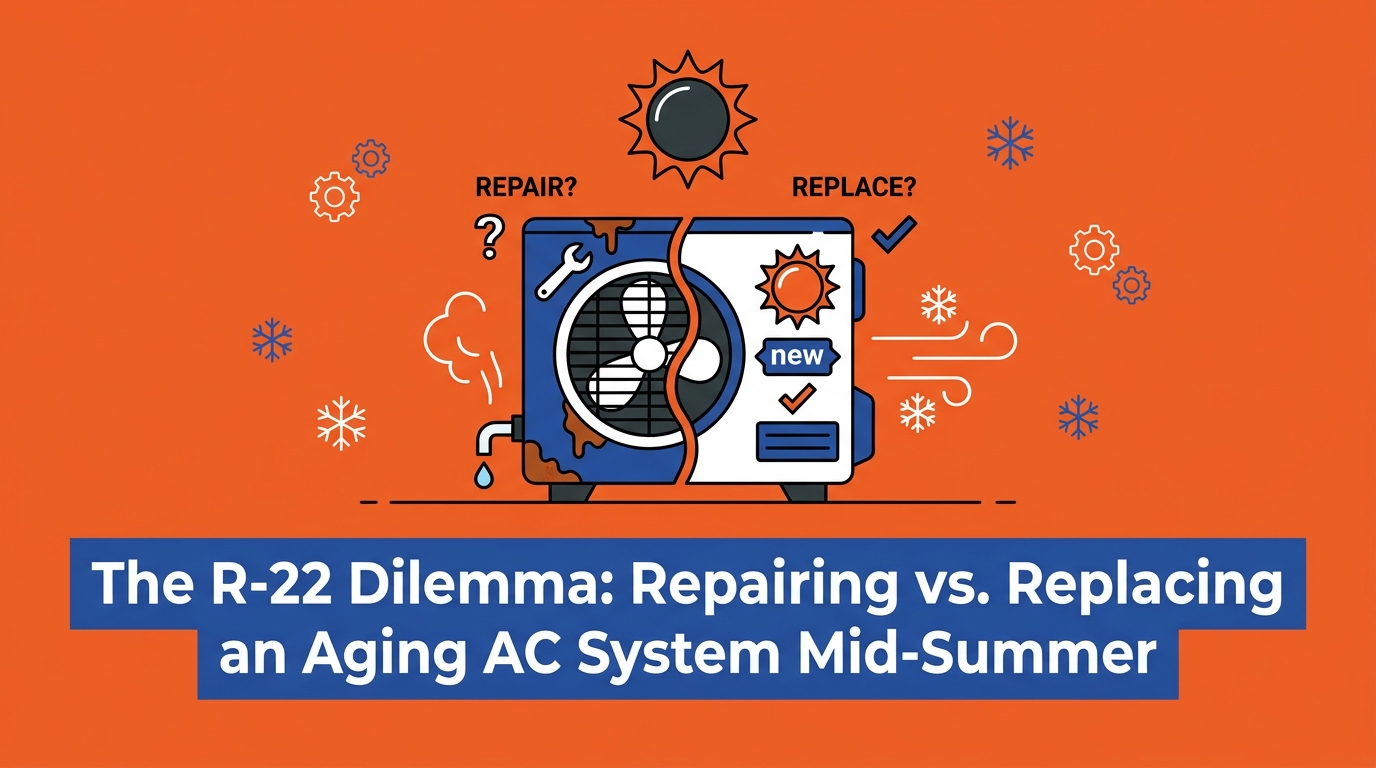

Is your older AC unit blowing warm air right when you need it most? It is late afternoon, the sun is beating down on your roof, and your indoor temperature is slowly creeping up. When you rely on legacy R-22 AC units to keep your home comfortable, a sudden breakdown during July peak summer heat forces a highly stressful decision. You are suddenly faced with a choice between paying a massive premium to patch a phased-out system or investing in a modern replacement.
Making this choice requires objective facts, not high-pressure panic. You need to understand the mechanical reality of your equipment, the regulatory changes affecting your refrigerant, and the long-term impact on your comfort. If you need immediate help sorting through your options, explore our professional HVAC services or check out available HVAC financing options to help bridge the gap.
When the temperature spikes, the instinct is to find the fastest, cheapest fix to get the cold air flowing again. However, applying a temporary band-aid to a failing system often leads to a second, more catastrophic breakdown just days later. By stepping back and evaluating the true condition of your air conditioner, you can make a choice that restores your home's comfort permanently.
To make an informed decision about your air conditioner, you first need to understand the regulatory and mechanical landscape surrounding your equipment. The refrigerant inside your system is the lifeblood of the cooling process, and the rules governing it have changed drastically over the last decade.
The regulatory shift: On January 1, 2020, the Environmental Protection Agency officially banned the production and import of R-22 refrigerant in the United States. This decision was made because R-22 is an ozone-depleting substance. While it is not illegal to continue using an existing R-22 system, the supply of this specific refrigerant is now strictly limited to whatever was stockpiled before the ban or whatever can be recovered and reclaimed from old, decommissioned units.
The supply and demand reality: Because no new R-22 is entering the market, the cost of reclaimed supplies has skyrocketed. A simple "recharge" that might have been a minor maintenance expense a decade ago now commands a significant premium. Paying to inject scarce refrigerant into a leaking system is essentially pouring money through a hole in your equipment. Furthermore, since the industry standard shifted to R-410A around 2010, any system still utilizing R-22 is well past the Department of Energy's estimated 15-year lifespan for central air conditioners.
The mechanical risk: Some homeowners are tempted by cheaper "drop-in" replacement refrigerants marketed as R-22 alternatives. These chemical blends operate at different pressures and often do not mix well with the mineral oil used in legacy R-22 AC units. Using these unauthorized blends can drastically reduce your system's cooling capacity, cause poor oil return to the compressor, and ultimately void any remaining component warranties. There is no true, safe shortcut when an R-22 system starts losing its charge.
When you apply a quick fix to an aging system, you are sending a weakened piece of machinery back into a brutal operational environment. Understanding how thermal stress impacts your equipment is critical before investing in a major repair.
During July peak summer heat, your air conditioner is forced into a near 100-percent duty cycle. It runs continuously from late morning until well after sunset just to maintain a baseline temperature. This relentless operation leaves no time for the system to rest or cool down, placing immense mechanical stress on every moving part, especially the compressor.
If your system was just recharged due to a leak, the compressor has already been operating under compromised conditions. Running an air conditioner with low refrigerant causes the compressor to overheat. Even after you refill the system, that prior heat damage remains. When the unit is immediately subjected to severe summer temperatures, the compounding strain frequently leads to secondary failures, such as a complete compressor burnout, rendering your expensive refrigerant recharge completely useless.
Before agreeing to add refrigerant, a thorough evaluation is required. If your AC not cooling properly in extreme heat is caused by a degraded coil, patching it is a losing battle. One local homeowner recently reached out when their system needed a recharge. A technician performed comprehensive diagnostic testing and clearly explained the process, ensuring the customer understood the true state of their equipment before moving forward with any service.
Despite the challenges surrounding legacy equipment, there are specific scenarios where repairing an older unit might still be a viable short-term option. However, this route requires a careful, objective look at the math and the mechanical risks.
• Non-refrigerant electrical failures: If your system stopped working because of a blown dual-run capacitor, a faulty contactor, or a failed condenser fan motor, these are standard mechanical repairs. They do not involve the sealed refrigerant circuit and can often be fixed reliably without dealing with the R-22 shortage.
• The "5,000 Rule" baseline: To evaluate the financial logic of a repair, multiply the estimated repair cost by the age of your equipment. If the resulting number is less than 5,000, a repair might be justifiable. If it exceeds 5,000, putting that money toward a new system is generally the wiser investment.
• Immediate short-term needs: If you are moving out of the house in the next few months, a temporary fix might make sense, provided the buyer is aware of the legacy R-22 AC units on the property.
If the required repair involves adding refrigerant, you must face the reality of coil degradation. Refrigerant leaks in older systems are rarely caused by a single, easily patched puncture. They are typically the result of formicary corrosion—microscopic holes that form across the entire surface of the copper evaporator coils over many years. Fixing one hole today does absolutely nothing to prevent a different microscopic hole from opening up next week. When facing continuous summer operation, these band-aid fixes are highly temporary.


When a system has reached the end of its functional life, upgrading to a modern air conditioner offers benefits that go far beyond simply having cold air again. The technological advancements made since your old system was manufactured are substantial.
Modern air conditioning systems are vastly more energy-efficient than units manufactured 15 to 20 years ago. Today's baseline SEER2 (Seasonal Energy Efficiency Ratio) ratings far exceed the standard ratings from the early 2000s. This means a new system requires significantly less electricity to produce the same amount of cooling. Over time, the reduction in your monthly energy consumption helps offset the initial investment of the new equipment.
Modern refrigerants, such as R-410A and the newer R-454B, operate at different pressures and possess superior thermodynamic properties compared to R-22. They absorb and release heat much more efficiently. This translates to faster cooling cycles, more consistent indoor temperatures, and a system that does not have to struggle to keep up when the afternoon sun hits your home.
Perhaps the greatest benefit of replacement is the restoration of reliable comfort. Another local homeowner recently dealt with an AC that was misdiagnosed and left them without cooling for almost a week during the intense summer heat. Once a proper evaluation was completed, a new system was installed promptly. Their house is now nice and cool, and they no longer have to worry about whether their AC will survive the next heatwave. Furthermore, new equipment comes with comprehensive manufacturer warranties, providing a long-term safety net that legacy R-22 AC units simply cannot offer.
In Derby, KS, peak summer high temperatures frequently exceed 90 degrees, and this heat is heavily compounded by high humidity. Surviving this specific climate requires more than just raw cooling power; it requires precise moisture management.
Air conditioning involves two distinct processes: sensible cooling (lowering the actual temperature of the air) and latent cooling (removing moisture from the air). Older, failing systems often lose their ability to perform effective latent cooling. They might blow cold air, but they leave the indoor environment feeling clammy and sticky. Modern systems are engineered with advanced coil designs that extract humidity highly effectively during the cooling cycle.
When indoor humidity is high, your body's natural cooling mechanism—sweat evaporation—cannot function properly. This makes 75 degrees in a humid house feel significantly hotter and more uncomfortable than 75 degrees in a dry house. A properly sized modern system runs long enough to pull that thick moisture out of your living space without freezing up or burning out, ensuring your home feels crisp and comfortable even during July peak summer heat.
Once a new, high-efficiency system is installed, it is vital to protect that investment. Modern equipment features tighter tolerances and advanced electronics that require clean airflow to function correctly. Keeping this new equipment running efficiently requires routine preventative maintenance. Regular tune-ups ensure the system continues to manage both temperature and humidity flawlessly season after season.
An emergency breakdown should be met with clear, objective options, never high-pressure scare tactics. We believe in providing an honest, transparent financial framework to help you weigh your choices without feeling backed into a corner.
When you are deciding the best path forward, looking at a side-by-side comparison can help remove the emotion from the situation.
• Short-Term Cost — Repairing an R-22 System: Requires a significant premium for scarce refrigerant. — Replacing with a Modern System: Requires a larger initial investment, but flexible options exist.
• Long-Term Reliability — Repairing an R-22 System: High risk of secondary failures and future leaks. — Replacing with a Modern System: Highly reliable with comprehensive manufacturer warranties.
• Energy Efficiency — Repairing an R-22 System: Continues to draw high amperage and inflate utility bills. — Replacing with a Modern System: Advanced technology significantly reduces monthly energy usage.
• Comfort Level — Repairing an R-22 System: Struggles with latent cooling and high humidity. — Replacing with a Modern System: Provides crisp, consistent cooling and excellent dehumidification.
By utilizing HVAC financing options, you can bridge the gap between an expensive, temporary band-aid and a permanent solution, making a reliable new system immediately accessible without overwhelming sticker shock.
One family recently experienced extensive condensation in their basement that was causing actual damage during the summer. As new customers with an immediate need, they were provided with clear, objective options and scheduled for an immediate new system installation. The new system permanently resolved the basement moisture damage and finally allowed them to sleep better, proving that the right investment solves multiple problems at once.
You do not have to suffer through July peak summer heat wondering if your patched AC will survive another day. Seek an objective evaluation of your failing unit to get the facts you need. With flexible payment options available to eliminate sticker shock, you can schedule a consultation today and make a confident, informed decision that secures your family's long-term comfort.
In most cases involving refrigerant leaks, it is no longer worth repairing an R-22 system. Because the EPA has banned the production of R-22, the remaining supply is extremely expensive, making recharges a poor financial investment. Additionally, legacy units are usually well past their expected lifespan, meaning other major components are likely to fail soon. Minor electrical repairs, however, might still be justifiable if the sealed refrigerant system is intact.
If your R-22 AC leaks, your system will lose its ability to cool your home and the compressor will begin to overheat. You cannot simply top it off with cheap refrigerant anymore due to the phase-out and resulting scarcity. Fixing the leak requires locating the microscopic holes, attempting to braze or patch them, and then paying a premium for reclaimed R-22 to refill the system.
Yes, flexible financing options are widely available to help homeowners handle sudden summer breakdowns. These programs allow you to break the total cost of a new, high-efficiency system into manageable monthly payments. This approach removes the immediate sticker shock and allows you to invest in long-term reliability rather than wasting money on a temporary R-22 patch.
Yes, you can still get R-22, but the supply is strictly limited to reclaimed and recovered stock. Since no new R-22 has been manufactured or imported into the United States since January 1, 2020, the available supply continues to shrink every year. This dwindling inventory has caused the price of R-22 to rise significantly, making it a costly option for older systems.
No, you should never mix different types of refrigerants, and "drop-in" replacements are highly discouraged. Modern refrigerants operate at different pressure levels and use different types of lubricating oils than legacy R-22 systems. Using an incompatible chemical blend can severely damage your compressor, reduce your system's cooling capacity, and void any remaining warranties.
Modern refrigerants, combined with advanced coil designs, are vastly superior at handling high humidity environments. They absorb and transfer heat much more efficiently than R-22. This allows modern systems to run highly effective latent cooling cycles, pulling thick moisture out of the indoor air so that your home feels crisp, dry, and comfortable even during peak summer heatwaves.


Our A/C stopped working on a Sunday and due to health issues, we needed to find a service company available on a Sunday. I called MJB and left a message on their emergency voice mail. Within 10 minutes Tom Buck called me to hear my description of the symptoms. He was just finishing an appointment in Wichita and would be on his way to my home on the south end of Derby. He arrived within 30 minutes! From start to finish he was the perfect example of what you could ever hope for in an HVAC tech and a human being. His evaluation of our system inside and out was as thorough as I could ever imagine and once he was done with the repair, our system is running as well or better than ever. Well worth the price for the evaluation, parts, and labor. Thank you again Tom for an awesome experience.
Our AC went out during the hottest days of the year, and they were out next day! We have been jerked around by a shoddy home warranty for years. We finally had a chance to pick our own repair people, and MJB came highly recommended. I can see why! I was impressed with the honesty and speed at which they fixed our AC unit!
Our commercial building had a lightening/electrical strike and damaged our 20 ton AC unit. No one could find us a new unit before the end of September. Imagining going all of August and September with no AC in Kansas and working inside near 100 degree temps is less than thrilling. Dale and the team at MJB called around and saved the day. They had us a new unit 5 weeks earlier than other could promise and I now have happy employees. The unit is amazingly quiet, super cold and so much more energy efficient. Thank you for being our super hero!
Came out and installed my new furnace. Was very polite and affordable. They are very acknowledgeable and I highly recommend!
Thank you very much. We had our 1st warm night in 3weeks. MJB took the time and effort to find the real problem. And the employees were kind and thoughtful and explained things very well. I cannot thank you and all of MJB. Will recommend you highly. Thanks again Marjorie Herman Oxford Kansas
We had a new system installed and I was so impressed with how quick they were in come out and install it, in the middle of a hot summer day. They were so friendly & very professional. I had a small problem with a weird sound and they came over immediately and fixed it. Love them!


