.avif)





Blogs
Stay updated with our latest blog posts.
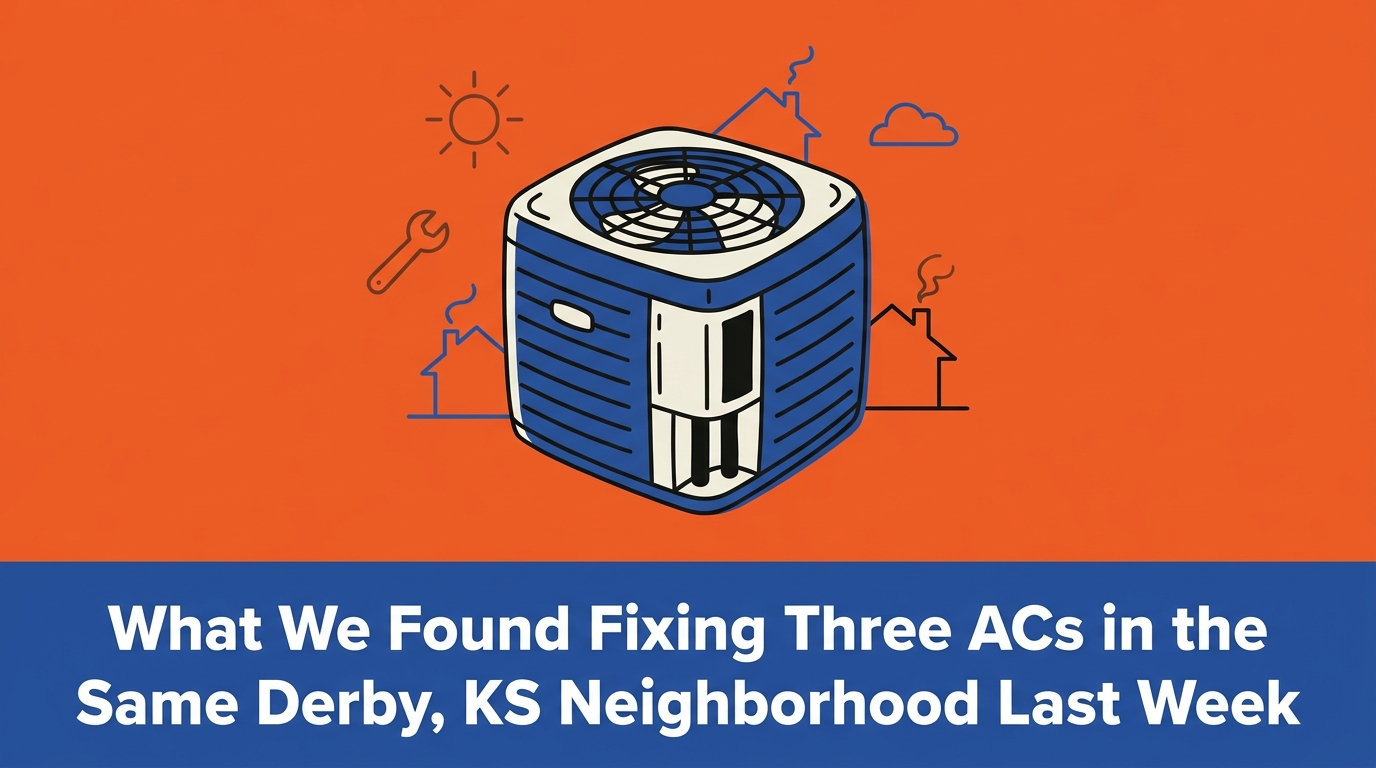

Your air conditioner is running nonstop, but the house still feels uncomfortably warm. It is a frustrating scenario, especially when summer temperatures start climbing and your thermostat refuses to budge. When looking at what we found fixing three ACs in the same Derby neighborhood last week, the root cause wasn't just a coincidence—it was a predictable pattern. Homeowners in this specific Derby subdivision were all facing the exact same sudden equipment failure, forcing a tough choice between patching an aging system or upgrading it entirely to handle the summer load.
If you are noticing similar symptoms, understanding this pattern can save you time, money, and days of discomfort. For comprehensive air conditioning solutions and reliable AC repair service in Derby, our team starts by looking at the bigger picture to find the true root cause of the breakdown.
What we observed when opening these units was a textbook example of batch-level equipment degradation. All three homes in the neighborhood had identical builder-grade condenser units installed during the exact same construction phase back in 2011. Because these 15-year-old units were manufactured, installed, and operated under the exact same conditions for over a decade, their internal components were reaching the end of their operational lifecycle simultaneously.
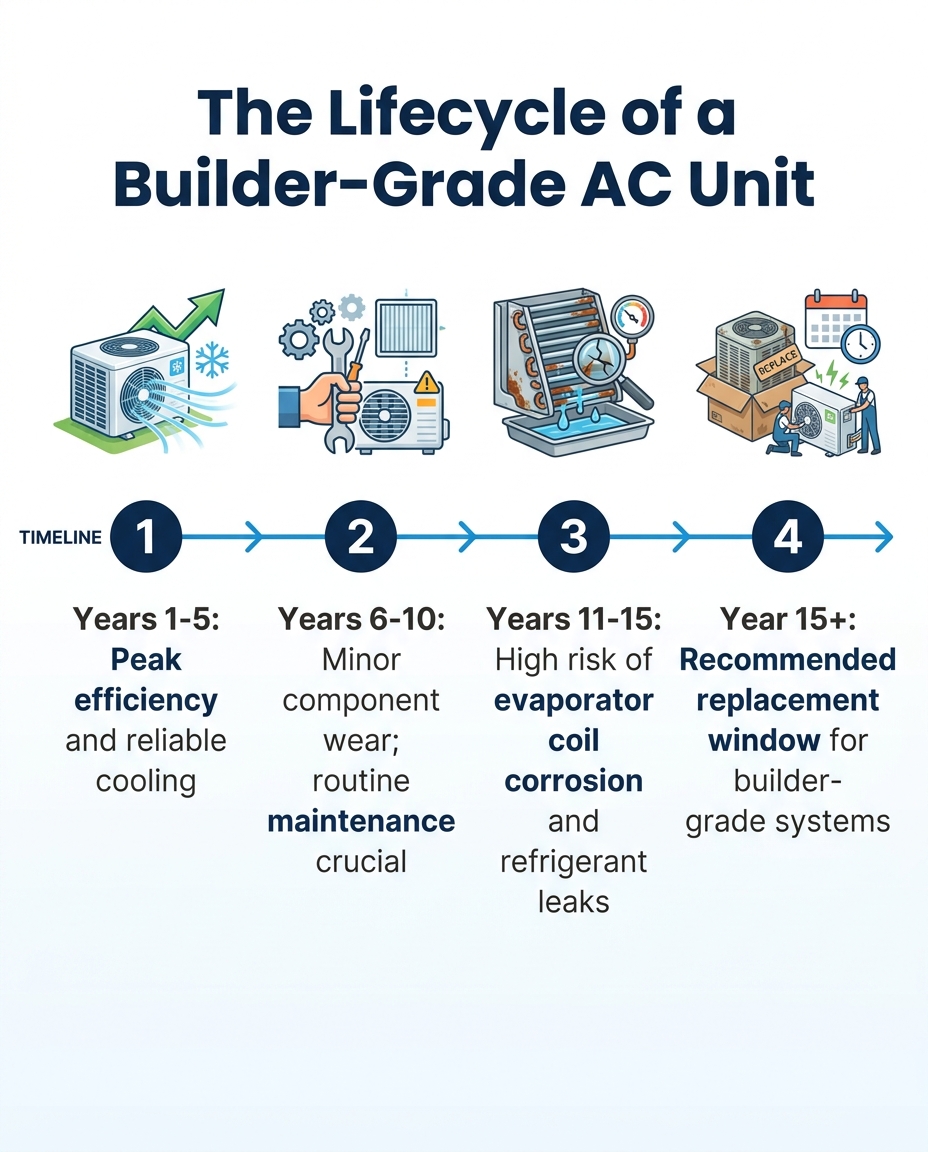
Builder-grade HVAC systems are designed to meet the minimum efficiency and performance standards required by building codes at the time of construction. They typically have a reliable lifespan of 10 to 15 years before major components, like the compressor or the evaporator coil, begin to fail. While scheduling routine AC maintenance can sometimes stretch this window by keeping the system clean and well-lubricated, the fundamental materials used in these older units eventually succumb to wear and tear. In this specific cluster of service calls, the pattern was undeniable: the copper and aluminum components inside the 2011 units had deteriorated to the point of failure.
To understand why three neighbors would lose their air conditioning in the exact same week, you have to look at how modern subdivisions are built. Developers typically purchase HVAC systems in bulk to keep construction costs down. A single HVAC contractor might install dozens of identical units across a new neighborhood over a period of just a few months.
• Identical starting lines: Every system in the phase is activated around the same time.
• Identical usage patterns: Homes of similar square footage in the same neighborhood run their cooling cycles for roughly the same amount of hours each season.
• Identical environmental exposure: The outdoor condenser units face the exact same weather patterns, humidity levels, and seasonal debris year after year.
Consequently, these systems age in lockstep. When one 2011 builder-grade unit in a subdivision experiences a catastrophic coil leak due to age, it is highly likely that the houses next door are only weeks or months away from experiencing the exact same breakdown.

The simultaneous failures we diagnosed were not random; they were directly triggered by the environment. With summer temperatures regularly exceeding 95°F in the Derby area, the intense July heat places maximum strain on aging HVAC equipment. This extreme thermal load acts as the final catalyst for systems that are already on the brink of failure.
The primary culprit in these 15-year-old units is a phenomenon known as formicary corrosion. Over a decade of use, volatile organic compounds (VOCs) from household cleaners, building materials, and everyday living mix with the natural condensation that forms on the indoor evaporator coil. This chemical reaction slowly eats away at the metal, creating microscopic pinhole leaks. For years, these weakened spots might hold up, but the July peak summer heat changes the equation dramatically.
The Cause-and-Effect Breakdown:
• Increased thermal load: The high outdoor temperatures force the air conditioner to run in near-continuous cycles just to maintain a basic indoor temperature.
• Maximized system pressure: Continuous operation causes the refrigerant pressures inside the aging copper lines to spike and remain elevated for hours on end.
• Micro-leaks become blowouts: The weakened, corroded walls of the evaporator coil can no longer withstand the sustained high pressure, causing slow micro-leaks to rupture into sudden, complete failures.
• Loss of cooling capacity: As refrigerant escapes, the system blows warm air, runs constantly, and eventually freezes over or damages the compressor.
This sequence of events explains exactly why these neighborhood breakdowns cluster together during the hottest weeks of the year. It is a predictable reaction to environmental stress exposing the underlying weakness of aging builder-grade materials.
When an air conditioner starts blowing warm air, the immediate temptation is to ask for a quick refrigerant recharge just to get through the weekend. However, repeatedly recharging a leaking 15-year-old coil is a temporary, inefficient, and ultimately wasteful fix. Because air conditioning systems are closed loops, they never "consume" refrigerant. If the system is low, there is a leak—and putting more refrigerant into a failing 2011 unit is like putting air into a tire with a massive nail in it.
One local homeowner reached out after an initial misdiagnosis left their system down for almost a week during intense hot weather. Because the root structural failure of the coil was missed, they were left stranded in the heat. Our team arrived, correctly identified the underlying batch failure, got the system stabilized, and ultimately installed a new system so the house is reliably cool again. Misdiagnosing or merely patching an end-of-life coil often results in multiple service call fees and days of severe discomfort before a permanent solution is implemented.
Understanding the broader conversation about repairing vs. replacing an aging AC is critical for homeowners in these subdivisions. A minor service need, like a blown capacitor or a clogged drain line, is a straightforward repair. A structural coil failure on a 15-year-old unit is a completely different scenario.
• Immediate Result — Recharging a Leaking 15-Year-Old Unit: Temporary cooling until the refrigerant leaks out again. — Installing a Modern AC Replacement: Immediate, reliable, and consistent cooling performance.
• Long-Term Reliability — Recharging a Leaking 15-Year-Old Unit: Very low. The corroded coil will continue to degrade and leak. — Installing a Modern AC Replacement: High. New coils are built with advanced, corrosion-resistant materials.
• Energy Efficiency — Recharging a Leaking 15-Year-Old Unit: Poor. A compromised system runs longer and draws more power. — Installing a Modern AC Replacement: Excellent. Modern units use significantly less electricity to cool the same space.
• Risk of Future Breakdown — Recharging a Leaking 15-Year-Old Unit: High. The aging compressor is now at risk due to fluctuating pressures. — Installing a Modern AC Replacement: Minimal. The system is protected by fresh components and manufacturer warranties.
Running a compromised system not only fails to keep you comfortable, but it also drives up your monthly energy bills significantly. The system has to work twice as hard to produce half the cooling, burning through electricity while slowly destroying its remaining components.
Treating every service call as an isolated incident can lead to missed underlying trends. If a technician simply looks at one broken air conditioner without considering the context of the neighborhood, they might offer a short-sighted patch. However, tracking installation batches across specific subdivisions allows for much faster, more accurate diagnostics.
Our deep local expertise and historical knowledge of Derby's housing developments mean we can often anticipate these subdivision-wide lifecycle trends that other technicians might miss. When we receive a call from a specific neighborhood known to have 2011 builder-grade units, we already know to thoroughly inspect the evaporator coil for formicary corrosion before suggesting any temporary fixes. This pattern recognition is invaluable for homeowners.
Anticipating these failures helps homeowners make informed decisions rather than reactive, panic-driven ones. As another local customer noted after a recent home AC service call, receiving courteous, upfront, and timely diagnostics builds the trust needed to navigate major household decisions. When you know that your system's failure is part of a broader, predictable lifecycle event rather than a mysterious fluke, it becomes much easier to weigh your options logically. Our commitment is always to find the root cause right the first time, ensuring your family isn't left sweltering in the heat waiting for a second or third repair attempt.
If you live in a Derby subdivision that was developed around 15 years ago, you are likely in the primary window for these types of batch failures. Taking proactive steps now can save you from an emergency breakdown during the July peak summer heat. Modern units offer significantly better performance under heavy summer loads, utilizing advanced scroll compressors and all-aluminum coils that resist the corrosion seen in older models.
Here is how you can evaluate your current situation and prepare for the future:
1. Check your equipment's manufacturing date: Look at the data plate on the side of your outdoor condenser unit. It will typically list the month and year of manufacture. If the date is 2011 or earlier, your system is officially in its end-of-life phase.
2. Monitor your cooling cycles: Pay attention to how long your system runs. A subtle warning sign of a micro-leak is a system that takes hours to drop the indoor temperature by a single degree, or one that never quite reaches the set point on the thermostat.
3. Watch for elevated indoor humidity: An air conditioner's job is to remove humidity as well as heat. If your home feels clammy or sticky despite the AC running constantly, the evaporator coil is likely compromised and failing to extract moisture.
4. Listen for strange noises: A bubbling or hissing sound coming from the indoor unit is a strong indicator that refrigerant is actively escaping from a corroded coil.
5. Schedule a professional evaluation: If you suspect your system is failing, have a professional evaluate the overall health of the unit. We can measure the exact refrigerant pressures and inspect the coil for chemical wear.
When a system is past its expected lifespan and showing signs of structural failure, moving forward with a professional AC replacement is often the most cost-effective and reliable path forward. You gain the peace of mind knowing your home is equipped to handle whatever the Kansas summer throws at it.
AC units in the same subdivision often fail simultaneously because they were installed in bulk during the same construction phase. These identical builder-grade systems experience the exact same environmental wear, usage patterns, and thermal loads over their lifespan. When the internal components reach the 10 to 15-year mark, they begin to degrade and fail in lockstep with neighboring homes.
Builder-grade air conditioners typically last between 10 and 15 years before requiring major repairs or complete replacement. These systems are designed to meet minimum building code standards at the time of construction, meaning they utilize standard materials that naturally degrade over time. Routine maintenance can help them reach the 15-year mark, but structural component failure becomes highly likely beyond that point.
If your AC unit is 15 years old, replacing the entire system is almost always a better investment than replacing just the leaking coil. An aging system likely has a worn-out compressor and outdated electrical components that will also fail soon. Installing a new system ensures you get modern energy efficiency, a fresh warranty, and reliable performance during extreme heat.
Your AC is likely blowing warm air in July because extreme outdoor heat maximizes the pressure inside your aging refrigerant lines, forcing slow micro-leaks to rupture completely. When the system loses refrigerant, it can no longer absorb heat from inside your home. The continuous operation required to combat the summer heat simply overwhelms the weakened, corroded components.
A refrigerant leak on a 15-year-old evaporator coil cannot typically be permanently patched. The leaks are usually caused by widespread formicary corrosion, meaning the metal is fundamentally compromised and riddled with microscopic holes. Patching one spot simply forces the pressure to blow out another weakened area shortly after.
The most common signs of a failing evaporator coil include your system running constantly without cooling the house, elevated indoor humidity, and a hissing or bubbling sound from the indoor unit. You might also notice ice forming on the refrigerant lines outside or a sudden, unexplained spike in your monthly energy bills as the system struggles to operate efficiently.
Dealing with a sudden AC breakdown in the middle of summer is stressful, especially when you realize your aging builder-grade system has finally reached its limit. Understanding the predictable lifecycle of these units helps you make the best choice for your home. If you are tired of patching an old system, our team is here to provide clear diagnostics and reliable solutions that keep your family comfortable for years to come.


Our A/C stopped working on a Sunday and due to health issues, we needed to find a service company available on a Sunday. I called MJB and left a message on their emergency voice mail. Within 10 minutes Tom Buck called me to hear my description of the symptoms. He was just finishing an appointment in Wichita and would be on his way to my home on the south end of Derby. He arrived within 30 minutes! From start to finish he was the perfect example of what you could ever hope for in an HVAC tech and a human being. His evaluation of our system inside and out was as thorough as I could ever imagine and once he was done with the repair, our system is running as well or better than ever. Well worth the price for the evaluation, parts, and labor. Thank you again Tom for an awesome experience.
Our AC went out during the hottest days of the year, and they were out next day! We have been jerked around by a shoddy home warranty for years. We finally had a chance to pick our own repair people, and MJB came highly recommended. I can see why! I was impressed with the honesty and speed at which they fixed our AC unit!
Our commercial building had a lightening/electrical strike and damaged our 20 ton AC unit. No one could find us a new unit before the end of September. Imagining going all of August and September with no AC in Kansas and working inside near 100 degree temps is less than thrilling. Dale and the team at MJB called around and saved the day. They had us a new unit 5 weeks earlier than other could promise and I now have happy employees. The unit is amazingly quiet, super cold and so much more energy efficient. Thank you for being our super hero!
Came out and installed my new furnace. Was very polite and affordable. They are very acknowledgeable and I highly recommend!
Thank you very much. We had our 1st warm night in 3weeks. MJB took the time and effort to find the real problem. And the employees were kind and thoughtful and explained things very well. I cannot thank you and all of MJB. Will recommend you highly. Thanks again Marjorie Herman Oxford Kansas
We had a new system installed and I was so impressed with how quick they were in come out and install it, in the middle of a hot summer day. They were so friendly & very professional. I had a small problem with a weird sound and they came over immediately and fixed it. Love them!