.avif)





Blogs
Stay updated with our latest blog posts.
The standard efficiency vs high efficiency HVAC comparison is one of the most important decisions you'll make when replacing your home's heating or cooling system — and in Central Kansas, where summers run hot and winters can be brutal, getting it right has a real impact on your comfort and your utility bills.
Here's a quick breakdown to answer the core question right away:
| Feature | Standard Efficiency | High Efficiency |
|---|---|---|
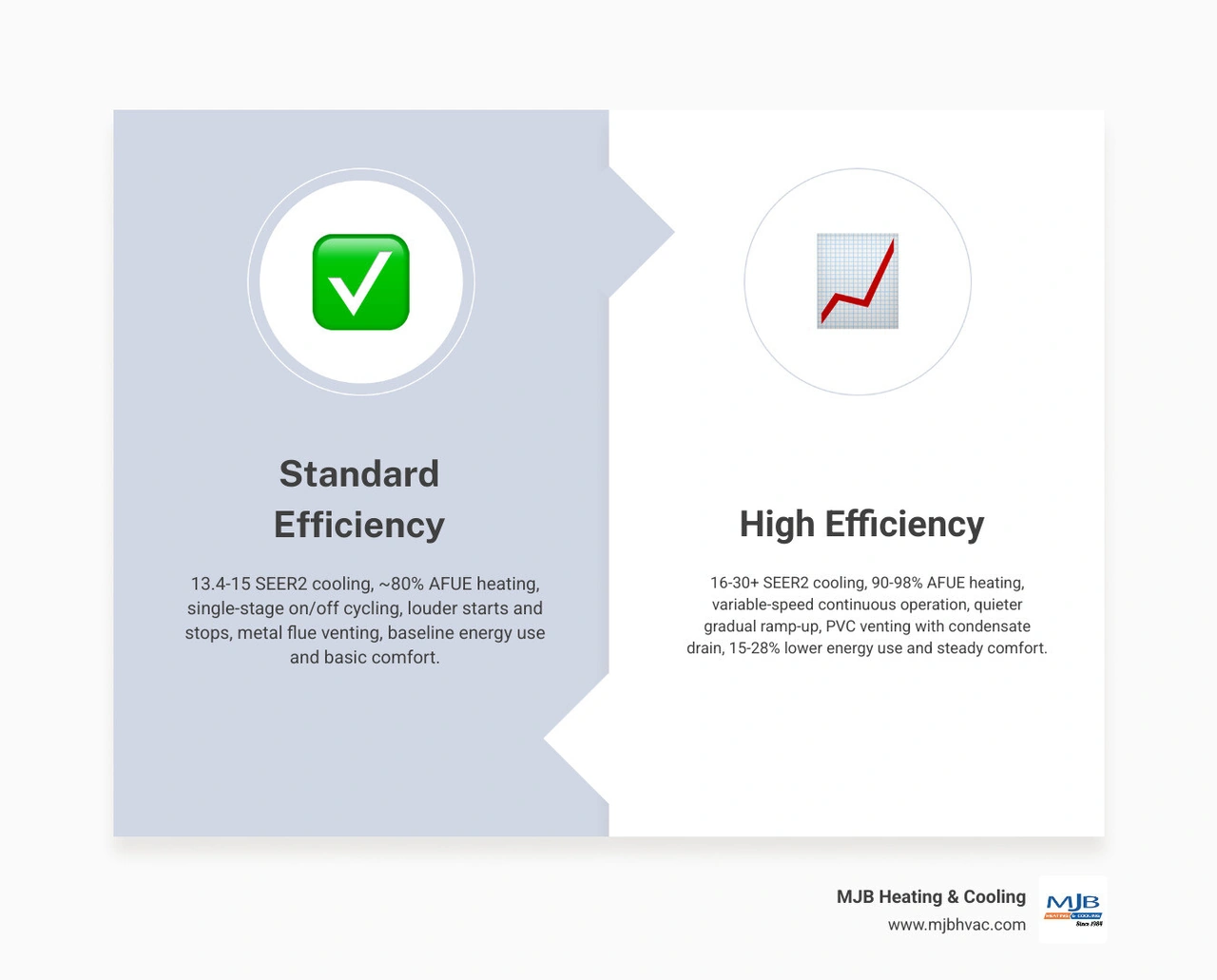
| Central AC (SEER2) | 13.4 - 15 | 16 - 30+ |
| Furnace (AFUE) | ~80% | 90 - 98% |
| Heat Pump (HSPF2) | Up to 7.7 | 9.0+ |
| Compressor Type | Single-stage | Variable-speed or two-stage |
| Venting | Metal flue | PVC pipe |
| Condensate Drain | No | Yes |
| Annual Energy Savings vs Standard | Baseline | 15 - 28% less energy used |
| Typical Payback Period | N/A | 5 - 12 years depending on climate and usage |
| Comfort Level | Basic on/off cycling | Steady airflow, fewer temperature swings |
| Noise Level | Louder starts and stops | Quieter, gradual ramp-up |
The short answer: high-efficiency systems cost more upfront but use significantly less energy, run more quietly, and keep your home more comfortable. Whether that trade-off makes sense depends on how long you plan to stay, how often your system runs, and what fuel you're using.
But there's more to the decision than a single number on a rating label. A high-efficiency furnace that converts 96% of its gas into heat still underperforms if your ductwork leaks 25% of that air into the attic. Ratings tell you what a system can do — installation quality, home insulation, and proper sizing determine what it actually does.
In this guide, MJB Heating & Cooling walks you through every angle of the standard vs high efficiency HVAC comparison — from technical design differences and real-world energy savings to Kansas-specific climate considerations, current rebates, and honest guidance on when each option makes the most sense for your home.
For most homeowners in Wichita, Derby, Andover, Hutchinson, Newton, and the rest of our Central Kansas service area, the real question is not "Is high efficiency better?" It usually is. The real question is "Is it better for my home, my usage, and how long I plan to stay here?"
Here is the practical side-by-side view:
| Category | Standard Efficiency | High Efficiency |
|---|---|---|
| AC efficiency | 13.4 to 15 SEER2 | 16 to 18 SEER2 common, 18+ premium |
| Furnace efficiency | Around 80 AFUE | 90 to 98 AFUE |
| Heat pump efficiency | About 7.5 to 7.7 HSPF2 | 9.0+ HSPF2 |
| Operation | Single-stage, mostly on/off | Two-stage or variable-capacity |
| Indoor blower | Basic PSC or lower-end motor designs | ECM or variable-speed blower |
| Comfort | More temperature swing | More even temperatures |
| Humidity control | Basic | Better dehumidification during cooling |
| Sound | More noticeable starts and stops | Lower, smoother sound profile |
| Installation needs | Simpler venting | May need PVC venting and condensate drain |
| Best fit | Lowest initial investment, simple replacement | Long-term savings and comfort focus |
In 2026, "standard efficiency" does not mean old or bad equipment. It means equipment built close to today's federal minimum efficiency standards.
For most homes, that means:
In plain English, standard-efficiency equipment is the baseline option. It meets modern requirements, cools and heats your home safely, and can be the right answer when simplicity and lower upfront investment matter most.
"High efficiency" usually starts where performance moves beyond minimum compliance and into better part-load operation, better comfort, and lower utility use.
For most homeowners, that means:
This is where equipment starts doing more than just turning on and off. It starts adjusting to your home's actual needs. If you want a deeper explanation of what these ratings mean, see Efficiency Ratings Explained for Homeowners.
The biggest difference is how systems handle partial demand.
A standard system usually runs at full output, reaches the thermostat setting, then shuts off. That works, but it creates more cycling losses, bigger temperature swings, and less precise humidity removal.
A high-efficiency system is usually better at part-load operation. Instead of full blast or nothing, it can run longer at lower speeds. That matters because homes rarely need 100% output all day long. In real life, most HVAC systems spend much of their time meeting moderate demand, not extreme demand.
That is why high-efficiency equipment often feels better even before you notice the utility savings.
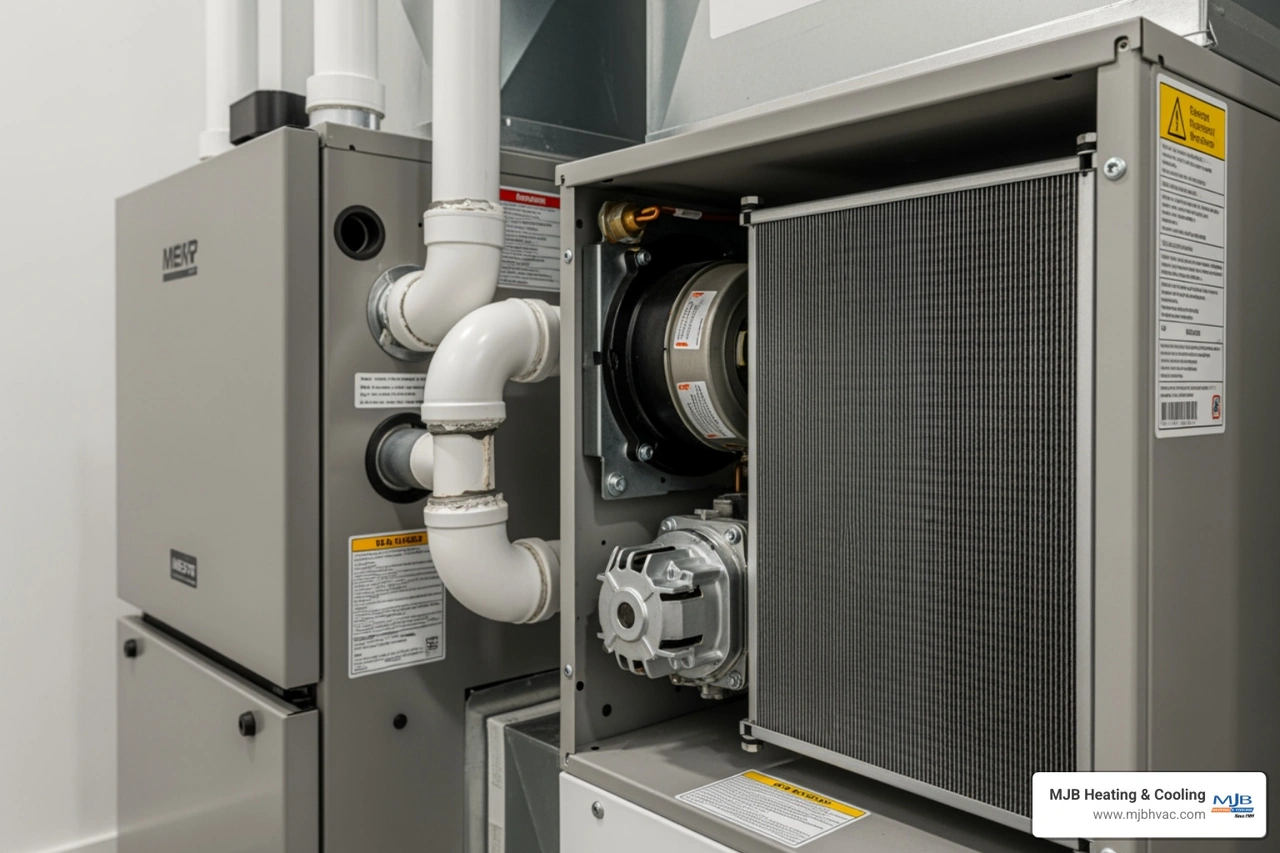
A lot of the performance gap comes from hardware.
A standard 80 AFUE furnace usually has:
A high-efficiency condensing furnace usually has:
That secondary heat exchanger is the key. It recovers heat that a standard furnace simply sends outside.
On the cooling side, the difference is usually in compressor and blower design:
This is where homeowners usually say, "Oh, now I get it."
A single-stage system behaves like a light switch. It is on or off.
A variable-speed system behaves more like a dimmer switch. It can ease into operation, run steadily, and match output more closely to the weather and your home's demand.
That helps with:
Some high-efficiency systems can make temperature adjustments in much smaller increments than standard equipment, which helps keep room temperatures more stable. In practical terms, that can mean 1 to 2 degree swings instead of 3 to 5 degree swings.
Here is the part homeowners do not always hear during a quick sales pitch: ratings are only part of the story.
Real-world efficiency depends heavily on:
Duct leakage can waste 20% to 30% of conditioned air in many homes. An oversized unit can short-cycle and fail to dehumidify properly. An undersized unit may run constantly and still struggle. Even the best high-efficiency system can disappoint if it is installed poorly.
That is why we always recommend proper system sizing and duct evaluation, not just comparing model numbers. For more on that, read How Proper HVAC Sizing Affects Comfort and Efficiency.
When homeowners ask whether high efficiency is "worth it," they usually mean one thing: will the savings justify the upgrade?
The honest answer is: sometimes quickly, sometimes slowly.
Research consistently shows that high-efficiency systems can reduce energy use by about 15% to 28% compared with standard models, depending on the equipment type and how often it runs.
Examples:
Homes heated with propane or electric resistance usually see the strongest savings from high-efficiency upgrades. If you want a closer look at savings scenarios, see How Much Does a High Efficiency System Save.
Payback tends to be faster when:
Payback tends to be slower when:
For Kansas homeowners, this often means high-efficiency furnaces and heat pumps make the most sense in homes with heavy seasonal use, especially where comfort problems or fuel costs are already noticeable.
A newer, efficient HVAC system can also help your home in ways that do not show up on the monthly utility bill.
Benefits can include:
If resale value is part of your thinking, this guide is worth reading: How a New HVAC System Increases Home Value.
This is the section where efficiency becomes personal.
A standard system can absolutely heat and cool a home. But because it often cycles on and off in bigger bursts, you may notice:
High-efficiency systems usually run longer at lower output. That means:
In a Kansas summer, that humidity control matters. Your thermostat might say 72 either way, but 72 with lower humidity feels much better than 72 with sticky air. Your skin knows the difference, even if your thermostat is staying neutral.
High-efficiency systems are usually quieter because they do not slam on at full power as often.
Noise improvements often come from:
Standard systems are not necessarily loud, but they are more likely to produce that familiar "thump... whoosh..." startup pattern. High-efficiency systems are usually smoother and less noticeable, which is great if your outdoor unit is near a patio or your indoor equipment is close to living space.
High-efficiency systems can support better indoor air quality, but they are not magic boxes.
They may help by:
But they still depend on basics:
So yes, high-efficiency equipment can help indoor air quality, but it works best as part of a whole-home approach.
There is no universal winner for every home in Central Kansas. The right choice depends on your house, your fuel type, and your goals.
High-efficiency equipment often makes the most sense when:
This is especially true in larger homes, multi-level homes, and homes with a history of hot and cold spots.
A standard system can still be the better choice when:
There is nothing "wrong" with choosing standard efficiency when the math and circumstances support it. Sometimes simple really is smart.
This is where the standard efficiency vs high efficiency HVAC comparison overlaps with system type.
A traditional AC cools only. A furnace handles heating. A heat pump can do both by reversing refrigerant flow.
In cooling mode, a heat pump and an AC can have very similar efficiency. The big difference shows up in heating mode.
Heat pumps are often a great fit when:
For many Kansas homes, dual-fuel systems can be a strong option because they combine heat pump efficiency in milder weather with furnace performance in colder conditions. If you want to understand heating efficiency on heat pumps better, see Discover Energy Savings with Daikin's HSPF Rating Insights.
Before replacing a system, we recommend using this checklist:
Both system types need regular maintenance. Neither one enjoys neglect.
Standard systems typically need:
High-efficiency systems need all of the above, plus closer attention to components such as:
That does not always mean "more maintenance," but it can mean more specialized maintenance. Annual professional service is a smart move either way.
Rebates and incentives can change quickly, so we always recommend checking current programs before you decide.
Places to look include:
Research in this topic area shows incentives can significantly improve payback, especially on qualifying heat pumps and high-efficiency systems. For Kansas-focused guidance, visit Kansas Energy Rebates for HVAC Upgrades.
Before you sign off on any replacement, ask these questions:
If you are comparing features between equipment lines, What Makes Daikin HVAC Systems Different can help you understand what to look for.
For Central Kansas homeowners, the best HVAC decision is not always the one with the highest rating. It is the one that matches your home, your comfort goals, and how long you plan to live there.
In many Wichita-area homes, high-efficiency systems are worth serious consideration because they can lower energy use, improve humidity control, reduce noise, and deliver steadier comfort in both summer and winter. But standard-efficiency equipment still has a valid place, especially when simplicity and lower upfront investment are the priority.
At MJB Heating & Cooling, we have served the Wichita metro and surrounding communities since 1984 with honest guidance, quality workmanship, and practical recommendations that fit the home in front of us, not a one-size-fits-all sales pitch.
If you want help comparing your options, visit https://www.mjbhvac.com to learn more or schedule service with our family-owned team.
The standard efficiency vs high efficiency HVAC comparison is one of the most important decisions you'll make when replacing your home's heating or cooling system — and in Central Kansas, where summers run hot and winters can be brutal, getting it right has a real impact on your comfort and your utility bills.
Here's a quick breakdown to answer the core question right away:
| Feature | Standard Efficiency | High Efficiency |
|---|---|---|
| Central AC (SEER2) | 13.4 - 15 | 16 - 30+ |
| Furnace (AFUE) | ~80% | 90 - 98% |
| Heat Pump (HSPF2) | Up to 7.7 | 9.0+ |
| Compressor Type | Single-stage | Variable-speed or two-stage |
| Venting | Metal flue | PVC pipe |
| Condensate Drain | No | Yes |
| Annual Energy Savings vs Standard | Baseline | 15 - 28% less energy used |
| Typical Payback Period | N/A | 5 - 12 years depending on climate and usage |
| Comfort Level | Basic on/off cycling | Steady airflow, fewer temperature swings |
| Noise Level | Louder starts and stops | Quieter, gradual ramp-up |
The short answer: high-efficiency systems cost more upfront but use significantly less energy, run more quietly, and keep your home more comfortable. Whether that trade-off makes sense depends on how long you plan to stay, how often your system runs, and what fuel you're using.
But there's more to the decision than a single number on a rating label. A high-efficiency furnace that converts 96% of its gas into heat still underperforms if your ductwork leaks 25% of that air into the attic. Ratings tell you what a system can do — installation quality, home insulation, and proper sizing determine what it actually does.
In this guide, MJB Heating & Cooling walks you through every angle of the standard vs high efficiency HVAC comparison — from technical design differences and real-world energy savings to Kansas-specific climate considerations, current rebates, and honest guidance on when each option makes the most sense for your home.
For most homeowners in Wichita, Derby, Andover, Hutchinson, Newton, and the rest of our Central Kansas service area, the real question is not "Is high efficiency better?" It usually is. The real question is "Is it better for my home, my usage, and how long I plan to stay here?"
Here is the practical side-by-side view:
| Category | Standard Efficiency | High Efficiency |
|---|---|---|
| AC efficiency | 13.4 to 15 SEER2 | 16 to 18 SEER2 common, 18+ premium |
| Furnace efficiency | Around 80 AFUE | 90 to 98 AFUE |
| Heat pump efficiency | About 7.5 to 7.7 HSPF2 | 9.0+ HSPF2 |
| Operation | Single-stage, mostly on/off | Two-stage or variable-capacity |
| Indoor blower | Basic PSC or lower-end motor designs | ECM or variable-speed blower |
| Comfort | More temperature swing | More even temperatures |
| Humidity control | Basic | Better dehumidification during cooling |
| Sound | More noticeable starts and stops | Lower, smoother sound profile |
| Installation needs | Simpler venting | May need PVC venting and condensate drain |
| Best fit | Lowest initial investment, simple replacement | Long-term savings and comfort focus |
In 2026, "standard efficiency" does not mean old or bad equipment. It means equipment built close to today's federal minimum efficiency standards.
For most homes, that means:
In plain English, standard-efficiency equipment is the baseline option. It meets modern requirements, cools and heats your home safely, and can be the right answer when simplicity and lower upfront investment matter most.
"High efficiency" usually starts where performance moves beyond minimum compliance and into better part-load operation, better comfort, and lower utility use.
For most homeowners, that means:
This is where equipment starts doing more than just turning on and off. It starts adjusting to your home's actual needs. If you want a deeper explanation of what these ratings mean, see Efficiency Ratings Explained for Homeowners.
The biggest difference is how systems handle partial demand.
A standard system usually runs at full output, reaches the thermostat setting, then shuts off. That works, but it creates more cycling losses, bigger temperature swings, and less precise humidity removal.
A high-efficiency system is usually better at part-load operation. Instead of full blast or nothing, it can run longer at lower speeds. That matters because homes rarely need 100% output all day long. In real life, most HVAC systems spend much of their time meeting moderate demand, not extreme demand.
That is why high-efficiency equipment often feels better even before you notice the utility savings.
A lot of the performance gap comes from hardware.
A standard 80 AFUE furnace usually has:
A high-efficiency condensing furnace usually has:
That secondary heat exchanger is the key. It recovers heat that a standard furnace simply sends outside.
On the cooling side, the difference is usually in compressor and blower design:
This is where homeowners usually say, "Oh, now I get it."
A single-stage system behaves like a light switch. It is on or off.
A variable-speed system behaves more like a dimmer switch. It can ease into operation, run steadily, and match output more closely to the weather and your home's demand.
That helps with:
Some high-efficiency systems can make temperature adjustments in much smaller increments than standard equipment, which helps keep room temperatures more stable. In practical terms, that can mean 1 to 2 degree swings instead of 3 to 5 degree swings.
Here is the part homeowners do not always hear during a quick sales pitch: ratings are only part of the story.
Real-world efficiency depends heavily on:
Duct leakage can waste 20% to 30% of conditioned air in many homes. An oversized unit can short-cycle and fail to dehumidify properly. An undersized unit may run constantly and still struggle. Even the best high-efficiency system can disappoint if it is installed poorly.
That is why we always recommend proper system sizing and duct evaluation, not just comparing model numbers. For more on that, read How Proper HVAC Sizing Affects Comfort and Efficiency.
When homeowners ask whether high efficiency is "worth it," they usually mean one thing: will the savings justify the upgrade?
The honest answer is: sometimes quickly, sometimes slowly.
Research consistently shows that high-efficiency systems can reduce energy use by about 15% to 28% compared with standard models, depending on the equipment type and how often it runs.
Examples:
Homes heated with propane or electric resistance usually see the strongest savings from high-efficiency upgrades. If you want a closer look at savings scenarios, see How Much Does a High Efficiency System Save.
Payback tends to be faster when:
Payback tends to be slower when:
For Kansas homeowners, this often means high-efficiency furnaces and heat pumps make the most sense in homes with heavy seasonal use, especially where comfort problems or fuel costs are already noticeable.
A newer, efficient HVAC system can also help your home in ways that do not show up on the monthly utility bill.
Benefits can include:
If resale value is part of your thinking, this guide is worth reading: How a New HVAC System Increases Home Value.
This is the section where efficiency becomes personal.
A standard system can absolutely heat and cool a home. But because it often cycles on and off in bigger bursts, you may notice:
High-efficiency systems usually run longer at lower output. That means:
In a Kansas summer, that humidity control matters. Your thermostat might say 72 either way, but 72 with lower humidity feels much better than 72 with sticky air. Your skin knows the difference, even if your thermostat is staying neutral.
High-efficiency systems are usually quieter because they do not slam on at full power as often.
Noise improvements often come from:
Standard systems are not necessarily loud, but they are more likely to produce that familiar "thump... whoosh..." startup pattern. High-efficiency systems are usually smoother and less noticeable, which is great if your outdoor unit is near a patio or your indoor equipment is close to living space.
High-efficiency systems can support better indoor air quality, but they are not magic boxes.
They may help by:
But they still depend on basics:
So yes, high-efficiency equipment can help indoor air quality, but it works best as part of a whole-home approach.
There is no universal winner for every home in Central Kansas. The right choice depends on your house, your fuel type, and your goals.
High-efficiency equipment often makes the most sense when:
This is especially true in larger homes, multi-level homes, and homes with a history of hot and cold spots.
A standard system can still be the better choice when:
There is nothing "wrong" with choosing standard efficiency when the math and circumstances support it. Sometimes simple really is smart.
This is where the standard efficiency vs high efficiency HVAC comparison overlaps with system type.
A traditional AC cools only. A furnace handles heating. A heat pump can do both by reversing refrigerant flow.
In cooling mode, a heat pump and an AC can have very similar efficiency. The big difference shows up in heating mode.
Heat pumps are often a great fit when:
For many Kansas homes, dual-fuel systems can be a strong option because they combine heat pump efficiency in milder weather with furnace performance in colder conditions. If you want to understand heating efficiency on heat pumps better, see Discover Energy Savings with Daikin's HSPF Rating Insights.
Before replacing a system, we recommend using this checklist:
Both system types need regular maintenance. Neither one enjoys neglect.
Standard systems typically need:
High-efficiency systems need all of the above, plus closer attention to components such as:
That does not always mean "more maintenance," but it can mean more specialized maintenance. Annual professional service is a smart move either way.
Rebates and incentives can change quickly, so we always recommend checking current programs before you decide.
Places to look include:
Research in this topic area shows incentives can significantly improve payback, especially on qualifying heat pumps and high-efficiency systems. For Kansas-focused guidance, visit Kansas Energy Rebates for HVAC Upgrades.
Before you sign off on any replacement, ask these questions:
If you are comparing features between equipment lines, What Makes Daikin HVAC Systems Different can help you understand what to look for.
For Central Kansas homeowners, the best HVAC decision is not always the one with the highest rating. It is the one that matches your home, your comfort goals, and how long you plan to live there.
In many Wichita-area homes, high-efficiency systems are worth serious consideration because they can lower energy use, improve humidity control, reduce noise, and deliver steadier comfort in both summer and winter. But standard-efficiency equipment still has a valid place, especially when simplicity and lower upfront investment are the priority.
At MJB Heating & Cooling, we have served the Wichita metro and surrounding communities since 1984 with honest guidance, quality workmanship, and practical recommendations that fit the home in front of us, not a one-size-fits-all sales pitch.
If you want help comparing your options, visit https://www.mjbhvac.com to learn more or schedule service with our family-owned team.
The standard efficiency vs high efficiency HVAC comparison is one of the most important decisions you'll make when replacing your home's heating or cooling system — and in Central Kansas, where summers run hot and winters can be brutal, getting it right has a real impact on your comfort and your utility bills.
Here's a quick breakdown to answer the core question right away:
| Feature | Standard Efficiency | High Efficiency |
|---|---|---|
| Central AC (SEER2) | 13.4 - 15 | 16 - 30+ |
| Furnace (AFUE) | ~80% | 90 - 98% |
| Heat Pump (HSPF2) | Up to 7.7 | 9.0+ |
| Compressor Type | Single-stage | Variable-speed or two-stage |
| Venting | Metal flue | PVC pipe |
| Condensate Drain | No | Yes |
| Annual Energy Savings vs Standard | Baseline | 15 - 28% less energy used |
| Typical Payback Period | N/A | 5 - 12 years depending on climate and usage |
| Comfort Level | Basic on/off cycling | Steady airflow, fewer temperature swings |
| Noise Level | Louder starts and stops | Quieter, gradual ramp-up |
The short answer: high-efficiency systems cost more upfront but use significantly less energy, run more quietly, and keep your home more comfortable. Whether that trade-off makes sense depends on how long you plan to stay, how often your system runs, and what fuel you're using.
But there's more to the decision than a single number on a rating label. A high-efficiency furnace that converts 96% of its gas into heat still underperforms if your ductwork leaks 25% of that air into the attic. Ratings tell you what a system can do — installation quality, home insulation, and proper sizing determine what it actually does.
In this guide, MJB Heating & Cooling walks you through every angle of the standard vs high efficiency HVAC comparison — from technical design differences and real-world energy savings to Kansas-specific climate considerations, current rebates, and honest guidance on when each option makes the most sense for your home.
For most homeowners in Wichita, Derby, Andover, Hutchinson, Newton, and the rest of our Central Kansas service area, the real question is not "Is high efficiency better?" It usually is. The real question is "Is it better for my home, my usage, and how long I plan to stay here?"
Here is the practical side-by-side view:
| Category | Standard Efficiency | High Efficiency |
|---|---|---|
| AC efficiency | 13.4 to 15 SEER2 | 16 to 18 SEER2 common, 18+ premium |
| Furnace efficiency | Around 80 AFUE | 90 to 98 AFUE |
| Heat pump efficiency | About 7.5 to 7.7 HSPF2 | 9.0+ HSPF2 |
| Operation | Single-stage, mostly on/off | Two-stage or variable-capacity |
| Indoor blower | Basic PSC or lower-end motor designs | ECM or variable-speed blower |
| Comfort | More temperature swing | More even temperatures |
| Humidity control | Basic | Better dehumidification during cooling |
| Sound | More noticeable starts and stops | Lower, smoother sound profile |
| Installation needs | Simpler venting | May need PVC venting and condensate drain |
| Best fit | Lowest initial investment, simple replacement | Long-term savings and comfort focus |
In 2026, "standard efficiency" does not mean old or bad equipment. It means equipment built close to today's federal minimum efficiency standards.
For most homes, that means:
In plain English, standard-efficiency equipment is the baseline option. It meets modern requirements, cools and heats your home safely, and can be the right answer when simplicity and lower upfront investment matter most.
"High efficiency" usually starts where performance moves beyond minimum compliance and into better part-load operation, better comfort, and lower utility use.
For most homeowners, that means:
This is where equipment starts doing more than just turning on and off. It starts adjusting to your home's actual needs. If you want a deeper explanation of what these ratings mean, see Efficiency Ratings Explained for Homeowners.
The biggest difference is how systems handle partial demand.
A standard system usually runs at full output, reaches the thermostat setting, then shuts off. That works, but it creates more cycling losses, bigger temperature swings, and less precise humidity removal.
A high-efficiency system is usually better at part-load operation. Instead of full blast or nothing, it can run longer at lower speeds. That matters because homes rarely need 100% output all day long. In real life, most HVAC systems spend much of their time meeting moderate demand, not extreme demand.
That is why high-efficiency equipment often feels better even before you notice the utility savings.
A lot of the performance gap comes from hardware.
A standard 80 AFUE furnace usually has:
A high-efficiency condensing furnace usually has:
That secondary heat exchanger is the key. It recovers heat that a standard furnace simply sends outside.
On the cooling side, the difference is usually in compressor and blower design:
This is where homeowners usually say, "Oh, now I get it."
A single-stage system behaves like a light switch. It is on or off.
A variable-speed system behaves more like a dimmer switch. It can ease into operation, run steadily, and match output more closely to the weather and your home's demand.
That helps with:
Some high-efficiency systems can make temperature adjustments in much smaller increments than standard equipment, which helps keep room temperatures more stable. In practical terms, that can mean 1 to 2 degree swings instead of 3 to 5 degree swings.
Here is the part homeowners do not always hear during a quick sales pitch: ratings are only part of the story.
Real-world efficiency depends heavily on:
Duct leakage can waste 20% to 30% of conditioned air in many homes. An oversized unit can short-cycle and fail to dehumidify properly. An undersized unit may run constantly and still struggle. Even the best high-efficiency system can disappoint if it is installed poorly.
That is why we always recommend proper system sizing and duct evaluation, not just comparing model numbers. For more on that, read How Proper HVAC Sizing Affects Comfort and Efficiency.
When homeowners ask whether high efficiency is "worth it," they usually mean one thing: will the savings justify the upgrade?
The honest answer is: sometimes quickly, sometimes slowly.
Research consistently shows that high-efficiency systems can reduce energy use by about 15% to 28% compared with standard models, depending on the equipment type and how often it runs.
Examples:
Homes heated with propane or electric resistance usually see the strongest savings from high-efficiency upgrades. If you want a closer look at savings scenarios, see How Much Does a High Efficiency System Save.
Payback tends to be faster when:
Payback tends to be slower when:
For Kansas homeowners, this often means high-efficiency furnaces and heat pumps make the most sense in homes with heavy seasonal use, especially where comfort problems or fuel costs are already noticeable.
A newer, efficient HVAC system can also help your home in ways that do not show up on the monthly utility bill.
Benefits can include:
If resale value is part of your thinking, this guide is worth reading: How a New HVAC System Increases Home Value.
This is the section where efficiency becomes personal.
A standard system can absolutely heat and cool a home. But because it often cycles on and off in bigger bursts, you may notice:
High-efficiency systems usually run longer at lower output. That means:
In a Kansas summer, that humidity control matters. Your thermostat might say 72 either way, but 72 with lower humidity feels much better than 72 with sticky air. Your skin knows the difference, even if your thermostat is staying neutral.
High-efficiency systems are usually quieter because they do not slam on at full power as often.
Noise improvements often come from:
Standard systems are not necessarily loud, but they are more likely to produce that familiar "thump... whoosh..." startup pattern. High-efficiency systems are usually smoother and less noticeable, which is great if your outdoor unit is near a patio or your indoor equipment is close to living space.
High-efficiency systems can support better indoor air quality, but they are not magic boxes.
They may help by:
But they still depend on basics:
So yes, high-efficiency equipment can help indoor air quality, but it works best as part of a whole-home approach.
There is no universal winner for every home in Central Kansas. The right choice depends on your house, your fuel type, and your goals.
High-efficiency equipment often makes the most sense when:
This is especially true in larger homes, multi-level homes, and homes with a history of hot and cold spots.
A standard system can still be the better choice when:
There is nothing "wrong" with choosing standard efficiency when the math and circumstances support it. Sometimes simple really is smart.
This is where the standard efficiency vs high efficiency HVAC comparison overlaps with system type.
A traditional AC cools only. A furnace handles heating. A heat pump can do both by reversing refrigerant flow.
In cooling mode, a heat pump and an AC can have very similar efficiency. The big difference shows up in heating mode.
Heat pumps are often a great fit when:
For many Kansas homes, dual-fuel systems can be a strong option because they combine heat pump efficiency in milder weather with furnace performance in colder conditions. If you want to understand heating efficiency on heat pumps better, see Discover Energy Savings with Daikin's HSPF Rating Insights.
Before replacing a system, we recommend using this checklist:
Both system types need regular maintenance. Neither one enjoys neglect.
Standard systems typically need:
High-efficiency systems need all of the above, plus closer attention to components such as:
That does not always mean "more maintenance," but it can mean more specialized maintenance. Annual professional service is a smart move either way.
Rebates and incentives can change quickly, so we always recommend checking current programs before you decide.
Places to look include:
Research in this topic area shows incentives can significantly improve payback, especially on qualifying heat pumps and high-efficiency systems. For Kansas-focused guidance, visit Kansas Energy Rebates for HVAC Upgrades.
Before you sign off on any replacement, ask these questions:
If you are comparing features between equipment lines, What Makes Daikin HVAC Systems Different can help you understand what to look for.
For Central Kansas homeowners, the best HVAC decision is not always the one with the highest rating. It is the one that matches your home, your comfort goals, and how long you plan to live there.
In many Wichita-area homes, high-efficiency systems are worth serious consideration because they can lower energy use, improve humidity control, reduce noise, and deliver steadier comfort in both summer and winter. But standard-efficiency equipment still has a valid place, especially when simplicity and lower upfront investment are the priority.
At MJB Heating & Cooling, we have served the Wichita metro and surrounding communities since 1984 with honest guidance, quality workmanship, and practical recommendations that fit the home in front of us, not a one-size-fits-all sales pitch.
If you want help comparing your options, visit https://www.mjbhvac.com to learn more or schedule service with our family-owned team.
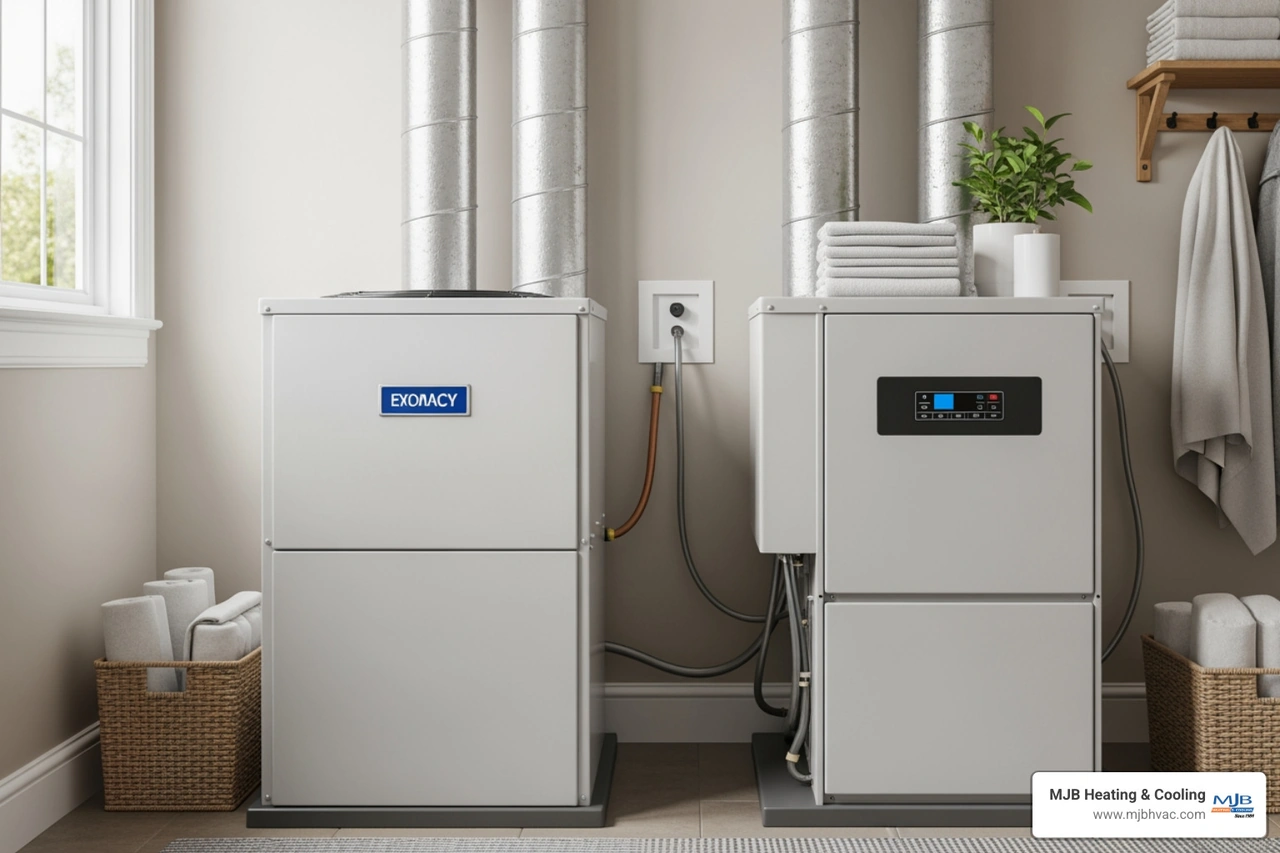

The standard efficiency vs high efficiency HVAC comparison is one of the most important decisions you'll make when replacing your home's heating or cooling system — and in Central Kansas, where summers run hot and winters can be brutal, getting it right has a real impact on your comfort and your utility bills.
Here's a quick breakdown to answer the core question right away:
| Feature | Standard Efficiency | High Efficiency |
|---|---|---|
| Central AC (SEER2) | 13.4 - 15 | 16 - 30+ |
| Furnace (AFUE) | ~80% | 90 - 98% |
| Heat Pump (HSPF2) | Up to 7.7 | 9.0+ |
| Compressor Type | Single-stage | Variable-speed or two-stage |
| Venting | Metal flue | PVC pipe |
| Condensate Drain | No | Yes |
| Annual Energy Savings vs Standard | Baseline | 15 - 28% less energy used |
| Typical Payback Period | N/A | 5 - 12 years depending on climate and usage |
| Comfort Level | Basic on/off cycling | Steady airflow, fewer temperature swings |
| Noise Level | Louder starts and stops | Quieter, gradual ramp-up |
The short answer: high-efficiency systems cost more upfront but use significantly less energy, run more quietly, and keep your home more comfortable. Whether that trade-off makes sense depends on how long you plan to stay, how often your system runs, and what fuel you're using.
But there's more to the decision than a single number on a rating label. A high-efficiency furnace that converts 96% of its gas into heat still underperforms if your ductwork leaks 25% of that air into the attic. Ratings tell you what a system can do — installation quality, home insulation, and proper sizing determine what it actually does.
In this guide, MJB Heating & Cooling walks you through every angle of the standard vs high efficiency HVAC comparison — from technical design differences and real-world energy savings to Kansas-specific climate considerations, current rebates, and honest guidance on when each option makes the most sense for your home.
For most homeowners in Wichita, Derby, Andover, Hutchinson, Newton, and the rest of our Central Kansas service area, the real question is not "Is high efficiency better?" It usually is. The real question is "Is it better for my home, my usage, and how long I plan to stay here?"
Here is the practical side-by-side view:
| Category | Standard Efficiency | High Efficiency |
|---|---|---|
| AC efficiency | 13.4 to 15 SEER2 | 16 to 18 SEER2 common, 18+ premium |
| Furnace efficiency | Around 80 AFUE | 90 to 98 AFUE |
| Heat pump efficiency | About 7.5 to 7.7 HSPF2 | 9.0+ HSPF2 |
| Operation | Single-stage, mostly on/off | Two-stage or variable-capacity |
| Indoor blower | Basic PSC or lower-end motor designs | ECM or variable-speed blower |
| Comfort | More temperature swing | More even temperatures |
| Humidity control | Basic | Better dehumidification during cooling |
| Sound | More noticeable starts and stops | Lower, smoother sound profile |
| Installation needs | Simpler venting | May need PVC venting and condensate drain |
| Best fit | Lowest initial investment, simple replacement | Long-term savings and comfort focus |
In 2026, "standard efficiency" does not mean old or bad equipment. It means equipment built close to today's federal minimum efficiency standards.
For most homes, that means:
In plain English, standard-efficiency equipment is the baseline option. It meets modern requirements, cools and heats your home safely, and can be the right answer when simplicity and lower upfront investment matter most.
"High efficiency" usually starts where performance moves beyond minimum compliance and into better part-load operation, better comfort, and lower utility use.
For most homeowners, that means:
This is where equipment starts doing more than just turning on and off. It starts adjusting to your home's actual needs. If you want a deeper explanation of what these ratings mean, see Efficiency Ratings Explained for Homeowners.
The biggest difference is how systems handle partial demand.
A standard system usually runs at full output, reaches the thermostat setting, then shuts off. That works, but it creates more cycling losses, bigger temperature swings, and less precise humidity removal.
A high-efficiency system is usually better at part-load operation. Instead of full blast or nothing, it can run longer at lower speeds. That matters because homes rarely need 100% output all day long. In real life, most HVAC systems spend much of their time meeting moderate demand, not extreme demand.
That is why high-efficiency equipment often feels better even before you notice the utility savings.
A lot of the performance gap comes from hardware.
A standard 80 AFUE furnace usually has:
A high-efficiency condensing furnace usually has:
That secondary heat exchanger is the key. It recovers heat that a standard furnace simply sends outside.
On the cooling side, the difference is usually in compressor and blower design:
This is where homeowners usually say, "Oh, now I get it."
A single-stage system behaves like a light switch. It is on or off.
A variable-speed system behaves more like a dimmer switch. It can ease into operation, run steadily, and match output more closely to the weather and your home's demand.
That helps with:
Some high-efficiency systems can make temperature adjustments in much smaller increments than standard equipment, which helps keep room temperatures more stable. In practical terms, that can mean 1 to 2 degree swings instead of 3 to 5 degree swings.
Here is the part homeowners do not always hear during a quick sales pitch: ratings are only part of the story.
Real-world efficiency depends heavily on:
Duct leakage can waste 20% to 30% of conditioned air in many homes. An oversized unit can short-cycle and fail to dehumidify properly. An undersized unit may run constantly and still struggle. Even the best high-efficiency system can disappoint if it is installed poorly.
That is why we always recommend proper system sizing and duct evaluation, not just comparing model numbers. For more on that, read How Proper HVAC Sizing Affects Comfort and Efficiency.
When homeowners ask whether high efficiency is "worth it," they usually mean one thing: will the savings justify the upgrade?
The honest answer is: sometimes quickly, sometimes slowly.
Research consistently shows that high-efficiency systems can reduce energy use by about 15% to 28% compared with standard models, depending on the equipment type and how often it runs.
Examples:
Homes heated with propane or electric resistance usually see the strongest savings from high-efficiency upgrades. If you want a closer look at savings scenarios, see How Much Does a High Efficiency System Save.
Payback tends to be faster when:
Payback tends to be slower when:
For Kansas homeowners, this often means high-efficiency furnaces and heat pumps make the most sense in homes with heavy seasonal use, especially where comfort problems or fuel costs are already noticeable.
A newer, efficient HVAC system can also help your home in ways that do not show up on the monthly utility bill.
Benefits can include:
If resale value is part of your thinking, this guide is worth reading: How a New HVAC System Increases Home Value.
This is the section where efficiency becomes personal.
A standard system can absolutely heat and cool a home. But because it often cycles on and off in bigger bursts, you may notice:
High-efficiency systems usually run longer at lower output. That means:
In a Kansas summer, that humidity control matters. Your thermostat might say 72 either way, but 72 with lower humidity feels much better than 72 with sticky air. Your skin knows the difference, even if your thermostat is staying neutral.
High-efficiency systems are usually quieter because they do not slam on at full power as often.
Noise improvements often come from:
Standard systems are not necessarily loud, but they are more likely to produce that familiar "thump... whoosh..." startup pattern. High-efficiency systems are usually smoother and less noticeable, which is great if your outdoor unit is near a patio or your indoor equipment is close to living space.
High-efficiency systems can support better indoor air quality, but they are not magic boxes.
They may help by:
But they still depend on basics:
So yes, high-efficiency equipment can help indoor air quality, but it works best as part of a whole-home approach.
There is no universal winner for every home in Central Kansas. The right choice depends on your house, your fuel type, and your goals.
High-efficiency equipment often makes the most sense when:
This is especially true in larger homes, multi-level homes, and homes with a history of hot and cold spots.
A standard system can still be the better choice when:
There is nothing "wrong" with choosing standard efficiency when the math and circumstances support it. Sometimes simple really is smart.
This is where the standard efficiency vs high efficiency HVAC comparison overlaps with system type.
A traditional AC cools only. A furnace handles heating. A heat pump can do both by reversing refrigerant flow.
In cooling mode, a heat pump and an AC can have very similar efficiency. The big difference shows up in heating mode.
Heat pumps are often a great fit when:
For many Kansas homes, dual-fuel systems can be a strong option because they combine heat pump efficiency in milder weather with furnace performance in colder conditions. If you want to understand heating efficiency on heat pumps better, see Discover Energy Savings with Daikin's HSPF Rating Insights.
Before replacing a system, we recommend using this checklist:
Both system types need regular maintenance. Neither one enjoys neglect.
Standard systems typically need:
High-efficiency systems need all of the above, plus closer attention to components such as:
That does not always mean "more maintenance," but it can mean more specialized maintenance. Annual professional service is a smart move either way.
Rebates and incentives can change quickly, so we always recommend checking current programs before you decide.
Places to look include:
Research in this topic area shows incentives can significantly improve payback, especially on qualifying heat pumps and high-efficiency systems. For Kansas-focused guidance, visit Kansas Energy Rebates for HVAC Upgrades.
Before you sign off on any replacement, ask these questions:
If you are comparing features between equipment lines, What Makes Daikin HVAC Systems Different can help you understand what to look for.
For Central Kansas homeowners, the best HVAC decision is not always the one with the highest rating. It is the one that matches your home, your comfort goals, and how long you plan to live there.
In many Wichita-area homes, high-efficiency systems are worth serious consideration because they can lower energy use, improve humidity control, reduce noise, and deliver steadier comfort in both summer and winter. But standard-efficiency equipment still has a valid place, especially when simplicity and lower upfront investment are the priority.
At MJB Heating & Cooling, we have served the Wichita metro and surrounding communities since 1984 with honest guidance, quality workmanship, and practical recommendations that fit the home in front of us, not a one-size-fits-all sales pitch.
If you want help comparing your options, visit https://www.mjbhvac.com to learn more or schedule service with our family-owned team.
The standard efficiency vs high efficiency HVAC comparison is one of the most important decisions you'll make when replacing your home's heating or cooling system — and in Central Kansas, where summers run hot and winters can be brutal, getting it right has a real impact on your comfort and your utility bills.
Here's a quick breakdown to answer the core question right away:
| Feature | Standard Efficiency | High Efficiency |
|---|---|---|
| Central AC (SEER2) | 13.4 - 15 | 16 - 30+ |
| Furnace (AFUE) | ~80% | 90 - 98% |
| Heat Pump (HSPF2) | Up to 7.7 | 9.0+ |
| Compressor Type | Single-stage | Variable-speed or two-stage |
| Venting | Metal flue | PVC pipe |
| Condensate Drain | No | Yes |
| Annual Energy Savings vs Standard | Baseline | 15 - 28% less energy used |
| Typical Payback Period | N/A | 5 - 12 years depending on climate and usage |
| Comfort Level | Basic on/off cycling | Steady airflow, fewer temperature swings |
| Noise Level | Louder starts and stops | Quieter, gradual ramp-up |
The short answer: high-efficiency systems cost more upfront but use significantly less energy, run more quietly, and keep your home more comfortable. Whether that trade-off makes sense depends on how long you plan to stay, how often your system runs, and what fuel you're using.
But there's more to the decision than a single number on a rating label. A high-efficiency furnace that converts 96% of its gas into heat still underperforms if your ductwork leaks 25% of that air into the attic. Ratings tell you what a system can do — installation quality, home insulation, and proper sizing determine what it actually does.
In this guide, MJB Heating & Cooling walks you through every angle of the standard vs high efficiency HVAC comparison — from technical design differences and real-world energy savings to Kansas-specific climate considerations, current rebates, and honest guidance on when each option makes the most sense for your home.
For most homeowners in Wichita, Derby, Andover, Hutchinson, Newton, and the rest of our Central Kansas service area, the real question is not "Is high efficiency better?" It usually is. The real question is "Is it better for my home, my usage, and how long I plan to stay here?"
Here is the practical side-by-side view:
| Category | Standard Efficiency | High Efficiency |
|---|---|---|
| AC efficiency | 13.4 to 15 SEER2 | 16 to 18 SEER2 common, 18+ premium |
| Furnace efficiency | Around 80 AFUE | 90 to 98 AFUE |
| Heat pump efficiency | About 7.5 to 7.7 HSPF2 | 9.0+ HSPF2 |
| Operation | Single-stage, mostly on/off | Two-stage or variable-capacity |
| Indoor blower | Basic PSC or lower-end motor designs | ECM or variable-speed blower |
| Comfort | More temperature swing | More even temperatures |
| Humidity control | Basic | Better dehumidification during cooling |
| Sound | More noticeable starts and stops | Lower, smoother sound profile |
| Installation needs | Simpler venting | May need PVC venting and condensate drain |
| Best fit | Lowest initial investment, simple replacement | Long-term savings and comfort focus |
In 2026, "standard efficiency" does not mean old or bad equipment. It means equipment built close to today's federal minimum efficiency standards.
For most homes, that means:
In plain English, standard-efficiency equipment is the baseline option. It meets modern requirements, cools and heats your home safely, and can be the right answer when simplicity and lower upfront investment matter most.
"High efficiency" usually starts where performance moves beyond minimum compliance and into better part-load operation, better comfort, and lower utility use.
For most homeowners, that means:
This is where equipment starts doing more than just turning on and off. It starts adjusting to your home's actual needs. If you want a deeper explanation of what these ratings mean, see Efficiency Ratings Explained for Homeowners.
The biggest difference is how systems handle partial demand.
A standard system usually runs at full output, reaches the thermostat setting, then shuts off. That works, but it creates more cycling losses, bigger temperature swings, and less precise humidity removal.
A high-efficiency system is usually better at part-load operation. Instead of full blast or nothing, it can run longer at lower speeds. That matters because homes rarely need 100% output all day long. In real life, most HVAC systems spend much of their time meeting moderate demand, not extreme demand.
That is why high-efficiency equipment often feels better even before you notice the utility savings.
A lot of the performance gap comes from hardware.
A standard 80 AFUE furnace usually has:
A high-efficiency condensing furnace usually has:
That secondary heat exchanger is the key. It recovers heat that a standard furnace simply sends outside.
On the cooling side, the difference is usually in compressor and blower design:
This is where homeowners usually say, "Oh, now I get it."
A single-stage system behaves like a light switch. It is on or off.
A variable-speed system behaves more like a dimmer switch. It can ease into operation, run steadily, and match output more closely to the weather and your home's demand.
That helps with:
Some high-efficiency systems can make temperature adjustments in much smaller increments than standard equipment, which helps keep room temperatures more stable. In practical terms, that can mean 1 to 2 degree swings instead of 3 to 5 degree swings.
Here is the part homeowners do not always hear during a quick sales pitch: ratings are only part of the story.
Real-world efficiency depends heavily on:
Duct leakage can waste 20% to 30% of conditioned air in many homes. An oversized unit can short-cycle and fail to dehumidify properly. An undersized unit may run constantly and still struggle. Even the best high-efficiency system can disappoint if it is installed poorly.
That is why we always recommend proper system sizing and duct evaluation, not just comparing model numbers. For more on that, read How Proper HVAC Sizing Affects Comfort and Efficiency.
When homeowners ask whether high efficiency is "worth it," they usually mean one thing: will the savings justify the upgrade?
The honest answer is: sometimes quickly, sometimes slowly.
Research consistently shows that high-efficiency systems can reduce energy use by about 15% to 28% compared with standard models, depending on the equipment type and how often it runs.
Examples:
Homes heated with propane or electric resistance usually see the strongest savings from high-efficiency upgrades. If you want a closer look at savings scenarios, see How Much Does a High Efficiency System Save.
Payback tends to be faster when:
Payback tends to be slower when:
For Kansas homeowners, this often means high-efficiency furnaces and heat pumps make the most sense in homes with heavy seasonal use, especially where comfort problems or fuel costs are already noticeable.
A newer, efficient HVAC system can also help your home in ways that do not show up on the monthly utility bill.
Benefits can include:
If resale value is part of your thinking, this guide is worth reading: How a New HVAC System Increases Home Value.
This is the section where efficiency becomes personal.
A standard system can absolutely heat and cool a home. But because it often cycles on and off in bigger bursts, you may notice:
High-efficiency systems usually run longer at lower output. That means:
In a Kansas summer, that humidity control matters. Your thermostat might say 72 either way, but 72 with lower humidity feels much better than 72 with sticky air. Your skin knows the difference, even if your thermostat is staying neutral.
High-efficiency systems are usually quieter because they do not slam on at full power as often.
Noise improvements often come from:
Standard systems are not necessarily loud, but they are more likely to produce that familiar "thump... whoosh..." startup pattern. High-efficiency systems are usually smoother and less noticeable, which is great if your outdoor unit is near a patio or your indoor equipment is close to living space.
High-efficiency systems can support better indoor air quality, but they are not magic boxes.
They may help by:
But they still depend on basics:
So yes, high-efficiency equipment can help indoor air quality, but it works best as part of a whole-home approach.
There is no universal winner for every home in Central Kansas. The right choice depends on your house, your fuel type, and your goals.
High-efficiency equipment often makes the most sense when:
This is especially true in larger homes, multi-level homes, and homes with a history of hot and cold spots.
A standard system can still be the better choice when:
There is nothing "wrong" with choosing standard efficiency when the math and circumstances support it. Sometimes simple really is smart.
This is where the standard efficiency vs high efficiency HVAC comparison overlaps with system type.
A traditional AC cools only. A furnace handles heating. A heat pump can do both by reversing refrigerant flow.
In cooling mode, a heat pump and an AC can have very similar efficiency. The big difference shows up in heating mode.
Heat pumps are often a great fit when:
For many Kansas homes, dual-fuel systems can be a strong option because they combine heat pump efficiency in milder weather with furnace performance in colder conditions. If you want to understand heating efficiency on heat pumps better, see Discover Energy Savings with Daikin's HSPF Rating Insights.
Before replacing a system, we recommend using this checklist:
Both system types need regular maintenance. Neither one enjoys neglect.
Standard systems typically need:
High-efficiency systems need all of the above, plus closer attention to components such as:
That does not always mean "more maintenance," but it can mean more specialized maintenance. Annual professional service is a smart move either way.
Rebates and incentives can change quickly, so we always recommend checking current programs before you decide.
Places to look include:
Research in this topic area shows incentives can significantly improve payback, especially on qualifying heat pumps and high-efficiency systems. For Kansas-focused guidance, visit Kansas Energy Rebates for HVAC Upgrades.
Before you sign off on any replacement, ask these questions:
If you are comparing features between equipment lines, What Makes Daikin HVAC Systems Different can help you understand what to look for.
For Central Kansas homeowners, the best HVAC decision is not always the one with the highest rating. It is the one that matches your home, your comfort goals, and how long you plan to live there.
In many Wichita-area homes, high-efficiency systems are worth serious consideration because they can lower energy use, improve humidity control, reduce noise, and deliver steadier comfort in both summer and winter. But standard-efficiency equipment still has a valid place, especially when simplicity and lower upfront investment are the priority.
At MJB Heating & Cooling, we have served the Wichita metro and surrounding communities since 1984 with honest guidance, quality workmanship, and practical recommendations that fit the home in front of us, not a one-size-fits-all sales pitch.
If you want help comparing your options, visit https://www.mjbhvac.com to learn more or schedule service with our family-owned team.


Our A/C stopped working on a Sunday and due to health issues, we needed to find a service company available on a Sunday. I called MJB and left a message on their emergency voice mail. Within 10 minutes Tom Buck called me to hear my description of the symptoms. He was just finishing an appointment in Wichita and would be on his way to my home on the south end of Derby. He arrived within 30 minutes! From start to finish he was the perfect example of what you could ever hope for in an HVAC tech and a human being. His evaluation of our system inside and out was as thorough as I could ever imagine and once he was done with the repair, our system is running as well or better than ever. Well worth the price for the evaluation, parts, and labor. Thank you again Tom for an awesome experience.
Our AC went out during the hottest days of the year, and they were out next day! We have been jerked around by a shoddy home warranty for years. We finally had a chance to pick our own repair people, and MJB came highly recommended. I can see why! I was impressed with the honesty and speed at which they fixed our AC unit!
Our commercial building had a lightening/electrical strike and damaged our 20 ton AC unit. No one could find us a new unit before the end of September. Imagining going all of August and September with no AC in Kansas and working inside near 100 degree temps is less than thrilling. Dale and the team at MJB called around and saved the day. They had us a new unit 5 weeks earlier than other could promise and I now have happy employees. The unit is amazingly quiet, super cold and so much more energy efficient. Thank you for being our super hero!
Came out and installed my new furnace. Was very polite and affordable. They are very acknowledgeable and I highly recommend!
Thank you very much. We had our 1st warm night in 3weeks. MJB took the time and effort to find the real problem. And the employees were kind and thoughtful and explained things very well. I cannot thank you and all of MJB. Will recommend you highly. Thanks again Marjorie Herman Oxford Kansas
We had a new system installed and I was so impressed with how quick they were in come out and install it, in the middle of a hot summer day. They were so friendly & very professional. I had a small problem with a weird sound and they came over immediately and fixed it. Love them!