.avif)





Blogs
Stay updated with our latest blog posts.
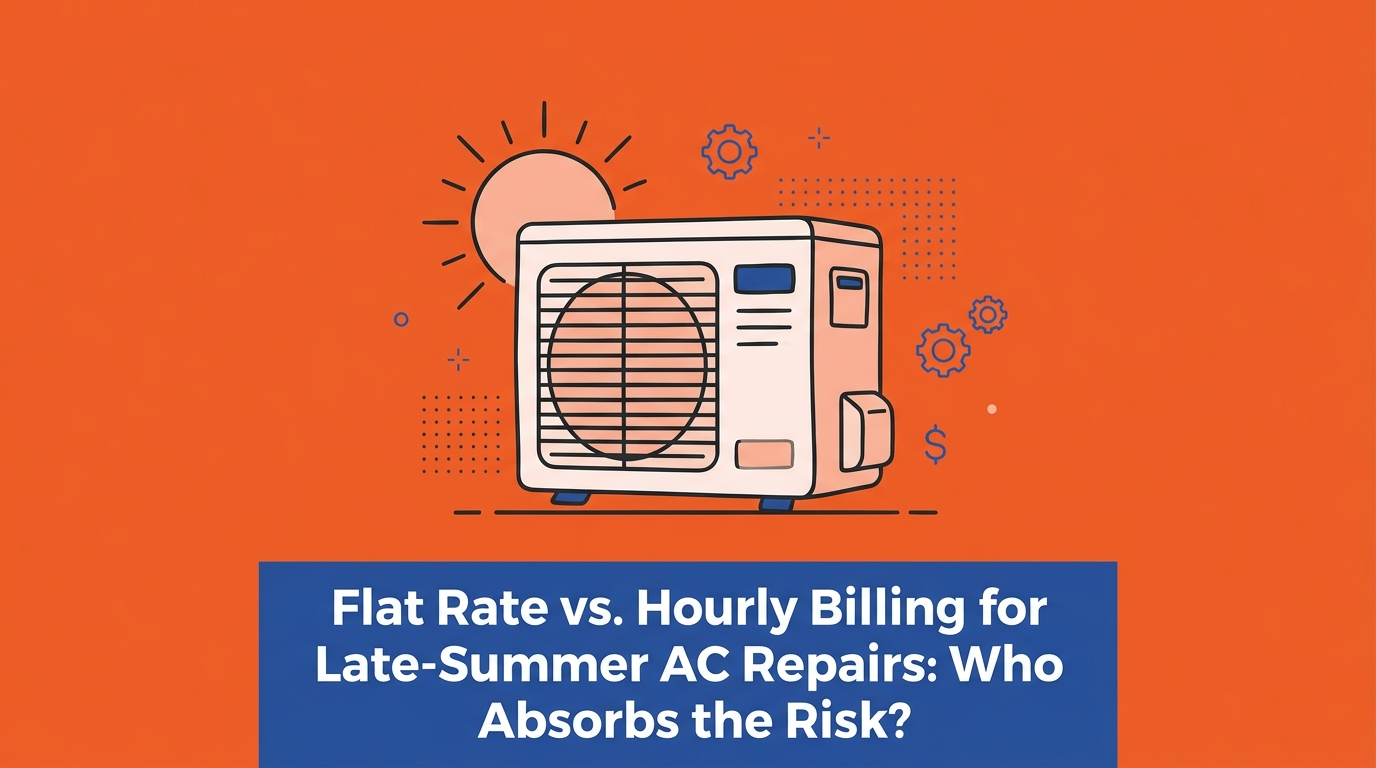

Have you ever found yourself weighing the pros and cons of flat rate vs. hourly billing for late-summer AC repairs while watching a technician work and worrying about a ticking clock? It is an incredibly stressful position for any homeowner. When your cooling system suddenly fails during the intense heat of a Derby KS August, you want it fixed as fast as possible—but you also need to know exactly what the final bill will be. At MJB Heating & Cooling, we know firsthand that the billing model a home service company uses directly dictates who assumes the financial risk of a complex, time-consuming repair.
If a technician spends three hours tracking down a stubborn electrical fault, should you be the one paying for that extra time? Understanding how these two distinct pricing structures work is the best way to protect yourself from open-ended financial risk when you just want your home comfortable again.
Need immediate assistance? Explore our professional HVAC services to see how our team can help, or schedule an AC repair today to restore your comfort.
When an air conditioner breaks down, the initial diagnostic phase is often the most unpredictable part of the process. A symptom like "blowing warm air" could be caused by a simple tripped breaker, or it could be the result of a microscopic leak deep within the evaporator coil. Because the root cause is unknown until a professional opens up the cabinet, the way that diagnostic time is billed becomes highly important. If you are paying by the minute, every trip to the service van and every manual consulted adds to your total. By comparing flat-rate predictability against open-ended hourly models, you can make a much more informed decision about who you invite into your home.
Not all air conditioning breakdowns are created equal. An issue that surfaces in May is often very different from a failure that occurs during the late-summer August cooling season. To understand why billing methods matter so much right now, you have to look at what your equipment has endured over the past several months.
In our years serving Derby KS, our team typically sees that by the time the back-to-school season arrives in late August, your air conditioner has likely been running for hundreds of hours. This continuous, heavy operation causes compounded equipment fatigue. Components that were slightly worn in the spring are now pushed to their absolute limits. The lingering heat forces AC units to run non-stop, amplifying wear and tear by August and turning minor inefficiencies into complete system failures.
Common late-season issues we encounter include:
• Micro-refrigerant leaks: Tiny vibrations over months of heavy use can cause microscopic cracks in copper lines, leading to a slow loss of cooling power.
• Failing compressors: The compressor works harder as the outdoor temperatures rise. If it has been overworking all season, it may finally overheat and shut down.
• Degraded capacitors: These electronic components store energy to start your motors. Prolonged exposure to high heat causes them to swell and eventually fail.
• Overheated blower motors: Pushing air through increasingly dirty filters all summer puts immense strain on the blower motor, often leading to late-season electrical shorts.
Diagnosing these layered, late-season issues requires meticulous testing rather than a quick visual glance. A technician cannot simply guess why a compressor overheated; they must test the electrical draw, check the refrigerant charge, and measure the airflow. This level of thoroughness takes time. If you are wondering why your AC stopped working at night after running fine all day, the answer is often buried under layers of seasonal fatigue that take careful investigation to uncover.
When you are sweltering in your Derby KS home, the mechanics of how a service call is billed might be the last thing on your mind. However, the hourly billing model fundamentally shifts the burden of risk onto your shoulders. In an hourly structure, you are charged for every minute the technician is on-site, regardless of how efficiently they work or how complex the problem turns out to be.
The most immediate drawback of hourly billing is the psychological stress it creates. Every time the technician walks out to their van for a part, consults a wiring schematic, or spends extra time testing a complicated circuit board, you know you are paying for that time. This creates a highly uncomfortable dynamic where you feel the need to monitor the clock instead of simply trusting the process.
Here are the specific hidden risks you face when paying by the hour:
• Paying for the learning curve: If a technician is newer to the field or unfamiliar with your specific equipment brand, they will naturally take longer to diagnose the issue. Under an hourly model, you end up paying extra for their on-the-job education.
• The complexity penalty: Modern cooling systems are highly complex, featuring variable-speed motors and intricate communication boards. Finding a microscopic short circuit takes time. You shouldn't be penalized financially simply because your machine has an obscure, hard-to-find issue.
• Incentivizing slow work: While most technicians are honest professionals, an open-ended hourly model inherently rewards slower work. There is no financial incentive for the company to invest in faster diagnostic tools or highly efficient training if they get paid more the longer a job takes.
• Unpredictable final totals: You cannot make an informed financial decision when you do not know the final number. Approving a repair without knowing the total cost is a gamble that many homeowners cannot afford to take.
Ultimately, hourly billing forces you to absorb the financial impact of a difficult diagnostic. When the heat is relentless, this added layer of financial anxiety is the last thing you need.
To combat the uncertainty of open-ended bills, our team at MJB Heating & Cooling operates on flat-rate pricing. This model is designed specifically to shift the diagnostic risk away from the homeowner and place it squarely on our shoulders. By offering transparent, flat-rate pricing that guarantees homeowners know exactly what they will pay upfront, eliminating the risk of inflated hourly bills, you gain total control over your repair decisions.
Flat-rate pricing provides a guaranteed, upfront cost for the job, regardless of how long it takes to complete. Before any tools are used to fix the problem, our technicians diagnose the system and present you with a firm quote. This quote includes the cost of the parts, the labor required to install them, and the expertise needed to do the job right. Whether the repair takes forty-five minutes or three hours, your final bill remains exactly what you agreed to.
This model forces the business to absorb the cost of a difficult, time-consuming diagnostic. If a technician runs into unexpected trouble while replacing a fan motor during the late-summer August cooling season, the company eats that extra labor time, not you. This allows technicians to take the time they actually need to fix the problem correctly without the customer stressing over the final bill.
We recently helped a local homeowner who experienced this firsthand when their AC system developed a highly unusual fault. Because our diagnostic and repair were priced at a flat rate, our technician took the necessary time to accurately trace the obscure issue and ensure it was fixed right the first time. The customer didn't have to worry about an escalating labor charge while we worked diligently to solve the problem.
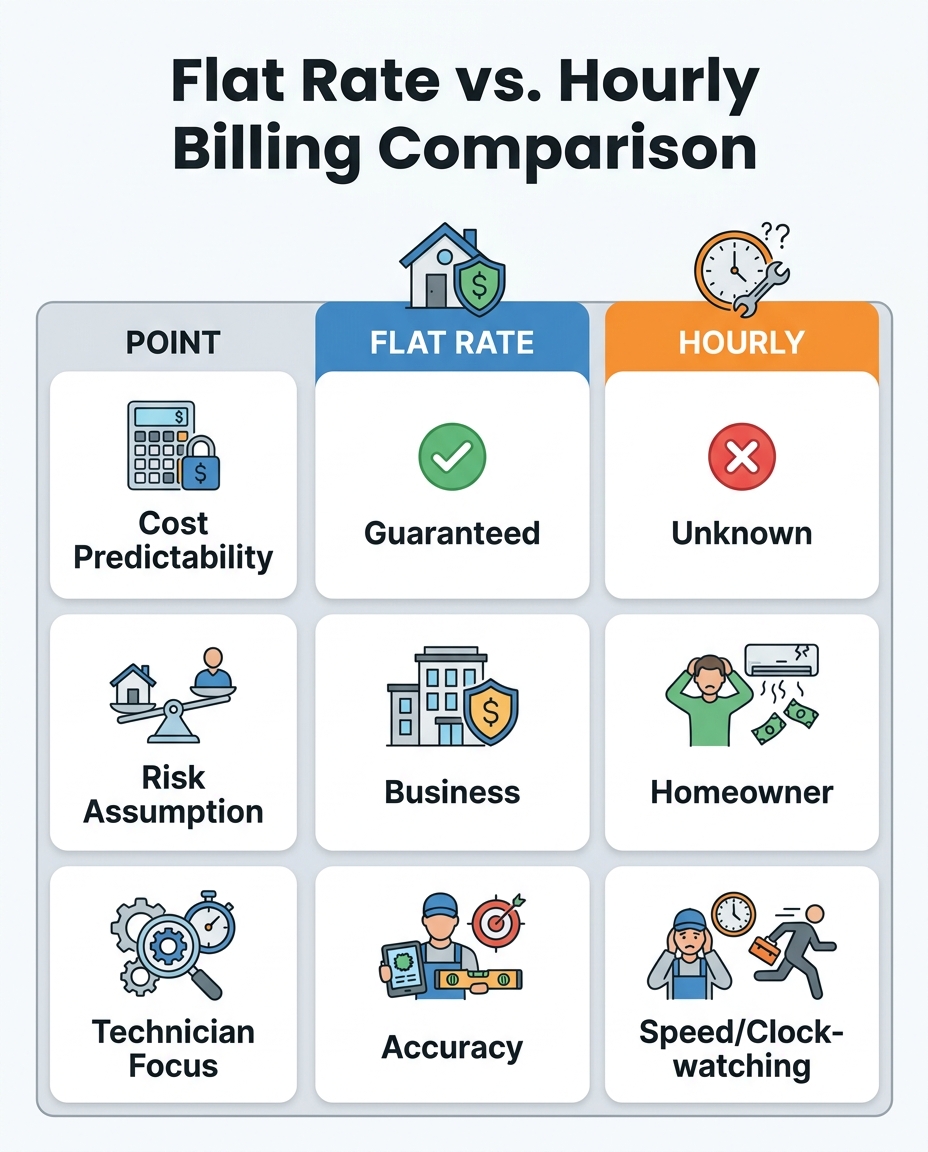
To truly understand the difference between these two approaches, it helps to look at them side-by-side. The way a company charges tells you a lot about how they value your time and your budget. When you live in Derby KS, where the summer weather demands reliable cooling, choosing the right billing model is just as important as choosing the right equipment.
• Cost Predictability — Flat-Rate Pricing: Guaranteed upfront before work begins. — Hourly Billing: Unknown until the job is completely finished.
• Risk Assumption — Flat-Rate Pricing: The business absorbs the cost of delays. — Hourly Billing: The homeowner pays for every extra minute.
• Technician Motivation — Flat-Rate Pricing: Focused on accuracy and doing the job right once. — Hourly Billing: Can inadvertently reward slower work or clock-milking.
• Homeowner Stress Level — Flat-Rate Pricing: Low. You know exactly what to expect. — Hourly Billing: High. The ticking clock creates constant anxiety.
• Approval Process — Flat-Rate Pricing: You approve a firm total before repairs start. — Hourly Billing: You approve an hourly rate, hoping it stays low.
The contrast is clear. Flat-rate billing is built on transparency, while hourly billing is built on variables you cannot control. By choosing a company that guarantees their pricing upfront, you are choosing peace of mind over uncertainty.
One of the most dangerous side effects of hourly billing is the pressure it puts on both the homeowner and the technician to rush. When you know you are paying by the minute, you might pressure the technician to hurry up. In response, the technician might rush through their diagnostic steps to keep your hourly bill low. This creates a perfect storm for misdiagnosing the root cause of the failure.
Rushing through a diagnostic often means treating the symptom rather than the disease. For example, a technician might quickly replace a blown fuse to get the system running and stop the clock. However, if they don't take the time to find out why the fuse blew in the first place, the system will inevitably break down again. In extreme late-summer heat, a misdiagnosis means suffering through dangerously hot indoor temperatures for days while you wait for a second service call.
Our team saw the fallout of this firsthand when a customer reached out to us after their AC was misdiagnosed by another contractor. They had been stuck without working cooling for almost a week in the sweltering heat. By taking the time to accurately assess the situation without watching a clock, our technicians finally brought the system back online and eventually replaced it with a reliable new unit. The house was finally nice and cool, all because the diagnostic process wasn't rushed.
Flat-rate pricing gives technicians the freedom to be thorough. During the late-summer August cooling season, your system needs a comprehensive evaluation. A technician working under a flat-rate model can check the refrigerant levels, test the electrical components, and inspect the ductwork without worrying that they are driving up your bill. This thoroughness is exactly what a preventative maintenance plan aims to achieve proactively, but it is equally critical during an emergency breakdown.
Even with the most predictable pricing model in the world, an end-of-season AC repair can still be a surprise expense. Air conditioners rarely give you a warning before they fail, and replacing major components like a compressor or an evaporator coil is a significant investment in your home. However, there is a massive difference between a surprise expense that is clearly quoted upfront and a surprise expense that continues to grow by the hour.
Knowing the exact cost upfront allows homeowners to make informed financial decisions immediately. When our technicians hand you a firm flat-rate quote, you can sit down at your kitchen table and decide how to proceed. You can weigh the cost of the repair against the age of the unit, and you can determine the best way to pay for it without the pressure of a running meter.
A customer recently called our team for help when their home AC needed urgent late-summer service in Derby KS. Because we provided courteous, upfront pricing immediately after the diagnostic, they could confidently approve the work and trust the process. Knowing the total cost allowed them to breathe easier.
When you know the final number, you can also explore options for managing larger, unexpected repair or replacement costs responsibly. Many homeowners choose to utilize flexible financing options to break a large flat-rate quote into manageable monthly payments. This is virtually impossible to do with an hourly bill, because you cannot finance an unknown amount. Predictability empowers you to take control of your comfort and your budget.
At MJB Heating & Cooling, we use flat-rate pricing to provide transparency and upfront cost guarantees to our customers. This model removes the anxiety of hourly billing, ensuring you never have to watch the clock while a technician works. It also allows us to absorb the financial risk if a repair takes longer than expected.
Yes, flat-rate repair is generally better for the homeowner because the company absorbs the risk of a repair taking longer than expected. It ensures technicians focus on quality and accuracy rather than rushing to keep an hourly labor charge low. You gain total peace of mind knowing the final bill before the work even begins.
Some technicians do still charge by the hour, but many modern, customer-focused companies have shifted entirely to flat-rate pricing. Hourly charging can lead to unpredictable final bills and creates unnecessary stress for the homeowner. Always ask a company about their billing structure before you schedule a service call.
Flat-rate pricing is a billing model where a specific job has a set price, regardless of the time it takes to complete. This clear upfront quote includes the necessary parts, the required labor, and the diagnostic expertise. It protects you from open-ended invoices and hidden fees.
Simple issues may take just a few minutes to identify, but complex end-of-season electrical or refrigerant faults can take hours to properly diagnose. During the late-summer August cooling season, equipment fatigue makes failures harder to trace. This wide variability in diagnostic time is exactly why flat-rate pricing is safer for your household budget.
When your air conditioner fails in the heat of a Derby KS summer, you shouldn't have to pay for a technician's extra hours just to figure out what went wrong. Diagnosing stubborn late-season issues takes time, patience, and expertise. With a flat-rate pricing model, you are protected from the anxiety of a ticking clock, and our business takes on the risk of a complicated repair. You deserve a clear, transparent explanation of your options and a firm quote before any work begins. If your system is struggling, do not wait for the problem to get worse. Reach out to MJB Heating & Cooling today to schedule an AC repair and secure your comfort with pricing you can trust.


Our A/C stopped working on a Sunday and due to health issues, we needed to find a service company available on a Sunday. I called MJB and left a message on their emergency voice mail. Within 10 minutes Tom Buck called me to hear my description of the symptoms. He was just finishing an appointment in Wichita and would be on his way to my home on the south end of Derby. He arrived within 30 minutes! From start to finish he was the perfect example of what you could ever hope for in an HVAC tech and a human being. His evaluation of our system inside and out was as thorough as I could ever imagine and once he was done with the repair, our system is running as well or better than ever. Well worth the price for the evaluation, parts, and labor. Thank you again Tom for an awesome experience.
Our AC went out during the hottest days of the year, and they were out next day! We have been jerked around by a shoddy home warranty for years. We finally had a chance to pick our own repair people, and MJB came highly recommended. I can see why! I was impressed with the honesty and speed at which they fixed our AC unit!
Our commercial building had a lightening/electrical strike and damaged our 20 ton AC unit. No one could find us a new unit before the end of September. Imagining going all of August and September with no AC in Kansas and working inside near 100 degree temps is less than thrilling. Dale and the team at MJB called around and saved the day. They had us a new unit 5 weeks earlier than other could promise and I now have happy employees. The unit is amazingly quiet, super cold and so much more energy efficient. Thank you for being our super hero!
Came out and installed my new furnace. Was very polite and affordable. They are very acknowledgeable and I highly recommend!
Thank you very much. We had our 1st warm night in 3weeks. MJB took the time and effort to find the real problem. And the employees were kind and thoughtful and explained things very well. I cannot thank you and all of MJB. Will recommend you highly. Thanks again Marjorie Herman Oxford Kansas
We had a new system installed and I was so impressed with how quick they were in come out and install it, in the middle of a hot summer day. They were so friendly & very professional. I had a small problem with a weird sound and they came over immediately and fixed it. Love them!