.avif)





Blogs
Stay updated with our latest blog posts.
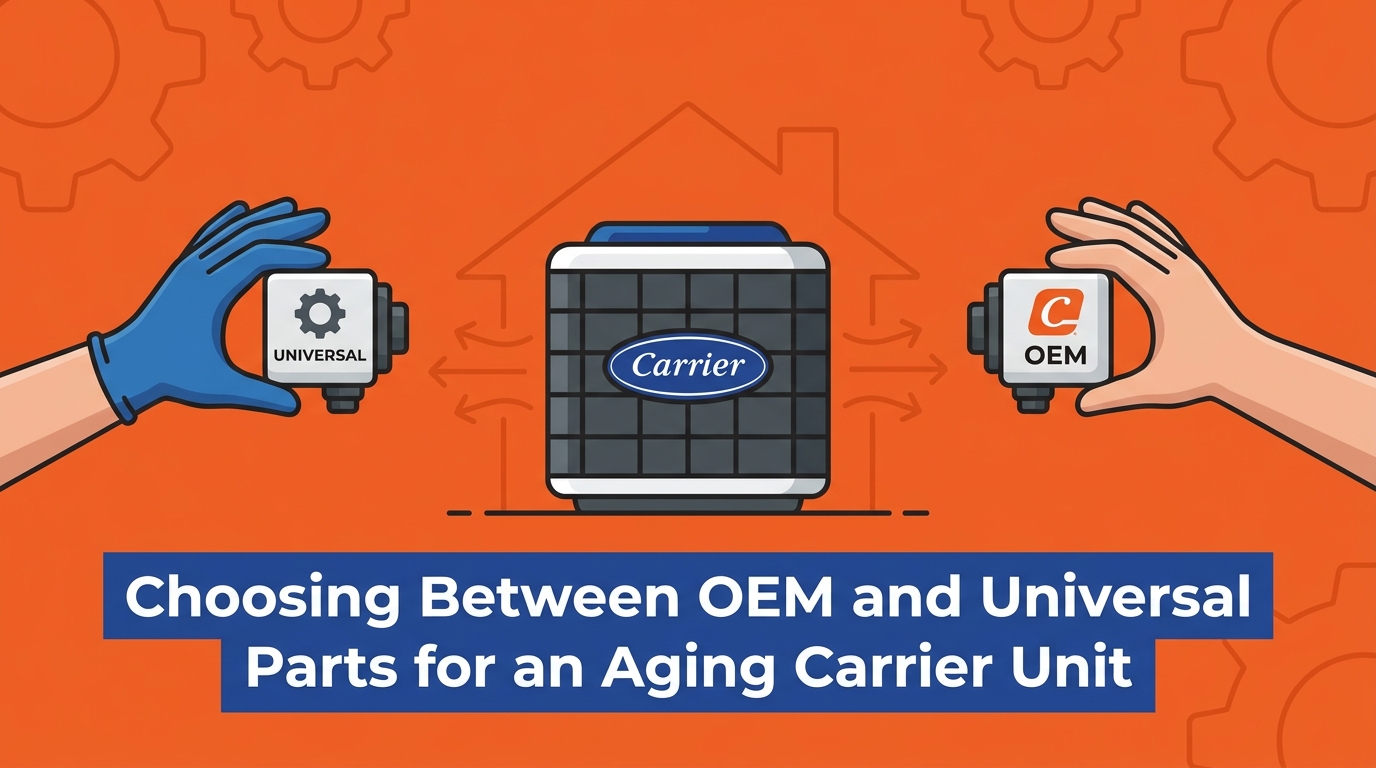

When your system shuts down in the sweltering late-summer heat, choosing between OEM and universal parts for an aging Carrier unit becomes an immediate, high-stakes decision. Is your air conditioner running nonstop, but the house still feels uncomfortably warm? Facing a sudden blower motor failure or a blown capacitor is stressful, especially in August as kids head back to school and you just want a cool home. For many homeowners, this scenario unfolds during the intense end-of-season heat, turning a comfortable home into an oven in a matter of hours.
Here at MJB Heating & Cooling, our technicians frequently help Derby homeowners navigate this exact breakdown. If you rely on an aging Carrier AC unit, a late-summer failure introduces a critical decision point. You need your home cooled down quickly, but you also want a repair that lasts. This leaves you weighing two distinct options: waiting for a specialized, exact-match replacement part to arrive, or authorizing the use of a readily available alternative to restore your comfort immediately. Balancing immediate relief with the long-term health of your HVAC system is not always straightforward.
Making this choice requires understanding the technical trade-offs of each path. Fortunately, relying on professional HVAC repair services can help you navigate this stressful situation, ensuring you have the facts needed to make the best decision for your home and your budget.
When an HVAC technician diagnoses a failed component inside your air conditioner, their first recommendation is usually an OEM replacement. OEM stands for Original Equipment Manufacturer. In this context, it means the replacement part was built by or specifically for Carrier, designed to the exact same specifications as the component that originally rolled off the assembly line.
These parts are engineered to meet strict quality control standards. Because they are designed specifically for your exact model, they ensure optimal airflow, energy efficiency, and electrical compatibility.
• Seamless integration: The physical dimensions, mounting brackets, and wiring harnesses match perfectly, meaning the technician does not have to modify your unit to make the part fit.
• Performance retention: An exact match ensures your air conditioner continues to operate at its intended efficiency rating, preventing unnecessary strain on the compressor.
• Safety compliance: Using the manufacturer's approved components maintains the safety testing certifications of the original equipment.
The primary drawback of choosing an OEM part for an aging Carrier AC unit is availability. As systems get older, local supply houses may stop keeping specific motors or circuit boards on the shelf. Ordering the part directly from the manufacturer or a regional warehouse introduces shipping lead times, which can be agonizing during peak breakdown seasons when demand is exceptionally high.
Opting for the exact manufacturer replacement provides significant peace of mind for long-term operation. It guarantees a physical fit without the need for custom bracket fabrication or complex wiring changes. By maintaining the original system efficiency, you protect the remaining lifespan of the unit. For homeowners who plan to keep their current air conditioner running for several more years, this reliability often outweighs the inconvenience of a short wait.
When the temperature inside your home is climbing and the OEM part is days away, universal parts become highly appealing. Universal, or aftermarket, parts are components designed and manufactured by third-party companies to fit a wide variety of HVAC brands and models, rather than just one specific unit.
The major advantage of universal parts is immediate availability. Local supply houses and technician service vans are heavily stocked with universal capacitors, contactors, and blower motors. This means your cooling can often be restored on the very same day the breakdown occurs.
However, choosing a universal part involves several technical realities that you should consider:
1. Installation modifications: Because a universal blower motor is designed to fit dozens of different air conditioners, it rarely drops perfectly into place. A technician often has to cut shafts to length, use adapter brackets, or modify the wiring harness to make it work in your specific Carrier unit.
2. Efficiency discrepancies: Universal motors may have slightly different RPMs (revolutions per minute) or electrical draws than your original motor. While they will get the air blowing again, they may not perfectly match the original efficiency specifications, potentially causing the system to work harder over time.
3. Durability concerns: While many aftermarket parts are built well, they are broadly engineered for mass compatibility rather than optimized for the unique airflow dynamics of your specific system.
The quick fix: Universal parts are excellent bridge solutions. Our team recently helped a local Derby family who went almost a week without AC during hot weather before reaching out for help. A quick diagnosis by our technicians and the use of readily available parts restored cooling temporarily, making the home livable again while they planned a long-term strategy, which ultimately involved installing a new system. Universal components often serve exactly this purpose—getting you out of an emergency.
Beyond immediate comfort and installation mechanics, you must consider how a replacement part affects your system's overall health and legal protections. Manufacturer warranties are highly specific agreements, and they generally stipulate the use of exact-match OEM parts to maintain coverage validity.
If your aging Carrier AC unit is still under a parts warranty, installing a universal blower motor or control board can void the remaining coverage for that specific section of the system—and potentially the entire unit, depending on the manufacturer's terms. Manufacturers cannot guarantee the performance of their equipment if third-party components alter the electrical load or airflow.
System compatibility is another critical factor. HVAC systems operate as closed loops where every component relies on the others. A universal motor that pulls slightly more electricity than the original can put unintended stress on an aging capacitor or control board. Over time, these small mismatched tolerances can accelerate wear and tear on surrounding parts, leading to a cascade of secondary breakdowns.
Regardless of which route you choose, keeping a close eye on system health is vital. Enrolling in a preventive HVAC maintenance plan allows a professional to monitor the electrical draw and physical condition of the replacement part, ensuring it integrates safely with your older equipment.
Making the right choice requires weighing the urgency of your situation against your long-term goals for the home. The extreme late-summer August heat in Derby, KS, makes waiting days for an OEM part feel unbearable, significantly elevating the appeal of universal parts. Conversely, if the weather is mild, waiting for the perfect part is much easier.
At MJB Heating & Cooling, taking the time to find the exact problem and ensuring it is fixed correctly is always our goal, a standard our customers appreciate after a thorough diagnostic visit fixes their system right the first time. To help you decide which path aligns with your current situation, here is a clear breakdown of the differences we discuss with homeowners:
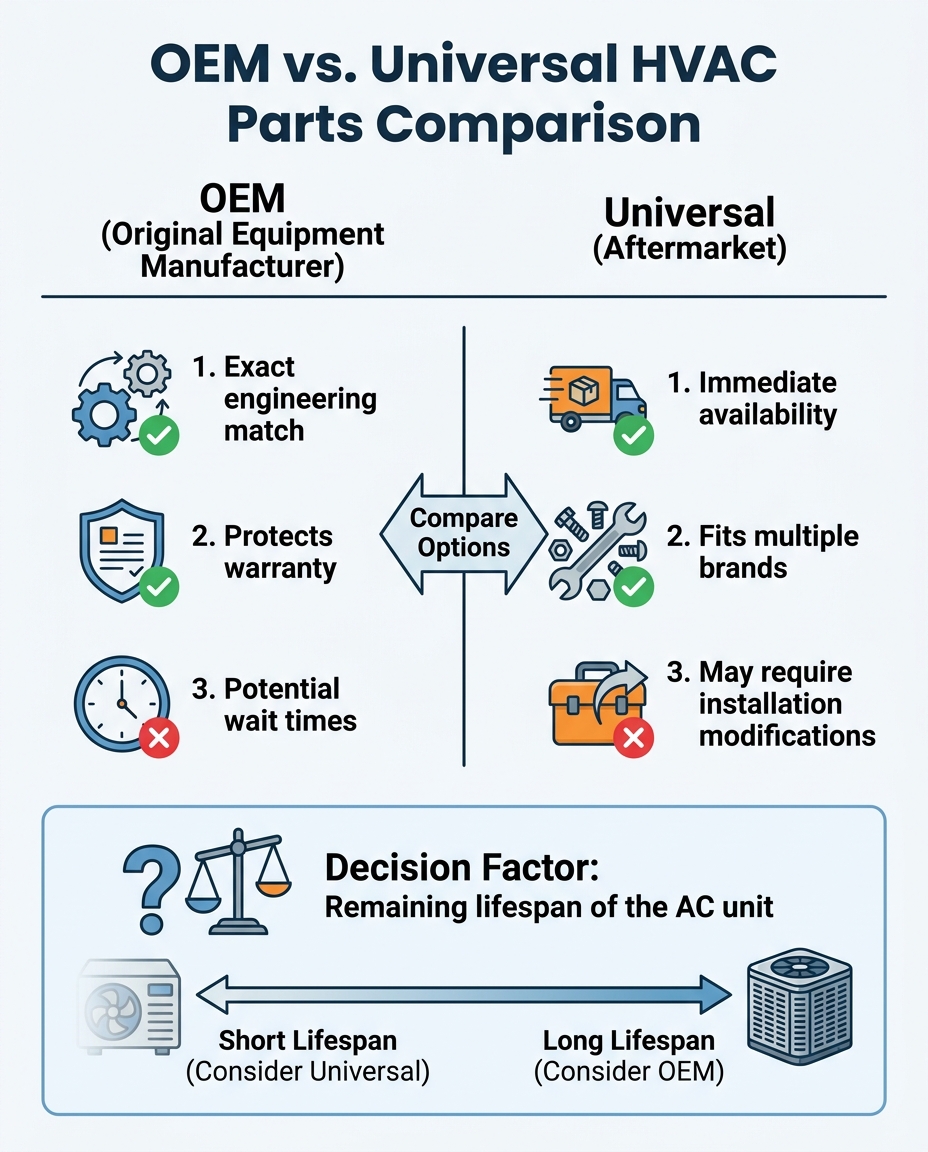
• Availability — OEM Carrier Parts: May require ordering; potential wait times of several days. — Universal / Aftermarket Parts: Usually stocked on technician vans or at local supply houses immediately.
• Fit & Installation — OEM Carrier Parts: Exact drop-in replacement; matches original brackets and wiring. — Universal / Aftermarket Parts: May require adapter kits, cutting, or wiring modifications to fit.
• Warranty Safety — OEM Carrier Parts: Fully compliant; protects any remaining manufacturer warranty. — Universal / Aftermarket Parts: High risk of voiding remaining manufacturer warranties.
• System Efficiency — OEM Carrier Parts: Maintains original SEER rating and factory airflow specifications. — Universal / Aftermarket Parts: May operate at slightly different speeds, altering overall efficiency.
The conversation about part sourcing naturally leads to a much larger question: is this specific air conditioner worth repairing at all? The age and overall condition of an aging Carrier AC unit should heavily dictate your repair strategy.
If your system is over ten to twelve years old, uses outdated refrigerant, and has a history of frequent breakdowns, investing heavily in a specialized OEM part might not make sense. You could wait days for a factory motor to arrive, only to have the compressor fail a month later. In these scenarios, a universal part might make sense as a cheap, temporary bandage—but the smarter long-term move is often replacement.
The structural cause: Air conditioners degrade over time. Coils corrode, electrical contacts pit, and moving parts lose their factory tolerances. When a major component fails late in the system's life, it is rarely an isolated incident; it is usually a symptom of systemic wear and tear.
The permanent solution: Before authorizing a major repair, it is critical to evaluate the cost of repairing an old HVAC versus buying a new system. A modern, high-efficiency air conditioner will provide better cooling, lower energy consumption, and a brand-new warranty that protects you from future unexpected expenses. If the upfront investment is a concern, exploring flexible HVAC financing options can make a full system replacement much more manageable than suffering through a string of continuous, stressful repairs.
To determine if you should keep fixing the old unit, assess the frequency of recent breakdowns. Have you had to call a technician multiple times this season? Next, consider the unit's energy efficiency compared to modern standards; older units cost significantly more to operate. Finally, evaluate if the current repair acts as a short-term bridge or a long-term solution. If it is just a bridge, putting that repair money toward a new system is usually the wiser investment.
Yes, in most cases, installing a third-party or aftermarket part will void the manufacturer's warranty for that specific component, and potentially for the entire system. Manufacturers require exact-match OEM parts to ensure the equipment operates within their tested safety and efficiency parameters. If your system is still under warranty, it is highly recommended to wait for the factory-approved part.
It is generally safe to use a universal blower motor, provided it is installed by a licensed and trained HVAC professional. The technician must ensure the motor's electrical draw, horsepower, and rotational direction match the requirements of your specific system. Incorrect installation or mismatched electrical specifications can lead to overheating, poor airflow, or damage to the control board.
A universal blower motor can work in a Carrier AC, but it almost always requires modifications during installation. Because universal motors are built to fit many different brands, the technician may need to install a new mounting bracket, cut the motor shaft to the correct length, or adapt the wiring harness. While it restores cooling, it is not a simple "plug and play" solution.
This depends entirely on your tolerance for heat and the health risks involved. If the indoor temperature is dangerously high and an OEM part will take several days to arrive, a universal part is a practical, immediate solution to restore safety and comfort. If the weather is mild or you have alternative cooling options, waiting for the OEM part is better for the long-term health of the system.
Aftermarket parts can have variable lifespans. Because they are mass-produced to fit a wide range of systems, they are not optimized for the specific airflow and electrical dynamics of your exact unit. While a high-quality universal part can last for years, an exact-match OEM part is generally more reliable and durable over the long term because it was engineered specifically for that environment.
Deciding between a universal part and an exact-match factory component is rarely a simple choice. The right path depends entirely on balancing your immediate need for cooling against the remaining lifespan of your equipment. A quick fix might restore your comfort today, but an exact match protects the integrity of your system for tomorrow.
You do not have to make this complex decision alone. MJB Heating & Cooling is committed to providing honest, transparent assessments. We help homeowners weigh the reliability of OEM parts against the urgency of universal alternatives without pushing a specific agenda. Our goal is to give you the facts so you can choose the best route for your home.
If your air conditioner is struggling to keep up, do not wait for a total breakdown. Reach out today to schedule an assessment for your aging Carrier unit. We will help you find a clear, reliable path forward that balances immediate comfort with long-term peace of mind.


Our A/C stopped working on a Sunday and due to health issues, we needed to find a service company available on a Sunday. I called MJB and left a message on their emergency voice mail. Within 10 minutes Tom Buck called me to hear my description of the symptoms. He was just finishing an appointment in Wichita and would be on his way to my home on the south end of Derby. He arrived within 30 minutes! From start to finish he was the perfect example of what you could ever hope for in an HVAC tech and a human being. His evaluation of our system inside and out was as thorough as I could ever imagine and once he was done with the repair, our system is running as well or better than ever. Well worth the price for the evaluation, parts, and labor. Thank you again Tom for an awesome experience.
Our AC went out during the hottest days of the year, and they were out next day! We have been jerked around by a shoddy home warranty for years. We finally had a chance to pick our own repair people, and MJB came highly recommended. I can see why! I was impressed with the honesty and speed at which they fixed our AC unit!
Our commercial building had a lightening/electrical strike and damaged our 20 ton AC unit. No one could find us a new unit before the end of September. Imagining going all of August and September with no AC in Kansas and working inside near 100 degree temps is less than thrilling. Dale and the team at MJB called around and saved the day. They had us a new unit 5 weeks earlier than other could promise and I now have happy employees. The unit is amazingly quiet, super cold and so much more energy efficient. Thank you for being our super hero!
Came out and installed my new furnace. Was very polite and affordable. They are very acknowledgeable and I highly recommend!
Thank you very much. We had our 1st warm night in 3weeks. MJB took the time and effort to find the real problem. And the employees were kind and thoughtful and explained things very well. I cannot thank you and all of MJB. Will recommend you highly. Thanks again Marjorie Herman Oxford Kansas
We had a new system installed and I was so impressed with how quick they were in come out and install it, in the middle of a hot summer day. They were so friendly & very professional. I had a small problem with a weird sound and they came over immediately and fixed it. Love them!