


.avif)





Blogs
Stay updated with our latest blog posts.
The cost of repairing old HVAC vs buying new system comes down to one simple test: multiply your unit's age by the repair quote. If that number tops $5,000, replacement almost always wins financially.
Here's a quick breakdown to help you decide:
| Situation | Best Move |
|---|---|
| System under 10 years old, minor repair | Repair |
| System 10-15 years old, major component failure | Evaluate with $5,000 Rule |
| System 15+ years old, any significant repair | Replace |
| Any age, R-22 refrigerant leak | Replace |
| 2+ unscheduled repairs in 24 months | Replace |
For most Wichita-area homeowners, an aging HVAC system eventually reaches a tipping point — the moment when putting more money into it stops making sense. Maybe your AC died during a July heat wave. Maybe your furnace quit on a January night. Either way, you're suddenly facing a repair quote and wondering if you're about to throw good money after bad.
The problem is that most homeowners make this decision under pressure, in a hot house, with a contractor standing in the living room. That's not the right time to run the numbers.
This guide gives you a clear, math-based framework — built around real cost data and the decision rules HVAC professionals actually use — so you can make the right call for your home and budget before the next breakdown happens.


When we visit homes in Derby or Maize, we often see homeowners struggling with the "sunk cost fallacy." This is the idea that because you spent money on a repair last year, you must keep repairing the unit to "get your money's worth." In reality, this often leads to a "slow bleed" where you spend thousands of dollars over three years on a system that eventually dies anyway.
To avoid this, we recommend using the $5,000 Rule. It is a straightforward heuristic: multiply the age of your equipment by the repair quote you just received. If the result is greater than $5,000, the math suggests that replacement is the superior economic choice.
For example, if you have a 12-year-old unit and the repair quote is for a significant amount, your "score" might be well over that threshold. At that point, you aren't just paying for a part; you are paying to keep an inefficient, late-life machine on life support.
Another critical factor is your 24-month repair history. If you have had two or more unscheduled repairs in the last two years, your system is signaling a systemic decline. To avoid costly mistakes common errors in furnace repair, it is vital to recognize when a "patch" is no longer a viable strategy. A system that breaks down frequently is no longer reliable, regardless of what the individual repair quotes say.
Not every breakdown is a death sentence for your HVAC. In many cases, repairing your current unit is the most logical path, especially if the system is relatively young or the issue is isolated.
Repairing makes sense when:
Is an HVAC maintenance plan worth it? Absolutely, because it often identifies these small issues before they spiral into catastrophic failures. A well-maintained 8-year-old system with a failed fan motor is a prime candidate for repair. In this scenario, the "bridge strategy" works: you spend a smaller amount to get another 5–7 years of life out of a structurally sound machine.
Minor electrical failures are the most common reason for service calls in places like Goddard and Park City. These components—like capacitors, relays, and fan motors—are the "wear items" of your HVAC system.
Replacing a capacitor is a routine task that typically costs a fraction of a new system. If your technician finds that the rest of the system—the compressor, the coils, and the heat exchanger—is in good health, then fixing the electrical side is a smart move. This is also a great time to ask, is upgrading to a smart thermostat worth it? Often, a "broken" AC is actually just a thermostat calibration issue or a loose electrical connection that can be solved quickly without replacing the whole unit.
By May 2026, the HVAC landscape has changed significantly. Modern SEER2 standards mean that even "entry-level" systems today are far more efficient than the high-end models from 15 years ago. If your current system is over 12 years old, you are likely overpaying on your utility bills every single month.
Newer systems offer features that older units simply cannot match:
You might also wonder, how much does a high efficiency system save? On average, switching from a 10-year-old SEER 10-13 unit to a modern SEER2 18+ model can reduce your cooling energy consumption by 30% to 50%. When you add in the potential for improved health—asking is a whole house air purifier worth it during installation—the value of a new system goes far beyond just "blowing cold air."
If your system was manufactured before 2010, it likely uses R-22 refrigerant (often called Freon). This is perhaps the single biggest "deal-breaker" in the repair vs. replace debate. The EPA has completely phased out the production and import of R-22.
Because the supply is now limited to reclaimed quantities, the price has skyrocketed. If an old R-22 system develops a leak in the evaporator coil or the sealed loop, a simple recharge can be incredibly expensive. In almost every case, we advise against putting expensive R-22 into a leaking, decade-old system. 2026 models utilize much more eco-friendly refrigerants like R-454B or R-32, which are better for the environment and much easier to service.
One of the best reasons to choose replacement in 2026 is the availability of significant financial incentives. Under the Inflation Reduction Act, homeowners can access substantial federal tax credits for high-efficiency upgrades.
We always encourage our customers to look into Kansas energy rebates for HVAC upgrades. These programs are designed to make the transition to Energy Star-certified equipment much more affordable. When you combine these tax credits with the monthly energy savings, the "net cost" of a new system is often much lower than homeowners realize.
In the Kansas climate, our HVAC systems work hard. From 100-degree humidity in July to sub-zero winds in January, the "runtime stress" on a unit in Wichita or Hutchinson is much higher than in more moderate climates.
| Feature | Old System (Repairing) | New System (Replacement) |
|---|---|---|
| Monthly Bill | High (Low Efficiency) | 30-50% Lower |
| Warranty | None (or 30-day labor) | 10-Year Parts & Labor |
| Reliability | High Risk of Failure | High Peace of Mind |
| Home Value | Neutral/Negative | 5-7% Increase |
| Refrigerant | Phased-out R-22 | Modern R-454B |
Beyond the monthly savings, there is the issue of home value. If you plan to sell your home in Andover or Rose Hill in the next few years, a 20-year-old HVAC system is a major red flag for buyers. It is often seen as a "ticking time bomb" that might lead to a deal collapsing during the inspection phase. A new, high-efficiency system is a documented asset that can boost resale value by up to 7%.
Furthermore, how proper HVAC sizing affects comfort and efficiency cannot be overstated. Many older homes have systems that were "guessed" rather than calculated. A new installation allows us to perform a Manual J load calculation, ensuring your new unit is perfectly sized for your home's square footage and insulation levels, which is crucial for managing Kansas humidity.
In the Wichita metro area, the average lifespan of a central AC or heat pump is 12 to 15 years. Furnaces can sometimes last 15 to 20 years. However, once a system hits the 10-year mark, it is considered to be in its "late-life" stage, where the risk of major component failure (like a compressor) increases significantly.
If you have had more than two unscheduled repairs in a 24-month period, your system is likely in a cycle of failure. At this point, you are often paying for "symptoms" while the "root cause"—general age and wear—remains unaddressed.
Yes. Real estate data suggests that a new HVAC system can provide a 5% to 7% boost in home value. More importantly, it provides peace of mind to buyers, which can help your home sell faster and avoid "repair credits" during the closing process.
Deciding on the cost of repairing old hvac vs buying new system is never easy, but it doesn't have to be a guessing game. By using the $5,000 Rule, considering the type of refrigerant your system uses, and weighing the massive energy savings of 2026 high-efficiency models, you can make a choice that protects your comfort and your wallet.
At MJB Heating & Cooling, we’ve been a family-owned staple in the Wichita metro area since 1984. Founded in Derby, KS, we pride ourselves on an honest business approach. We aren't here to sell you something you don't need; we're here to provide the quality workmanship and transparent advice we'd give our own families. Whether you're in Bel Aire, El Dorado, or Clearwater, we're ready to help you run the numbers.
Don't wait for the next extreme Kansas temperature swing to make the decision for you. Schedule your professional HVAC system evaluation today and let us help you find the most cost-effective path forward for your home.
The cost of repairing old HVAC vs buying new system comes down to one simple test: multiply your unit's age by the repair quote. If that number tops $5,000, replacement almost always wins financially.
Here's a quick breakdown to help you decide:
| Situation | Best Move |
|---|---|
| System under 10 years old, minor repair | Repair |
| System 10-15 years old, major component failure | Evaluate with $5,000 Rule |
| System 15+ years old, any significant repair | Replace |
| Any age, R-22 refrigerant leak | Replace |
| 2+ unscheduled repairs in 24 months | Replace |
For most Wichita-area homeowners, an aging HVAC system eventually reaches a tipping point — the moment when putting more money into it stops making sense. Maybe your AC died during a July heat wave. Maybe your furnace quit on a January night. Either way, you're suddenly facing a repair quote and wondering if you're about to throw good money after bad.
The problem is that most homeowners make this decision under pressure, in a hot house, with a contractor standing in the living room. That's not the right time to run the numbers.
This guide gives you a clear, math-based framework — built around real cost data and the decision rules HVAC professionals actually use — so you can make the right call for your home and budget before the next breakdown happens.
When we visit homes in Derby or Maize, we often see homeowners struggling with the "sunk cost fallacy." This is the idea that because you spent money on a repair last year, you must keep repairing the unit to "get your money's worth." In reality, this often leads to a "slow bleed" where you spend thousands of dollars over three years on a system that eventually dies anyway.
To avoid this, we recommend using the $5,000 Rule. It is a straightforward heuristic: multiply the age of your equipment by the repair quote you just received. If the result is greater than $5,000, the math suggests that replacement is the superior economic choice.
For example, if you have a 12-year-old unit and the repair quote is for a significant amount, your "score" might be well over that threshold. At that point, you aren't just paying for a part; you are paying to keep an inefficient, late-life machine on life support.
Another critical factor is your 24-month repair history. If you have had two or more unscheduled repairs in the last two years, your system is signaling a systemic decline. To avoid costly mistakes common errors in furnace repair, it is vital to recognize when a "patch" is no longer a viable strategy. A system that breaks down frequently is no longer reliable, regardless of what the individual repair quotes say.
Not every breakdown is a death sentence for your HVAC. In many cases, repairing your current unit is the most logical path, especially if the system is relatively young or the issue is isolated.
Repairing makes sense when:
Is an HVAC maintenance plan worth it? Absolutely, because it often identifies these small issues before they spiral into catastrophic failures. A well-maintained 8-year-old system with a failed fan motor is a prime candidate for repair. In this scenario, the "bridge strategy" works: you spend a smaller amount to get another 5–7 years of life out of a structurally sound machine.
Minor electrical failures are the most common reason for service calls in places like Goddard and Park City. These components—like capacitors, relays, and fan motors—are the "wear items" of your HVAC system.
Replacing a capacitor is a routine task that typically costs a fraction of a new system. If your technician finds that the rest of the system—the compressor, the coils, and the heat exchanger—is in good health, then fixing the electrical side is a smart move. This is also a great time to ask, is upgrading to a smart thermostat worth it? Often, a "broken" AC is actually just a thermostat calibration issue or a loose electrical connection that can be solved quickly without replacing the whole unit.
By May 2026, the HVAC landscape has changed significantly. Modern SEER2 standards mean that even "entry-level" systems today are far more efficient than the high-end models from 15 years ago. If your current system is over 12 years old, you are likely overpaying on your utility bills every single month.
Newer systems offer features that older units simply cannot match:
You might also wonder, how much does a high efficiency system save? On average, switching from a 10-year-old SEER 10-13 unit to a modern SEER2 18+ model can reduce your cooling energy consumption by 30% to 50%. When you add in the potential for improved health—asking is a whole house air purifier worth it during installation—the value of a new system goes far beyond just "blowing cold air."
If your system was manufactured before 2010, it likely uses R-22 refrigerant (often called Freon). This is perhaps the single biggest "deal-breaker" in the repair vs. replace debate. The EPA has completely phased out the production and import of R-22.
Because the supply is now limited to reclaimed quantities, the price has skyrocketed. If an old R-22 system develops a leak in the evaporator coil or the sealed loop, a simple recharge can be incredibly expensive. In almost every case, we advise against putting expensive R-22 into a leaking, decade-old system. 2026 models utilize much more eco-friendly refrigerants like R-454B or R-32, which are better for the environment and much easier to service.
One of the best reasons to choose replacement in 2026 is the availability of significant financial incentives. Under the Inflation Reduction Act, homeowners can access substantial federal tax credits for high-efficiency upgrades.
We always encourage our customers to look into Kansas energy rebates for HVAC upgrades. These programs are designed to make the transition to Energy Star-certified equipment much more affordable. When you combine these tax credits with the monthly energy savings, the "net cost" of a new system is often much lower than homeowners realize.
In the Kansas climate, our HVAC systems work hard. From 100-degree humidity in July to sub-zero winds in January, the "runtime stress" on a unit in Wichita or Hutchinson is much higher than in more moderate climates.
| Feature | Old System (Repairing) | New System (Replacement) |
|---|---|---|
| Monthly Bill | High (Low Efficiency) | 30-50% Lower |
| Warranty | None (or 30-day labor) | 10-Year Parts & Labor |
| Reliability | High Risk of Failure | High Peace of Mind |
| Home Value | Neutral/Negative | 5-7% Increase |
| Refrigerant | Phased-out R-22 | Modern R-454B |
Beyond the monthly savings, there is the issue of home value. If you plan to sell your home in Andover or Rose Hill in the next few years, a 20-year-old HVAC system is a major red flag for buyers. It is often seen as a "ticking time bomb" that might lead to a deal collapsing during the inspection phase. A new, high-efficiency system is a documented asset that can boost resale value by up to 7%.
Furthermore, how proper HVAC sizing affects comfort and efficiency cannot be overstated. Many older homes have systems that were "guessed" rather than calculated. A new installation allows us to perform a Manual J load calculation, ensuring your new unit is perfectly sized for your home's square footage and insulation levels, which is crucial for managing Kansas humidity.
In the Wichita metro area, the average lifespan of a central AC or heat pump is 12 to 15 years. Furnaces can sometimes last 15 to 20 years. However, once a system hits the 10-year mark, it is considered to be in its "late-life" stage, where the risk of major component failure (like a compressor) increases significantly.
If you have had more than two unscheduled repairs in a 24-month period, your system is likely in a cycle of failure. At this point, you are often paying for "symptoms" while the "root cause"—general age and wear—remains unaddressed.
Yes. Real estate data suggests that a new HVAC system can provide a 5% to 7% boost in home value. More importantly, it provides peace of mind to buyers, which can help your home sell faster and avoid "repair credits" during the closing process.
Deciding on the cost of repairing old hvac vs buying new system is never easy, but it doesn't have to be a guessing game. By using the $5,000 Rule, considering the type of refrigerant your system uses, and weighing the massive energy savings of 2026 high-efficiency models, you can make a choice that protects your comfort and your wallet.
At MJB Heating & Cooling, we’ve been a family-owned staple in the Wichita metro area since 1984. Founded in Derby, KS, we pride ourselves on an honest business approach. We aren't here to sell you something you don't need; we're here to provide the quality workmanship and transparent advice we'd give our own families. Whether you're in Bel Aire, El Dorado, or Clearwater, we're ready to help you run the numbers.
Don't wait for the next extreme Kansas temperature swing to make the decision for you. Schedule your professional HVAC system evaluation today and let us help you find the most cost-effective path forward for your home.
The cost of repairing old HVAC vs buying new system comes down to one simple test: multiply your unit's age by the repair quote. If that number tops $5,000, replacement almost always wins financially.
Here's a quick breakdown to help you decide:
| Situation | Best Move |
|---|---|
| System under 10 years old, minor repair | Repair |
| System 10-15 years old, major component failure | Evaluate with $5,000 Rule |
| System 15+ years old, any significant repair | Replace |
| Any age, R-22 refrigerant leak | Replace |
| 2+ unscheduled repairs in 24 months | Replace |
For most Wichita-area homeowners, an aging HVAC system eventually reaches a tipping point — the moment when putting more money into it stops making sense. Maybe your AC died during a July heat wave. Maybe your furnace quit on a January night. Either way, you're suddenly facing a repair quote and wondering if you're about to throw good money after bad.
The problem is that most homeowners make this decision under pressure, in a hot house, with a contractor standing in the living room. That's not the right time to run the numbers.
This guide gives you a clear, math-based framework — built around real cost data and the decision rules HVAC professionals actually use — so you can make the right call for your home and budget before the next breakdown happens.
When we visit homes in Derby or Maize, we often see homeowners struggling with the "sunk cost fallacy." This is the idea that because you spent money on a repair last year, you must keep repairing the unit to "get your money's worth." In reality, this often leads to a "slow bleed" where you spend thousands of dollars over three years on a system that eventually dies anyway.
To avoid this, we recommend using the $5,000 Rule. It is a straightforward heuristic: multiply the age of your equipment by the repair quote you just received. If the result is greater than $5,000, the math suggests that replacement is the superior economic choice.
For example, if you have a 12-year-old unit and the repair quote is for a significant amount, your "score" might be well over that threshold. At that point, you aren't just paying for a part; you are paying to keep an inefficient, late-life machine on life support.
Another critical factor is your 24-month repair history. If you have had two or more unscheduled repairs in the last two years, your system is signaling a systemic decline. To avoid costly mistakes common errors in furnace repair, it is vital to recognize when a "patch" is no longer a viable strategy. A system that breaks down frequently is no longer reliable, regardless of what the individual repair quotes say.
Not every breakdown is a death sentence for your HVAC. In many cases, repairing your current unit is the most logical path, especially if the system is relatively young or the issue is isolated.
Repairing makes sense when:
Is an HVAC maintenance plan worth it? Absolutely, because it often identifies these small issues before they spiral into catastrophic failures. A well-maintained 8-year-old system with a failed fan motor is a prime candidate for repair. In this scenario, the "bridge strategy" works: you spend a smaller amount to get another 5–7 years of life out of a structurally sound machine.
Minor electrical failures are the most common reason for service calls in places like Goddard and Park City. These components—like capacitors, relays, and fan motors—are the "wear items" of your HVAC system.
Replacing a capacitor is a routine task that typically costs a fraction of a new system. If your technician finds that the rest of the system—the compressor, the coils, and the heat exchanger—is in good health, then fixing the electrical side is a smart move. This is also a great time to ask, is upgrading to a smart thermostat worth it? Often, a "broken" AC is actually just a thermostat calibration issue or a loose electrical connection that can be solved quickly without replacing the whole unit.
By May 2026, the HVAC landscape has changed significantly. Modern SEER2 standards mean that even "entry-level" systems today are far more efficient than the high-end models from 15 years ago. If your current system is over 12 years old, you are likely overpaying on your utility bills every single month.
Newer systems offer features that older units simply cannot match:
You might also wonder, how much does a high efficiency system save? On average, switching from a 10-year-old SEER 10-13 unit to a modern SEER2 18+ model can reduce your cooling energy consumption by 30% to 50%. When you add in the potential for improved health—asking is a whole house air purifier worth it during installation—the value of a new system goes far beyond just "blowing cold air."
If your system was manufactured before 2010, it likely uses R-22 refrigerant (often called Freon). This is perhaps the single biggest "deal-breaker" in the repair vs. replace debate. The EPA has completely phased out the production and import of R-22.
Because the supply is now limited to reclaimed quantities, the price has skyrocketed. If an old R-22 system develops a leak in the evaporator coil or the sealed loop, a simple recharge can be incredibly expensive. In almost every case, we advise against putting expensive R-22 into a leaking, decade-old system. 2026 models utilize much more eco-friendly refrigerants like R-454B or R-32, which are better for the environment and much easier to service.
One of the best reasons to choose replacement in 2026 is the availability of significant financial incentives. Under the Inflation Reduction Act, homeowners can access substantial federal tax credits for high-efficiency upgrades.
We always encourage our customers to look into Kansas energy rebates for HVAC upgrades. These programs are designed to make the transition to Energy Star-certified equipment much more affordable. When you combine these tax credits with the monthly energy savings, the "net cost" of a new system is often much lower than homeowners realize.
In the Kansas climate, our HVAC systems work hard. From 100-degree humidity in July to sub-zero winds in January, the "runtime stress" on a unit in Wichita or Hutchinson is much higher than in more moderate climates.
| Feature | Old System (Repairing) | New System (Replacement) |
|---|---|---|
| Monthly Bill | High (Low Efficiency) | 30-50% Lower |
| Warranty | None (or 30-day labor) | 10-Year Parts & Labor |
| Reliability | High Risk of Failure | High Peace of Mind |
| Home Value | Neutral/Negative | 5-7% Increase |
| Refrigerant | Phased-out R-22 | Modern R-454B |
Beyond the monthly savings, there is the issue of home value. If you plan to sell your home in Andover or Rose Hill in the next few years, a 20-year-old HVAC system is a major red flag for buyers. It is often seen as a "ticking time bomb" that might lead to a deal collapsing during the inspection phase. A new, high-efficiency system is a documented asset that can boost resale value by up to 7%.
Furthermore, how proper HVAC sizing affects comfort and efficiency cannot be overstated. Many older homes have systems that were "guessed" rather than calculated. A new installation allows us to perform a Manual J load calculation, ensuring your new unit is perfectly sized for your home's square footage and insulation levels, which is crucial for managing Kansas humidity.
In the Wichita metro area, the average lifespan of a central AC or heat pump is 12 to 15 years. Furnaces can sometimes last 15 to 20 years. However, once a system hits the 10-year mark, it is considered to be in its "late-life" stage, where the risk of major component failure (like a compressor) increases significantly.
If you have had more than two unscheduled repairs in a 24-month period, your system is likely in a cycle of failure. At this point, you are often paying for "symptoms" while the "root cause"—general age and wear—remains unaddressed.
Yes. Real estate data suggests that a new HVAC system can provide a 5% to 7% boost in home value. More importantly, it provides peace of mind to buyers, which can help your home sell faster and avoid "repair credits" during the closing process.
Deciding on the cost of repairing old hvac vs buying new system is never easy, but it doesn't have to be a guessing game. By using the $5,000 Rule, considering the type of refrigerant your system uses, and weighing the massive energy savings of 2026 high-efficiency models, you can make a choice that protects your comfort and your wallet.
At MJB Heating & Cooling, we’ve been a family-owned staple in the Wichita metro area since 1984. Founded in Derby, KS, we pride ourselves on an honest business approach. We aren't here to sell you something you don't need; we're here to provide the quality workmanship and transparent advice we'd give our own families. Whether you're in Bel Aire, El Dorado, or Clearwater, we're ready to help you run the numbers.
Don't wait for the next extreme Kansas temperature swing to make the decision for you. Schedule your professional HVAC system evaluation today and let us help you find the most cost-effective path forward for your home.
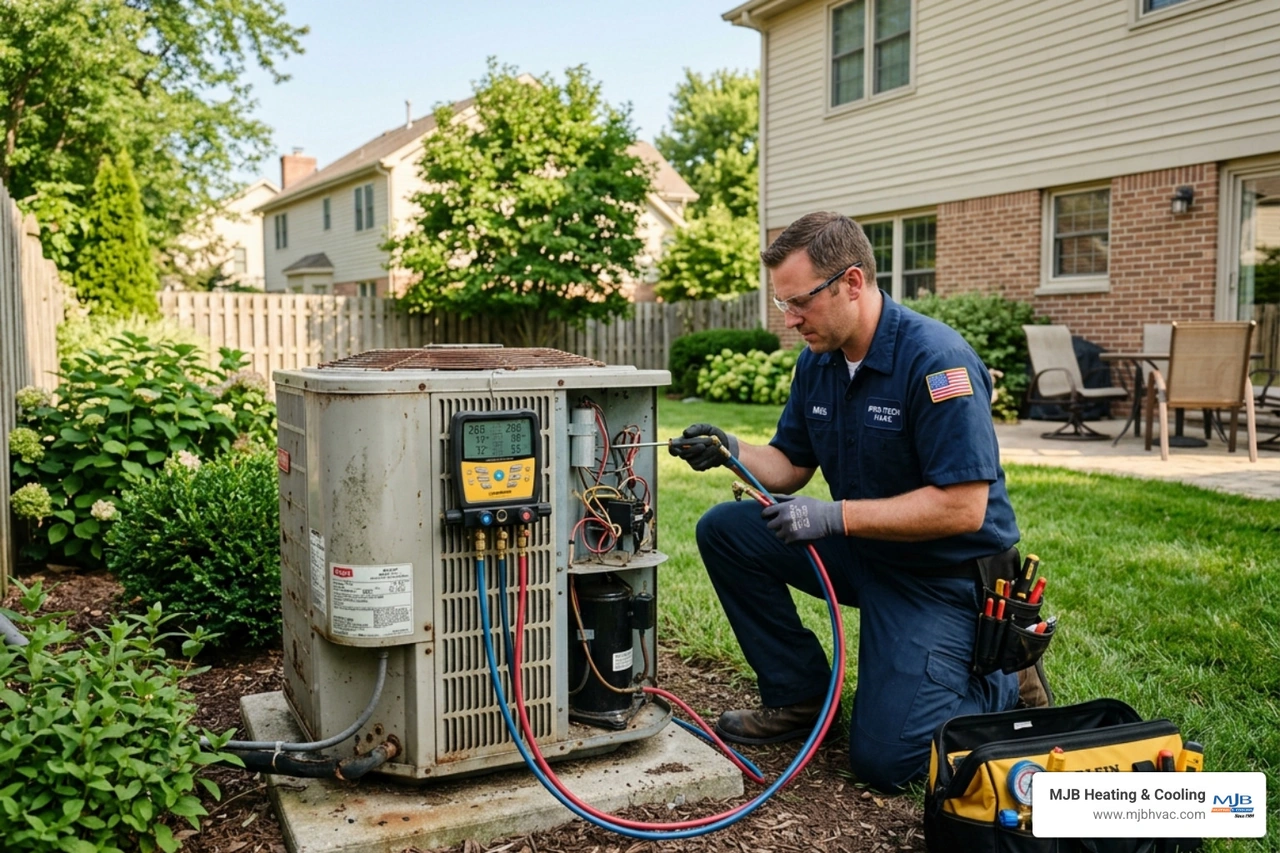

The cost of repairing old HVAC vs buying new system comes down to one simple test: multiply your unit's age by the repair quote. If that number tops $5,000, replacement almost always wins financially.
Here's a quick breakdown to help you decide:
| Situation | Best Move |
|---|---|
| System under 10 years old, minor repair | Repair |
| System 10-15 years old, major component failure | Evaluate with $5,000 Rule |
| System 15+ years old, any significant repair | Replace |
| Any age, R-22 refrigerant leak | Replace |
| 2+ unscheduled repairs in 24 months | Replace |
For most Wichita-area homeowners, an aging HVAC system eventually reaches a tipping point — the moment when putting more money into it stops making sense. Maybe your AC died during a July heat wave. Maybe your furnace quit on a January night. Either way, you're suddenly facing a repair quote and wondering if you're about to throw good money after bad.
The problem is that most homeowners make this decision under pressure, in a hot house, with a contractor standing in the living room. That's not the right time to run the numbers.
This guide gives you a clear, math-based framework — built around real cost data and the decision rules HVAC professionals actually use — so you can make the right call for your home and budget before the next breakdown happens.
When we visit homes in Derby or Maize, we often see homeowners struggling with the "sunk cost fallacy." This is the idea that because you spent money on a repair last year, you must keep repairing the unit to "get your money's worth." In reality, this often leads to a "slow bleed" where you spend thousands of dollars over three years on a system that eventually dies anyway.
To avoid this, we recommend using the $5,000 Rule. It is a straightforward heuristic: multiply the age of your equipment by the repair quote you just received. If the result is greater than $5,000, the math suggests that replacement is the superior economic choice.
For example, if you have a 12-year-old unit and the repair quote is for a significant amount, your "score" might be well over that threshold. At that point, you aren't just paying for a part; you are paying to keep an inefficient, late-life machine on life support.
Another critical factor is your 24-month repair history. If you have had two or more unscheduled repairs in the last two years, your system is signaling a systemic decline. To avoid costly mistakes common errors in furnace repair, it is vital to recognize when a "patch" is no longer a viable strategy. A system that breaks down frequently is no longer reliable, regardless of what the individual repair quotes say.
Not every breakdown is a death sentence for your HVAC. In many cases, repairing your current unit is the most logical path, especially if the system is relatively young or the issue is isolated.
Repairing makes sense when:
Is an HVAC maintenance plan worth it? Absolutely, because it often identifies these small issues before they spiral into catastrophic failures. A well-maintained 8-year-old system with a failed fan motor is a prime candidate for repair. In this scenario, the "bridge strategy" works: you spend a smaller amount to get another 5–7 years of life out of a structurally sound machine.
Minor electrical failures are the most common reason for service calls in places like Goddard and Park City. These components—like capacitors, relays, and fan motors—are the "wear items" of your HVAC system.
Replacing a capacitor is a routine task that typically costs a fraction of a new system. If your technician finds that the rest of the system—the compressor, the coils, and the heat exchanger—is in good health, then fixing the electrical side is a smart move. This is also a great time to ask, is upgrading to a smart thermostat worth it? Often, a "broken" AC is actually just a thermostat calibration issue or a loose electrical connection that can be solved quickly without replacing the whole unit.
By May 2026, the HVAC landscape has changed significantly. Modern SEER2 standards mean that even "entry-level" systems today are far more efficient than the high-end models from 15 years ago. If your current system is over 12 years old, you are likely overpaying on your utility bills every single month.
Newer systems offer features that older units simply cannot match:
You might also wonder, how much does a high efficiency system save? On average, switching from a 10-year-old SEER 10-13 unit to a modern SEER2 18+ model can reduce your cooling energy consumption by 30% to 50%. When you add in the potential for improved health—asking is a whole house air purifier worth it during installation—the value of a new system goes far beyond just "blowing cold air."
If your system was manufactured before 2010, it likely uses R-22 refrigerant (often called Freon). This is perhaps the single biggest "deal-breaker" in the repair vs. replace debate. The EPA has completely phased out the production and import of R-22.
Because the supply is now limited to reclaimed quantities, the price has skyrocketed. If an old R-22 system develops a leak in the evaporator coil or the sealed loop, a simple recharge can be incredibly expensive. In almost every case, we advise against putting expensive R-22 into a leaking, decade-old system. 2026 models utilize much more eco-friendly refrigerants like R-454B or R-32, which are better for the environment and much easier to service.
One of the best reasons to choose replacement in 2026 is the availability of significant financial incentives. Under the Inflation Reduction Act, homeowners can access substantial federal tax credits for high-efficiency upgrades.
We always encourage our customers to look into Kansas energy rebates for HVAC upgrades. These programs are designed to make the transition to Energy Star-certified equipment much more affordable. When you combine these tax credits with the monthly energy savings, the "net cost" of a new system is often much lower than homeowners realize.
In the Kansas climate, our HVAC systems work hard. From 100-degree humidity in July to sub-zero winds in January, the "runtime stress" on a unit in Wichita or Hutchinson is much higher than in more moderate climates.
| Feature | Old System (Repairing) | New System (Replacement) |
|---|---|---|
| Monthly Bill | High (Low Efficiency) | 30-50% Lower |
| Warranty | None (or 30-day labor) | 10-Year Parts & Labor |
| Reliability | High Risk of Failure | High Peace of Mind |
| Home Value | Neutral/Negative | 5-7% Increase |
| Refrigerant | Phased-out R-22 | Modern R-454B |
Beyond the monthly savings, there is the issue of home value. If you plan to sell your home in Andover or Rose Hill in the next few years, a 20-year-old HVAC system is a major red flag for buyers. It is often seen as a "ticking time bomb" that might lead to a deal collapsing during the inspection phase. A new, high-efficiency system is a documented asset that can boost resale value by up to 7%.
Furthermore, how proper HVAC sizing affects comfort and efficiency cannot be overstated. Many older homes have systems that were "guessed" rather than calculated. A new installation allows us to perform a Manual J load calculation, ensuring your new unit is perfectly sized for your home's square footage and insulation levels, which is crucial for managing Kansas humidity.
In the Wichita metro area, the average lifespan of a central AC or heat pump is 12 to 15 years. Furnaces can sometimes last 15 to 20 years. However, once a system hits the 10-year mark, it is considered to be in its "late-life" stage, where the risk of major component failure (like a compressor) increases significantly.
If you have had more than two unscheduled repairs in a 24-month period, your system is likely in a cycle of failure. At this point, you are often paying for "symptoms" while the "root cause"—general age and wear—remains unaddressed.
Yes. Real estate data suggests that a new HVAC system can provide a 5% to 7% boost in home value. More importantly, it provides peace of mind to buyers, which can help your home sell faster and avoid "repair credits" during the closing process.
Deciding on the cost of repairing old hvac vs buying new system is never easy, but it doesn't have to be a guessing game. By using the $5,000 Rule, considering the type of refrigerant your system uses, and weighing the massive energy savings of 2026 high-efficiency models, you can make a choice that protects your comfort and your wallet.
At MJB Heating & Cooling, we’ve been a family-owned staple in the Wichita metro area since 1984. Founded in Derby, KS, we pride ourselves on an honest business approach. We aren't here to sell you something you don't need; we're here to provide the quality workmanship and transparent advice we'd give our own families. Whether you're in Bel Aire, El Dorado, or Clearwater, we're ready to help you run the numbers.
Don't wait for the next extreme Kansas temperature swing to make the decision for you. Schedule your professional HVAC system evaluation today and let us help you find the most cost-effective path forward for your home.
The cost of repairing old HVAC vs buying new system comes down to one simple test: multiply your unit's age by the repair quote. If that number tops $5,000, replacement almost always wins financially.
Here's a quick breakdown to help you decide:
| Situation | Best Move |
|---|---|
| System under 10 years old, minor repair | Repair |
| System 10-15 years old, major component failure | Evaluate with $5,000 Rule |
| System 15+ years old, any significant repair | Replace |
| Any age, R-22 refrigerant leak | Replace |
| 2+ unscheduled repairs in 24 months | Replace |
For most Wichita-area homeowners, an aging HVAC system eventually reaches a tipping point — the moment when putting more money into it stops making sense. Maybe your AC died during a July heat wave. Maybe your furnace quit on a January night. Either way, you're suddenly facing a repair quote and wondering if you're about to throw good money after bad.
The problem is that most homeowners make this decision under pressure, in a hot house, with a contractor standing in the living room. That's not the right time to run the numbers.
This guide gives you a clear, math-based framework — built around real cost data and the decision rules HVAC professionals actually use — so you can make the right call for your home and budget before the next breakdown happens.
When we visit homes in Derby or Maize, we often see homeowners struggling with the "sunk cost fallacy." This is the idea that because you spent money on a repair last year, you must keep repairing the unit to "get your money's worth." In reality, this often leads to a "slow bleed" where you spend thousands of dollars over three years on a system that eventually dies anyway.
To avoid this, we recommend using the $5,000 Rule. It is a straightforward heuristic: multiply the age of your equipment by the repair quote you just received. If the result is greater than $5,000, the math suggests that replacement is the superior economic choice.
For example, if you have a 12-year-old unit and the repair quote is for a significant amount, your "score" might be well over that threshold. At that point, you aren't just paying for a part; you are paying to keep an inefficient, late-life machine on life support.
Another critical factor is your 24-month repair history. If you have had two or more unscheduled repairs in the last two years, your system is signaling a systemic decline. To avoid costly mistakes common errors in furnace repair, it is vital to recognize when a "patch" is no longer a viable strategy. A system that breaks down frequently is no longer reliable, regardless of what the individual repair quotes say.
Not every breakdown is a death sentence for your HVAC. In many cases, repairing your current unit is the most logical path, especially if the system is relatively young or the issue is isolated.
Repairing makes sense when:
Is an HVAC maintenance plan worth it? Absolutely, because it often identifies these small issues before they spiral into catastrophic failures. A well-maintained 8-year-old system with a failed fan motor is a prime candidate for repair. In this scenario, the "bridge strategy" works: you spend a smaller amount to get another 5–7 years of life out of a structurally sound machine.
Minor electrical failures are the most common reason for service calls in places like Goddard and Park City. These components—like capacitors, relays, and fan motors—are the "wear items" of your HVAC system.
Replacing a capacitor is a routine task that typically costs a fraction of a new system. If your technician finds that the rest of the system—the compressor, the coils, and the heat exchanger—is in good health, then fixing the electrical side is a smart move. This is also a great time to ask, is upgrading to a smart thermostat worth it? Often, a "broken" AC is actually just a thermostat calibration issue or a loose electrical connection that can be solved quickly without replacing the whole unit.
By May 2026, the HVAC landscape has changed significantly. Modern SEER2 standards mean that even "entry-level" systems today are far more efficient than the high-end models from 15 years ago. If your current system is over 12 years old, you are likely overpaying on your utility bills every single month.
Newer systems offer features that older units simply cannot match:
You might also wonder, how much does a high efficiency system save? On average, switching from a 10-year-old SEER 10-13 unit to a modern SEER2 18+ model can reduce your cooling energy consumption by 30% to 50%. When you add in the potential for improved health—asking is a whole house air purifier worth it during installation—the value of a new system goes far beyond just "blowing cold air."
If your system was manufactured before 2010, it likely uses R-22 refrigerant (often called Freon). This is perhaps the single biggest "deal-breaker" in the repair vs. replace debate. The EPA has completely phased out the production and import of R-22.
Because the supply is now limited to reclaimed quantities, the price has skyrocketed. If an old R-22 system develops a leak in the evaporator coil or the sealed loop, a simple recharge can be incredibly expensive. In almost every case, we advise against putting expensive R-22 into a leaking, decade-old system. 2026 models utilize much more eco-friendly refrigerants like R-454B or R-32, which are better for the environment and much easier to service.
One of the best reasons to choose replacement in 2026 is the availability of significant financial incentives. Under the Inflation Reduction Act, homeowners can access substantial federal tax credits for high-efficiency upgrades.
We always encourage our customers to look into Kansas energy rebates for HVAC upgrades. These programs are designed to make the transition to Energy Star-certified equipment much more affordable. When you combine these tax credits with the monthly energy savings, the "net cost" of a new system is often much lower than homeowners realize.
In the Kansas climate, our HVAC systems work hard. From 100-degree humidity in July to sub-zero winds in January, the "runtime stress" on a unit in Wichita or Hutchinson is much higher than in more moderate climates.
| Feature | Old System (Repairing) | New System (Replacement) |
|---|---|---|
| Monthly Bill | High (Low Efficiency) | 30-50% Lower |
| Warranty | None (or 30-day labor) | 10-Year Parts & Labor |
| Reliability | High Risk of Failure | High Peace of Mind |
| Home Value | Neutral/Negative | 5-7% Increase |
| Refrigerant | Phased-out R-22 | Modern R-454B |
Beyond the monthly savings, there is the issue of home value. If you plan to sell your home in Andover or Rose Hill in the next few years, a 20-year-old HVAC system is a major red flag for buyers. It is often seen as a "ticking time bomb" that might lead to a deal collapsing during the inspection phase. A new, high-efficiency system is a documented asset that can boost resale value by up to 7%.
Furthermore, how proper HVAC sizing affects comfort and efficiency cannot be overstated. Many older homes have systems that were "guessed" rather than calculated. A new installation allows us to perform a Manual J load calculation, ensuring your new unit is perfectly sized for your home's square footage and insulation levels, which is crucial for managing Kansas humidity.
In the Wichita metro area, the average lifespan of a central AC or heat pump is 12 to 15 years. Furnaces can sometimes last 15 to 20 years. However, once a system hits the 10-year mark, it is considered to be in its "late-life" stage, where the risk of major component failure (like a compressor) increases significantly.
If you have had more than two unscheduled repairs in a 24-month period, your system is likely in a cycle of failure. At this point, you are often paying for "symptoms" while the "root cause"—general age and wear—remains unaddressed.
Yes. Real estate data suggests that a new HVAC system can provide a 5% to 7% boost in home value. More importantly, it provides peace of mind to buyers, which can help your home sell faster and avoid "repair credits" during the closing process.
Deciding on the cost of repairing old hvac vs buying new system is never easy, but it doesn't have to be a guessing game. By using the $5,000 Rule, considering the type of refrigerant your system uses, and weighing the massive energy savings of 2026 high-efficiency models, you can make a choice that protects your comfort and your wallet.
At MJB Heating & Cooling, we’ve been a family-owned staple in the Wichita metro area since 1984. Founded in Derby, KS, we pride ourselves on an honest business approach. We aren't here to sell you something you don't need; we're here to provide the quality workmanship and transparent advice we'd give our own families. Whether you're in Bel Aire, El Dorado, or Clearwater, we're ready to help you run the numbers.
Don't wait for the next extreme Kansas temperature swing to make the decision for you. Schedule your professional HVAC system evaluation today and let us help you find the most cost-effective path forward for your home.


Our A/C stopped working on a Sunday and due to health issues, we needed to find a service company available on a Sunday. I called MJB and left a message on their emergency voice mail. Within 10 minutes Tom Buck called me to hear my description of the symptoms. He was just finishing an appointment in Wichita and would be on his way to my home on the south end of Derby. He arrived within 30 minutes! From start to finish he was the perfect example of what you could ever hope for in an HVAC tech and a human being. His evaluation of our system inside and out was as thorough as I could ever imagine and once he was done with the repair, our system is running as well or better than ever. Well worth the price for the evaluation, parts, and labor. Thank you again Tom for an awesome experience.
Our AC went out during the hottest days of the year, and they were out next day! We have been jerked around by a shoddy home warranty for years. We finally had a chance to pick our own repair people, and MJB came highly recommended. I can see why! I was impressed with the honesty and speed at which they fixed our AC unit!
Our commercial building had a lightening/electrical strike and damaged our 20 ton AC unit. No one could find us a new unit before the end of September. Imagining going all of August and September with no AC in Kansas and working inside near 100 degree temps is less than thrilling. Dale and the team at MJB called around and saved the day. They had us a new unit 5 weeks earlier than other could promise and I now have happy employees. The unit is amazingly quiet, super cold and so much more energy efficient. Thank you for being our super hero!
Came out and installed my new furnace. Was very polite and affordable. They are very acknowledgeable and I highly recommend!
Thank you very much. We had our 1st warm night in 3weeks. MJB took the time and effort to find the real problem. And the employees were kind and thoughtful and explained things very well. I cannot thank you and all of MJB. Will recommend you highly. Thanks again Marjorie Herman Oxford Kansas
We had a new system installed and I was so impressed with how quick they were in come out and install it, in the middle of a hot summer day. They were so friendly & very professional. I had a small problem with a weird sound and they came over immediately and fixed it. Love them!


