


.avif)





Blogs
Stay updated with our latest blog posts.
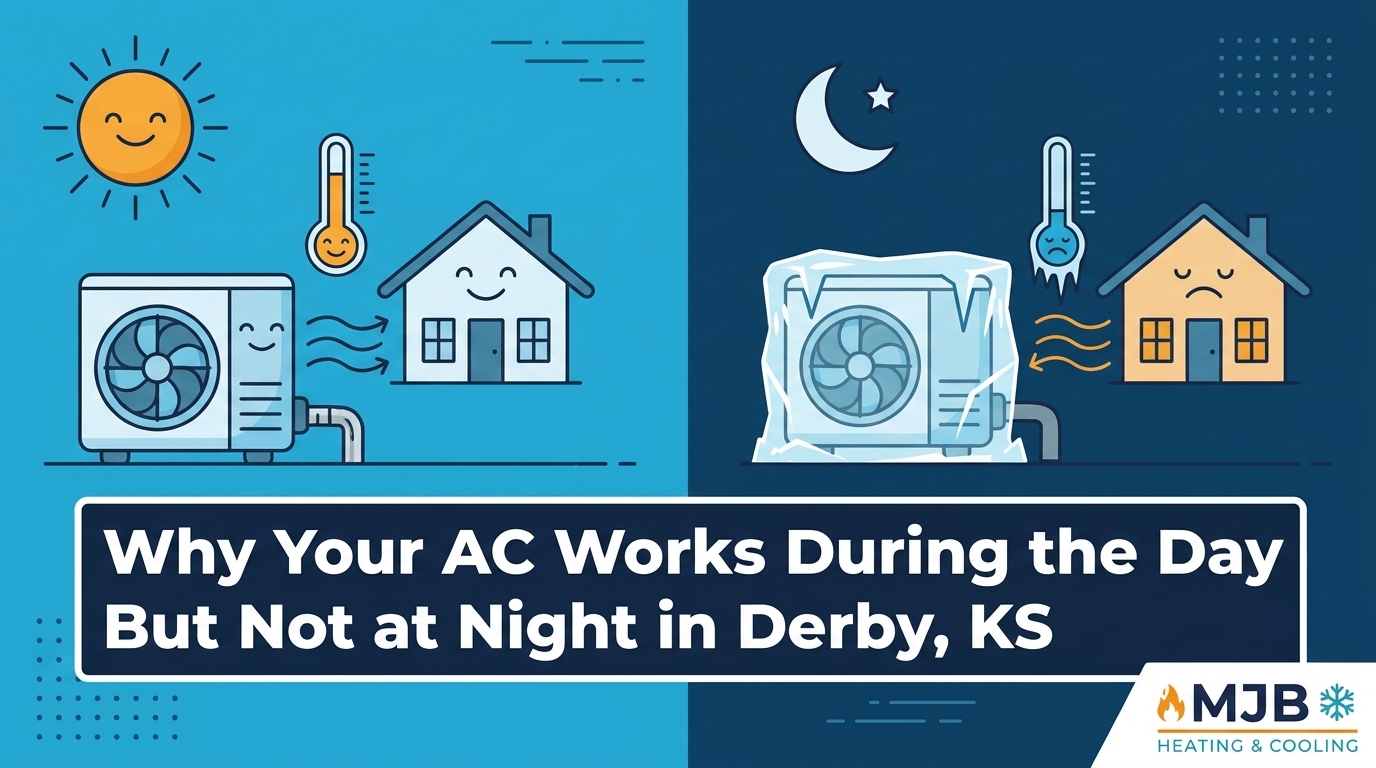

Is your cooling system actually broken, or is there a specific reason why your AC freezes up when the sun goes down in Derby? At MJB Heating & Cooling, we frequently answer emergency calls about this highly frustrating mid-summer mystery: your air conditioning runs flawlessly during the peak heat of a July afternoon, keeping your home perfectly comfortable. But when you wake up at 3:00 a.m. sweating, you discover the vents are blowing warm air and the refrigerant lines outside are encased in a solid block of ice. You are not alone in asking why your ac works during the day but not at night. This specific pattern points directly to a shift in how your system handles the heat load once ambient temperatures drop. When faced with this issue, your immediate decision point is whether to safely thaw the unit and hope for the best, or to identify the underlying airflow restriction before your compressor sustains permanent damage. To get to the bottom of this, you need professional HVAC service to diagnose the root cause and restore reliable cooling.
When our technicians diagnose a system that fails only after dark, we first look at the thermodynamics of how air conditioning actually functions. Air conditioners do not create cold air; they remove heat from the air inside your home. The indoor evaporator coil absorbs this heat, and the outdoor condenser releases it. For this heat exchange process to work correctly, the indoor evaporator coil must maintain a temperature above 32 degrees Fahrenheit. If the coil drops below freezing, the natural condensation that forms on the metal fins instantly turns to ice, eventually blocking all airflow and crippling the system.
During the peak heat of the day, your home is full of warm air. The system has plenty of ambient heat to absorb, which naturally keeps the evaporator coil well above the freezing mark. However, significant diurnal temperature swings are common in our region. When daytime highs in the 90s or 100s drop into the lower 70s during Midwest summer nights, the amount of heat available for the system to absorb decreases dramatically. If your system is already operating on the margins due to restricted airflow or a slight refrigerant imbalance, this nighttime temperature drop acts as the exact tipping point for ice formation.
The relationship between ambient heat and coil temperature is a delicate balancing act. When the sun goes down and your house cools off, the return air being pulled into your ductwork carries significantly less heat. Less ambient heat means the evaporator coil naturally runs colder than it does during the afternoon.
If your system has proper airflow, this temperature drop is not a problem. The blower motor pushes enough air across the coil to keep it above 32 degrees. But without proper airflow to balance this reduction in heat load, the system crosses the freezing threshold. The condensation freezes instantly, creating a thin layer of frost that quickly snowballs into a thick block of ice as the system continues to run throughout the night.
• Indoor Heat Load — Daytime Operation (95°F+ Ambient): High. Constant heat entering through windows and roof. — Nighttime Operation (70°F Ambient): Low. Sun is down, external heat transfer stops.
• Coil Temperature — Daytime Operation (95°F+ Ambient): Naturally elevated due to high volume of warm return air. — Nighttime Operation (70°F Ambient): Naturally lower due to cooler return air.
• Airflow Requirement — Daytime Operation (95°F+ Ambient): Critical for cooling, but coil is less likely to freeze. — Nighttime Operation (70°F Ambient): Absolutely vital to prevent coil temperatures from dropping below 32°F.
• System Vulnerability — Daytime Operation (95°F+ Ambient): System runs longer cycles, testing compressor endurance. — Nighttime Operation (70°F Ambient): System is highly vulnerable to freezing if airflow is restricted.
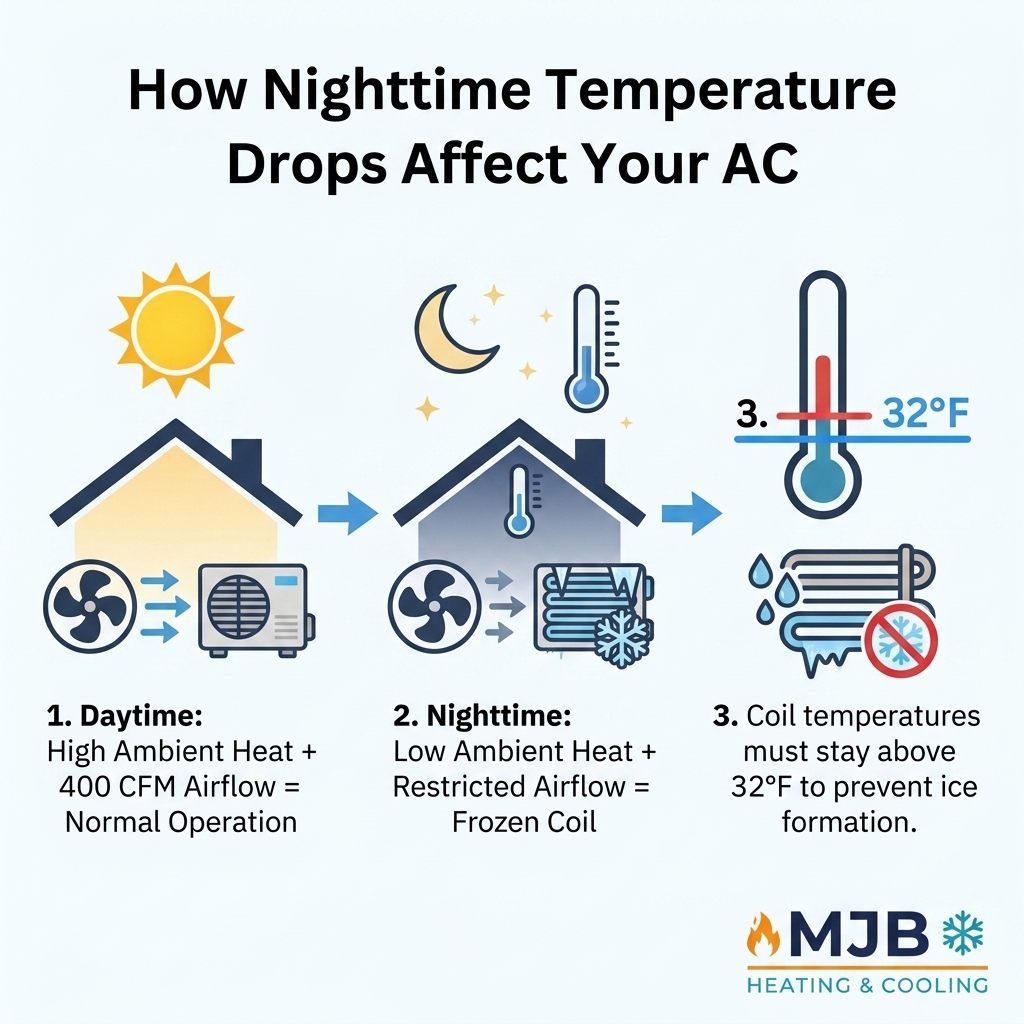
When investigating why a cooling system fails overnight, our team typically sees restricted airflow as the most common and easily fixable reason. A standard residential air conditioner requires approximately 400 CFM (cubic feet per minute) of airflow per ton of cooling capacity to operate safely. If you have a 3-ton AC unit, the blower motor must push roughly 1,200 CFM of air across the evaporator coil to keep the system balanced. When that airflow drops, the coil temperature drops with it.
In our experience serving the Derby KS area, if you experience this nighttime freezing phenomenon, poor airflow is almost always the catalyst. A severely clogged air filter is the number one cause of restricted airflow in residential homes. Homeowners often wonder how a dirty filter could be the problem if the system worked fine at 3:00 p.m. The answer goes back to the heat load. A dirty filter might pass just enough air to keep the coil above freezing when pulling in 80-degree air from a hot house. But when the house cools down to 72 degrees at night, that same restricted airflow is no longer enough to prevent the coil from dipping below 32 degrees.
To understand the mechanics of this failure, here is exactly how restricted airflow leads to a frozen system:
1. The Restriction Begins: A clogged filter, collapsed duct, or closed vents prevent the blower motor from pulling enough warm air from the house.
2. The Coil Starves for Heat: Without a steady supply of 400 CFM of warm air per ton, the liquid refrigerant inside the evaporator coil absorbs less heat than it was designed to.
3. The Temperature Plummets: Because the refrigerant is not absorbing heat, its temperature drops rapidly, chilling the copper coils and aluminum fins below the freezing point of water.
4. Condensation Freezes: The natural humidity pulled from your indoor air condenses on the freezing coil and instantly turns to frost.
5. The Ice Block Forms: As the system continues running throughout the night, the frost thickens into a solid block of ice, further blocking whatever airflow remained and completely stopping the cooling process.
Closed or blocked supply vents can also disrupt this necessary air circulation. Many homeowners close vents in unused guest rooms, believing it saves energy. In reality, modern HVAC systems are balanced for a specific static pressure. Closing vents increases pressure, reduces total airflow, and forces the blower motor to work harder while delivering less air to the coil. If you want to know exactly what to check when your AC isn't cooling properly, starting with your airflow pathways is the most critical step.
If you wake up to a warm house and discover that your AC works during the day but not at night because it has frozen solid, your immediate priority is damage control. Never force a frozen system to keep running. Continuing to run a frozen air conditioner forces the compressor to work against extreme pressure, which can cause the compressor motor to burn out entirely—a catastrophic and expensive failure. We advise our customers to thaw the unit safely before any troubleshooting can begin.
Follow this checklist to safely thaw your equipment without causing water damage to your home or electrical damage to your HVAC system:
• Turn the thermostat from "Cool" to "Off" immediately: This is the most crucial step. Switching the system to "Off" stops the outdoor compressor from running and halts the flow of cold refrigerant to the indoor coil. Do not simply raise the temperature setting; turn the cooling function completely off.
• Switch the fan setting from "Auto" to "On": While the compressor remains off, turning the fan to "On" forces your indoor blower motor to run continuously. This pushes warm, unconditioned indoor air over the frozen evaporator coil, drastically speeding up the melting process safely.
• Place towels around the indoor unit: As a solid block of ice melts, it produces a massive amount of water. Often, this volume of water overwhelms the primary condensate drain pan. Place thick towels around the base of your indoor furnace or air handler to catch overflowing water and prevent damage to your flooring or the sensitive electrical control boards located in the lower compartment of the furnace.
• Check the condensate drain line: Ensure the PVC pipe leading away from your indoor unit is draining water properly. If the line is clogged, the melting ice will have nowhere to go but onto your floor.
• Wait completely for the ice to melt: Patience is mandatory. A heavily frozen coil can take anywhere from 4 to 24 hours to thaw completely, depending on the severity of the ice buildup and the temperature of your home. Never use a hair dryer, heat gun, or sharp tools to chip away the ice, as you can easily puncture the pressurized copper refrigerant lines.
While you wait for the system to thaw completely, there are several safe, basic elements you can inspect. Empowering yourself to check these basic airflow components can save you time, and it provides valuable information to our technicians if a professional repair is ultimately required.
First, locate and inspect your HVAC air filter. This is a pattern we see often for systems that freeze during Midwest summer nights. Pull the filter out and hold it up to a light source. If you cannot see light shining through the pleats, the filter is severely restricted and must be replaced immediately. Even if a filter is only a month old, high dust environments, pet dander, or running the system continuously during a heatwave can clog it much faster than the manufacturer's suggested lifespan.
Next, walk through every room in your home and ensure all supply registers and return grilles are fully open and unobstructed. Move any rugs, heavy furniture, or curtains that might be blocking the return air vents. Your system needs to breathe freely to maintain that critical 400 CFM of airflow. If return vents are blocked, the blower motor is essentially suffocating, which accelerates the freezing process when ambient temperatures drop.
Finally, check the outdoor condenser unit for heavy debris. While indoor airflow is far more commonly responsible for evaporator coil freezing, a condenser choked by cottonwood, grass clippings, or overgrown shrubs can cause systemic pressure issues. Ensure there is at least two feet of clear space around all sides of the outdoor unit.
It is vital to emphasize that even if you find a filthy air filter and replace it, the system must remain completely off until the ice has entirely melted. Turning the system back on while ice remains on the coil will simply cause the new frost to build upon the old ice, restarting the cycle.
If you have replaced a dirty filter, opened all your vents, and completely thawed the system, but the unit freezes again the following night, you are dealing with a complex mechanical or chemical issue. Recurring freezing in the Derby KS area requires advanced diagnostics that go beyond DIY troubleshooting.
One of the most frequent causes of chronic freezing is a low refrigerant charge. Air conditioning systems do not consume refrigerant; it operates in a closed loop. If your system is low on refrigerant, there is a leak somewhere in the copper lines or coils. Paradoxically, low refrigerant causes the pressure inside the evaporator coil to drop. According to the laws of thermodynamics, a drop in pressure results in a drop in temperature. This makes the coil excessively cold—well below 32 degrees—causing the ambient humidity to freeze on contact, regardless of how clean your filter is.
Another complex issue involves faulty blower motors. If the motor is failing, if the run capacitor is weak, or if the blower wheel is heavily caked in dust, the fan will fail to push the required CFM of air across the coil. The motor might sound like it is running, but it lacks the torque to move enough air to keep the coil above freezing when the nighttime heat load drops.
Refrigerant handling and electrical motor diagnostics require specialized tools, EPA certification, and professional licensing. As a Certified Daikin Comfort Pro Dealer, our team at MJB Heating & Cooling uses advanced digital manifolds, anemometers, and psychrometers to pinpoint exact refrigerant pressures and blower motor airflow volumes without guesswork. We measure the exact superheat and subcooling of your system to determine precisely why it is failing after dark. This level of precision highlights the importance of proactive routine AC maintenance to catch these precise pressure and airflow imbalances before peak summer heat arrives.
Your AC works during the day because the high ambient heat in your home keeps the evaporator coil above freezing. At night, the temperature drops, reducing the heat load. If your system has restricted airflow or low refrigerant, this nighttime drop removes the last bit of heat keeping the system balanced, causing the coil temperature to plummet below 32 degrees and freeze solid.
Air conditioners freeze up at night primarily due to restricted airflow across the indoor evaporator coil. When the sun goes down, the air returning to the AC is cooler. If a dirty air filter, blocked vent, or failing blower motor prevents enough of this air from passing over the coil, the refrigerant inside gets too cold, freezing the natural condensation on the metal fins.
It typically takes between 4 to 24 hours for AC coils to unfreeze completely. The exact time depends on the thickness of the ice block, the temperature inside your home, and whether you leave the blower fan running. You can speed up the process safely by turning the thermostat to "Off" and switching the fan setting to "On" to circulate warm air over the frozen components.
No, you should never run your AC if it is frozen. Continuing to run a frozen air conditioner forces the outdoor compressor to work under extreme strain against blocked refrigerant flow. This can quickly cause the compressor motor to overheat and burn out, leading to a catastrophic system failure that requires an expensive replacement.
If your AC freezes up, immediately turn the thermostat cooling function to "Off" and turn the fan setting to "On" to begin the thawing process. Place thick towels around the indoor unit to catch overflowing water from the melting ice. Once the system is completely thawed, check and replace your air filter before attempting to restart the air conditioner.
Yes, low refrigerant is a major cause of an AC freezing at night. When refrigerant levels are low due to a leak, the pressure inside the evaporator coil drops significantly. Lower pressure creates lower temperatures, pushing the coil below the freezing point. This issue becomes especially apparent at night when ambient temperatures drop and there is less heat to offset the freezing coil.
Waking up to a hot house and a frozen air conditioner is incredibly stressful, but resolving why your AC freezes up when the sun goes down in Derby does not have to be a nightmare. Nighttime freezing is a highly specific but completely solvable issue when diagnosed by experienced professionals. If you have already checked your air filter and ensured your vents are open, but the system continues to turn into a block of ice overnight, it is time to stop resetting the system and address the root cause.
Protect your compressor from permanent damage by having our certified technicians at MJB Heating & Cooling measure your airflow, check your refrigerant pressures, and inspect your blower motor. We have the specialized tools and local expertise to get your system back to reliable, round-the-clock cooling. Do not spend another night hoping the system survives until morning; schedule AC repair with our team today and restore reliable comfort to your home.


Our A/C stopped working on a Sunday and due to health issues, we needed to find a service company available on a Sunday. I called MJB and left a message on their emergency voice mail. Within 10 minutes Tom Buck called me to hear my description of the symptoms. He was just finishing an appointment in Wichita and would be on his way to my home on the south end of Derby. He arrived within 30 minutes! From start to finish he was the perfect example of what you could ever hope for in an HVAC tech and a human being. His evaluation of our system inside and out was as thorough as I could ever imagine and once he was done with the repair, our system is running as well or better than ever. Well worth the price for the evaluation, parts, and labor. Thank you again Tom for an awesome experience.
Our AC went out during the hottest days of the year, and they were out next day! We have been jerked around by a shoddy home warranty for years. We finally had a chance to pick our own repair people, and MJB came highly recommended. I can see why! I was impressed with the honesty and speed at which they fixed our AC unit!
Our commercial building had a lightening/electrical strike and damaged our 20 ton AC unit. No one could find us a new unit before the end of September. Imagining going all of August and September with no AC in Kansas and working inside near 100 degree temps is less than thrilling. Dale and the team at MJB called around and saved the day. They had us a new unit 5 weeks earlier than other could promise and I now have happy employees. The unit is amazingly quiet, super cold and so much more energy efficient. Thank you for being our super hero!
Came out and installed my new furnace. Was very polite and affordable. They are very acknowledgeable and I highly recommend!
Thank you very much. We had our 1st warm night in 3weeks. MJB took the time and effort to find the real problem. And the employees were kind and thoughtful and explained things very well. I cannot thank you and all of MJB. Will recommend you highly. Thanks again Marjorie Herman Oxford Kansas
We had a new system installed and I was so impressed with how quick they were in come out and install it, in the middle of a hot summer day. They were so friendly & very professional. I had a small problem with a weird sound and they came over immediately and fixed it. Love them!


