.avif)





Blogs
Stay updated with our latest blog posts.
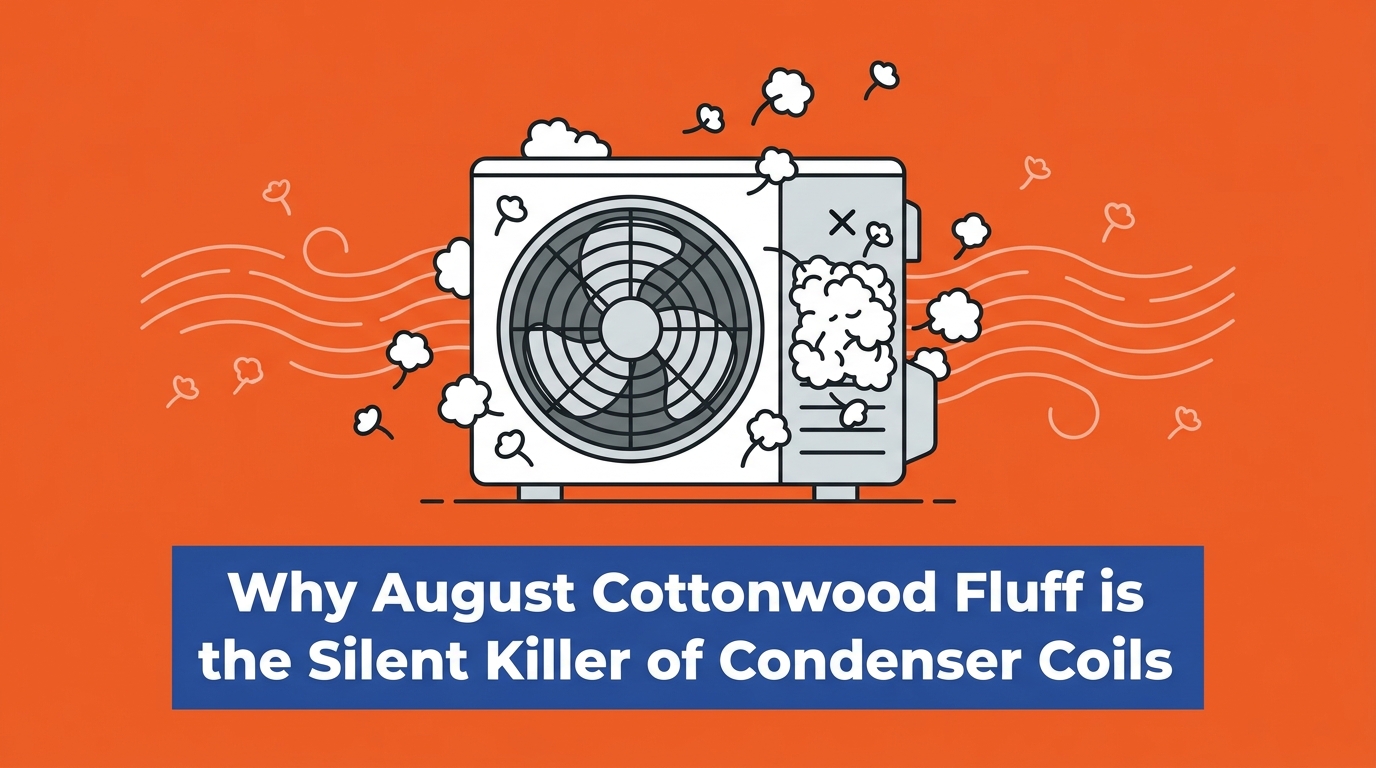

Your air conditioner is running nonstop, but the house still feels uncomfortably warm, which is exactly why August cottonwood fluff is the silent killer of condenser coils. The thermostat reads a steady 78 degrees, yet warm air barely trickles from your vents. You step outside and hear the outdoor unit straining, the fan blade roaring louder than usual. When you look closely at the metal box sitting in your yard, you see a thick, white, blanket-like substance clinging to the sides. This is the concrete problem our team at MJB Heating & Cooling sees facing Derby homeowners every year during late summer: extreme environmental shedding combining with peak cooling demand to completely suffocate your cooling equipment.
The timing could not be worse. August and late summer bring unyielding high temperatures, forcing your air conditioning system to run at maximum capacity just to maintain a baseline level of comfort. Simultaneously, environmental debris—specifically the highly fibrous seeds from local trees—reaches peak accumulation. The wind carries this fine material directly into the path of your outdoor unit's powerful intake fan. Within a matter of weeks, or sometimes even days, your equipment goes from breathing freely to wearing a dense, restrictive coat of fluff.
This creates a critical decision point for you as a homeowner. When a system struggles to cool the house and runs continuously, it is incredibly easy to assume the unit has suffered a permanent mechanical failure. You might worry that the compressor is dead or that the system has reached the end of its lifespan. However, recognizing that your struggling unit might simply be suffocating is the first step toward saving it. Catching this airflow restriction early is a primary benefit of holding a proactive HVAC maintenance plan. By scheduling an inspection before the strain causes a total breakdown, you can restore your system's efficiency. Addressing this thick layer of debris safely requires professional AC services before the internal components sustain permanent, irreversible heat damage.
To understand why this specific type of debris is so destructive, you have to look at the mechanics of the debris itself. Standard dust or dirt buildup is certainly bad for an air conditioner, but it typically accumulates slowly and allows some air to pass through. Cottonwood seeds and similar fibrous fluff behave very differently. As the outdoor unit's fan pulls air through the outdoor condenser coils, it also pulls in these fine, sticky seeds. The fibers interlock with one another, weaving themselves into a dense, felt-like mat. When morning dew or light rain wets this mat, it dries into a tight, nearly impenetrable layer.
The thermodynamics of a suffocated system:
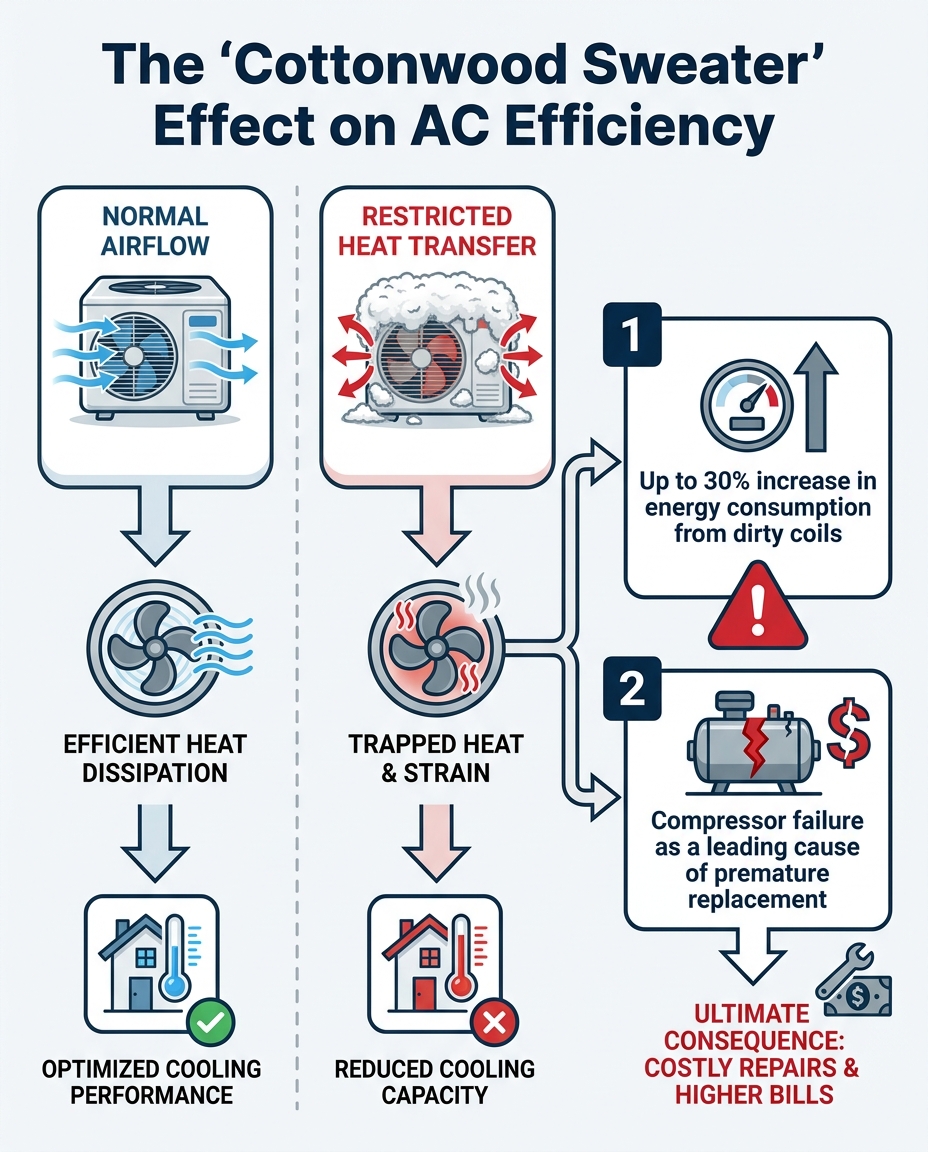
Your air conditioner does not actually "make" cold air. Instead, it operates by absorbing heat from inside your home and transferring it outside. The outdoor unit is entirely responsible for releasing that trapped indoor heat into the outdoor air. When a thick layer of fluff coats the exterior, it acts precisely like a heavy winter sweater. It creates a highly effective insulating blanket that traps the heat inside the system. The very mechanism designed to dissipate heat is now entirely blocked from interacting with the outside air.
• Clean Condenser — Airflow Status: Unrestricted air pulls through aluminum fins. — Heat Transfer: Heat easily dissipates into the outdoor air. — System Strain: Normal operating pressure; efficient energy use.
• Standard Dust Buildup — Airflow Status: Partial restriction; air moves slower. — Heat Transfer: Heat release is delayed but functional. — System Strain: Moderate strain; slightly higher utility bills.
• The "Cottonwood Sweater" — Airflow Status: Severe blockage; felt-like mat stops air. — Heat Transfer: Heat is trapped inside the insulated unit. — System Strain: Extreme pressure spikes; high risk of compressor failure.
The role of the outdoor unit is to take high-pressure, high-temperature refrigerant gas and cool it down until it condenses back into a liquid. This requires a massive volume of ambient outdoor air to flow rapidly over the delicate aluminum fins that house the copper refrigerant tubing. The fan at the top of the unit pulls this air through the sides and exhausts it out the top.
When the release mechanism is insulated by environmental debris, the entire cooling cycle halts. The fan continues to spin, burning electricity, but no air passes over the coils. Because the heat cannot escape, the refrigerant remains hot. This scalding hot refrigerant is then sent back inside your home, which is why the air coming from your vents suddenly feels lukewarm. The system is still trying to cool your home, but the vital heat-release stage has been completely neutralized by a layer of interlocking fluff.
One of the most stressful experiences for a homeowner is listening to an air conditioner run constantly while the indoor temperature continues to climb. The symptoms are alarming: the house remains warm, humidity levels rise, and the outdoor unit sounds noticeably louder or harsher than normal. Because these are the exact same symptoms of a catastrophic mechanical failure, homeowners frequently misdiagnose the problem. It is common to assume the system has completely leaked all its refrigerant or that the compressor has finally died of old age.
These assumptions often lead to unnecessary panic. While the system is indeed in distress, the root cause is often external suffocation rather than internal death. However, this does not mean the situation is harmless. The urgency of addressing an AC not cooling properly in extreme heat cannot be overstated. When a system is pushed to operate under these suffocating conditions, it is fighting a losing battle against the weather.
Real-world situations highlight just how quickly this can escalate. Just last late summer, our MJB Heating & Cooling technicians responded to a local homeowner who went almost a week without AC in the heat because their system struggled and finally stopped cooling altogether. We got the AC running by addressing the immediate operational strain, and eventually installed a new system to properly handle the home's long-term cooling load. This illustrates a pattern we see often: how a system can rapidly go from merely struggling to failing entirely during a sustained heat wave. The longer the unit runs while suffocated, the closer it gets to crossing the line from a simple cleaning job to a mandatory component replacement.
When you walk outside and see a visible blanket of white fluff covering your air conditioner, the immediate temptation is to grab the nearest garden hose and wash it off. It seems like a logical, quick fix. Unfortunately, our team frequently sees this well-intentioned DIY approach become one of the fastest ways to cause permanent, expensive damage to cooling equipment. High-pressure water and delicate HVAC components are a disastrous combination.
Why the garden hose method fails:
1. Pushing seeds deeper into the coils: The felt-like mat of fluff sits on the surface of the fins. When you hit it with a direct stream of water from a hose nozzle, you do not wash it away. Instead, the water pressure forces the fine seeds and wet fibers deep into the narrow crevices between the aluminum fins. Once the debris is wedged inside the center of the coil block, it becomes nearly impossible to extract.
2. Creating an insulating mud: Cottonwood fluff holds onto moisture. When mixed with the standard dust already present on the unit and soaked with a hose, it turns into a thick, sticky mud. This mud bakes onto the internal copper tubing as soon as the unit heats up again, creating a permanent insulating barrier.
3. Crushing the delicate aluminum fins: The fins on your outdoor unit are incredibly thin—often thinner than a soda can. They are designed this way to maximize surface area for heat transfer. A strong blast of water from a hose nozzle carries enough kinetic energy to easily bend, fold, or completely crush these fins flat.
The permanent cost of bent fins:
When aluminum fins are bent over, they block airflow just as effectively as the fluff did. However, unlike debris, bent metal cannot simply be washed away. If you crush a large section of your condenser fins with a hose, you permanently restrict the system's ability to breathe. This compounds the original problem, leaving you with a unit that will forever struggle to release heat, regardless of how clean it is.
Operating a suffocating air conditioner does more than just make your living room uncomfortable; it triggers a destructive ripple effect throughout the entire system. The financial and mechanical consequences of ignoring a blanketed outdoor unit are severe. According to Department of Energy data, dirty and restricted components can increase an air conditioning system's energy consumption by up to 30%. When your unit is running continuously during the hottest part of the year, that loss of efficiency translates directly into massive spikes on your monthly utility bills.
The financial impact of wasted electricity is frustrating, but the mechanical toll is far worse. Restricted airflow leads directly to compressor overheating. The compressor is the heart of your air conditioning system, responsible for pumping refrigerant through the lines. It relies entirely on the returning flow of cool refrigerant to keep its internal motor from melting down. When the outdoor coils are insulated by fluff, the heat is never released. Scalding hot refrigerant returns to the compressor, baking the motor windings hour after hour.
Compressor failure due to this exact type of overheating is one of the leading causes of premature system replacement. A compressor is not a part you want to replace; it is a major, labor-intensive repair that often makes replacing the entire outdoor unit the more logical choice.
The stress of a suffocating unit does not stop at the compressor. The compounding strain wreaks havoc on the electrical components as well. As the system fights to move refrigerant against extreme pressure, the electrical draw spikes. This excess amperage degrades capacitors, burns the contacts on relays, and overheats wiring.
Fortunately, modern systems are equipped with safety switches designed to prevent catastrophic electrical fires. High-pressure switches and thermal overloads will frequently trigger when the system gets too hot, abruptly shutting the unit down. If your system runs for a while, shuts off with a hard clunk, and refuses to turn back on until it cools down, these safety mechanisms are likely saving your equipment from a complete meltdown.

Because DIY methods are so risky, removing stubborn local environmental debris requires a professional touch. HVAC technicians do not use high-pressure water to blast debris inward. Instead, they utilize specialized tools and techniques designed specifically to lift debris safely away from the delicate internal components.
The professional cleaning process:
Technicians typically use specialized, foaming chemical coil cleaners. These specific solutions are applied at low pressure. The chemical reaction creates a thick foam that expands from the inside out, gently pushing the interwoven seeds, dirt, and fluff away from the center of the coil block to the surface. Once the debris is pushed outward, it can be safely rinsed away with a gentle, low-pressure flow of water that will not bend the aluminum fins.
Furthermore, a professional cleaning includes fin combing. If any fins have been slightly bent by hail, flying branches, or previous improper washing, technicians use specialized fin combs to meticulously straighten the metal. This restores the factory-level heat transfer efficiency that your system needs to survive the summer.
This level of care is especially vital when dealing with local climate factors. Late summer high temperatures in Derby KS combine heavily with the aggressive shedding of the Eastern Cottonwood—the state tree of Kansas. This creates a hyper-local peak system stress that generic maintenance advice often misses. Working with experts familiar with Derby and surrounding service areas makes a significant difference. At MJB Heating & Cooling, we understand these specific local environmental challenges deeply because our team has spent years clearing Eastern Cottonwood debris from local units. Utilizing our specialized, fin-safe maintenance techniques ensures that the heavy regional debris is removed thoroughly without compromising the structural integrity of your equipment.
Yes, cottonwood fluff can absolutely ruin an air conditioner if left unaddressed. The dense fibers weave together to form an insulating blanket over the outdoor condenser coils, blocking all airflow. Without airflow, the system cannot release heat, which causes the compressor to overheat rapidly. Repeated overheating will eventually burn out the compressor motor, leading to a total system failure.
The safest way to remove cottonwood from AC coils is to hire a professional technician who uses expanding foaming cleaners. These specialized cleaners push the debris out from the inside of the coil block without relying on high water pressure. You should never use a high-pressure nozzle or a power washer, as this will crush the delicate aluminum fins and push the seeds deeper into the unit.
If your AC is running constantly but not cooling in August, it is highly likely that the outdoor unit is suffocating from late summer debris. When the coils are blocked by fluff, the system cannot transfer heat to the outside air, so it just circulates warm air back into your home. The system runs continuously because the thermostat never reaches its target temperature.
An AC compressor overheats when the system is unable to release the heat it absorbed from inside your home. This is most commonly caused by restricted airflow over the outdoor condenser coils due to dirt, debris, or cottonwood fluff. When the heat cannot escape, the returning refrigerant remains hot, which bakes the internal motor of the compressor until the safety switches trip.
No, you should never cover your AC unit while it is operating to protect it from seeds. Covering a running unit restricts the airflow it desperately needs to function, which will cause it to overheat even faster than the debris would. If you are concerned about heavy shedding, the best approach is regular professional cleaning rather than attempting to filter the air yourself.
In areas with heavy environmental shedding, an outdoor unit may need to be checked and cleaned multiple times during the summer season. While a comprehensive professional tune-up is typically done once a year in the spring, a severe localized drop of cottonwood seeds in late summer may necessitate a second, targeted coil cleaning to keep the system breathing freely.
When your air conditioner starts losing ground against the late summer heat, the most important thing to remember is that the issue is likely a suffocating layer of fluff rather than a dead unit. Before you panic and assume you need a complete system replacement, look at the outdoor equipment. If it is wearing a thick, white sweater of debris, it simply cannot breathe.
You can take comfort in knowing that a professional cleaning is the immediate next step to save the equipment. As the back-to-school transition begins and the August heat persists, do not let your system fight a losing battle. Recognizing why August cottonwood fluff is the silent killer of condenser coils gives you the power to act. Secure your home's comfort and protect your equipment from permanent damage by scheduling professional AC services today.


Our A/C stopped working on a Sunday and due to health issues, we needed to find a service company available on a Sunday. I called MJB and left a message on their emergency voice mail. Within 10 minutes Tom Buck called me to hear my description of the symptoms. He was just finishing an appointment in Wichita and would be on his way to my home on the south end of Derby. He arrived within 30 minutes! From start to finish he was the perfect example of what you could ever hope for in an HVAC tech and a human being. His evaluation of our system inside and out was as thorough as I could ever imagine and once he was done with the repair, our system is running as well or better than ever. Well worth the price for the evaluation, parts, and labor. Thank you again Tom for an awesome experience.
Our AC went out during the hottest days of the year, and they were out next day! We have been jerked around by a shoddy home warranty for years. We finally had a chance to pick our own repair people, and MJB came highly recommended. I can see why! I was impressed with the honesty and speed at which they fixed our AC unit!
Our commercial building had a lightening/electrical strike and damaged our 20 ton AC unit. No one could find us a new unit before the end of September. Imagining going all of August and September with no AC in Kansas and working inside near 100 degree temps is less than thrilling. Dale and the team at MJB called around and saved the day. They had us a new unit 5 weeks earlier than other could promise and I now have happy employees. The unit is amazingly quiet, super cold and so much more energy efficient. Thank you for being our super hero!
Came out and installed my new furnace. Was very polite and affordable. They are very acknowledgeable and I highly recommend!
Thank you very much. We had our 1st warm night in 3weeks. MJB took the time and effort to find the real problem. And the employees were kind and thoughtful and explained things very well. I cannot thank you and all of MJB. Will recommend you highly. Thanks again Marjorie Herman Oxford Kansas
We had a new system installed and I was so impressed with how quick they were in come out and install it, in the middle of a hot summer day. They were so friendly & very professional. I had a small problem with a weird sound and they came over immediately and fixed it. Love them!