


.avif)





Blogs
Stay updated with our latest blog posts.
Knowing when to repair vs replace your HVAC system is one of the most important decisions you'll make as a homeowner — and it's rarely obvious. Here's a quick breakdown to help you decide:
| Situation | Likely Answer |
|---|---|
| System under 10 years old, minor issue | Repair |
| System over 10 years (AC) or 15 years (furnace), rising bills | Replace |
| Age × repair cost exceeds $5,000 | Replace |
| Repair cost exceeds 50% of new system value | Replace |
| Carbon monoxide risk or cracked heat exchanger | Replace immediately |
| Frequent breakdowns in the last 2–3 years | Replace |
| Small, isolated component failure, system otherwise healthy | Repair |
Your HVAC system works hard — especially through Central Kansas summers and winters. At some point, every system starts costing more to keep alive than it's worth. Maybe your energy bills keep creeping up. Maybe you've had a technician out twice already this year. Or maybe your system is just old and you're wondering if the next repair bill is the last one you should pay.
The honest answer is: it depends on a few key factors — your system's age, how often it breaks down, how efficiently it runs, and whether it poses any safety risks. This guide walks through all of them clearly, so you can make a confident, informed decision for your home.
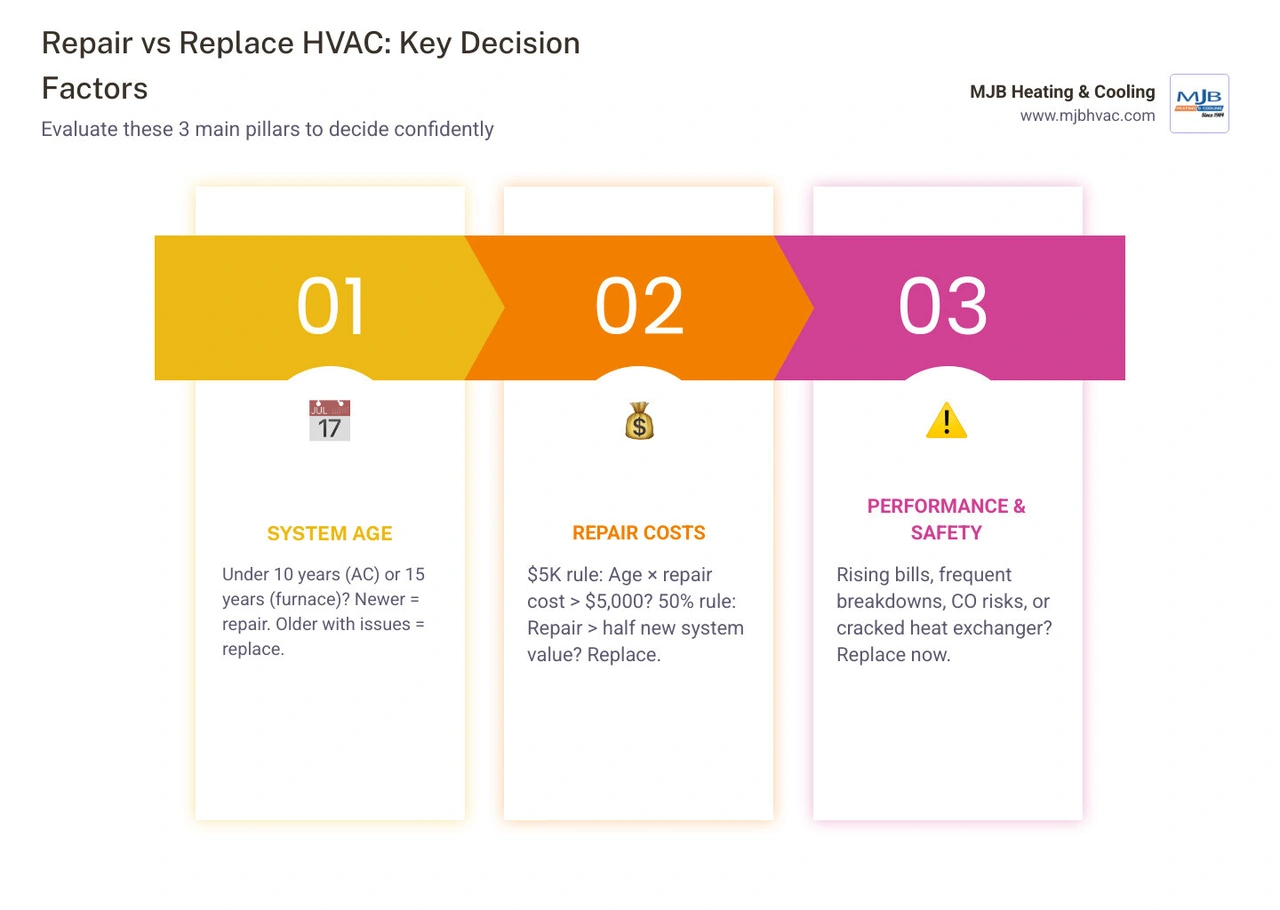
The repair-or-replace decision usually comes down to seven things:
If your system is relatively young, has been reliable, and the issue is minor, repair often makes sense. If it is older, less efficient, and starting to behave like a needy houseguest, replacement is usually the smarter long-term move.
For newer systems, repair is often the practical answer. In general, if your equipment is under about 10 years old and the problem is isolated, we usually look at repair first.
Repair is more likely to make sense when:
Examples include thermostat issues, a failed capacitor, contactor problems, a clogged drain line, sensor issues, or a blower-related repair. Those are frustrating problems, but they do not automatically mean the whole system is done for.
Age changes the math quickly. A system can still run and still be a poor investment to keep repairing.
Good replacement benchmarks for homeowners are:
That does not mean every 11-year-old AC must be replaced tomorrow morning. It does mean you should start evaluating reliability, efficiency, refrigerant type, and repair frequency more carefully.
Replacement becomes more likely when an older system has:
Here are the typical lifespan ranges homeowners should keep in mind:
Those are averages, not guarantees. Installation quality, maintenance history, how hard the system runs in Kansas weather, and ductwork condition all affect lifespan.
Even before total failure, older systems usually lose efficiency. That means the system may still cool or heat the home, but it works harder, runs longer, and costs more to do the same job.
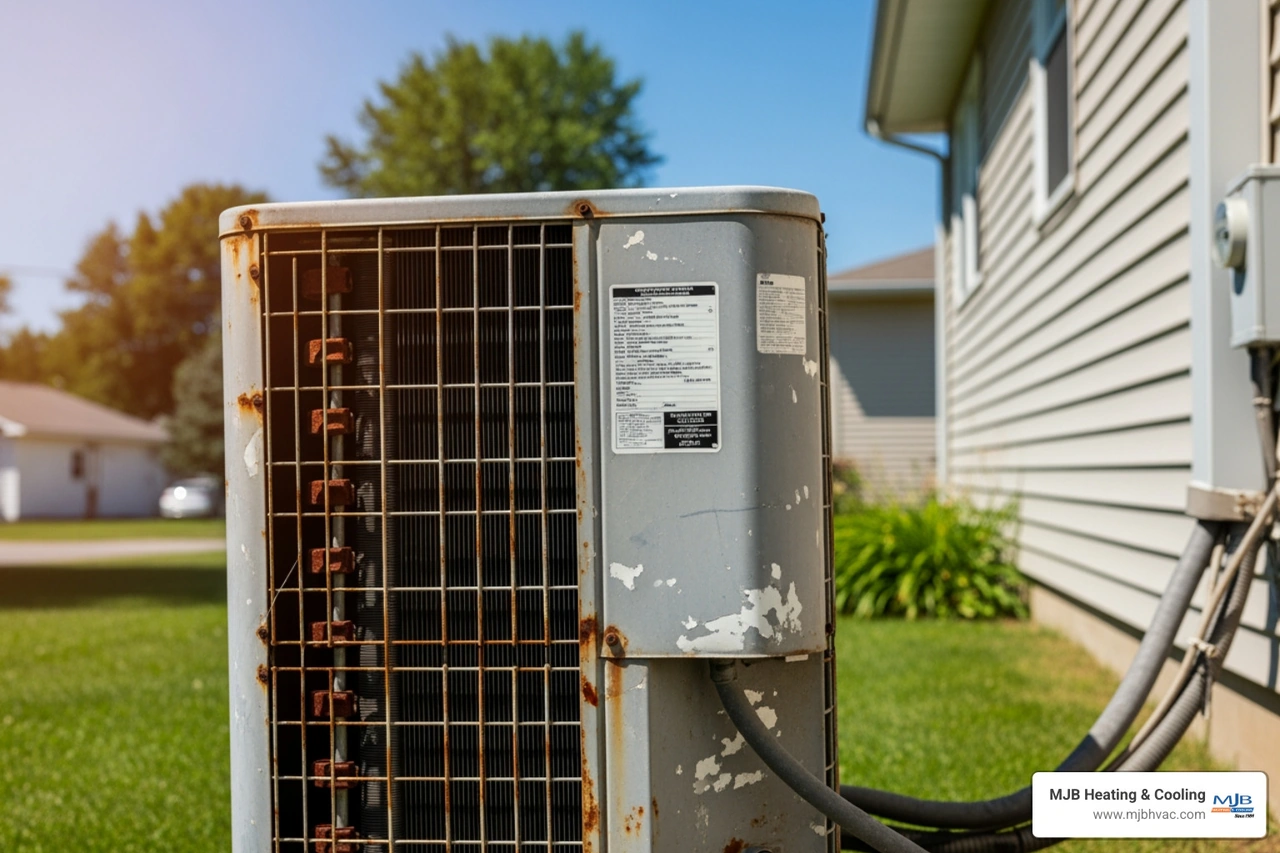
Not every HVAC issue calls for a brand-new system. Sometimes your equipment just needs a targeted fix and a good tune-up.
If your system has generally been dependable and the issue is small, repair may be the best answer. Many common service calls involve parts that can fail without meaning the whole system is at end of life. If you want a quick rundown of common cooling problems, our guide on signs your AC needs repair is a helpful next read.
Repair usually makes more sense when you are dealing with symptoms like:
These are important issues to fix, but they are not always signs that replacement is necessary.
A good rule of thumb: if the system is otherwise healthy, the repair is isolated, and comfort returns after service, repair is usually reasonable.
Regular maintenance absolutely matters. It will not make an HVAC system immortal, but it can delay major failures and help you get the full useful life from your equipment.
Maintenance helps by:
For homeowners in Wichita and surrounding Central Kansas communities, seasonal service is especially important because systems often swing from heavy cooling demand to heavy heating demand. Our articles on whether an HVAC maintenance plan is worth it and HVAC maintenance tips for Kansas homeowners go deeper into what good maintenance should include.
Before you approve a major repair or replacement, ask clear questions. A good contractor should be able to explain the situation in plain English, not mystery-box language.
Ask things like:
Those answers can make the decision a lot less emotional and a lot more practical.
Sometimes repair is technically possible but financially unwise. That is where replacement becomes the better move.
Common replacement signals include:
Two common rules help remove some guesswork.
The $5,000 rule:
Example: a 12-year-old system facing a major repair may be a poor candidate for more investment, while a 4-year-old system with the same issue may still be worth fixing.
The 50% rule:
This rule is most useful for major failures, such as a compressor, heat exchanger, or coil issue on older equipment.
Neither rule should be treated like sacred HVAC law etched on a stone tablet. They are decision tools, not the only factors. Age, safety, comfort, and energy use still matter.
If your system still runs but your bills keep climbing, that is often a sign of efficiency loss.
Older systems operate at lower efficiency than modern equipment. Research shows replacing a SEER 9 air conditioner with a SEER 14 model can reduce energy consumption by more than 35%. Standard newer systems can often cut monthly operating costs by roughly 20% to 40% compared to older units, and ENERGY STAR certified models can improve savings further.
Efficiency numbers to know:
In simple terms, higher numbers generally mean better efficiency. Modern furnaces that earn ENERGY STAR recognition can be about 15% more efficient than conventional models. New air conditioners also must meet stronger minimum efficiency standards than older units.
If you want a clear explanation of these ratings, see our guide on efficiency ratings explained for homeowners. You can also read how much does a high-efficiency system save for a practical look at long-term value.
Sometimes the biggest clue is not a breakdown. It is the fact that your home never feels right.
Replacement may be the better answer when you are dealing with:
That said, equipment is not always the only culprit. Leaky ducts, inadequate insulation, improper sizing, or poor airflow design can also cause uneven temperatures. In some homes, especially two-story layouts, the problem is a combination of aging equipment and duct issues.
Our guide on how proper HVAC sizing affects comfort and efficiency explains why bigger is not always better and why proper design matters.
If your older AC or heat pump uses R-22 refrigerant, replacement deserves serious consideration.
Why? Because R-22 has been phased out. That means:
If an older R-22 system develops a coil leak or other refrigerant-related problem, replacement is often the more sensible path. Newer systems use modern refrigerants and are far more likely to deliver better efficiency, better parts availability, and lower long-term headaches.
Some HVAC problems are not really repair-vs-replace debates. They are safety decisions.
If your system presents a carbon monoxide risk, gas leak concern, major electrical hazard, or fire risk, replacement may be necessary right away.
A cracked heat exchanger is one of the biggest red flags in a gas furnace. It can allow combustion gases, including carbon monoxide, to enter the air stream.
Other serious warning signs include:
In these situations, do not keep trying to squeeze another season out of the unit. Shut the system down and have it evaluated immediately. Safety always outranks squeezing out one more year.
Sometimes you can replace a single part. Sometimes that is a bad bargain.
Partial replacement may make sense when:
Full replacement is often better when:
| Option | Best when | Main concern |
|---|---|---|
| Partial replacement | Newer system with isolated failure | Compatibility and future reliability |
| Full replacement | Older system with major failure or multiple issues | Higher upfront commitment, but better long-term performance |
In some homes, a ductless option may also be worth considering, especially for additions, problem rooms, or homes with duct limitations. If that applies to your home, read our central AC vs ductless mini-split comparison.
The right answer is not based on the equipment alone. Your home and your plans matter too.
Central Kansas puts real stress on HVAC systems. We deal with hot summers, cold winters, and shoulder seasons that cannot always decide what they want to be. That means system sizing, airflow, and equipment performance matter a lot.
Factors that can change the answer include:
A replacement is a great opportunity to correct old design problems, not just swap boxes. If your current system has always struggled, the issue may be more than age. Our Kansas climate HVAC guide explains why local weather and home design should be part of the decision.
In 2026, incentives can make replacement more appealing, especially for high-efficiency equipment.
Homeowners may be able to take advantage of:
Because programs can change, we always recommend checking current eligibility before making a final decision. Our guide to Kansas energy rebates for HVAC upgrades is a good place to start.
This depends on timing and the condition of the system.
Repair may be the better move if:
Replacement may make more sense if:
If you are staying only a short time, a well-chosen repair is often reasonable. If the equipment is unsafe, unreliable, or visibly worn out, replacement may protect the sale and reduce negotiation headaches.
Possibly, yes. Rising bills often mean the system has become less efficient, even if it still turns on every day. Aging compressors, worn motors, dirty coils, airflow restrictions, duct leakage, and lower original efficiency ratings all add up. If the unit is older and bills keep increasing, replacement is often worth serious consideration.
Usually, yes. If you have had multiple repairs over the last two to three years, reliability is declining. One repair is normal. A pattern of repairs usually means more wear is waiting in line. At that point, replacement often provides more peace of mind and fewer surprise breakdowns.
Before making the call, we recommend evaluating:
A thorough inspection helps separate a fixable problem from a system that is simply worn out.
Deciding whether to repair or replace your HVAC system is not always simple, but it does get easier when you look at the right factors: age, repair frequency, efficiency, comfort, refrigerant type, and safety.
In general:
At MJB Heating & Cooling, we have served homeowners across the Wichita metro and Central Kansas since 1984 with honest recommendations, quality workmanship, and practical solutions. If you are weighing your options, we can inspect your system, explain what we find clearly, and help you choose the path that makes the most sense for your home and long-term comfort.
For more information about our HVAC services, visit our service page.
Knowing when to repair vs replace your HVAC system is one of the most important decisions you'll make as a homeowner — and it's rarely obvious. Here's a quick breakdown to help you decide:
| Situation | Likely Answer |
|---|---|
| System under 10 years old, minor issue | Repair |
| System over 10 years (AC) or 15 years (furnace), rising bills | Replace |
| Age × repair cost exceeds $5,000 | Replace |
| Repair cost exceeds 50% of new system value | Replace |
| Carbon monoxide risk or cracked heat exchanger | Replace immediately |
| Frequent breakdowns in the last 2–3 years | Replace |
| Small, isolated component failure, system otherwise healthy | Repair |
Your HVAC system works hard — especially through Central Kansas summers and winters. At some point, every system starts costing more to keep alive than it's worth. Maybe your energy bills keep creeping up. Maybe you've had a technician out twice already this year. Or maybe your system is just old and you're wondering if the next repair bill is the last one you should pay.
The honest answer is: it depends on a few key factors — your system's age, how often it breaks down, how efficiently it runs, and whether it poses any safety risks. This guide walks through all of them clearly, so you can make a confident, informed decision for your home.
The repair-or-replace decision usually comes down to seven things:
If your system is relatively young, has been reliable, and the issue is minor, repair often makes sense. If it is older, less efficient, and starting to behave like a needy houseguest, replacement is usually the smarter long-term move.
For newer systems, repair is often the practical answer. In general, if your equipment is under about 10 years old and the problem is isolated, we usually look at repair first.
Repair is more likely to make sense when:
Examples include thermostat issues, a failed capacitor, contactor problems, a clogged drain line, sensor issues, or a blower-related repair. Those are frustrating problems, but they do not automatically mean the whole system is done for.
Age changes the math quickly. A system can still run and still be a poor investment to keep repairing.
Good replacement benchmarks for homeowners are:
That does not mean every 11-year-old AC must be replaced tomorrow morning. It does mean you should start evaluating reliability, efficiency, refrigerant type, and repair frequency more carefully.
Replacement becomes more likely when an older system has:
Here are the typical lifespan ranges homeowners should keep in mind:
Those are averages, not guarantees. Installation quality, maintenance history, how hard the system runs in Kansas weather, and ductwork condition all affect lifespan.
Even before total failure, older systems usually lose efficiency. That means the system may still cool or heat the home, but it works harder, runs longer, and costs more to do the same job.
Not every HVAC issue calls for a brand-new system. Sometimes your equipment just needs a targeted fix and a good tune-up.
If your system has generally been dependable and the issue is small, repair may be the best answer. Many common service calls involve parts that can fail without meaning the whole system is at end of life. If you want a quick rundown of common cooling problems, our guide on signs your AC needs repair is a helpful next read.
Repair usually makes more sense when you are dealing with symptoms like:
These are important issues to fix, but they are not always signs that replacement is necessary.
A good rule of thumb: if the system is otherwise healthy, the repair is isolated, and comfort returns after service, repair is usually reasonable.
Regular maintenance absolutely matters. It will not make an HVAC system immortal, but it can delay major failures and help you get the full useful life from your equipment.
Maintenance helps by:
For homeowners in Wichita and surrounding Central Kansas communities, seasonal service is especially important because systems often swing from heavy cooling demand to heavy heating demand. Our articles on whether an HVAC maintenance plan is worth it and HVAC maintenance tips for Kansas homeowners go deeper into what good maintenance should include.
Before you approve a major repair or replacement, ask clear questions. A good contractor should be able to explain the situation in plain English, not mystery-box language.
Ask things like:
Those answers can make the decision a lot less emotional and a lot more practical.
Sometimes repair is technically possible but financially unwise. That is where replacement becomes the better move.
Common replacement signals include:
Two common rules help remove some guesswork.
The $5,000 rule:
Example: a 12-year-old system facing a major repair may be a poor candidate for more investment, while a 4-year-old system with the same issue may still be worth fixing.
The 50% rule:
This rule is most useful for major failures, such as a compressor, heat exchanger, or coil issue on older equipment.
Neither rule should be treated like sacred HVAC law etched on a stone tablet. They are decision tools, not the only factors. Age, safety, comfort, and energy use still matter.
If your system still runs but your bills keep climbing, that is often a sign of efficiency loss.
Older systems operate at lower efficiency than modern equipment. Research shows replacing a SEER 9 air conditioner with a SEER 14 model can reduce energy consumption by more than 35%. Standard newer systems can often cut monthly operating costs by roughly 20% to 40% compared to older units, and ENERGY STAR certified models can improve savings further.
Efficiency numbers to know:
In simple terms, higher numbers generally mean better efficiency. Modern furnaces that earn ENERGY STAR recognition can be about 15% more efficient than conventional models. New air conditioners also must meet stronger minimum efficiency standards than older units.
If you want a clear explanation of these ratings, see our guide on efficiency ratings explained for homeowners. You can also read how much does a high-efficiency system save for a practical look at long-term value.
Sometimes the biggest clue is not a breakdown. It is the fact that your home never feels right.
Replacement may be the better answer when you are dealing with:
That said, equipment is not always the only culprit. Leaky ducts, inadequate insulation, improper sizing, or poor airflow design can also cause uneven temperatures. In some homes, especially two-story layouts, the problem is a combination of aging equipment and duct issues.
Our guide on how proper HVAC sizing affects comfort and efficiency explains why bigger is not always better and why proper design matters.
If your older AC or heat pump uses R-22 refrigerant, replacement deserves serious consideration.
Why? Because R-22 has been phased out. That means:
If an older R-22 system develops a coil leak or other refrigerant-related problem, replacement is often the more sensible path. Newer systems use modern refrigerants and are far more likely to deliver better efficiency, better parts availability, and lower long-term headaches.
Some HVAC problems are not really repair-vs-replace debates. They are safety decisions.
If your system presents a carbon monoxide risk, gas leak concern, major electrical hazard, or fire risk, replacement may be necessary right away.
A cracked heat exchanger is one of the biggest red flags in a gas furnace. It can allow combustion gases, including carbon monoxide, to enter the air stream.
Other serious warning signs include:
In these situations, do not keep trying to squeeze another season out of the unit. Shut the system down and have it evaluated immediately. Safety always outranks squeezing out one more year.
Sometimes you can replace a single part. Sometimes that is a bad bargain.
Partial replacement may make sense when:
Full replacement is often better when:
| Option | Best when | Main concern |
|---|---|---|
| Partial replacement | Newer system with isolated failure | Compatibility and future reliability |
| Full replacement | Older system with major failure or multiple issues | Higher upfront commitment, but better long-term performance |
In some homes, a ductless option may also be worth considering, especially for additions, problem rooms, or homes with duct limitations. If that applies to your home, read our central AC vs ductless mini-split comparison.
The right answer is not based on the equipment alone. Your home and your plans matter too.
Central Kansas puts real stress on HVAC systems. We deal with hot summers, cold winters, and shoulder seasons that cannot always decide what they want to be. That means system sizing, airflow, and equipment performance matter a lot.
Factors that can change the answer include:
A replacement is a great opportunity to correct old design problems, not just swap boxes. If your current system has always struggled, the issue may be more than age. Our Kansas climate HVAC guide explains why local weather and home design should be part of the decision.
In 2026, incentives can make replacement more appealing, especially for high-efficiency equipment.
Homeowners may be able to take advantage of:
Because programs can change, we always recommend checking current eligibility before making a final decision. Our guide to Kansas energy rebates for HVAC upgrades is a good place to start.
This depends on timing and the condition of the system.
Repair may be the better move if:
Replacement may make more sense if:
If you are staying only a short time, a well-chosen repair is often reasonable. If the equipment is unsafe, unreliable, or visibly worn out, replacement may protect the sale and reduce negotiation headaches.
Possibly, yes. Rising bills often mean the system has become less efficient, even if it still turns on every day. Aging compressors, worn motors, dirty coils, airflow restrictions, duct leakage, and lower original efficiency ratings all add up. If the unit is older and bills keep increasing, replacement is often worth serious consideration.
Usually, yes. If you have had multiple repairs over the last two to three years, reliability is declining. One repair is normal. A pattern of repairs usually means more wear is waiting in line. At that point, replacement often provides more peace of mind and fewer surprise breakdowns.
Before making the call, we recommend evaluating:
A thorough inspection helps separate a fixable problem from a system that is simply worn out.
Deciding whether to repair or replace your HVAC system is not always simple, but it does get easier when you look at the right factors: age, repair frequency, efficiency, comfort, refrigerant type, and safety.
In general:
At MJB Heating & Cooling, we have served homeowners across the Wichita metro and Central Kansas since 1984 with honest recommendations, quality workmanship, and practical solutions. If you are weighing your options, we can inspect your system, explain what we find clearly, and help you choose the path that makes the most sense for your home and long-term comfort.
For more information about our HVAC services, visit our service page.
Knowing when to repair vs replace your HVAC system is one of the most important decisions you'll make as a homeowner — and it's rarely obvious. Here's a quick breakdown to help you decide:
| Situation | Likely Answer |
|---|---|
| System under 10 years old, minor issue | Repair |
| System over 10 years (AC) or 15 years (furnace), rising bills | Replace |
| Age × repair cost exceeds $5,000 | Replace |
| Repair cost exceeds 50% of new system value | Replace |
| Carbon monoxide risk or cracked heat exchanger | Replace immediately |
| Frequent breakdowns in the last 2–3 years | Replace |
| Small, isolated component failure, system otherwise healthy | Repair |
Your HVAC system works hard — especially through Central Kansas summers and winters. At some point, every system starts costing more to keep alive than it's worth. Maybe your energy bills keep creeping up. Maybe you've had a technician out twice already this year. Or maybe your system is just old and you're wondering if the next repair bill is the last one you should pay.
The honest answer is: it depends on a few key factors — your system's age, how often it breaks down, how efficiently it runs, and whether it poses any safety risks. This guide walks through all of them clearly, so you can make a confident, informed decision for your home.
The repair-or-replace decision usually comes down to seven things:
If your system is relatively young, has been reliable, and the issue is minor, repair often makes sense. If it is older, less efficient, and starting to behave like a needy houseguest, replacement is usually the smarter long-term move.
For newer systems, repair is often the practical answer. In general, if your equipment is under about 10 years old and the problem is isolated, we usually look at repair first.
Repair is more likely to make sense when:
Examples include thermostat issues, a failed capacitor, contactor problems, a clogged drain line, sensor issues, or a blower-related repair. Those are frustrating problems, but they do not automatically mean the whole system is done for.
Age changes the math quickly. A system can still run and still be a poor investment to keep repairing.
Good replacement benchmarks for homeowners are:
That does not mean every 11-year-old AC must be replaced tomorrow morning. It does mean you should start evaluating reliability, efficiency, refrigerant type, and repair frequency more carefully.
Replacement becomes more likely when an older system has:
Here are the typical lifespan ranges homeowners should keep in mind:
Those are averages, not guarantees. Installation quality, maintenance history, how hard the system runs in Kansas weather, and ductwork condition all affect lifespan.
Even before total failure, older systems usually lose efficiency. That means the system may still cool or heat the home, but it works harder, runs longer, and costs more to do the same job.
Not every HVAC issue calls for a brand-new system. Sometimes your equipment just needs a targeted fix and a good tune-up.
If your system has generally been dependable and the issue is small, repair may be the best answer. Many common service calls involve parts that can fail without meaning the whole system is at end of life. If you want a quick rundown of common cooling problems, our guide on signs your AC needs repair is a helpful next read.
Repair usually makes more sense when you are dealing with symptoms like:
These are important issues to fix, but they are not always signs that replacement is necessary.
A good rule of thumb: if the system is otherwise healthy, the repair is isolated, and comfort returns after service, repair is usually reasonable.
Regular maintenance absolutely matters. It will not make an HVAC system immortal, but it can delay major failures and help you get the full useful life from your equipment.
Maintenance helps by:
For homeowners in Wichita and surrounding Central Kansas communities, seasonal service is especially important because systems often swing from heavy cooling demand to heavy heating demand. Our articles on whether an HVAC maintenance plan is worth it and HVAC maintenance tips for Kansas homeowners go deeper into what good maintenance should include.
Before you approve a major repair or replacement, ask clear questions. A good contractor should be able to explain the situation in plain English, not mystery-box language.
Ask things like:
Those answers can make the decision a lot less emotional and a lot more practical.
Sometimes repair is technically possible but financially unwise. That is where replacement becomes the better move.
Common replacement signals include:
Two common rules help remove some guesswork.
The $5,000 rule:
Example: a 12-year-old system facing a major repair may be a poor candidate for more investment, while a 4-year-old system with the same issue may still be worth fixing.
The 50% rule:
This rule is most useful for major failures, such as a compressor, heat exchanger, or coil issue on older equipment.
Neither rule should be treated like sacred HVAC law etched on a stone tablet. They are decision tools, not the only factors. Age, safety, comfort, and energy use still matter.
If your system still runs but your bills keep climbing, that is often a sign of efficiency loss.
Older systems operate at lower efficiency than modern equipment. Research shows replacing a SEER 9 air conditioner with a SEER 14 model can reduce energy consumption by more than 35%. Standard newer systems can often cut monthly operating costs by roughly 20% to 40% compared to older units, and ENERGY STAR certified models can improve savings further.
Efficiency numbers to know:
In simple terms, higher numbers generally mean better efficiency. Modern furnaces that earn ENERGY STAR recognition can be about 15% more efficient than conventional models. New air conditioners also must meet stronger minimum efficiency standards than older units.
If you want a clear explanation of these ratings, see our guide on efficiency ratings explained for homeowners. You can also read how much does a high-efficiency system save for a practical look at long-term value.
Sometimes the biggest clue is not a breakdown. It is the fact that your home never feels right.
Replacement may be the better answer when you are dealing with:
That said, equipment is not always the only culprit. Leaky ducts, inadequate insulation, improper sizing, or poor airflow design can also cause uneven temperatures. In some homes, especially two-story layouts, the problem is a combination of aging equipment and duct issues.
Our guide on how proper HVAC sizing affects comfort and efficiency explains why bigger is not always better and why proper design matters.
If your older AC or heat pump uses R-22 refrigerant, replacement deserves serious consideration.
Why? Because R-22 has been phased out. That means:
If an older R-22 system develops a coil leak or other refrigerant-related problem, replacement is often the more sensible path. Newer systems use modern refrigerants and are far more likely to deliver better efficiency, better parts availability, and lower long-term headaches.
Some HVAC problems are not really repair-vs-replace debates. They are safety decisions.
If your system presents a carbon monoxide risk, gas leak concern, major electrical hazard, or fire risk, replacement may be necessary right away.
A cracked heat exchanger is one of the biggest red flags in a gas furnace. It can allow combustion gases, including carbon monoxide, to enter the air stream.
Other serious warning signs include:
In these situations, do not keep trying to squeeze another season out of the unit. Shut the system down and have it evaluated immediately. Safety always outranks squeezing out one more year.
Sometimes you can replace a single part. Sometimes that is a bad bargain.
Partial replacement may make sense when:
Full replacement is often better when:
| Option | Best when | Main concern |
|---|---|---|
| Partial replacement | Newer system with isolated failure | Compatibility and future reliability |
| Full replacement | Older system with major failure or multiple issues | Higher upfront commitment, but better long-term performance |
In some homes, a ductless option may also be worth considering, especially for additions, problem rooms, or homes with duct limitations. If that applies to your home, read our central AC vs ductless mini-split comparison.
The right answer is not based on the equipment alone. Your home and your plans matter too.
Central Kansas puts real stress on HVAC systems. We deal with hot summers, cold winters, and shoulder seasons that cannot always decide what they want to be. That means system sizing, airflow, and equipment performance matter a lot.
Factors that can change the answer include:
A replacement is a great opportunity to correct old design problems, not just swap boxes. If your current system has always struggled, the issue may be more than age. Our Kansas climate HVAC guide explains why local weather and home design should be part of the decision.
In 2026, incentives can make replacement more appealing, especially for high-efficiency equipment.
Homeowners may be able to take advantage of:
Because programs can change, we always recommend checking current eligibility before making a final decision. Our guide to Kansas energy rebates for HVAC upgrades is a good place to start.
This depends on timing and the condition of the system.
Repair may be the better move if:
Replacement may make more sense if:
If you are staying only a short time, a well-chosen repair is often reasonable. If the equipment is unsafe, unreliable, or visibly worn out, replacement may protect the sale and reduce negotiation headaches.
Possibly, yes. Rising bills often mean the system has become less efficient, even if it still turns on every day. Aging compressors, worn motors, dirty coils, airflow restrictions, duct leakage, and lower original efficiency ratings all add up. If the unit is older and bills keep increasing, replacement is often worth serious consideration.
Usually, yes. If you have had multiple repairs over the last two to three years, reliability is declining. One repair is normal. A pattern of repairs usually means more wear is waiting in line. At that point, replacement often provides more peace of mind and fewer surprise breakdowns.
Before making the call, we recommend evaluating:
A thorough inspection helps separate a fixable problem from a system that is simply worn out.
Deciding whether to repair or replace your HVAC system is not always simple, but it does get easier when you look at the right factors: age, repair frequency, efficiency, comfort, refrigerant type, and safety.
In general:
At MJB Heating & Cooling, we have served homeowners across the Wichita metro and Central Kansas since 1984 with honest recommendations, quality workmanship, and practical solutions. If you are weighing your options, we can inspect your system, explain what we find clearly, and help you choose the path that makes the most sense for your home and long-term comfort.
For more information about our HVAC services, visit our service page.


Knowing when to repair vs replace your HVAC system is one of the most important decisions you'll make as a homeowner — and it's rarely obvious. Here's a quick breakdown to help you decide:
| Situation | Likely Answer |
|---|---|
| System under 10 years old, minor issue | Repair |
| System over 10 years (AC) or 15 years (furnace), rising bills | Replace |
| Age × repair cost exceeds $5,000 | Replace |
| Repair cost exceeds 50% of new system value | Replace |
| Carbon monoxide risk or cracked heat exchanger | Replace immediately |
| Frequent breakdowns in the last 2–3 years | Replace |
| Small, isolated component failure, system otherwise healthy | Repair |
Your HVAC system works hard — especially through Central Kansas summers and winters. At some point, every system starts costing more to keep alive than it's worth. Maybe your energy bills keep creeping up. Maybe you've had a technician out twice already this year. Or maybe your system is just old and you're wondering if the next repair bill is the last one you should pay.
The honest answer is: it depends on a few key factors — your system's age, how often it breaks down, how efficiently it runs, and whether it poses any safety risks. This guide walks through all of them clearly, so you can make a confident, informed decision for your home.
The repair-or-replace decision usually comes down to seven things:
If your system is relatively young, has been reliable, and the issue is minor, repair often makes sense. If it is older, less efficient, and starting to behave like a needy houseguest, replacement is usually the smarter long-term move.
For newer systems, repair is often the practical answer. In general, if your equipment is under about 10 years old and the problem is isolated, we usually look at repair first.
Repair is more likely to make sense when:
Examples include thermostat issues, a failed capacitor, contactor problems, a clogged drain line, sensor issues, or a blower-related repair. Those are frustrating problems, but they do not automatically mean the whole system is done for.
Age changes the math quickly. A system can still run and still be a poor investment to keep repairing.
Good replacement benchmarks for homeowners are:
That does not mean every 11-year-old AC must be replaced tomorrow morning. It does mean you should start evaluating reliability, efficiency, refrigerant type, and repair frequency more carefully.
Replacement becomes more likely when an older system has:
Here are the typical lifespan ranges homeowners should keep in mind:
Those are averages, not guarantees. Installation quality, maintenance history, how hard the system runs in Kansas weather, and ductwork condition all affect lifespan.
Even before total failure, older systems usually lose efficiency. That means the system may still cool or heat the home, but it works harder, runs longer, and costs more to do the same job.
Not every HVAC issue calls for a brand-new system. Sometimes your equipment just needs a targeted fix and a good tune-up.
If your system has generally been dependable and the issue is small, repair may be the best answer. Many common service calls involve parts that can fail without meaning the whole system is at end of life. If you want a quick rundown of common cooling problems, our guide on signs your AC needs repair is a helpful next read.
Repair usually makes more sense when you are dealing with symptoms like:
These are important issues to fix, but they are not always signs that replacement is necessary.
A good rule of thumb: if the system is otherwise healthy, the repair is isolated, and comfort returns after service, repair is usually reasonable.
Regular maintenance absolutely matters. It will not make an HVAC system immortal, but it can delay major failures and help you get the full useful life from your equipment.
Maintenance helps by:
For homeowners in Wichita and surrounding Central Kansas communities, seasonal service is especially important because systems often swing from heavy cooling demand to heavy heating demand. Our articles on whether an HVAC maintenance plan is worth it and HVAC maintenance tips for Kansas homeowners go deeper into what good maintenance should include.
Before you approve a major repair or replacement, ask clear questions. A good contractor should be able to explain the situation in plain English, not mystery-box language.
Ask things like:
Those answers can make the decision a lot less emotional and a lot more practical.
Sometimes repair is technically possible but financially unwise. That is where replacement becomes the better move.
Common replacement signals include:
Two common rules help remove some guesswork.
The $5,000 rule:
Example: a 12-year-old system facing a major repair may be a poor candidate for more investment, while a 4-year-old system with the same issue may still be worth fixing.
The 50% rule:
This rule is most useful for major failures, such as a compressor, heat exchanger, or coil issue on older equipment.
Neither rule should be treated like sacred HVAC law etched on a stone tablet. They are decision tools, not the only factors. Age, safety, comfort, and energy use still matter.
If your system still runs but your bills keep climbing, that is often a sign of efficiency loss.
Older systems operate at lower efficiency than modern equipment. Research shows replacing a SEER 9 air conditioner with a SEER 14 model can reduce energy consumption by more than 35%. Standard newer systems can often cut monthly operating costs by roughly 20% to 40% compared to older units, and ENERGY STAR certified models can improve savings further.
Efficiency numbers to know:
In simple terms, higher numbers generally mean better efficiency. Modern furnaces that earn ENERGY STAR recognition can be about 15% more efficient than conventional models. New air conditioners also must meet stronger minimum efficiency standards than older units.
If you want a clear explanation of these ratings, see our guide on efficiency ratings explained for homeowners. You can also read how much does a high-efficiency system save for a practical look at long-term value.
Sometimes the biggest clue is not a breakdown. It is the fact that your home never feels right.
Replacement may be the better answer when you are dealing with:
That said, equipment is not always the only culprit. Leaky ducts, inadequate insulation, improper sizing, or poor airflow design can also cause uneven temperatures. In some homes, especially two-story layouts, the problem is a combination of aging equipment and duct issues.
Our guide on how proper HVAC sizing affects comfort and efficiency explains why bigger is not always better and why proper design matters.
If your older AC or heat pump uses R-22 refrigerant, replacement deserves serious consideration.
Why? Because R-22 has been phased out. That means:
If an older R-22 system develops a coil leak or other refrigerant-related problem, replacement is often the more sensible path. Newer systems use modern refrigerants and are far more likely to deliver better efficiency, better parts availability, and lower long-term headaches.
Some HVAC problems are not really repair-vs-replace debates. They are safety decisions.
If your system presents a carbon monoxide risk, gas leak concern, major electrical hazard, or fire risk, replacement may be necessary right away.
A cracked heat exchanger is one of the biggest red flags in a gas furnace. It can allow combustion gases, including carbon monoxide, to enter the air stream.
Other serious warning signs include:
In these situations, do not keep trying to squeeze another season out of the unit. Shut the system down and have it evaluated immediately. Safety always outranks squeezing out one more year.
Sometimes you can replace a single part. Sometimes that is a bad bargain.
Partial replacement may make sense when:
Full replacement is often better when:
| Option | Best when | Main concern |
|---|---|---|
| Partial replacement | Newer system with isolated failure | Compatibility and future reliability |
| Full replacement | Older system with major failure or multiple issues | Higher upfront commitment, but better long-term performance |
In some homes, a ductless option may also be worth considering, especially for additions, problem rooms, or homes with duct limitations. If that applies to your home, read our central AC vs ductless mini-split comparison.
The right answer is not based on the equipment alone. Your home and your plans matter too.
Central Kansas puts real stress on HVAC systems. We deal with hot summers, cold winters, and shoulder seasons that cannot always decide what they want to be. That means system sizing, airflow, and equipment performance matter a lot.
Factors that can change the answer include:
A replacement is a great opportunity to correct old design problems, not just swap boxes. If your current system has always struggled, the issue may be more than age. Our Kansas climate HVAC guide explains why local weather and home design should be part of the decision.
In 2026, incentives can make replacement more appealing, especially for high-efficiency equipment.
Homeowners may be able to take advantage of:
Because programs can change, we always recommend checking current eligibility before making a final decision. Our guide to Kansas energy rebates for HVAC upgrades is a good place to start.
This depends on timing and the condition of the system.
Repair may be the better move if:
Replacement may make more sense if:
If you are staying only a short time, a well-chosen repair is often reasonable. If the equipment is unsafe, unreliable, or visibly worn out, replacement may protect the sale and reduce negotiation headaches.
Possibly, yes. Rising bills often mean the system has become less efficient, even if it still turns on every day. Aging compressors, worn motors, dirty coils, airflow restrictions, duct leakage, and lower original efficiency ratings all add up. If the unit is older and bills keep increasing, replacement is often worth serious consideration.
Usually, yes. If you have had multiple repairs over the last two to three years, reliability is declining. One repair is normal. A pattern of repairs usually means more wear is waiting in line. At that point, replacement often provides more peace of mind and fewer surprise breakdowns.
Before making the call, we recommend evaluating:
A thorough inspection helps separate a fixable problem from a system that is simply worn out.
Deciding whether to repair or replace your HVAC system is not always simple, but it does get easier when you look at the right factors: age, repair frequency, efficiency, comfort, refrigerant type, and safety.
In general:
At MJB Heating & Cooling, we have served homeowners across the Wichita metro and Central Kansas since 1984 with honest recommendations, quality workmanship, and practical solutions. If you are weighing your options, we can inspect your system, explain what we find clearly, and help you choose the path that makes the most sense for your home and long-term comfort.
For more information about our HVAC services, visit our service page.
Knowing when to repair vs replace your HVAC system is one of the most important decisions you'll make as a homeowner — and it's rarely obvious. Here's a quick breakdown to help you decide:
| Situation | Likely Answer |
|---|---|
| System under 10 years old, minor issue | Repair |
| System over 10 years (AC) or 15 years (furnace), rising bills | Replace |
| Age × repair cost exceeds $5,000 | Replace |
| Repair cost exceeds 50% of new system value | Replace |
| Carbon monoxide risk or cracked heat exchanger | Replace immediately |
| Frequent breakdowns in the last 2–3 years | Replace |
| Small, isolated component failure, system otherwise healthy | Repair |
Your HVAC system works hard — especially through Central Kansas summers and winters. At some point, every system starts costing more to keep alive than it's worth. Maybe your energy bills keep creeping up. Maybe you've had a technician out twice already this year. Or maybe your system is just old and you're wondering if the next repair bill is the last one you should pay.
The honest answer is: it depends on a few key factors — your system's age, how often it breaks down, how efficiently it runs, and whether it poses any safety risks. This guide walks through all of them clearly, so you can make a confident, informed decision for your home.
The repair-or-replace decision usually comes down to seven things:
If your system is relatively young, has been reliable, and the issue is minor, repair often makes sense. If it is older, less efficient, and starting to behave like a needy houseguest, replacement is usually the smarter long-term move.
For newer systems, repair is often the practical answer. In general, if your equipment is under about 10 years old and the problem is isolated, we usually look at repair first.
Repair is more likely to make sense when:
Examples include thermostat issues, a failed capacitor, contactor problems, a clogged drain line, sensor issues, or a blower-related repair. Those are frustrating problems, but they do not automatically mean the whole system is done for.
Age changes the math quickly. A system can still run and still be a poor investment to keep repairing.
Good replacement benchmarks for homeowners are:
That does not mean every 11-year-old AC must be replaced tomorrow morning. It does mean you should start evaluating reliability, efficiency, refrigerant type, and repair frequency more carefully.
Replacement becomes more likely when an older system has:
Here are the typical lifespan ranges homeowners should keep in mind:
Those are averages, not guarantees. Installation quality, maintenance history, how hard the system runs in Kansas weather, and ductwork condition all affect lifespan.
Even before total failure, older systems usually lose efficiency. That means the system may still cool or heat the home, but it works harder, runs longer, and costs more to do the same job.
Not every HVAC issue calls for a brand-new system. Sometimes your equipment just needs a targeted fix and a good tune-up.
If your system has generally been dependable and the issue is small, repair may be the best answer. Many common service calls involve parts that can fail without meaning the whole system is at end of life. If you want a quick rundown of common cooling problems, our guide on signs your AC needs repair is a helpful next read.
Repair usually makes more sense when you are dealing with symptoms like:
These are important issues to fix, but they are not always signs that replacement is necessary.
A good rule of thumb: if the system is otherwise healthy, the repair is isolated, and comfort returns after service, repair is usually reasonable.
Regular maintenance absolutely matters. It will not make an HVAC system immortal, but it can delay major failures and help you get the full useful life from your equipment.
Maintenance helps by:
For homeowners in Wichita and surrounding Central Kansas communities, seasonal service is especially important because systems often swing from heavy cooling demand to heavy heating demand. Our articles on whether an HVAC maintenance plan is worth it and HVAC maintenance tips for Kansas homeowners go deeper into what good maintenance should include.
Before you approve a major repair or replacement, ask clear questions. A good contractor should be able to explain the situation in plain English, not mystery-box language.
Ask things like:
Those answers can make the decision a lot less emotional and a lot more practical.
Sometimes repair is technically possible but financially unwise. That is where replacement becomes the better move.
Common replacement signals include:
Two common rules help remove some guesswork.
The $5,000 rule:
Example: a 12-year-old system facing a major repair may be a poor candidate for more investment, while a 4-year-old system with the same issue may still be worth fixing.
The 50% rule:
This rule is most useful for major failures, such as a compressor, heat exchanger, or coil issue on older equipment.
Neither rule should be treated like sacred HVAC law etched on a stone tablet. They are decision tools, not the only factors. Age, safety, comfort, and energy use still matter.
If your system still runs but your bills keep climbing, that is often a sign of efficiency loss.
Older systems operate at lower efficiency than modern equipment. Research shows replacing a SEER 9 air conditioner with a SEER 14 model can reduce energy consumption by more than 35%. Standard newer systems can often cut monthly operating costs by roughly 20% to 40% compared to older units, and ENERGY STAR certified models can improve savings further.
Efficiency numbers to know:
In simple terms, higher numbers generally mean better efficiency. Modern furnaces that earn ENERGY STAR recognition can be about 15% more efficient than conventional models. New air conditioners also must meet stronger minimum efficiency standards than older units.
If you want a clear explanation of these ratings, see our guide on efficiency ratings explained for homeowners. You can also read how much does a high-efficiency system save for a practical look at long-term value.
Sometimes the biggest clue is not a breakdown. It is the fact that your home never feels right.
Replacement may be the better answer when you are dealing with:
That said, equipment is not always the only culprit. Leaky ducts, inadequate insulation, improper sizing, or poor airflow design can also cause uneven temperatures. In some homes, especially two-story layouts, the problem is a combination of aging equipment and duct issues.
Our guide on how proper HVAC sizing affects comfort and efficiency explains why bigger is not always better and why proper design matters.
If your older AC or heat pump uses R-22 refrigerant, replacement deserves serious consideration.
Why? Because R-22 has been phased out. That means:
If an older R-22 system develops a coil leak or other refrigerant-related problem, replacement is often the more sensible path. Newer systems use modern refrigerants and are far more likely to deliver better efficiency, better parts availability, and lower long-term headaches.
Some HVAC problems are not really repair-vs-replace debates. They are safety decisions.
If your system presents a carbon monoxide risk, gas leak concern, major electrical hazard, or fire risk, replacement may be necessary right away.
A cracked heat exchanger is one of the biggest red flags in a gas furnace. It can allow combustion gases, including carbon monoxide, to enter the air stream.
Other serious warning signs include:
In these situations, do not keep trying to squeeze another season out of the unit. Shut the system down and have it evaluated immediately. Safety always outranks squeezing out one more year.
Sometimes you can replace a single part. Sometimes that is a bad bargain.
Partial replacement may make sense when:
Full replacement is often better when:
| Option | Best when | Main concern |
|---|---|---|
| Partial replacement | Newer system with isolated failure | Compatibility and future reliability |
| Full replacement | Older system with major failure or multiple issues | Higher upfront commitment, but better long-term performance |
In some homes, a ductless option may also be worth considering, especially for additions, problem rooms, or homes with duct limitations. If that applies to your home, read our central AC vs ductless mini-split comparison.
The right answer is not based on the equipment alone. Your home and your plans matter too.
Central Kansas puts real stress on HVAC systems. We deal with hot summers, cold winters, and shoulder seasons that cannot always decide what they want to be. That means system sizing, airflow, and equipment performance matter a lot.
Factors that can change the answer include:
A replacement is a great opportunity to correct old design problems, not just swap boxes. If your current system has always struggled, the issue may be more than age. Our Kansas climate HVAC guide explains why local weather and home design should be part of the decision.
In 2026, incentives can make replacement more appealing, especially for high-efficiency equipment.
Homeowners may be able to take advantage of:
Because programs can change, we always recommend checking current eligibility before making a final decision. Our guide to Kansas energy rebates for HVAC upgrades is a good place to start.
This depends on timing and the condition of the system.
Repair may be the better move if:
Replacement may make more sense if:
If you are staying only a short time, a well-chosen repair is often reasonable. If the equipment is unsafe, unreliable, or visibly worn out, replacement may protect the sale and reduce negotiation headaches.
Possibly, yes. Rising bills often mean the system has become less efficient, even if it still turns on every day. Aging compressors, worn motors, dirty coils, airflow restrictions, duct leakage, and lower original efficiency ratings all add up. If the unit is older and bills keep increasing, replacement is often worth serious consideration.
Usually, yes. If you have had multiple repairs over the last two to three years, reliability is declining. One repair is normal. A pattern of repairs usually means more wear is waiting in line. At that point, replacement often provides more peace of mind and fewer surprise breakdowns.
Before making the call, we recommend evaluating:
A thorough inspection helps separate a fixable problem from a system that is simply worn out.
Deciding whether to repair or replace your HVAC system is not always simple, but it does get easier when you look at the right factors: age, repair frequency, efficiency, comfort, refrigerant type, and safety.
In general:
At MJB Heating & Cooling, we have served homeowners across the Wichita metro and Central Kansas since 1984 with honest recommendations, quality workmanship, and practical solutions. If you are weighing your options, we can inspect your system, explain what we find clearly, and help you choose the path that makes the most sense for your home and long-term comfort.
For more information about our HVAC services, visit our service page.


Our A/C stopped working on a Sunday and due to health issues, we needed to find a service company available on a Sunday. I called MJB and left a message on their emergency voice mail. Within 10 minutes Tom Buck called me to hear my description of the symptoms. He was just finishing an appointment in Wichita and would be on his way to my home on the south end of Derby. He arrived within 30 minutes! From start to finish he was the perfect example of what you could ever hope for in an HVAC tech and a human being. His evaluation of our system inside and out was as thorough as I could ever imagine and once he was done with the repair, our system is running as well or better than ever. Well worth the price for the evaluation, parts, and labor. Thank you again Tom for an awesome experience.
Our AC went out during the hottest days of the year, and they were out next day! We have been jerked around by a shoddy home warranty for years. We finally had a chance to pick our own repair people, and MJB came highly recommended. I can see why! I was impressed with the honesty and speed at which they fixed our AC unit!
Our commercial building had a lightening/electrical strike and damaged our 20 ton AC unit. No one could find us a new unit before the end of September. Imagining going all of August and September with no AC in Kansas and working inside near 100 degree temps is less than thrilling. Dale and the team at MJB called around and saved the day. They had us a new unit 5 weeks earlier than other could promise and I now have happy employees. The unit is amazingly quiet, super cold and so much more energy efficient. Thank you for being our super hero!
Came out and installed my new furnace. Was very polite and affordable. They are very acknowledgeable and I highly recommend!
Thank you very much. We had our 1st warm night in 3weeks. MJB took the time and effort to find the real problem. And the employees were kind and thoughtful and explained things very well. I cannot thank you and all of MJB. Will recommend you highly. Thanks again Marjorie Herman Oxford Kansas
We had a new system installed and I was so impressed with how quick they were in come out and install it, in the middle of a hot summer day. They were so friendly & very professional. I had a small problem with a weird sound and they came over immediately and fixed it. Love them!


