.avif)





Blogs
Stay updated with our latest blog posts.
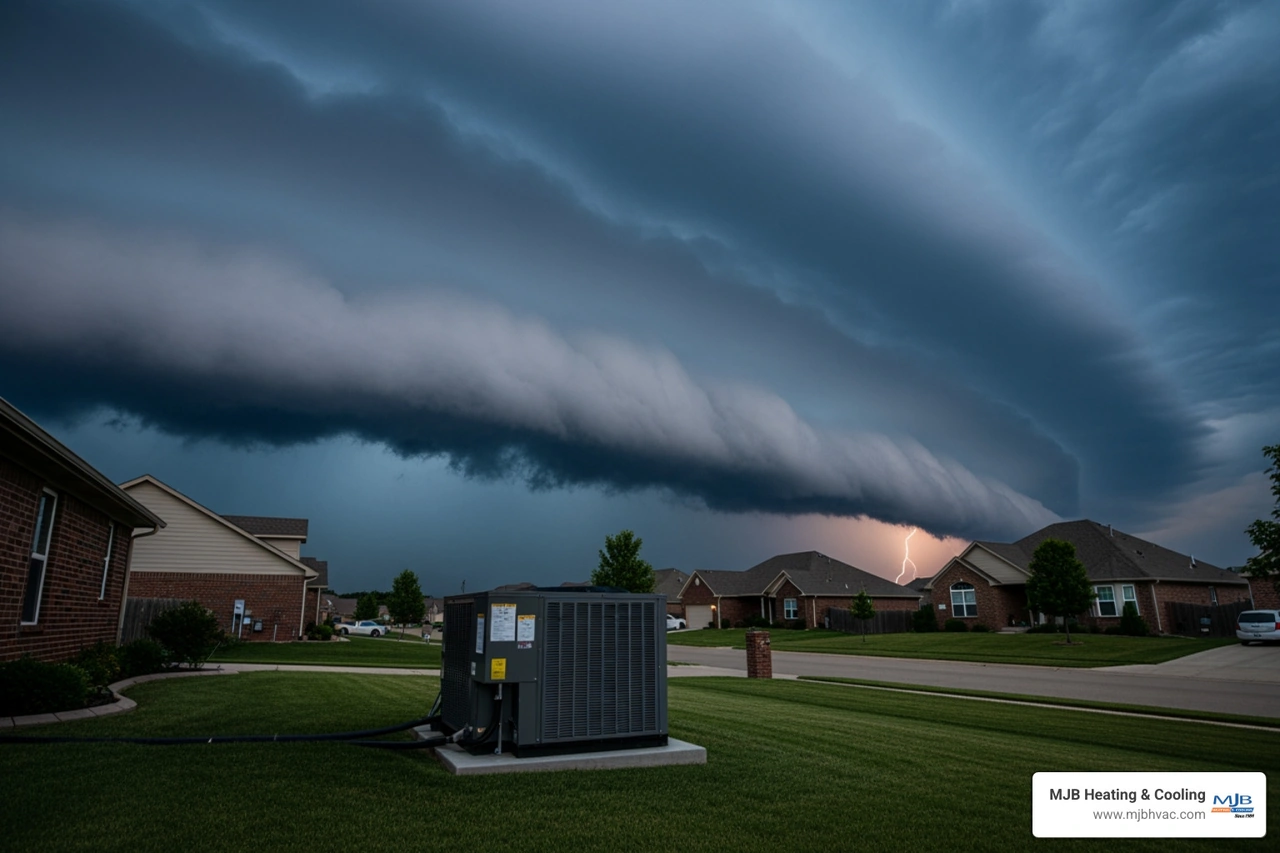
Understanding how severe storms and tornadoes affect your HVAC system is critical for homeowners across Central Kansas — one of the most storm-active regions in the entire country. Living in Tornado Alley means your outdoor condenser, electrical components, and indoor equipment face real threats every spring and summer, from flying debris and hail to power surges and flash flooding.
Tornadoes cause an average of $1.4 billion in property damage annually across the U.S., and outdoor HVAC units are consistently among the most exposed components on any home. High winds can displace or destroy condenser units in over 40% of severe weather events in the Midwest and South. Power surges from lightning damage HVAC electrical components in roughly 25% of affected homes. And hailstorms — a near-annual reality in Kansas — can cut condenser efficiency by up to 30%.
The damage isn't always obvious right away. A unit that still turns on after a storm isn't necessarily working correctly. Hidden issues like bent condenser fins, flooded electrical components, or surge-damaged circuit boards often show up weeks later as higher energy bills, uneven cooling, or sudden system failure.
Here's a quick breakdown of the main ways storms damage HVAC systems:
This guide walks through each of these risks in detail — and what you can do before and after a storm to protect your system.
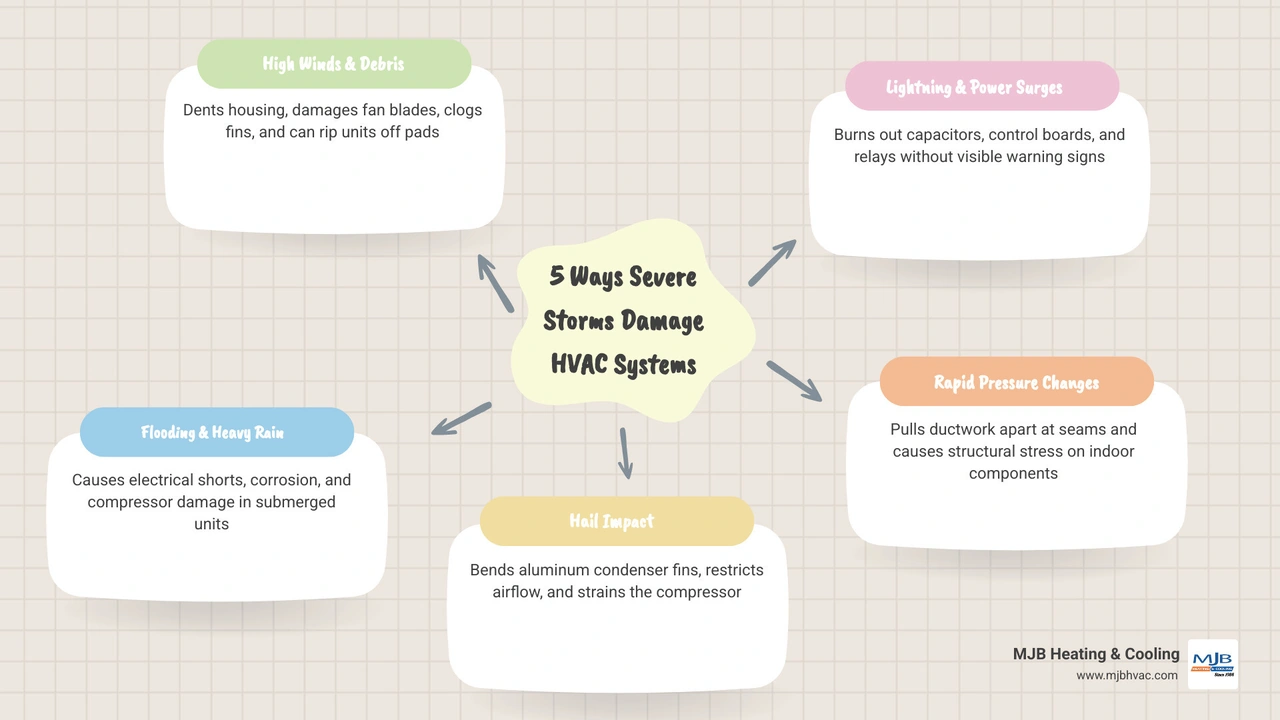
When we talk about how severe storms and tornadoes affect your HVAC, the first thing that comes to mind is the sheer power of the wind. In Central Kansas, we aren’t just dealing with a light breeze; we’re talking about straight-line winds that can hit 80 mph and tornadoes that can exceed 200 mph. These forces test the structural integrity of your home and your cooling system.
High winds exert immense pressure on the outdoor condenser unit. If the unit isn't properly secured, it can be shifted, tilted, or even completely uprooted from its foundation. When a unit moves, it often shears the copper refrigerant lines and electrical conduits, leading to an immediate system failure and a potentially dangerous situation. You can learn more about the specifics of local weather patterns in our guide on How Kansas Severe Weather Affects Your HVAC System.
The wind itself is dangerous, but the debris it carries is often what does the most damage. In places like Wichita, Maize, and Goddard, storms often turn everyday objects into projectiles. Tree limbs, loose shingles, lawn furniture, and even gravel can be hurled against your condenser.
This debris can cause several types of damage:
Understanding the Kansas Climate HVAC Guide is essential for knowing how to prepare for these seasonal projectiles.
To combat these high-wind events, we always recommend ensuring your unit is properly anchored. Most modern installations in the Wichita metro area use heavy-duty concrete pads. However, in high-wind zones, simply sitting on a pad isn't enough.
Using "hurricane straps" or specialized tie-down kits can keep the unit from sliding or tipping during a tornado. These brackets bolt the unit directly to the concrete, providing the stability needed to withstand the intense pressure differentials that occur during a storm.
While wind gets the headlines, water is the silent killer of HVAC systems. Heavy rainfall and flash flooding are common in cities like Derby and Haysville. When water enters the electrical housing of your outdoor unit, it can cause immediate short circuits.
Even if the water recedes quickly, it often leaves behind silt and mud. This sediment acts as an insulator, trapping heat inside the unit and causing internal corrosion that will shorten the system's lifespan. We’ve seen that How Proper Maintenance Prevents Mold Growth is a key topic for homeowners because moisture trapped in the system is an invitation for fungal issues.
It isn't just the outdoor unit at risk. If your furnace or air handler is located in a basement or crawlspace, flash flooding can submerge the lower components. Water damage to a furnace's gas valves, burners, and blower motor is often irreparable and poses a significant safety risk.
Furthermore, if water enters your ductwork, it can lead to long-term air quality issues. Moisture inside dark, dusty ducts is the perfect breeding ground for spores. This is why How Your HVAC System Affects the Air You Breathe is such a vital consideration after a flood event.
If you live in a flood-prone area like certain parts of Derby, KS, and your unit has been submerged, do not turn it on. Even if the water has cleared, the internal electrical components must be professionally cleaned and dried. Salt and minerals in the water can lead to "wicking," where moisture travels up wires into the control board, causing a fire hazard. A professional inspection is the only way to ensure the system is safe to operate.
Hail is a frequent visitor to Central Kansas, and it is particularly brutal on HVAC units. Your condenser is wrapped in thin aluminum fins that are designed to dissipate heat. When hailstones strike these fins, they flatten the soft metal, closing the gaps that allow air to flow through the coils.
| Unit Condition | Airflow Efficiency | Compressor Strain | Estimated Energy Bill Impact |
|---|---|---|---|
| Healthy Unit | 100% | Normal | Baseline |
| Light Hail Damage | 85% | Moderate | 10-15% Increase |
| Severe Hail Damage | 60% or less | High | 30% or more Increase |
Following HVAC Maintenance Tips for Kansas Homeowners can help you identify this damage early before it leads to a total system meltdown.
When the fins are bent, the heat exchange process is crippled. Your system has to work twice as hard to remove heat from your home, leading to massive efficiency loss. While some minor damage can be fixed using a "fin comb" to straighten the metal, severe impacts often require a full coil replacement.
Protective hail guards — essentially heavy-duty metal screens — can be installed to shield these delicate fins from the worst of the impact without significantly restricting airflow.
In towns like Andover, which has a significant history of severe storms, we often find units that are "limping" along after a hailstorm. The homeowner might notice the AC is running constantly (cycling) but the house never quite reaches the set temperature. This constant strain leads to premature compressor failure, which is one of the most expensive repairs in the industry.
Lightning doesn't have to strike your house to cause damage. A strike blocks away can send a massive voltage spike through the power lines. How severe storms and tornadoes affect your HVAC electrical system is often the most frustrating type of damage because it is invisible to the naked eye.
Common signs of electrical storm damage include:
We strongly recommend a multi-layered approach to electrical safety. While whole-home surge protectors are great, a dedicated HVAC surge protector installed at the outdoor disconnect box provides a much higher level of defense. These devices are designed to sacrificial themselves to save your expensive compressor and control boards.
Preparation is your best defense. Before the clouds turn green in Wichita, take a few minutes to:
Once the storm has passed and it is safe to go outside, perform a visual inspection of your HVAC system:
If you suspect damage, don't try to DIY the repairs. Modern HVAC systems use high-voltage electricity and pressurized refrigerants that require specialized tools and training. Furthermore, many manufacturer warranties require proof of professional maintenance and repair to remain valid. A licensed technician can find "hidden" leaks or electrical weaknesses that would otherwise lead to a breakdown in the middle of a July heatwave.
Yes. While it’s tempting to keep the house cool, the risk of a power surge or lightning strike is high during a Kansas thunderstorm. Turning the system off at the thermostat — or better yet, flipping the breaker — protects the sensitive electronics from voltage spikes and "brownouts" (low voltage) that can burn out the motor.
You can use a specialized "hail cover" or a hardcover, but only when the unit is turned off. Never run your AC with a cover on it; this will cause the system to overheat instantly, potentially destroying the compressor. If you use a temporary cover during a storm, make sure to remove it as soon as the weather clears.
If your energy bills suddenly spike, your system makes a new "whirring" or "humming" sound, or if some rooms are suddenly warmer than others, you likely have hidden storm damage. These are signs that the system is struggling to compensate for a leak, a bent fan, or flattened fins.
At MJB Heating & Cooling, we’ve been helping our neighbors in the Wichita metro area weather the storms since 1984. From Derby to Hutchinson and everywhere in between, we understand the unique challenges the Central Kansas climate poses to your home comfort. Whether you need a post-storm safety inspection or a complete system upgrade to a more resilient unit, our family-owned team is here to provide honest, dependable service. Don't let a severe storm compromise your comfort — stay proactive and keep your system protected.
Understanding how severe storms and tornadoes affect your HVAC system is critical for homeowners across Central Kansas — one of the most storm-active regions in the entire country. Living in Tornado Alley means your outdoor condenser, electrical components, and indoor equipment face real threats every spring and summer, from flying debris and hail to power surges and flash flooding.
Tornadoes cause an average of $1.4 billion in property damage annually across the U.S., and outdoor HVAC units are consistently among the most exposed components on any home. High winds can displace or destroy condenser units in over 40% of severe weather events in the Midwest and South. Power surges from lightning damage HVAC electrical components in roughly 25% of affected homes. And hailstorms — a near-annual reality in Kansas — can cut condenser efficiency by up to 30%.
The damage isn't always obvious right away. A unit that still turns on after a storm isn't necessarily working correctly. Hidden issues like bent condenser fins, flooded electrical components, or surge-damaged circuit boards often show up weeks later as higher energy bills, uneven cooling, or sudden system failure.
Here's a quick breakdown of the main ways storms damage HVAC systems:
This guide walks through each of these risks in detail — and what you can do before and after a storm to protect your system.
When we talk about how severe storms and tornadoes affect your HVAC, the first thing that comes to mind is the sheer power of the wind. In Central Kansas, we aren’t just dealing with a light breeze; we’re talking about straight-line winds that can hit 80 mph and tornadoes that can exceed 200 mph. These forces test the structural integrity of your home and your cooling system.
High winds exert immense pressure on the outdoor condenser unit. If the unit isn't properly secured, it can be shifted, tilted, or even completely uprooted from its foundation. When a unit moves, it often shears the copper refrigerant lines and electrical conduits, leading to an immediate system failure and a potentially dangerous situation. You can learn more about the specifics of local weather patterns in our guide on How Kansas Severe Weather Affects Your HVAC System.
The wind itself is dangerous, but the debris it carries is often what does the most damage. In places like Wichita, Maize, and Goddard, storms often turn everyday objects into projectiles. Tree limbs, loose shingles, lawn furniture, and even gravel can be hurled against your condenser.
This debris can cause several types of damage:
Understanding the Kansas Climate HVAC Guide is essential for knowing how to prepare for these seasonal projectiles.
To combat these high-wind events, we always recommend ensuring your unit is properly anchored. Most modern installations in the Wichita metro area use heavy-duty concrete pads. However, in high-wind zones, simply sitting on a pad isn't enough.
Using "hurricane straps" or specialized tie-down kits can keep the unit from sliding or tipping during a tornado. These brackets bolt the unit directly to the concrete, providing the stability needed to withstand the intense pressure differentials that occur during a storm.
While wind gets the headlines, water is the silent killer of HVAC systems. Heavy rainfall and flash flooding are common in cities like Derby and Haysville. When water enters the electrical housing of your outdoor unit, it can cause immediate short circuits.
Even if the water recedes quickly, it often leaves behind silt and mud. This sediment acts as an insulator, trapping heat inside the unit and causing internal corrosion that will shorten the system's lifespan. We’ve seen that How Proper Maintenance Prevents Mold Growth is a key topic for homeowners because moisture trapped in the system is an invitation for fungal issues.
It isn't just the outdoor unit at risk. If your furnace or air handler is located in a basement or crawlspace, flash flooding can submerge the lower components. Water damage to a furnace's gas valves, burners, and blower motor is often irreparable and poses a significant safety risk.
Furthermore, if water enters your ductwork, it can lead to long-term air quality issues. Moisture inside dark, dusty ducts is the perfect breeding ground for spores. This is why How Your HVAC System Affects the Air You Breathe is such a vital consideration after a flood event.
If you live in a flood-prone area like certain parts of Derby, KS, and your unit has been submerged, do not turn it on. Even if the water has cleared, the internal electrical components must be professionally cleaned and dried. Salt and minerals in the water can lead to "wicking," where moisture travels up wires into the control board, causing a fire hazard. A professional inspection is the only way to ensure the system is safe to operate.
Hail is a frequent visitor to Central Kansas, and it is particularly brutal on HVAC units. Your condenser is wrapped in thin aluminum fins that are designed to dissipate heat. When hailstones strike these fins, they flatten the soft metal, closing the gaps that allow air to flow through the coils.
| Unit Condition | Airflow Efficiency | Compressor Strain | Estimated Energy Bill Impact |
|---|---|---|---|
| Healthy Unit | 100% | Normal | Baseline |
| Light Hail Damage | 85% | Moderate | 10-15% Increase |
| Severe Hail Damage | 60% or less | High | 30% or more Increase |
Following HVAC Maintenance Tips for Kansas Homeowners can help you identify this damage early before it leads to a total system meltdown.
When the fins are bent, the heat exchange process is crippled. Your system has to work twice as hard to remove heat from your home, leading to massive efficiency loss. While some minor damage can be fixed using a "fin comb" to straighten the metal, severe impacts often require a full coil replacement.
Protective hail guards — essentially heavy-duty metal screens — can be installed to shield these delicate fins from the worst of the impact without significantly restricting airflow.
In towns like Andover, which has a significant history of severe storms, we often find units that are "limping" along after a hailstorm. The homeowner might notice the AC is running constantly (cycling) but the house never quite reaches the set temperature. This constant strain leads to premature compressor failure, which is one of the most expensive repairs in the industry.
Lightning doesn't have to strike your house to cause damage. A strike blocks away can send a massive voltage spike through the power lines. How severe storms and tornadoes affect your HVAC electrical system is often the most frustrating type of damage because it is invisible to the naked eye.
Common signs of electrical storm damage include:
We strongly recommend a multi-layered approach to electrical safety. While whole-home surge protectors are great, a dedicated HVAC surge protector installed at the outdoor disconnect box provides a much higher level of defense. These devices are designed to sacrificial themselves to save your expensive compressor and control boards.
Preparation is your best defense. Before the clouds turn green in Wichita, take a few minutes to:
Once the storm has passed and it is safe to go outside, perform a visual inspection of your HVAC system:
If you suspect damage, don't try to DIY the repairs. Modern HVAC systems use high-voltage electricity and pressurized refrigerants that require specialized tools and training. Furthermore, many manufacturer warranties require proof of professional maintenance and repair to remain valid. A licensed technician can find "hidden" leaks or electrical weaknesses that would otherwise lead to a breakdown in the middle of a July heatwave.
Yes. While it’s tempting to keep the house cool, the risk of a power surge or lightning strike is high during a Kansas thunderstorm. Turning the system off at the thermostat — or better yet, flipping the breaker — protects the sensitive electronics from voltage spikes and "brownouts" (low voltage) that can burn out the motor.
You can use a specialized "hail cover" or a hardcover, but only when the unit is turned off. Never run your AC with a cover on it; this will cause the system to overheat instantly, potentially destroying the compressor. If you use a temporary cover during a storm, make sure to remove it as soon as the weather clears.
If your energy bills suddenly spike, your system makes a new "whirring" or "humming" sound, or if some rooms are suddenly warmer than others, you likely have hidden storm damage. These are signs that the system is struggling to compensate for a leak, a bent fan, or flattened fins.
At MJB Heating & Cooling, we’ve been helping our neighbors in the Wichita metro area weather the storms since 1984. From Derby to Hutchinson and everywhere in between, we understand the unique challenges the Central Kansas climate poses to your home comfort. Whether you need a post-storm safety inspection or a complete system upgrade to a more resilient unit, our family-owned team is here to provide honest, dependable service. Don't let a severe storm compromise your comfort — stay proactive and keep your system protected.
Understanding how severe storms and tornadoes affect your HVAC system is critical for homeowners across Central Kansas — one of the most storm-active regions in the entire country. Living in Tornado Alley means your outdoor condenser, electrical components, and indoor equipment face real threats every spring and summer, from flying debris and hail to power surges and flash flooding.
Tornadoes cause an average of $1.4 billion in property damage annually across the U.S., and outdoor HVAC units are consistently among the most exposed components on any home. High winds can displace or destroy condenser units in over 40% of severe weather events in the Midwest and South. Power surges from lightning damage HVAC electrical components in roughly 25% of affected homes. And hailstorms — a near-annual reality in Kansas — can cut condenser efficiency by up to 30%.
The damage isn't always obvious right away. A unit that still turns on after a storm isn't necessarily working correctly. Hidden issues like bent condenser fins, flooded electrical components, or surge-damaged circuit boards often show up weeks later as higher energy bills, uneven cooling, or sudden system failure.
Here's a quick breakdown of the main ways storms damage HVAC systems:
This guide walks through each of these risks in detail — and what you can do before and after a storm to protect your system.
When we talk about how severe storms and tornadoes affect your HVAC, the first thing that comes to mind is the sheer power of the wind. In Central Kansas, we aren’t just dealing with a light breeze; we’re talking about straight-line winds that can hit 80 mph and tornadoes that can exceed 200 mph. These forces test the structural integrity of your home and your cooling system.
High winds exert immense pressure on the outdoor condenser unit. If the unit isn't properly secured, it can be shifted, tilted, or even completely uprooted from its foundation. When a unit moves, it often shears the copper refrigerant lines and electrical conduits, leading to an immediate system failure and a potentially dangerous situation. You can learn more about the specifics of local weather patterns in our guide on How Kansas Severe Weather Affects Your HVAC System.
The wind itself is dangerous, but the debris it carries is often what does the most damage. In places like Wichita, Maize, and Goddard, storms often turn everyday objects into projectiles. Tree limbs, loose shingles, lawn furniture, and even gravel can be hurled against your condenser.
This debris can cause several types of damage:
Understanding the Kansas Climate HVAC Guide is essential for knowing how to prepare for these seasonal projectiles.
To combat these high-wind events, we always recommend ensuring your unit is properly anchored. Most modern installations in the Wichita metro area use heavy-duty concrete pads. However, in high-wind zones, simply sitting on a pad isn't enough.
Using "hurricane straps" or specialized tie-down kits can keep the unit from sliding or tipping during a tornado. These brackets bolt the unit directly to the concrete, providing the stability needed to withstand the intense pressure differentials that occur during a storm.
While wind gets the headlines, water is the silent killer of HVAC systems. Heavy rainfall and flash flooding are common in cities like Derby and Haysville. When water enters the electrical housing of your outdoor unit, it can cause immediate short circuits.
Even if the water recedes quickly, it often leaves behind silt and mud. This sediment acts as an insulator, trapping heat inside the unit and causing internal corrosion that will shorten the system's lifespan. We’ve seen that How Proper Maintenance Prevents Mold Growth is a key topic for homeowners because moisture trapped in the system is an invitation for fungal issues.
It isn't just the outdoor unit at risk. If your furnace or air handler is located in a basement or crawlspace, flash flooding can submerge the lower components. Water damage to a furnace's gas valves, burners, and blower motor is often irreparable and poses a significant safety risk.
Furthermore, if water enters your ductwork, it can lead to long-term air quality issues. Moisture inside dark, dusty ducts is the perfect breeding ground for spores. This is why How Your HVAC System Affects the Air You Breathe is such a vital consideration after a flood event.
If you live in a flood-prone area like certain parts of Derby, KS, and your unit has been submerged, do not turn it on. Even if the water has cleared, the internal electrical components must be professionally cleaned and dried. Salt and minerals in the water can lead to "wicking," where moisture travels up wires into the control board, causing a fire hazard. A professional inspection is the only way to ensure the system is safe to operate.
Hail is a frequent visitor to Central Kansas, and it is particularly brutal on HVAC units. Your condenser is wrapped in thin aluminum fins that are designed to dissipate heat. When hailstones strike these fins, they flatten the soft metal, closing the gaps that allow air to flow through the coils.
| Unit Condition | Airflow Efficiency | Compressor Strain | Estimated Energy Bill Impact |
|---|---|---|---|
| Healthy Unit | 100% | Normal | Baseline |
| Light Hail Damage | 85% | Moderate | 10-15% Increase |
| Severe Hail Damage | 60% or less | High | 30% or more Increase |
Following HVAC Maintenance Tips for Kansas Homeowners can help you identify this damage early before it leads to a total system meltdown.
When the fins are bent, the heat exchange process is crippled. Your system has to work twice as hard to remove heat from your home, leading to massive efficiency loss. While some minor damage can be fixed using a "fin comb" to straighten the metal, severe impacts often require a full coil replacement.
Protective hail guards — essentially heavy-duty metal screens — can be installed to shield these delicate fins from the worst of the impact without significantly restricting airflow.
In towns like Andover, which has a significant history of severe storms, we often find units that are "limping" along after a hailstorm. The homeowner might notice the AC is running constantly (cycling) but the house never quite reaches the set temperature. This constant strain leads to premature compressor failure, which is one of the most expensive repairs in the industry.
Lightning doesn't have to strike your house to cause damage. A strike blocks away can send a massive voltage spike through the power lines. How severe storms and tornadoes affect your HVAC electrical system is often the most frustrating type of damage because it is invisible to the naked eye.
Common signs of electrical storm damage include:
We strongly recommend a multi-layered approach to electrical safety. While whole-home surge protectors are great, a dedicated HVAC surge protector installed at the outdoor disconnect box provides a much higher level of defense. These devices are designed to sacrificial themselves to save your expensive compressor and control boards.
Preparation is your best defense. Before the clouds turn green in Wichita, take a few minutes to:
Once the storm has passed and it is safe to go outside, perform a visual inspection of your HVAC system:
If you suspect damage, don't try to DIY the repairs. Modern HVAC systems use high-voltage electricity and pressurized refrigerants that require specialized tools and training. Furthermore, many manufacturer warranties require proof of professional maintenance and repair to remain valid. A licensed technician can find "hidden" leaks or electrical weaknesses that would otherwise lead to a breakdown in the middle of a July heatwave.
Yes. While it’s tempting to keep the house cool, the risk of a power surge or lightning strike is high during a Kansas thunderstorm. Turning the system off at the thermostat — or better yet, flipping the breaker — protects the sensitive electronics from voltage spikes and "brownouts" (low voltage) that can burn out the motor.
You can use a specialized "hail cover" or a hardcover, but only when the unit is turned off. Never run your AC with a cover on it; this will cause the system to overheat instantly, potentially destroying the compressor. If you use a temporary cover during a storm, make sure to remove it as soon as the weather clears.
If your energy bills suddenly spike, your system makes a new "whirring" or "humming" sound, or if some rooms are suddenly warmer than others, you likely have hidden storm damage. These are signs that the system is struggling to compensate for a leak, a bent fan, or flattened fins.
At MJB Heating & Cooling, we’ve been helping our neighbors in the Wichita metro area weather the storms since 1984. From Derby to Hutchinson and everywhere in between, we understand the unique challenges the Central Kansas climate poses to your home comfort. Whether you need a post-storm safety inspection or a complete system upgrade to a more resilient unit, our family-owned team is here to provide honest, dependable service. Don't let a severe storm compromise your comfort — stay proactive and keep your system protected.

Understanding how severe storms and tornadoes affect your HVAC system is critical for homeowners across Central Kansas — one of the most storm-active regions in the entire country. Living in Tornado Alley means your outdoor condenser, electrical components, and indoor equipment face real threats every spring and summer, from flying debris and hail to power surges and flash flooding.
Tornadoes cause an average of $1.4 billion in property damage annually across the U.S., and outdoor HVAC units are consistently among the most exposed components on any home. High winds can displace or destroy condenser units in over 40% of severe weather events in the Midwest and South. Power surges from lightning damage HVAC electrical components in roughly 25% of affected homes. And hailstorms — a near-annual reality in Kansas — can cut condenser efficiency by up to 30%.
The damage isn't always obvious right away. A unit that still turns on after a storm isn't necessarily working correctly. Hidden issues like bent condenser fins, flooded electrical components, or surge-damaged circuit boards often show up weeks later as higher energy bills, uneven cooling, or sudden system failure.
Here's a quick breakdown of the main ways storms damage HVAC systems:
This guide walks through each of these risks in detail — and what you can do before and after a storm to protect your system.
When we talk about how severe storms and tornadoes affect your HVAC, the first thing that comes to mind is the sheer power of the wind. In Central Kansas, we aren’t just dealing with a light breeze; we’re talking about straight-line winds that can hit 80 mph and tornadoes that can exceed 200 mph. These forces test the structural integrity of your home and your cooling system.
High winds exert immense pressure on the outdoor condenser unit. If the unit isn't properly secured, it can be shifted, tilted, or even completely uprooted from its foundation. When a unit moves, it often shears the copper refrigerant lines and electrical conduits, leading to an immediate system failure and a potentially dangerous situation. You can learn more about the specifics of local weather patterns in our guide on How Kansas Severe Weather Affects Your HVAC System.
The wind itself is dangerous, but the debris it carries is often what does the most damage. In places like Wichita, Maize, and Goddard, storms often turn everyday objects into projectiles. Tree limbs, loose shingles, lawn furniture, and even gravel can be hurled against your condenser.
This debris can cause several types of damage:
Understanding the Kansas Climate HVAC Guide is essential for knowing how to prepare for these seasonal projectiles.
To combat these high-wind events, we always recommend ensuring your unit is properly anchored. Most modern installations in the Wichita metro area use heavy-duty concrete pads. However, in high-wind zones, simply sitting on a pad isn't enough.
Using "hurricane straps" or specialized tie-down kits can keep the unit from sliding or tipping during a tornado. These brackets bolt the unit directly to the concrete, providing the stability needed to withstand the intense pressure differentials that occur during a storm.
While wind gets the headlines, water is the silent killer of HVAC systems. Heavy rainfall and flash flooding are common in cities like Derby and Haysville. When water enters the electrical housing of your outdoor unit, it can cause immediate short circuits.
Even if the water recedes quickly, it often leaves behind silt and mud. This sediment acts as an insulator, trapping heat inside the unit and causing internal corrosion that will shorten the system's lifespan. We’ve seen that How Proper Maintenance Prevents Mold Growth is a key topic for homeowners because moisture trapped in the system is an invitation for fungal issues.
It isn't just the outdoor unit at risk. If your furnace or air handler is located in a basement or crawlspace, flash flooding can submerge the lower components. Water damage to a furnace's gas valves, burners, and blower motor is often irreparable and poses a significant safety risk.
Furthermore, if water enters your ductwork, it can lead to long-term air quality issues. Moisture inside dark, dusty ducts is the perfect breeding ground for spores. This is why How Your HVAC System Affects the Air You Breathe is such a vital consideration after a flood event.
If you live in a flood-prone area like certain parts of Derby, KS, and your unit has been submerged, do not turn it on. Even if the water has cleared, the internal electrical components must be professionally cleaned and dried. Salt and minerals in the water can lead to "wicking," where moisture travels up wires into the control board, causing a fire hazard. A professional inspection is the only way to ensure the system is safe to operate.
Hail is a frequent visitor to Central Kansas, and it is particularly brutal on HVAC units. Your condenser is wrapped in thin aluminum fins that are designed to dissipate heat. When hailstones strike these fins, they flatten the soft metal, closing the gaps that allow air to flow through the coils.
| Unit Condition | Airflow Efficiency | Compressor Strain | Estimated Energy Bill Impact |
|---|---|---|---|
| Healthy Unit | 100% | Normal | Baseline |
| Light Hail Damage | 85% | Moderate | 10-15% Increase |
| Severe Hail Damage | 60% or less | High | 30% or more Increase |
Following HVAC Maintenance Tips for Kansas Homeowners can help you identify this damage early before it leads to a total system meltdown.
When the fins are bent, the heat exchange process is crippled. Your system has to work twice as hard to remove heat from your home, leading to massive efficiency loss. While some minor damage can be fixed using a "fin comb" to straighten the metal, severe impacts often require a full coil replacement.
Protective hail guards — essentially heavy-duty metal screens — can be installed to shield these delicate fins from the worst of the impact without significantly restricting airflow.
In towns like Andover, which has a significant history of severe storms, we often find units that are "limping" along after a hailstorm. The homeowner might notice the AC is running constantly (cycling) but the house never quite reaches the set temperature. This constant strain leads to premature compressor failure, which is one of the most expensive repairs in the industry.
Lightning doesn't have to strike your house to cause damage. A strike blocks away can send a massive voltage spike through the power lines. How severe storms and tornadoes affect your HVAC electrical system is often the most frustrating type of damage because it is invisible to the naked eye.
Common signs of electrical storm damage include:
We strongly recommend a multi-layered approach to electrical safety. While whole-home surge protectors are great, a dedicated HVAC surge protector installed at the outdoor disconnect box provides a much higher level of defense. These devices are designed to sacrificial themselves to save your expensive compressor and control boards.
Preparation is your best defense. Before the clouds turn green in Wichita, take a few minutes to:
Once the storm has passed and it is safe to go outside, perform a visual inspection of your HVAC system:
If you suspect damage, don't try to DIY the repairs. Modern HVAC systems use high-voltage electricity and pressurized refrigerants that require specialized tools and training. Furthermore, many manufacturer warranties require proof of professional maintenance and repair to remain valid. A licensed technician can find "hidden" leaks or electrical weaknesses that would otherwise lead to a breakdown in the middle of a July heatwave.
Yes. While it’s tempting to keep the house cool, the risk of a power surge or lightning strike is high during a Kansas thunderstorm. Turning the system off at the thermostat — or better yet, flipping the breaker — protects the sensitive electronics from voltage spikes and "brownouts" (low voltage) that can burn out the motor.
You can use a specialized "hail cover" or a hardcover, but only when the unit is turned off. Never run your AC with a cover on it; this will cause the system to overheat instantly, potentially destroying the compressor. If you use a temporary cover during a storm, make sure to remove it as soon as the weather clears.
If your energy bills suddenly spike, your system makes a new "whirring" or "humming" sound, or if some rooms are suddenly warmer than others, you likely have hidden storm damage. These are signs that the system is struggling to compensate for a leak, a bent fan, or flattened fins.
At MJB Heating & Cooling, we’ve been helping our neighbors in the Wichita metro area weather the storms since 1984. From Derby to Hutchinson and everywhere in between, we understand the unique challenges the Central Kansas climate poses to your home comfort. Whether you need a post-storm safety inspection or a complete system upgrade to a more resilient unit, our family-owned team is here to provide honest, dependable service. Don't let a severe storm compromise your comfort — stay proactive and keep your system protected.
Understanding how severe storms and tornadoes affect your HVAC system is critical for homeowners across Central Kansas — one of the most storm-active regions in the entire country. Living in Tornado Alley means your outdoor condenser, electrical components, and indoor equipment face real threats every spring and summer, from flying debris and hail to power surges and flash flooding.
Tornadoes cause an average of $1.4 billion in property damage annually across the U.S., and outdoor HVAC units are consistently among the most exposed components on any home. High winds can displace or destroy condenser units in over 40% of severe weather events in the Midwest and South. Power surges from lightning damage HVAC electrical components in roughly 25% of affected homes. And hailstorms — a near-annual reality in Kansas — can cut condenser efficiency by up to 30%.
The damage isn't always obvious right away. A unit that still turns on after a storm isn't necessarily working correctly. Hidden issues like bent condenser fins, flooded electrical components, or surge-damaged circuit boards often show up weeks later as higher energy bills, uneven cooling, or sudden system failure.
Here's a quick breakdown of the main ways storms damage HVAC systems:
This guide walks through each of these risks in detail — and what you can do before and after a storm to protect your system.
When we talk about how severe storms and tornadoes affect your HVAC, the first thing that comes to mind is the sheer power of the wind. In Central Kansas, we aren’t just dealing with a light breeze; we’re talking about straight-line winds that can hit 80 mph and tornadoes that can exceed 200 mph. These forces test the structural integrity of your home and your cooling system.
High winds exert immense pressure on the outdoor condenser unit. If the unit isn't properly secured, it can be shifted, tilted, or even completely uprooted from its foundation. When a unit moves, it often shears the copper refrigerant lines and electrical conduits, leading to an immediate system failure and a potentially dangerous situation. You can learn more about the specifics of local weather patterns in our guide on How Kansas Severe Weather Affects Your HVAC System.
The wind itself is dangerous, but the debris it carries is often what does the most damage. In places like Wichita, Maize, and Goddard, storms often turn everyday objects into projectiles. Tree limbs, loose shingles, lawn furniture, and even gravel can be hurled against your condenser.
This debris can cause several types of damage:
Understanding the Kansas Climate HVAC Guide is essential for knowing how to prepare for these seasonal projectiles.
To combat these high-wind events, we always recommend ensuring your unit is properly anchored. Most modern installations in the Wichita metro area use heavy-duty concrete pads. However, in high-wind zones, simply sitting on a pad isn't enough.
Using "hurricane straps" or specialized tie-down kits can keep the unit from sliding or tipping during a tornado. These brackets bolt the unit directly to the concrete, providing the stability needed to withstand the intense pressure differentials that occur during a storm.
While wind gets the headlines, water is the silent killer of HVAC systems. Heavy rainfall and flash flooding are common in cities like Derby and Haysville. When water enters the electrical housing of your outdoor unit, it can cause immediate short circuits.
Even if the water recedes quickly, it often leaves behind silt and mud. This sediment acts as an insulator, trapping heat inside the unit and causing internal corrosion that will shorten the system's lifespan. We’ve seen that How Proper Maintenance Prevents Mold Growth is a key topic for homeowners because moisture trapped in the system is an invitation for fungal issues.
It isn't just the outdoor unit at risk. If your furnace or air handler is located in a basement or crawlspace, flash flooding can submerge the lower components. Water damage to a furnace's gas valves, burners, and blower motor is often irreparable and poses a significant safety risk.
Furthermore, if water enters your ductwork, it can lead to long-term air quality issues. Moisture inside dark, dusty ducts is the perfect breeding ground for spores. This is why How Your HVAC System Affects the Air You Breathe is such a vital consideration after a flood event.
If you live in a flood-prone area like certain parts of Derby, KS, and your unit has been submerged, do not turn it on. Even if the water has cleared, the internal electrical components must be professionally cleaned and dried. Salt and minerals in the water can lead to "wicking," where moisture travels up wires into the control board, causing a fire hazard. A professional inspection is the only way to ensure the system is safe to operate.
Hail is a frequent visitor to Central Kansas, and it is particularly brutal on HVAC units. Your condenser is wrapped in thin aluminum fins that are designed to dissipate heat. When hailstones strike these fins, they flatten the soft metal, closing the gaps that allow air to flow through the coils.
| Unit Condition | Airflow Efficiency | Compressor Strain | Estimated Energy Bill Impact |
|---|---|---|---|
| Healthy Unit | 100% | Normal | Baseline |
| Light Hail Damage | 85% | Moderate | 10-15% Increase |
| Severe Hail Damage | 60% or less | High | 30% or more Increase |
Following HVAC Maintenance Tips for Kansas Homeowners can help you identify this damage early before it leads to a total system meltdown.
When the fins are bent, the heat exchange process is crippled. Your system has to work twice as hard to remove heat from your home, leading to massive efficiency loss. While some minor damage can be fixed using a "fin comb" to straighten the metal, severe impacts often require a full coil replacement.
Protective hail guards — essentially heavy-duty metal screens — can be installed to shield these delicate fins from the worst of the impact without significantly restricting airflow.
In towns like Andover, which has a significant history of severe storms, we often find units that are "limping" along after a hailstorm. The homeowner might notice the AC is running constantly (cycling) but the house never quite reaches the set temperature. This constant strain leads to premature compressor failure, which is one of the most expensive repairs in the industry.
Lightning doesn't have to strike your house to cause damage. A strike blocks away can send a massive voltage spike through the power lines. How severe storms and tornadoes affect your HVAC electrical system is often the most frustrating type of damage because it is invisible to the naked eye.
Common signs of electrical storm damage include:
We strongly recommend a multi-layered approach to electrical safety. While whole-home surge protectors are great, a dedicated HVAC surge protector installed at the outdoor disconnect box provides a much higher level of defense. These devices are designed to sacrificial themselves to save your expensive compressor and control boards.
Preparation is your best defense. Before the clouds turn green in Wichita, take a few minutes to:
Once the storm has passed and it is safe to go outside, perform a visual inspection of your HVAC system:
If you suspect damage, don't try to DIY the repairs. Modern HVAC systems use high-voltage electricity and pressurized refrigerants that require specialized tools and training. Furthermore, many manufacturer warranties require proof of professional maintenance and repair to remain valid. A licensed technician can find "hidden" leaks or electrical weaknesses that would otherwise lead to a breakdown in the middle of a July heatwave.
Yes. While it’s tempting to keep the house cool, the risk of a power surge or lightning strike is high during a Kansas thunderstorm. Turning the system off at the thermostat — or better yet, flipping the breaker — protects the sensitive electronics from voltage spikes and "brownouts" (low voltage) that can burn out the motor.
You can use a specialized "hail cover" or a hardcover, but only when the unit is turned off. Never run your AC with a cover on it; this will cause the system to overheat instantly, potentially destroying the compressor. If you use a temporary cover during a storm, make sure to remove it as soon as the weather clears.
If your energy bills suddenly spike, your system makes a new "whirring" or "humming" sound, or if some rooms are suddenly warmer than others, you likely have hidden storm damage. These are signs that the system is struggling to compensate for a leak, a bent fan, or flattened fins.
At MJB Heating & Cooling, we’ve been helping our neighbors in the Wichita metro area weather the storms since 1984. From Derby to Hutchinson and everywhere in between, we understand the unique challenges the Central Kansas climate poses to your home comfort. Whether you need a post-storm safety inspection or a complete system upgrade to a more resilient unit, our family-owned team is here to provide honest, dependable service. Don't let a severe storm compromise your comfort — stay proactive and keep your system protected.


Our A/C stopped working on a Sunday and due to health issues, we needed to find a service company available on a Sunday. I called MJB and left a message on their emergency voice mail. Within 10 minutes Tom Buck called me to hear my description of the symptoms. He was just finishing an appointment in Wichita and would be on his way to my home on the south end of Derby. He arrived within 30 minutes! From start to finish he was the perfect example of what you could ever hope for in an HVAC tech and a human being. His evaluation of our system inside and out was as thorough as I could ever imagine and once he was done with the repair, our system is running as well or better than ever. Well worth the price for the evaluation, parts, and labor. Thank you again Tom for an awesome experience.
Our AC went out during the hottest days of the year, and they were out next day! We have been jerked around by a shoddy home warranty for years. We finally had a chance to pick our own repair people, and MJB came highly recommended. I can see why! I was impressed with the honesty and speed at which they fixed our AC unit!
Our commercial building had a lightening/electrical strike and damaged our 20 ton AC unit. No one could find us a new unit before the end of September. Imagining going all of August and September with no AC in Kansas and working inside near 100 degree temps is less than thrilling. Dale and the team at MJB called around and saved the day. They had us a new unit 5 weeks earlier than other could promise and I now have happy employees. The unit is amazingly quiet, super cold and so much more energy efficient. Thank you for being our super hero!
Came out and installed my new furnace. Was very polite and affordable. They are very acknowledgeable and I highly recommend!
Thank you very much. We had our 1st warm night in 3weeks. MJB took the time and effort to find the real problem. And the employees were kind and thoughtful and explained things very well. I cannot thank you and all of MJB. Will recommend you highly. Thanks again Marjorie Herman Oxford Kansas
We had a new system installed and I was so impressed with how quick they were in come out and install it, in the middle of a hot summer day. They were so friendly & very professional. I had a small problem with a weird sound and they came over immediately and fixed it. Love them!