.avif)





Blogs
Stay updated with our latest blog posts.
Spring maintenance to prevent summer breakdowns is the single most effective step Wichita and Central Kansas homeowners can take before the heat arrives — and the window to act is right now, in spring, before your AC is working overtime.
Here's a quick look at what spring maintenance actually does for your system:
Most AC systems don't fail dramatically. They fail quietly — a dirty filter here, a loose wire there, a weak capacitor that barely made it through February. Then the first triple-digit day arrives, the system runs full tilt, and that marginal component finally gives out. It's a pattern that plays out every summer, and it's almost entirely preventable.
Kansas weather makes this especially urgent. Temperatures can swing from 60°F to 90°F in a single day in spring, and by June, Central Kansas homeowners are dealing with intense heat, pollen surges, cottonwood fuzz clogging outdoor units, and humidity spikes that push already-stressed systems to their limits.
The good news? A little attention in March or April goes a long way.

In home comfort, timing is everything. Spring represents a unique "reset" window for your HVAC system. After sitting dormant or running sparingly during the mild weeks following winter, your air conditioner needs a transition period before it is asked to perform at 100% capacity. Dust settles on internal components during the off-season, and mechanical parts can stiffen. Jumping straight into a July heatwave without a checkup is like asking a car that hasn't moved in months to win a drag race.
The late March to mid-April window is the "Goldilocks" zone for HVAC service in Central Kansas. Scheduling during this time allows us to perform light-load testing. We can diagnose how the system handles cooling without the extreme pressure of a 100-degree day. If we find a part that is starting to fail, there is plenty of lead time to order components and complete the repair before you actually need the AC.
Once June hits, the "summer rush" begins. In many areas, including Wichita and Derby, HVAC schedules can stretch out for weeks. By acting in the spring, you avoid being the homeowner waiting in a hot house for a technician who is already juggling a dozen emergency calls.
Ignoring a minor issue in April often leads to a catastrophe in August. A dirty filter, for example, isn't just a nuisance; it restricts airflow, which can cause the evaporator coil to freeze. This forces the compressor to work twice as hard until it eventually overheats and fails.
Other common "quiet" killers include loose wiring—which causes roughly 30% of all AC failures—and weak capacitors. A capacitor that barely clears its electrical specifications in the spring will almost certainly fail under the heavy load of summer. These small problems also lead to Signs Your AC Needs Repair like short-cycling, which wears out the motor and sends your utility bills skyrocketing.
Our local climate presents specific challenges. Central Kansas is notorious for high pollen counts and the dreaded "cottonwood season." That white, fluffy fuzz acts like a blanket on your outdoor condenser coils, trapping heat and forcing the system to consume up to 30% more energy just to keep up.
Additionally, many homes in Augusta or El Dorado have older ductwork located in hot attics. If these ducts have leaks, you could be losing up to 30% of your conditioned air before it ever reaches your living room. Combined with yard debris from spring storms, your system faces a literal uphill battle every summer.

While professional service is essential for technical components, there are several tasks you can handle yourself to give your system a head start. Think of these as the "pre-flight check" for your summer cooling.
The simplest and most effective task is checking your air filter. A dirty filter forces your system to work harder, raising energy bills by 15–30%. During the dusty Kansas spring, we recommend checking your filter every 30 days. If you have pets or suffer from allergies, consider a high-efficiency pleated filter with a MERV 8-11 rating.
Also, walk through your home and ensure all supply and return vents are open and unobstructed. Blocking vents in unused rooms doesn't save money; instead, it increases duct pressure and can lead to frozen coils. For more details, see How Often Should You Change Your HVAC Air Filter.
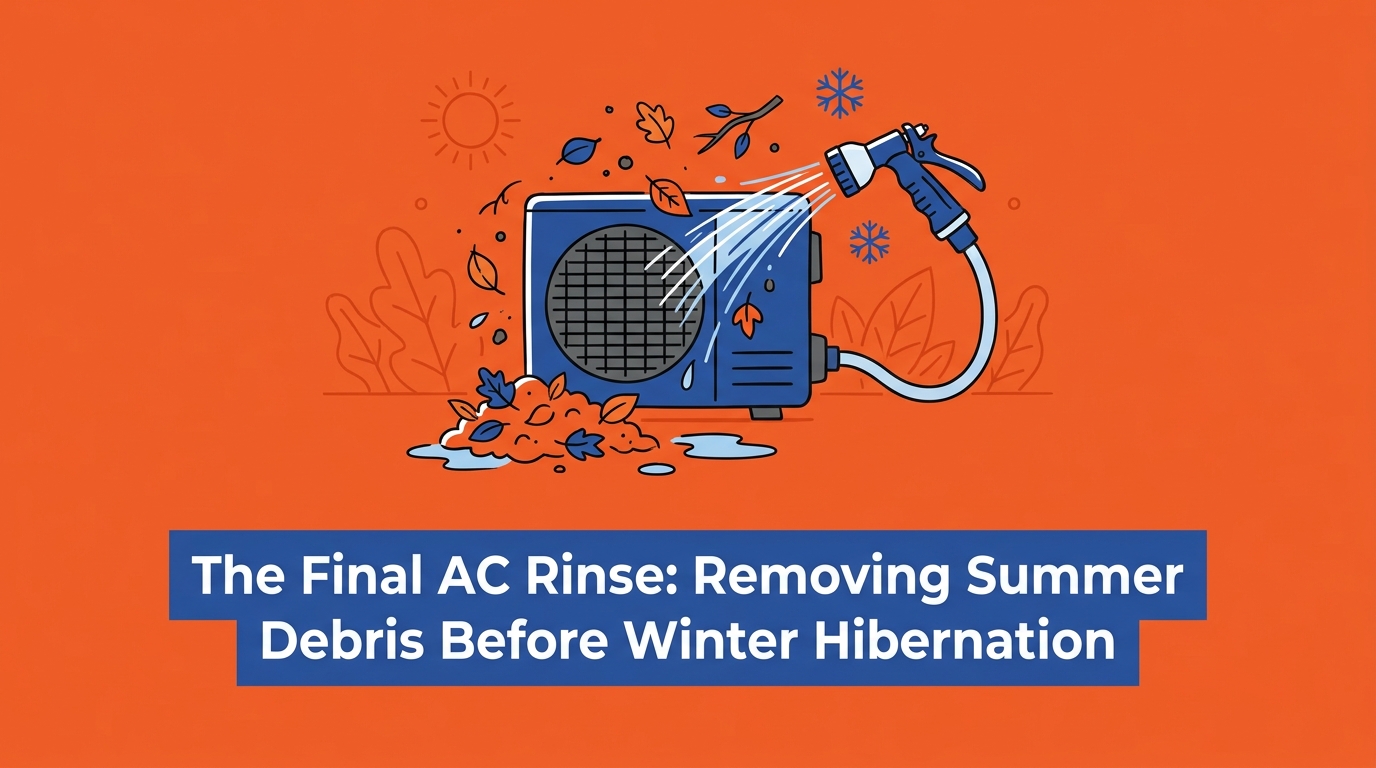
Your outdoor condenser needs to "breathe" to release heat. Maintain at least a 2-foot clearance around the unit by trimming back grass, weeds, and shrubs. After a spring storm, check for branches or leaves stuck in the grille. You can gently rinse the outdoor coils with a garden hose (never use a pressure washer, as it can crush the delicate fins). Also, inspect the foam insulation on the refrigerant lines; if it's cracked or missing, your system loses efficiency. Learn more about Spring AC Preparation for Kansas Summer.
Your AC removes a surprising amount of water from the air. To prevent clogs, you can pour a little diluted white vinegar down the condensate drain line to stop algae growth. Finally, test your thermostat by switching it to "Cool" mode and setting it a few degrees below room temperature. Listen for unusual noises and check for musty odors, which could indicate a problem before the real heat hits.
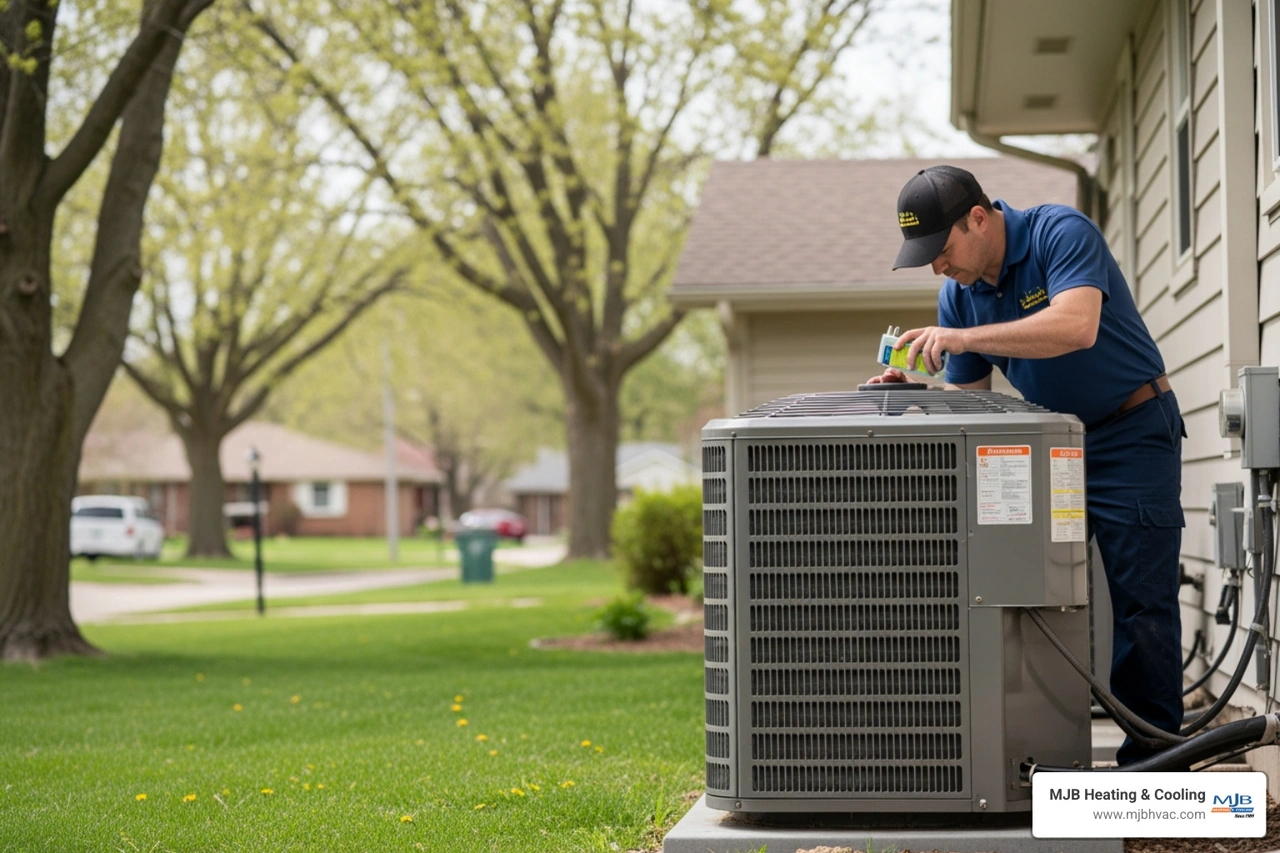
While DIY steps are great, a professional spring maintenance to prevent summer breakdowns visit goes much deeper. Certified technicians have the tools to see what is happening inside the machine—things the average homeowner simply can't detect.
When we perform a spring tune-up, we aren't just looking at the surface. A comprehensive visit includes:
For a full breakdown, check out our Essential HVAC Maintenance Tips for Your Furnace and AC.
A technician can identify a "marginal" part—something that technically works today but will fail under pressure. This includes finding loose wires (responsible for 13% of home electrical fires), identifying a weak blower motor, or spotting a tiny refrigerant leak. Catching these early saves you from the "Saturday night breakdown" where you're left without cooling until Monday. We discuss the importance of timing in How Often Should You Service Your HVAC System.
Systems that skip annual maintenance run 15–25% less efficiently. Over time, that extra work cuts the lifespan of a $10,000 system by nearly a decade. Furthermore, most major brands require documented annual maintenance to honor their warranties. If your compressor fails in July but you haven't had a spring tune-up in years, the manufacturer may deny your claim.
| Feature | Well-Maintained AC | Neglected AC |
|---|---|---|
| Lifespan | 15–20 Years | 7–12 Years |
| Energy Efficiency | 100% of Rated SEER | 70–85% of Rated SEER |
| Breakdown Risk | Very Low (95% reduction) | High during heatwaves |
| Monthly Bills | Stable and optimized | 15–30% Higher |
Even with the best care, systems age. It is vital to recognize the early warning signs that your unit is struggling before it stops entirely.
If you notice warm air coming from the vents when the system should be cooling, or if the airflow feels noticeably weaker than last year, your system is crying for help. Unusual sounds—like banging, squealing, or grinding—often indicate a failing motor or a loose belt. Musty smells usually point to biological growth in the drain pan or coils, while a burning metallic smell is an electrical emergency. If you see water pooling around your indoor unit, your condensate line is likely backed up. Don't wait; these are clear Signs Your AC Needs Repair.
In a place like Wichita or Newton, a system that struggles at 80°F will fail at 100°F. High outdoor temperatures mean the refrigerant has a harder time releasing heat. This increases the internal pressure and temperature of the compressor. If the coils are even slightly dirty or the airflow is restricted, the system simply cannot shed the heat fast enough. This leads to "system shock," where the unit runs continuously until a safety switch trips or a component burns out.
Your HVAC system is also your home's primary air filter and dehumidifier. When maintenance is neglected, the system fails to remove humidity effectively, creating a damp environment where mold can thrive. Clogged filters and dirty coils also recirculate pollen and dust, which can be devastating during the Kansas allergy season. Proper care is the best way to ensure your air stays clean; see How Proper Maintenance Prevents Mold Growth.
The financial benefits of spring maintenance to prevent summer breakdowns are immediate. Since cooling accounts for half of your electricity bill, even a small efficiency gain translates to real dollars in your pocket.
When we clean your coils and ensure your refrigerant is at the perfect level, your system doesn't have to run as long to reach your desired temperature. This "reduced runtime" is the key to savings. In fact, professional maintenance can lower HVAC operating costs by as much as 23%. Simple steps like replacing a dirty filter can save between 5 and 15 percent of the energy used by your air conditioner.
Friction is the enemy of any mechanical system. During a tune-up, we lubricate moving parts, which reduces the electricity required to start the motors and prevents premature wear. By ensuring the system is balanced and the airflow is correct, we prevent the "hard starts" that eventually kill compressors. Consistency is key—a unit that receives annual care can easily reach 20 years of service.
Beyond the spring visit, you can keep your system happy by:
For more localized advice, read our HVAC Maintenance Tips for Kansas Homeowners. If you want to take the guesswork out of scheduling, consider Is an HVAC Maintenance Plan Worth It.
The ideal time is late March through April. This is after the final freeze of the winter but before the first "surprise" heatwave in May. Scheduling early ensures you get your preferred time slot and gives us time to fix any issues we might find before you really need the cooling.
We recommend checking them every 30 days. Our region is particularly dusty and high in pollen, which can clog a standard filter much faster than the manufacturer's "90-day" suggestion. If you have pets that shed, monthly replacement is a must.
Absolutely. Statistics show that 87% of emergency calls are preventable. By optimizing the system in the spring, you ensure it runs at its highest rated efficiency, which directly lowers your monthly utility costs and provides peace of mind when the temperatures hit triple digits.
At MJB Heating & Cooling, we’ve been a family-owned staple in the Wichita metro area since 1984. Founded in Derby, KS, we’ve built our reputation on quality workmanship and an honest, "no-surprises" approach to home comfort. We know exactly what the Kansas climate throws at your HVAC system, and we’re here to make sure your home remains a sanctuary all summer long.
Don't wait for the first heatwave to find out your AC isn't up to the task. Invest in your comfort and your wallet by prioritizing spring maintenance to prevent summer breakdowns. Whether you're in Andover, Augusta, Haysville, or anywhere else in our Central Kansas service area, our licensed technicians are ready to help.
Contact us today to schedule your spring AC tune-up and enjoy a stress-free summer!
Spring maintenance to prevent summer breakdowns is the single most effective step Wichita and Central Kansas homeowners can take before the heat arrives — and the window to act is right now, in spring, before your AC is working overtime.
Here's a quick look at what spring maintenance actually does for your system:
Most AC systems don't fail dramatically. They fail quietly — a dirty filter here, a loose wire there, a weak capacitor that barely made it through February. Then the first triple-digit day arrives, the system runs full tilt, and that marginal component finally gives out. It's a pattern that plays out every summer, and it's almost entirely preventable.
Kansas weather makes this especially urgent. Temperatures can swing from 60°F to 90°F in a single day in spring, and by June, Central Kansas homeowners are dealing with intense heat, pollen surges, cottonwood fuzz clogging outdoor units, and humidity spikes that push already-stressed systems to their limits.
The good news? A little attention in March or April goes a long way.
In home comfort, timing is everything. Spring represents a unique "reset" window for your HVAC system. After sitting dormant or running sparingly during the mild weeks following winter, your air conditioner needs a transition period before it is asked to perform at 100% capacity. Dust settles on internal components during the off-season, and mechanical parts can stiffen. Jumping straight into a July heatwave without a checkup is like asking a car that hasn't moved in months to win a drag race.
The late March to mid-April window is the "Goldilocks" zone for HVAC service in Central Kansas. Scheduling during this time allows us to perform light-load testing. We can diagnose how the system handles cooling without the extreme pressure of a 100-degree day. If we find a part that is starting to fail, there is plenty of lead time to order components and complete the repair before you actually need the AC.
Once June hits, the "summer rush" begins. In many areas, including Wichita and Derby, HVAC schedules can stretch out for weeks. By acting in the spring, you avoid being the homeowner waiting in a hot house for a technician who is already juggling a dozen emergency calls.
Ignoring a minor issue in April often leads to a catastrophe in August. A dirty filter, for example, isn't just a nuisance; it restricts airflow, which can cause the evaporator coil to freeze. This forces the compressor to work twice as hard until it eventually overheats and fails.
Other common "quiet" killers include loose wiring—which causes roughly 30% of all AC failures—and weak capacitors. A capacitor that barely clears its electrical specifications in the spring will almost certainly fail under the heavy load of summer. These small problems also lead to Signs Your AC Needs Repair like short-cycling, which wears out the motor and sends your utility bills skyrocketing.
Our local climate presents specific challenges. Central Kansas is notorious for high pollen counts and the dreaded "cottonwood season." That white, fluffy fuzz acts like a blanket on your outdoor condenser coils, trapping heat and forcing the system to consume up to 30% more energy just to keep up.
Additionally, many homes in Augusta or El Dorado have older ductwork located in hot attics. If these ducts have leaks, you could be losing up to 30% of your conditioned air before it ever reaches your living room. Combined with yard debris from spring storms, your system faces a literal uphill battle every summer.
While professional service is essential for technical components, there are several tasks you can handle yourself to give your system a head start. Think of these as the "pre-flight check" for your summer cooling.
The simplest and most effective task is checking your air filter. A dirty filter forces your system to work harder, raising energy bills by 15–30%. During the dusty Kansas spring, we recommend checking your filter every 30 days. If you have pets or suffer from allergies, consider a high-efficiency pleated filter with a MERV 8-11 rating.
Also, walk through your home and ensure all supply and return vents are open and unobstructed. Blocking vents in unused rooms doesn't save money; instead, it increases duct pressure and can lead to frozen coils. For more details, see How Often Should You Change Your HVAC Air Filter.
Your outdoor condenser needs to "breathe" to release heat. Maintain at least a 2-foot clearance around the unit by trimming back grass, weeds, and shrubs. After a spring storm, check for branches or leaves stuck in the grille. You can gently rinse the outdoor coils with a garden hose (never use a pressure washer, as it can crush the delicate fins). Also, inspect the foam insulation on the refrigerant lines; if it's cracked or missing, your system loses efficiency. Learn more about Spring AC Preparation for Kansas Summer.
Your AC removes a surprising amount of water from the air. To prevent clogs, you can pour a little diluted white vinegar down the condensate drain line to stop algae growth. Finally, test your thermostat by switching it to "Cool" mode and setting it a few degrees below room temperature. Listen for unusual noises and check for musty odors, which could indicate a problem before the real heat hits.
While DIY steps are great, a professional spring maintenance to prevent summer breakdowns visit goes much deeper. Certified technicians have the tools to see what is happening inside the machine—things the average homeowner simply can't detect.
When we perform a spring tune-up, we aren't just looking at the surface. A comprehensive visit includes:
For a full breakdown, check out our Essential HVAC Maintenance Tips for Your Furnace and AC.
A technician can identify a "marginal" part—something that technically works today but will fail under pressure. This includes finding loose wires (responsible for 13% of home electrical fires), identifying a weak blower motor, or spotting a tiny refrigerant leak. Catching these early saves you from the "Saturday night breakdown" where you're left without cooling until Monday. We discuss the importance of timing in How Often Should You Service Your HVAC System.
Systems that skip annual maintenance run 15–25% less efficiently. Over time, that extra work cuts the lifespan of a $10,000 system by nearly a decade. Furthermore, most major brands require documented annual maintenance to honor their warranties. If your compressor fails in July but you haven't had a spring tune-up in years, the manufacturer may deny your claim.
| Feature | Well-Maintained AC | Neglected AC |
|---|---|---|
| Lifespan | 15–20 Years | 7–12 Years |
| Energy Efficiency | 100% of Rated SEER | 70–85% of Rated SEER |
| Breakdown Risk | Very Low (95% reduction) | High during heatwaves |
| Monthly Bills | Stable and optimized | 15–30% Higher |
Even with the best care, systems age. It is vital to recognize the early warning signs that your unit is struggling before it stops entirely.
If you notice warm air coming from the vents when the system should be cooling, or if the airflow feels noticeably weaker than last year, your system is crying for help. Unusual sounds—like banging, squealing, or grinding—often indicate a failing motor or a loose belt. Musty smells usually point to biological growth in the drain pan or coils, while a burning metallic smell is an electrical emergency. If you see water pooling around your indoor unit, your condensate line is likely backed up. Don't wait; these are clear Signs Your AC Needs Repair.
In a place like Wichita or Newton, a system that struggles at 80°F will fail at 100°F. High outdoor temperatures mean the refrigerant has a harder time releasing heat. This increases the internal pressure and temperature of the compressor. If the coils are even slightly dirty or the airflow is restricted, the system simply cannot shed the heat fast enough. This leads to "system shock," where the unit runs continuously until a safety switch trips or a component burns out.
Your HVAC system is also your home's primary air filter and dehumidifier. When maintenance is neglected, the system fails to remove humidity effectively, creating a damp environment where mold can thrive. Clogged filters and dirty coils also recirculate pollen and dust, which can be devastating during the Kansas allergy season. Proper care is the best way to ensure your air stays clean; see How Proper Maintenance Prevents Mold Growth.
The financial benefits of spring maintenance to prevent summer breakdowns are immediate. Since cooling accounts for half of your electricity bill, even a small efficiency gain translates to real dollars in your pocket.
When we clean your coils and ensure your refrigerant is at the perfect level, your system doesn't have to run as long to reach your desired temperature. This "reduced runtime" is the key to savings. In fact, professional maintenance can lower HVAC operating costs by as much as 23%. Simple steps like replacing a dirty filter can save between 5 and 15 percent of the energy used by your air conditioner.
Friction is the enemy of any mechanical system. During a tune-up, we lubricate moving parts, which reduces the electricity required to start the motors and prevents premature wear. By ensuring the system is balanced and the airflow is correct, we prevent the "hard starts" that eventually kill compressors. Consistency is key—a unit that receives annual care can easily reach 20 years of service.
Beyond the spring visit, you can keep your system happy by:
For more localized advice, read our HVAC Maintenance Tips for Kansas Homeowners. If you want to take the guesswork out of scheduling, consider Is an HVAC Maintenance Plan Worth It.
The ideal time is late March through April. This is after the final freeze of the winter but before the first "surprise" heatwave in May. Scheduling early ensures you get your preferred time slot and gives us time to fix any issues we might find before you really need the cooling.
We recommend checking them every 30 days. Our region is particularly dusty and high in pollen, which can clog a standard filter much faster than the manufacturer's "90-day" suggestion. If you have pets that shed, monthly replacement is a must.
Absolutely. Statistics show that 87% of emergency calls are preventable. By optimizing the system in the spring, you ensure it runs at its highest rated efficiency, which directly lowers your monthly utility costs and provides peace of mind when the temperatures hit triple digits.
At MJB Heating & Cooling, we’ve been a family-owned staple in the Wichita metro area since 1984. Founded in Derby, KS, we’ve built our reputation on quality workmanship and an honest, "no-surprises" approach to home comfort. We know exactly what the Kansas climate throws at your HVAC system, and we’re here to make sure your home remains a sanctuary all summer long.
Don't wait for the first heatwave to find out your AC isn't up to the task. Invest in your comfort and your wallet by prioritizing spring maintenance to prevent summer breakdowns. Whether you're in Andover, Augusta, Haysville, or anywhere else in our Central Kansas service area, our licensed technicians are ready to help.
Contact us today to schedule your spring AC tune-up and enjoy a stress-free summer!
Spring maintenance to prevent summer breakdowns is the single most effective step Wichita and Central Kansas homeowners can take before the heat arrives — and the window to act is right now, in spring, before your AC is working overtime.
Here's a quick look at what spring maintenance actually does for your system:
Most AC systems don't fail dramatically. They fail quietly — a dirty filter here, a loose wire there, a weak capacitor that barely made it through February. Then the first triple-digit day arrives, the system runs full tilt, and that marginal component finally gives out. It's a pattern that plays out every summer, and it's almost entirely preventable.
Kansas weather makes this especially urgent. Temperatures can swing from 60°F to 90°F in a single day in spring, and by June, Central Kansas homeowners are dealing with intense heat, pollen surges, cottonwood fuzz clogging outdoor units, and humidity spikes that push already-stressed systems to their limits.
The good news? A little attention in March or April goes a long way.
In home comfort, timing is everything. Spring represents a unique "reset" window for your HVAC system. After sitting dormant or running sparingly during the mild weeks following winter, your air conditioner needs a transition period before it is asked to perform at 100% capacity. Dust settles on internal components during the off-season, and mechanical parts can stiffen. Jumping straight into a July heatwave without a checkup is like asking a car that hasn't moved in months to win a drag race.
The late March to mid-April window is the "Goldilocks" zone for HVAC service in Central Kansas. Scheduling during this time allows us to perform light-load testing. We can diagnose how the system handles cooling without the extreme pressure of a 100-degree day. If we find a part that is starting to fail, there is plenty of lead time to order components and complete the repair before you actually need the AC.
Once June hits, the "summer rush" begins. In many areas, including Wichita and Derby, HVAC schedules can stretch out for weeks. By acting in the spring, you avoid being the homeowner waiting in a hot house for a technician who is already juggling a dozen emergency calls.
Ignoring a minor issue in April often leads to a catastrophe in August. A dirty filter, for example, isn't just a nuisance; it restricts airflow, which can cause the evaporator coil to freeze. This forces the compressor to work twice as hard until it eventually overheats and fails.
Other common "quiet" killers include loose wiring—which causes roughly 30% of all AC failures—and weak capacitors. A capacitor that barely clears its electrical specifications in the spring will almost certainly fail under the heavy load of summer. These small problems also lead to Signs Your AC Needs Repair like short-cycling, which wears out the motor and sends your utility bills skyrocketing.
Our local climate presents specific challenges. Central Kansas is notorious for high pollen counts and the dreaded "cottonwood season." That white, fluffy fuzz acts like a blanket on your outdoor condenser coils, trapping heat and forcing the system to consume up to 30% more energy just to keep up.
Additionally, many homes in Augusta or El Dorado have older ductwork located in hot attics. If these ducts have leaks, you could be losing up to 30% of your conditioned air before it ever reaches your living room. Combined with yard debris from spring storms, your system faces a literal uphill battle every summer.
While professional service is essential for technical components, there are several tasks you can handle yourself to give your system a head start. Think of these as the "pre-flight check" for your summer cooling.
The simplest and most effective task is checking your air filter. A dirty filter forces your system to work harder, raising energy bills by 15–30%. During the dusty Kansas spring, we recommend checking your filter every 30 days. If you have pets or suffer from allergies, consider a high-efficiency pleated filter with a MERV 8-11 rating.
Also, walk through your home and ensure all supply and return vents are open and unobstructed. Blocking vents in unused rooms doesn't save money; instead, it increases duct pressure and can lead to frozen coils. For more details, see How Often Should You Change Your HVAC Air Filter.
Your outdoor condenser needs to "breathe" to release heat. Maintain at least a 2-foot clearance around the unit by trimming back grass, weeds, and shrubs. After a spring storm, check for branches or leaves stuck in the grille. You can gently rinse the outdoor coils with a garden hose (never use a pressure washer, as it can crush the delicate fins). Also, inspect the foam insulation on the refrigerant lines; if it's cracked or missing, your system loses efficiency. Learn more about Spring AC Preparation for Kansas Summer.
Your AC removes a surprising amount of water from the air. To prevent clogs, you can pour a little diluted white vinegar down the condensate drain line to stop algae growth. Finally, test your thermostat by switching it to "Cool" mode and setting it a few degrees below room temperature. Listen for unusual noises and check for musty odors, which could indicate a problem before the real heat hits.
While DIY steps are great, a professional spring maintenance to prevent summer breakdowns visit goes much deeper. Certified technicians have the tools to see what is happening inside the machine—things the average homeowner simply can't detect.
When we perform a spring tune-up, we aren't just looking at the surface. A comprehensive visit includes:
For a full breakdown, check out our Essential HVAC Maintenance Tips for Your Furnace and AC.
A technician can identify a "marginal" part—something that technically works today but will fail under pressure. This includes finding loose wires (responsible for 13% of home electrical fires), identifying a weak blower motor, or spotting a tiny refrigerant leak. Catching these early saves you from the "Saturday night breakdown" where you're left without cooling until Monday. We discuss the importance of timing in How Often Should You Service Your HVAC System.
Systems that skip annual maintenance run 15–25% less efficiently. Over time, that extra work cuts the lifespan of a $10,000 system by nearly a decade. Furthermore, most major brands require documented annual maintenance to honor their warranties. If your compressor fails in July but you haven't had a spring tune-up in years, the manufacturer may deny your claim.
| Feature | Well-Maintained AC | Neglected AC |
|---|---|---|
| Lifespan | 15–20 Years | 7–12 Years |
| Energy Efficiency | 100% of Rated SEER | 70–85% of Rated SEER |
| Breakdown Risk | Very Low (95% reduction) | High during heatwaves |
| Monthly Bills | Stable and optimized | 15–30% Higher |
Even with the best care, systems age. It is vital to recognize the early warning signs that your unit is struggling before it stops entirely.
If you notice warm air coming from the vents when the system should be cooling, or if the airflow feels noticeably weaker than last year, your system is crying for help. Unusual sounds—like banging, squealing, or grinding—often indicate a failing motor or a loose belt. Musty smells usually point to biological growth in the drain pan or coils, while a burning metallic smell is an electrical emergency. If you see water pooling around your indoor unit, your condensate line is likely backed up. Don't wait; these are clear Signs Your AC Needs Repair.
In a place like Wichita or Newton, a system that struggles at 80°F will fail at 100°F. High outdoor temperatures mean the refrigerant has a harder time releasing heat. This increases the internal pressure and temperature of the compressor. If the coils are even slightly dirty or the airflow is restricted, the system simply cannot shed the heat fast enough. This leads to "system shock," where the unit runs continuously until a safety switch trips or a component burns out.
Your HVAC system is also your home's primary air filter and dehumidifier. When maintenance is neglected, the system fails to remove humidity effectively, creating a damp environment where mold can thrive. Clogged filters and dirty coils also recirculate pollen and dust, which can be devastating during the Kansas allergy season. Proper care is the best way to ensure your air stays clean; see How Proper Maintenance Prevents Mold Growth.
The financial benefits of spring maintenance to prevent summer breakdowns are immediate. Since cooling accounts for half of your electricity bill, even a small efficiency gain translates to real dollars in your pocket.
When we clean your coils and ensure your refrigerant is at the perfect level, your system doesn't have to run as long to reach your desired temperature. This "reduced runtime" is the key to savings. In fact, professional maintenance can lower HVAC operating costs by as much as 23%. Simple steps like replacing a dirty filter can save between 5 and 15 percent of the energy used by your air conditioner.
Friction is the enemy of any mechanical system. During a tune-up, we lubricate moving parts, which reduces the electricity required to start the motors and prevents premature wear. By ensuring the system is balanced and the airflow is correct, we prevent the "hard starts" that eventually kill compressors. Consistency is key—a unit that receives annual care can easily reach 20 years of service.
Beyond the spring visit, you can keep your system happy by:
For more localized advice, read our HVAC Maintenance Tips for Kansas Homeowners. If you want to take the guesswork out of scheduling, consider Is an HVAC Maintenance Plan Worth It.
The ideal time is late March through April. This is after the final freeze of the winter but before the first "surprise" heatwave in May. Scheduling early ensures you get your preferred time slot and gives us time to fix any issues we might find before you really need the cooling.
We recommend checking them every 30 days. Our region is particularly dusty and high in pollen, which can clog a standard filter much faster than the manufacturer's "90-day" suggestion. If you have pets that shed, monthly replacement is a must.
Absolutely. Statistics show that 87% of emergency calls are preventable. By optimizing the system in the spring, you ensure it runs at its highest rated efficiency, which directly lowers your monthly utility costs and provides peace of mind when the temperatures hit triple digits.
At MJB Heating & Cooling, we’ve been a family-owned staple in the Wichita metro area since 1984. Founded in Derby, KS, we’ve built our reputation on quality workmanship and an honest, "no-surprises" approach to home comfort. We know exactly what the Kansas climate throws at your HVAC system, and we’re here to make sure your home remains a sanctuary all summer long.
Don't wait for the first heatwave to find out your AC isn't up to the task. Invest in your comfort and your wallet by prioritizing spring maintenance to prevent summer breakdowns. Whether you're in Andover, Augusta, Haysville, or anywhere else in our Central Kansas service area, our licensed technicians are ready to help.
Contact us today to schedule your spring AC tune-up and enjoy a stress-free summer!

Spring maintenance to prevent summer breakdowns is the single most effective step Wichita and Central Kansas homeowners can take before the heat arrives — and the window to act is right now, in spring, before your AC is working overtime.
Here's a quick look at what spring maintenance actually does for your system:
Most AC systems don't fail dramatically. They fail quietly — a dirty filter here, a loose wire there, a weak capacitor that barely made it through February. Then the first triple-digit day arrives, the system runs full tilt, and that marginal component finally gives out. It's a pattern that plays out every summer, and it's almost entirely preventable.
Kansas weather makes this especially urgent. Temperatures can swing from 60°F to 90°F in a single day in spring, and by June, Central Kansas homeowners are dealing with intense heat, pollen surges, cottonwood fuzz clogging outdoor units, and humidity spikes that push already-stressed systems to their limits.
The good news? A little attention in March or April goes a long way.
In home comfort, timing is everything. Spring represents a unique "reset" window for your HVAC system. After sitting dormant or running sparingly during the mild weeks following winter, your air conditioner needs a transition period before it is asked to perform at 100% capacity. Dust settles on internal components during the off-season, and mechanical parts can stiffen. Jumping straight into a July heatwave without a checkup is like asking a car that hasn't moved in months to win a drag race.
The late March to mid-April window is the "Goldilocks" zone for HVAC service in Central Kansas. Scheduling during this time allows us to perform light-load testing. We can diagnose how the system handles cooling without the extreme pressure of a 100-degree day. If we find a part that is starting to fail, there is plenty of lead time to order components and complete the repair before you actually need the AC.
Once June hits, the "summer rush" begins. In many areas, including Wichita and Derby, HVAC schedules can stretch out for weeks. By acting in the spring, you avoid being the homeowner waiting in a hot house for a technician who is already juggling a dozen emergency calls.
Ignoring a minor issue in April often leads to a catastrophe in August. A dirty filter, for example, isn't just a nuisance; it restricts airflow, which can cause the evaporator coil to freeze. This forces the compressor to work twice as hard until it eventually overheats and fails.
Other common "quiet" killers include loose wiring—which causes roughly 30% of all AC failures—and weak capacitors. A capacitor that barely clears its electrical specifications in the spring will almost certainly fail under the heavy load of summer. These small problems also lead to Signs Your AC Needs Repair like short-cycling, which wears out the motor and sends your utility bills skyrocketing.
Our local climate presents specific challenges. Central Kansas is notorious for high pollen counts and the dreaded "cottonwood season." That white, fluffy fuzz acts like a blanket on your outdoor condenser coils, trapping heat and forcing the system to consume up to 30% more energy just to keep up.
Additionally, many homes in Augusta or El Dorado have older ductwork located in hot attics. If these ducts have leaks, you could be losing up to 30% of your conditioned air before it ever reaches your living room. Combined with yard debris from spring storms, your system faces a literal uphill battle every summer.
While professional service is essential for technical components, there are several tasks you can handle yourself to give your system a head start. Think of these as the "pre-flight check" for your summer cooling.
The simplest and most effective task is checking your air filter. A dirty filter forces your system to work harder, raising energy bills by 15–30%. During the dusty Kansas spring, we recommend checking your filter every 30 days. If you have pets or suffer from allergies, consider a high-efficiency pleated filter with a MERV 8-11 rating.
Also, walk through your home and ensure all supply and return vents are open and unobstructed. Blocking vents in unused rooms doesn't save money; instead, it increases duct pressure and can lead to frozen coils. For more details, see How Often Should You Change Your HVAC Air Filter.
Your outdoor condenser needs to "breathe" to release heat. Maintain at least a 2-foot clearance around the unit by trimming back grass, weeds, and shrubs. After a spring storm, check for branches or leaves stuck in the grille. You can gently rinse the outdoor coils with a garden hose (never use a pressure washer, as it can crush the delicate fins). Also, inspect the foam insulation on the refrigerant lines; if it's cracked or missing, your system loses efficiency. Learn more about Spring AC Preparation for Kansas Summer.
Your AC removes a surprising amount of water from the air. To prevent clogs, you can pour a little diluted white vinegar down the condensate drain line to stop algae growth. Finally, test your thermostat by switching it to "Cool" mode and setting it a few degrees below room temperature. Listen for unusual noises and check for musty odors, which could indicate a problem before the real heat hits.
While DIY steps are great, a professional spring maintenance to prevent summer breakdowns visit goes much deeper. Certified technicians have the tools to see what is happening inside the machine—things the average homeowner simply can't detect.
When we perform a spring tune-up, we aren't just looking at the surface. A comprehensive visit includes:
For a full breakdown, check out our Essential HVAC Maintenance Tips for Your Furnace and AC.
A technician can identify a "marginal" part—something that technically works today but will fail under pressure. This includes finding loose wires (responsible for 13% of home electrical fires), identifying a weak blower motor, or spotting a tiny refrigerant leak. Catching these early saves you from the "Saturday night breakdown" where you're left without cooling until Monday. We discuss the importance of timing in How Often Should You Service Your HVAC System.
Systems that skip annual maintenance run 15–25% less efficiently. Over time, that extra work cuts the lifespan of a $10,000 system by nearly a decade. Furthermore, most major brands require documented annual maintenance to honor their warranties. If your compressor fails in July but you haven't had a spring tune-up in years, the manufacturer may deny your claim.
| Feature | Well-Maintained AC | Neglected AC |
|---|---|---|
| Lifespan | 15–20 Years | 7–12 Years |
| Energy Efficiency | 100% of Rated SEER | 70–85% of Rated SEER |
| Breakdown Risk | Very Low (95% reduction) | High during heatwaves |
| Monthly Bills | Stable and optimized | 15–30% Higher |
Even with the best care, systems age. It is vital to recognize the early warning signs that your unit is struggling before it stops entirely.
If you notice warm air coming from the vents when the system should be cooling, or if the airflow feels noticeably weaker than last year, your system is crying for help. Unusual sounds—like banging, squealing, or grinding—often indicate a failing motor or a loose belt. Musty smells usually point to biological growth in the drain pan or coils, while a burning metallic smell is an electrical emergency. If you see water pooling around your indoor unit, your condensate line is likely backed up. Don't wait; these are clear Signs Your AC Needs Repair.
In a place like Wichita or Newton, a system that struggles at 80°F will fail at 100°F. High outdoor temperatures mean the refrigerant has a harder time releasing heat. This increases the internal pressure and temperature of the compressor. If the coils are even slightly dirty or the airflow is restricted, the system simply cannot shed the heat fast enough. This leads to "system shock," where the unit runs continuously until a safety switch trips or a component burns out.
Your HVAC system is also your home's primary air filter and dehumidifier. When maintenance is neglected, the system fails to remove humidity effectively, creating a damp environment where mold can thrive. Clogged filters and dirty coils also recirculate pollen and dust, which can be devastating during the Kansas allergy season. Proper care is the best way to ensure your air stays clean; see How Proper Maintenance Prevents Mold Growth.
The financial benefits of spring maintenance to prevent summer breakdowns are immediate. Since cooling accounts for half of your electricity bill, even a small efficiency gain translates to real dollars in your pocket.
When we clean your coils and ensure your refrigerant is at the perfect level, your system doesn't have to run as long to reach your desired temperature. This "reduced runtime" is the key to savings. In fact, professional maintenance can lower HVAC operating costs by as much as 23%. Simple steps like replacing a dirty filter can save between 5 and 15 percent of the energy used by your air conditioner.
Friction is the enemy of any mechanical system. During a tune-up, we lubricate moving parts, which reduces the electricity required to start the motors and prevents premature wear. By ensuring the system is balanced and the airflow is correct, we prevent the "hard starts" that eventually kill compressors. Consistency is key—a unit that receives annual care can easily reach 20 years of service.
Beyond the spring visit, you can keep your system happy by:
For more localized advice, read our HVAC Maintenance Tips for Kansas Homeowners. If you want to take the guesswork out of scheduling, consider Is an HVAC Maintenance Plan Worth It.
The ideal time is late March through April. This is after the final freeze of the winter but before the first "surprise" heatwave in May. Scheduling early ensures you get your preferred time slot and gives us time to fix any issues we might find before you really need the cooling.
We recommend checking them every 30 days. Our region is particularly dusty and high in pollen, which can clog a standard filter much faster than the manufacturer's "90-day" suggestion. If you have pets that shed, monthly replacement is a must.
Absolutely. Statistics show that 87% of emergency calls are preventable. By optimizing the system in the spring, you ensure it runs at its highest rated efficiency, which directly lowers your monthly utility costs and provides peace of mind when the temperatures hit triple digits.
At MJB Heating & Cooling, we’ve been a family-owned staple in the Wichita metro area since 1984. Founded in Derby, KS, we’ve built our reputation on quality workmanship and an honest, "no-surprises" approach to home comfort. We know exactly what the Kansas climate throws at your HVAC system, and we’re here to make sure your home remains a sanctuary all summer long.
Don't wait for the first heatwave to find out your AC isn't up to the task. Invest in your comfort and your wallet by prioritizing spring maintenance to prevent summer breakdowns. Whether you're in Andover, Augusta, Haysville, or anywhere else in our Central Kansas service area, our licensed technicians are ready to help.
Contact us today to schedule your spring AC tune-up and enjoy a stress-free summer!
Spring maintenance to prevent summer breakdowns is the single most effective step Wichita and Central Kansas homeowners can take before the heat arrives — and the window to act is right now, in spring, before your AC is working overtime.
Here's a quick look at what spring maintenance actually does for your system:
Most AC systems don't fail dramatically. They fail quietly — a dirty filter here, a loose wire there, a weak capacitor that barely made it through February. Then the first triple-digit day arrives, the system runs full tilt, and that marginal component finally gives out. It's a pattern that plays out every summer, and it's almost entirely preventable.
Kansas weather makes this especially urgent. Temperatures can swing from 60°F to 90°F in a single day in spring, and by June, Central Kansas homeowners are dealing with intense heat, pollen surges, cottonwood fuzz clogging outdoor units, and humidity spikes that push already-stressed systems to their limits.
The good news? A little attention in March or April goes a long way.
In home comfort, timing is everything. Spring represents a unique "reset" window for your HVAC system. After sitting dormant or running sparingly during the mild weeks following winter, your air conditioner needs a transition period before it is asked to perform at 100% capacity. Dust settles on internal components during the off-season, and mechanical parts can stiffen. Jumping straight into a July heatwave without a checkup is like asking a car that hasn't moved in months to win a drag race.
The late March to mid-April window is the "Goldilocks" zone for HVAC service in Central Kansas. Scheduling during this time allows us to perform light-load testing. We can diagnose how the system handles cooling without the extreme pressure of a 100-degree day. If we find a part that is starting to fail, there is plenty of lead time to order components and complete the repair before you actually need the AC.
Once June hits, the "summer rush" begins. In many areas, including Wichita and Derby, HVAC schedules can stretch out for weeks. By acting in the spring, you avoid being the homeowner waiting in a hot house for a technician who is already juggling a dozen emergency calls.
Ignoring a minor issue in April often leads to a catastrophe in August. A dirty filter, for example, isn't just a nuisance; it restricts airflow, which can cause the evaporator coil to freeze. This forces the compressor to work twice as hard until it eventually overheats and fails.
Other common "quiet" killers include loose wiring—which causes roughly 30% of all AC failures—and weak capacitors. A capacitor that barely clears its electrical specifications in the spring will almost certainly fail under the heavy load of summer. These small problems also lead to Signs Your AC Needs Repair like short-cycling, which wears out the motor and sends your utility bills skyrocketing.
Our local climate presents specific challenges. Central Kansas is notorious for high pollen counts and the dreaded "cottonwood season." That white, fluffy fuzz acts like a blanket on your outdoor condenser coils, trapping heat and forcing the system to consume up to 30% more energy just to keep up.
Additionally, many homes in Augusta or El Dorado have older ductwork located in hot attics. If these ducts have leaks, you could be losing up to 30% of your conditioned air before it ever reaches your living room. Combined with yard debris from spring storms, your system faces a literal uphill battle every summer.
While professional service is essential for technical components, there are several tasks you can handle yourself to give your system a head start. Think of these as the "pre-flight check" for your summer cooling.
The simplest and most effective task is checking your air filter. A dirty filter forces your system to work harder, raising energy bills by 15–30%. During the dusty Kansas spring, we recommend checking your filter every 30 days. If you have pets or suffer from allergies, consider a high-efficiency pleated filter with a MERV 8-11 rating.
Also, walk through your home and ensure all supply and return vents are open and unobstructed. Blocking vents in unused rooms doesn't save money; instead, it increases duct pressure and can lead to frozen coils. For more details, see How Often Should You Change Your HVAC Air Filter.
Your outdoor condenser needs to "breathe" to release heat. Maintain at least a 2-foot clearance around the unit by trimming back grass, weeds, and shrubs. After a spring storm, check for branches or leaves stuck in the grille. You can gently rinse the outdoor coils with a garden hose (never use a pressure washer, as it can crush the delicate fins). Also, inspect the foam insulation on the refrigerant lines; if it's cracked or missing, your system loses efficiency. Learn more about Spring AC Preparation for Kansas Summer.
Your AC removes a surprising amount of water from the air. To prevent clogs, you can pour a little diluted white vinegar down the condensate drain line to stop algae growth. Finally, test your thermostat by switching it to "Cool" mode and setting it a few degrees below room temperature. Listen for unusual noises and check for musty odors, which could indicate a problem before the real heat hits.
While DIY steps are great, a professional spring maintenance to prevent summer breakdowns visit goes much deeper. Certified technicians have the tools to see what is happening inside the machine—things the average homeowner simply can't detect.
When we perform a spring tune-up, we aren't just looking at the surface. A comprehensive visit includes:
For a full breakdown, check out our Essential HVAC Maintenance Tips for Your Furnace and AC.
A technician can identify a "marginal" part—something that technically works today but will fail under pressure. This includes finding loose wires (responsible for 13% of home electrical fires), identifying a weak blower motor, or spotting a tiny refrigerant leak. Catching these early saves you from the "Saturday night breakdown" where you're left without cooling until Monday. We discuss the importance of timing in How Often Should You Service Your HVAC System.
Systems that skip annual maintenance run 15–25% less efficiently. Over time, that extra work cuts the lifespan of a $10,000 system by nearly a decade. Furthermore, most major brands require documented annual maintenance to honor their warranties. If your compressor fails in July but you haven't had a spring tune-up in years, the manufacturer may deny your claim.
| Feature | Well-Maintained AC | Neglected AC |
|---|---|---|
| Lifespan | 15–20 Years | 7–12 Years |
| Energy Efficiency | 100% of Rated SEER | 70–85% of Rated SEER |
| Breakdown Risk | Very Low (95% reduction) | High during heatwaves |
| Monthly Bills | Stable and optimized | 15–30% Higher |
Even with the best care, systems age. It is vital to recognize the early warning signs that your unit is struggling before it stops entirely.
If you notice warm air coming from the vents when the system should be cooling, or if the airflow feels noticeably weaker than last year, your system is crying for help. Unusual sounds—like banging, squealing, or grinding—often indicate a failing motor or a loose belt. Musty smells usually point to biological growth in the drain pan or coils, while a burning metallic smell is an electrical emergency. If you see water pooling around your indoor unit, your condensate line is likely backed up. Don't wait; these are clear Signs Your AC Needs Repair.
In a place like Wichita or Newton, a system that struggles at 80°F will fail at 100°F. High outdoor temperatures mean the refrigerant has a harder time releasing heat. This increases the internal pressure and temperature of the compressor. If the coils are even slightly dirty or the airflow is restricted, the system simply cannot shed the heat fast enough. This leads to "system shock," where the unit runs continuously until a safety switch trips or a component burns out.
Your HVAC system is also your home's primary air filter and dehumidifier. When maintenance is neglected, the system fails to remove humidity effectively, creating a damp environment where mold can thrive. Clogged filters and dirty coils also recirculate pollen and dust, which can be devastating during the Kansas allergy season. Proper care is the best way to ensure your air stays clean; see How Proper Maintenance Prevents Mold Growth.
The financial benefits of spring maintenance to prevent summer breakdowns are immediate. Since cooling accounts for half of your electricity bill, even a small efficiency gain translates to real dollars in your pocket.
When we clean your coils and ensure your refrigerant is at the perfect level, your system doesn't have to run as long to reach your desired temperature. This "reduced runtime" is the key to savings. In fact, professional maintenance can lower HVAC operating costs by as much as 23%. Simple steps like replacing a dirty filter can save between 5 and 15 percent of the energy used by your air conditioner.
Friction is the enemy of any mechanical system. During a tune-up, we lubricate moving parts, which reduces the electricity required to start the motors and prevents premature wear. By ensuring the system is balanced and the airflow is correct, we prevent the "hard starts" that eventually kill compressors. Consistency is key—a unit that receives annual care can easily reach 20 years of service.
Beyond the spring visit, you can keep your system happy by:
For more localized advice, read our HVAC Maintenance Tips for Kansas Homeowners. If you want to take the guesswork out of scheduling, consider Is an HVAC Maintenance Plan Worth It.
The ideal time is late March through April. This is after the final freeze of the winter but before the first "surprise" heatwave in May. Scheduling early ensures you get your preferred time slot and gives us time to fix any issues we might find before you really need the cooling.
We recommend checking them every 30 days. Our region is particularly dusty and high in pollen, which can clog a standard filter much faster than the manufacturer's "90-day" suggestion. If you have pets that shed, monthly replacement is a must.
Absolutely. Statistics show that 87% of emergency calls are preventable. By optimizing the system in the spring, you ensure it runs at its highest rated efficiency, which directly lowers your monthly utility costs and provides peace of mind when the temperatures hit triple digits.
At MJB Heating & Cooling, we’ve been a family-owned staple in the Wichita metro area since 1984. Founded in Derby, KS, we’ve built our reputation on quality workmanship and an honest, "no-surprises" approach to home comfort. We know exactly what the Kansas climate throws at your HVAC system, and we’re here to make sure your home remains a sanctuary all summer long.
Don't wait for the first heatwave to find out your AC isn't up to the task. Invest in your comfort and your wallet by prioritizing spring maintenance to prevent summer breakdowns. Whether you're in Andover, Augusta, Haysville, or anywhere else in our Central Kansas service area, our licensed technicians are ready to help.
Contact us today to schedule your spring AC tune-up and enjoy a stress-free summer!


Our A/C stopped working on a Sunday and due to health issues, we needed to find a service company available on a Sunday. I called MJB and left a message on their emergency voice mail. Within 10 minutes Tom Buck called me to hear my description of the symptoms. He was just finishing an appointment in Wichita and would be on his way to my home on the south end of Derby. He arrived within 30 minutes! From start to finish he was the perfect example of what you could ever hope for in an HVAC tech and a human being. His evaluation of our system inside and out was as thorough as I could ever imagine and once he was done with the repair, our system is running as well or better than ever. Well worth the price for the evaluation, parts, and labor. Thank you again Tom for an awesome experience.
Our AC went out during the hottest days of the year, and they were out next day! We have been jerked around by a shoddy home warranty for years. We finally had a chance to pick our own repair people, and MJB came highly recommended. I can see why! I was impressed with the honesty and speed at which they fixed our AC unit!
Our commercial building had a lightening/electrical strike and damaged our 20 ton AC unit. No one could find us a new unit before the end of September. Imagining going all of August and September with no AC in Kansas and working inside near 100 degree temps is less than thrilling. Dale and the team at MJB called around and saved the day. They had us a new unit 5 weeks earlier than other could promise and I now have happy employees. The unit is amazingly quiet, super cold and so much more energy efficient. Thank you for being our super hero!
Came out and installed my new furnace. Was very polite and affordable. They are very acknowledgeable and I highly recommend!
Thank you very much. We had our 1st warm night in 3weeks. MJB took the time and effort to find the real problem. And the employees were kind and thoughtful and explained things very well. I cannot thank you and all of MJB. Will recommend you highly. Thanks again Marjorie Herman Oxford Kansas
We had a new system installed and I was so impressed with how quick they were in come out and install it, in the middle of a hot summer day. They were so friendly & very professional. I had a small problem with a weird sound and they came over immediately and fixed it. Love them!