.avif)





Blogs
Stay updated with our latest blog posts.
When it comes to adding cooling without ductwork options compared side by side, the choices available to Central Kansas homeowners in 2026 are better than ever — but they're not all equal. Many homes across Wichita, Andover, Derby, and surrounding communities were built long before central air conditioning became standard. That means no existing vents, no duct chases, and no easy path to a traditional forced-air system.
Here's a quick look at how the main ductless cooling options stack up:
| System | SEER Range | Installation Impact | Noise Level | Best For |
|---|---|---|---|---|
| Ductless Mini-Split | 18-42 | Very low (3" wall hole) | 19-40 dB | Whole-home or zoned cooling |
| High-Velocity Small-Duct | 14-18 | Moderate (2" flex ducts) | 40-50 dB | Aesthetic-sensitive older homes |
| Window AC Unit | 10-15 | Low (window opening) | 50-60 dB | Single-room, temporary use |
| Portable AC | 8-12 | None (plug-in) | 55-70 dB | Flexible, short-term relief |
| Through-Wall / PTAC | 10-16 | Low-moderate (wall cut) | 45-60 dB | Additions, garages, single rooms |
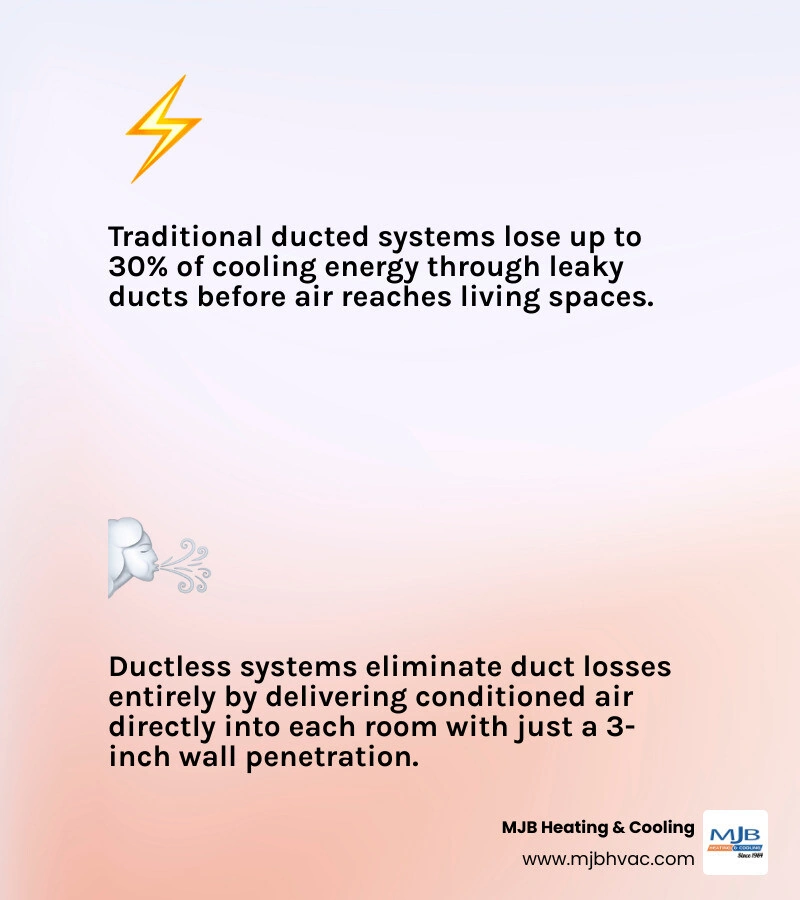
What makes this decision more urgent is the energy math. Traditional ducted systems can lose up to 30% of their cooling energy through leaky ducts and poor insulation before that air ever reaches a living space. For a home without existing ductwork, adding ducts can cost upwards of $18,000 in retrofit work alone — before you even factor in the equipment. Ductless alternatives sidestep that problem entirely.
If you want to dig deeper into how ductless technology works for homes like yours, Ductless Heating and Cooling for Homes Without Ductwork is a great place to start.
When evaluating how to keep your home comfortable, it helps to look at the technological landscape of 2026. The HVAC industry has moved rapidly toward higher efficiency standards, and the transition to environmentally friendly, high-performance refrigerants like R-32 and R-454B has unlocked up to a 12% improvement in system efficiency compared to older units.
For homes without existing vents—whether a historic bungalow in College Hill or a ranch home in Maize—the primary goal is to find a system that balances seasonal performance, installation disruption, and operational noise.
If we look at the seasonal energy efficiency ratio (SEER2) ratings, modern ductless mini-splits are the undisputed heavyweights. While a standard ducted central air conditioner typically operates in the 14 to 16 SEER range, top-tier ductless systems can reach SEER2 ratings of up to 42. This massive gap exists because mini-splits deliver conditioned air directly into the room, bypassing the energy-wasting journey through dusty, leaky attic or crawlspace ducts.
To see how these systems match up against standard ducted units in detail, take a look at our Central AC vs Ductless Mini Split Comparison.
When choosing a system, the first major fork in the road is deciding between a permanent home improvement and a temporary, seasonal fix.
Temporary options like window units and portable air conditioners are often tempting because they don't require professional installation. However, they come with significant daily compromises. They block your natural light, compromise home security, and are notoriously loud.
On the other side of the coin, permanent solutions like ductless mini-splits and high-velocity systems are designed to blend into your home's structure. They require professional installation but reward you with year-round comfort, whispering decibel levels, and a significant boost to your home’s resale value. For historic homes with plaster walls, original woodwork, or solid brick facades, a permanent, non-invasive system is the only way to preserve architectural integrity while enjoying modern comfort.
To understand the core technology of the most popular permanent option, check out our guide on What is a Ductless Mini Split System.
Ductless mini-splits are widely considered the gold standard for non-ducted cooling. The secret to their performance lies in inverter technology. Traditional air conditioners operate like a basic light switch—they are either 100% on or completely off, leading to annoying temperature swings and high energy spikes. Inverter-driven compressors work more like a dimmer switch. They continuously adjust their speed to match the exact cooling load of the room, running at a low, steady sip of energy to maintain a perfectly consistent climate.
Additionally, mini-splits excel at zoning. Instead of cooling an entire house to keep one bedroom comfortable, you can control individual air handlers independently. If you want to explore how to configure these systems for your specific layout, read our breakdown of Single vs Multi-Zone Ductless AC Systems.
For homeowners in our immediate service areas, we provide specialized local expertise. You can learn more about local options by visiting our service pages for Ductless AC Andover KS and AC Mini Split Andover KS.
High-velocity systems are a unique hybrid option. They still use a central indoor unit, but instead of wide, rigid sheet-metal ductwork, they distribute air through flexible, insulated tubes that are only two inches in diameter. These mini-ducts can be snaked through existing wall cavities, crawlspaces, and ceilings with minimal demolition.
The main advantage of high-velocity systems is aesthetic preservation. The air outlets are tiny, round openings about the size of a CD, making them practically invisible in historic ceilings.
However, high-velocity systems have some notable trade-offs. They are generally much more expensive to install than mini-splits due to the complexity of snaking the flexible tubes. They also operate at lower SEER2 ratings (typically 14 to 18) and can produce a noticeable "whooshing" sound of air movement if they are not engineered and baffled correctly.
Window and portable units are best viewed as temporary band-aids rather than long-term comfort solutions. Portable units, particularly single-hose models, suffer from a major engineering flaw: negative pressure. As the unit blows hot air out of the window through its exhaust hose, it creates a vacuum inside the room. This vacuum forces hot, humid outdoor air to be sucked in through cracks in your doors, windows, and floorboards, reducing the unit's effective cooling power by up to 40%.
Window units are slightly more efficient than portables, but they are incredibly loud—operating at 50 to 60 decibels, which is equivalent to a noisy office or vacuum cleaner. They also invite dust, insects, and security risks, and they must be dragged out of storage and reinstalled every spring. If you are struggling with hot spots in your home and want to move past temporary units, you can read our tips to Troubleshoot Uneven Cooling with Ductless AC.
Central Kansas is home to beautiful historic properties, from the plaster-and-lath bungalows in Wichita's Riverside neighborhood to older farmhouses in Sedgwick and Halstead. Preserving these structures requires an HVAC approach that respects their construction. Cutting large holes in original plaster walls or running bulky duct chases through historic closets can permanently ruin the character of an older home.
Ductless mini-splits are highly favored for historic preservation because they require only a small, three-inch hole through an exterior wall to connect the indoor air handler to the outdoor condenser via copper refrigerant lines.
Beyond preserving plaster, indoor air quality is another critical consideration. Older homes tend to accumulate dust, pollen, and drafts. Modern ductless units feature multi-stage filtration systems that can capture up to 99.9% of airborne particles and allergens.
To learn more about how these systems can help you breathe easier, check out Ways Ductless AC Improves Indoor Air.
Of course, getting the most out of your system depends heavily on where the equipment is placed. To maximize both performance and visual appeal, read our guide on AC Mini Split Placement for Maximum Efficiency.
Central Kansas summers are famous for their intense heat and heavy humidity. This climate immediately rules out certain options like evaporative coolers (often called "swamp coolers"). Evaporative coolers rely on the evaporation of water to lower air temperatures, which only works in dry climates where relative humidity is consistently below 50%. In a Kansas July, a swamp cooler will simply turn your home into a muggy, uncomfortable greenhouse.
To stay comfortable in our climate, you need a system that actively dehumidifies the air as it cools. Ductless mini-splits excel at this. Because they run continuously at lower speeds thanks to inverter compressors, they keep air moving across the cold evaporator coil longer, pulling significantly more moisture out of the air than a standard system that cycles on and off rapidly.
If you are experiencing airflow issues or poor humidity control in your current setup, see how to Resolve Poor Airflow Issues with Ductless AC.
One of the greatest challenges of cooling an older, multi-story home is managing temperature imbalances. The second floor is almost always a sweltering hot zone, while the basement feels like an icebox. Traditional central air conditioning struggles with this because it relies on a single thermostat, usually located on the main floor.
Multi-split systems solve this by allowing you to connect up to four or five indoor air handlers to a single outdoor condenser. Each indoor unit acts as an independent zone with its own thermostat. You can keep the upstairs bedrooms cool at night while leaving the downstairs living areas turned off, saving energy and ensuring perfect comfort exactly where you are sitting.
To learn more about setting up zones, read about Temperature Zoning with Ductless AC Systems.
Finding the right spots for these units is key to balanced airflow, which is why we've put together a guide on the Best Locations for AC Mini Split Installation.
For older houses without existing ductwork, a mini-split system is almost always the superior choice. Retrofitting a traditional central air system requires major construction to build duct chases, which eats up valuable closet space and destroys historic plaster walls. Furthermore, traditional ducts lose up to 30% of their cooling energy through leaks.
Mini-splits bypass this waste entirely, require only a three-inch hole in the wall to install, and offer whisper-quiet, zoned comfort.
If you already have a system and want to keep it running perfectly, keep an eye out for these Signs Your Ductless AC System Needs Attention.
The difference is night and day. Window air conditioners have the compressor—the loudest part of the system—sitting directly inside your window frame, vibrating against the sash and operating at 50 to 60 decibels.
Ductless mini-splits place the noisy compressor outside in the yard. The indoor air handler only contains a whisper-quiet fan, operating at a mere 19 to 32 decibels. To put that in perspective, a mini-split at low speed is quieter than rustling leaves or a library whisper, making it ideal for bedrooms and home offices.
Yes! Most modern ductless systems are actually air-source heat pumps. In the summer, they pump heat out of your home to keep you cool. In the winter, they reverse the process, extracting heat from the outdoor air and pumping it inside.
Thanks to advanced cold-climate engineering, high-performance mini-splits can provide efficient, cozy heating even when Central Kansas winter temperatures drop well below freezing, offering a complete, year-round comfort solution.
When adding cooling without ductwork options compared side by side, it is clear that while temporary units offer quick relief, a permanent ductless mini-split is the smartest investment for long-term comfort, energy savings, and home preservation.
At MJB Heating & Cooling, we have been helping our neighbors across the Wichita metro area stay comfortable since 1984. As a family-owned business founded in Derby, KS, we built our reputation on honest advice, quality workmanship, and a straightforward, transparent approach to HVAC service. Whether you need a single-zone system for a new home addition or a multi-zone setup for a historic property, our licensed technicians have the local expertise to design the perfect system for your home.
If you are ready to explore your options, we invite you to check out our local services for Ductless AC Derby KS and AC Mini Split Derby KS. Give us a call or schedule a consultation today, and let's find the perfect ductless solution for your home!
When it comes to adding cooling without ductwork options compared side by side, the choices available to Central Kansas homeowners in 2026 are better than ever — but they're not all equal. Many homes across Wichita, Andover, Derby, and surrounding communities were built long before central air conditioning became standard. That means no existing vents, no duct chases, and no easy path to a traditional forced-air system.
Here's a quick look at how the main ductless cooling options stack up:
| System | SEER Range | Installation Impact | Noise Level | Best For |
|---|---|---|---|---|
| Ductless Mini-Split | 18-42 | Very low (3" wall hole) | 19-40 dB | Whole-home or zoned cooling |
| High-Velocity Small-Duct | 14-18 | Moderate (2" flex ducts) | 40-50 dB | Aesthetic-sensitive older homes |
| Window AC Unit | 10-15 | Low (window opening) | 50-60 dB | Single-room, temporary use |
| Portable AC | 8-12 | None (plug-in) | 55-70 dB | Flexible, short-term relief |
| Through-Wall / PTAC | 10-16 | Low-moderate (wall cut) | 45-60 dB | Additions, garages, single rooms |
What makes this decision more urgent is the energy math. Traditional ducted systems can lose up to 30% of their cooling energy through leaky ducts and poor insulation before that air ever reaches a living space. For a home without existing ductwork, adding ducts can cost upwards of $18,000 in retrofit work alone — before you even factor in the equipment. Ductless alternatives sidestep that problem entirely.
If you want to dig deeper into how ductless technology works for homes like yours, Ductless Heating and Cooling for Homes Without Ductwork is a great place to start.
When evaluating how to keep your home comfortable, it helps to look at the technological landscape of 2026. The HVAC industry has moved rapidly toward higher efficiency standards, and the transition to environmentally friendly, high-performance refrigerants like R-32 and R-454B has unlocked up to a 12% improvement in system efficiency compared to older units.
For homes without existing vents—whether a historic bungalow in College Hill or a ranch home in Maize—the primary goal is to find a system that balances seasonal performance, installation disruption, and operational noise.
If we look at the seasonal energy efficiency ratio (SEER2) ratings, modern ductless mini-splits are the undisputed heavyweights. While a standard ducted central air conditioner typically operates in the 14 to 16 SEER range, top-tier ductless systems can reach SEER2 ratings of up to 42. This massive gap exists because mini-splits deliver conditioned air directly into the room, bypassing the energy-wasting journey through dusty, leaky attic or crawlspace ducts.
To see how these systems match up against standard ducted units in detail, take a look at our Central AC vs Ductless Mini Split Comparison.
When choosing a system, the first major fork in the road is deciding between a permanent home improvement and a temporary, seasonal fix.
Temporary options like window units and portable air conditioners are often tempting because they don't require professional installation. However, they come with significant daily compromises. They block your natural light, compromise home security, and are notoriously loud.
On the other side of the coin, permanent solutions like ductless mini-splits and high-velocity systems are designed to blend into your home's structure. They require professional installation but reward you with year-round comfort, whispering decibel levels, and a significant boost to your home’s resale value. For historic homes with plaster walls, original woodwork, or solid brick facades, a permanent, non-invasive system is the only way to preserve architectural integrity while enjoying modern comfort.
To understand the core technology of the most popular permanent option, check out our guide on What is a Ductless Mini Split System.
Ductless mini-splits are widely considered the gold standard for non-ducted cooling. The secret to their performance lies in inverter technology. Traditional air conditioners operate like a basic light switch—they are either 100% on or completely off, leading to annoying temperature swings and high energy spikes. Inverter-driven compressors work more like a dimmer switch. They continuously adjust their speed to match the exact cooling load of the room, running at a low, steady sip of energy to maintain a perfectly consistent climate.
Additionally, mini-splits excel at zoning. Instead of cooling an entire house to keep one bedroom comfortable, you can control individual air handlers independently. If you want to explore how to configure these systems for your specific layout, read our breakdown of Single vs Multi-Zone Ductless AC Systems.
For homeowners in our immediate service areas, we provide specialized local expertise. You can learn more about local options by visiting our service pages for Ductless AC Andover KS and AC Mini Split Andover KS.
High-velocity systems are a unique hybrid option. They still use a central indoor unit, but instead of wide, rigid sheet-metal ductwork, they distribute air through flexible, insulated tubes that are only two inches in diameter. These mini-ducts can be snaked through existing wall cavities, crawlspaces, and ceilings with minimal demolition.
The main advantage of high-velocity systems is aesthetic preservation. The air outlets are tiny, round openings about the size of a CD, making them practically invisible in historic ceilings.
However, high-velocity systems have some notable trade-offs. They are generally much more expensive to install than mini-splits due to the complexity of snaking the flexible tubes. They also operate at lower SEER2 ratings (typically 14 to 18) and can produce a noticeable "whooshing" sound of air movement if they are not engineered and baffled correctly.
Window and portable units are best viewed as temporary band-aids rather than long-term comfort solutions. Portable units, particularly single-hose models, suffer from a major engineering flaw: negative pressure. As the unit blows hot air out of the window through its exhaust hose, it creates a vacuum inside the room. This vacuum forces hot, humid outdoor air to be sucked in through cracks in your doors, windows, and floorboards, reducing the unit's effective cooling power by up to 40%.
Window units are slightly more efficient than portables, but they are incredibly loud—operating at 50 to 60 decibels, which is equivalent to a noisy office or vacuum cleaner. They also invite dust, insects, and security risks, and they must be dragged out of storage and reinstalled every spring. If you are struggling with hot spots in your home and want to move past temporary units, you can read our tips to Troubleshoot Uneven Cooling with Ductless AC.
Central Kansas is home to beautiful historic properties, from the plaster-and-lath bungalows in Wichita's Riverside neighborhood to older farmhouses in Sedgwick and Halstead. Preserving these structures requires an HVAC approach that respects their construction. Cutting large holes in original plaster walls or running bulky duct chases through historic closets can permanently ruin the character of an older home.
Ductless mini-splits are highly favored for historic preservation because they require only a small, three-inch hole through an exterior wall to connect the indoor air handler to the outdoor condenser via copper refrigerant lines.
Beyond preserving plaster, indoor air quality is another critical consideration. Older homes tend to accumulate dust, pollen, and drafts. Modern ductless units feature multi-stage filtration systems that can capture up to 99.9% of airborne particles and allergens.
To learn more about how these systems can help you breathe easier, check out Ways Ductless AC Improves Indoor Air.
Of course, getting the most out of your system depends heavily on where the equipment is placed. To maximize both performance and visual appeal, read our guide on AC Mini Split Placement for Maximum Efficiency.
Central Kansas summers are famous for their intense heat and heavy humidity. This climate immediately rules out certain options like evaporative coolers (often called "swamp coolers"). Evaporative coolers rely on the evaporation of water to lower air temperatures, which only works in dry climates where relative humidity is consistently below 50%. In a Kansas July, a swamp cooler will simply turn your home into a muggy, uncomfortable greenhouse.
To stay comfortable in our climate, you need a system that actively dehumidifies the air as it cools. Ductless mini-splits excel at this. Because they run continuously at lower speeds thanks to inverter compressors, they keep air moving across the cold evaporator coil longer, pulling significantly more moisture out of the air than a standard system that cycles on and off rapidly.
If you are experiencing airflow issues or poor humidity control in your current setup, see how to Resolve Poor Airflow Issues with Ductless AC.
One of the greatest challenges of cooling an older, multi-story home is managing temperature imbalances. The second floor is almost always a sweltering hot zone, while the basement feels like an icebox. Traditional central air conditioning struggles with this because it relies on a single thermostat, usually located on the main floor.
Multi-split systems solve this by allowing you to connect up to four or five indoor air handlers to a single outdoor condenser. Each indoor unit acts as an independent zone with its own thermostat. You can keep the upstairs bedrooms cool at night while leaving the downstairs living areas turned off, saving energy and ensuring perfect comfort exactly where you are sitting.
To learn more about setting up zones, read about Temperature Zoning with Ductless AC Systems.
Finding the right spots for these units is key to balanced airflow, which is why we've put together a guide on the Best Locations for AC Mini Split Installation.
For older houses without existing ductwork, a mini-split system is almost always the superior choice. Retrofitting a traditional central air system requires major construction to build duct chases, which eats up valuable closet space and destroys historic plaster walls. Furthermore, traditional ducts lose up to 30% of their cooling energy through leaks.
Mini-splits bypass this waste entirely, require only a three-inch hole in the wall to install, and offer whisper-quiet, zoned comfort.
If you already have a system and want to keep it running perfectly, keep an eye out for these Signs Your Ductless AC System Needs Attention.
The difference is night and day. Window air conditioners have the compressor—the loudest part of the system—sitting directly inside your window frame, vibrating against the sash and operating at 50 to 60 decibels.
Ductless mini-splits place the noisy compressor outside in the yard. The indoor air handler only contains a whisper-quiet fan, operating at a mere 19 to 32 decibels. To put that in perspective, a mini-split at low speed is quieter than rustling leaves or a library whisper, making it ideal for bedrooms and home offices.
Yes! Most modern ductless systems are actually air-source heat pumps. In the summer, they pump heat out of your home to keep you cool. In the winter, they reverse the process, extracting heat from the outdoor air and pumping it inside.
Thanks to advanced cold-climate engineering, high-performance mini-splits can provide efficient, cozy heating even when Central Kansas winter temperatures drop well below freezing, offering a complete, year-round comfort solution.
When adding cooling without ductwork options compared side by side, it is clear that while temporary units offer quick relief, a permanent ductless mini-split is the smartest investment for long-term comfort, energy savings, and home preservation.
At MJB Heating & Cooling, we have been helping our neighbors across the Wichita metro area stay comfortable since 1984. As a family-owned business founded in Derby, KS, we built our reputation on honest advice, quality workmanship, and a straightforward, transparent approach to HVAC service. Whether you need a single-zone system for a new home addition or a multi-zone setup for a historic property, our licensed technicians have the local expertise to design the perfect system for your home.
If you are ready to explore your options, we invite you to check out our local services for Ductless AC Derby KS and AC Mini Split Derby KS. Give us a call or schedule a consultation today, and let's find the perfect ductless solution for your home!
When it comes to adding cooling without ductwork options compared side by side, the choices available to Central Kansas homeowners in 2026 are better than ever — but they're not all equal. Many homes across Wichita, Andover, Derby, and surrounding communities were built long before central air conditioning became standard. That means no existing vents, no duct chases, and no easy path to a traditional forced-air system.
Here's a quick look at how the main ductless cooling options stack up:
| System | SEER Range | Installation Impact | Noise Level | Best For |
|---|---|---|---|---|
| Ductless Mini-Split | 18-42 | Very low (3" wall hole) | 19-40 dB | Whole-home or zoned cooling |
| High-Velocity Small-Duct | 14-18 | Moderate (2" flex ducts) | 40-50 dB | Aesthetic-sensitive older homes |
| Window AC Unit | 10-15 | Low (window opening) | 50-60 dB | Single-room, temporary use |
| Portable AC | 8-12 | None (plug-in) | 55-70 dB | Flexible, short-term relief |
| Through-Wall / PTAC | 10-16 | Low-moderate (wall cut) | 45-60 dB | Additions, garages, single rooms |
What makes this decision more urgent is the energy math. Traditional ducted systems can lose up to 30% of their cooling energy through leaky ducts and poor insulation before that air ever reaches a living space. For a home without existing ductwork, adding ducts can cost upwards of $18,000 in retrofit work alone — before you even factor in the equipment. Ductless alternatives sidestep that problem entirely.
If you want to dig deeper into how ductless technology works for homes like yours, Ductless Heating and Cooling for Homes Without Ductwork is a great place to start.
When evaluating how to keep your home comfortable, it helps to look at the technological landscape of 2026. The HVAC industry has moved rapidly toward higher efficiency standards, and the transition to environmentally friendly, high-performance refrigerants like R-32 and R-454B has unlocked up to a 12% improvement in system efficiency compared to older units.
For homes without existing vents—whether a historic bungalow in College Hill or a ranch home in Maize—the primary goal is to find a system that balances seasonal performance, installation disruption, and operational noise.
If we look at the seasonal energy efficiency ratio (SEER2) ratings, modern ductless mini-splits are the undisputed heavyweights. While a standard ducted central air conditioner typically operates in the 14 to 16 SEER range, top-tier ductless systems can reach SEER2 ratings of up to 42. This massive gap exists because mini-splits deliver conditioned air directly into the room, bypassing the energy-wasting journey through dusty, leaky attic or crawlspace ducts.
To see how these systems match up against standard ducted units in detail, take a look at our Central AC vs Ductless Mini Split Comparison.
When choosing a system, the first major fork in the road is deciding between a permanent home improvement and a temporary, seasonal fix.
Temporary options like window units and portable air conditioners are often tempting because they don't require professional installation. However, they come with significant daily compromises. They block your natural light, compromise home security, and are notoriously loud.
On the other side of the coin, permanent solutions like ductless mini-splits and high-velocity systems are designed to blend into your home's structure. They require professional installation but reward you with year-round comfort, whispering decibel levels, and a significant boost to your home’s resale value. For historic homes with plaster walls, original woodwork, or solid brick facades, a permanent, non-invasive system is the only way to preserve architectural integrity while enjoying modern comfort.
To understand the core technology of the most popular permanent option, check out our guide on What is a Ductless Mini Split System.
Ductless mini-splits are widely considered the gold standard for non-ducted cooling. The secret to their performance lies in inverter technology. Traditional air conditioners operate like a basic light switch—they are either 100% on or completely off, leading to annoying temperature swings and high energy spikes. Inverter-driven compressors work more like a dimmer switch. They continuously adjust their speed to match the exact cooling load of the room, running at a low, steady sip of energy to maintain a perfectly consistent climate.
Additionally, mini-splits excel at zoning. Instead of cooling an entire house to keep one bedroom comfortable, you can control individual air handlers independently. If you want to explore how to configure these systems for your specific layout, read our breakdown of Single vs Multi-Zone Ductless AC Systems.
For homeowners in our immediate service areas, we provide specialized local expertise. You can learn more about local options by visiting our service pages for Ductless AC Andover KS and AC Mini Split Andover KS.
High-velocity systems are a unique hybrid option. They still use a central indoor unit, but instead of wide, rigid sheet-metal ductwork, they distribute air through flexible, insulated tubes that are only two inches in diameter. These mini-ducts can be snaked through existing wall cavities, crawlspaces, and ceilings with minimal demolition.
The main advantage of high-velocity systems is aesthetic preservation. The air outlets are tiny, round openings about the size of a CD, making them practically invisible in historic ceilings.
However, high-velocity systems have some notable trade-offs. They are generally much more expensive to install than mini-splits due to the complexity of snaking the flexible tubes. They also operate at lower SEER2 ratings (typically 14 to 18) and can produce a noticeable "whooshing" sound of air movement if they are not engineered and baffled correctly.
Window and portable units are best viewed as temporary band-aids rather than long-term comfort solutions. Portable units, particularly single-hose models, suffer from a major engineering flaw: negative pressure. As the unit blows hot air out of the window through its exhaust hose, it creates a vacuum inside the room. This vacuum forces hot, humid outdoor air to be sucked in through cracks in your doors, windows, and floorboards, reducing the unit's effective cooling power by up to 40%.
Window units are slightly more efficient than portables, but they are incredibly loud—operating at 50 to 60 decibels, which is equivalent to a noisy office or vacuum cleaner. They also invite dust, insects, and security risks, and they must be dragged out of storage and reinstalled every spring. If you are struggling with hot spots in your home and want to move past temporary units, you can read our tips to Troubleshoot Uneven Cooling with Ductless AC.
Central Kansas is home to beautiful historic properties, from the plaster-and-lath bungalows in Wichita's Riverside neighborhood to older farmhouses in Sedgwick and Halstead. Preserving these structures requires an HVAC approach that respects their construction. Cutting large holes in original plaster walls or running bulky duct chases through historic closets can permanently ruin the character of an older home.
Ductless mini-splits are highly favored for historic preservation because they require only a small, three-inch hole through an exterior wall to connect the indoor air handler to the outdoor condenser via copper refrigerant lines.
Beyond preserving plaster, indoor air quality is another critical consideration. Older homes tend to accumulate dust, pollen, and drafts. Modern ductless units feature multi-stage filtration systems that can capture up to 99.9% of airborne particles and allergens.
To learn more about how these systems can help you breathe easier, check out Ways Ductless AC Improves Indoor Air.
Of course, getting the most out of your system depends heavily on where the equipment is placed. To maximize both performance and visual appeal, read our guide on AC Mini Split Placement for Maximum Efficiency.
Central Kansas summers are famous for their intense heat and heavy humidity. This climate immediately rules out certain options like evaporative coolers (often called "swamp coolers"). Evaporative coolers rely on the evaporation of water to lower air temperatures, which only works in dry climates where relative humidity is consistently below 50%. In a Kansas July, a swamp cooler will simply turn your home into a muggy, uncomfortable greenhouse.
To stay comfortable in our climate, you need a system that actively dehumidifies the air as it cools. Ductless mini-splits excel at this. Because they run continuously at lower speeds thanks to inverter compressors, they keep air moving across the cold evaporator coil longer, pulling significantly more moisture out of the air than a standard system that cycles on and off rapidly.
If you are experiencing airflow issues or poor humidity control in your current setup, see how to Resolve Poor Airflow Issues with Ductless AC.
One of the greatest challenges of cooling an older, multi-story home is managing temperature imbalances. The second floor is almost always a sweltering hot zone, while the basement feels like an icebox. Traditional central air conditioning struggles with this because it relies on a single thermostat, usually located on the main floor.
Multi-split systems solve this by allowing you to connect up to four or five indoor air handlers to a single outdoor condenser. Each indoor unit acts as an independent zone with its own thermostat. You can keep the upstairs bedrooms cool at night while leaving the downstairs living areas turned off, saving energy and ensuring perfect comfort exactly where you are sitting.
To learn more about setting up zones, read about Temperature Zoning with Ductless AC Systems.
Finding the right spots for these units is key to balanced airflow, which is why we've put together a guide on the Best Locations for AC Mini Split Installation.
For older houses without existing ductwork, a mini-split system is almost always the superior choice. Retrofitting a traditional central air system requires major construction to build duct chases, which eats up valuable closet space and destroys historic plaster walls. Furthermore, traditional ducts lose up to 30% of their cooling energy through leaks.
Mini-splits bypass this waste entirely, require only a three-inch hole in the wall to install, and offer whisper-quiet, zoned comfort.
If you already have a system and want to keep it running perfectly, keep an eye out for these Signs Your Ductless AC System Needs Attention.
The difference is night and day. Window air conditioners have the compressor—the loudest part of the system—sitting directly inside your window frame, vibrating against the sash and operating at 50 to 60 decibels.
Ductless mini-splits place the noisy compressor outside in the yard. The indoor air handler only contains a whisper-quiet fan, operating at a mere 19 to 32 decibels. To put that in perspective, a mini-split at low speed is quieter than rustling leaves or a library whisper, making it ideal for bedrooms and home offices.
Yes! Most modern ductless systems are actually air-source heat pumps. In the summer, they pump heat out of your home to keep you cool. In the winter, they reverse the process, extracting heat from the outdoor air and pumping it inside.
Thanks to advanced cold-climate engineering, high-performance mini-splits can provide efficient, cozy heating even when Central Kansas winter temperatures drop well below freezing, offering a complete, year-round comfort solution.
When adding cooling without ductwork options compared side by side, it is clear that while temporary units offer quick relief, a permanent ductless mini-split is the smartest investment for long-term comfort, energy savings, and home preservation.
At MJB Heating & Cooling, we have been helping our neighbors across the Wichita metro area stay comfortable since 1984. As a family-owned business founded in Derby, KS, we built our reputation on honest advice, quality workmanship, and a straightforward, transparent approach to HVAC service. Whether you need a single-zone system for a new home addition or a multi-zone setup for a historic property, our licensed technicians have the local expertise to design the perfect system for your home.
If you are ready to explore your options, we invite you to check out our local services for Ductless AC Derby KS and AC Mini Split Derby KS. Give us a call or schedule a consultation today, and let's find the perfect ductless solution for your home!


When it comes to adding cooling without ductwork options compared side by side, the choices available to Central Kansas homeowners in 2026 are better than ever — but they're not all equal. Many homes across Wichita, Andover, Derby, and surrounding communities were built long before central air conditioning became standard. That means no existing vents, no duct chases, and no easy path to a traditional forced-air system.
Here's a quick look at how the main ductless cooling options stack up:
| System | SEER Range | Installation Impact | Noise Level | Best For |
|---|---|---|---|---|
| Ductless Mini-Split | 18-42 | Very low (3" wall hole) | 19-40 dB | Whole-home or zoned cooling |
| High-Velocity Small-Duct | 14-18 | Moderate (2" flex ducts) | 40-50 dB | Aesthetic-sensitive older homes |
| Window AC Unit | 10-15 | Low (window opening) | 50-60 dB | Single-room, temporary use |
| Portable AC | 8-12 | None (plug-in) | 55-70 dB | Flexible, short-term relief |
| Through-Wall / PTAC | 10-16 | Low-moderate (wall cut) | 45-60 dB | Additions, garages, single rooms |
What makes this decision more urgent is the energy math. Traditional ducted systems can lose up to 30% of their cooling energy through leaky ducts and poor insulation before that air ever reaches a living space. For a home without existing ductwork, adding ducts can cost upwards of $18,000 in retrofit work alone — before you even factor in the equipment. Ductless alternatives sidestep that problem entirely.
If you want to dig deeper into how ductless technology works for homes like yours, Ductless Heating and Cooling for Homes Without Ductwork is a great place to start.
When evaluating how to keep your home comfortable, it helps to look at the technological landscape of 2026. The HVAC industry has moved rapidly toward higher efficiency standards, and the transition to environmentally friendly, high-performance refrigerants like R-32 and R-454B has unlocked up to a 12% improvement in system efficiency compared to older units.
For homes without existing vents—whether a historic bungalow in College Hill or a ranch home in Maize—the primary goal is to find a system that balances seasonal performance, installation disruption, and operational noise.
If we look at the seasonal energy efficiency ratio (SEER2) ratings, modern ductless mini-splits are the undisputed heavyweights. While a standard ducted central air conditioner typically operates in the 14 to 16 SEER range, top-tier ductless systems can reach SEER2 ratings of up to 42. This massive gap exists because mini-splits deliver conditioned air directly into the room, bypassing the energy-wasting journey through dusty, leaky attic or crawlspace ducts.
To see how these systems match up against standard ducted units in detail, take a look at our Central AC vs Ductless Mini Split Comparison.
When choosing a system, the first major fork in the road is deciding between a permanent home improvement and a temporary, seasonal fix.
Temporary options like window units and portable air conditioners are often tempting because they don't require professional installation. However, they come with significant daily compromises. They block your natural light, compromise home security, and are notoriously loud.
On the other side of the coin, permanent solutions like ductless mini-splits and high-velocity systems are designed to blend into your home's structure. They require professional installation but reward you with year-round comfort, whispering decibel levels, and a significant boost to your home’s resale value. For historic homes with plaster walls, original woodwork, or solid brick facades, a permanent, non-invasive system is the only way to preserve architectural integrity while enjoying modern comfort.
To understand the core technology of the most popular permanent option, check out our guide on What is a Ductless Mini Split System.
Ductless mini-splits are widely considered the gold standard for non-ducted cooling. The secret to their performance lies in inverter technology. Traditional air conditioners operate like a basic light switch—they are either 100% on or completely off, leading to annoying temperature swings and high energy spikes. Inverter-driven compressors work more like a dimmer switch. They continuously adjust their speed to match the exact cooling load of the room, running at a low, steady sip of energy to maintain a perfectly consistent climate.
Additionally, mini-splits excel at zoning. Instead of cooling an entire house to keep one bedroom comfortable, you can control individual air handlers independently. If you want to explore how to configure these systems for your specific layout, read our breakdown of Single vs Multi-Zone Ductless AC Systems.
For homeowners in our immediate service areas, we provide specialized local expertise. You can learn more about local options by visiting our service pages for Ductless AC Andover KS and AC Mini Split Andover KS.
High-velocity systems are a unique hybrid option. They still use a central indoor unit, but instead of wide, rigid sheet-metal ductwork, they distribute air through flexible, insulated tubes that are only two inches in diameter. These mini-ducts can be snaked through existing wall cavities, crawlspaces, and ceilings with minimal demolition.
The main advantage of high-velocity systems is aesthetic preservation. The air outlets are tiny, round openings about the size of a CD, making them practically invisible in historic ceilings.
However, high-velocity systems have some notable trade-offs. They are generally much more expensive to install than mini-splits due to the complexity of snaking the flexible tubes. They also operate at lower SEER2 ratings (typically 14 to 18) and can produce a noticeable "whooshing" sound of air movement if they are not engineered and baffled correctly.
Window and portable units are best viewed as temporary band-aids rather than long-term comfort solutions. Portable units, particularly single-hose models, suffer from a major engineering flaw: negative pressure. As the unit blows hot air out of the window through its exhaust hose, it creates a vacuum inside the room. This vacuum forces hot, humid outdoor air to be sucked in through cracks in your doors, windows, and floorboards, reducing the unit's effective cooling power by up to 40%.
Window units are slightly more efficient than portables, but they are incredibly loud—operating at 50 to 60 decibels, which is equivalent to a noisy office or vacuum cleaner. They also invite dust, insects, and security risks, and they must be dragged out of storage and reinstalled every spring. If you are struggling with hot spots in your home and want to move past temporary units, you can read our tips to Troubleshoot Uneven Cooling with Ductless AC.
Central Kansas is home to beautiful historic properties, from the plaster-and-lath bungalows in Wichita's Riverside neighborhood to older farmhouses in Sedgwick and Halstead. Preserving these structures requires an HVAC approach that respects their construction. Cutting large holes in original plaster walls or running bulky duct chases through historic closets can permanently ruin the character of an older home.
Ductless mini-splits are highly favored for historic preservation because they require only a small, three-inch hole through an exterior wall to connect the indoor air handler to the outdoor condenser via copper refrigerant lines.
Beyond preserving plaster, indoor air quality is another critical consideration. Older homes tend to accumulate dust, pollen, and drafts. Modern ductless units feature multi-stage filtration systems that can capture up to 99.9% of airborne particles and allergens.
To learn more about how these systems can help you breathe easier, check out Ways Ductless AC Improves Indoor Air.
Of course, getting the most out of your system depends heavily on where the equipment is placed. To maximize both performance and visual appeal, read our guide on AC Mini Split Placement for Maximum Efficiency.
Central Kansas summers are famous for their intense heat and heavy humidity. This climate immediately rules out certain options like evaporative coolers (often called "swamp coolers"). Evaporative coolers rely on the evaporation of water to lower air temperatures, which only works in dry climates where relative humidity is consistently below 50%. In a Kansas July, a swamp cooler will simply turn your home into a muggy, uncomfortable greenhouse.
To stay comfortable in our climate, you need a system that actively dehumidifies the air as it cools. Ductless mini-splits excel at this. Because they run continuously at lower speeds thanks to inverter compressors, they keep air moving across the cold evaporator coil longer, pulling significantly more moisture out of the air than a standard system that cycles on and off rapidly.
If you are experiencing airflow issues or poor humidity control in your current setup, see how to Resolve Poor Airflow Issues with Ductless AC.
One of the greatest challenges of cooling an older, multi-story home is managing temperature imbalances. The second floor is almost always a sweltering hot zone, while the basement feels like an icebox. Traditional central air conditioning struggles with this because it relies on a single thermostat, usually located on the main floor.
Multi-split systems solve this by allowing you to connect up to four or five indoor air handlers to a single outdoor condenser. Each indoor unit acts as an independent zone with its own thermostat. You can keep the upstairs bedrooms cool at night while leaving the downstairs living areas turned off, saving energy and ensuring perfect comfort exactly where you are sitting.
To learn more about setting up zones, read about Temperature Zoning with Ductless AC Systems.
Finding the right spots for these units is key to balanced airflow, which is why we've put together a guide on the Best Locations for AC Mini Split Installation.
For older houses without existing ductwork, a mini-split system is almost always the superior choice. Retrofitting a traditional central air system requires major construction to build duct chases, which eats up valuable closet space and destroys historic plaster walls. Furthermore, traditional ducts lose up to 30% of their cooling energy through leaks.
Mini-splits bypass this waste entirely, require only a three-inch hole in the wall to install, and offer whisper-quiet, zoned comfort.
If you already have a system and want to keep it running perfectly, keep an eye out for these Signs Your Ductless AC System Needs Attention.
The difference is night and day. Window air conditioners have the compressor—the loudest part of the system—sitting directly inside your window frame, vibrating against the sash and operating at 50 to 60 decibels.
Ductless mini-splits place the noisy compressor outside in the yard. The indoor air handler only contains a whisper-quiet fan, operating at a mere 19 to 32 decibels. To put that in perspective, a mini-split at low speed is quieter than rustling leaves or a library whisper, making it ideal for bedrooms and home offices.
Yes! Most modern ductless systems are actually air-source heat pumps. In the summer, they pump heat out of your home to keep you cool. In the winter, they reverse the process, extracting heat from the outdoor air and pumping it inside.
Thanks to advanced cold-climate engineering, high-performance mini-splits can provide efficient, cozy heating even when Central Kansas winter temperatures drop well below freezing, offering a complete, year-round comfort solution.
When adding cooling without ductwork options compared side by side, it is clear that while temporary units offer quick relief, a permanent ductless mini-split is the smartest investment for long-term comfort, energy savings, and home preservation.
At MJB Heating & Cooling, we have been helping our neighbors across the Wichita metro area stay comfortable since 1984. As a family-owned business founded in Derby, KS, we built our reputation on honest advice, quality workmanship, and a straightforward, transparent approach to HVAC service. Whether you need a single-zone system for a new home addition or a multi-zone setup for a historic property, our licensed technicians have the local expertise to design the perfect system for your home.
If you are ready to explore your options, we invite you to check out our local services for Ductless AC Derby KS and AC Mini Split Derby KS. Give us a call or schedule a consultation today, and let's find the perfect ductless solution for your home!
When it comes to adding cooling without ductwork options compared side by side, the choices available to Central Kansas homeowners in 2026 are better than ever — but they're not all equal. Many homes across Wichita, Andover, Derby, and surrounding communities were built long before central air conditioning became standard. That means no existing vents, no duct chases, and no easy path to a traditional forced-air system.
Here's a quick look at how the main ductless cooling options stack up:
| System | SEER Range | Installation Impact | Noise Level | Best For |
|---|---|---|---|---|
| Ductless Mini-Split | 18-42 | Very low (3" wall hole) | 19-40 dB | Whole-home or zoned cooling |
| High-Velocity Small-Duct | 14-18 | Moderate (2" flex ducts) | 40-50 dB | Aesthetic-sensitive older homes |
| Window AC Unit | 10-15 | Low (window opening) | 50-60 dB | Single-room, temporary use |
| Portable AC | 8-12 | None (plug-in) | 55-70 dB | Flexible, short-term relief |
| Through-Wall / PTAC | 10-16 | Low-moderate (wall cut) | 45-60 dB | Additions, garages, single rooms |
What makes this decision more urgent is the energy math. Traditional ducted systems can lose up to 30% of their cooling energy through leaky ducts and poor insulation before that air ever reaches a living space. For a home without existing ductwork, adding ducts can cost upwards of $18,000 in retrofit work alone — before you even factor in the equipment. Ductless alternatives sidestep that problem entirely.
If you want to dig deeper into how ductless technology works for homes like yours, Ductless Heating and Cooling for Homes Without Ductwork is a great place to start.
When evaluating how to keep your home comfortable, it helps to look at the technological landscape of 2026. The HVAC industry has moved rapidly toward higher efficiency standards, and the transition to environmentally friendly, high-performance refrigerants like R-32 and R-454B has unlocked up to a 12% improvement in system efficiency compared to older units.
For homes without existing vents—whether a historic bungalow in College Hill or a ranch home in Maize—the primary goal is to find a system that balances seasonal performance, installation disruption, and operational noise.
If we look at the seasonal energy efficiency ratio (SEER2) ratings, modern ductless mini-splits are the undisputed heavyweights. While a standard ducted central air conditioner typically operates in the 14 to 16 SEER range, top-tier ductless systems can reach SEER2 ratings of up to 42. This massive gap exists because mini-splits deliver conditioned air directly into the room, bypassing the energy-wasting journey through dusty, leaky attic or crawlspace ducts.
To see how these systems match up against standard ducted units in detail, take a look at our Central AC vs Ductless Mini Split Comparison.
When choosing a system, the first major fork in the road is deciding between a permanent home improvement and a temporary, seasonal fix.
Temporary options like window units and portable air conditioners are often tempting because they don't require professional installation. However, they come with significant daily compromises. They block your natural light, compromise home security, and are notoriously loud.
On the other side of the coin, permanent solutions like ductless mini-splits and high-velocity systems are designed to blend into your home's structure. They require professional installation but reward you with year-round comfort, whispering decibel levels, and a significant boost to your home’s resale value. For historic homes with plaster walls, original woodwork, or solid brick facades, a permanent, non-invasive system is the only way to preserve architectural integrity while enjoying modern comfort.
To understand the core technology of the most popular permanent option, check out our guide on What is a Ductless Mini Split System.
Ductless mini-splits are widely considered the gold standard for non-ducted cooling. The secret to their performance lies in inverter technology. Traditional air conditioners operate like a basic light switch—they are either 100% on or completely off, leading to annoying temperature swings and high energy spikes. Inverter-driven compressors work more like a dimmer switch. They continuously adjust their speed to match the exact cooling load of the room, running at a low, steady sip of energy to maintain a perfectly consistent climate.
Additionally, mini-splits excel at zoning. Instead of cooling an entire house to keep one bedroom comfortable, you can control individual air handlers independently. If you want to explore how to configure these systems for your specific layout, read our breakdown of Single vs Multi-Zone Ductless AC Systems.
For homeowners in our immediate service areas, we provide specialized local expertise. You can learn more about local options by visiting our service pages for Ductless AC Andover KS and AC Mini Split Andover KS.
High-velocity systems are a unique hybrid option. They still use a central indoor unit, but instead of wide, rigid sheet-metal ductwork, they distribute air through flexible, insulated tubes that are only two inches in diameter. These mini-ducts can be snaked through existing wall cavities, crawlspaces, and ceilings with minimal demolition.
The main advantage of high-velocity systems is aesthetic preservation. The air outlets are tiny, round openings about the size of a CD, making them practically invisible in historic ceilings.
However, high-velocity systems have some notable trade-offs. They are generally much more expensive to install than mini-splits due to the complexity of snaking the flexible tubes. They also operate at lower SEER2 ratings (typically 14 to 18) and can produce a noticeable "whooshing" sound of air movement if they are not engineered and baffled correctly.
Window and portable units are best viewed as temporary band-aids rather than long-term comfort solutions. Portable units, particularly single-hose models, suffer from a major engineering flaw: negative pressure. As the unit blows hot air out of the window through its exhaust hose, it creates a vacuum inside the room. This vacuum forces hot, humid outdoor air to be sucked in through cracks in your doors, windows, and floorboards, reducing the unit's effective cooling power by up to 40%.
Window units are slightly more efficient than portables, but they are incredibly loud—operating at 50 to 60 decibels, which is equivalent to a noisy office or vacuum cleaner. They also invite dust, insects, and security risks, and they must be dragged out of storage and reinstalled every spring. If you are struggling with hot spots in your home and want to move past temporary units, you can read our tips to Troubleshoot Uneven Cooling with Ductless AC.
Central Kansas is home to beautiful historic properties, from the plaster-and-lath bungalows in Wichita's Riverside neighborhood to older farmhouses in Sedgwick and Halstead. Preserving these structures requires an HVAC approach that respects their construction. Cutting large holes in original plaster walls or running bulky duct chases through historic closets can permanently ruin the character of an older home.
Ductless mini-splits are highly favored for historic preservation because they require only a small, three-inch hole through an exterior wall to connect the indoor air handler to the outdoor condenser via copper refrigerant lines.
Beyond preserving plaster, indoor air quality is another critical consideration. Older homes tend to accumulate dust, pollen, and drafts. Modern ductless units feature multi-stage filtration systems that can capture up to 99.9% of airborne particles and allergens.
To learn more about how these systems can help you breathe easier, check out Ways Ductless AC Improves Indoor Air.
Of course, getting the most out of your system depends heavily on where the equipment is placed. To maximize both performance and visual appeal, read our guide on AC Mini Split Placement for Maximum Efficiency.
Central Kansas summers are famous for their intense heat and heavy humidity. This climate immediately rules out certain options like evaporative coolers (often called "swamp coolers"). Evaporative coolers rely on the evaporation of water to lower air temperatures, which only works in dry climates where relative humidity is consistently below 50%. In a Kansas July, a swamp cooler will simply turn your home into a muggy, uncomfortable greenhouse.
To stay comfortable in our climate, you need a system that actively dehumidifies the air as it cools. Ductless mini-splits excel at this. Because they run continuously at lower speeds thanks to inverter compressors, they keep air moving across the cold evaporator coil longer, pulling significantly more moisture out of the air than a standard system that cycles on and off rapidly.
If you are experiencing airflow issues or poor humidity control in your current setup, see how to Resolve Poor Airflow Issues with Ductless AC.
One of the greatest challenges of cooling an older, multi-story home is managing temperature imbalances. The second floor is almost always a sweltering hot zone, while the basement feels like an icebox. Traditional central air conditioning struggles with this because it relies on a single thermostat, usually located on the main floor.
Multi-split systems solve this by allowing you to connect up to four or five indoor air handlers to a single outdoor condenser. Each indoor unit acts as an independent zone with its own thermostat. You can keep the upstairs bedrooms cool at night while leaving the downstairs living areas turned off, saving energy and ensuring perfect comfort exactly where you are sitting.
To learn more about setting up zones, read about Temperature Zoning with Ductless AC Systems.
Finding the right spots for these units is key to balanced airflow, which is why we've put together a guide on the Best Locations for AC Mini Split Installation.
For older houses without existing ductwork, a mini-split system is almost always the superior choice. Retrofitting a traditional central air system requires major construction to build duct chases, which eats up valuable closet space and destroys historic plaster walls. Furthermore, traditional ducts lose up to 30% of their cooling energy through leaks.
Mini-splits bypass this waste entirely, require only a three-inch hole in the wall to install, and offer whisper-quiet, zoned comfort.
If you already have a system and want to keep it running perfectly, keep an eye out for these Signs Your Ductless AC System Needs Attention.
The difference is night and day. Window air conditioners have the compressor—the loudest part of the system—sitting directly inside your window frame, vibrating against the sash and operating at 50 to 60 decibels.
Ductless mini-splits place the noisy compressor outside in the yard. The indoor air handler only contains a whisper-quiet fan, operating at a mere 19 to 32 decibels. To put that in perspective, a mini-split at low speed is quieter than rustling leaves or a library whisper, making it ideal for bedrooms and home offices.
Yes! Most modern ductless systems are actually air-source heat pumps. In the summer, they pump heat out of your home to keep you cool. In the winter, they reverse the process, extracting heat from the outdoor air and pumping it inside.
Thanks to advanced cold-climate engineering, high-performance mini-splits can provide efficient, cozy heating even when Central Kansas winter temperatures drop well below freezing, offering a complete, year-round comfort solution.
When adding cooling without ductwork options compared side by side, it is clear that while temporary units offer quick relief, a permanent ductless mini-split is the smartest investment for long-term comfort, energy savings, and home preservation.
At MJB Heating & Cooling, we have been helping our neighbors across the Wichita metro area stay comfortable since 1984. As a family-owned business founded in Derby, KS, we built our reputation on honest advice, quality workmanship, and a straightforward, transparent approach to HVAC service. Whether you need a single-zone system for a new home addition or a multi-zone setup for a historic property, our licensed technicians have the local expertise to design the perfect system for your home.
If you are ready to explore your options, we invite you to check out our local services for Ductless AC Derby KS and AC Mini Split Derby KS. Give us a call or schedule a consultation today, and let's find the perfect ductless solution for your home!


Our A/C stopped working on a Sunday and due to health issues, we needed to find a service company available on a Sunday. I called MJB and left a message on their emergency voice mail. Within 10 minutes Tom Buck called me to hear my description of the symptoms. He was just finishing an appointment in Wichita and would be on his way to my home on the south end of Derby. He arrived within 30 minutes! From start to finish he was the perfect example of what you could ever hope for in an HVAC tech and a human being. His evaluation of our system inside and out was as thorough as I could ever imagine and once he was done with the repair, our system is running as well or better than ever. Well worth the price for the evaluation, parts, and labor. Thank you again Tom for an awesome experience.
Our AC went out during the hottest days of the year, and they were out next day! We have been jerked around by a shoddy home warranty for years. We finally had a chance to pick our own repair people, and MJB came highly recommended. I can see why! I was impressed with the honesty and speed at which they fixed our AC unit!
Our commercial building had a lightening/electrical strike and damaged our 20 ton AC unit. No one could find us a new unit before the end of September. Imagining going all of August and September with no AC in Kansas and working inside near 100 degree temps is less than thrilling. Dale and the team at MJB called around and saved the day. They had us a new unit 5 weeks earlier than other could promise and I now have happy employees. The unit is amazingly quiet, super cold and so much more energy efficient. Thank you for being our super hero!
Came out and installed my new furnace. Was very polite and affordable. They are very acknowledgeable and I highly recommend!
Thank you very much. We had our 1st warm night in 3weeks. MJB took the time and effort to find the real problem. And the employees were kind and thoughtful and explained things very well. I cannot thank you and all of MJB. Will recommend you highly. Thanks again Marjorie Herman Oxford Kansas
We had a new system installed and I was so impressed with how quick they were in come out and install it, in the middle of a hot summer day. They were so friendly & very professional. I had a small problem with a weird sound and they came over immediately and fixed it. Love them!