.avif)





Blogs
Stay updated with our latest blog posts.
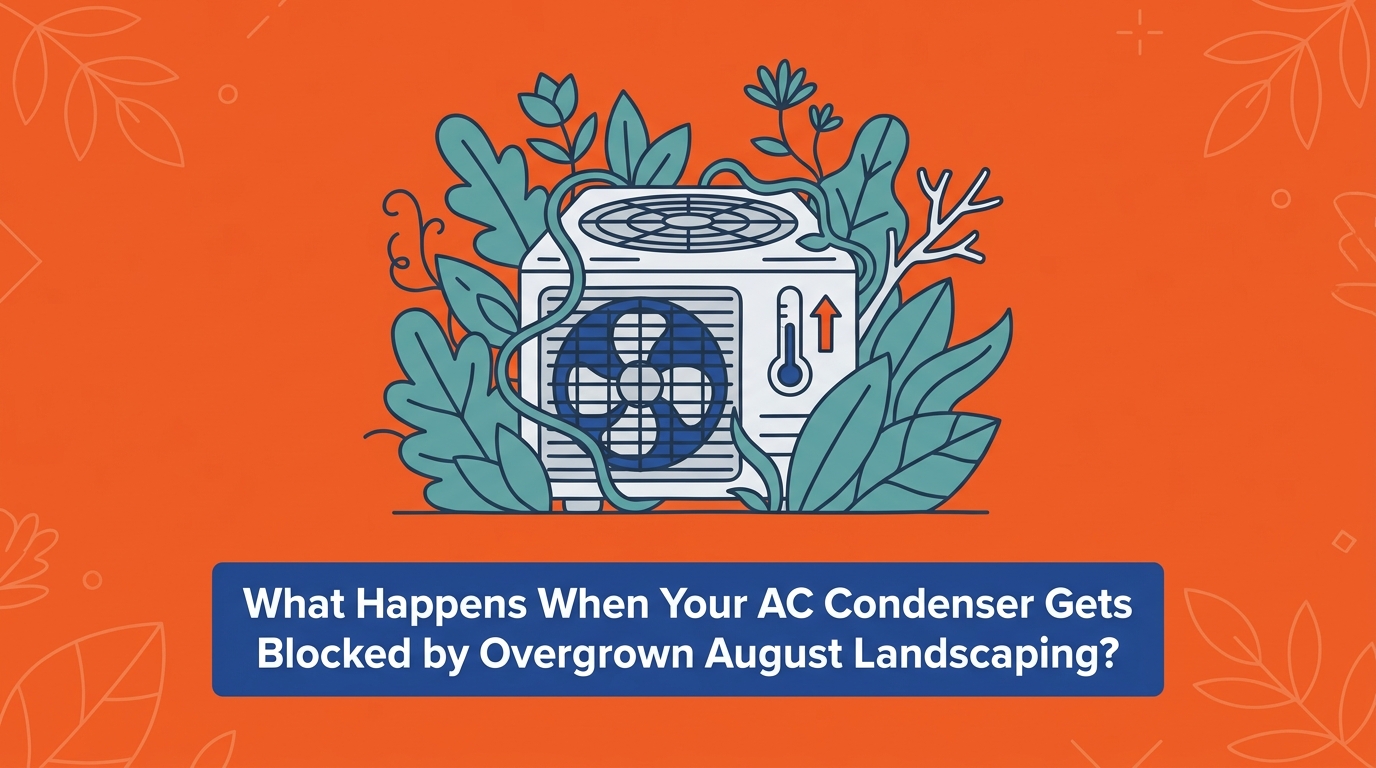

August late summer heat is already pushing your cooling system to its absolute limits, and as families prepare for the back-to-school transition, the last thing you want is a breakdown. Here at MJB Heating & Cooling, a pattern we see often is homeowners wondering exactly what happens when your AC condenser gets blocked by overgrown August landscaping. The short answer is that your system begins to suffocate. You might notice the outdoor unit running continuously, yet the air coming from your indoor vents feels lukewarm at best. It is incredibly frustrating to hear your equipment working overtime while your living room remains uncomfortably warm.
Most homeowners don't realize that this specific combination of symptoms doesn't automatically mean the compressor is dying or that the system has a massive refrigerant leak. Very often, the root cause is entirely outside the mechanical components of the unit. Unchecked summer vegetation—tall grass, creeping vines, and dense bushes—can easily wrap around the outdoor unit over the course of a few months, effectively choking off the air it needs to function.
Before you assume the worst and prepare for a massive repair bill, take a walk outside and inspect your landscaping. If your outdoor equipment is buried under a jungle of weeds and overgrown shrubs, you have likely found the culprit. Clearing away that perimeter is the first step in troubleshooting. However, if the unit has been suffocating for a while, the underlying strain may require professional HVAC services to fully correct the damage and restore your system's health.
To understand why a few weeds can cause such massive problems, you have to look at how your air conditioner actually works. Your AC does not create cold air; it removes heat from inside your house and pumps it outside. The outdoor condenser unit is responsible for releasing that collected heat into the outdoor air. When overgrown weeds and bushes act like a thick blanket around the unit, they trap that exhausted heat right against the equipment.
This trapped heat leads to dangerous head pressure spikes. The compressor, which acts as the heart of your cooling system, has to work exponentially harder to push refrigerant through a system that cannot breathe. Just last late summer, our MJB Heating & Cooling technicians responded to a Derby homeowner who found themselves without AC for almost a week during a brutal heatwave. By the time our team diagnosed the issue, the severe lack of airflow had taken such a toll that they ultimately needed a completely new system installed to restore reliable cooling.
Here's the thing: refrigerant relies on a precise balance of temperature and pressure to absorb and release heat. When the condenser fan cannot pull in fresh, ambient air to cool the coils, the temperature inside the unit skyrockets. As the temperature rises, the pressure of the refrigerant gas also rises.
These head pressure spikes force the compressor motor to grind against intense resistance. It is similar to trying to pedal a bicycle uphill in the highest gear. The motor draws more electricity, runs hotter, and eventually triggers a thermal overload switch. This safety mechanism shuts the compressor down before it literally melts its own internal wiring, leaving you without any cooling at all.
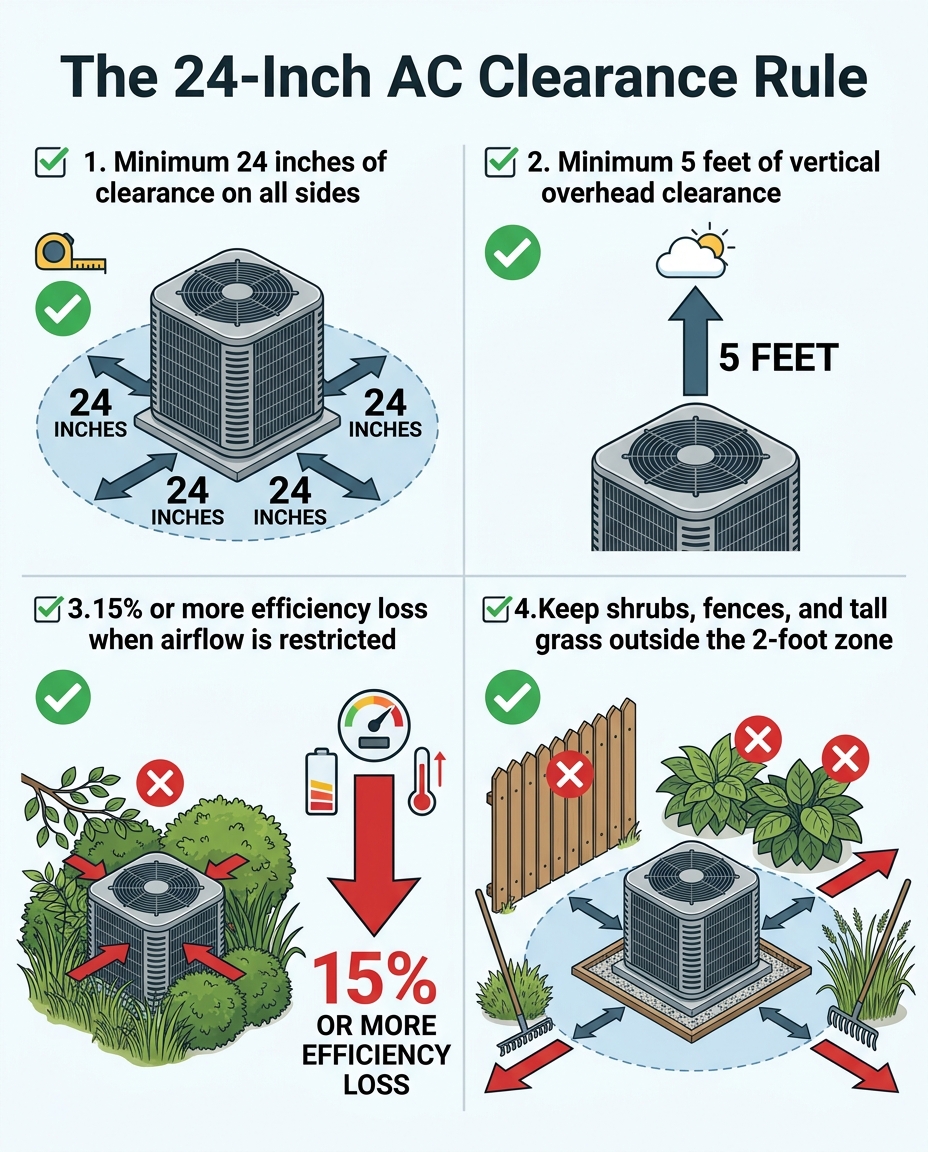
Vegetation doesn't block an AC unit overnight. It is a slow, cumulative process. A small weed in May turns into a dense thicket by late summer. Because the restriction happens gradually, a pattern we see often in our Derby service calls is systems slowly losing efficiency—often dropping 15% or more in cooling capacity—without homeowners immediately noticing. You just end up paying higher energy bills.
• Normal Operation — Airflow Condition: Unrestricted, pulling fresh air freely — Compressor Impact: Standard load, normal operating temperatures — Cooling Performance: Reaches thermostat set point quickly
• Partial Blockage — Airflow Condition: Vents partially covered by tall grass — Compressor Impact: Moderate strain, higher energy consumption — Cooling Performance: Runs longer cycles, struggles on hot afternoons
• Severe Blockage — Airflow Condition: Unit encased in dense bushes/vines — Compressor Impact: Extreme head pressure spikes, thermal overload — Cooling Performance: Constant running, blowing warm air, or total shutdown
By the time the thermal overload switch trips, the unit has likely been operating under severe stress for weeks. This continuous operation under blocked conditions degrades the oil inside the compressor and shortens the overall lifespan of the equipment.
If you want to protect your equipment during the demanding August late summer heat, you need to follow the industry-standard guidelines for outdoor unit spacing. In our years of servicing HVAC systems across the area, we at MJB Heating & Cooling always remind our customers that the Department of Energy, along with major equipment manufacturers, strongly recommends maintaining a minimum 24-inch (2-foot) clearance around the entire perimeter of the AC condenser.
This clearance zone allows the powerful fan inside the unit to pull in an adequate volume of ambient air. Without that 2-foot buffer, the fan ends up recirculating the same superheated air it just exhausted, which completely defeats the heat transfer process. Whether you are looking at standard builder-grade units or comparing top HVAC brands, these fundamental laws of thermodynamics and airflow apply universally.
Creating this safe zone isn't just about eyeballing the distance. You need to actively measure and maintain the space. Here is how our technicians recommend ensuring your unit has the room it needs to breathe:
1. Measure all four sides: Take a tape measure and ensure there is at least 24 inches of totally empty space between the metal casing of the unit and any fence, wall, or shrubbery.
2. Check the vertical clearance: The unit exhausts hot air straight up. You need a minimum of 5 feet of vertical clearance above the unit. Low-hanging tree branches or custom-built patio decks can trap heat just as badly as ground-level weeds.
3. Look for hidden blockages: Inspect the narrow gap between the unit and your home's exterior wall. This area is notorious for trapping wind-blown leaves, trash, and creeping vines that you might not see from the yard.
4. Inspect the ground level: Ensure that mulch, decorative rocks, or soil haven't piled up around the base of the unit, which can block the lowest intake louvers and trap moisture against the metal casing.

The timing of these landscaping issues is not a coincidence. In our experience working on local homes, the environment in Derby KS during late summer creates a perfect storm for air conditioning failures. This region experiences intense heat combined with heavy humidity, pushing cooling systems to their absolute maximum load right when vegetation reaches its peak seasonal growth.
When you have high humidity, your air conditioner is essentially doing two jobs at once. It has to lower the actual temperature of the air (sensible heat), but it also has to wring out the heavy moisture suspended in the air (latent heat). Removing that moisture requires the indoor evaporator coil to get extremely cold, which means the outdoor unit has to reject an immense amount of absorbed heat.
If the outdoor unit is blocked by overgrown bushes, it cannot reject that heavy, moisture-laden heat load. The system ends up running continuously, trying desperately to reach the thermostat set point, but failing because the heat has nowhere to go. This is why a partially blocked unit might survive a mild June afternoon but will completely shut down during a humid August heatwave.
Homeowners across the service areas in and around Derby must remain vigilant. The weeds that seemed harmless a few months ago are now thick, dense barriers. Because the local climate demands so much from your HVAC equipment, even minor airflow restrictions can become catastrophic when the humidity spikes.
When you discover that your outdoor unit is buried in vegetation, your first instinct is probably to grab a pair of gloves and start ripping weeds out by the roots. While clearing the 24-inch perimeter is exactly what you should do, you must be incredibly careful about how you handle the weeds that have actually grown into the unit itself.
There is a hard line between safe DIY landscaping and the need for professional intervention. You can safely trim back bushes, pull tall weeds from the surrounding soil, and rake away dead leaves from the perimeter. However, if vines or thick weeds have grown through the metal grating and into the delicate aluminum coil fins, aggressive pulling will cause permanent damage.
The coil fins on your outdoor unit are made of incredibly thin aluminum. They are designed this way to maximize surface area for heat transfer, not for structural strength. If you forcefully yank a thick weed out of the vents, you will easily bend and flatten these fins.
Bent fins permanently restrict airflow just as badly as the weeds did, leading to the exact same head pressure spikes we discussed earlier. Once those fins are flattened, the unit cannot breathe in that localized area. Restoring them requires specialized fin-combing tools and extreme patience to avoid tearing the metal.
If debris has bypassed the outer vents, or if your system still struggles to cool the house after you have cleared the yard, it is time to bring in an expert. Our MJB Heating & Cooling team sees this often in the field. During a recent late-summer call, one of our technicians took the time to properly diagnose a struggling system rather than just guessing. By carefully inspecting the unit, they found internal debris blocking the coil. We were able to extract it safely and fix the AC right the first time, protecting the delicate fins from damage.
MJB Heating & Cooling's thorough maintenance checks safely clear this internal debris and optimize unit performance without damaging those critical components. A professional cleaning involves dismantling the outer casing, safely removing ingested organic matter, and using specialized, non-corrosive chemical cleaners to wash dirt and pollen out of the micro-crevices of the coil. Furthermore, a technician will check the system's operating pressures to ensure that the period of restricted airflow didn't cause underlying damage to the compressor.
If your AC condenser is blocked by vegetation or debris, the required airflow is severely restricted. This causes the compressor to overheat, forces head pressure to spike dangerously high, and drops your system's cooling efficiency significantly. Over time, this strain can trigger a thermal shutdown or lead to a complete compressor failure during the hottest parts of the August late summer season.
An outdoor AC unit needs a minimum of 24 inches of empty clearance on all sides to operate efficiently. Additionally, it requires at least 5 feet of vertical clearance above the unit so that the hot air exhausted by the fan can dissipate safely into the atmosphere without being pushed back down into the system.
Yes, tall weeds can completely block the intake vents on the sides of your outdoor condenser. When the vents are choked off, the internal temperature rises rapidly, triggering the system's thermal overload switch to shut down the compressor before it destroys itself from the excessive heat and pressure.
To safely hide an outdoor AC unit, use slatted privacy screens, lattice fencing, or widely spaced shrubs that strictly maintain the 24-inch clearance rule. You must ensure that whatever barrier you use allows for plenty of cross-ventilation so the unit can easily pull in fresh air and exhaust hot air without restriction.
No, you should never use a pressure washer to clean your AC fins. The high-pressure water will instantly flatten the delicate aluminum fins, permanently destroying the unit's ability to transfer heat and ruining the equipment. Always rely on a professional to perform specialized chemical cleaning and safe debris removal.
A simple walk around your yard to check your landscaping can save your air conditioning system from unnecessary strain and massive repair bills. By keeping the perimeter clear of overgrown weeds and bushes, you allow your equipment to breathe and reject heat efficiently, even during the most brutal August late summer afternoons.
If you have cleared the vegetation but your home still isn't cooling down properly, the system likely needs professional attention to undo the stress it endured. Don't wait for a total breakdown. Schedule a routine AC maintenance plan visit today to ensure your internal coils are clean, your pressures are balanced, and your home stays comfortable for the rest of the season.


Our A/C stopped working on a Sunday and due to health issues, we needed to find a service company available on a Sunday. I called MJB and left a message on their emergency voice mail. Within 10 minutes Tom Buck called me to hear my description of the symptoms. He was just finishing an appointment in Wichita and would be on his way to my home on the south end of Derby. He arrived within 30 minutes! From start to finish he was the perfect example of what you could ever hope for in an HVAC tech and a human being. His evaluation of our system inside and out was as thorough as I could ever imagine and once he was done with the repair, our system is running as well or better than ever. Well worth the price for the evaluation, parts, and labor. Thank you again Tom for an awesome experience.
Our AC went out during the hottest days of the year, and they were out next day! We have been jerked around by a shoddy home warranty for years. We finally had a chance to pick our own repair people, and MJB came highly recommended. I can see why! I was impressed with the honesty and speed at which they fixed our AC unit!
Our commercial building had a lightening/electrical strike and damaged our 20 ton AC unit. No one could find us a new unit before the end of September. Imagining going all of August and September with no AC in Kansas and working inside near 100 degree temps is less than thrilling. Dale and the team at MJB called around and saved the day. They had us a new unit 5 weeks earlier than other could promise and I now have happy employees. The unit is amazingly quiet, super cold and so much more energy efficient. Thank you for being our super hero!
Came out and installed my new furnace. Was very polite and affordable. They are very acknowledgeable and I highly recommend!
Thank you very much. We had our 1st warm night in 3weeks. MJB took the time and effort to find the real problem. And the employees were kind and thoughtful and explained things very well. I cannot thank you and all of MJB. Will recommend you highly. Thanks again Marjorie Herman Oxford Kansas
We had a new system installed and I was so impressed with how quick they were in come out and install it, in the middle of a hot summer day. They were so friendly & very professional. I had a small problem with a weird sound and they came over immediately and fixed it. Love them!