.avif)





Blogs
Stay updated with our latest blog posts.
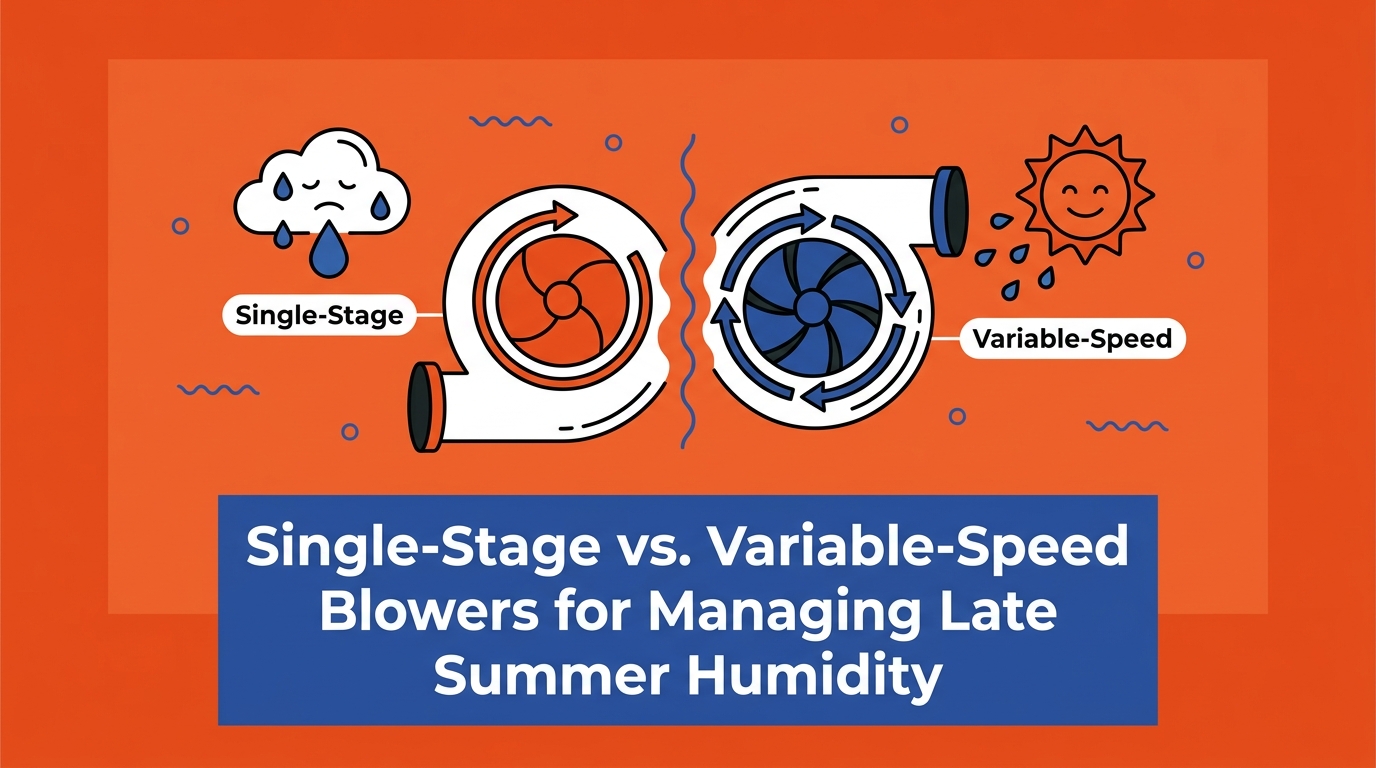

Are you constantly lowering your thermostat, but your living room still feels sticky and uncomfortable? When comparing single-stage vs. variable-speed blowers for managing late summer humidity, the core issue comes down to how your air conditioner handles moisture rather than just temperature. At MJB Heating & Cooling, our technicians notice that in late August across the Derby area, temperatures often drop slightly while dew points remain stubbornly high. This creates a challenging environment where your home reaches the desired temperature quickly, but the air still feels heavy, damp, and muggy.
If you are tired of battling muggy indoor air, exploring professional cooling services is the first step toward lasting comfort.
Many homeowners assume that if the air conditioner is blowing cold air, it is doing its job perfectly. However, cooling the air and removing moisture are two entirely different physical processes. Standard air conditioning units are primarily designed to cool the house to the exact set point on the thermostat. Because thermostats measure sensible heat (the actual temperature of the air) rather than latent heat (the moisture content in the air), a standard system will shut off the moment the room hits 70 degrees, regardless of how humid it still is.
During late summer, the thermal load on your home shifts. As families prepare for the back-to-school transition, you might not need maximum cooling power because the blistering heat of July has passed, but you desperately need maximum dehumidification. This is where the physical limitations of older blower technology become obvious. If your system blasts cold air at full capacity, it satisfies the thermostat in just ten or fifteen minutes. Unfortunately, a ten-minute cooling cycle is nowhere near long enough to extract a meaningful amount of water from the indoor air. Deciding whether upgrading your blower technology is the right solution for persistent humidity requires a closer look at how moisture removal actually works inside your ductwork.
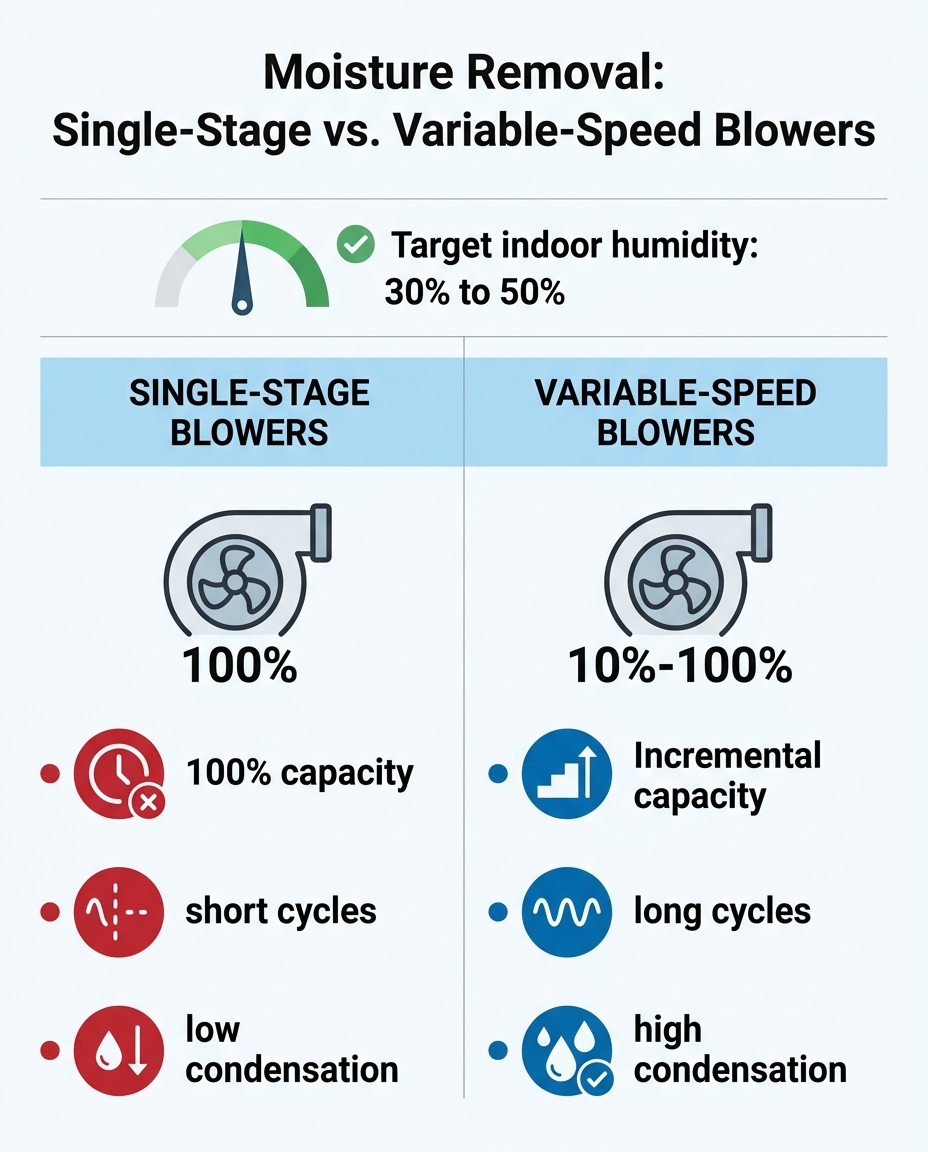
To understand why some homes feel perfectly crisp while others feel like a swamp, you have to look at the physics of how HVAC systems dehumidify. The Environmental Protection Agency (EPA) recommends maintaining indoor humidity levels between 30% and 50% to ensure optimal comfort, protect wood furnishings, and prevent the growth of mold or mildew. When indoor humidity levels routinely climb above 50%, the air loses its ability to absorb sweat from your skin, which is why a 72-degree room can feel incredibly hot and sticky.
Your air conditioner does not actually create cold air out of nothing; it removes heat and moisture from the existing air inside your home. This process happens at the evaporator coil, a series of cold copper or aluminum tubes located inside your indoor air handler. As warm, damp indoor air is pulled through the return vents and blown over this freezing cold coil, two things happen simultaneously. First, the heat is absorbed by the refrigerant inside the coil (sensible cooling). Second, the moisture in the warm air condenses into liquid water on the surface of the cold metal, much like water beads forming on the outside of a glass of iced tea on a hot day.
The critical factor in this moisture removal process is time. The relationship between airflow speed and condensation rates is straightforward: slower air moving over the coil results in more moisture being extracted. If the blower fan pushes air across the evaporator coil too quickly, the air does not have enough time to cool down below its dew point, and very little condensation forms. Short, blast-cooling cycles fail to pull enough water out of the air because the system simply isn't running long enough for the condensation process to reach peak efficiency. To truly dry out the air, the system needs to run for extended periods with a gentle, steady airflow.
Traditional heating and cooling systems are equipped with single-stage blowers, which are mechanically straightforward but highly limited when dealing with high latent heat. A single-stage system has exactly one speed: 100% capacity. Whenever the thermostat signals a need for cooling, the blower motor kicks on at full blast, pushing the maximum volume of air through your ductwork until the target temperature is reached, at which point it shuts off completely.
This all-or-nothing operation leads to a phenomenon known as "short-cycling," especially during days when the temperature is moderate but the humidity is high. Because the system is operating at maximum capacity, it rapidly drops the sensible temperature of the house. The thermostat registers that the room has reached the desired temperature and shuts the cooling cycle down prematurely. If you have ever wondered why your heat pump isn't dehumidifying properly, this rapid on-and-off cycling is often the primary culprit. The system is simply too powerful for the sensible heat load, causing it to shut off before it can address the latent heat load.
Beyond the short run times, the sheer speed of a single-stage blower actively works against moisture removal. By blasting warm air rapidly over the evaporator coil, a single-stage motor minimizes the contact time available for condensation to form. The air is cooled just enough to drop the room temperature, but the water vapor remains suspended in the air. Ultimately, single-stage units are designed primarily for rapid temperature drops, not precision moisture control. If your indoor humidity levels remain above 50% despite the AC running frequently, the mechanical limitations of a single-stage blower are likely to blame.
Variable-speed blower technology was engineered specifically to solve the shortcomings of traditional single-stage motors. Instead of operating on a simple on/off binary, a variable-speed air handler uses an Electronically Commutated Motor (ECM) that can precisely adjust its output based on the real-time demands of the home. These advanced motors can run at a wide range of speeds, often operating at 30% or 40% capacity for extended periods rather than blasting at 100%.
The secret to a variable-speed blower's dehumidification power lies in its ability to slow down. When the thermostat detects high humidity during late summer (August), it signals the variable-speed motor to drop its fan speed. This incremental adjustment allows the indoor air to pass over the freezing evaporator coil much more slowly. Because the air spends more time in direct contact with the cold metal, significantly more water vapor condenses into liquid and drains away out of the house. The system prioritizes moisture removal over rapid temperature drops.
By running continuously at lower capacities, variable-speed systems achieve longer, slower cooling cycles. These extended run times are exactly what is needed to wring excess water out of the air. In addition to superior humidity control, this continuous circulation provides several added benefits. It eliminates the noticeable temperature swings and hot spots common with single-stage systems, constantly mixing the air for an even temperature throughout the house. Furthermore, because the motor operates at lower speeds, it is significantly quieter, eliminating the loud rush of air that typically accompanies a single-stage system kicking on.
Choosing the right equipment requires a clear understanding of how these two distinct technologies stack up against each other under real-world conditions. When indoor humidity levels spike above 50%, the differences in performance become starkly apparent. The following comparison framework breaks down the critical metrics that impact your daily comfort.
• Moisture Removal (Dehumidification) — Single-Stage Blower: Low to inconsistent. Stops removing moisture as soon as the target temperature is hit. — Variable-Speed Blower: High and continuous. Runs longer cycles specifically to extract latent heat.
• Cooling Cycle Length — Single-Stage Blower: Short, abrupt cycles that rapidly drop temperature but fail to dry the air. — Variable-Speed Blower: Long, steady cycles that gently cool the space while maximizing water extraction.
• Evaporator Coil Interaction — Single-Stage Blower: Fast airflow results in minimal contact time and low condensation rates. — Variable-Speed Blower: Slow, controlled airflow results in maximum contact time and high condensation rates.
• Comfort and Temperature Consistency — Single-Stage Blower: Noticeable temperature swings (hot and cold spots) between cycles. — Variable-Speed Blower: Even, precise temperature control with constant air mixing throughout the home.
• Acoustic Profile (Noise Level) — Single-Stage Blower: Loud startup and a constant, forceful rush of air through the vents. — Variable-Speed Blower: Whisper-quiet operation, often unnoticeable when running at lower capacities.
Understanding the mechanical differences is important, but grounding this technical discussion in the real-world consequences of unmanaged humidity is where the true value lies. Failing to manage indoor moisture does not just make your skin feel clammy; it can actively damage your property. Physical signs that a system is failing to dehumidify include condensation weeping down basement walls, a persistent musty odor in the ductwork, peeling paint, and hardwood floors or doors that warp and stick in their frames.
In one instance during a recent late-summer stretch, our MJB Heating & Cooling team responded to a Derby homeowner requiring immediate assistance due to extensive condensation in their basement that was actively causing property damage. After our technicians evaluated the home's thermal load and provided several equipment options, we installed a new, properly sized system within a matter of days. This definitive action completely resolved the condensation issue and protected the structural integrity of the space. When humidity goes unmanaged for long periods, the long-term impact on home integrity and sleep quality is severe. Dust mites and mold spores thrive in damp environments, directly impacting indoor air quality.
While upgrading the system is often the most definitive way to resolve deep-seated moisture issues, it is also essential to ensure that any equipment is properly cared for. A dirty evaporator coil or a clogged condensate drain line will cripple even the most advanced variable-speed motor. Maintaining the equipment properly ensures optimal airflow and drainage, allowing the system to shed the water it extracts. Enrolling in a preventative HVAC maintenance plan ensures that coils remain clean and blower motors are calibrated correctly to handle the demands of late summer (August) weather.
If your home is chronically stuck with indoor humidity levels above 50%, upgrading from a basic single-stage unit to a variable-speed air handler is a massive leap forward. However, to achieve truly objective, premium climate control, the blower motor inside the house must be paired with advanced technology outside the house. This is where inverter-driven compressors come into play.
It is important to explain the difference between standard variable-speed motors (which handle the indoor fan) and advanced inverter technology (which handles the outdoor compressor). A standard air conditioner might have a variable-speed indoor fan, but the outdoor compressor still only runs at one or two speeds. In contrast, an inverter-driven compressor can ramp its cooling capacity up and down in microscopic increments, acting much like the accelerator pedal on a car rather than a simple light switch.
As a Certified Daikin Comfort Pro Dealer, the MJB Heating & Cooling team has seen firsthand how Daikin's industry-leading variable-speed inverter technology elevates home comfort for our local customers. When an inverter-driven outdoor compressor communicates seamlessly with a variable-speed indoor blower, the system can perfectly match the exact sensible and latent heat loads of the house at any given moment. If the temperature is mild but the air is incredibly sticky, the inverter dials back the cooling power while the indoor blower slows down to maximize moisture extraction. This continuous, precise synchronization is the definitive answer for homes that struggle with sticky air.
Framing this upgrade as an investment in long-term comfort and structural protection makes sense when you consider the damage high humidity can cause. To help make this premium technology accessible, there are flexible financing options for system upgrades available, allowing homeowners to solve their humidity problems without compromising on equipment quality. Certain energy efficiency upgrades may also qualify for federal tax credits or local utility incentive programs, so we always recommend verifying current options with your tax professional.
Living with a home that feels like a damp cave during late summer (August) is frustrating, especially when you are paying high utility bills to keep the air conditioner running. To summarize, variable-speed blowers are mechanically superior for moisture control because they slow the airflow down, maximize contact time with the cold evaporator coil, and run the longer cycles necessary to wring water out of the air.
However, simply buying the most advanced equipment is not a guarantee of success if it is not sized correctly for your specific ductwork and square footage. That is why our team always conducts a thorough professional assessment to match the right technology to your home's specific thermal load. An undersized variable-speed system will struggle to cool the house, while an oversized system will still short-cycle despite its advanced motor. If you are tired of clammy indoor air and restless nights, we encourage you to explore your upgrade options and consult with our professionals who can correctly calculate your home's unique dehumidification needs.
Yes, a variable speed blower is highly effective at reducing indoor humidity. By running at lower speeds for longer periods, it allows warm indoor air to spend more time passing over the cold evaporator coil. This extended contact time maximizes condensation, pulling significantly more moisture out of the air than a standard single-stage system.
Your house likely remains humid because the air conditioner is short-cycling. A standard single-stage AC blasts cold air at 100% capacity, rapidly dropping the room temperature and satisfying the thermostat before it has time to extract moisture. The system shuts off quickly, leaving the water vapor suspended in your indoor air.
Variable speed air conditioning is widely considered the best choice for high humidity climates. Because these systems can adjust their output incrementally, they prioritize latent heat removal (dehumidification) without overcooling the home. This continuous, low-capacity operation prevents the sticky, clammy feeling common in muggy regions.
The most effective way to lower humidity without freezing your family is to utilize a system with a variable-speed blower and an inverter-driven compressor. These systems communicate to lower the fan speed and reduce the cooling output, focusing entirely on wringing moisture out of the air rather than dropping the sensible temperature.
You should strongly consider upgrading your HVAC equipment if your indoor humidity consistently stays above 50% despite the air conditioner running normally. The EPA recommends keeping indoor moisture between 30% and 50%; prolonged exposure to higher levels can damage wood furnishings, encourage mold growth, and significantly decrease your daily comfort.


Our A/C stopped working on a Sunday and due to health issues, we needed to find a service company available on a Sunday. I called MJB and left a message on their emergency voice mail. Within 10 minutes Tom Buck called me to hear my description of the symptoms. He was just finishing an appointment in Wichita and would be on his way to my home on the south end of Derby. He arrived within 30 minutes! From start to finish he was the perfect example of what you could ever hope for in an HVAC tech and a human being. His evaluation of our system inside and out was as thorough as I could ever imagine and once he was done with the repair, our system is running as well or better than ever. Well worth the price for the evaluation, parts, and labor. Thank you again Tom for an awesome experience.
Our AC went out during the hottest days of the year, and they were out next day! We have been jerked around by a shoddy home warranty for years. We finally had a chance to pick our own repair people, and MJB came highly recommended. I can see why! I was impressed with the honesty and speed at which they fixed our AC unit!
Our commercial building had a lightening/electrical strike and damaged our 20 ton AC unit. No one could find us a new unit before the end of September. Imagining going all of August and September with no AC in Kansas and working inside near 100 degree temps is less than thrilling. Dale and the team at MJB called around and saved the day. They had us a new unit 5 weeks earlier than other could promise and I now have happy employees. The unit is amazingly quiet, super cold and so much more energy efficient. Thank you for being our super hero!
Came out and installed my new furnace. Was very polite and affordable. They are very acknowledgeable and I highly recommend!
Thank you very much. We had our 1st warm night in 3weeks. MJB took the time and effort to find the real problem. And the employees were kind and thoughtful and explained things very well. I cannot thank you and all of MJB. Will recommend you highly. Thanks again Marjorie Herman Oxford Kansas
We had a new system installed and I was so impressed with how quick they were in come out and install it, in the middle of a hot summer day. They were so friendly & very professional. I had a small problem with a weird sound and they came over immediately and fixed it. Love them!