





Blogs
Stay updated with our latest blog posts.


You check the thermostat as the sun goes down, frustrated because the house already feels drafty despite the heater kicking on and off all afternoon. If you are tired of battling these massive indoor temperature swings, upgrading to daikin heat pump inverter technology might be the exact solution your home needs. Late fall brings a specific kind of weather whiplash to our area. A November afternoon in Derby, KS can easily reach a comfortable 60 degrees, only to plunge rapidly toward freezing the moment the sun drops below the horizon.
Traditional heating systems struggle to keep up with these sudden shifts. They blast hot air, shut off, and leave you shivering before they finally decide to turn back on. This constant cycle of "too hot" and "too cold" makes your living room uncomfortable and forces you to constantly adjust the dial on your wall. Fortunately, modern engineering offers a better way to handle unpredictable fall weather. If you are ready to explore better comfort, we provide comprehensive HVAC services to keep your home perfectly balanced all season long.
At its core, an inverter heat pump is a heating and cooling system that continuously adjusts its motor speed to match exactly what your home needs. Older heating systems use a basic on/off switch. They are either running at maximum capacity or completely powered down. Inverter technology changes this by using a variable-speed compressor. This advanced compressor communicates with smart sensors inside your home, monitoring the indoor climate minute by minute.
Instead of blasting your rooms with a massive wave of heat and then shutting down, the system provides a steady, continuous stream of warm air at a much lower intensity. This constant, low-level operation is the secret to maintaining a perfectly even temperature, no matter what the weather is doing outside. If you are considering an upgrade before winter hits, you can explore flexible financing options for a new Daikin heat pump to make the transition easier.
To understand why this technology is so effective, think about how you drive a car on the highway.
• The Inverter Way: When you drive on the highway, you gently press the accelerator to reach 65 mph. If you encounter a slight hill, you press the gas pedal just a tiny bit more to maintain your speed. It is a smooth, efficient, and comfortable ride.
• The Single-Stage Way: Now, imagine trying to maintain 65 mph by flooring the gas pedal until you hit 65, taking your foot completely off the gas until you drop to 40, and then flooring it again. This stop-and-go driving would be incredibly jerky, uncomfortable, and terrible for your vehicle's engine.
That jerky, stop-and-go driving is exactly how a traditional single-stage heater operates. By functioning like a smart accelerator pedal, variable-speed technology dramatically reduces wear and tear on your equipment while keeping your family perfectly comfortable.
To fully appreciate the benefits of variable-speed operation, it helps to look at the pain points of the status quo. Most older homes still rely on single-stage heat pumps or furnaces. As the name suggests, these units only have one stage of operation: 100% capacity. When your thermostat detects that the room has dropped below your set temperature, it sends a signal to turn the system on.
The system roars to life, blowing a high volume of hot air into your living space. Once the thermostat registers that the target temperature has been reached, the system abruptly shuts off. During late fall and November temperature drops, this creates a frustrating phenomenon known as "short-cycling." Because the outdoor temperature is dropping rapidly, your home loses heat quickly. The system turns on, blasts heat, turns off, and then has to turn right back on a few minutes later.
This constant on-and-off cycling causes noticeable temperature swings. You feel a sudden rush of hot air, followed by a period of drafty stillness as the room cools down again. The air in your home is never truly balanced. If you are curious about how different manufacturers handle these common heating problems, you can read more about how Daikin compares to other HVAC brands.
• Operation Style — Traditional Single-Stage System: Stop-and-go (0% or 100%) — Inverter-Driven System: Continuous modulation (adjusts anywhere from 30% to 100%)
• Temperature Swings — Traditional Single-Stage System: Noticeable hot and cold spikes — Inverter-Driven System: Stays within 0.5 degrees of your target
• Energy Consumption — Traditional Single-Stage System: High (wastes power during hard start-ups) — Inverter-Driven System: Low (maintains steady, efficient speed)
• Wear and Tear — Traditional Single-Stage System: Heavy strain on electrical components — Inverter-Driven System: Minimal strain due to gentle operation
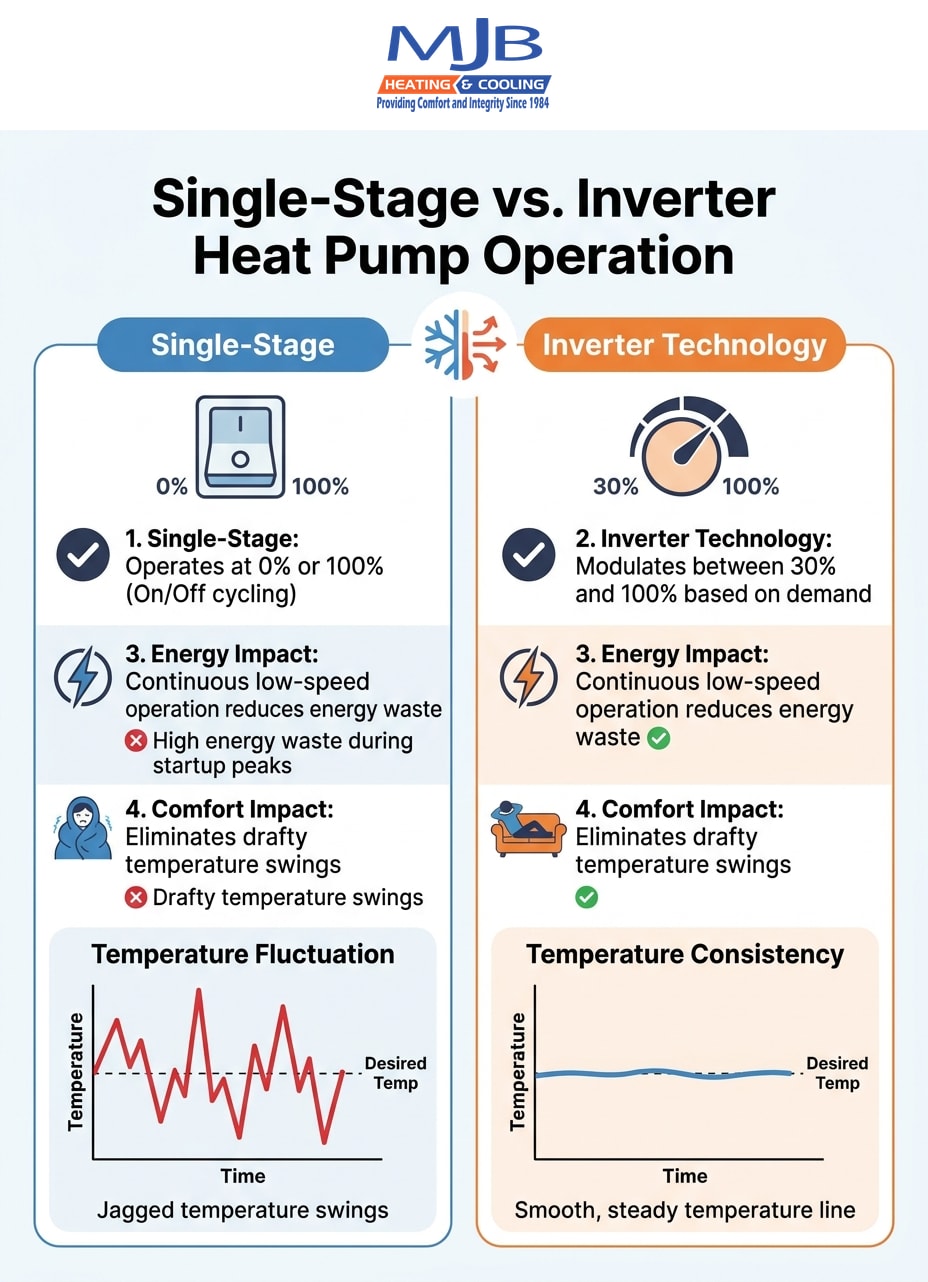
The true test of a heating system in the Midwest is how it handles rapid weather transitions. A 30-degree afternoon-to-evening temperature drop is completely normal in Kansas. When the sun sets, the heat loss in your home accelerates quickly. A variable-speed compressor is uniquely designed to handle this exact scenario without skipping a beat.
Here is exactly how the system responds chronologically as a mild afternoon turns into a freezing evening:
1. Late Afternoon (Mild): The outdoor temperature is 55 degrees. Your home only needs a tiny amount of heat to stay comfortable. The compressor runs at a very low, quiet speed—perhaps just 30% capacity—gently circulating warm air to prevent drafts.
2. Early Evening (Dropping): The sun goes down and the outdoor temperature drops to 40 degrees. The smart sensors detect the increased heat loss. Instead of shutting off and waiting for the house to get cold, the compressor slowly ramps up to 50% capacity, matching the dropping temperature perfectly.
3. Nightfall (Freezing): The temperature plunges below freezing. The system continues to incrementally increase its speed, perhaps reaching 80% or 90% capacity, providing the exact amount of thermal energy required to keep your living room at a cozy 70 degrees.
This process is called real-time thermal load adjustment. The system calculates the precise amount of heat needed minute-by-minute. By continuously circulating conditioned air, the system completely eliminates cold spots in the corners of your home. You never feel that sudden chill that usually warns you the heater is about to kick on, because the heater never actually stops working—it just adapts.
One of the most common concerns homeowners have when learning about this technology is the cost of operation. It is completely natural to assume that a system running continuously will use more electricity than a system that turns off periodically. However, the exact opposite is true.
The most energy-intensive part of running any heavy machinery is the start-up phase. When a traditional single-stage motor powers on, it requires a massive surge of electricity—known as the inrush current—to get the heavy mechanical parts moving from a dead stop. Because traditional systems start and stop dozens of times a day, they waste a tremendous amount of electricity just turning themselves on.
By running continuously at a much lower speed, an inverter-driven compressor avoids these massive power surges entirely. It uses a small, steady trickle of electricity to maintain the temperature, which is significantly more efficient. This high efficiency is reflected in the system's SEER2 (cooling) and HSPF2 (heating) ratings. Variable-speed technology consistently achieves much higher efficiency scores than standard equipment. Because of this exceptional energy performance, many high-efficiency heat pump installations may qualify for general federal tax credits or utility incentives. We always recommend consulting a tax professional or checking with your local utility provider to see what programs apply to your home.
While precise temperature control and lower energy bills are the primary reasons homeowners upgrade, the secondary lifestyle benefits are just as impactful. Traditional HVAC systems are notoriously loud. When they kick on, you often have to turn up the volume on the television or pause your conversation.
Variable-speed technology changes the entire sensory experience of your home. Because the equipment spends the vast majority of its time running at lower speeds, it operates at a fraction of the noise level of standard units.
• Whisper-Quiet Compressors: The outdoor unit runs so quietly that you might not even realize it is on when you are standing next to it on your patio.
• Silent Indoor Airflow: Lower fan speeds indoors mean you no longer hear the loud, rushing "whoosh" of air surging through your vents every time the system starts.
• Improved Air Quality: Because the system circulates air continuously, your indoor air passes through the HVAC filter much more frequently. This constant filtration traps more dust, pollen, and airborne particles, leading to fresher, cleaner air.
• No More Drafts: Continuous gentle airflow prevents the air in your home from becoming stagnant, eliminating the drafty sensation common in older houses.
To ensure you continue to enjoy these quiet, efficient benefits year after year, it is highly recommended to keep up with routine heat pump maintenance. A clean, well-calibrated system will always perform better and last longer.
Investing in advanced heating technology is only half the equation; the other half is proper installation. Even the most sophisticated inverter heat pump will underperform if it is improperly sized for your home's specific square footage, layout, and insulation levels.
Before any equipment is installed, a professional must perform a detailed load calculation. If a system is oversized, it will heat the home too quickly and shut off, completely defeating the purpose of variable-speed technology. If it is undersized, it will struggle to keep up during the coldest nights of the year.
Furthermore, homes in Derby KS often utilize dual-fuel systems, where a heat pump is paired with a backup gas furnace for extreme cold. Setting the correct "balance point"—the exact temperature at which the system switches from the heat pump to the gas furnace—requires deep local climate knowledge. As local experts, MJB Heating & Cooling understands exactly how to size and calibrate these advanced systems to handle the specific demands of Midwest temperature swings. We ensure the inverter's response curve is tailored to your home's unique thermal profile. If you need assistance, we provide professional heating services across our service areas to ensure your equipment is installed flawlessly.
An inverter heat pump works by continuously modulating the speed of its compressor to match the exact heating or cooling demand of your home. Instead of turning on at full blast and then shutting off completely, it adjusts its output smoothly, much like pressing the accelerator pedal in a car to maintain a steady speed. This constant adjustment allows the system to provide precise temperature control while using less energy.
Yes, inverter heat pumps are designed to run almost continuously during the heating season, but at very low, efficient speeds. Running constantly at a low capacity is actually better for the equipment and uses less electricity than a traditional system that frequently starts and stops. This continuous operation is what eliminates cold spots and keeps your indoor temperature perfectly stable.
The primary advantage is unmatched indoor comfort with significantly lower energy waste. Because the system continuously adapts to changing weather, you never experience the hot and cold temperature swings common with standard heaters. Additionally, the steady operation reduces wear and tear on the mechanical parts, lowers noise levels, and improves indoor air filtration.
Yes, variable-speed technology is exceptionally well-suited for cold weather and rapid temperature drops. The system can incrementally ramp up its heating capacity as the outdoor temperature falls, ensuring your home stays warm without sudden drafts. Many modern models are specifically engineered to maintain high heating performance even when temperatures drop below freezing.
No, it actually uses significantly less electricity. The most power-hungry part of an HVAC cycle is the hard start-up phase when the motor powers on from a dead stop. By running continuously at a low speed, variable-speed technology avoids these massive power surges, resulting in much better overall energy efficiency and lower electrical strain.
Surviving the unpredictable weather of late fall does not mean you have to constantly fight with your thermostat. By physically adjusting its compressor speed to match the exact conditions outside, Daikin heat pump inverter technology provides a smart, efficient solution to weather whiplash. You get to enjoy steady, quiet, and reliable warmth no matter how fast the temperature drops outside. As you prepare your home for the upcoming winter, now is the perfect time to explore your heating options and ensure your family stays perfectly comfortable all season long.


Our A/C stopped working on a Sunday and due to health issues, we needed to find a service company available on a Sunday. I called MJB and left a message on their emergency voice mail. Within 10 minutes Tom Buck called me to hear my description of the symptoms. He was just finishing an appointment in Wichita and would be on his way to my home on the south end of Derby. He arrived within 30 minutes! From start to finish he was the perfect example of what you could ever hope for in an HVAC tech and a human being. His evaluation of our system inside and out was as thorough as I could ever imagine and once he was done with the repair, our system is running as well or better than ever. Well worth the price for the evaluation, parts, and labor. Thank you again Tom for an awesome experience.
Our AC went out during the hottest days of the year, and they were out next day! We have been jerked around by a shoddy home warranty for years. We finally had a chance to pick our own repair people, and MJB came highly recommended. I can see why! I was impressed with the honesty and speed at which they fixed our AC unit!
Our commercial building had a lightening/electrical strike and damaged our 20 ton AC unit. No one could find us a new unit before the end of September. Imagining going all of August and September with no AC in Kansas and working inside near 100 degree temps is less than thrilling. Dale and the team at MJB called around and saved the day. They had us a new unit 5 weeks earlier than other could promise and I now have happy employees. The unit is amazingly quiet, super cold and so much more energy efficient. Thank you for being our super hero!
Came out and installed my new furnace. Was very polite and affordable. They are very acknowledgeable and I highly recommend!
Thank you very much. We had our 1st warm night in 3weeks. MJB took the time and effort to find the real problem. And the employees were kind and thoughtful and explained things very well. I cannot thank you and all of MJB. Will recommend you highly. Thanks again Marjorie Herman Oxford Kansas
We had a new system installed and I was so impressed with how quick they were in come out and install it, in the middle of a hot summer day. They were so friendly & very professional. I had a small problem with a weird sound and they came over immediately and fixed it. Love them!


