


.avif)





Blogs
Stay updated with our latest blog posts.

Here at MJB Heating & Cooling, we field countless calls from Derby families wondering when to settle for a band-aid fix vs. investing in a permanent AC repair, especially when their system starts blowing warm air right as a late-August heatwave hits its peak. You are not alone in this frustrating back-to-school season situation. It is late afternoon, the sun is beating down on your roof, and your thermostat reading keeps climbing higher no matter what you set it to. The immediate discomfort quickly turns into a sense of panic as you realize your home is losing its only defense against the brutal end-of-summer temperatures.
This puts you face-to-face with one of the most stressful dilemmas a homeowner can encounter. Do you spend a smaller amount right now just to limp the system through the rest of the season, or do you commit to a major, permanent system overhaul? Making this choice while you are sweating in your own living room is incredibly difficult. A temporary patch might seem like the obvious choice to stop the immediate suffering, but without knowing the underlying condition of your equipment, our technicians often warn that a quick patch could just be throwing good money after bad.
Professional diagnostics are always the first step to understanding which path is actually viable for your specific equipment. Before you can make an educated decision, a licensed technician needs to evaluate the mechanical reality of your compressor, coils, and electrical components. Once we know exactly what is failing, you can leverage comprehensive HVAC services to map out a strategy that protects both your immediate comfort and your long-term financial health.
In our years of servicing HVAC systems across Derby, we have learned that a "Band-Aid" fix is not a careless mistake or a sloppy repair. When executed properly by a professional, it is a safe, calculated, and temporary intervention designed to restore your cooling temporarily, rather than permanently solving the underlying degradation of the unit. These tactical bridges are meant to buy you time. They do not reverse the aging process of a failing compressor or magically seal a deteriorating evaporator coil.
For example, during a routine service call right here in Derby this past spring, our team encountered a homeowner's system that was struggling to maintain temperature and simply needed a quick recharge. Our technician performed thorough testing, recharged the system to restore immediate cooling, and clearly explained to the family that because air conditioning systems are closed loops, needing a recharge indicates a leak that will eventually need a permanent resolution. This transparent approach allows homeowners to enjoy a cool house today while planning for the future.
Understanding the difference between a temporary patch and a permanent solution helps you set realistic expectations for your system's performance. Here are a few common examples of stop-gap measures that our technicians might use to keep your home comfortable in a pinch.
1. Installing a Hard Start Kit: As air conditioners age, the compressor can become mechanically tight, requiring a massive surge of electricity to turn on. A hard start kit acts like a defibrillator, giving the compressor an extra jolt of power to get it running. This can coax a struggling compressor into working for a few more months, but it does not fix the internal wear and tear.
2. Recharging Refrigerant for a Minor Leak: If your system has a very slow, non-hazardous microscopic leak, topping off the refrigerant can temporarily restore the unit's ability to absorb heat. This might buy you a few weeks or even a full season of comfort, but the refrigerant will inevitably escape again until the leaking coil or line set is replaced.
3. Bypassing Non-Critical Sensors: In some very specific, older systems, certain non-safety-related sensors may fail and prevent the unit from running. A technician can sometimes safely bypass these convenience sensors temporarily to get the cold air flowing, provided it poses absolutely no risk to the electrical safety of the home.
4. Applying Temporary Sealants: For very specific types of minor leaks in accessible areas, specialized HVAC sealants can be introduced into the system. These act like a tire patch, temporarily sealing the pinhole. However, we note that they are notorious for eventually gumming up expansion valves and are strictly a last-resort measure to buy a little more time.
There is a massive psychological pressure that comes with making a major financial decision during an active heatwave. When your house is sweltering and your family is miserable, the urgency to just "make it stop" can lead to rushed choices. Our team frequently sees homeowners ready to agree to an expensive permanent repair on a dying system simply because they want the cold air back on immediately, without taking the time to consider if a full replacement would be a better long-term investment.
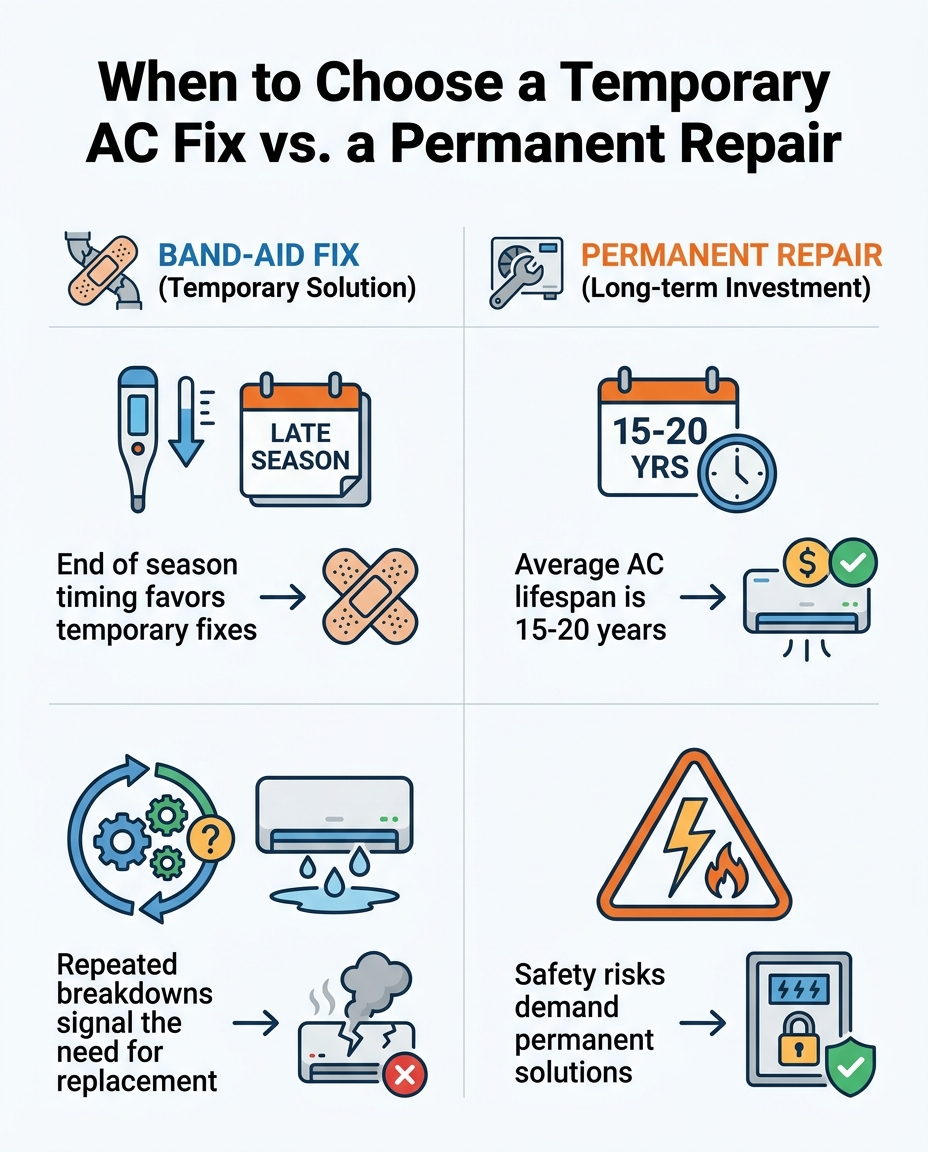
This is where understanding the local climate becomes a massive strategic advantage. In our experience serving Kansas, August is brutally hot, pushing cooling systems to their absolute limits. However, September brings rapid, noticeable relief. If your system breaks down during that late-August heatwave, a temporary fix is highly strategic. It removes the immediate danger of heat exposure and bridges the specific weather gap between the peak of summer and the mild autumn months.
By limping your system into the fall, you completely remove the urgency from the equation. You gain the breathing room to evaluate replacement options, gather multiple opinions, and review your finances with a clear head. If you are currently sweating through a breakdown, the smartest first step is to schedule an AC repair diagnostic to see if a temporary fix can safely and affordably bridge the gap to cooler weather.
Deciding between a quick patch and a comprehensive overhaul requires looking at the big picture. Every home, budget, and cooling system is different. At MJB Heating & Cooling, we believe in honest, transparent guidance. Sometimes, the absolute best advice we can give a homeowner is to spend less today. We would much rather help you safely limp an older system to the finish line with a temporary patch than push a high-pressure replacement when a stop-gap is the smarter strategic choice for your family.
To help you weigh these options, we advise looking at the age of your equipment, the history of its reliability, and how the repair impacts your home's long-term value. Systems nearing the 15 to 20-year mark generally respond very poorly to expensive permanent repairs, as fixing one major component often just transfers the strain to the next weakest link.
If you are trying to map out your next steps, reviewing the cost of repairing an old HVAC versus buying a new system is a great way to contextualize the data below. Here is a clear breakdown of how these two paths compare across several critical categories based on what we see in the field.
• Immediate Goal — Temporary "Band-Aid" Fix: Restore cooling rapidly to survive a current heatwave. — Permanent Repair / Replacement: Ensure reliable, uninterrupted comfort for years to come.
• Best for System Age — Temporary "Band-Aid" Fix: Older systems (15+ years) slated for replacement soon. — Permanent Repair / Replacement: Newer systems (under 10 years) with plenty of life left.
• Financial Impact — Temporary "Band-Aid" Fix: Lower upfront expense, but zero long-term return on investment. — Permanent Repair / Replacement: Higher initial investment, but prevents recurring breakdown costs.
• Warranty Status — Temporary "Band-Aid" Fix: Often used on out-of-warranty systems where parts are obsolete. — Permanent Repair / Replacement: The preferred route if the failing component is still under warranty.
• Reliability Expectation — Temporary "Band-Aid" Fix: Unpredictable; the system could fail again in a week or a month. — Permanent Repair / Replacement: High confidence; the root cause of the failure has been eliminated.
• The cooling season is almost over: If you only need the system to run for a few more weeks before the autumn weather arrives, a temporary patch makes logical sense.
• The unit is slated for replacement next spring: If you already know you are upgrading your equipment next year, there is no reason to sink heavy funds into a permanent repair today.
• You need time to review options: A quick fix buys you the necessary time to gather funds, research different equipment brands, and make a decision without the pressure of a hot house.
• The unit is relatively new: If your system is under ten years old and still covered by a manufacturer parts warranty, our team will almost always recommend a permanent repair as the right financial move.
• The system has a history of reliable performance: If this is the first time the unit has broken down in five years, it is likely an isolated part failure rather than a symptom of systemic decline.
• A stop-gap poses a safety risk: If a temporary patch could lead to electrical hazards, water damage, or carbon monoxide risks (in hybrid systems), a permanent fix is the only acceptable route.
While buying time is a valid strategy, our technicians also encounter distinct scenarios where a temporary fix is impossible, unsafe, or financially reckless. HVAC systems are high-voltage, highly pressurized pieces of mechanical equipment. When certain critical components fail, there is no safe way to patch them together. Attempting to do so can put your home at risk of severe property damage or electrical hazards.
Consider a situation our MJB Heating & Cooling team handled for a family in the Derby area during a brutal late-summer stretch. They went almost a week without AC in the blistering heat, hoping a simple tweak would get it running again. After our thorough professional diagnosis, it became clear that patching their 25-year-old system was no longer viable or safe due to compounding mechanical failures. The team addressed the immediate hazards and ultimately installed a completely new system, finally cooling the house effectively and providing long-term reliability.
Based on our field experience, here are the primary situations where you must bypass the band-aid and move straight to a permanent repair or replacement:
• A Completely Seized Compressor: The compressor is the heart of the air conditioner. If its internal mechanical parts have physically locked up and welded together from extreme heat and friction, no hard start kit or capacitor will revive it. It must be replaced.
• Massive Refrigerant Blowouts: A microscopic pinhole leak can sometimes be temporarily managed. However, if a line has ruptured or a coil has split, the system will dump its entire refrigerant charge in minutes. You cannot recharge a system with a gaping hole; the leak must be permanently brazed or the coil replaced.
• Severe Electrical Hazards: If the breakdown is caused by melted wires, scorched contactors, or a failing breaker that keeps tripping, a temporary fix is a severe fire risk. Electrical integrity must be fully and permanently restored before the unit is turned back on.
• The Sunk Cost Fallacy: If you have already paid for three "temporary" fixes this summer, you are experiencing the sunk cost fallacy. Repeatedly applying band-aids to a system that has been failing for an extended period costs more than simply fixing it right the first time.
The core of this decision always comes down to managing your immediate comfort against your future financial investments. It is easy to look at a temporary fix and see it as the "cheaper" option. However, we always urge our customers to analyze the cumulative cost of multiple temporary fixes versus a single permanent repair. Throwing money at a doomed system week after week quickly drains the budget you could have used for a down payment on a highly efficient, brand-new unit.
Furthermore, an air conditioner that is limping along on a band-aid fix is rarely operating at peak efficiency. When a compressor is struggling or a system is slightly low on refrigerant, it has to run twice as long to cool your home in the Derby KS heat. This means your monthly utility bills will spike dramatically. The money you think you are saving by delaying a permanent repair is often just being transferred directly to your local utility company.
The harsh financial reality is that while a band-aid is cheaper today, it offers zero return on investment if the system completely dies next month. Investing in a permanent repair or a full system replacement dramatically improves your home's energy efficiency, lowers your monthly cooling bills, and restores your peace of mind. As a bonus, federal tax credits or local utility incentive programs may apply to qualifying high-efficiency installations, though we advise readers to verify current programs with their utility or a tax professional. If the upfront cost of a permanent solution is the primary hurdle, many homeowners find that utilizing flexible HVAC financing options makes long-term reliability highly accessible without causing immediate financial strain.
If you decide that a stop-gap measure is the right call for your current late-August heatwave crisis, the most important thing you can do is avoid becoming complacent. Once the cold air starts blowing again, it is tempting to forget the breakdown ever happened. However, the clock is ticking on that temporary fix. You must use the time you just bought to actively research and plan your next steps.
Transitioning from a reactive panic to a proactive strategy ensures you are never caught off guard again. Our team recommends this simple timeline to follow after a temporary fix is applied to your system:
1. Week 1: Monitor System Performance. Pay close attention to how the unit sounds and how effectively it cools. If you notice strange grinding noises or if the system runs constantly without reaching the set temperature, the temporary fix may already be failing.
2. Month 1: Research and Budget. Use the mild autumn off-season to start looking into replacement equipment. Gather information on different efficiency ratings, read up on the latest technology, and begin setting aside funds for a permanent solution.
3. Month 2: Schedule a Comprehensive Evaluation. Once the extreme heat has passed, have a technician return to perform a deep-dive assessment of your entire HVAC infrastructure, including your ductwork and insulation, to map out a long-term plan.
4. Ongoing: Commit to Regular Upkeep. The best way to prevent minor issues from becoming major mid-summer crises is through consistent maintenance. Enrolling in a preventative maintenance plan ensures a professional is putting eyes on your equipment twice a year, catching wear and tear long before it causes a catastrophic failure.
Taking a proactive approach completely eliminates the panic of emergency breakdowns. You shift from simply surviving the summer to confidently controlling your home's comfort and energy efficiency year-round.
When is an AC not worth repairing?
In our experience, an air conditioner is generally not worth repairing when it is over 15 years old and the cost of the repair exceeds half the value of a new system. At this age, major components like the compressor and evaporator coil are nearing the end of their functional lifespan. Sinking heavy funds into an obsolete unit often leads to a cycle of continuous breakdowns.
Can a temporary AC fix last the rest of the summer?
Yes, a temporary fix can often last through the end of the cooling season, depending on the specific nature of the failure. For instance, a hard start kit or a minor refrigerant top-off can usually bridge the gap for a few weeks until the autumn weather arrives. However, our technicians caution that these solutions are inherently unpredictable and should not be relied upon for long-term comfort.
What are common band-aid fixes for air conditioners?
Common stop-gap measures include installing a hard start kit to help a struggling compressor turn on, topping off refrigerant to offset a very slow microscopic leak, or safely bypassing non-critical convenience sensors. These interventions are designed solely to restore temporary airflow. They do not address the root mechanical degradation of the equipment.
Is it worth fixing a 15-year-old AC?
Fixing a 15-year-old AC is rarely a sound financial investment unless the repair is exceptionally minor, such as replacing a basic capacitor or a blown fuse. Because the average lifespan of central cooling equipment is 15 to 20 years, major repairs on units this old offer no return on investment. The system will continue to lose efficiency and will likely require full replacement shortly anyway.
How long does a refrigerant recharge last on a leaking AC?
The lifespan of a temporary refrigerant recharge depends entirely on the size and location of the leak. A microscopic pinhole leak might hold a charge for an entire cooling season, while a larger fracture in the coil could vent the new refrigerant in a matter of days. Because air conditioning systems are closed loops, needing a recharge always indicates a physical leak that eventually requires a permanent repair.
When should you stop putting money into an old AC?
You should stop putting money into an old AC when you experience the "sunk cost" cycle of calling for repairs multiple times in a single season. If your system requires frequent refrigerant top-offs, struggles to keep the house cool despite running constantly, and is past its manufacturer warranty, it is time to halt repairs. Redirecting those funds toward a high-efficiency replacement is the much smarter financial strategy.
Knowing when to settle for a band-aid fix vs. investing in a permanent AC repair ultimately comes down to timing, safety, and your long-term goals. If you are struggling with a failing system right now, you deserve a clear, honest framework to help you decide your next steps. Do not let the back-to-school heat pressure you into a rushed decision—reach out to our MJB Heating & Cooling team today to schedule a comprehensive evaluation and find the smartest strategic solution for your home.


Our A/C stopped working on a Sunday and due to health issues, we needed to find a service company available on a Sunday. I called MJB and left a message on their emergency voice mail. Within 10 minutes Tom Buck called me to hear my description of the symptoms. He was just finishing an appointment in Wichita and would be on his way to my home on the south end of Derby. He arrived within 30 minutes! From start to finish he was the perfect example of what you could ever hope for in an HVAC tech and a human being. His evaluation of our system inside and out was as thorough as I could ever imagine and once he was done with the repair, our system is running as well or better than ever. Well worth the price for the evaluation, parts, and labor. Thank you again Tom for an awesome experience.
Our AC went out during the hottest days of the year, and they were out next day! We have been jerked around by a shoddy home warranty for years. We finally had a chance to pick our own repair people, and MJB came highly recommended. I can see why! I was impressed with the honesty and speed at which they fixed our AC unit!
Our commercial building had a lightening/electrical strike and damaged our 20 ton AC unit. No one could find us a new unit before the end of September. Imagining going all of August and September with no AC in Kansas and working inside near 100 degree temps is less than thrilling. Dale and the team at MJB called around and saved the day. They had us a new unit 5 weeks earlier than other could promise and I now have happy employees. The unit is amazingly quiet, super cold and so much more energy efficient. Thank you for being our super hero!
Came out and installed my new furnace. Was very polite and affordable. They are very acknowledgeable and I highly recommend!
Thank you very much. We had our 1st warm night in 3weeks. MJB took the time and effort to find the real problem. And the employees were kind and thoughtful and explained things very well. I cannot thank you and all of MJB. Will recommend you highly. Thanks again Marjorie Herman Oxford Kansas
We had a new system installed and I was so impressed with how quick they were in come out and install it, in the middle of a hot summer day. They were so friendly & very professional. I had a small problem with a weird sound and they came over immediately and fixed it. Love them!


